The debt consolidation loan vs balance transfer question comes down to one thing: which product can actually absorb the debts you have, and which one lets you pay them off for the least total cost at a monthly payment you can sustain. A consolidation loan is a fixed-payment installment loan that can replace several balances at once. A balance transfer card is a revolving credit line that may offer a temporary 0% promotional APR, but only up to its credit limit and only for a limited time.
If you’re holding balances on three or four cards, a store card, and maybe a medical or utility bill, the first practical question isn’t the rate. It’s whether one card could even take all of it. Credit limits on new cards are set by the issuer after it reviews your credit, and they often fall short of the total you owe across several accounts. A loan, by contrast, is sized to the amount you request and are approved for, which is why it’s often the more flexible tool for a scattered pile of debt.
This guide looks at the two options through a consolidation lens: how many debts each can take, what the combined cost looks like using hypothetical numbers computed in Python, and how a hybrid plan can sometimes beat either one alone. If your real question is narrower, such as how fast you can pay off one card balance, see our companion comparison of a balance transfer card versus a personal loan for payoff speed.
- A loan can usually pay off many kinds of balances in one move; a balance transfer is limited by the new card’s credit limit and by which accounts the issuer will accept.
- A 0% promotional APR can be far cheaper than a loan, but only if you can clear the transferred balance before the promotion ends. After that, the card’s regular APR applies.
- Both options usually carry an upfront fee: a balance transfer fee (a percentage of the amount moved) or a loan origination fee (a percentage of the loan). Fees vary by lender and issuer.
- In the hypothetical $12,400 example below, a split plan used a transfer for part of the debt and cost less than a full loan at the same $450 monthly budget. That outcome depends entirely on the terms you’re actually offered.
- Consolidating only helps if the underlying spending gap is fixed. The CFPB warns that taking on new debt to pay old debt can simply postpone the problem.
Rate context is from the Federal Reserve’s G.19 Consumer Credit release of October 7, 2026, which reported preliminary August 2026 averages. All dollar examples are hypothetical and computed for illustration; your offers will differ.
Debt Consolidation Loan vs. Balance Transfer: The Short Answer
What each product does with several debts
A loan pays creditors and replaces them with one installment
A debt consolidation loan is a personal installment loan used to pay off other debts. The CFPB describes personal installment loans as closed-end loans: the lender provides all the money at the start, and you repay in fixed installments over a set period. Used for consolidation, the loan proceeds retire your old balances, and you’re left with one monthly payment and one end date.
Because the loan amount is set by what you request and the lender approves, it can cover credit cards, a store card, and other balances in a single step. Some lenders send funds directly to your creditors, while others deposit the money with you, so check how your lender handles it. Terms, fees and eligibility vary by lender, which is why comparing multiple offers matters.
A balance transfer moves card balances onto one card
A balance transfer moves what you owe on one or more credit cards to a different card, often one offering a low or 0% promotional rate for a set number of months. The CFPB notes that many issuers offer zero-percent or low-interest transfers to move balances onto one card, and that the promotional rate usually expires, after which the rate may rise.
The transfer is capped by the new card’s credit limit, and it typically applies to credit card balances rather than every kind of bill. You also usually pay a balance transfer fee. The CFPB says it is typically a percentage of the amount transferred or a flat amount, whichever is greater, and that a fee can be charged even on a zero percent offer.
Which tends to fit which pile of debt
When the debt is spread across cards and other bills
If your debts include several cards plus other obligations, a loan has the structural advantage. You can size it to the full amount, and the fixed term creates a built-in finish line. That’s helpful if you tend to pay only the minimum on revolving accounts, since an installment schedule forces principal down each month.
The catch is that the loan’s rate is fixed by your credit profile, not by a promotion. If your offered rate isn’t meaningfully below what you’re paying now, or if origination fees eat the difference, the consolidation may save little. Our guide to credit scores for a debt consolidation loan explains what lenders typically weigh.
When the debt is mostly on one or two cards
If most of the debt sits on one or two cards and a new card could plausibly cover it, a balance transfer may cost far less during the promotional window. The savings come from not paying interest while every payment goes to principal. That advantage disappears if you can’t finish paying within the promotion, or if you keep spending on the cards you just emptied.
A rule of thumb: divide the transferred amount, fee included, by the number of promotional months. If that monthly figure is more than you can comfortably pay, the plan is either shaky or needs a different structure, such as a smaller transfer paired with a loan.
| Feature | Debt consolidation loan | Balance transfer card |
|---|---|---|
| What it can cover | Cards plus other debts, up to the approved amount | Mostly card balances, up to the new credit limit |
| Rate type | Usually a fixed rate for the full term (confirm in your offer) | Promotional 0% or low APR for a limited period, then a regular APR |
| Typical upfront cost | Origination fee on some loans | Balance transfer fee, usually a percentage of the amount moved |
| Repayment structure | Fixed monthly installments with an end date | Revolving; minimum payment alone may not clear the balance in time |
| Main risk | Longer term can raise total cost | Promotion ends with a balance left, or a late payment raises the rate |
| Who may fit | Borrowers with several debts who want a fixed schedule | Borrowers who can clear the transfer within the promotional period |
How Each Option Consolidates Debt, Step by Step
The loan route
From application to paying off the old accounts
Most consolidation loans start with prequalification, where a lender estimates terms using a soft pull, a credit check that doesn’t affect your scores. If you proceed with a formal application, the lender typically runs a hard pull. The CFPB explains that hard inquiries usually occur when you apply for credit and that most scoring models consider how recently and frequently you apply.
After approval, the funds are either sent to your creditors or deposited to you to pay them. Confirm each old account is paid in full and that its final balance, including interest accrued since your last statement, is covered. A small leftover balance can keep interest running.
Paying creditors directly versus receiving the cash
Receiving the proceeds yourself gives you flexibility but also a temptation: the money can drift to other spending, leaving you with the loan and the old balances. Direct payment to creditors, where offered, removes that risk. Neither method is universally better, and availability depends on the lender.
Whichever route you take, keep making at least the minimum payments on the old accounts until you see each one reach a zero balance on a statement. Payments that stop too early can create late fees and credit report damage that’s hard to explain later.
The balance transfer route
Transfer requests and the limit that caps what moves
When you’re approved for a transfer card, you generally tell the issuer which accounts to pay and how much. The amount that can move is limited by your approved credit limit, and the transfer fee is usually added to the new balance. That means a card with an $8,000 limit might not accept an $8,000 transfer once the fee is included; check how your issuer handles this.
Issuers also commonly restrict transfers between their own accounts, so balances held with the same bank may not be eligible. Terms vary by issuer, so read the offer’s disclosures before you apply.
Why old payments continue until the transfer posts
Transfers are not instant. Until the transfer posts to your old account, you remain responsible for its payment due date. Skipping a minimum payment while waiting can trigger late fees and a credit report entry, even if the transfer lands a few days later.
Another timing point: the promotional clock often starts when the account opens or when the transfer is made, depending on the offer. If the transfer must be requested within a specific window to get the promotional rate, the offer disclosures will say so. Missing that window can leave you with a higher rate than you expected.
What a Hypothetical $12,400 Looks Like Under Each Path
The setup and assumptions
Four balances with different rates
To make the comparison concrete, imagine a hypothetical borrower, not a real person, with $12,400 spread across four accounts: $5,200 at 23.99%, $3,600 at 21.99%, $1,800 on a store card at 26.99%, and $1,800 at 19.99%. The blended APR on that mix works out to about 23.26%. For context, the Federal Reserve’s G.19 release of October 7, 2026 reported a preliminary August 2026 average of 22.36% on credit card accounts assessed interest.
These rates are illustrations chosen to sit near market averages, not quotes. Your cards and offers will differ, and the right comparison always uses your actual numbers.
The assumptions behind each path
Every path in this example uses the same fixed $450 monthly budget, so the comparison is apples-to-apples on cash out of pocket. The loan path assumes a 12% interest rate over 36 months with a 5% origination fee rolled into the loan. The balance transfer path assumes a 3% transfer fee, 0% for 18 months, then 24.99%. All figures were computed in Python with monthly compounding.
Because a new card may not offer a limit high enough for all four debts, the example tests two transfer versions: a full transfer (if the limit allowed it) and a partial $8,000 transfer with the remaining $4,400 left on the cheaper cards at a blended 21.2%.
Results at a fixed monthly budget
What $450 a month does on each path
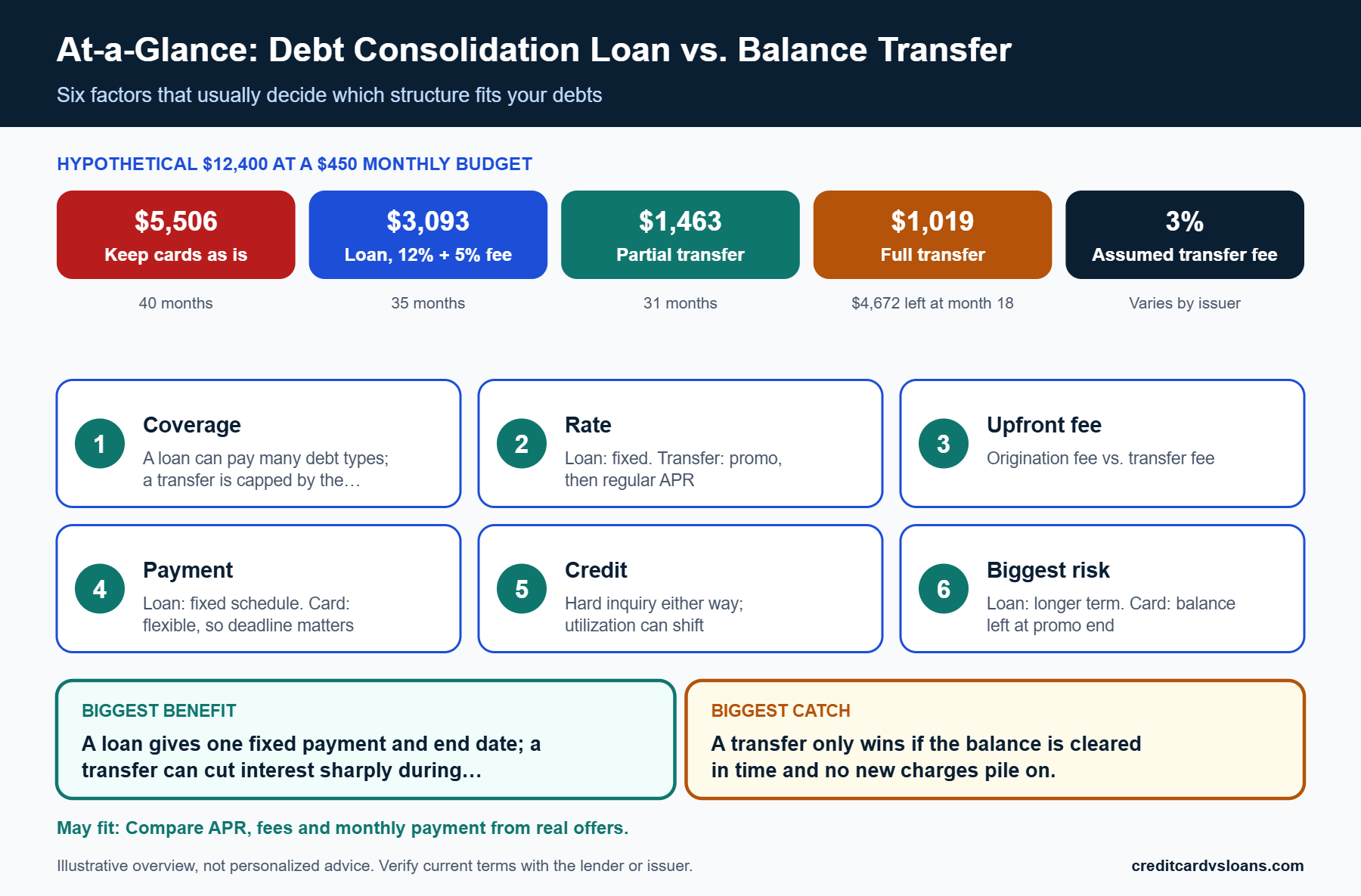
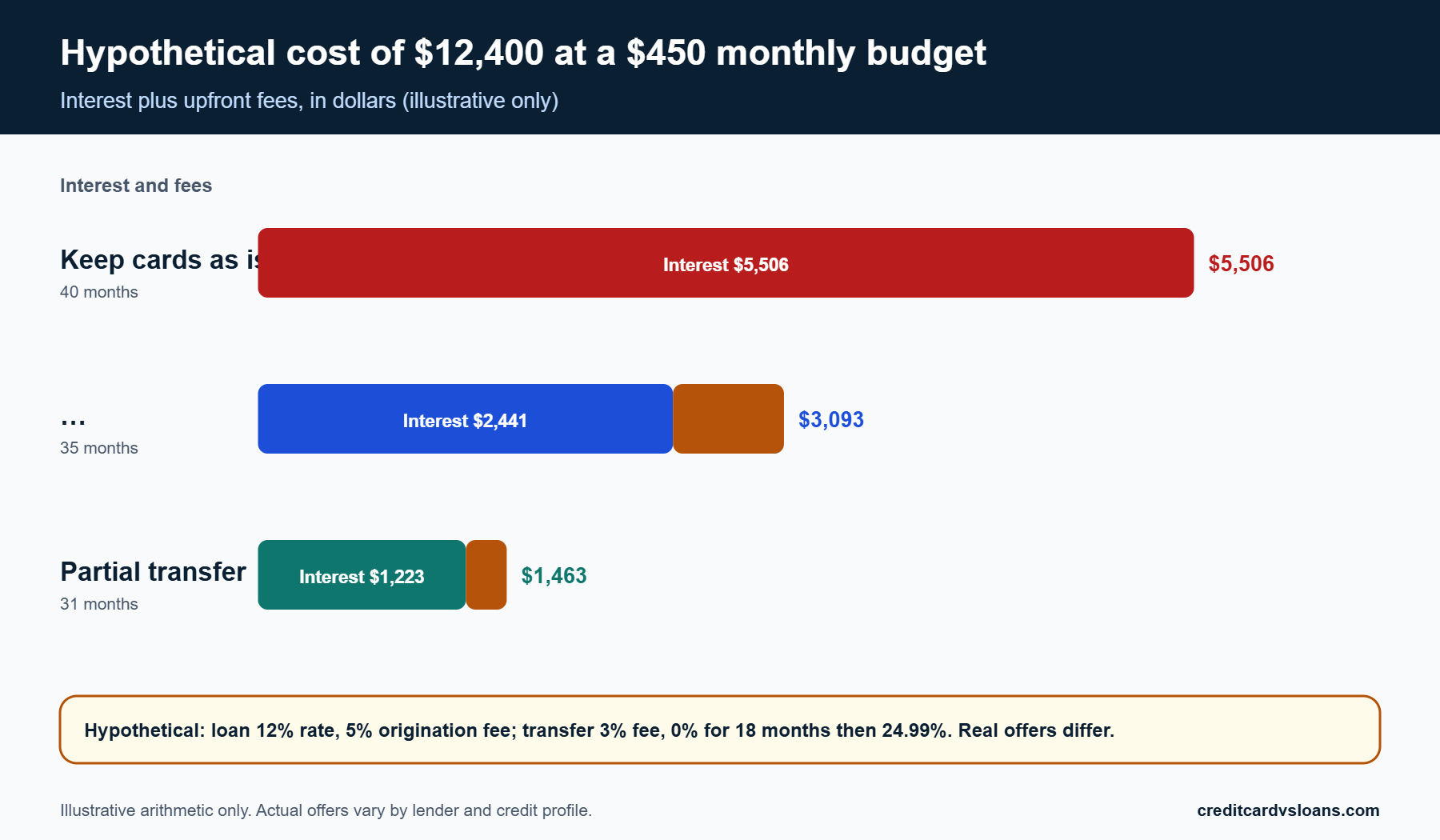
At $450 a month, leaving the cards alone takes about 40 months and costs roughly $5,506 in interest in this hypothetical. The loan path, with the fee rolled in, finishes in about 35 months with $2,441 in interest plus a $653 origination fee. The partial transfer finishes in about 31 months and costs $1,223 in interest plus a $240 transfer fee.
A full $12,400 transfer, if an issuer approved a limit that high, would be cheaper still on paper at $647 in interest plus a $372 fee. But with the 3% fee the starting balance is $12,772, and only about $8,100 gets paid during the 18 promotional months. Roughly $4,672 would roll onto the 24.99% regular APR, which is why this version is the most fragile.
| Path | Months to pay off | Interest | Upfront fee | Total cost |
|---|---|---|---|---|
| Keep four accounts as they are (blended 23.26%) | 40 | $5,506 | $0 | $5,506 |
| Consolidation loan (12% rate, 5% origination fee) | 35 | $2,441 | $653 | $3,093 |
| Partial transfer ($8,000 at 3% fee) plus $4,400 left on cards | 31 | $1,223 | $240 | $1,463 |
| Full transfer ($12,400 at 3% fee, 0% for 18 months) | 30 | $647 | $372 | $1,019, with $4,672 still owed at month 18 |
How the answer shifts with a bigger or smaller budget
At $550 a month, the loan path takes about 28 months and costs about $2,576 including the fee, while the partial transfer takes about 25 months and costs about $862. At $700 a month, the loan path costs about $2,119 and the partial transfer about $553. The gap narrows in dollars as payoff gets faster, but the transfer stays ahead as long as the promotion fully covers the balance it holds.
At the low end, below the loan’s own payment of roughly $434 a month, the loan can’t be shortened below its term, while a card has no fixed schedule. A lower budget stretches the card path past the promotional window, which is exactly where the savings shrink. See the fee-versus-interest breakdown in balance transfer fee vs. interest for how to size that risk.
Fees, APR and True Cost of Debt Consolidation Loan vs Balance Transfer
Fees on each side
Origination fees on consolidation loans
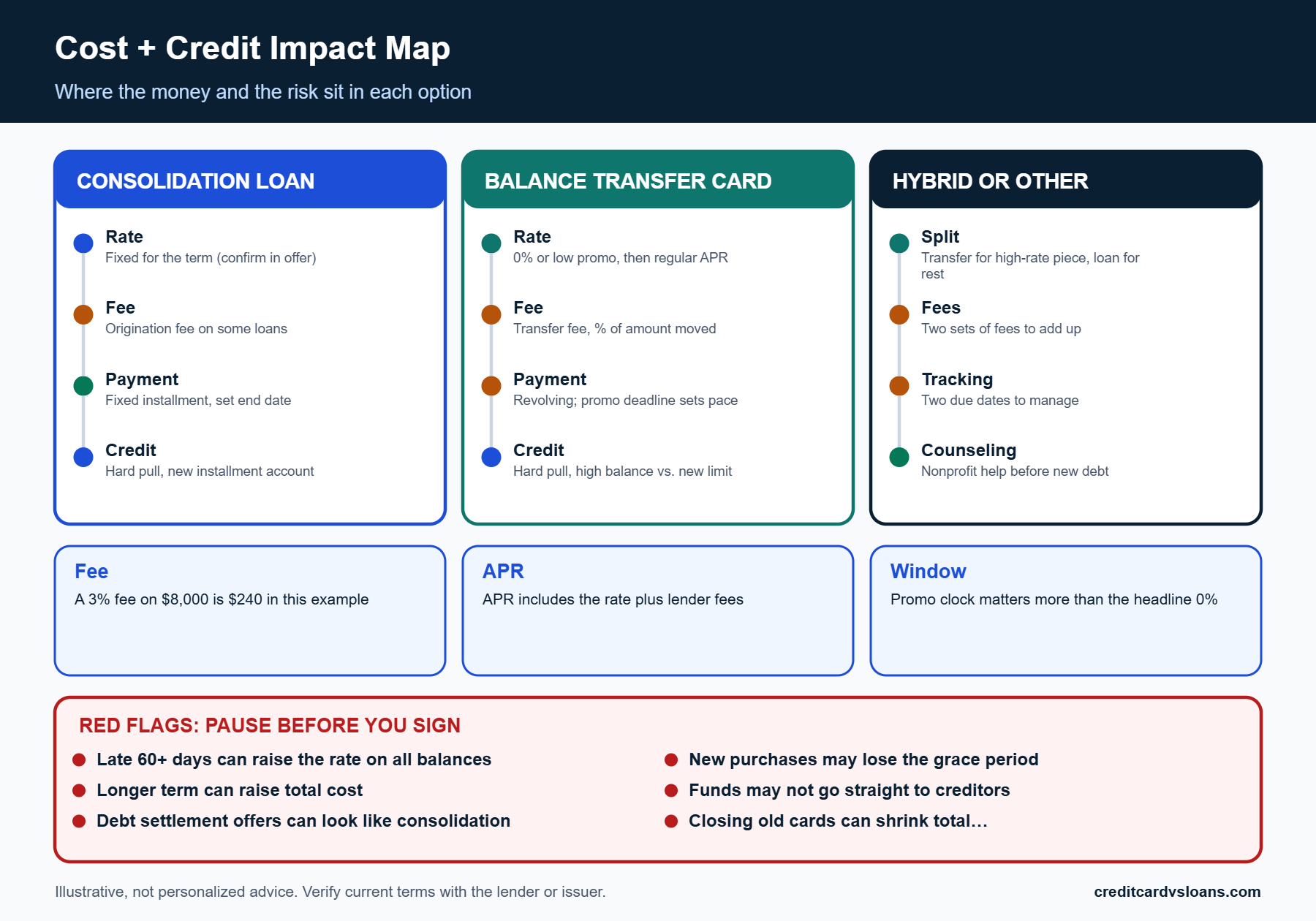
Some personal loans charge an origination fee, usually a percentage of the loan, which may be deducted from the proceeds or added to the balance. The CFPB explains that the APR is the interest rate plus additional fees charged by the lender, which is why APR, not the headline rate, is the right number for comparing loan offers.
In this example, a 5% fee on a loan sized to net $12,400 adds about $653 in cost and raises the amount you owe to about $13,053. If you’re comparing lenders, ask for the APR and the dollar fee. A lower rate with a higher fee can cost more than a slightly higher rate with no fee.
Transfer fees on balance transfer cards
The CFPB says a balance transfer fee is charged to transfer an outstanding balance to a different card, and that it can apply even to a zero percent rate offer. At a 3% fee, an $8,000 transfer costs $240 up front, and a $12,400 transfer costs $372. Fee percentages and minimum dollar amounts vary by issuer.
The fee is real money, but it’s also a known, one-time cost. Compare it with the interest you would otherwise pay during the promotional months, which in this example would run to hundreds of dollars per quarter on the original balances.
Promotional APR versus a fixed rate
What a promotional rate does and doesn’t do
A promotional APR is a temporary rate, such as 0% for 18 months. Under Regulation Z, a promotional period of six months or longer can end and be followed by a higher rate, provided the issuer disclosed the period’s length and the later rate before it began. After it ends, the card’s regular APR applies to what’s left.
A loan’s fixed rate doesn’t change during the term, which gives you predictability. A promotional rate gives you a window, which rewards a clear payoff plan and punishes drift. The right pick depends partly on your behavior, not just your math.
Market context from the Federal Reserve
The Federal Reserve’s G.19 release of October 7, 2026 reported a preliminary August 2026 average rate of 22.36% on credit card accounts assessed interest and 11.90% on 24-month personal loans at commercial banks. Those are averages across borrowers, not offers, and the personal loan series covers a specific loan type at banks, so don’t treat it as the rate you’ll receive.
What the data does show is the structural gap: a typical borrower paying card interest pays roughly double the rate of an average bank personal loan, which is why moving revolving debt into a lower-rate product can lower cost, if you qualify at a lower rate.
Credit Score Impact and Approval Requirements
Who gets approved for each product
What lenders weigh for a consolidation loan
The CFPB lists the factors most personal loan lenders consider: your credit score and reports, income, existing debts, the loan amount and length, and sometimes bank account transactions. Rates also depend on state law limits. A borrower with a thin credit file or high existing debts may be offered a higher rate or a smaller amount.
Because standards differ widely, prequalify with several lenders using soft pulls and compare the APR, fee and term on each. Our guide to what credit score you need for a debt consolidation loan covers the common thresholds in more detail.
Why balance transfer approvals can be tougher
Issuers set their own approval standards for promotional offers, and the credit limit they grant may be well below what you owe. The CFPB also cautions that damaged credit may prevent you from getting low-rate balance transfers, consolidation loans or home equity loans. That’s a reason to check your reports before applying.
Read our explainer on credit scores for a balance transfer card for the approval factors issuers look at. If you’re declined, you’ve still taken a hard pull, so avoid applying for several cards in a row.
How each option can affect your credit
Inquiries and new accounts
Both options typically involve a hard inquiry when you formally apply. The CFPB notes that hard inquiries affect scores because most models consider how recently and frequently you apply for credit, while soft inquiries such as prescreening or checking your own report do not. A new account also lowers the average age of your accounts, which many scoring models consider.
The effect varies by person and can be small and temporary, or larger if your file is thin. No source can tell you in advance how your score will move, so treat any specific promise with suspicion.
Utilization, closed accounts and payment history
Paying off cards with a loan can lower the share of your revolving credit that you’re using, a factor many scoring models consider. A balance transfer may do the opposite in the short run, since the new card carries a large balance against its limit. Closing the old cards can shrink your total available credit, so think before you close accounts.
The factor that matters most over time is on-time payment. Whichever product you choose, set up automatic payments for at least the minimum, and add an extra payment manually if you’re targeting a promotional deadline.
Risks That Can Turn Consolidation Into More Debt
Balance transfer risks
When the promotion ends and when a late payment lands
The most common failure is simple: the promotional period ends with a balance still on the card. In the full-transfer example at $450 a month, about $4,672 remains after 18 months and begins accruing at 24.99%. Setting a target of paying the transferred balance, fee included, divided by the promotional months, gives you a monthly number to hold yourself to.
The CFPB also warns that if you are more than 60 days late, the issuer can raise the rate on all balances, including the transferred one. Under Regulation Z, an issuer can generally raise a rate if it hasn’t received the required minimum payment within 60 days of the due date, and it must restore the earlier rate only after six consecutive on-time payments following the increase. One late payment can undo months of planning.
New purchases, grace periods and where your payments go
The CFPB cautions that new purchases on a card carrying a promotional balance can start accruing interest right away, and that the only way to avoid it is paying the full balance, including the promotional balance, by the due date. That makes the transfer card a poor everyday card while the promotion is running.
Payment allocation matters too. Under Regulation Z, payments above the minimum generally go first to the balance with the highest APR. If you add a purchase balance at 24% to a 0% transfer balance, your extra payment attacks the purchase balance first, which is helpful, but the 0% balance still has to be cleared by the deadline.
Loan risks
A longer term can cost more even at a lower rate
The CFPB points out that a lower monthly payment often comes with a longer repayment term, and that you may pay considerably more overall, including loan fees and interest. If you take a 60-month loan to reduce your payment, the total interest can exceed what you’d pay on a shorter, higher-payment loan, even at a lower rate.
The reverse is also true: a loan that costs a little more per month but ends years sooner can cost thousands less in total. Ask for the total repayment amount on each term you’re offered and compare those totals, not just monthly payments.
Re-borrowing on the cards you just paid off
The CFPB notes that if you borrow because you spend more than you earn, consolidation alone may not fix the problem, and that taking on new debt to pay old debt may only postpone it. Freshly emptied cards are a quiet temptation: a borrower can end up with the loan balance and new card balances at the same time.
A practical safeguard is to decide in advance what you will do with the paid-off accounts, whether that means keeping one open with a small recurring charge paid in full, or removing saved card numbers from shopping accounts. Closing accounts has credit effects, so weigh that choice.
Alternatives and Hybrid Plans Worth Comparing
Splitting the debt across two tools
A transfer for the high-rate piece, a loan for the rest
When the total exceeds what a transfer card will take, a hybrid can make sense. In the hypothetical, the partial plan sent the $8,000 of highest-rate balances to a transfer card and kept $4,400 on lower-rate cards. A variation is to use a small loan for the remainder, creating a fixed payment on the piece that won’t fit the promotional window.
Hybrids add complexity: two applications, two inquiries, and more due dates. They only pay off if you track both clearly. Put both payments on autopay and calendar the promotional end date.
Targeting the highest-rate balances first
Even without a new product, directing every extra dollar to the card with the highest APR while paying minimums elsewhere reduces interest over time. In this example, the store card at 26.99% is the obvious target. A consolidation product helps most when it replaces your highest-rate debts, not the cheapest ones.
Before you open anything new, list each balance, APR and minimum, and sort by APR. This five-minute exercise often makes the right plan obvious. For a broader comparison of revolving credit and installment loans, see credit card vs. personal loan and 0% APR credit card vs. personal loan.
Options that don’t involve a new loan
Credit counseling and talking to creditors
The CFPB suggests nonprofit credit counselors as a first step and recommends asking creditors whether they will lower minimum payments, waive fees, reduce your interest rate or move your due date. These conversations cost nothing and are worth having before you add a new account.
Counselors can review your whole budget, which matters because the CFPB notes that borrowing to cover spending beyond income may not fix the underlying issue. Look for a nonprofit organization and ask about fees up front.
Debt settlement offers that sound like consolidation
The CFPB warns that some companies advertising consolidation are actually debt settlement companies, which often charge upfront fees and may tell you to stop paying creditors and deposit money into a special account. That can be risky for your credit and your finances.
A legitimate consolidation loan or balance transfer comes from a bank, credit union or licensed lender and is documented with standard disclosures such as APR and fees. If an offer asks you to stop paying creditors or pay large fees before any debt is resolved, treat it as a red flag.
Which Path Fits Which Borrower
Matching the tool to the situation
Borrowers who tend to lean toward a loan
A loan tends to fit when you have several types of debt, when you need a fixed finish line to keep yourself on track, or when no card issuer will extend a limit large enough. It also fits if your budget is tight and you can’t commit to a high monthly payment that a promotional deadline would require.
Check the total cost, including the fee, against what you’d pay by staying put. If the savings are small, the structure might still be the main value. Our companion article on credit card vs. personal loan for a specific spending need shows how this same logic applies to a different case.
Borrowers who tend to lean toward a transfer
A transfer tends to fit when the debt is mostly on one or two cards, when you can clear it within the promotional window, and when you can avoid new spending on the card. If the monthly payment needed to finish on time is comfortably within your budget, the savings can be substantial.
If the monthly figure is a stretch, consider a smaller transfer or a loan. Remember that approval, limit and promotional terms are decided by the issuer, so plan for the possibility that your offer is less generous than an advertised one.
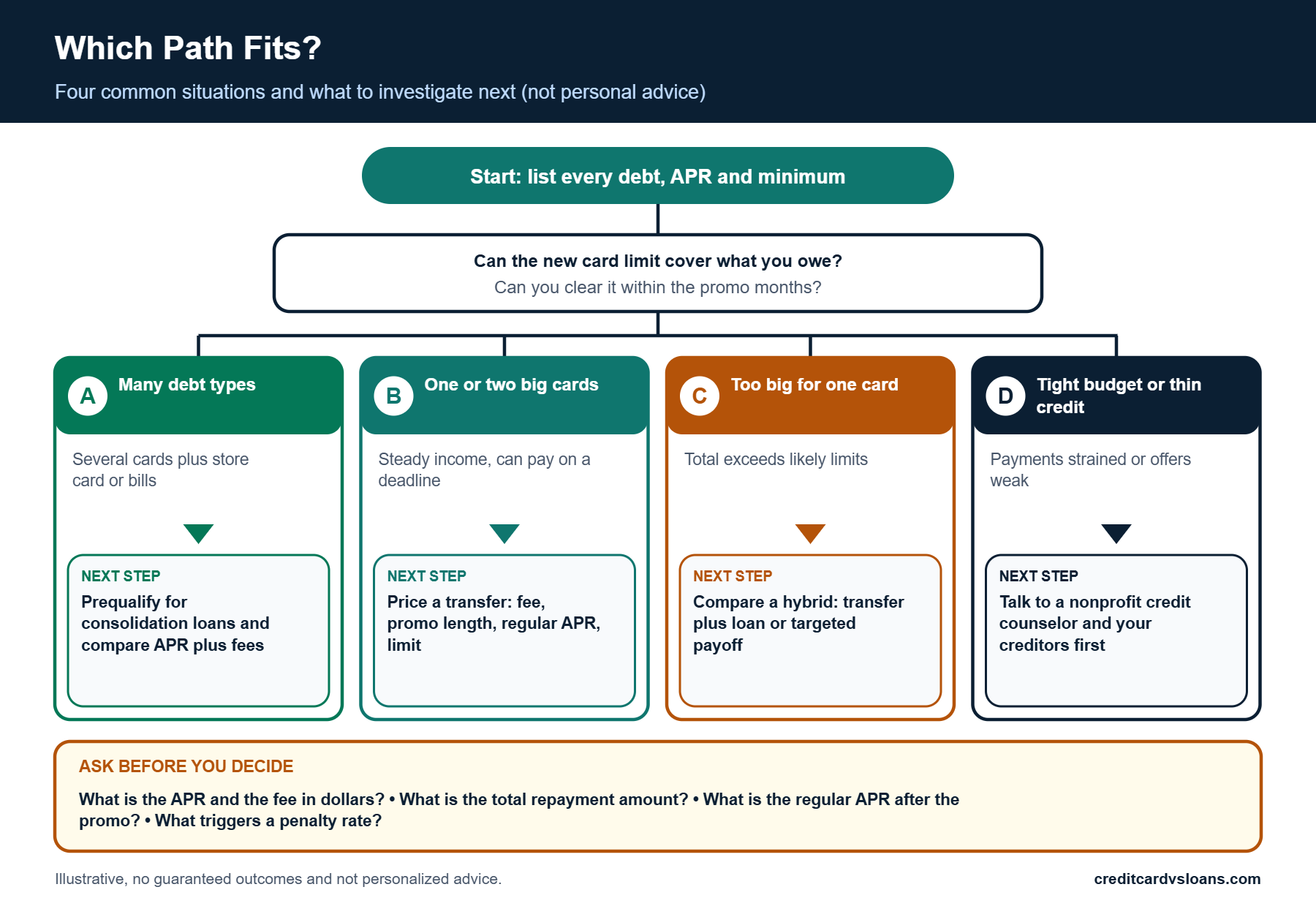
| Borrower scenario | Option to investigate | Why | What to verify | When to avoid it |
|---|---|---|---|---|
| Several cards plus a store card or other bills | Consolidation loan | One amount covers many accounts | APR, origination fee, whether funds go to creditors | If the offered APR is close to your current blended rate |
| One or two large card balances, steady income | Balance transfer card | Promotional window cuts interest while principal falls | Fee, promo length, post-promo APR, credit limit | If you can’t finish paying before the promotion ends |
| Total exceeds any likely card limit | Hybrid plan | Transfer for high-rate piece, loan or payoff for the rest | Combined fees and two due dates | If tracking two products would be hard |
| Tight monthly budget, unsure about discipline | Loan with a longer fixed term, or credit counseling | Predictable payment without a deadline cliff | Total repayment amount at each term | If the longer term makes total cost unattractive |
| Damaged credit or recent late payments | Credit counseling and creditor outreach first | New credit may be costly or unavailable | Nonprofit status and fees | Offers that ask you to stop paying creditors |
Stress-testing your choice before you commit
Three what-if questions to ask of any plan
Before choosing between a debt consolidation loan vs balance transfer, test the plan against three realistic bumps. What if your income dips for two months and you can only afford minimum payments? What if a car repair or medical bill forces you to put a charge on the transfer card? What if the loan’s payment is due the week before your paycheck?
A good plan survives at least one of these. A loan’s fixed payment is easy to model against a bad month. A transfer plan can handle a bad month only if you’ve built a buffer of extra payments before the promotional end date.
Questions to ask the lender or issuer before you sign
Ask for the APR, the fee in dollars, the term or promotional length, the regular APR after the promotion, and what triggers a penalty rate. For a loan, ask whether there is a prepayment penalty and whether funds go to creditors directly. For a card, ask whether new purchases get a grace period while a promotional balance is open.
Get the answers in writing or from the official disclosures, which for credit cards include the pricing table with APRs and fees. If a representative can’t point to the number in the documents, treat it as unconfirmed.
Checklist, Conclusion and Next Steps
A pre-commitment checklist
Numbers to gather before you apply
List every balance, APR, minimum payment and due date. Total them and compute your blended APR by weighting each rate by its balance. Decide the monthly amount you can pay without relying on credit, and test it against an unexpected expense.
Then pull your credit reports and look for errors or accounts you don’t recognize. Fixing an error before applying can change the offers you see. Compare your blended APR with the APRs on any offers you prequalify for, and include fees in the comparison.
Behavior commitments that make the math work
Decide in advance what happens to the old cards. Decide how you’ll cover irregular expenses without new charges. Set up automatic payments and calendar the date three months before any promotional period ends so you can adjust.
If you’re comparing with a payoff-speed question in mind, our guide to balance transfer vs. personal loan focuses on how quickly each option clears a single balance, and our article on credit card vs. personal loan decisions covers the same trade-offs in another context.
Questions that come up after the first comparison
Can you use both a loan and a transfer on the same debts?
Yes, though not for the same dollars. A common pattern is to move the most expensive card balances to a transfer card and use a loan for what’s left, or to take a loan first and later use a transfer for a balance that creeps back. Each step has its own fee and its own inquiry, so the savings have to be large enough to cover both.
Keep the sequence simple. Two products with two due dates, two fees and two sets of terms is manageable for some borrowers and a source of missed payments for others. If you notice that you’re adding complexity to chase a small saving, a single product is usually the safer choice.
What if the numbers are close?
When the total cost of a loan and a transfer plan differ by only a small amount, let the risk profile decide. A fixed loan payment protects you from a missed promotional deadline. A transfer rewards discipline but punishes slips. Think about which failure you are more likely to face in the next year, not which spreadsheet row looks better.
It also helps to ask which option leaves you in a stronger position if something goes wrong. A loan with no prepayment penalty can be paid off early with spare cash. A transfer card with a balance left at the end of the promotion can often be paid down with the same spare cash, but at a higher interest rate in the meantime.
The bottom line
How to choose between a loan and a transfer
Choose a consolidation loan when you need one tool to cover many kinds of debt on a fixed schedule. Choose a balance transfer when the amount is manageable for the card’s limit and you can clear it before the promotion ends. Consider a hybrid when neither alone fits, and consider credit counseling first if your budget doesn’t cover the payments any plan would need.
In the hypothetical $12,400 example, the lowest-cost plan at a $450 budget used a transfer for the highest-rate piece. That result came from the assumed fees, promotional length and rates, not from a rule. Run your own numbers with the offers you actually receive.
Next steps you can take this week
- Write down each debt with its balance, APR, minimum payment and due date, and compute your blended APR.
- Check your credit reports and fix any errors before applying.
- Prequalify for consolidation loans using soft pulls and record the APR, fee, term and total repayment amount.
- If considering a transfer card, record the credit limit, transfer fee, promotional length and regular APR, and calculate the monthly payment needed to finish on time.
- Decide what you will do with the old accounts, and set autopay on every new payment.
- If the numbers don’t work, contact a nonprofit credit counselor or call your creditors about hardship options.
For the credit-score side of a transfer, read what score a balance transfer card typically requires, and for broader context on loans versus cards see our credit card vs. personal loan comparison.
- 0% APR Credit Card vs. Personal Loan: Which Is Cheaper?
- Credit Card vs. Personal Loan: Which Is Better for Borrowing?
- What Credit Score Do You Need for a Debt Consolidation Loan?
- What Credit Score Do You Need for a Balance Transfer Card?
- Credit Card vs. Personal Loan for Back-to-School Spending: Which Is Better?
- CFPB: What do I need to know about consolidating my credit card debt?
- CFPB: What is a balance transfer fee? Can it be charged on a zero percent offer?
- CFPB: What is a personal installment loan?
- CFPB: What is the difference between a loan interest rate and the APR?
- CFPB: What is a credit inquiry?
- CFPB (Regulation Z): 12 CFR 1026.55 Limitations on increasing APRs, fees, and charges
- CFPB (Regulation Z): 12 CFR 1026.53 Allocation of payments
- CFPB: You could still end up paying interest on a zero percent interest credit card offer (2014 archived post)
- Federal Reserve: Consumer Credit – G.19 (release of October 7, 2026)
Last updated: October 22, 2026. Rates, fees and lender rules change; verify current terms before acting.
The information on creditcardvsloans.com is provided for general educational and informational purposes only. It is not financial, legal, tax, credit, accounting or investment advice, and reading it does not create an advisor-client, fiduciary or any other professional relationship. Nothing here is an offer, solicitation or recommendation to borrow, lend or apply for any product.
Credit scores, interest rates, fees, eligibility rules, lender policies and laws change frequently and vary by lender, location and individual circumstances. Examples, figures and scenarios are illustrative only, do not predict your results and do not guarantee approval, savings, a particular rate or a credit-score outcome. Always confirm current terms directly with the lender or issuer and read the full agreement before you apply or sign.
Although we aim for accuracy and use reputable sources, we make no representations or warranties, express or implied, about the completeness, accuracy, reliability or timeliness of the content. Content may be drafted with the assistance of automated tools, so errors or omissions may still occur. Links to third-party sites are provided for convenience; we don’t control and aren’t responsible for their content.
To the fullest extent permitted by law, creditcardvsloans.com and its owners, editors, authors, contributors and affiliates disclaim all liability for any loss, damage or expense arising directly or indirectly from your use of, or reliance on, this content. Before making financial decisions, consult a licensed professional, such as a qualified financial advisor, attorney, tax professional or nonprofit credit counselor, who can consider your complete situation.