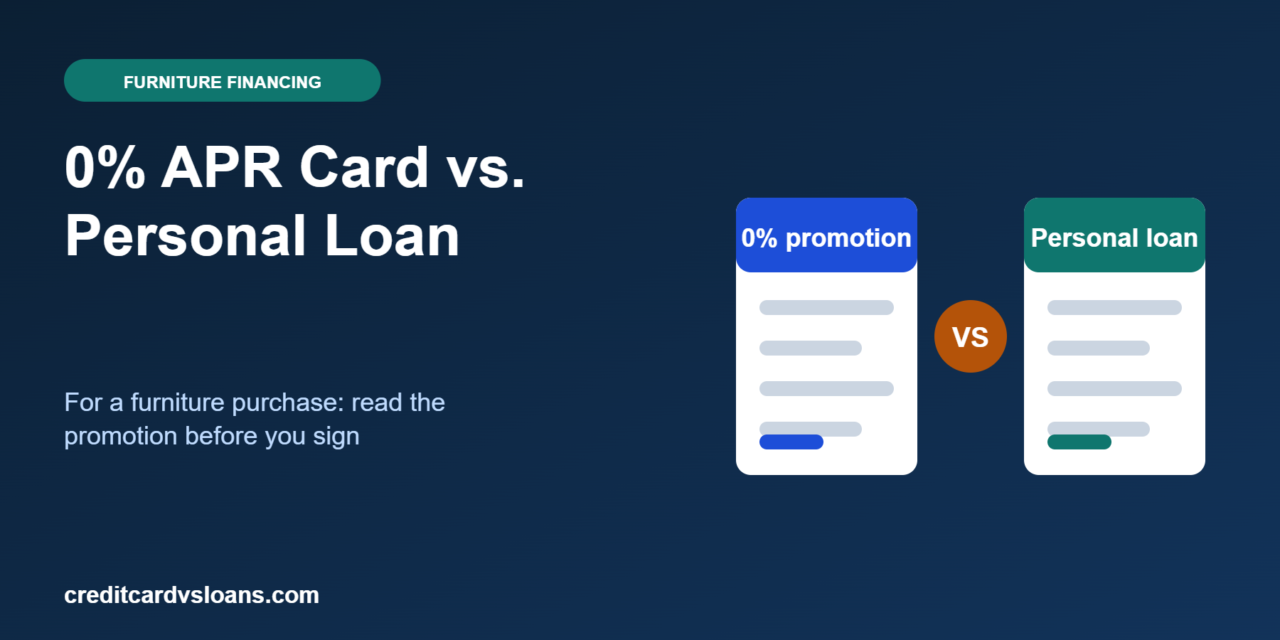
For most furniture purchases, a true 0% APR credit card is the cheaper choice only if you can pay off the full price before the promotion ends, and a personal loan is the safer choice if payoff will take longer. The 0% APR credit card vs personal loan for furniture purchase decision also hides a trap that most other purchases do not: many furniture stores advertise financing that looks like 0% but is actually deferred interest.
Furniture is a classic financing moment. The total is large enough to hurt, the delivery date is weeks away, and the checkout screen or salesperson offers "no interest" terms on the spot. That convenience is real, and so is the risk of paying far more than the sticker price if the plan slips. A few minutes with the terms before you sign can save you hundreds of dollars.
This guide keeps to the furniture question: how to compare a promotional card, a store financing plan and a personal loan for a mid-sized purchase. For the general cost comparison, see our 0% APR credit card vs personal loan guide. Nothing here is an offer, and no one can promise approval, savings or rates.
- Check first whether "no interest" means a true 0% APR or deferred interest. The CFPB explains that deferred interest is charged retroactively to the purchase date if the full balance is not paid on time.
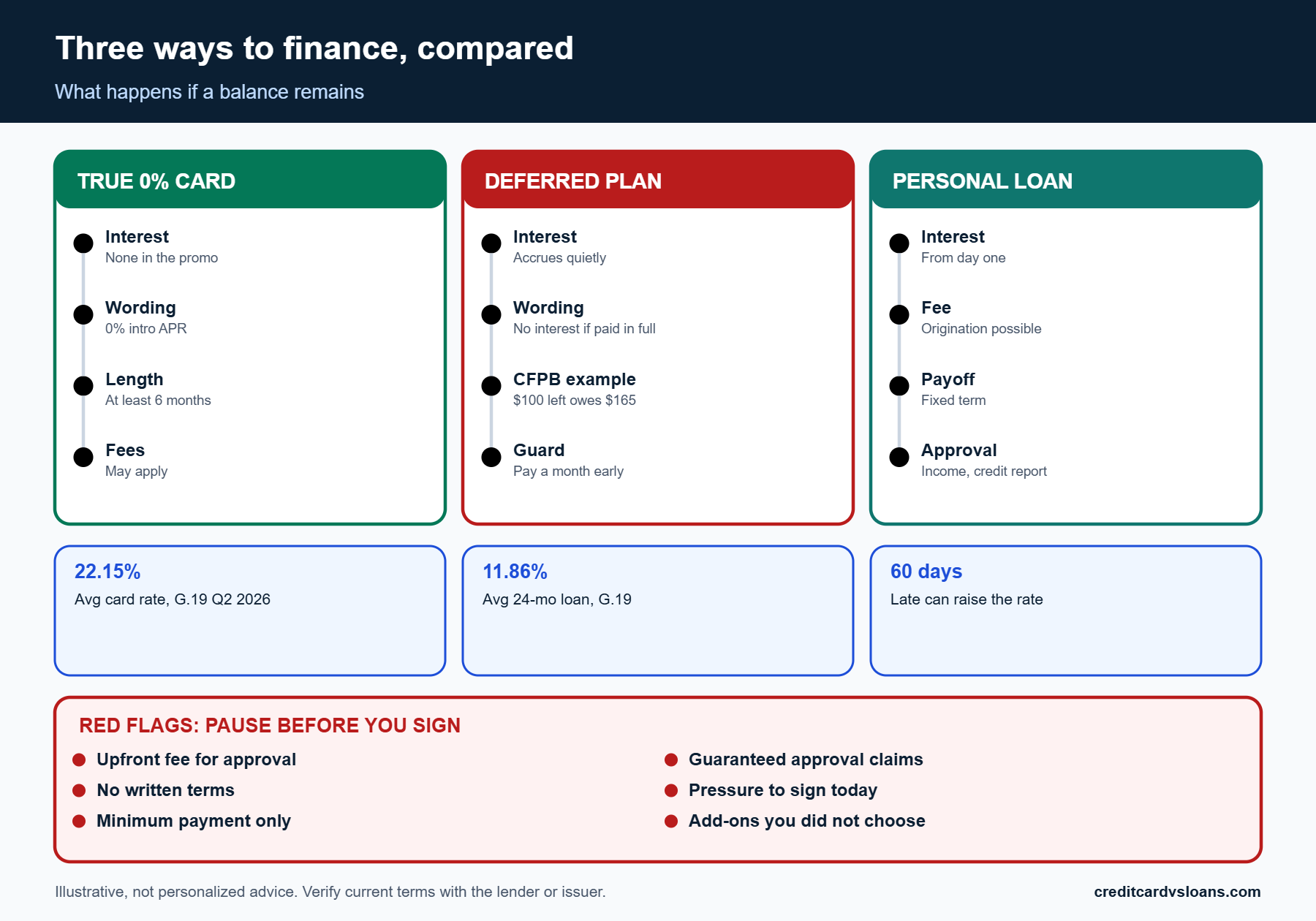
- In the CFPB's $400 television example, $100 left at the end meant owing $165 under deferred interest versus $100 under a true 0% plan.
- Divide the price, plus any fee, by the number of promotional months to see the payment that actually clears the balance. The minimum payment usually will not.
- A fixed-rate personal loan costs interest, but it gives a firm payoff date and no retroactive charge.
- Per the Federal Reserve's G.19 release of Sept. 8, 2026, average rates were 22.15% on card accounts assessed interest and 11.86% on 24-month bank personal loans (Q2 2026). These are averages, not offers.
Rate averages are from the Federal Reserve's G.19 Consumer Credit release dated Sept. 8, 2026. All dollar examples below are hypothetical and show method, not quotes.
The Short Answer for a Furniture Purchase
Which financing fits which kind of buyer
When a true 0% card tends to win
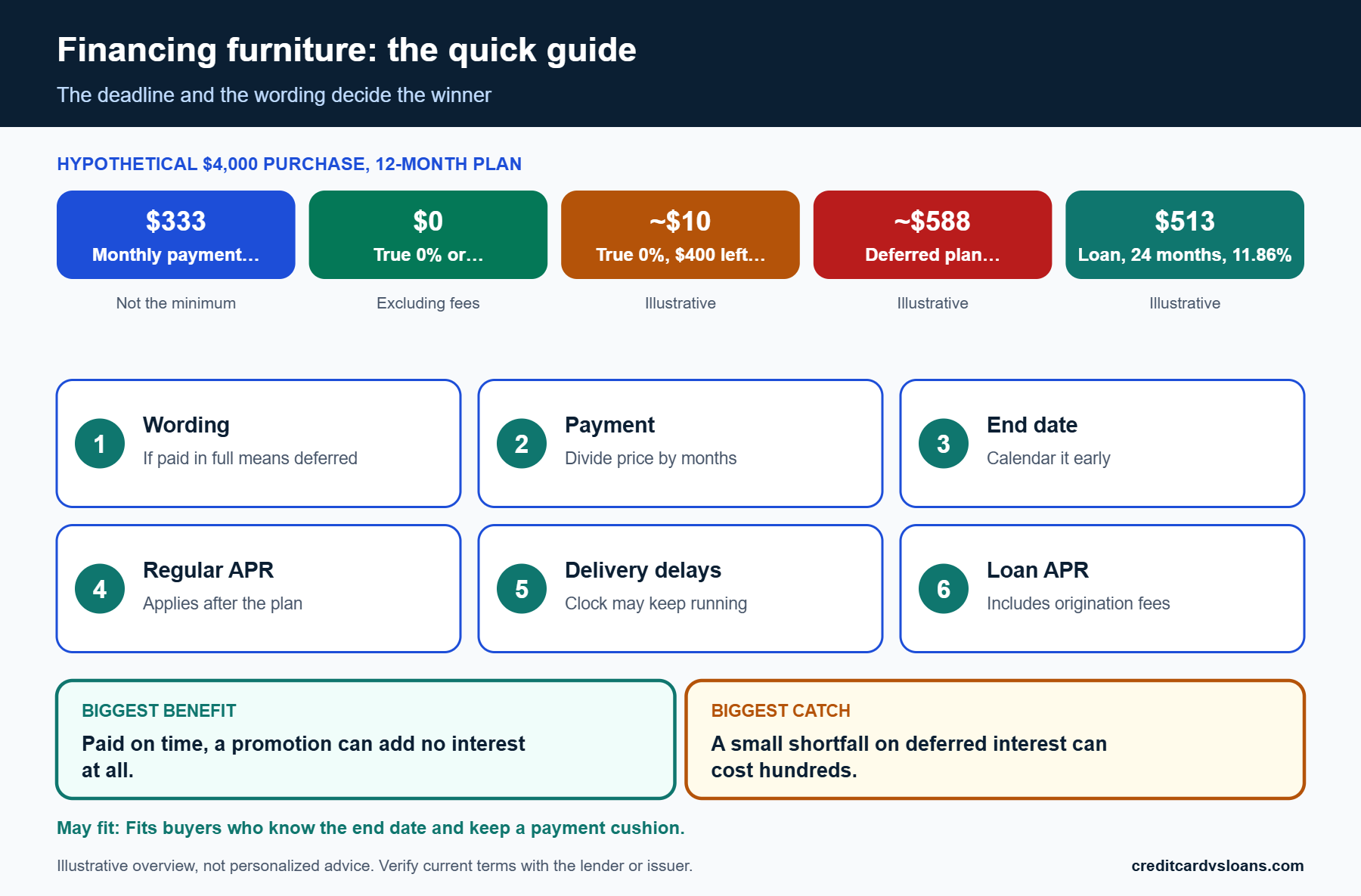
If you can pay the full price, including any fee, before the promotion ends, a true 0% card can cost nothing in interest. On a hypothetical $4,000 sofa and dining set, a 12-month promotion means paying about $333.34 a month. The CFPB says that with a zero-percent promotion, interest applies only to any remaining balance after the promotion, starting from the end date.
That makes the card attractive for buyers with predictable income who treat the promotion as a strict deadline. It is less attractive if you also plan to use the card for other purchases, because new purchases can accrue interest and complicate how payments are applied.
When a personal loan tends to win
A fixed-rate loan fits buyers who need more than a year, who want one payment that never changes or who are not sure they will hit a promotional deadline. You pay interest from day one, but there is no retroactive charge and the payoff date is set by the contract.
A loan can also make sense for a larger project, such as furnishing an entire home, where a single card limit or promotional window would not stretch far enough.
When store financing needs extra scrutiny
Retail financing is convenient, and some offers are true 0%. Many are deferred interest, and the CFPB notes that the word "if" in the pitch, as in "no interest if paid in full," is the signal. Ask the salesperson, or read the disclosure, to confirm which type you are being offered and what the regular APR is.
Convenience should not be the deciding factor. You can usually apply for a card or loan elsewhere and bring the financing with you, then compare it against the store's plan.
Why furniture is a special case
Big tickets, long delivery times
Furniture orders often arrive weeks or months after payment, and returns and damage claims add time. If you finance a purchase with a promotional clock, the clock may start at checkout, not at delivery. A late shipment can eat into your payoff window.
Ask when the promotional period starts and how a delayed or returned order is handled. If an item is returned, confirm how the financing balance is adjusted.
Add-ons that inflate the balance
Delivery fees, protection plans and assembly services can push the total above the sticker price. Each added dollar raises the payment you need to clear a promotion, and some add-ons are optional. Decline what you do not need, and see whether a price negotiation or a cash discount is available.
The cleanest comparison starts with the out-the-door price in writing, then adds financing costs on top of that figure.
How the Furniture Financing Options Work
Promotional cards and store plans
A true 0% card on the purchase
A 0% introductory APR on purchases means no interest accrues on the promotional balance for the stated period. The issuer must disclose the length of the introductory period and the rate that applies afterward. The CFPB notes that such a promotional rate must generally last at least six months, and that the rule does not apply if you are more than 60 days late.
Fees can still apply. If you move an existing balance rather than make a new purchase, a balance transfer fee may be charged, even on a zero percent offer. For a new furniture purchase, check the card terms for annual fees and any other costs.
A store card or financing plan at checkout
Retailers commonly offer their own card or a financing plan through a lending partner, often with a promotional period. Some are true 0%. Many use deferred interest, where interest accrues from the purchase date and is added if the balance is not cleared by the deadline. The CFPB's blog on promotional financing lays out how to recognize the difference.
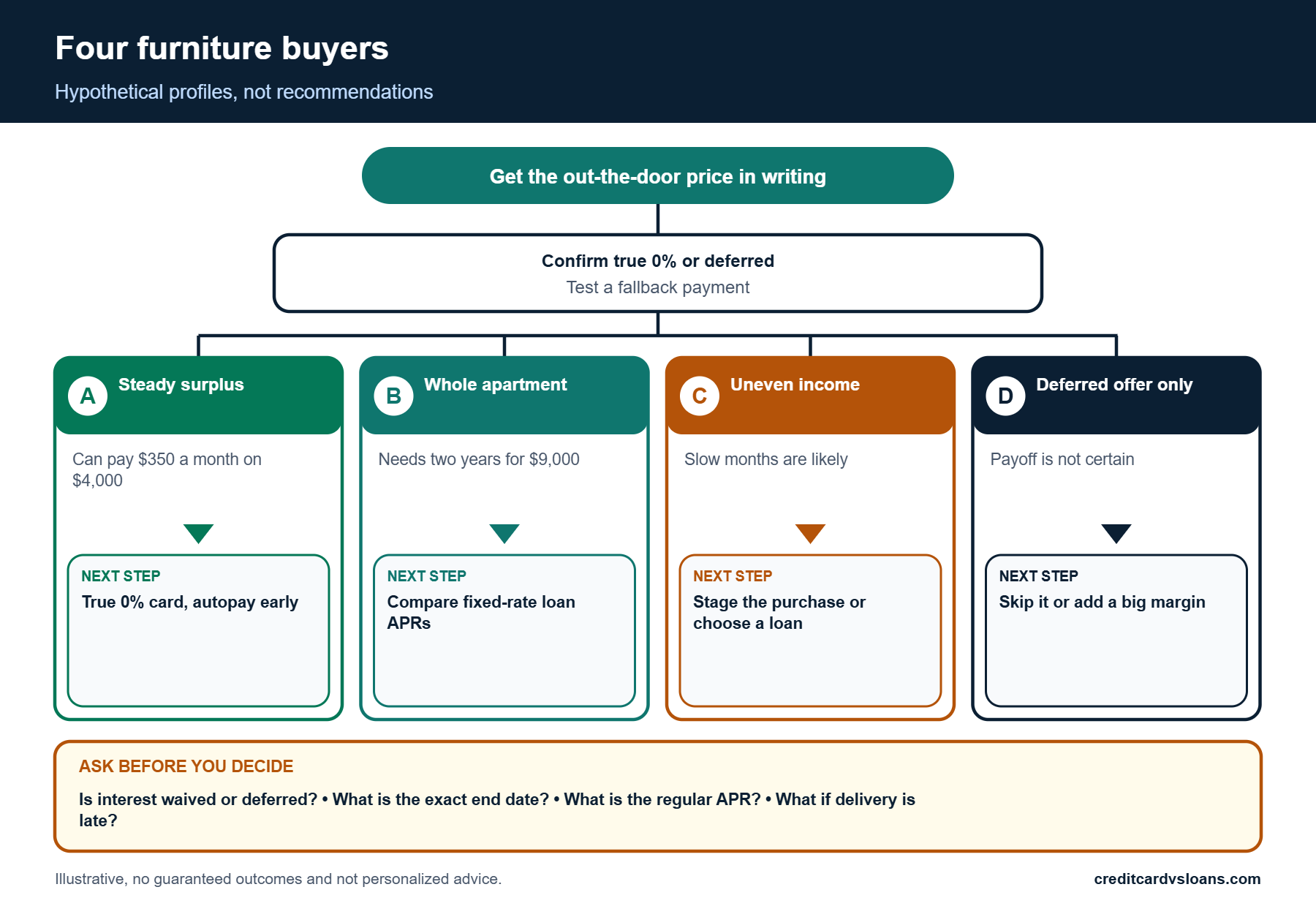
Ask three questions at the register: is interest waived or deferred, what is the regular APR, and what is the exact end date? The answers should match the written terms, which you should read before you sign.
Why the minimum payment will not finish the plan
On many promotional plans, the minimum payment is set low and does not pay off the balance in the promotional period. The CFPB advises calculating the monthly payment needed to clear the balance in time because the minimum is usually not enough.
For a $4,000 order on a 12-month plan, that means about $333.34 a month, plus any fees. Set that as your fixed payment, treat the minimum as irrelevant and schedule autopay at the larger amount.
Personal loans for furniture
What the loan offers and what it costs
A personal loan pays out a lump sum, which you can use to pay the retailer in full. Some retailers give a modest discount for payment up front, though policies differ. You then repay the lender on a fixed schedule. The CFPB notes that APR includes the lender's fees such as origination charges, and that APR is the number to compare across offers.
The Federal Reserve reported a 11.86% average rate on 24-month commercial bank personal loans for Q2 2026. Your offer could differ widely depending on your credit, income and the lender.
A side-by-side look
Table 1 compares the three paths. Look at the row for what happens if a balance remains, since that is where the products diverge most.
| Feature | True 0% APR card | Store deferred-interest plan | Personal loan |
|---|---|---|---|
| Interest during the plan | None accrues | Accrues in the background | Charged from day one |
| If balance remains at the end | Interest only on the remainder, going forward | Interest charged back to the purchase date | No cliff; payoff is scheduled |
| Fees to check | Balance transfer or other fees, annual fee | Late fees, possible activation or processing fees | Origination fee, late fee |
| Payment pattern | Flexible; minimum rarely clears the plan | Flexible; minimum rarely clears the plan | Fixed |
| Best fit | Buyers who will finish inside the window | Buyers who will pay it off with certainty | Buyers who need a longer, steady plan |
0% APR Credit Card vs Personal Loan for a Furniture Purchase: The Cost Math
What a $4,000 purchase looks like under each path
Reading the table
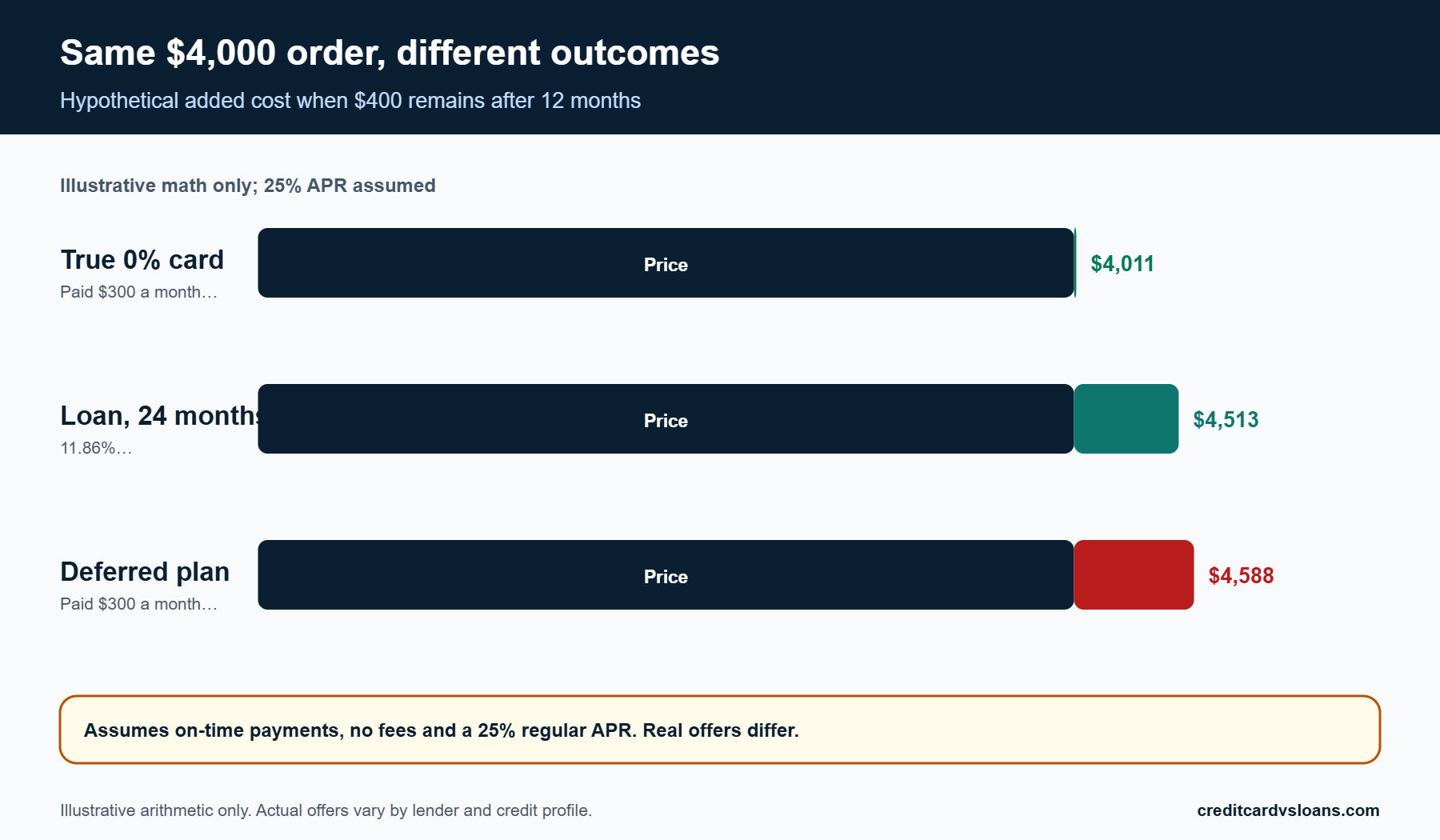
Table 2 uses a hypothetical $4,000 order, no other purchases on the card, on-time payments and an assumed 25% regular APR that echoes the CFPB's own example. The loan figures use the Fed's 11.86% average for 24-month bank personal loans as a stand-in rate. None of these figures is an offer.
| Scenario | Assumptions | Monthly payment | Cost beyond the $4,000 |
|---|---|---|---|
| True 0% card, paid in 12 months | No fee; 0% for 12 months | $333.34 | $0 |
| True 0% card, $300 per month | $400 left after 12 months, then 25% APR assumed | $300.00 | About $10.59, paid off in 2 more months |
| Deferred interest plan, paid in 12 months | 25% APR assumed; balance fully cleared by deadline | $333.34 | $0 |
| Deferred interest plan, $300 per month | $400 left; 25% APR assumed on the declining balance | $300.00 | About $587.50 added at the end, so you owe about $987.50 |
| Loan, 24 months | 11.86% APR, no origination fee | $188.03 | $512.78 |
| Loan, 12 months | 11.86% APR, no origination fee | $355.13 | $261.60 |
| Loan, 24 months, 5% origination fee | 11.86% interest on $4210.53 so you receive $4,000 | $197.93 | $750.29 |
Paid on time, the promotions win
If you clear the full balance inside the window, both a true 0% card and a deferred plan cost nothing beyond the price (plus any fees), while a loan costs hundreds of dollars in interest. That is the appeal of promotional financing, and it is real money for a buyer who plans carefully.
The catch is the second and fourth rows. Paying $300 instead of $333.34 is a small shortfall, yet the two promotions behave very differently. A true 0% card leaves about a $10 interest cost on the $400 leftover. A deferred plan adds roughly $587.50 in back interest in this example.
Why the shortfall is so lopsided
Deferred interest is calculated on the balance that was outstanding each month during the promotion, then added at once if any balance remains. In this example the borrower paid $3,600 of the $4,000, yet owed an extra $587.50, about 15% of the original price. The CFPB's $400 TV example shows the same effect at smaller scale: $100 left became $165 owed.
For a furniture buyer, this means a small miscalculation, a delivery delay or one skipped payment can cost far more than the interest a loan would have charged. It is the main reason to favor a loan, or a true 0% card, when you are not certain of the deadline.
Where the loan earns its keep
Predictable payment and no cliff
The 24-month loan row costs about $513 in interest in this example, but the payment is $188.03 and there is no retroactive charge. If your cash flow is tight or uneven, the loan's lower payment can be worth the interest as an insurance premium.
The 12-month loan row shows that a shorter term raises the payment and cuts the interest, to about $262 here. The right term is the shortest one that you can sustain comfortably.
Fees can flip the ranking
The origination fee row shows how a fee changes the picture: borrowing extra to net $4,000 raises the cost to about $750 over 24 months. Always compare the amount you receive, the APR and the total of payments, as the CFPB advises when comparing loans.
Some lenders charge no origination fee. Prequalify with a soft pull where available to see actual terms before you apply.
Deferred Interest at the Furniture Store: What to Know
How to spot and handle a deferred plan
The wording that gives it away
The CFPB advises reading the promotion: "0% intro APR for 12 months" points to a true zero rate, while "no interest if paid in full in 12 months" points to deferred interest. The "if" matters. Furniture and electronics promotions use this pattern often, although practices differ by retailer and lender, so confirm in writing.
If the staff cannot answer clearly, ask for the credit agreement before you apply. A hard inquiry for a plan you decline to use is an avoidable cost.
Protecting yourself on a deferred plan
Use a margin. Aim to pay the balance a month early, and schedule autopay at the full monthly amount needed, not the minimum. Check the statement each month for the remaining promotional balance and the end date.
The CFPB notes that extra payments usually go to the higher-rate balance, and that to direct them to a deferred balance, you may need to ask your issuer. If you carry other balances on the same account, call and ask how payments are applied.
What to do if you are going to miss the deadline
If you can see you will be short, pay as much as you can before the end date, because interest is charged on whatever remains. Contact the issuer early and ask about options. Some borrowers pay the remainder with a fixed-rate loan to avoid a long period at the regular APR.
Do not ignore it and hope. The retroactive charge applies to the original purchase date, and the longer the balance sits afterward, the more interest continues to build. Our general guide, 0% APR credit card vs personal loan, covers this decision in a broader context.
A reading checklist
Table 3: the six checks
Table 3 turns the fine print into a checklist you can use at the register or at home. It takes five minutes and can save hundreds of dollars.
| What to check | Where to find it | What a good answer looks like |
|---|---|---|
| Waived or deferred interest | Disclosure box, agreement | Interest is waived, not deferred; or you have a plan to clear it with a margin |
| Exact end date | Terms and first statement | A date you have put on your calendar |
| Regular APR after the plan | Agreement | Known, and you could tolerate it on a small leftover |
| Fees | Fee schedule | Itemized, including annual, late and processing fees |
| Payment allocation | Ask the issuer | You know where extra payments go |
| Return and delay policy | Store policy | Written, with financing adjustments explained |
Ask for a cash price or discount
Before financing, ask the retailer whether there is a lower price for cash, a seasonal sale or a price-match policy. A lower sticker price reduces the amount financed and the payment needed to clear any promotion.
Negotiation is not guaranteed, and policies vary. But a hundred dollars off a $4,000 purchase is worth more than most reward programs.
Approval, Credit Scores and the Effect on Your File
How lenders decide
Approval standards differ
The CFPB explains that scores vary by model, data source and date, and lenders use them with other information to decide on approval and pricing. Each card issuer and loan lender sets its own standards. For 0% cards, our guide to credit scores for balance transfer cards discusses the pattern, which applies to purchase offers too.
Store cards are often marketed to a broad group, but approval is never guaranteed, and the credit limit may be lower than the purchase price. If the limit is below your order, a loan may be the only way to finance the whole amount.
Prequalify before you apply
Where offered, prequalification uses a soft pull, which the CFPB says does not affect your scores. A full application triggers a hard inquiry, which can lower scores because models consider how often and how recently you apply for credit.
Prequalify for a loan and, if offered, for a card before committing. Then apply once, to the option that tested best.
What the financing may do to your credit file
A new account and a higher balance
Any new financing adds an account and possibly a hard inquiry. A store card or 0% card with a high balance relative to its limit pushes utilization up, and myFICO lists amounts owed at 30% of a FICO Score. A loan adds an installment account instead.
Effects vary by profile, and no one can promise a direction. Pay on time, because payment history is the largest factor, at 35% per myFICO.
Why store-card habits matter
Opening a store card for a discount at checkout can add a new account and inquiry for a one-time saving. That may be worth it, or it may not, depending on your credit goals in the next year or two.
If you plan to apply for a mortgage or auto loan soon, think carefully about new applications. Our guide to choosing between a credit card and a personal loan explains how the two products behave differently over time.
Risks and Red Flags When Financing Furniture
Card and store-plan risks
Late payments end promotions
The CFPB says an issuer can raise the rate on existing balances if your minimum payment is not received within 60 days after the due date, and the six-month promotional protection does not apply when you are more than 60 days late. A rate increase on a financed furniture balance can stack on top of any deferred interest.
Autopay at the full planned amount, not just the minimum, is the simplest guard. Add a calendar alert for the promotion's end date and for the month before.
Using the same card for other spending
New purchases on a card carrying a promotional balance can accrue interest, and payment allocation can send your money to the wrong balance first. Keep other spending elsewhere until the furniture balance is gone.
If you hold both a promotional balance and regular purchases on one card, ask the issuer in writing how payments are applied.
Returns, delays and damaged goods
A delayed delivery or a return can leave you paying on a plan for something you do not have. Dispute rights and return policies differ, and financing terms may not pause automatically.
Keep records of orders, delivery dates and communications. If an item is returned, confirm in writing how the financing balance changes.
Loan and add-on risks
Paying for protection and fees you did not choose
Add-on products such as extended protection plans or credit insurance can inflate the amount financed. Optional means optional: decline what you do not want and ask for the out-the-door price in writing.
For a loan, check the origination fee, APR, term and total of payments. If a lender cannot show them clearly, compare another.
Predatory or high-pressure offers
Be cautious of offers that guarantee approval, ask for fees up front or pressure you to decide today. Our guide to predatory lending warning signs describes patterns to watch for.
The FTC suggests reporting scams at ReportFraud.ftc.gov or to your state attorney general.
Scenarios: Choosing for Your Own Situation
Three hypothetical furniture buyers
The buyer with a reliable monthly surplus
Imagine a hypothetical buyer who earns steady pay and can put $350 a month toward a $4,000 living room set. A true 0% card with a 12-month window fits well, because the payment needed is $333.34. The buyer sets autopay at $350, pays early and costs nothing beyond the price.
The same buyer should still check whether the offer is deferred. If it is, the margin matters even more, so the extra $16.66 a month is a deliberate cushion.
The buyer furnishing a whole apartment
Now imagine a hypothetical buyer who needs $9,000 of furniture and would take two years to repay. A single promotion may not stretch that far, and a loan's fixed payment can be easier to plan around. The buyer compares the APR of two prequalified offers and chooses the one with the lowest total cost.
For a related budgeting problem, see how families finance seasonal costs in our guide to financing back-to-school costs and the back-to-school 0% APR vs personal loan comparison, where the same promotional-clock logic applies to smaller amounts.
The buyer with irregular income
Consider a hypothetical freelancer with uneven monthly income. A tight promotional deadline is risky, and a deferred plan is riskier still. A smaller purchase, a staged purchase or a loan with a payment that fits even in a slow month may be safer.
Staging the purchase, buying the bed now and the dining set later, can keep each financing amount manageable.
A decision table
Using Table 4
Find the row that matches your real situation, not your hoped-for one. If two rows fit, choose the safer one. The table is a starting point for comparing actual offers.
| Buyer picture | Leans toward | Watch for |
|---|---|---|
| Will pay in full within the promotion with room to spare | True 0% card | Transfer or other fees, and mixing in other spending |
| Offer is deferred interest, and payoff is certain | Deferred plan, with a margin | Any shortfall adds back interest |
| Payoff needs more than a year | Fixed-rate loan | Origination fee and total interest |
| Income is uneven | Loan with a modest payment, or a smaller purchase | Missed payments and late fees |
| Limit would not cover the order | Loan or a split order | Second hard inquiry |
If the numbers are close
When costs are within a hundred dollars or so, prefer the option you are least likely to break. A loan fails slowly, through interest. A deferred plan fails suddenly, through a retroactive charge.
Also factor in the simplicity of one payment against one product. That value is real even if it is hard to price.
Ways to Spend Less Before You Finance Anything
Lower the amount you need to borrow
Stage the purchase and prioritize
Furniture rarely has to arrive all at once. Beds, seating for daily use and work surfaces tend to matter first, while accent pieces can wait. Buying in stages shrinks each financing amount, shortens each payoff and gives you time to save for the next piece.
A smaller balance also fits more easily inside a promotional window, which reduces the chance that you will need the retroactive-interest safety net at all. If a plan falls apart, the damage is limited to the piece you financed.
Use savings strategically
A down payment from savings reduces both the balance and the interest, but it should not drain your emergency cushion. A rule of thumb is to keep enough cash for a surprise bill, so a repair does not force you to borrow again at a worse rate.
If you are unsure how much to keep, consider the size of your typical monthly expenses and the stability of your income, and decide on a floor before you spend.
Shop price and timing
Prices on furniture move with sales seasons, floor-model clearances and price-matching policies. Asking about a cash or pay-in-full discount, a delivery fee waiver or a floor-model price can lower the total before any financing enters the picture.
Always compare the out-the-door price, including delivery, assembly and taxes, across stores. A financing offer on a higher price is not a bargain.
Compare where the money comes from
Credit unions and community lenders
Credit unions and community banks sometimes offer small installment loans with different pricing than national lenders. Rates and eligibility vary, so ask. Prequalification, where offered, uses a soft pull and lets you see terms without affecting your score.
Whatever the source, insist on seeing the APR, fees, term and total of payments in writing before applying. That is the information you need for an apples-to-apples comparison, and a lender who hesitates to provide it is telling you something.
Your existing cards
If you already hold a card with a promotional offer on purchases, using it may avoid a new application. Check the terms and the end date, and confirm that the promotion applies to the purchase and not just to transfers.
If you are weighing the broader question of cards against installment loans for other uses, our guide to credit cards vs personal loans covers the structural differences.
Your Furniture Financing Checklist and Next Steps
Before you commit
Work out the numbers in order
Start with the out-the-door price, then the number of promotional months and the fee, and compute the monthly payment that clears the balance with a month to spare. Compare it with the payment on a prequalified loan, using APR and the total of payments.
Test both with a fallback: what happens if you pay $30 or $50 less than planned for two months? The answer tells you whether the plan is robust. On a deferred plan, the answer should be that you still clear the balance.
Confirm the details in writing
Ask for the written terms: whether interest is waived or deferred, the regular APR, the end date, the fees and the return policy. Keep copies of the receipt, the agreement and your delivery confirmation.
If a salesperson says something that is not in the written terms, ask them to add it or treat it as not promised. Verbal assurances do not change the contract.
A next-step list
Follow this order.
- Get the out-the-door price in writing, and ask about cash discounts.
- Prequalify for a loan and any card offers using soft pulls where available.
- Confirm whether the promotion is true 0% or deferred interest.
- Calculate the payment that clears the balance a month early, and test a fallback payment.
- Apply once, to the best option, and set autopay at the full planned amount.
- Add the promotion end date and a one-month-early reminder to your calendar.
Keep other spending off the promotional account until the balance is gone.
Making the final call
Choose the plan you are least likely to break
If you can pay the full price comfortably inside a true 0% window, the card is usually cheaper. If the promotion is deferred and you have any doubt, a fixed-rate loan or a smaller purchase is usually safer. If payoff will take more than a year, a loan is the natural fit.
Neither choice is a moral judgment. The goal is a plan that survives a bad month, because that is when the fine print matters.
If neither payment fits
If neither payment fits comfortably, the right answer may be to wait, buy less, or finance in stages. If you are already struggling with debt, the FTC and CFPB advise contacting creditors early and consulting an accredited nonprofit credit counselor who gives fee quotes in writing and does not charge before doing work.
Furniture can wait a few months. A plan that strains your budget lasts for years.
The bottom line
Treat the promotional deadline as a contract: if you can meet it with room to spare, a true 0% card is usually the cheapest way to finance furniture, and if you cannot, a personal loan is usually the safer one.
Confirm true 0% versus deferred interest, compute the payment that clears the balance early, and choose the plan that still works in your worst month.
Questions that decide close calls
Is a store card discount worth a new account?
Some retailers offer a percentage off a first purchase if you open their card. On a large furniture order, that discount can be meaningful. Weigh it against a hard inquiry, a new account and the temptation to keep using the card at a high regular APR. If you take the discount, pay the purchase off quickly and consider whether you want the account open afterward.
Do the arithmetic honestly. A discount that saves a couple hundred dollars is worth more than a loan's interest, but only if you do not then carry a balance at the store card's regular rate. A discount followed by an unpaid deferred balance can cost more than it saved.
What if the furniture arrives late or is damaged?
Delivery problems are common enough that you should plan for them. Ask the retailer how long delivery typically takes, what happens if an order is delayed and how returns work. Keep your order confirmation and any messages about delays.
On a promotional plan, the clock may keep running while you wait. If delivery pushes the payoff window, contact the issuer or lender and the store early. The CFPB advises reading and understanding the terms of any promotional offer, so keep a copy of the terms you agreed to. If you dispute a charge, follow the process in your card agreement and do not stop paying without understanding the consequences.
Should you finance used or secondhand furniture differently?
Used furniture is usually cheaper, which often means you can pay in cash or with a short 0% window and skip financing altogether. Marketplace sellers rarely offer financing, so any card or loan you use is your own. Compare as you would for new items, and be careful with sellers who ask for unusual payment methods.
The FTC advises caution with payment requests that are hard to reverse or trace. Use payment methods with buyer protections, inspect items before paying where possible and keep records of the transaction.
How much of your income should furniture payments take?
There is no official percentage, and your budget is the real guide. A common rule of thumb is to keep all debt payments comfortably below what you can sustain in a lean month, and to treat discretionary purchases like furniture as the first thing to cut when money is tight.
Write out your fixed bills, add the new payment and look at what is left. If the margin is thin, shorten the plan by buying less or extending the loan term modestly, accepting a little more interest in exchange for safety. A smaller payment you never miss beats a faster plan you might.
What should you do if you already signed a deferred plan?
Start by finding the end date and the remaining promotional balance on your latest statement. Then compute the monthly payment that clears the balance by that date, and raise your autopay to that amount right away. The earlier you correct a shortfall, the less it costs, because every month of the plan lets you shave the balance that deferred interest is calculated on.
If you cannot reach the deadline, compare the cost of a fixed-rate loan used to clear the remainder before the end date. The loan charges interest going forward, while missing the deadline can add interest back to the purchase date. Prequalify with a soft pull, check the APR and fees, and make sure the loan funds before the promotion ends, with a few days of slack for processing.
Whatever you choose, write down the date you acted and keep records of the payments. If a payment seems to have been misapplied, contact the issuer promptly and ask for a correction in writing. Most problems are cheaper to fix in month ten than in month thirteen.
One last practical point: keep a short log of your plan, with the purchase date, the promotional end date, the monthly payment, the account number you pay from and the contact number for the issuer. When something goes wrong with a large purchase, the person with the clearest records resolves it fastest, and a one-page log takes ten minutes to create when you sign the agreement.
Share the log with anyone else who helps manage your household finances so a missed login or a vacation does not cause a missed payment. If you pay by autopay, check the first two statements to make sure the amounts and dates match what you expected.
- 0% APR Credit Card vs. Personal Loan: Which Is Cheaper?
- 0% APR Credit Card vs. Personal Loan for Back-to-School Spending: Which Wins?
- Credit Card vs. Personal Loan: Which Is Better for Borrowing?
- How to Finance Back-to-School Costs: Credit Cards, Loans and Lower-Cost Options
- What Credit Score Do You Need for a Balance Transfer Card?
- Federal Reserve: Consumer Credit – G.19 (release of Sept. 8, 2026) (Average card and 24-month personal loan rates, Q2 2026)
- CFPB: How to understand special promotional financing offers on credit cards (True 0% versus deferred interest, $400 example)
- CFPB: Bulletin re: marketing of credit card promotional APR offers (Bulletin 2014-02)
- CFPB: What is a balance transfer fee?
- CFPB: How long can I keep a low rate on a balance transfer or other introductory rate?
- CFPB: When can my credit card company increase my interest rate?
- CFPB: What is the difference between a loan interest rate and the APR?
- CFPB: What is a credit inquiry?
- FTC: How To Get Out of Debt
- myFICO: What’s in your credit score (Category weights)
Last updated: October 22, 2026. Rates, fees and lender rules change; verify current terms before acting.
The information on creditcardvsloans.com is provided for general educational and informational purposes only. It is not financial, legal, tax, credit, accounting or investment advice, and reading it does not create an advisor-client, fiduciary or any other professional relationship. Nothing here is an offer, solicitation or recommendation to borrow, lend or apply for any product.
Credit scores, interest rates, fees, eligibility rules, lender policies and laws change frequently and vary by lender, location and individual circumstances. Examples, figures and scenarios are illustrative only, do not predict your results and do not guarantee approval, savings, a particular rate or a credit-score outcome. Always confirm current terms directly with the lender or issuer and read the full agreement before you apply or sign.
Although we aim for accuracy and use reputable sources, we make no representations or warranties, express or implied, about the completeness, accuracy, reliability or timeliness of the content. Content may be drafted with the assistance of automated tools, so errors or omissions may still occur. Links to third-party sites are provided for convenience; we don’t control and aren’t responsible for their content.
To the fullest extent permitted by law, creditcardvsloans.com and its owners, editors, authors, contributors and affiliates disclaim all liability for any loss, damage or expense arising directly or indirectly from your use of, or reliance on, this content. Before making financial decisions, consult a licensed professional, such as a qualified financial advisor, attorney, tax professional or nonprofit credit counselor, who can consider your complete situation.