A student credit card is a starter credit card marketed to college students and other young adults with little or no credit history, and it can help you build a record of on-time payments if you use it in a small, planned way. It can also become an expensive habit if you treat the limit as spending money. The difference usually comes down to three things: whether you qualify under the federal rules for people under 21, what the card costs when you carry a balance, and whether you have a repayment plan before you swipe.
This guide is built for a real decision, not a sales pitch. It explains what a student credit card is, who can get one, what issuers look at, what it costs, how it compares with a secured card or a credit-builder loan, and how to keep your balance small enough that the card works for you. It stays product-neutral: there are no named cards here, no affiliate relationships, and no “best card” list, because the right choice depends on your income, your file, and the fine print in the cardholder agreement.
Nothing here can promise an approval, a rate, or a score change. Issuers set their own standards, scoring models differ, and your situation is your own. What we can do is show you how the pieces fit together, point you to the federal sources that govern them, and give you checklists you can use before you apply and every month after.
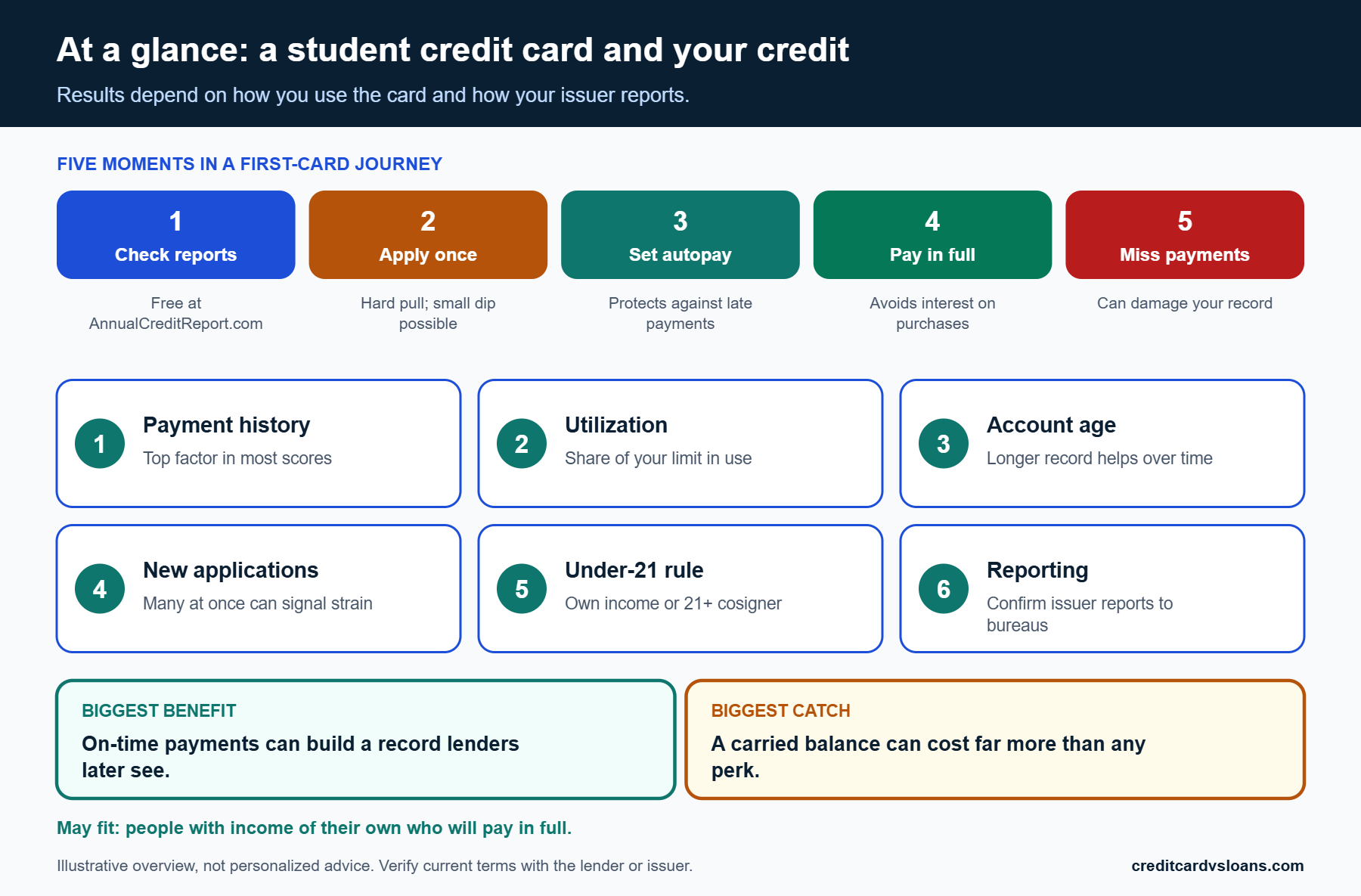
- Federal rules generally require applicants under 21 to show an independent ability to make payments, or to apply with a qualifying cosigner or joint applicant who is 21 or older.
- A student credit card helps most when you pay on time and keep balances low. Carrying a balance can cost far more than any benefit the card offers.
- Compare the APR, annual fee, other fees, and the way your issuer reports to the credit bureaus before you apply, not after.
- If you have no income of your own, a secured card, a credit-builder loan, or waiting may fit better than forcing an unsecured application.
- Do not use a card as a substitute for a school-cost plan. Compare it with other ways to cover the bill first.
Rules and rates change. The federal regulations and agency pages cited here were checked in October 2026, and the average-rate figures come from the Federal Reserve’s G.19 release dated October 7, 2026. Your issuer’s cardholder agreement is always the final word on your own terms.
Is a student credit card right for you? A quick decision guide
Who a student credit card tends to fit
Signs a starter card could make sense
A student credit card tends to fit someone who has a steady source of income, even a modest one, and a small recurring expense they can already afford in cash. Think of a part-time job, a work-study paycheck, or regular support you control, paired with a bill like a phone plan or a streaming subscription that the card can cover and that you pay off in full each month.
It also fits if you are comfortable with a simple routine: check the balance weekly, set up autopay for at least the minimum, and pay the statement balance in full before the due date. If that routine sounds realistic, a card can start a payment record that lenders later see. If it sounds like a chore you would skip, that is useful information too.
Signs you may want to wait or choose another route
If your income is irregular or close to zero, if you already struggle to cover basics, or if you would be tempted to use the card for groceries and rent because the money has run out, hold off. A card used to bridge a monthly shortfall tends to grow into a revolving balance, and the interest compounds against you.
Waiting is not failure. You can build credit later, and in the meantime you can check your reports, build a savings cushion, and look at lower-risk options such as a secured card or a credit-builder loan. Both are covered further down, and the trade-off between them and an unsecured student card is spelled out in Table 2.
What a student credit card can and cannot do for your credit
How on-time payments become a credit record
Credit scores are calculated from the information in your credit reports. According to the Consumer Financial Protection Bureau (CFPB), scoring models typically weigh whether you pay on time, how much unpaid debt you carry, how many and what types of accounts you have, how long they have been open, how much of your available credit you use, and recent applications for new credit. The CFPB also notes that most credit scores consider repayment history the number one factor.
That is why a single card used lightly and paid on time can matter for someone with a thin credit file. Each on-time month adds to the record, provided your issuer reports to the nationwide credit bureaus, which you should confirm before you apply. Not every issuer reports to all three bureaus, and reporting practices are set by the lender, not by law.
What the card will not do
A student credit card will not fix a poor budget, and it will not move your score on a schedule. The CFPB points out that you do not have one credit score; scores vary by model, data, and the date they are calculated. A change you see in one app may not match what a lender sees.
It also will not make a purchase cheaper. Putting a purchase on a card simply converts it into a loan if you do not pay in full by the due date. When someone says a card will “build your credit,” the accurate version is narrower: the way you use it can build a record, and that record is only as good as the payments behind it.
A situation-by-situation decision table
Match your situation to a sensible first step
Use Table 1 as a first pass. It is a rule of thumb, not an eligibility test, because issuers apply their own standards and your full profile matters. Read across the row that sounds most like you, then use the next sections to check the details.
| Your situation | Reasonable first step | Main thing to watch |
|---|---|---|
| Under 21, steady income of your own | Consider an unsecured starter or student credit card | Issuer must see your independent ability to pay |
| Under 21, little or no income | Ask about a cosigner or joint applicant who is 21 or older, or wait | The cosigner takes on legal responsibility |
| Thin credit file, limited cash | Compare a secured card or credit-builder loan | Deposit, fees, and whether the account is reported |
| Already carrying a balance you cannot clear | Pause new card spending; build a payoff plan first | Interest compounding on the unpaid amount |
| 21 or older with no history | Apply under the standard rules; compare starter options | Hard pulls and annual fees |
| Need to cover tuition or a large school bill | Do not default to a card; compare other funding first | Interest cost on large balances |
Questions to ask before you apply
Before you start any application, ask yourself four plain questions. Can I make at least the minimum payment from my own income every month, even in a slow month? Will this card reduce my cash stress or add to it? Have I read the APR and fees? And is there a lower-risk way to reach the same goal?
If you answer yes to the first and third and you have a clear use for the card, the next step is to see how a lender might view your application. That is covered in the sections on federal rules and issuer decisions. If you are also weighing how this fits with other school costs, see how to finance back-to-school costs for the wider set of options.
The costs and risks at a glance
What you pay if you slip
The cost of a student credit card is mostly a cost of behavior. If you pay the full statement balance by the due date, many cards charge little beyond an annual fee, if there is one. If you carry a balance, interest applies, and the Federal Reserve’s G.19 release of October 7, 2026 put the average rate on accounts assessed interest at 22.15 percent for the second quarter of 2026. That figure is a national average, not a quote, and your own rate may be higher or lower.
A late payment can add a fee, can put a mark on your record, and can in some cases raise your rate on the account. The sections on costs and rights below explain the rules the CFPB describes. The point to hold onto here is that the downside is mostly avoidable with autopay and a small balance.
The risks that are not about money
There are quieter risks too. A cosigner’s finances and relationship are on the line, a hard pull can have a small effect on some scores, and an account you stop watching can hide fraud for months. A card that is easy to use in a phone wallet is also easy to overuse.
None of these are reasons to avoid a card, only reasons to set it up on purpose. The rest of the guide turns each risk into a habit or a checklist item, so you can decide with the trade-offs in front of you rather than discovering them later.
What a student credit card actually is, and what it is not
The definition and where the label comes from
A marketing category, not a legal product type
“Student credit card” is a marketing label. There is no separate federal product called a student card with its own rate or fee schedule. Issuers use the term for starter credit cards aimed at people who are enrolled in school or who are early in their financial lives, and the cards usually come with lower credit limits and modest features. Whatever the name on the marketing page, the card is governed by the same Truth in Lending rules as any other consumer credit card, plus the extra under-21 provisions covered in the next section.
That matters because the label tells you very little about price. One issuer’s student credit card may carry no annual fee and a lower rate than another’s regular card; another may charge more than a standard card. You cannot tell from the name, so the only reliable comparison is the terms disclosed in the application, which you should read line by line.
Some issuers also require proof of enrollment, a school email address, or a minimum age, while others simply accept anyone who meets the general credit standards. Treat any such requirement as the issuer’s own rule rather than a federal one.
What issuers typically offer in this category
Starter cards of this kind commonly have a low initial credit limit, a basic rewards program or none at all, and a variable APR. A low limit is not necessarily bad news for someone building a record. The CFPB explains that low limits can reflect a short credit history, high balances elsewhere, low income, or the limit set for that specific card, and that issuers usually set the limit after you apply based on your credit report and the income you report.
For a first-time cardholder, a small limit does double duty. It caps how much you can borrow in a bad month, and it keeps you honest about what you can repay. The catch is that a low limit makes utilization, the share of your limit that you use, climb quickly: a $200 purchase on a $300 limit is already high usage. We return to that in the section on building credit month by month, and the topic has its own full guide in credit utilization and your score.
How it compares with the alternatives
Unsecured, secured, credit-builder loan and authorized user
There are several ways to start a credit record, and a student credit card is only one of them. The CFPB lists a secured credit card, a credit-builder loan, and certain retail or store cards as ways to start building credit, and it cautions that debit cards, prepaid cards, and many payday or “buy here, pay here” arrangements typically do not build a record that lenders see. Table 2 lays out how the main options differ on the points that matter most.
The Federal Trade Commission describes a secured card as one backed by a deposit you make with the issuer, often a percentage of your limit and sometimes the full amount, which the issuer can use if you miss payments. The FTC adds that secured cards generally, though not always, carry higher APRs and annual fees than unsecured cards, and that activation or monthly fees can reduce the credit you can actually use.
| Option | How it works | Upfront cash needed | Main trade-off |
|---|---|---|---|
| Student or starter credit card (unsecured) | Revolving credit line; you repay what you spend | Usually none | Interest on carried balances; under-21 income rules apply |
| Secured credit card | Deposit backs the limit; you use it like a card | Deposit, sometimes up to the full limit | Often higher fees; confirm bureau reporting |
| Credit-builder loan | Lender holds the loan amount while you make small payments, typically over several months | Monthly payments, no lump sum | You get the money at the end; interest or fees may apply |
| Debit or prepaid card | Spends your own money | Funds you load or have in the account | Generally does not build a credit record |
| Retail or store card | Credit usable at one retailer or chain | Usually none | Narrow use; rates can be high |
Where an authorized-user arrangement fits
Some families add a young adult as an authorized user on a parent’s card. That can put another person’s account history on your file if the issuer reports authorized users to the bureaus, but practices differ by issuer, so ask the issuer how it handles authorized users. Treat it as something to ask the issuer about directly rather than something to assume.
It also ties your credit to someone else’s habits. If the primary cardholder carries a high balance or pays late, that history may show up on your report too. The primary cardholder, not you, is typically the person legally responsible for the debt, so the arrangement is a trust decision as much as a credit one. If you have your own income, applying in your own name usually gives you the most control.
The federal rules for applicants under 21
What the CARD Act regulation requires
Independent ability to pay, or a qualifying cosigner
The key rule sits in Regulation Z, the federal regulation that implements the Truth in Lending Act, at 12 CFR 1026.51. For anyone under 21, a card issuer generally may not open a credit card account unless the consumer submitted a written application and the issuer has either financial information showing the consumer has an independent ability to make the required minimum periodic payments, or a signed agreement from a cosigner, guarantor, or joint applicant who is at least 21 and who accepts liability, along with financial information showing that person can make the payments.
The CFPB’s consumer page on age and credit cards frames it the same way: lenders generally cannot open a card for someone under 21, an applicant can still qualify by showing they can independently make the payments, or a person over 21 can cosign and take responsibility if the primary holder cannot pay. The page uses the word “generally,” which signals that the rule has structure and conditions, not that it is a flat ban.
Credit limit increases before you turn 21
The same regulation limits increases while you are still under 21. If the account was opened on the basis of your own independent ability to pay, an increase generally requires that you can independently make the payments at the higher limit, or that a cosigner, guarantor, or joint applicant aged 21 or older agrees in writing to assume liability for the increase. If the account was opened with a cosigner, an increase generally requires that same person to agree in writing to be responsible for it.
In practical terms, do not expect your limit to rise automatically in a way that bypasses these steps while you are under 21. If an issuer offers an increase, it may ask for updated income information or for the cosigner’s written agreement, and that is the regulation at work. After 21, the general ability-to-pay rule in the same regulation still applies, which is the next point.
The general ability-to-pay rule that applies to everyone
What issuers must consider before opening or raising a limit
Under 12 CFR 1026.51(a), a card issuer may not open a credit card account or raise a limit without considering the consumer’s ability to make the required minimum periodic payments, based on income or assets and current obligations. Issuers must maintain reasonable written policies for this review, and the review must weigh at least one measure such as debt-to-income ratio, debt-to-asset ratio, or the income left after debt payments. Reviewing no information, or issuing a card to someone with no income or assets, is not considered reasonable under the regulation.
That is why a no-income applicant often hears no, even with a spotless record, and why an issuer asks you what you earn. This protects borrowers from taking on credit they cannot service, but it also means a student with no earnings of their own has limited paths to an unsecured card in their own name.
What the rule does not tell you
The regulation sets a floor, not a formula. It does not set a minimum income, a minimum score, or a fixed list of what counts as income. Each issuer writes its own policy, so two issuers can reach different answers on the same application, and a no from one issuer does not predict a no from another.
The regulation does not list exactly which kinds of money an issuer must count for an under-21 applicant, such as scholarships, grants, or family support. That detail varies by lender and can change, so ask the issuer or read its application instructions rather than relying on a general claim from a third-party site. If you are unsure whether an arrangement meets the rule, the CFPB’s consumer pages and your state regulator are the places to ask.
How issuers decide: income, credit file, cosigners and inquiries
What goes into the decision
Income, obligations and your credit file
When you submit an application, the issuer typically looks at three things: what you say you earn, what you already owe, and what your credit reports show. For a first-time applicant the reports may be thin or empty, so the income and obligation side carries more weight. That is consistent with the ability-to-pay rule described above, which directs issuers to weigh income or assets against current obligations.
Be accurate on the application. Overstating income to improve the odds is a red flag for the issuer and can cause trouble for you later. If the amount you report is modest, that is simply the input the issuer needs to size a limit you can manage. A smaller limit that fits your income is a better foundation than a larger one you cannot sustain.
Why a thin file is not the same as bad credit
A thin credit file means there is little information to score, not that the information is negative. Many young adults start there. Some scoring models need a minimum amount of history before they can produce a score at all, and lenders may handle an unscored applicant differently than a low-scored one. The CFPB notes that the factors in scoring include how long accounts have been open and the types of credit you hold, so a brand-new file has little to measure.
Before applying, pull your reports so you know what an issuer will see. The FTC explains that you can get free credit reports from each nationwide bureau through AnnualCreditReport.com, the only site authorized to fill these orders, and that the bureaus also offer free weekly reports there. Check for accounts you do not recognize, which can signal identity theft, and dispute errors with both the bureau and the business that supplied the information.
Cosigners, joint applicants and hard pulls
What a cosigner takes on
If you apply with a cosigner, guarantor, or joint applicant who is at least 21, that person is not just vouching for you. Under the regulation, they agree to accept liability, and the CFPB describes a cosigner as someone who agrees to be responsible for the debt if the primary account holder cannot pay. That can mean a late payment or a high balance affects their credit and their finances, not only yours.
If you are asking a parent, relative, or friend, have a direct conversation first. Agree on who reviews statements, what happens if a payment is missed, and when you plan to apply on your own. Ask the issuer how a cosigner can be removed, because policies differ by issuer. The relationship can be harder to repair than a credit score.
Hard pulls, soft pulls and prequalifying
A hard pull is a credit check tied to an application, and it can appear on your report and have a small effect on some scores. A soft pull, used for prequalification and for checking your own reports, is generally not visible to lenders making decisions. Not every issuer offers a prequalify tool, and prequalification is not an approval, but when it is available it lets you see whether an application is likely to move forward without a hard pull.
The question of how much one application matters, and how spacing several of them can compound, is covered in does applying for a credit card hurt your credit score. The short version for a student: apply for one card that fits, rather than several at once. The CFPB notes that applying for many accounts in a short period can signal financial strain to scoring models.
What a student credit card costs: APR, fees and interest
APR and how interest accumulates
What APR means for a card you carry a balance on
APR, or annual percentage rate, is the yearly cost of borrowing expressed as a percentage. On a credit card, interest is charged on balances you do not pay by the due date, and the CFPB notes that cards have either fixed or adjustable rates tied to an index, so you should check which applies to yours. If you pay the full statement balance on time each month, you can often avoid interest on new purchases, though the specific rules differ by issuer and are written in the cardholder agreement.
For context, the Federal Reserve’s G.19 consumer credit release dated October 7, 2026 reported an interest rate of 20.94 percent on all credit card accounts and 22.15 percent on accounts assessed interest for the second quarter of 2026, not seasonally adjusted. These are national averages across all cardholders, not an offer for any student and not a prediction of what you would be charged. Your own rate depends on the issuer, your file, and the card.
An illustration of how repayment pace changes the cost
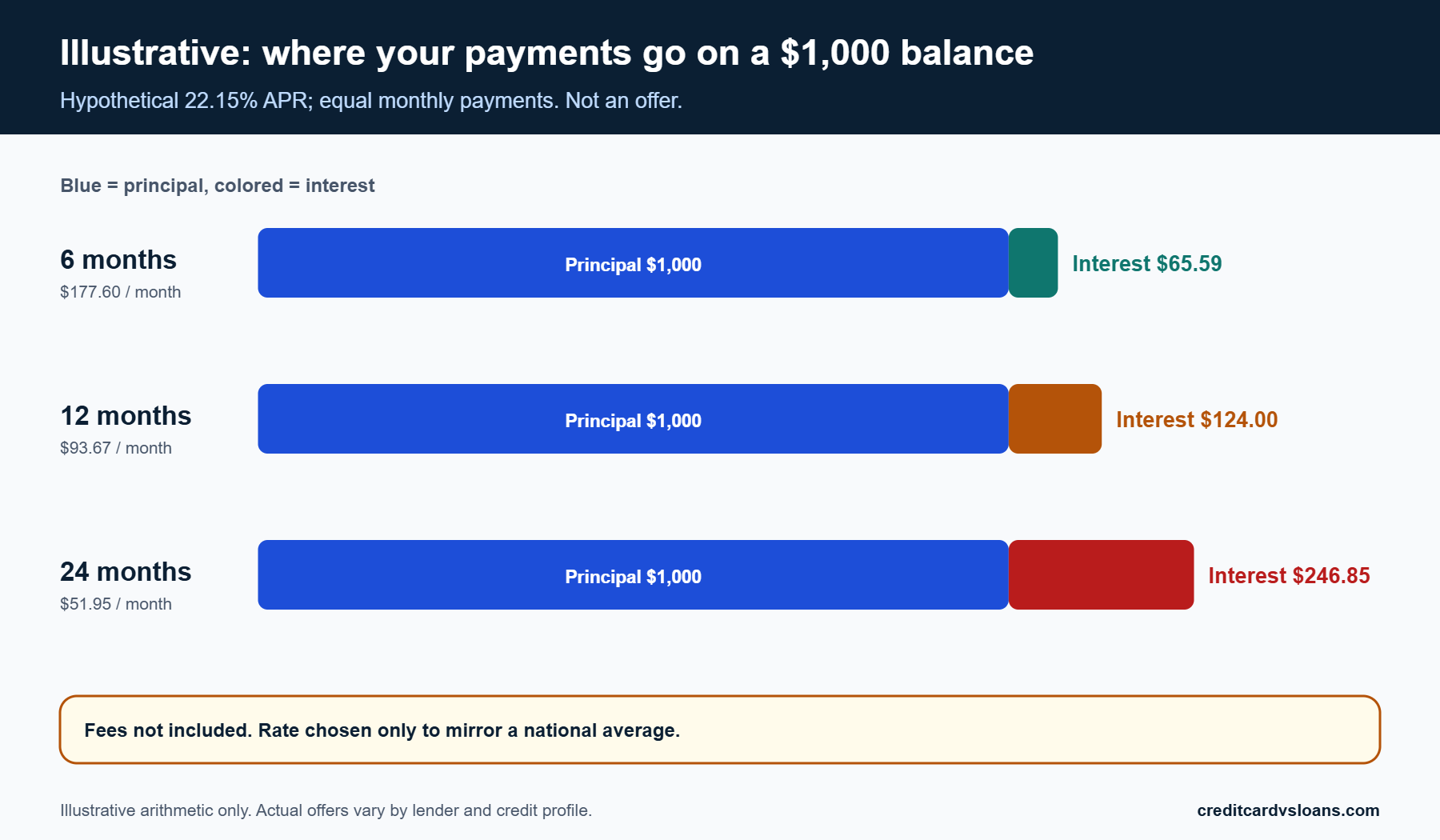
The pace at which you repay matters more than most beginners expect. The figures below are hypothetical and assume a fixed 22.15 percent APR (chosen only to mirror the G.19 average above), no new purchases, monthly compounding, and equal payments. They are not a quote.
On a $1,000 balance repaid in six equal payments, the payment is about $177.60 and the total interest is about $65.59. Over 12 months the payment is about $93.67 and the interest about $124.00. Over 24 months it is about $51.95 and the interest about $246.85. If you instead paid only $25 a month, the balance would take roughly six years to clear and cost on the order of $830 in interest. Smaller payments feel gentler month to month and cost far more in total.
Fees and rules that can change what you pay
The fee types to look for
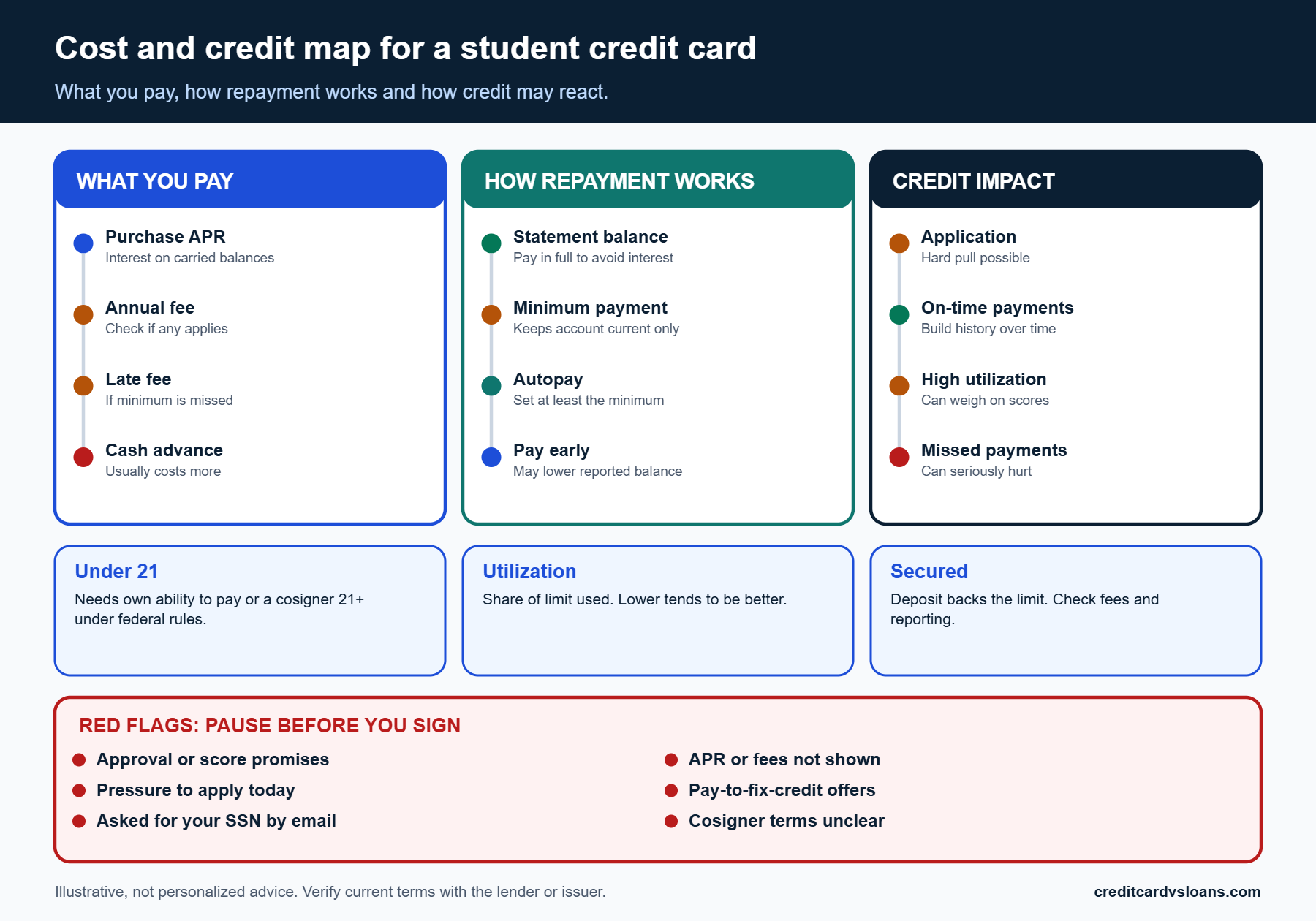
The FTC lists fees that can accompany credit cards, including annual fees, late fees, cash advance fees, and balance transfer fees. For a student card the ones most likely to matter are the annual fee, if any, the late fee if you miss a due date, and the cash advance fee if you use the card to get cash. Read the fee table in the application, called the Schumer box, and compare it across issuers apples-to-apples.
Federal rules on late fee amounts have been subject to change, so do not rely on a general figure. If a late fee amount matters for your decision, read the issuer’s cardholder agreement and check the CFPB’s credit card pages. Table 3 summarizes the cost items worth finding before you apply.
| Item | Why it matters | Where to look |
|---|---|---|
| Purchase APR (fixed or variable) | Sets the interest cost on any balance you carry | Fee and rate table in the application |
| Annual fee | A fixed yearly cost even if you never carry a balance | Fee table |
| Late payment fee | Charged if the minimum is not paid by the due date | Cardholder agreement |
| Cash advance APR and fee | Often costs more than purchases and may start accruing interest immediately | Cardholder agreement |
| Penalty APR trigger | Rate can rise if you fall far behind | Cardholder agreement |
| Credit limit | Sets your utilization math and your maximum borrowing | Approval notice |
| Bureau reporting | Determines whether on-time payments help build a record | Ask the issuer directly |
When an issuer can change your rate
The CFPB explains that, generally, an issuer cannot raise the rate on new purchases during the first year of the account. After the first year it must give 45 days’ notice, and the new rate applies to purchases made more than 14 days after that notice. Increases on an existing balance are generally restricted, with exceptions that include the expiration of a promotional rate, a variable rate that follows its index up, or a minimum payment that arrives more than 60 days late.
If your rate rose because you were more than 60 days late, the issuer must restore the earlier rate after six consecutive on-time minimum payments, according to the CFPB. After a 45-day-notice increase, the issuer generally must review the rate at least every six months. The practical lesson is simple: a missed payment can trigger a cost that lingers, so autopay for at least the minimum is worth setting up on day one.
Choosing between an unsecured card, a secured card and a credit-builder loan
When an unsecured student credit card is the better fit
You have income and want a simple, low-cost starting point
An unsecured student credit card is usually the simplest option when you can show income of your own, you have no negative marks in your reports, and you want a card without tying up a deposit. It requires no upfront cash, and if you pay the statement balance in full, the cost can be limited to an annual fee, if there is one. That makes it the lower-friction route for a disciplined user.
The trade-off is exposure. With no deposit, the limit is a line of borrowing, and every month you do not pay in full is a month of interest. If you are unsure you will stick to the plan, give yourself guardrails: choose the lowest limit offered, turn off any automatic limit increase if the issuer allows it, and keep the card out of any shopping app that stores it for one-tap checkout.
Questions that should decide it
Ask four things. Is the annual fee zero, or does the card justify it? Does the issuer report to all three nationwide bureaus? Is the APR fixed or variable, and what is it today? And is there a clear way to reach a graduation point, where a later review or a new application could lead to better terms?
If the issuer cannot answer those plainly in writing, move on. A reputable card agreement states them, and you can usually read the agreement on the issuer’s website before you apply. Compare at least two or three agreements, because the same applicant can get quite different terms depending on the lender.
When a secured card or credit-builder loan may fit better
Secured cards trade a deposit for access
A secured card can work if you have little or no credit history, or marks in your file that make unsecured approval unlikely, and you can set aside a deposit. As the FTC explains, the deposit is usually a percentage of your credit limit and sometimes up to 100 percent, the issuer uses it if you miss payments, and you typically get it back when you pay off the balance and close the account. The FTC says many issuers report your activity to the bureaus and that on-time payments and staying within your limit may help you build credit and eventually qualify for an unsecured card.
Two cautions stand out. First, secured cards have the same legal protections as other credit cards, including a cap of $50 on your losses from unauthorized use and dispute rights, per the FTC, so a secured card is a real credit card with real debt. Second, higher APRs and annual fees are common, and activation or monthly fees can reduce the credit you can use. Always confirm that the issuer reports to the bureaus, and ask how and when the deposit is returned.
Credit-builder loans are slower but structured
A credit-builder loan reverses the usual order: the lender holds the loan amount in an account while you make small payments, commonly over six to 24 months according to the CFPB, and you receive the money at the end. For someone who is concerned about overspending on a card, that structure has appeal because there is nothing to overspend. You build a payment record on an installment account instead of a revolving one.
The catch is that you must make every payment, interest or fees may apply, and you do not have the funds to use in the meantime. Compare the total cost and ask whether the lender reports to the bureaus. If your main goal is a credit record rather than spending flexibility, this can be a reasonable fit, and a local credit union or bank is a place to ask. A nonprofit credit counselor can also help you compare options without a sales incentive.
Using a student credit card without overspending
Set a rule for what the card is for
Give the card one narrow job
The easiest way to avoid overspending is to give the card a single job. Put one predictable bill on it, such as a phone plan or a transit pass, and treat it as a payment tool rather than a pool of extra money. Set the card to pay the statement balance in full from your checking account on the due date, and keep a buffer in that account so the payment never bounces.
This approach also keeps your utilization low, which is the share of your limit that you use. The CFPB suggests that experts commonly recommend using no more than about 30 percent of your available credit, and notes you do not need to carry a balance to build credit; paying in full each month typically yields the best scores while minimizing interest. On a $500 limit, 30 percent is $150. A single $150 bill fits, but a month of dining out and a textbook might not.
What to keep off the card
Keep rent, groceries when your budget is already tight, and emergency expenses off the card unless you could pay them off within the billing cycle. Those are the categories where a cash crunch tempts students to roll a balance, and interest on a revolving balance compounds the problem.
Also avoid cash advances. Table 3 flagged them because they typically cost more than purchases, and the CFPB’s credit card pages note that issuers set separate terms for them in the agreement. If you need cash urgently, a conversation with your school’s financial aid office or a nonprofit counselor is usually a cheaper first call than a card advance.
Build habits that make mistakes unlikely
Autopay, alerts and a weekly look at the balance
Set autopay for at least the minimum so a missed date does not trigger fees or credit damage, then add a calendar reminder to pay the full statement balance a few days before the due date. Turn on balance and transaction alerts in the issuer’s app. A weekly two-minute check of the balance is more reliable than hoping you remember what you spent.
The CFPB makes a point that is easy to miss: once a card company starts charging interest, it generally keeps charging until it receives your payment, and the rules for when interest starts vary by company, so your cardholder agreement is where to check. That is why paying the full statement balance, not just the minimum, is the habit that matters most.
A monthly budget check that fits on one page
Once a month, write down three numbers: what came in, what the card charged, and what you paid. If the card charges are more than you could have paid in cash that month, you are using the card as a loan, and it is time to cut back. If you carried a balance, note the interest charge on your statement so the cost is visible rather than abstract.
If the balance is growing, stop adding new charges and contact the issuer early. Do not wait until you are behind. Nonprofit credit counselors can help you build a payoff plan, and the CFPB suggests asking your bank, credit union, or a nonprofit credit counseling agency about credit-building options and cautions against products that do not help your record.
Building credit month by month with a student credit card
What to expect in the first year
A realistic timeline, without promises
Credit building is gradual, and no one can tell you when a particular score will appear or what it will be. What you can do is understand the sequence. After an account opens, the issuer begins reporting to the bureaus on its own schedule, usually monthly. A first scored file may take some months to form, and models differ on how much history they need. Table 4 sketches the general order of events, with the caveat that every step depends on the issuer and the scoring model.
| Stage | What usually happens | What you do |
|---|---|---|
| Before applying | Issuer may offer prequalification with a soft pull | Check your reports; read the agreement |
| Application | Hard pull recorded; decision and limit set | Apply once, with accurate income |
| Month 1 | Account opens; first statement arrives | Set autopay and alerts |
| Months 2 to 6 | Payment history begins to appear on reports | Pay the full statement balance each month |
| Months 6 to 12 | Longer record forms; issuer may review the account | Keep usage low; check reports |
| After 12 months | You may consider a limit review or a different card | Compare terms before changing anything |
What helps and what hurts along the way
The helpful moves are the boring ones: pay on time, pay in full when you can, keep your balance low relative to your limit, and let the account age. The CFPB lists length of credit history as a meaningful factor, which is one reason not to open and close accounts rapidly.
The moves that hurt are just as plain: paying late, carrying a high share of your limit, applying for several accounts at once, and closing your oldest account without thinking about the effect on your history. A single missed payment can outweigh months of good behavior, so automate the minimum.
Utilization, limits and reading your reports
How balance relative to limit shows up
Utilization is the share of your revolving credit that you are using. A $150 balance on a $500 limit is 30 percent; $450 on the same limit is 90 percent. The CFPB’s guidance is to keep balances low relative to total limits and notes that experts suggest staying under roughly 30 percent. Lower tends to be better for scoring, though the exact effect depends on the model and your file.
One quirk catches students: issuers typically report the balance as of the statement date, not the due date. If you charge $300 on a $500 limit and pay it in full after the statement closes, the report may still show 60 percent. Paying early, before the statement closes, is a way to show a lower figure. The mechanics are explained in more depth in our guide to credit utilization.
Check your reports at least once or twice a year
Pull your reports from AnnualCreditReport.com, the official source named by the FTC, and read them for accuracy. Look for accounts you do not recognize, wrong balances, and payments marked late that you made on time. The FTC explains that if you find errors you should contact both the credit bureau and the business that supplied the wrong information, and that errors can also signal identity theft, which can be reported at IdentityTheft.gov.
Be wary of other sites that advertise free reports, scores, or monitoring; the FTC warns that only AnnualCreditReport.com is the official source, and that neither it nor the bureaus will email or call asking for your Social Security number or account information. A score you see in a banking app is useful as a trend, but it may not match what a lender uses.
Paying for school costs: when a card helps and when it does not
Cards versus other ways to cover back-to-school bills
Why a student card is a poor tool for large bills
A student credit card usually comes with a low limit and a variable APR that, on average across cardholders, runs above 20 percent according to the Federal Reserve’s G.19 release of October 7, 2026. That combination makes it a poor match for tuition, housing deposits, or a large equipment purchase. A large balance means a high utilization rate and a heavy interest cost, and a low limit may not cover the bill anyway.
The better question is not whether you can put the bill on a card, but what the lowest-cost, most predictable way to pay is. Options include school payment plans, scholarship or grant money, federal student aid, and savings. Our guides on how to finance back-to-school costs and the best way to pay for back-to-school costs compare those paths directly, and we avoid repeating them here.
Where a card still has a role
A card can make sense for small, predictable purchases that you can clear within one billing cycle, such as books or supplies when the payment is already in your budget. It can also add purchase protections: the FTC notes that credit cards come with strong dispute rights and a cap of $50 on liability for unauthorized use, which debit cards do not match in the same way.
Use the card for what you can repay quickly and keep the larger costs on the lower-rate path. If a school bill is the main reason you want a card, pause and read the comparison between revolving and fixed-payment borrowing in credit card versus personal loan: which is better for borrowing. That article explains how installment loans differ from revolving credit so you can match the tool to the need.
A side-by-side look at paying a school bill
Comparing cost certainty across payment routes
Cost certainty is the central difference. A card’s cost depends on how fast you repay, while a fixed-payment arrangement spells out the payments in advance. Table 5 compares common routes. It does not rank them, because the right one depends on the amount, your income, and what each option offers you.
| Route | How cost works | Best used for | Main risk |
|---|---|---|---|
| Student credit card | Interest on balances carried past the due date | Small bills you will clear quickly | High utilization and compounding interest |
| School payment plan | Terms set by the school; ask about fees | Spreading a known charge across the term | Missed installments can carry penalties |
| Savings or cash | No borrowing cost | Anything you can cover without hurting your cushion | Draining an emergency fund |
| Fixed-payment loan | Set payment and term; rate depends on your file | Larger amounts you want on a clear schedule | Origination fees and long commitments |
| Scholarships or grants | Not repaid | Eligible tuition or program costs | Deadlines and eligibility rules |
A hypothetical example
Take a hypothetical student who needs $600 for books and supplies. Using the same illustrative 22.15 percent APR, repaying in three equal monthly payments costs about $207.43 a month and about $22.29 in total interest. Spreading it over 12 months lowers the payment to about $56.20 but raises the total interest to about $74.40. Both are small next to a tuition bill, which is why small purchases are where a card is least risky.
Now imagine the same student put a $1,200 school expense on the card and paid $50 a month. At that illustrative rate, it would take well over two years to clear, and the interest would add several hundred dollars. These are hypothetical numbers, not offers, but they show why size and speed matter more than the label on the card.
Common mistakes, red flags and offers to avoid
Mistakes that quietly raise your cost
Paying only the minimum and letting the balance roll
The minimum payment is designed to keep your account in good standing, not to clear the debt quickly. Paying only the minimum can stretch repayment out for years, and the illustration earlier showed how a $25 monthly payment on a $1,000 balance at a 22.15 percent illustrative APR can take roughly six years and cost on the order of $830 in interest. That is almost the same as the original balance.
If you cannot pay in full, pay as much as you reasonably can above the minimum and stop adding new charges until the balance is gone. If you are already behind, call the issuer before the next due date rather than after. Some issuers offer hardship options, but they vary, so ask what is available.
Treating a new, higher limit as extra money
A limit increase raises what you can borrow, not what you can afford. It can lower your utilization on paper, but if your spending rises to match, the benefit disappears. For under-21 accounts, the regulation described earlier adds conditions to increases, so an offer you receive may still require income verification or a cosigner’s written agreement.
Keep your spending anchored to your income, not the limit. A useful rule of thumb is to treat the limit as the issuer’s ceiling and your budget as your own lower ceiling, and let the second one decide how much you charge.
Red flags in offers, from lenders and from third parties
Campus tables, giveaways and pressure to apply on the spot
Be skeptical of any pitch that pushes you to apply immediately, promises a gift for signing up, or avoids showing the APR and fees. A legitimate offer comes with the rate and fee table and lets you take time to read it. Rules on card marketing on campuses can vary, so do not assume a particular protection applies; check the CFPB’s credit card pages or your school’s student affairs office if you want to know the rules for your campus.
If a pitch says approval is certain or implies your credit will improve by a set amount, treat it as a red flag. No lender or service can promise a score change, and the FTC repeatedly warns consumers about services that promise to fix credit.
Credit repair promises and “free” report traps
The FTC advises using AnnualCreditReport.com for free credit reports and warns that other sites advertising free reports, scores, or monitoring may not be the official source. Anyone who contacts you by email, phone, or text asking for your Social Security number or account information claiming to be from a bureau is not following the process the FTC describes.
You can dispute errors yourself with the bureau and the furnisher at no cost, so there is rarely a reason to pay someone to do it. If you want help, a nonprofit credit counseling agency is a more reliable starting point than a company that charges upfront for results. When in doubt, step away and verify through the official agency page.
Your rights and protections as a cardholder
Protections that come with a credit card
Unauthorized charges and disputes
Credit cards carry federal protections that many young cardholders do not know about. The FTC notes that credit cards, including secured ones, limit your loss for unauthorized use to $50 and give you dispute rights for billing errors. The CFPB’s credit card pages also include guidance on disputing a charge and on what to do when a card is lost or stolen.
If you spot a charge you do not recognize, report it to the issuer promptly, in writing if possible, and keep a record of what you said and when. Do not wait for the next statement. Quick action gives you the clearest path to a correction and reduces the chance of an issue spreading to other accounts.
Your agreement and your right to understand it
The cardholder agreement is the contract that spells out your rate, fees, and the way interest is calculated, and the CFPB says you can find it on the issuer’s website, through the CFPB’s agreements page, or by requesting a copy from the company. Read it at least once. Note the due date rule, the grace period language if any, the late fee, and the penalty APR trigger.
The CFPB also explains that a rate on existing balances generally cannot increase unless specific conditions apply, such as a promotional period ending, a variable index moving, or a payment arriving more than 60 days late. Knowing these rules helps you tell a legitimate change from an error you should contest.
Asking for help early
Who to contact if you are struggling
If the balance is growing faster than you can pay it, contact the issuer first and ask what options exist. Then consider a nonprofit credit counseling agency; the CFPB recommends asking your bank, credit union, or a nonprofit credit counseling agency about building or repairing credit. Your school’s financial aid or student services office can also point you to emergency funds or counseling resources.
Avoid payday loans and similar quick-cash products as a fix. The CFPB notes that payday loans generally do not help because on-time payments are not reported to the nationwide bureaus, while the costs can be high. A small, early conversation almost always beats a large, late one.
Where to take a complaint
If an issuer handles your account unfairly or does not resolve a dispute, you can submit a complaint to the CFPB, and your state attorney general or banking regulator may also help. Response times vary, so treat the process as a way to be heard rather than a guaranteed outcome.
Keep copies of your statements, correspondence, and notes of any calls. A clear paper trail makes every next step easier, whether that is a dispute, a complaint, or a request for a better rate.
Moving on: graduating, upgrading or closing a student card
When to keep, upgrade or switch
The case for keeping your first account open
Your oldest account supports your credit history length, which the CFPB lists among the factors that scoring models consider. If your student card has no annual fee and you use it lightly, keeping it open usually costs nothing and preserves that history. A small recurring charge paid by autopay can keep the account active so the issuer does not close it for inactivity.
The CFPB provides a how-to for closing an account if you decide to. Before you close, check whether the card carries a fee, whether closing would raise your overall utilization, and whether it is your longest-standing account. Those three answers usually settle the question.
When a different card may make more sense
After a year or more of on-time payments, you may qualify for terms that better fit your life, such as a card with no annual fee and a lower APR, or one with features you will actually use. Many issuers review accounts and offer product changes or limit increases after a period of good behavior, though that varies and is never guaranteed.
If you consider a new card, apply for one that fits and compare terms first, since each application is a hard pull. The question of whether an application hurts is addressed in our guide to credit card applications and your score. Ask the current issuer about a product change first, which can avoid a new inquiry.
Setting up your next stage
Moving from student status to a standard card
As you finish school and your income grows, the focus shifts from starting a record to managing a broader financial picture. That might include a higher limit, a card you use for more categories, or an eventual installment loan such as an auto loan. Each stage has its own tradeoffs, and a framework for choosing between revolving and fixed-payment credit is in credit card vs. personal loan.
Keep paying in full, keep utilization low, and keep checking your reports. Those three habits carry from your first card into every later credit decision.
Updating your income and information
When your income changes, tell the issuer or update your profile. Accurate information helps the issuer size your limit appropriately, and for accounts that were opened with a cosigner, you can ask about the steps to apply on your own once you qualify. The process for removing a cosigner varies by issuer, so contact the issuer to learn what applies.
Finally, keep an eye on your contact information so you receive statements and notices of changes. The CFPB explains that issuers must give notice before certain rate increases, and missing that notice can cost you the chance to respond.
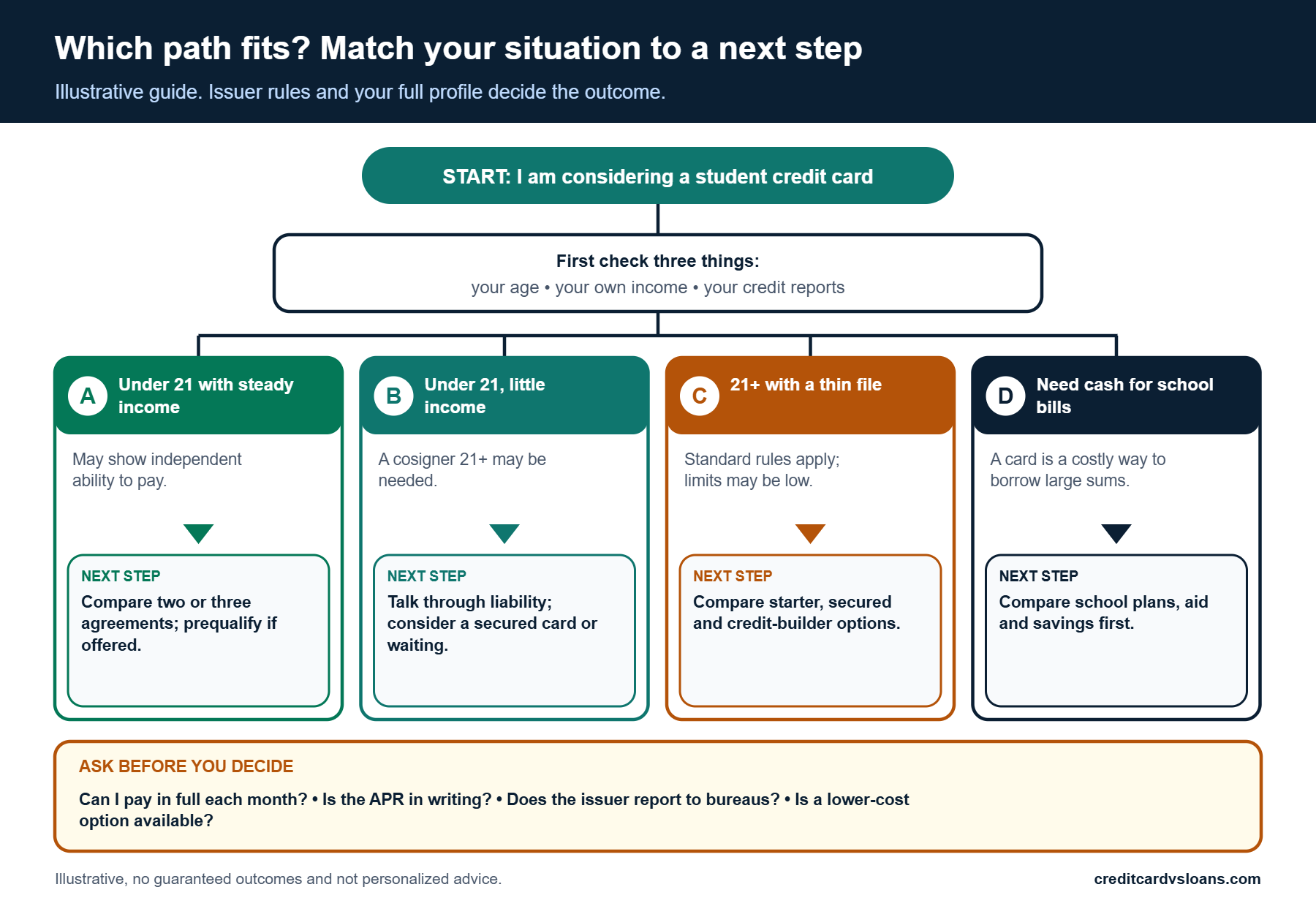
Your student credit card decision checklist and next steps
The decision, in plain terms
When a student credit card is a reasonable yes
A student credit card is a reasonable yes when you are old enough to meet the federal rules for your age, you can show income that covers the minimum payment, you have read the APR and fees, and you plan to pay the statement balance in full each month. If you are under 21, that means either an independent ability to pay that the issuer can verify, or a cosigner, guarantor, or joint applicant who is at least 21 and willing to take on the liability.
It is also a reasonable yes when the card has a narrow job, such as one recurring bill, and you have autopay and alerts set up before the first purchase. In that case the card is a tool for building a payment record, not a source of cash. Even then, the outcome is not guaranteed: an issuer can decline an application, set a lower limit than you hoped, or report in ways that differ from what you expected.
You have predictable income, a small bill the card will cover, a habit of paying in full, and an issuer whose agreement you have read and understood. The rest of this checklist helps you confirm each piece.
When the better answer is not yet, or a different product
The better answer is not yet if you have no income of your own and no cosigner you trust, if you are already carrying a balance you cannot clear, or if you want the card mainly to pay for something you cannot afford. In those cases a secured card, a credit-builder loan, or waiting while you build income may serve you better.
It is also not yet if you cannot yet say how you would pay the statement in a month when your income dips. Build a small cushion first, even a modest one, so a single surprise does not turn into revolving debt. There is no deadline on starting a credit record, and the cost of starting too early can be higher than the cost of starting a few months later.
If you are looking at a card because you are short on cash this month and the plan is to pay it back later, the card is functioning as a loan. Compare the cost with other options and talk to a nonprofit credit counselor before you apply.
The checklist before you apply
Confirm your eligibility and your file
Work through these steps in order. They take less than an hour and can save you from a hard pull you did not need.
- Write down your own monthly income and the payments you already owe, so you can describe an independent ability to pay if you are under 21.
- If you plan to use a cosigner or joint applicant, confirm they are at least 21, understand they take on liability, and agree in writing on how statements will be shared.
- Pull your reports from AnnualCreditReport.com, the source the FTC identifies as the official one, and look for errors or accounts you do not recognize.
- Dispute any errors with both the credit bureau and the business that supplied the information.
- Check whether the issuer offers prequalification with a soft pull, and use it if available.
- Apply for one card at a time, and give each decision time before trying another.
If a step turns up a problem, such as an error or an unfamiliar account, resolve it first. An application made while your file has an unresolved error can result in a denial or worse terms than you would otherwise get.
Read the terms line by line
Read the fee table and the cardholder agreement before you accept the offer, and keep a copy. Use this list as a guide.
- Is the purchase APR fixed or variable, and what is it today?
- Is there an annual fee, and what are the late fee, cash advance fee, and any foreign transaction fee?
- Does the issuer report to all three nationwide bureaus?
- When does interest start on purchases, and how does the issuer describe the grace period, if any?
- What triggers a penalty APR?
- If the card is secured, how much is the deposit, how is it returned, and are there activation or monthly fees?
- If there is a cosigner, how can they be removed later?
Compare at least two agreements apples-to-apples. If the issuer will not answer a question in writing, treat that as a reason to keep looking.
The checklist after you have the card
The first week
Set up the account the way you intend to use it. Turn on autopay for at least the minimum and, if you can, for the full statement balance from an account that always holds a buffer. Turn on alerts for transactions and for upcoming due dates.
- Save the issuer’s customer service number and know how to report a lost or stolen card.
- Choose the one recurring bill that the card will cover and add it.
- Set your personal spending ceiling at a number below the limit, such as the 30 percent the CFPB notes experts commonly suggest, as a rule of thumb for utilization.
- Decide who sees the statements and when you will review them.
- Keep the agreement and your setup notes in a folder you can find later.
Treat the card as a payment tool from day one. The habits you set in the first week tend to persist, and it is easier to start with a plan than to retrofit one after a bad month.
Every month
A short monthly routine does most of the work of protecting your credit and your budget.
- Check the statement for charges you do not recognize and report them promptly.
- Pay the full statement balance by the due date, and pay before the statement closes if you want a lower reported balance.
- Note any interest charged, and if there is some, stop new spending until the balance is cleared.
- Confirm that the payment posted and that your due date has not changed.
- Keep the usage at or below your personal ceiling, adjusting if your income changes.
Twice a year, pull your credit reports and read them end to end. If something looks wrong, start the dispute process right away.
Next steps and a short list of questions people ask
Your next three moves
First, decide which row of Table 1 sounds like you, and confirm whether you meet the federal under-21 requirement or are 21 or older. Second, pull your free reports and write down your income and obligations. Third, compare two or three agreements, and prequalify if the issuer offers it, before submitting a single application.
If you are still choosing how to pay for school costs, return to how to finance back-to-school costs and the comparison of back-to-school payment options first. If the card is not the right tool this time, you have lost nothing by waiting, and you can come back to this checklist whenever your situation changes.
A student credit card can help you build a payment record if you can qualify under the federal rules, you pay on time, and you keep balances small. It becomes costly the moment you carry a balance at a double-digit APR. If you cannot meet those conditions yet, a secured card, a credit-builder loan, or a short wait is a fair choice, not a setback.
Questions not answered above
Will a student credit card show up on my report right away? Not always. The issuer reports on its own schedule, and the CFPB notes that you have many scores, not one. Expect it to take time for activity to appear and to affect any score, and do not assume a particular result.
Can a parent open a card in my name? The rules for under-21 accounts require a written application and either your independent ability to pay or a qualifying cosigner, guarantor, or joint applicant who is 21 or older. Someone else cannot simply open an account in your name without you; if you are unsure about an arrangement, check with the issuer and the CFPB.
Is it better to pay the minimum so I can keep the money? Generally no. Paying the minimum leaves a balance that accrues interest, and the illustration earlier showed how slowly a small payment can clear a balance. Pay the full statement balance when you can.
For anything specific to your state or your account, your issuer’s agreement, the CFPB at consumerfinance.gov, the FTC at consumer.ftc.gov, and your state regulator are the places to confirm details. This guide is general information, not legal or financial advice for your situation.
Special situations worth a closer look
If a parent or relative is your cosigner
A family cosigner can be the difference between an approval and a denial for a young applicant with little income, but it changes the relationship. Under the regulation, the cosigner accepts liability, which means the issuer can look to them if the account is not paid. Their credit file and their finances are exposed to your habits, and that deserves a frank conversation before you sign anything.
Agree on the basics up front: which expenses the card will cover, who can see the statements, what happens if a payment is missed, and when you will try to qualify on your own. Put the plan in writing for your own reference. Ask the issuer how, if at all, a cosigner can be released later, since policies differ by issuer. If either of you is uneasy, a secured card or a credit-builder loan removes the need for a cosigner entirely.
If you are 21 or older with no credit history
Once you are 21, the under-21 provisions no longer apply to a new application, but the general ability-to-pay rule still does. The issuer must consider your income or assets and obligations, so having no earnings can still lead to a denial or a very small limit, as the CFPB explains for low limits generally.
Being older does not guarantee approval, and a file with no history is still a thin file. The same sequence applies: check your reports, compare agreements, prequalify if offered, apply for one card, and keep usage low. Many people at this stage also consider a secured card or a credit-builder loan to build a record in parallel. The same cautions about fees, bureau reporting, and total cost apply, so read each agreement before you commit.
Whatever your starting point, build the record slowly and keep the account in good standing. A track record of on-time payments takes time to form, and the habits that create it are the same ones that keep the card affordable.
- Credit Utilization: How Card Balances Affect Your Credit Score
- Does Applying for a Credit Card Hurt Your Credit Score?
- Best Way to Pay for Back-to-School Costs: Compare Borrowing Options Before You Commit
- How to Finance Back-to-School Costs: Credit Cards, Loans and Lower-Cost Options
- Credit Card vs. Personal Loan: Which Is Better for Borrowing?
- eCFR: 12 CFR 1026.51 – Ability to pay (including consumers under 21) (Ability-to-pay rule and under-21 provisions)
- CFPB: Can a card issuer consider my age when deciding whether to issue a credit card to me?
- CFPB: When can my credit card company increase my interest rate?
- CFPB: Why did I get a low credit limit on a credit card?
- CFPB: What are some ways to start or rebuild a good credit history?
- CFPB: How do I get and keep a good credit score?
- CFPB: What is a credit score?
- CFPB: I paid off my entire bill and still got charged interest. How can that be?
- FTC: Comparing Credit, Charge, Secured Credit, Debit, or Prepaid Cards
- FTC: Free Credit Reports
- Federal Reserve: Consumer Credit – G.19 (release of October 7, 2026) (Credit card interest rates, Q2 2026)
Last updated: October 22, 2026. Rates, fees and lender rules change; verify current terms before acting.
The information on creditcardvsloans.com is provided for general educational and informational purposes only. It is not financial, legal, tax, credit, accounting or investment advice, and reading it does not create an advisor-client, fiduciary or any other professional relationship. Nothing here is an offer, solicitation or recommendation to borrow, lend or apply for any product.
Credit scores, interest rates, fees, eligibility rules, lender policies and laws change frequently and vary by lender, location and individual circumstances. Examples, figures and scenarios are illustrative only, do not predict your results and do not guarantee approval, savings, a particular rate or a credit-score outcome. Always confirm current terms directly with the lender or issuer and read the full agreement before you apply or sign.
Although we aim for accuracy and use reputable sources, we make no representations or warranties, express or implied, about the completeness, accuracy, reliability or timeliness of the content. Content may be drafted with the assistance of automated tools, so errors or omissions may still occur. Links to third-party sites are provided for convenience; we don’t control and aren’t responsible for their content.
To the fullest extent permitted by law, creditcardvsloans.com and its owners, editors, authors, contributors and affiliates disclaim all liability for any loss, damage or expense arising directly or indirectly from your use of, or reliance on, this content. Before making financial decisions, consult a licensed professional, such as a qualified financial advisor, attorney, tax professional or nonprofit credit counselor, who can consider your complete situation.