The loan agreement red flags that matter most are an upfront fee demanded before you receive any money, an approval promised before anyone has looked at your application, an APR that isn’t given to you in writing, and blank spaces or pressure to sign right now. Any one of them is a reason to stop and ask questions. Two or more together are a reason to walk away.
Most people read a personal loan agreement the way they read a software license: they scroll to the signature line. That habit is understandable, because the document is long and the money feels urgent. But the agreement is the only place where the real price, the repayment schedule, and your obligations if something goes wrong are written down in a form you can enforce.
This guide is for the moment between “I got an offer” and “I signed.” It covers what to check line by line, which fees and add-ons quietly raise the cost, which clauses shift risk onto you, and how to tell a hard-but-legitimate lender from a scam. It uses illustrative math (clearly labeled) and primary-source guidance from the Federal Trade Commission (FTC) and the Consumer Financial Protection Bureau (CFPB). It is general education, not legal advice, and it can’t judge a specific contract you’re holding. For that, a nonprofit credit counselor, a legal aid office, or your state regulator is the right next call.
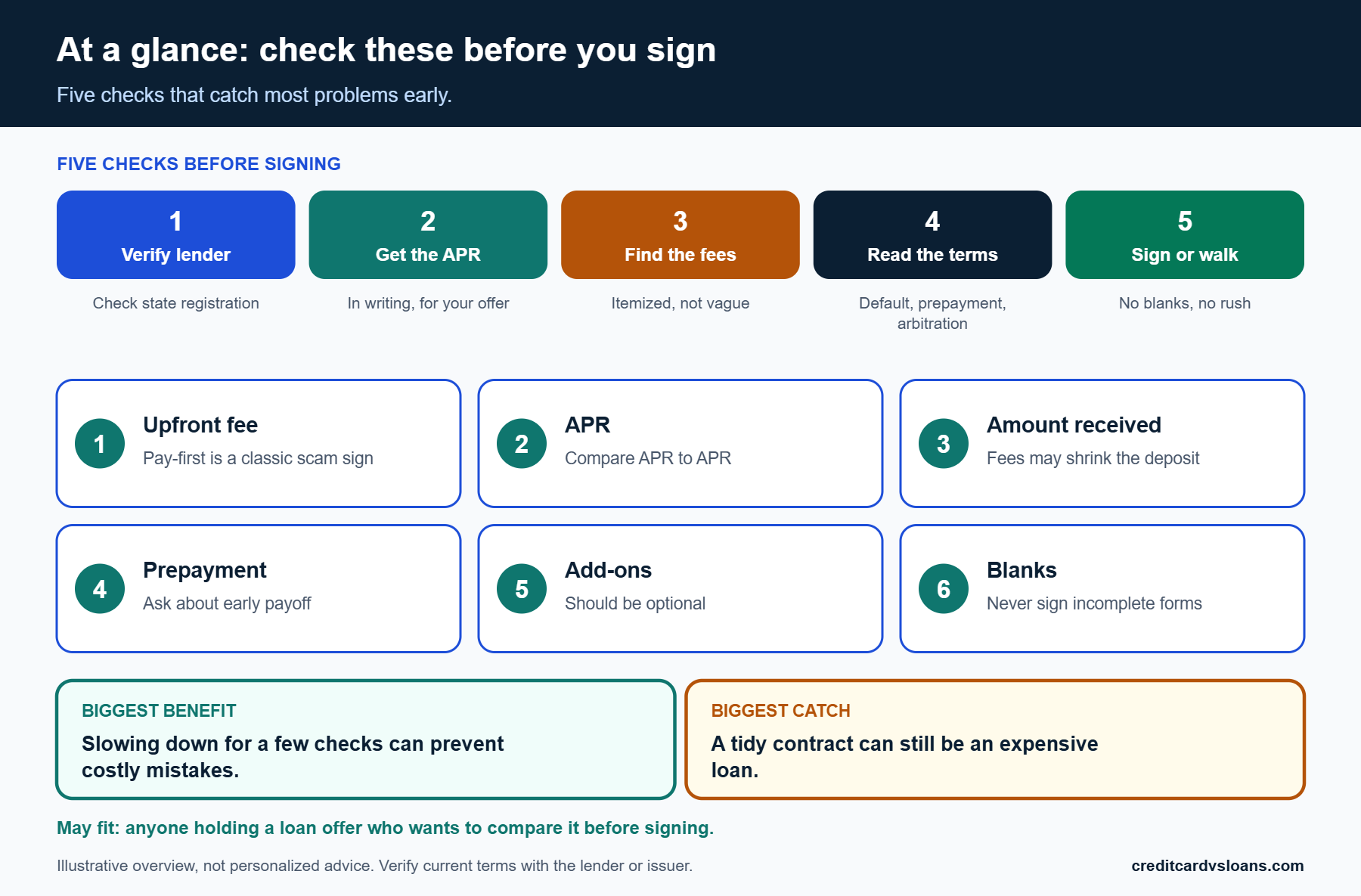
- Pay-first is the clearest warning. The FTC says legitimate lenders may charge an application or appraisal fee, but nobody legitimate promises a loan in exchange for a fee.
- Compare APR to APR, not interest rate to interest rate. The APR is meant to reflect fees as well as interest, so it is the apples-to-apples figure.
- Fees deducted from your proceeds mean you repay more than you receive. The illustration below shows how a hypothetical 6% origination fee moves a 12% rate to roughly a 16% effective cost.
- Blank spaces, “sign today” pressure, and requests to misstate income are red flags in their own right, whatever the rate looks like.
- If you already paid or signed, act quickly: document everything, report scams to the FTC, and use the CFPB and your state regulator for lender problems.
The sourcing below comes from FTC and CFPB consumer-education pages and a CFPB enforcement notice reviewed in preparation for this article. Rates, fee norms, and laws change and vary by state, so treat every number here as an illustration and every legal point as a starting place, not a final answer.
The short answer: which loan agreement red flags matter most
Red flags that should stop you immediately
Money requested before you are funded
The FTC describes advance-fee loan scams this way: a scammer promises a loan or access to credit no matter your history, asks for an upfront fee labeled something like processing, insurance, or application, and then disappears. There is no loan and no lender. The agency’s guidance also notes that legitimate lenders may charge an application or appraisal fee, but they don’t promise a loan in exchange for paying one.
The practical test is timing and direction. A fee that is disclosed up front and taken out of loan proceeds after approval is a pricing question you can compare across lenders. A fee you must send separately, by wire, gift card, or crypto, before any money arrives, is the pattern the FTC warns about.
Approval promised before any real review
Real underwriting takes a look at your credit report and verifies your information first. The FTC lists “approved” before any application review, and ads promising credit regardless of history, among the signs of an advance-fee scheme. A prequalification that uses a soft pull (an inquiry that doesn’t affect your score) and is clearly labeled as an estimate is different. It isn’t a promise.
If you are told you’re approved and then asked to pay to release the funds, treat that sequence as a red flag even if the website looks polished. Polish is cheap. Our guide to predatory lending signs goes further on how these offers are packaged and what to compare them against.
Red flags that call for a pause and a question
Numbers that do not match across documents
Look at the loan amount, the rate, the APR, the monthly payment, and the number of payments in every document you receive: the advertisement, the prequalification screen, the offer, and the final agreement. They should reconcile. If the final payment is higher than the quoted one or the term is longer, ask why in writing before you sign.
Mismatches aren’t always bad faith. Fees get added, rates reprice after verification, and terms change. But a lender that can’t explain the difference in plain language has told you something about how it will handle a billing dispute later.
Blank spaces, rush tactics, and income that is not yours
Never sign a document with blanks that someone else can fill in after you leave. Ask for the complete document, and for time to read it. A lender that says the offer vanishes in an hour is selling urgency, not a loan.
The same goes for any suggestion that you round up your income or leave out a debt. The FTC’s advance-fee guidance and common sense agree here: a loan built on a misstatement is a loan you can’t afford, and the misstatement can become your problem, not the lender’s.
How to read a personal loan agreement line by line
Start with the cost disclosures
APR versus interest rate
The CFPB’s Ask CFPB page on APR explains that the annual percentage rate is a broader measure of borrowing cost than the interest rate because it reflects fees and other charges you pay to get the loan, while the interest rate is just the yearly cost of the money. That page is written about mortgages, and it warns that the APR has limits, but the core idea carries over when you compare two personal loans: the APR is usually higher than the rate because it brings fees into the picture.
So the first number to find is the APR, in writing. If you only see “rates as low as” in marketing copy, ask for the APR on your specific offer. Compare it with the APR on every other offer, and don’t rank loans by the rate alone.
Total you will pay back
Look for the total of payments and the amount you actually receive. The gap between them is the real price of the loan: interest plus any fees. If the agreement shows a $10,000 loan but your bank deposit will be $9,400, the missing $600 is a fee that you still repay with interest.
Federal Truth in Lending rules generally require lenders to give consumers cost disclosures like these for consumer loans, though the exact form depends on the product. Whatever the legal wrapper, your job is simple: find the numbers, do the subtraction, and make sure the agreement and the offer agree.
Then check the terms that change what happens later
Payment schedule, due dates, and autopay
Confirm the number of payments, the amount, the first due date, and how the payment is collected. Autopay discounts, if offered, should be spelled out, along with what happens if an autopay attempt fails. Some borrowers prefer to pay manually to keep control of their cash flow, so ask whether a discount, if any, is tied to autopay.
Check also whether the payment amount can change. A fixed payment on a fixed term is easier to budget. Anything described as variable, a balloon, or an introductory payment deserves a plain-language explanation of the worst case.
Early payoff and prepayment terms
A prepayment penalty is a fee some lenders charge when you pay a loan off early. The CFPB explains it for mortgages as a fee that applies when you pay off all or part of the balance early, and advises reading the fine print to learn when it applies. For personal loans the rules and market practice vary, and the CFPB page we reviewed doesn’t speak to them, so ask the lender directly: “Is there any fee or reduced benefit if I pay off early?” and get the answer in the agreement.
One carve-out is documented: for active-duty servicemembers and covered dependents, the Military Lending Act bars prepayment penalties on covered loans. The rest of us have to read the contract.
| What to find | What a good answer looks like | What should make you pause |
|---|---|---|
| APR | Stated in writing for your specific offer | Only “rates as low as” or a rate with no APR |
| Amount you receive | Clearly shown, with any deducted fee itemized | Deposit differs from the loan amount with no explanation |
| Total of payments | One figure that you can reconcile | Different totals in different documents |
| Term and payment | Fixed number of equal payments | Variable or balloon payments left unexplained |
| Origination or other fees | Stated as a percentage or dollar amount | A separate fee demanded before funding |
| Late fees | Amount and grace period listed | Vague wording such as “applicable charges” |
| Prepayment terms | Plainly stated, ideally no penalty | Penalty or lost benefit with no explanation |
| Add-on products | Optional and priced separately | Pre-checked or bundled without your agreement |
| Blank spaces | None | Any blank on a document you sign |
| Lender identity | Name, address, and state registration you can verify | No verifiable address or registration |
Fees and add-ons that quietly raise the cost
Origination and other upfront fees
How an origination fee works
An origination fee is a charge for processing the loan, usually stated as a percentage of the amount borrowed. The catch is how it is paid. Many lenders subtract it from your proceeds, so you receive less than the face amount but repay interest on the full amount. Others add it to the balance. Either way, it belongs in the APR, which is why two loans with the same rate can have very different APRs.
Here is a hypothetical illustration, not an offer. A $10,000 loan at a 12% rate over 36 months has a payment of $332.14 and total interest of about $1,957. Add a 6% origination fee ($600) taken from proceeds, and you receive $9,400 while still making the same payments. Your total cost of borrowing becomes roughly $2,557, and the effective annual cost climbs to about 16.4%. That is my own computation from the payment stream and is only an approximation of how a lender would disclose it.
Fees paid before funding versus fees taken from proceeds
These two are easy to confuse and very different. A fee deducted from the loan proceeds after you are approved and shown on the agreement is a price you can compare. A fee you are told to pay separately before any funds arrive, particularly by wire, gift card, or crypto, matches the advance-fee pattern the FTC warns about. The FTC adds that scammers often ask for payment methods that are hard to recover.
If a lender asks for money up front, ask which agreement the fee appears in, what it is called, and whether it can be taken from proceeds instead. If the answers are vague or the pressure rises, stop. The FTC also suggests checking whether the lender is registered with your state attorney general or banking regulator and searching the company name with the words “review” or “complaint.”
Add-on products and late charges
Credit insurance, protection plans, and bundled extras
Some lenders offer optional products alongside the loan, such as credit insurance or payment-protection plans. They are not automatically a problem, but they should be optional, priced separately, and explained in plain language. When an add-on is financed into the loan, you pay interest on it too.
A hypothetical example: finance an extra $400 add-on into a $5,000, 12%, 36-month loan and the payment rises from about $166.07 to about $179.36. Over the term you repay roughly $478 more than you would have without the add-on, even though the sticker price was $400. If you didn’t ask for it, ask for it to be removed and the documents reissued. For active-duty servicemembers, the CFPB notes that credit insurance and add-on products count toward the Military APR cap.
Late fees, returned-payment fees, and grace periods
Late fees are set by the agreement and, in some cases, by state law, so the amount varies. What you want is a stated dollar amount or percentage, a stated grace period, and a description of what triggers a returned-payment fee. Vague language such as “applicable charges” shifts the guessing onto you.
Ask also whether the lender reports late payments to the credit bureaus and after how many days. This matters less for the fee than for your credit file. Our overview of credit score ranges for personal loans explains how lenders weigh payment history, and why one missed payment can cost more than any fee.
| Charge | How it usually works | Question to ask |
|---|---|---|
| Origination fee | Percentage or flat fee, often taken from proceeds | Is it included in the APR, and is it deducted from the amount I receive? |
| Application or appraisal fee | May be charged by legitimate lenders | Is it refundable if I am declined, and is it in writing? |
| Late fee | Set in the agreement; may be limited by state law | What is the amount and the grace period? |
| Returned-payment fee | Charged if a payment fails | Is there a fee for a failed autopay and a way to change the due date? |
| Prepayment penalty | Fee for paying early; varies by lender and product | Is there any penalty or lost discount for early payoff? |
| Credit insurance or add-ons | Optional products, sometimes financed | Is this required? Can I decline it and still get the same rate? |
| Fee before funding | Paid separately, before you receive money | Why can’t this come out of the proceeds? Is the lender registered in my state? |
Loan agreement red flags in the cost math
What a longer term or a fee does to total cost
The term trade-off
A longer term lowers the monthly payment and raises the total interest. That is the trade-off lenders lean on when they steer you to a payment you can afford rather than a cost you can accept. It isn’t a trick, but it is a choice, and it should be yours.
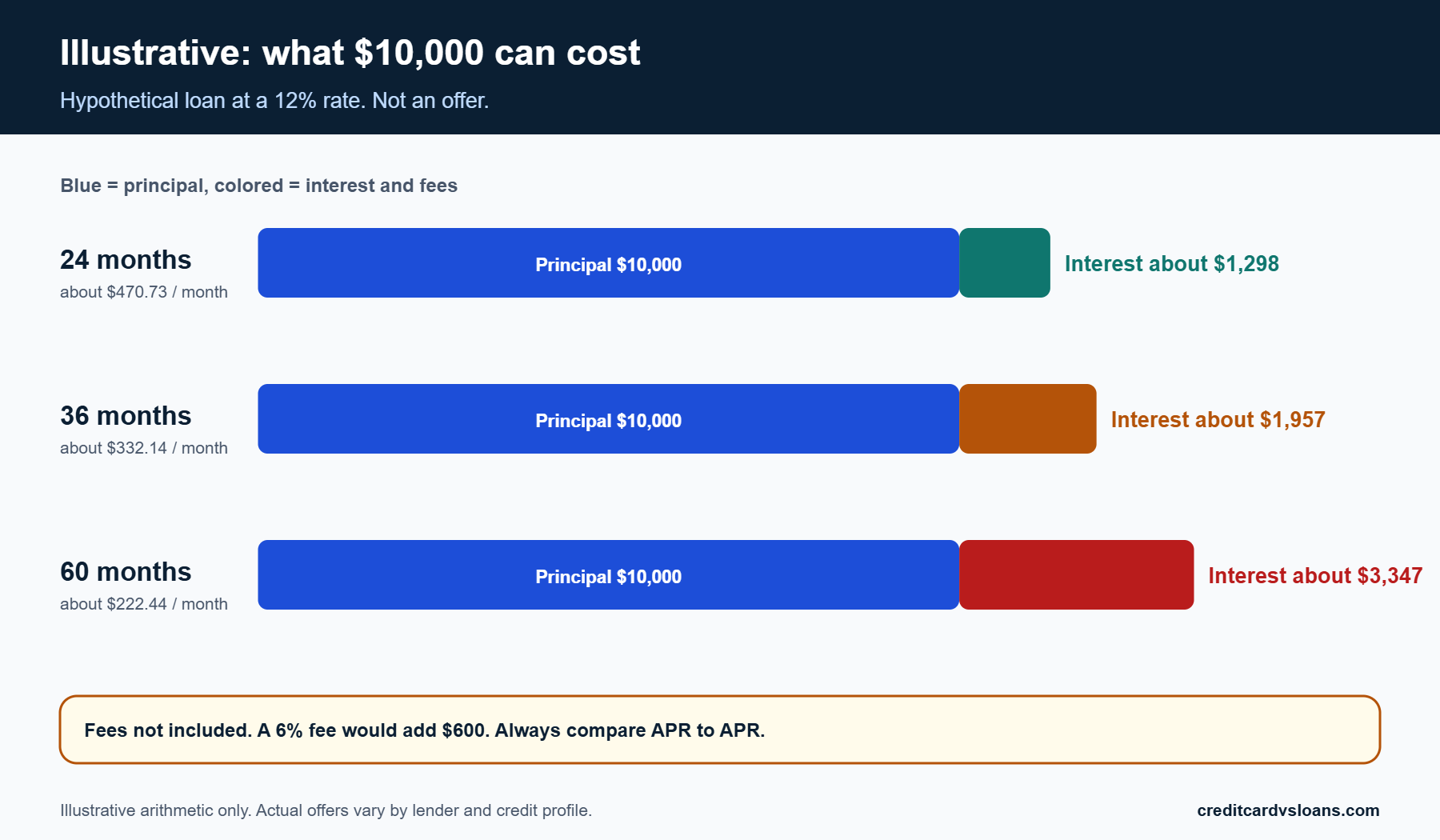
Take the same hypothetical $10,000 at 12%. Over 24 months the payment is about $470.73 and interest about $1,298. Over 36 months it is about $332.14 and $1,957. Over 60 months it is about $222.44 and $3,347. The payment drops by more than half from 24 to 60 months, yet the interest is roughly two and a half times as large. If you only look at the monthly figure, the longest loan looks friendliest.
A higher rate versus a fee: which costs more?
A fee and a rate are two ways of charging for the same loan, and the APR is how you compare them. In the same hypothetical, moving from a 12% rate to 24% on the same $10,000 over 36 months raises the payment to about $392.33 and interest to about $4,124. The 6% origination fee example earlier added $600 to cost without changing the payment at all.
Neither is automatically worse. A shorter loan with a fee can cost less than a longer loan with no fee. The only way to tell is to put the APR and the total of payments side by side for the same term. If a lender won’t state the APR on your offer, that alone is a reason to look elsewhere.
| Scenario | Monthly payment | Total interest | Fee taken from proceeds | You receive |
|---|---|---|---|---|
| 12% rate, 24 months | about $470.73 | about $1,298 | $0 | $10,000 |
| 12% rate, 36 months | about $332.14 | about $1,957 | $0 | $10,000 |
| 12% rate, 60 months | about $222.44 | about $3,347 | $0 | $10,000 |
| 24% rate, 36 months | about $392.33 | about $4,124 | $0 | $10,000 |
| 12% rate, 36 months, 6% fee | about $332.14 | about $1,957 plus $600 fee | $600 | $9,400 |
These figures assume level monthly payments and monthly compounding, and they are computed for illustration only. Real offers will differ.
When the payment fits but the loan does not
Payment pressure and your cash crunch
Lenders and brokers often frame the decision as “can you afford the payment?” It’s a fair question, but only half of one. The other half is what the loan costs in total and how it behaves if your income dips. A payment that fits this month but leaves no breathing room for car repairs or a short work week can turn one cash crunch into a delinquency.
A rule of thumb: build your own budget before you look at offers, decide the maximum payment you could keep making through a rough patch, and treat anything above it as a warning. If the numbers only work on an optimistic income assumption, the loan is a bad fit, whatever the rate.
Rate shopping without damaging your file
Many lenders let you prequalify with a soft pull, which doesn’t affect your score and gives you an estimate of the rate and terms. A hard pull usually comes later, when you formally apply. Comparing several prequalified offers before you apply is the cleanest way to find the lowest APR you can reasonably get.
Prequalification is an estimate, not an approval. If a site demands a fee or a bank login just to show you an estimate, step back. For a wider view of how this choice stacks up against a revolving card, see our comparison of credit card versus personal loan borrowing.
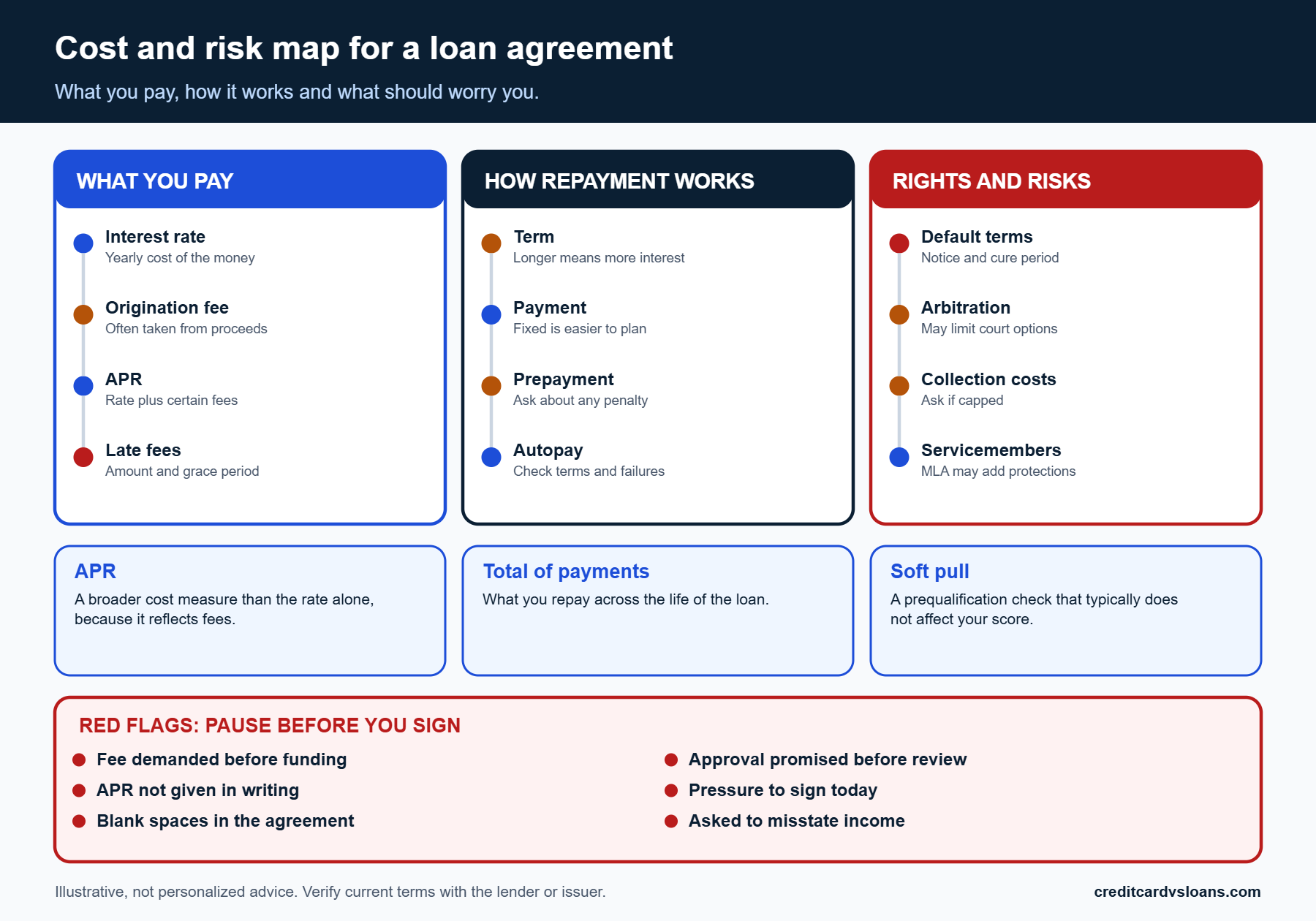
Contract terms that shift risk onto you
Default, acceleration, and collection terms
What counts as default, and what happens next
Find the section that defines default. Most agreements treat a missed payment as default, but some add triggers such as a change in your job, a bankruptcy filing, or a missed payment on another account. Then find what the lender may do: demand the full balance at once (often called acceleration), report to the credit bureaus, or send the account to collections.
You are looking for a grace period, a notice requirement, and a way to cure the problem. A contract that lets the lender declare default with no notice and no cure window is more aggressive than one that gives you ten or fifteen days and a letter. The specifics vary by lender and by state, so treat this as a comparison point, not a legal standard.
Collection costs and what you could owe on top
Some agreements say you will pay the lender’s collection costs or legal fees if the account goes bad. That isn’t unusual, but it should be clear. Ask whether the language caps those costs or leaves them open-ended, and whether state law limits them (this varies by state).
If a loan does go into collections, you have rights as a consumer. The FTC explains that a debt collector must send validation information at first contact or within five days, and that a written dispute within 30 days of receiving it requires the collector to stop collection until it mails verification. Our guide to the credit card debt statute of limitations covers what happens when old debts resurface.
Arbitration, waivers, and signing away rights
Mandatory arbitration and class-action waivers
Many consumer contracts require disputes to go to private arbitration rather than court, and some bar group lawsuits. These clauses are legal in many contexts and are not by themselves a scam. But they change your options, so you should know whether one is there before you sign.
Look for words such as arbitration, waiver, jury trial, and class action. If you see them, consider whether you are comfortable with the trade. If you are not, compare offers that don’t include them, or ask whether the clause can be removed. A lender may say no, which is useful information too.
Special protections for servicemembers
The CFPB summarizes the Military Lending Act this way: for active-duty servicemembers and their covered dependents, a covered loan cannot carry a Military Annual Percentage Rate above 36%, and the MAPR counts finance charges, credit insurance, add-on products and certain fees. Covered lenders also cannot require mandatory arbitration, mandatory military allotments, or prepayment penalties. Covered products include payday loans, vehicle title loans, and most installment loans, with exceptions such as loans secured by the property being purchased.
If you are covered and a personal loan offer includes any of those terms, that is a significant red flag. The covered-borrower status and the exact scope of the rule are matters to verify with the CFPB, the Department of Defense, or a military legal assistance office.
Red flags in the offer itself, before any agreement
Scam patterns versus aggressive lenders
The advance-fee loan pattern
The FTC’s description is consistent and worth memorizing. The ad says bad credit is no problem. The approval comes before a credit check. A fee is demanded, often called processing, insurance, or an application fee, either before you apply or after you are told you are approved. After you pay, the money you were promised never arrives.
The agency notes that scammers target people with bad credit or trouble getting loans, and some buy lists of people who searched for or applied for payday or other loans. If you’ve been shopping for credit and suddenly receive an unsolicited call or text with a perfect offer, treat the timing as suspicious, not lucky.
Unsolicited calls, robocalls, and pressure
The FTC says unsolicited calls offering loans are a warning sign and that telemarketers may not promise you a loan and ask for payment up front. Recorded sales pitches from robocalls are illegal, and the agency suggests hanging up and reporting them. Separately, a CFPB action alleged that a debt-settlement operation told consumers they had been rejected for personal loans in order to sell them other services; the complaint is an allegation, not a finding.
Pressure takes many forms: a countdown, a limited slot, a bonus for signing today. A legitimate lender gives you the documents and the time to read them. If you can’t get one of those, leave.
Verification steps that take ten minutes
Confirm who the lender is
The FTC suggests checking whether a lender is registered in your state with your state attorney general or banking or financial regulator. Do that through the regulator’s own website, which you find yourself, not through a link the lender gives you. Then search the company name and phone number together with the words “review,” “complaint,” and “scam.”
Check that the agreement lists a physical address and a contact method that works, and that the name on the agreement matches the name in the ad. If you were passed from a marketer to a different lender, ask which company will actually fund and service the loan.
Watch how you are asked to pay and what you are asked to share
The FTC says scammers commonly ask for cryptocurrency, wire transfers, or gift cards, which are hard to recover. A legitimate lender collects payments by bank transfer, card, or check and gives you receipts. Be careful as well with requests for your bank login, a copy of your ID, or a Social Security number before you have even seen the terms. Share what a lender needs to underwrite only after you’ve confirmed it is real.
| Red flag | What it may mean | What to do |
|---|---|---|
| Fee demanded before funds arrive | Possible advance-fee scam | Stop; verify registration; report at ReportFraud.ftc.gov |
| Approval promised before review | No real underwriting | Ask for the lender’s name and license; walk away if unclear |
| APR not given in writing | Cost hidden or still unsettled | Request the APR and total of payments before you apply |
| Deposit smaller than loan amount | Fee taken from proceeds | Find the fee, add it to your cost comparison |
| Blank spaces on documents | Terms can be filled in later | Do not sign; ask for the complete document |
| Pressure to sign today | Urgency is replacing information | Ask for time; compare with other offers |
| Asked to misstate income | Unaffordable loan or fraud risk | Decline; do not sign |
| Payment by gift card, wire, or crypto | Hard-to-recover payment channel | Do not pay; report |
Red flags that change by situation
When the loan is meant to consolidate debt
Check that the new loan actually costs less
A consolidation loan feels like progress because several payments become one. But a single payment is a convenience, not a saving. Compare the APR on the new loan with the rates on the debts it would replace, add any origination fee, and compare the total you would pay under each path, including how long you would be in debt.
A lower payment achieved only by stretching the term can cost more in total. If the arithmetic only works when you ignore the fee or the longer term, the loan may be moving the problem, not solving it. Our guide to personal loan credit score requirements is a useful companion when you’re weighing eligibility against cost.
Watch for offers that mix consolidation with debt relief
Some firms pitch a loan and a debt-settlement program in the same call. The FTC warns about debt relief companies that charge fees before settling debts, promise to eliminate unsecured debt for pennies on the dollar, or tell you to stop talking to creditors without explaining the consequences. A CFPB notice describes the Telemarketing Sales Rule as barring companies that sell debt relief by telemarketing from requesting or receiving fees before the debt has been settled or altered and you have made at least one payment under the new terms.
If the same salesperson is pushing a loan and a relief program, slow down and ask for the terms of each in writing. They are separate decisions with separate risks.
When you are in a hurry or have a thin file
Urgency makes every red flag easier to miss
Emergencies shrink the time you give to reading. That’s exactly when a pricey or deceptive offer is most likely to work on you. If you need money in days, say a car repair or a vet bill, spend your first ten minutes asking whether a payment plan, a credit union, or an existing credit line can cover it for less.
If you must borrow quickly, use the same checks, just faster: APR in writing, amount received, no fee before funding, verifiable lender, no blanks. A short list you can run in ten minutes beats a long one you skip.
Lead generators and marketplaces
Many sites that look like lenders are actually lead generators that collect your details and pass them to others. That is not automatically a problem, but your information may be shared widely, and the entity that finally contacts you may not be the one you thought you were dealing with. Read the privacy and consent language before you enter your Social Security number or bank details.
Ask the first question out loud: “Who is the lender, who services the loan, and where do I send payments?” If the answer is a runaround, close the tab. This is a practical rule of thumb, not a legal rule.
What to do when you spot a red flag
Ask, compare, or walk away
Ask for the fix in writing
Not every red flag is a scam. A missing APR, an unexplained fee, or an unclear late-fee clause is often a lender being sloppy or hoping you will not ask. Put your question in an email or the lender’s secure message system so there is a record, and ask for a corrected document rather than a verbal promise.
A useful script: “Please send the APR, the amount I will receive after any fees, the total of payments, and the prepayment terms for this specific offer.” If the response is quick, specific, and consistent with the agreement, that’s a good sign. If it dodges or pushes you to sign first, you have your answer.
Compare apples-to-apples before you decide
Line up at least two or three prequalified offers for the same amount and term. Compare APR, total of payments, the amount you actually receive, and the prepayment and late-fee terms. If your credit is thin or in the 600s, our guide to a personal loan with a 600 credit score explains how pricing and alternatives look in that range.
Also consider options that are not personal loans at all, such as a credit union product, a payment plan with the original creditor, or a credit card with a promotional APR. They have different risks, and our credit card versus personal loan comparison helps you weigh them.
If you already paid or signed
If you paid a suspected scammer
The FTC says to act as quickly as possible, since scammers often request payment methods that are hard to recover, and to report the scam at ReportFraud.ftc.gov. Reports help law enforcement and warn others. Contact your bank or the payment service right away to ask whether the transaction can be stopped or disputed, and watch your accounts for unauthorized activity.
Do not send more money to recover the first payment. Follow-up demands for a release fee or a tax are a known second act. For debts or loans you are worried about, the FTC suggests nonprofit credit counseling, which is often free or low cost.
If you signed a loan with terms you now regret
Start by collecting everything: the agreement, the advertisement or offer, your messages with the lender, and your payment records. Read the agreement for any cancellation or rescission language. Many consumer loans have none, so don’t assume you have a right to back out, and note the deadline if one exists.
Then reach out to the lender in writing, and consider a complaint to the CFPB or to your state regulator. A nonprofit credit counselor or a legal aid office can help you judge whether a term looks improper. This article cannot tell you whether a specific clause is enforceable. That depends on your state and your facts.
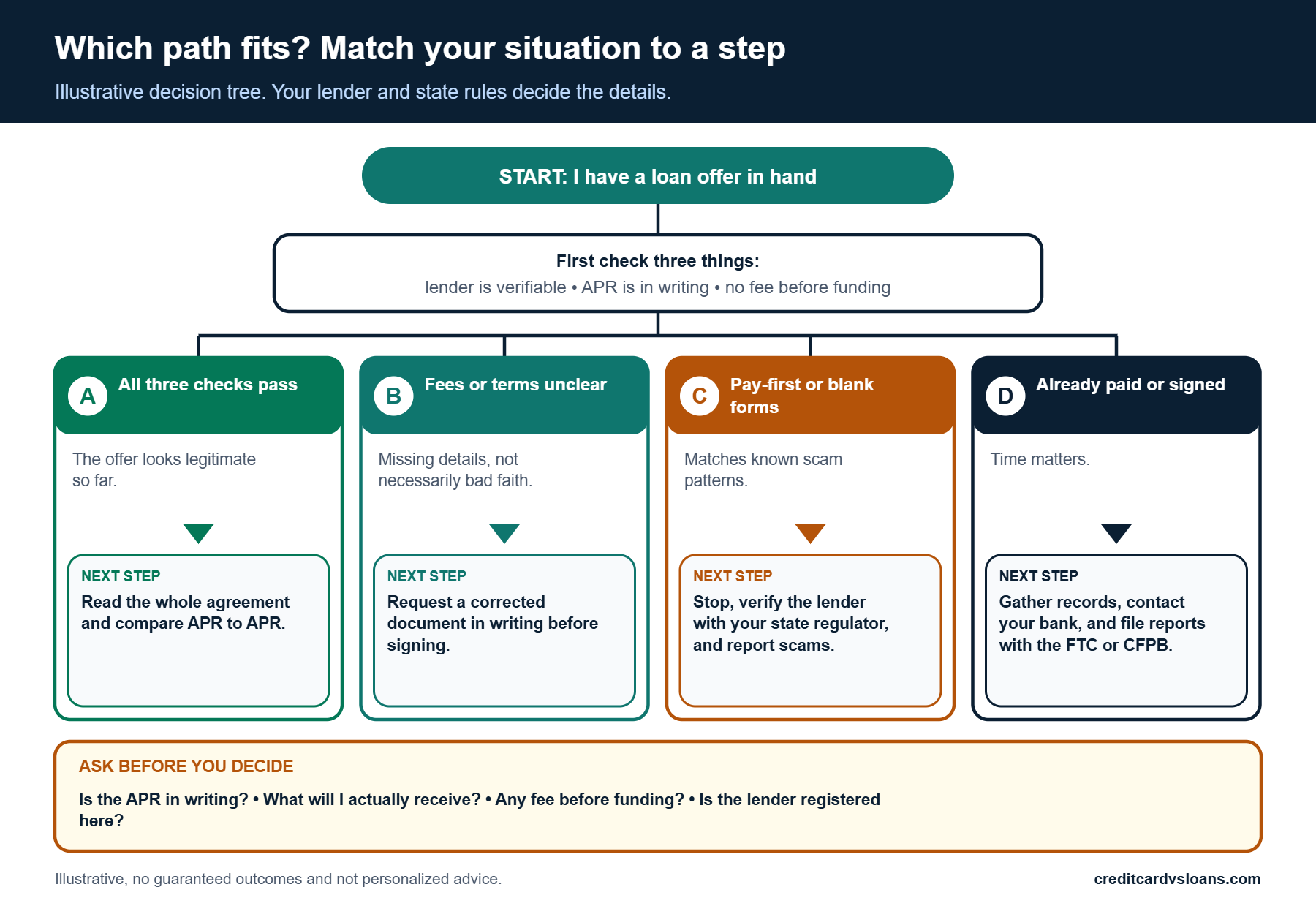
Conclusion: your decision path and next steps
How to decide
Sign only if the answers line up
Sign when the APR, the amount you receive, the total of payments, and the payment schedule are all in writing and consistent; when any fee is itemized and either deducted from proceeds or clearly disclosed; when the lender is verifiable; and when you have had time to read the whole document. If the lender also passes your own affordability test with room to spare, you have a loan worth comparing seriously.
That still does not make it the right loan. It makes it a fair one to compare against others.
Walk away when the pattern shows up
Walk away if the lender demands money before funding, promises approval before review, will not state the APR, or hands you a document with blanks. If you feel pressured, that alone is enough. You can always come back to a legitimate offer, while a scam’s loss is usually permanent.
If you are unsure, a nonprofit credit counselor can review your situation without selling you a product. Our companion guide on predatory lending signs covers the lenders that stay just inside the line.
Your pre-signing checklist
Before you apply
- Decide the largest monthly payment you can sustain if your income dips.
- Prequalify with soft pulls at two or three lenders for the same amount and term.
- Look up each lender’s registration with your state regulator, using the regulator’s own website.
- Ask each lender for the APR, any origination or other fees, and prepayment terms in writing.
If a lender asks for money at this stage, treat it as a stop sign and verify before you go further.
Before you sign
- Read the whole agreement, including arbitration, default, and late-fee sections.
- Check that the APR, amount received, total of payments, and payment count match your offer.
- Confirm there are no blank spaces and no add-ons you did not choose.
- Keep complete copies, and note how to reach the lender and how to dispute an error.
If something changed between the offer and the agreement, ask why in writing and wait for the answer before you sign.
Your next steps in the next 24 hours
If you are still shopping
Start with the simplest comparison you can make. Pick one loan amount and one term, and ask each lender for the same four numbers: the APR, the amount you would receive, the total of payments, and the prepayment terms. Put them in a plain table or spreadsheet. A comparison built on the same inputs is the closest thing to an apples-to-apples view that you will get, and it quickly shows which lender is vague.
Then look at what you are really borrowing for. If the purpose is to consolidate debt, check the other options too: a payment plan with the original creditor, a nonprofit credit counseling session, or a lower-cost secured option at a credit union. The FTC describes reputable credit counselors as certified and trained in consumer credit, debt management, and budgeting, and notes that most are nonprofits. It also cautions that nonprofit status alone does not guarantee that services are free, affordable, or legitimate, so ask for fees in writing.
Finally, set a decision date. Sleeping on a loan offer is one of the cheapest risk controls available. If a lender can’t wait one night for a decision that will take you years to repay, the urgency belongs to them, not to you.
If you already have an offer or agreement
Take the documents you have and mark each red flag from this guide in the margin: the APR, the fee, the amount received, prepayment, add-ons, arbitration, default. Anything unmarked is something you haven’t confirmed. Send the lender a short written list of questions about the unmarked items and the numbers that don’t reconcile.
If the answers are good, you have a clearer, safer loan. If they are not, you have the information to decline. And if you’ve already paid a fee to someone who now won’t respond, report it at ReportFraud.ftc.gov, tell your bank, and keep copies of every message. For follow-up reading on how lenders price risk, see our guide to what credit score you need for a personal loan.
None of this replaces advice from a licensed professional. It is a way to ask better questions before you sign, and to recognize the moment when the best answer is no.
- Predatory Lending: Warning Signs in Personal Loans and Debt Relief Offers
- What Credit Score Do You Need for a Personal Loan?
- Credit Card vs. Personal Loan: Which Is Better for Borrowing?
- Personal Loan With a 600 Credit Score: Rates, Approval and Alternatives
- Credit Card Debt Statute of Limitations: What It Means and What It Doesn’t
- FTC: What to Know About Advance-Fee Loans (Warning signs of advance-fee loan scams and how to verify a lender)
- FTC: Coping with Debt (Credit counseling, debt relief scam warning signs, advance-fee loans)
- FTC: Debt Collection FAQs (Validation notices and the 30-day dispute window)
- CFPB: What is an APR? (APR versus interest rate (mortgage context))
- CFPB: What is a prepayment penalty? (Mortgage context; used for the general concept only)
- CFPB: What is covered under the Military Lending Act? (36% MAPR cap and other protections for covered borrowers)
- CFPB: CFPB takes action against debt relief business taking illegal advance fees (Telemarketing Sales Rule advance-fee ban; allegations only)
Last updated: October 22, 2026. Rates, fees and lender rules change; verify current terms before acting.
The information on creditcardvsloans.com is provided for general educational and informational purposes only. It is not financial, legal, tax, credit, accounting or investment advice, and reading it does not create an advisor-client, fiduciary or any other professional relationship. Nothing here is an offer, solicitation or recommendation to borrow, lend or apply for any product.
Credit scores, interest rates, fees, eligibility rules, lender policies and laws change frequently and vary by lender, location and individual circumstances. Examples, figures and scenarios are illustrative only, do not predict your results and do not guarantee approval, savings, a particular rate or a credit-score outcome. Always confirm current terms directly with the lender or issuer and read the full agreement before you apply or sign.
Although we aim for accuracy and use reputable sources, we make no representations or warranties, express or implied, about the completeness, accuracy, reliability or timeliness of the content. Content may be drafted with the assistance of automated tools, so errors or omissions may still occur. Links to third-party sites are provided for convenience; we don’t control and aren’t responsible for their content.
To the fullest extent permitted by law, creditcardvsloans.com and its owners, editors, authors, contributors and affiliates disclaim all liability for any loss, damage or expense arising directly or indirectly from your use of, or reliance on, this content. Before making financial decisions, consult a licensed professional, such as a qualified financial advisor, attorney, tax professional or nonprofit credit counselor, who can consider your complete situation.