Whether to borrow now or wait credit score improvements comes down to one comparison: what waiting costs you versus what a better score might save you. If you need money for something that can’t be delayed, or if waiting means paying high-rate card interest or late fees, borrowing now can be the cheaper path even at a higher APR. If the need can wait and your credit report has fixable problems, a few months of preparation may lower your price. Neither answer is guaranteed, because no one can promise how much a score will move or what a lender will offer.
The trouble with the usual advice, “improve your credit first,” is that it treats waiting as free. It isn’t. Waiting has a cost in interest on existing debt, in missed opportunities, and sometimes in fees. Borrowing now also has a cost, and part of it is the higher price a lower score can bring. Our job in this guide is to put both costs on the same page so you can make the call with numbers instead of a hunch.
The math below is hypothetical, the rate averages come from the Federal Reserve, and the rules come from consumer agencies. Your score, income, and offers will differ, so use the framework and plug in your own figures.
- Compare two totals: the extra cost of borrowing at today’s likely rate, and the cost of waiting (interest on existing debt, fees, and delay) minus what a better rate might save.
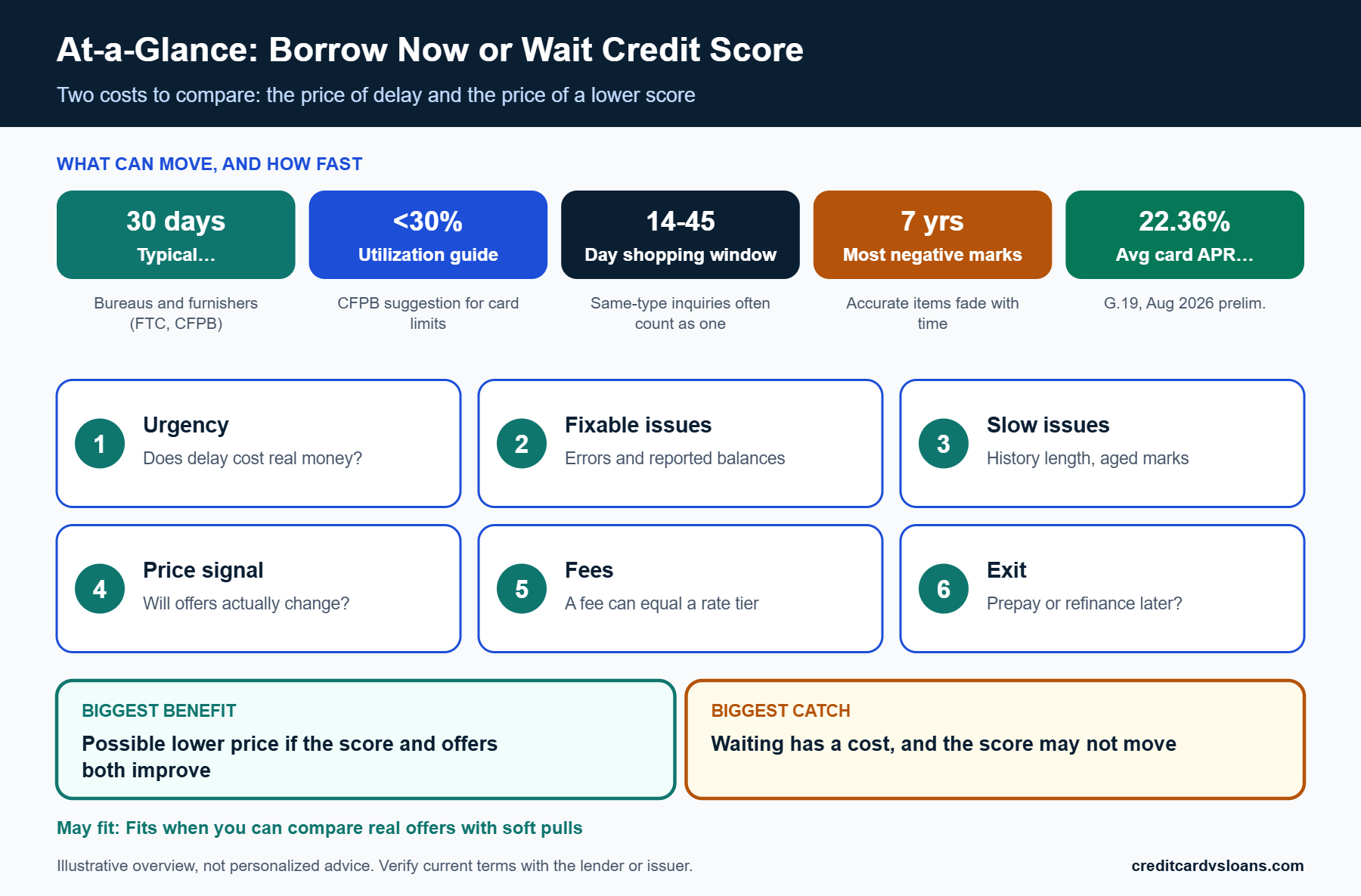
- Some things can improve quickly, such as fixing a reporting error or lowering a reported card balance. Others, like length of history and the aging of negative marks, take time.
- A shopping window of roughly 14 to 45 days for the same type of loan generally counts as one inquiry, so comparing offers has limited score cost.
- Waiting only pays if the score actually improves and the lender prices that improvement. Treat any expected savings as a possibility, not a promise.
- If you borrow now, choose a loan you can repay early without a penalty, so you can refinance or pay faster if your credit improves.
Average rate figures come from the Federal Reserve’s G.19 release of October 7, 2026. Everything labeled hypothetical is illustrative arithmetic, not a lender quote.
Table of contents
Borrow Now or Wait? How Your Credit Score Fits the Decision
The Borrow Now or Wait Credit Score Decision in One Sentence
Compare the cost of waiting with the cost of borrowing
A useful way to frame the borrow now or wait credit score question is to ask: what extra do I pay if I borrow today at a higher rate, and what do I pay if I delay? If the extra interest from borrowing now is smaller than the cost of waiting, borrow. If the savings from a better rate clearly exceed the cost of waiting, waiting is worth considering.
The cost of waiting includes more than interest. It can include late fees if the thing you need to fund is an overdue bill, the premium of using a higher-cost short-term option in the meantime, and whatever you lose by postponing the purchase or repair. It also includes risk: your score might not change in the direction you hope.
When borrowing now is hard to avoid
Some needs don’t fit a waiting plan: a car repair that keeps you commuting, an urgent medical bill, or a debt that is already compounding at a high rate. When the cost of delay is large and sure, a modest increase in the loan rate is often the smaller problem.
The same logic applies in reverse. If the purchase is a want rather than a need, or if you have no deadline, waiting costs less. In those cases improving your odds of a better rate, and saving a larger down payment, can pay off. The sections that follow help you tell which situation you’re in.
What Can Change in a Few Months and What Cannot
Faster levers: errors and reported balances
Some changes can show up within a billing cycle or two. The FTC says errors on your credit reports can be disputed for free, that the bureaus generally must investigate within 30 days, and that both the bureau and the company that reported the item are responsible for correcting mistakes. If something wrong is dragging your report down, fixing it before you apply can matter.
Balances can also move quickly. The CFPB notes that scores are calculated at different times, so a card balance that is high when your score is calculated can affect it even if you pay in full the next day. Paying a card down before its statement date, so the reported balance is lower, is one practical way to influence the reported utilization, the share of your available credit that you’re using.
Slower levers: history and aging marks
Other pieces move slowly. FICO says length of credit history is 15 percent of its general weighting, and the FTC says accurate negative information generally stays on your report for about seven years, with bankruptcies up to ten, and that it fades with time rather than disappearing on request. Paying on time every month is the steady way to improve, and the CFPB calls payment history the most important scoring factor.
Those slower levers mean that “wait until my score is higher” can take far longer than a few months if your problems are old marks and a thin history. That does not make waiting wrong, but it should change how you estimate the cost of delay.
How a Lower Score Changes the Price of a Loan
How Lenders Turn a Score Into a Price
Risk-based pricing in plain English
The CFPB explains that a credit score helps lenders decide whether to approve you and helps set the interest rate and credit limit, and that higher scores generally lead to easier approval and better terms. In other words, the same loan can carry a different APR depending on how risky your file looks to that lender. Income, existing debts, the loan amount, and the term also matter, as the CFPB’s explanation of how lenders price auto loans shows.
That is why waiting has value only if the lender actually moves your price when your score improves. Lenders often use tiers, so a small change inside a tier may not change the offer, while a jump across a tier boundary might. You cannot see a lender’s tiers in advance, which is another reason to prequalify.
Averages are not your offer
As of the Federal Reserve’s G.19 release of October 7, 2026, the preliminary August 2026 average APR was 11.90 percent for 24-month personal loans at commercial banks, 21.19 percent across all credit card accounts, and 22.36 percent for card accounts assessed interest. Those figures blend borrowers of every credit level, so a lower-score borrower may see offers above the average and a higher-score borrower may see offers below it.
The averages help for context: card interest is already expensive for most borrowers, which means the real comparison for many people is a loan against their card, not a loan against nothing. Our guide to credit card versus personal loan borrowing works through that matchup.
Fees and Terms That Move With Risk
Origination fees and who pays them
Some lenders charge an origination fee, a one-time charge for processing the loan that is typically either deducted from the amount you receive or added to the balance. Fees can be higher for riskier borrowers, but lenders differ, and some charge none. A fee changes the real price of a loan in a way the stated rate hides, so ask for the APR and the fee in writing.
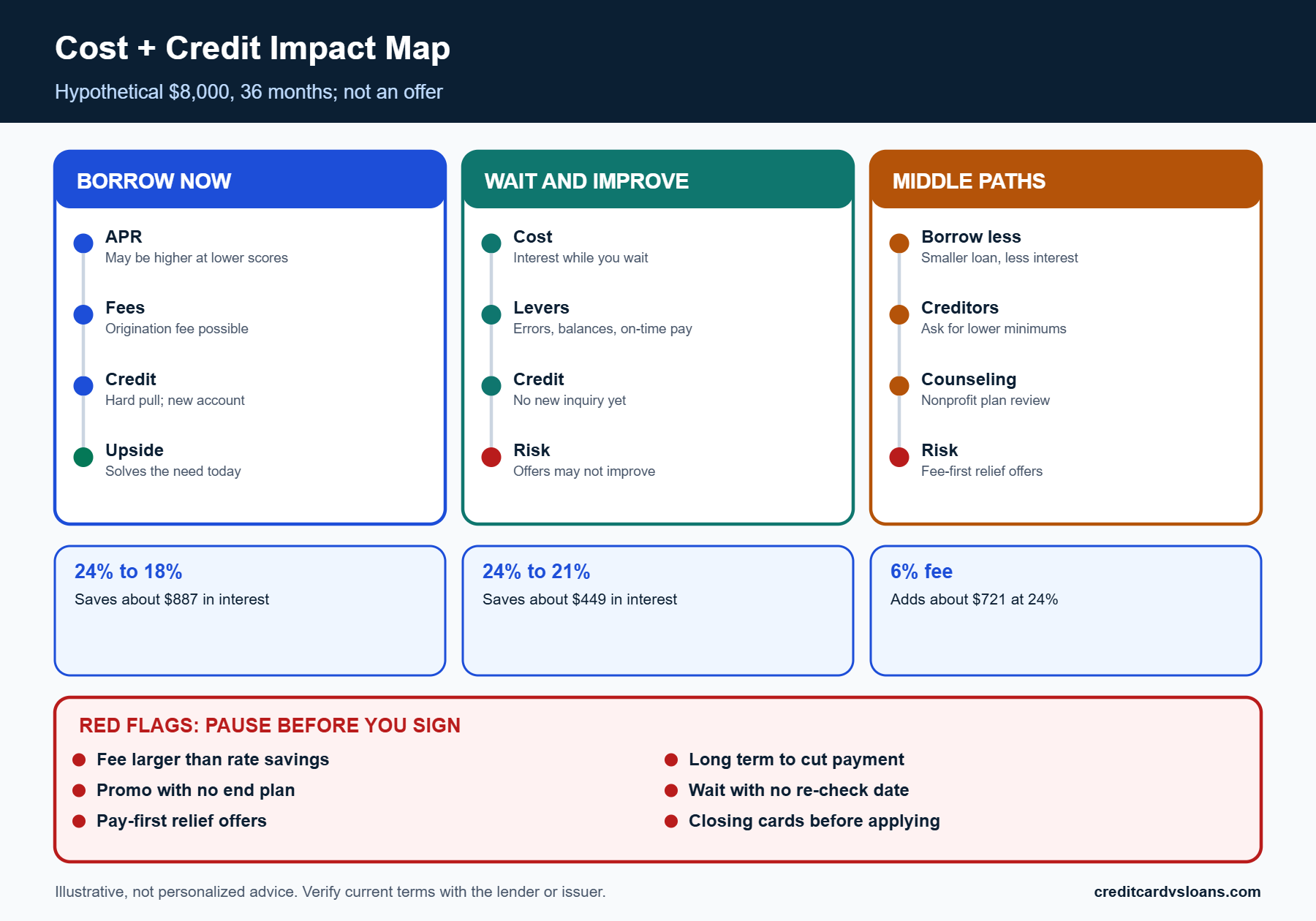
In the hypothetical math later in this guide, a 6 percent fee on an $8,000 need adds about $721 in total cost at a 24 percent rate. That is more than the roughly $449 in interest saved by a drop from 24 to 21 percent, which shows how a fee can matter as much as a rate tier.
Term length, teaser rates, and the payment trap
Lenders can lower your payment by stretching the term, which can make a higher-priced loan look affordable. The CFPB’s consolidation guidance warns that a lower monthly payment can mean a longer repayment period that raises total cost, and that low rates can be temporary teaser rates that rise later.
When you compare offers, compare them at the same term and fee structure, or compare total dollars paid. A rule of thumb: if a longer term is the only way the payment works, ask whether the purchase is affordable at all.
| Approach | May fit if | Main advantage | Main drawback | Primary cost drivers |
|---|---|---|---|---|
| Borrow now | The need can’t wait or delay is costly | Solves the problem today | May pay a higher APR or fee | APR, fees, term |
| Wait and improve credit | The need is flexible and fixable issues exist | Possible lower price later | No assurance the score moves or the price follows | Interest while waiting, time |
| Borrow a smaller amount now | Part of the need is urgent | Limits interest at a higher rate | May not cover the whole cost | Amount, APR |
| Borrow now, refinance later | Credit may improve and no prepayment penalty applies | Keeps flexibility | New fees and a new account on refinance | Prepayment terms, new fees |
| Use savings or reduce the need | You have a cushion or can scale back | No interest at all | Cushion is smaller afterward | Opportunity cost of cash |
What Borrowing Now Versus Waiting Could Cost: Hypothetical Math
The Rate Gap on a Hypothetical $8,000 Loan
The assumptions behind the numbers
The figures here are hypothetical and illustrative, illustrative, not offers from any lender. Assume an $8,000 fixed-rate loan repaid in equal monthly payments over 36 months with no fees, and five invented APR levels that stand in for what a borrower might be offered at different points in a credit journey. Real offers depend on the lender, your file, and the term, and a score change does not guarantee a price change.
We chose 24 percent as the starting point, an arbitrary rate near the upper range of what borrowers with weaker credit sometimes see, so it should not be read as a prediction for anyone. The point is the size of the gap between tiers, not the specific rates.
What each step down in rate is worth
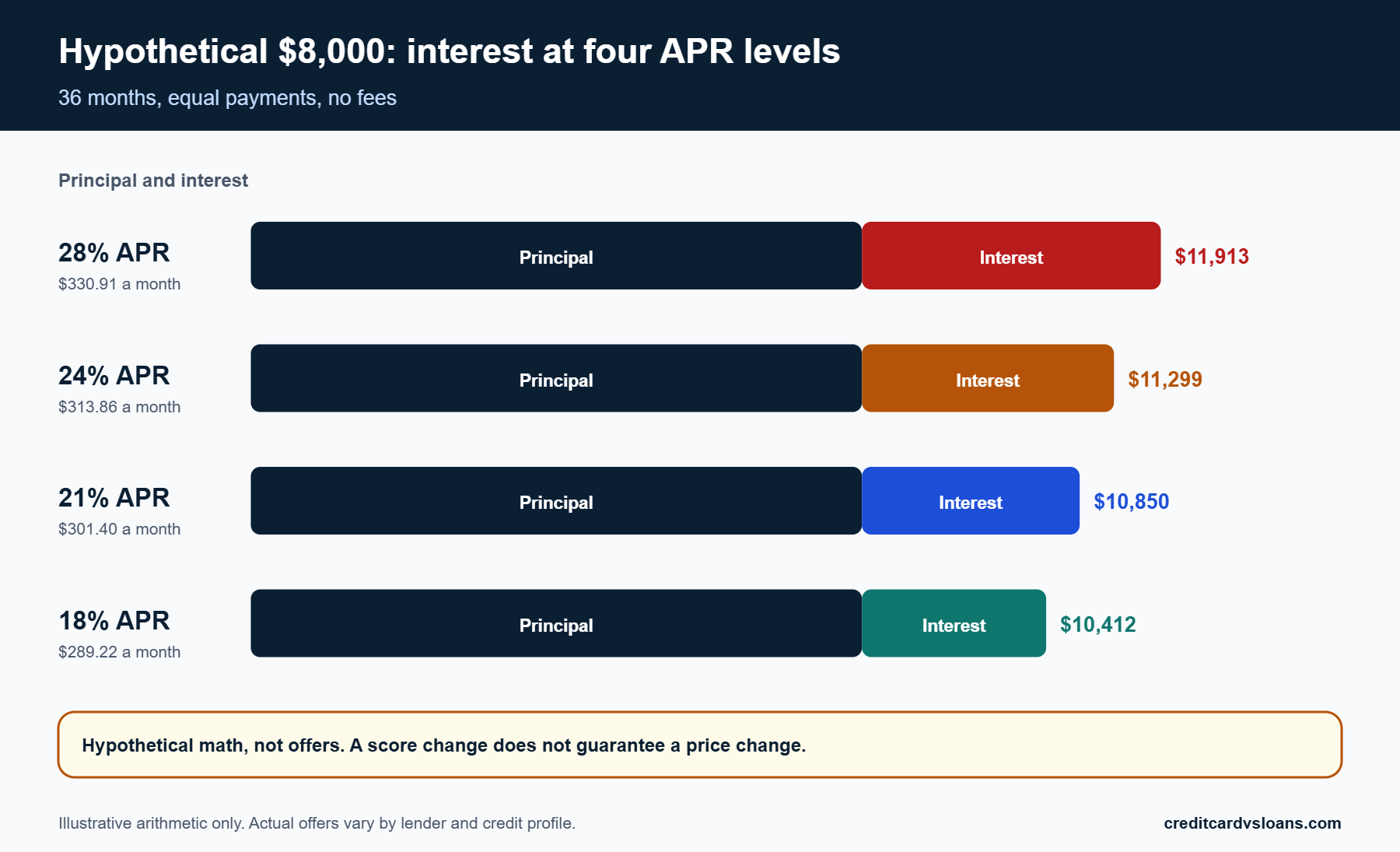
On this loan, the payment falls from $330.91 at 28 percent to $265.71 at 12 percent, and the total interest falls from $3,912.71 to $1,565.72. Dropping from 24 to 18 percent saves roughly $887 in interest over three years, about $25 a month. Dropping from 24 to 21 percent saves roughly $449.
Those are meaningful numbers, but they are also bounded. Compare them with the cost of waiting before you decide that a better tier is worth the delay.
| Hypothetical APR | Monthly payment | Total interest | Interest vs. the 24% loan |
|---|---|---|---|
| 28% | $330.91 | $3,912.71 | $613.65 more |
| 24% (baseline) | $313.86 | $3,299.06 | – |
| 21% | $301.40 | $2,850.42 | $448.64 less |
| 18% | $289.22 | $2,411.89 | $887.17 less |
| 12% | $265.71 | $1,565.72 | $1,733.34 less |
What Waiting Could Cost
Interest on the debt you carry while you wait
Suppose your reason to borrow is to pay off $3,000 of card debt at a hypothetical 24 percent. If you pay $100 a month for six months while you work on your credit, you would pay about $348 in interest during that stretch and still owe about $334. With no payments at all, the interest would be roughly $378. Those dollars are the toll for waiting.
If the purchase is something other than debt, the toll takes a different form: a repair that keeps costing you commute options, a higher-priced short-term alternative, or fees on a bill you can’t pay yet. Put a dollar figure on it as best you can, even if it is rough.
Putting savings and waiting costs side by side
Take the table above and subtract a six-month waiting cost of about $348. If waiting works and the offer falls from 24 to 18 percent, you net about $539 over the loan. If it falls to 21 percent, you net about $101. If the rate stays at 24 percent, waiting leaves you roughly $348 worse off. If the price rises, the loss grows.
That asymmetry is why “improve first” is a bet rather than a rule. It pays when the improvement is likely, large, and quick, and it loses when the score barely moves or the lender prices it the same.
| Outcome after six months | Hypothetical new APR | Interest saved vs. 24% loan | Hypothetical cost of waiting | Approximate net |
|---|---|---|---|---|
| Price improves a lot | 18% | $887.17 | about $348 | about +$539 |
| Price improves some | 21% | $448.64 | about $348 | about +$101 |
| No change | 24% | $0 | about $348 | about -$348 |
| Price gets worse | 28% | -$613.65 | about $348 | about -$961 |
Fees and Term Can Change the Winner
A fee can erase a rate improvement
Suppose a lender charges a 6 percent origination fee on the hypothetical $8,000 need, financed so you still receive $8,000. At 24 percent, the payment rises to about $333.90 and total cost reaches about $4,020, compared with $3,299 with no fee, a difference of roughly $721. An 18 percent loan with the same fee costs about $3,076, still above the no-fee 21 percent loan at $2,850.
So the fee line on the offer can be worth as much as an entire rate tier. When you compare “borrow now” with “borrow later,” compare them at the same fee assumptions, or ask each lender for an APR that includes fees.
Stretching the term to keep the payment low
The same 24 percent loan stretched to 48 months drops the payment to about $260.81 but raises interest to about $4,519. At 60 months, the payment falls to about $230.14 and interest rises to about $5,809. A lower payment does feel easier, and it can be the difference between paying on time and missing a payment. But it is the most expensive way to buy that comfort.
If you borrow now and expect your credit to improve, a shorter term with a payment you can handle is often better than a long term that keeps you in a high-rate loan for years. If you can’t afford the shorter term, take that as a signal about the size of the loan.
When Waiting Tends to Make Sense
Situations That Favor Improving Your Credit First
Your reports contain errors you can fix
If a review of your reports shows an account that isn’t yours, a late payment you made on time, or a balance that is wrong, fixing it can be the highest-value use of a few weeks. The FTC says you can get free reports from each of the three bureaus at AnnualCreditReport.com and dispute errors for free. The bureau must forward your evidence to the company that reported the item, give you written results, and provide a free updated copy if the report changes.
The CFPB adds that furnishers, the companies that report to the bureaus, generally must investigate within 30 days and correct or remove information that is wrong or can’t be verified. If you plan to borrow within the next few months, start disputes early so they are resolved before a lender pulls your file.
Your balances are high, but a payoff is within reach
If your card balances are the main drag on your file and you can pay them down meaningfully within a statement cycle or two, waiting a short time can help. The CFPB advises keeping utilization under about 30 percent of your limits, and notes that a balance reported when your score is calculated can matter even if you pay it off right after.
That does not require a long delay. A plan of paying down cards before statement dates for two to three cycles is a focused way to test whether a lower reported balance changes the offers you see, without promising that it will.
Ways to Improve While You Wait
Build the habits scoring models reward
The CFPB’s guidance on getting and keeping a good score is practical: pay on time using automatic payments or reminders, keep balances low, build a long credit history, apply only for credit you need, and check your reports. It also says you don’t need to carry a balance or have debt to build good credit, so paying in full is better than carrying a balance to “show” activity.
One sensible plan is to set a target date, such as three months out, with specific actions: every payment on time, utilization lowered below a chosen number, errors disputed. Then check your offers using soft-pull prequalification and decide with new data.
Starter products for thin or damaged files
If your file is thin or damaged, the CFPB lists secured credit cards, where a cash deposit sets your limit, and credit builder loans, where the lender holds the loan money in savings while you repay in small payments, usually over six to 24 months. It also cautions that debit cards, cash, and prepaid cards don’t build history, that payday loans don’t help because on-time payments are not reported to the nationwide bureaus, and that buy here, pay here auto loans often report only negative information.
These tools work slowly and cost something in fees or locked-up savings, so weigh them against your timeline. Ask a credit union or a nonprofit credit counselor which fit your situation.
When Borrowing Now Tends to Make Sense
Needs With a Real Deadline
When delay costs more than a higher rate
If the thing you need to fund protects your income or health, such as transportation to work, an essential repair, or a medical bill with collection pressure, the cost of delay can be large and hard to measure. In our hypothetical, a six-month wait cost about $348 in interest even when the rate improved, and the rate might not improve at all.
When the need is immediate, shift the question from “should I borrow” to “what is the cheapest and safest way to borrow.” That often means a credit union, a lender you’ve prequalified with, or a smaller loan amount, rather than the first offer you see.
Higher-cost fixes can cost more than a modest loan
Waiting is sometimes replaced by a short-term fix that costs more than a loan would: late fees, a payday-style product, or a cash advance on a card. The CFPB describes payday loans as products that don’t help build credit, and it warns about debt settlement offers that charge fees up front. If a delay pushes you toward options like these, a standard installment loan at a higher rate may still be the better deal.
Remember too that a missed payment on an existing account can hurt your score at least as much as a new loan would. If borrowing keeps you current, that has value that does not show up in an APR comparison.
How to Borrow Now Without Locking in a Bad Deal
Shop in a tight window and compare total cost
The CFPB says scoring models usually treat several inquiries of the same loan type made close together as one, with inquiries 14 to 45 days apart generally counting as no more than one, so comparison shopping is not penalized the way many people fear. Shop within a short window, use soft-pull prequalification first, and compare APR, fees, term, and total dollars paid. Our guide to whether rate shopping for a personal loan hurts your credit goes through the details.
Ask for the full terms in writing before applying, and read what the lender says about the type of credit check involved. Decline add-on products you don’t want, such as optional insurance or extras, which can raise the effective price.
Keep the exit open: prepay and refinance later
If you borrow now and your credit improves, you may be able to refinance at a lower rate or simply pay the loan off faster. That only works if the loan has no prepayment penalty and the refinance has no fees that eat the savings. In our hypothetical, a drop from 24 to 18 percent on a 36-month loan would save about $887, but a 6 percent fee on the new loan could erase most of it.
A good rule of thumb is to treat refinancing as a bonus, not a plan. Choose a loan you can afford at its current rate, then revisit your options after several months of on-time payments. Our explainer on how debt consolidation can affect your credit score over time describes how a new loan tends to show up on your score along the way.
Middle Paths: Alternatives to Borrowing Now or Waiting Indefinitely
Reduce the Amount You Need to Borrow
Ask the people you already owe
The CFPB’s consolidation guidance suggests asking creditors whether they will lower minimum payments, waive fees, reduce your interest rate, or move your due date. A successful request can reduce the cost of waiting directly, because it lowers what you owe each month while you improve your credit. Not every creditor agrees, and terms vary by issuer, but the call costs nothing.
If you are behind on several accounts, a nonprofit credit counselor can review your situation and, in some cases, set up a debt management plan. The CFPB notes that these plans often aim to lower payments by extending terms or reducing interest, that fees can apply, and that a counselor who tells you to stop paying your debts is a red flag.
Borrow less, or fund part of it another way
You don’t have to choose between the full amount now and nothing. Funding the urgent portion with a smaller loan, and the rest from savings or a payment plan with the provider, keeps interest down at a rate you may not love. In the hypothetical $8,000 example, borrowing $5,000 instead at 24 percent over 36 months would cost roughly $2,062 in interest rather than $3,299.
A smaller loan also has a lower payment, which can help you stay current while your credit builds. Then your future refinance or next loan starts from a stronger file.
Choose a Different Product Structure
Promotional card offers and what they require
A card with a promotional low or zero rate can be cheaper than a loan if you can pay off the balance within the promotion. The CFPB notes that issuers may charge a balance transfer fee even on a zero-percent offer, that promotional rates last for a limited time, and that being more than 60 days late can let the issuer raise rates on all balances. For purchases, the same card may not give a grace period on new charges once you carry a balance.
Whether you qualify depends on your credit and the issuer, so compare an actual offer. Our comparison of a 0% APR credit card versus a personal loan compares the two on cost.
Credit unions and secured options
Credit unions sometimes price differently than online lenders and may have small-dollar loans with defined caps. The NCUA says federal credit unions may charge up to 28 percent on payday alternative loans under its rules, which is a cap rather than a typical rate, and you must be a member to apply. Terms and eligibility differ by credit union.
If you have savings, a secured loan or a credit builder loan can serve two purposes: it can provide funds or build history and, because the lender holds your deposit, it can be easier to qualify for. These come with their own fees and trade-offs, so read the terms carefully. Don’t close old accounts to simplify things before borrowing, since the CFPB says closing a card can raise your utilization ratio and lower your score. Our look at whether closing a credit card hurts your score explains that trade-off.
| Scenario | Option to investigate | Why | What to verify | When to avoid it |
|---|---|---|---|---|
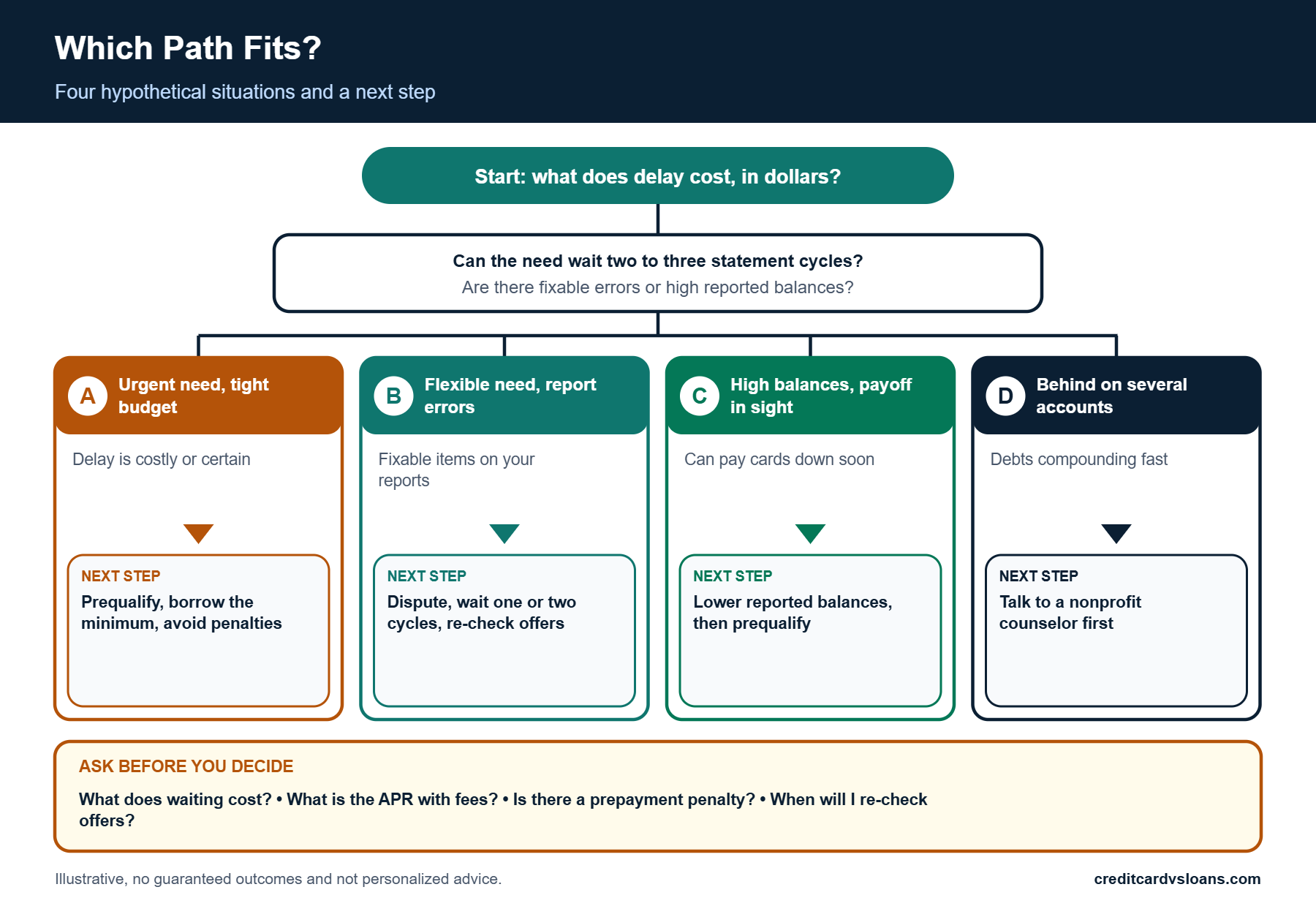
| Urgent repair, thin file | Credit union loan or smaller loan | Solves the need while limiting interest | APR, fees, prepayment, membership terms | If the payment strains your budget |
| Errors on reports, flexible timing | Dispute first, then reapply | Free fix may lower your price | Written dispute results, updated reports | If the need can’t wait a month or two |
| High card utilization, can pay down in 2-3 cycles | Pay down, then prequalify | Lower reported balance may help | Statement dates, soft-pull prequalification | If you’ll refill the cards |
| Can clear the debt in 12-18 months | Promotional card offer | Lower interest if paid in time | Transfer fee, promo length, post-promo APR | If you may not finish in time |
| Behind on several accounts | Nonprofit counseling first | Whole-picture review before new credit | Fees, how the plan reports, nonprofit status | Anyone who charges first or says to stop paying |
Stress-Test the Plan Against Your Budget
Set a payment ceiling before you shop
Before you compare a single offer, decide the largest monthly payment you can carry without skipping other bills. Work from your actual take-home pay and recurring costs, not from what a lender says you can afford. A lender’s approval tells you what it is willing to lend, not what fits your life.
Then use the ceiling to filter. In the hypothetical $8,000 example, a 24 percent loan over 36 months requires about $313.86 a month. If your ceiling is $265, the same loan only fits on a 48-month term, which raises interest by about $1,220. That is the moment to ask whether to borrow less, wait, or look for another source of funds.
Test the payment against a bad month
Run the payment through a rough month: a reduced paycheck, a car repair, or a medical copay. If the payment survives that test with room to spare, you have breathing room. If it only works when everything goes right, the loan may trade today’s problem for a missed-payment problem later.
Because payment history is the largest piece of a FICO score, a loan you struggle to repay can undo the very credit improvement you were waiting for. Consider automatic payments set a few days before the due date, and keep a small buffer in the account that pays the loan.
Your Decision Checklist and Next Steps
How the Answer Shifts With Your Starting Point
If your score is on the lower side
A lower score usually means the gap between today’s offer and a future offer is wider, which raises the potential payoff from improving. It also means more of the improvement may be slow, such as aged negative marks, so be realistic about what a short wait can change. Focus on the fast levers first: errors, reported balances, and a clean run of on-time payments.
It also means shopping carefully when you do borrow. Include a credit union, ask about all fees, and avoid any offer that asks for money before it delivers a service. The CFPB and FTC both say that paying up front for credit help is a warning sign.
If your score is already in a strong range
If you are already getting competitive offers, the extra gain from waiting is probably small, and the cost of waiting may exceed it. In that case the better use of time is rate shopping within a tight window, comparing fees, and choosing a term you can finish early.
Strong credit also gives you leverage. Ask whether the lender will waive an origination fee or match a competing offer, and check whether prepayment is free. A few minutes of negotiating can be worth more than months of waiting for a slightly higher score.
Questions to Settle Before You Decide
What if you don’t know how much your score will move?
You usually won’t. The CFPB says there is no single score and that scores differ by model, data source, and calculation date. A score in a free app may not match what a lender sees. The better approach is to test the market with soft-pull prequalification, which shows real offers without a hard inquiry, and see whether the price you are offered changes after your next round of improvements.
If the offers move meaningfully, borrowing after improvement may make sense. If they barely change over a few cycles, the cost of waiting is probably higher than the benefit, and that is information worth having.
How long should you wait if you decide to wait?
Pick a defined window rather than an open-ended one. Two or three statement cycles is long enough to dispute errors, show lower reported balances, and make several on-time payments. Set a date to re-check offers and a cost cap, such as the amount of interest you’ll accept paying on existing debt while you wait.
If problems like old collections or a short history are the main issue, the CFPB and FTC both stress that accurate negative information fades only with time, so a short wait may not change much. In that case, reduce the need or choose the cheapest safe borrowing option.
Mistakes to Avoid on Either Path
Applying everywhere, or closing accounts to look tidy
Spreading applications across many weeks and many loan types can add multiple inquiries, while a focused shopping window for one loan type is usually treated as a single inquiry. Likewise, closing old cards right before you borrow can raise your utilization ratio and shorten the picture lenders see. The CFPB says closing a card does not reliably raise a score and may lower it.
If an account has an annual fee that outweighs its value, closing it can still be sensible. Just avoid doing it in the weeks before an application, and ask a counselor or the issuer about alternatives such as converting to a no-fee card.
Treating a free score as the verdict
A score shown in an app is one of many, and the number a lender uses may differ. Use your app score as a direction, not a decision. Look at your actual reports for errors and at the real offers you receive. If an offer is far from what you expected, ask the lender what drove the price, and check whether the cause is something you can fix.
Finally, don’t let a plan to wait become a reason to stop looking. Re-check on the date you set, compare against your current costs, and decide with fresh numbers.
Conclusion: A Practical Way to Decide
The decision rule
Borrow now when the need is real, the cost of delay is large or certain, and the loan is affordable at today’s price. Wait when the need is flexible, the fixes are concrete (errors, high reported balances), and the estimated savings clearly exceed the cost of waiting. If the answer isn’t clear, take a middle path: borrow less, ask creditors for relief, or run a short, dated improvement plan with a re-check.
The bottom line is that the question is financial, not moral. A lower score is not a verdict on you, and a loan at a higher rate is not automatically a mistake. It is a price, and prices can be compared.
Next steps
- Write down the need, its deadline, and what delay will cost in dollars.
- Pull your free credit reports at AnnualCreditReport.com and dispute errors with the bureau and the reporting company.
- Prequalify with two or three lenders, including a credit union, within a short window, and record APR, fees, term, and total cost.
- Run the comparison: extra cost of borrowing now versus waiting cost minus possible savings.
- If you borrow, pick a payment you can handle and confirm there is no prepayment penalty.
- If you wait, set a re-check date, lower reported balances, and make every payment on time.
For related questions, see our guides to rate shopping and your credit and credit cards versus personal loans for borrowing.
- CFPB: What is a credit score?
- CFPB: How do I get and keep a good credit score?
- CFPB: What do I need to know if I’m thinking about consolidating my credit card debt?
- CFPB: What kind of credit inquiry has no effect on my credit score?
- CFPB: Will paying off my credit card balance every month improve my credit score?
- CFPB: What are some ways to start or rebuild a good credit history?
- CFPB: How do I dispute an error on my credit report?
- CFPB: Does it hurt my credit to close a credit card?
- FTC: Disputing Errors on Your Credit Reports
- Federal Reserve: Consumer Credit – G.19 (release of October 7, 2026)
- NCUA: Permissible Loan Interest Rate Ceiling Extended
- myFICO: What’s in your credit score?
Last updated: October 22, 2026. Rates, fees and lender rules change; verify current terms before acting.
The information on creditcardvsloans.com is provided for general educational and informational purposes only. It is not financial, legal, tax, credit, accounting or investment advice, and reading it does not create an advisor-client, fiduciary or any other professional relationship. Nothing here is an offer, solicitation or recommendation to borrow, lend or apply for any product.
Credit scores, interest rates, fees, eligibility rules, lender policies and laws change frequently and vary by lender, location and individual circumstances. Examples, figures and scenarios are illustrative only, do not predict your results and do not guarantee approval, savings, a particular rate or a credit-score outcome. Always confirm current terms directly with the lender or issuer and read the full agreement before you apply or sign.
Although we aim for accuracy and use reputable sources, we make no representations or warranties, express or implied, about the completeness, accuracy, reliability or timeliness of the content. Content may be drafted with the assistance of automated tools, so errors or omissions may still occur. Links to third-party sites are provided for convenience; we don’t control and aren’t responsible for their content.
To the fullest extent permitted by law, creditcardvsloans.com and its owners, editors, authors, contributors and affiliates disclaim all liability for any loss, damage or expense arising directly or indirectly from your use of, or reliance on, this content. Before making financial decisions, consult a licensed professional, such as a qualified financial advisor, attorney, tax professional or nonprofit credit counselor, who can consider your complete situation.