The best debt payoff option by credit score is usually the one that gives you the lowest total cost at a monthly payment you can keep up with, and your score mostly decides which of those options are open to you and at what price. With a lower score, the realistic menu often shrinks to nonprofit credit counseling, a credit union loan, or a plain payoff plan on your existing cards. With a higher score, a lower-rate personal loan or a promotional balance transfer card may become worth comparing. No score guarantees any particular offer, so the goal here is to help you decide what to investigate, not to promise what you will be approved for.
Most people searching this topic have a balance, usually on credit cards, and want to know whether to stay the course, consolidate, or ask for help. The honest answer changes as you move from a poor score to an excellent one, but it also depends on things a score never shows: your income, your other debts, how much you owe, and whether the spending that created the balance has stopped. A lower interest rate only helps if you actually pay the balance down.
This guide walks through the options tier by tier, shows hypothetical math you can compare apples-to-apples, and flags the traps that tend to appear at each end of the score range.
- Your credit score affects the price and availability of payoff tools, but it does not decide which strategy is smartest. Total cost and a payment you can sustain matter more.
- With a lower score, start with free or low-cost help: a nonprofit credit counselor, your creditors’ hardship options, and credit unions. Be wary of anyone who charges before they deliver.
- With a fair or good score, compare real offers (prequalify with soft pulls where available) against the APR you pay today, including any origination fee or balance transfer fee.
- With an excellent score, you may see low promotional or fixed rates, but a short promotional period can leave you exposed if the balance isn’t gone in time.
- The fastest payoff plan on any score is a fixed amount paid every month on the costliest debt first, while you keep minimums current on everything else.
Rate figures in this guide come from the Federal Reserve’s G.19 consumer credit release of October 7, 2026. Lender offers change often, so treat every dollar example below as hypothetical math, not a quote.
The Short Answer: Best Debt Payoff Option by Credit Score at a Glance
What Your Score Changes, and What It Doesn’t
A score works like a price tag, not a verdict
The Consumer Financial Protection Bureau describes a credit score as a number that predicts how likely you are to repay credit on time, built from the information in your credit reports. Lenders use it to decide whether to approve you and to help set the interest rate and credit limit. A higher score generally makes credit easier to get and can lead to better rates and terms, but the CFPB is also clear that there is no single score: scores differ by scoring model, data source, loan type, and the day they are calculated.
That matters for debt payoff because the same person can look different to a card issuer than to a credit union. Think of your score as one input to a price tag. It moves the price up or down, but it does not tell you whether a given option fits your budget, your timeline, or your discipline.
The three numbers that matter more than the tier label
Labels like bad, fair, good, and excellent are not standardized, and every lender draws its own lines. What stays constant is the math. Before you compare anything, line up three numbers for each option: the APR (annual percentage rate, which folds in interest and some required fees), the fees paid up front or at transfer, and the monthly payment you would need to make to finish by a date you choose.
Those three numbers make a debt payoff option by credit score comparison honest. A loan with a lower stated rate and a large origination fee can cost more than a slightly higher rate with no fee. A card with a long promotional period can look cheap until the transfer fee and the post-promotion rate are added in.
A Quick Map From Score Range to Options Worth Investigating
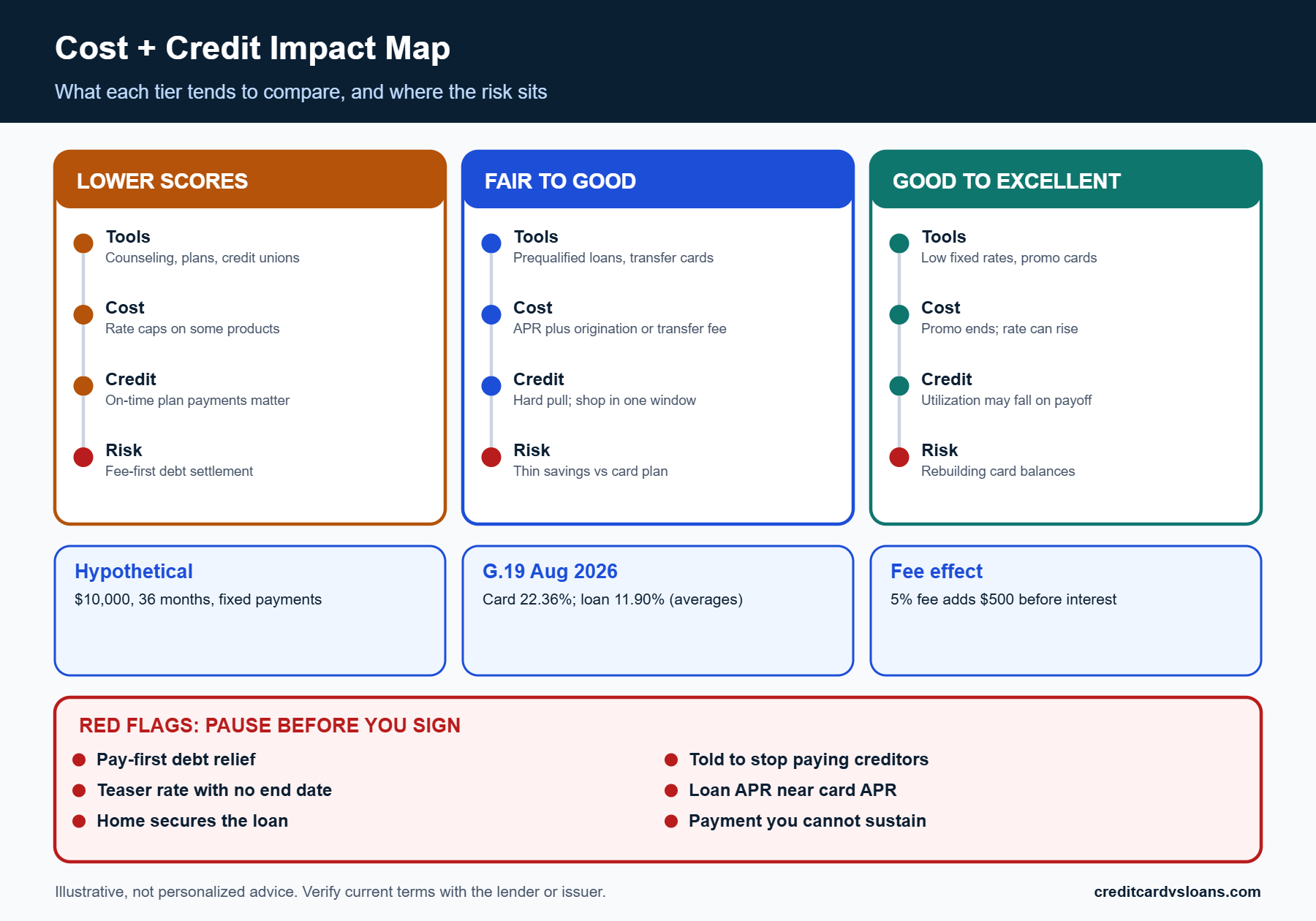
Lower scores: help first, products second
If your score is low, the options most likely to be both available and safe tend to be the ones that don’t depend heavily on a lender’s pricing model. A nonprofit credit counselor can review your whole situation and, in some cases, set up a debt management plan, where you make one monthly payment and the counselor distributes it to your creditors. Credit unions sometimes offer small-dollar loans with capped rates, and your own card issuer may have a hardship program. Products pitched aggressively to people with damaged credit, such as debt settlement programs that charge fees or loans secured by your car title, deserve extra skepticism.
If you are in this range and want to see how lenders view personal loans around the middle of it, our guide to a personal loan with a 650 credit score covers the approval and rate factors in more detail.
Higher scores: price shopping becomes the main job
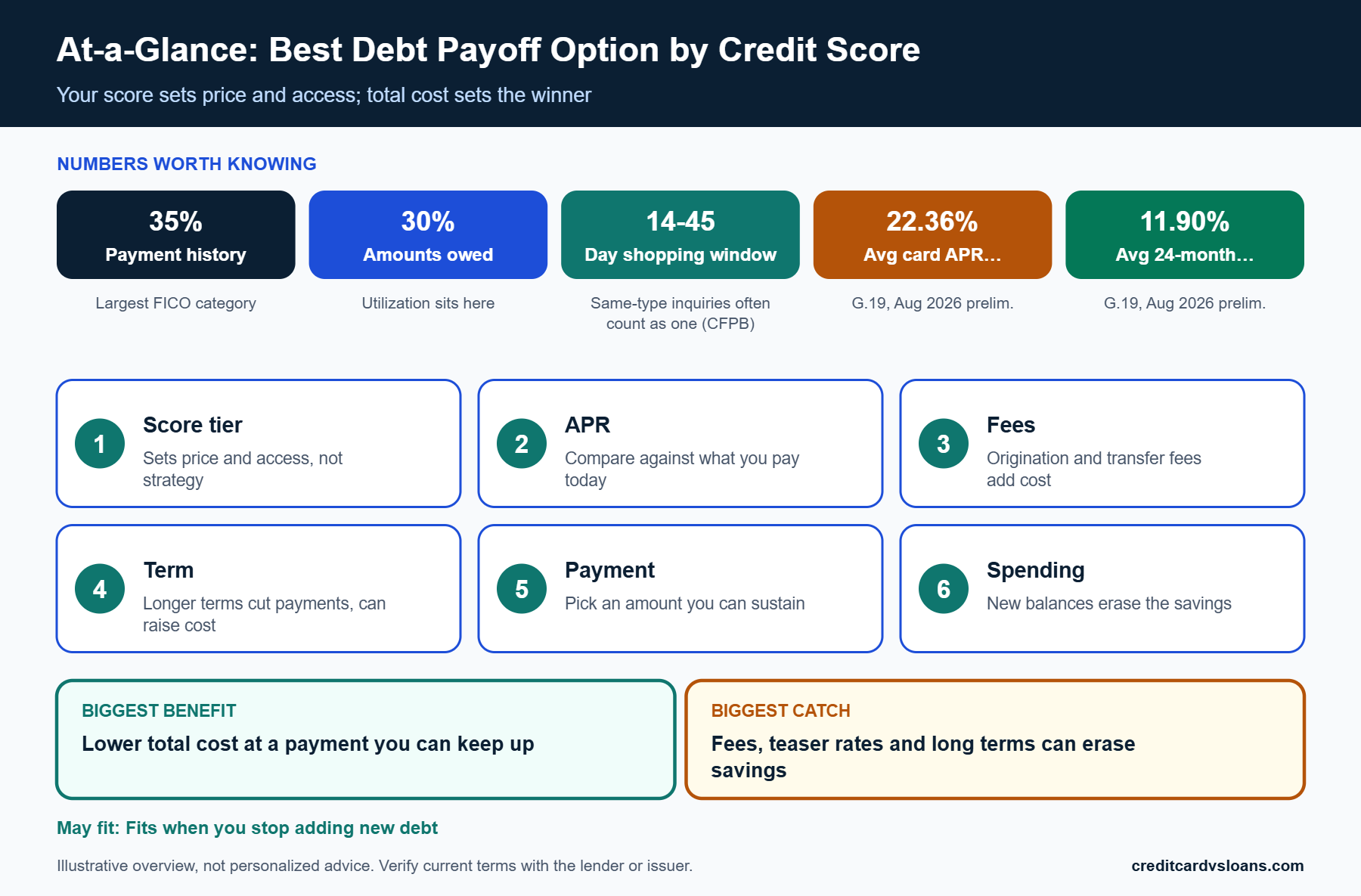
As scores rise, more lenders will make offers, and the differences between those offers get larger in dollar terms. That makes rate shopping the main task. You can prequalify with many lenders using a soft pull, which doesn’t affect your score, and compare actual APRs, terms, and fees. The CFPB notes that multiple inquiries from lenders for the same type of loan made within roughly 14 to 45 days generally count as no more than one for scoring, depending on the model, so a focused shopping window has limited effect.
Higher scores also open promotional balance transfer cards. These can be effective when you can finish paying before the promotion ends, and costly when you can’t. Our comparison of a balance transfer card versus a personal loan weighs those two tools directly.
How Lenders and Card Issuers Use Your Score to Set Requirements
What Scoring Models Actually Measure
Five categories, with payment history on top
FICO, the best-known scoring company, publishes the general weights it uses: payment history at 35 percent, amounts owed at 30 percent, length of credit history at 15 percent, credit mix at 10 percent, and new credit at 10 percent. FICO also notes that the importance of each category varies from person to person, so treat these as general guides rather than a formula you can solve.
For anyone paying off debt, two of those categories do most of the work. Paying every account on time protects the largest slice, and bringing balances down relative to your credit limits improves amounts owed. That second point is why paying debt down tends to help scores over time, although no one can promise how many points a given change will add.
You have many scores, not one
The CFPB lists the main reasons your numbers differ: the credit reporting company, the scoring model, the type of loan, and the calculation date. A score you see in a free banking app may not be the version a lender pulls. When a lender tells you your score is a certain number, ask which model and which bureau, and treat any consumer-facing number as an estimate.
The practical takeaway is to avoid anchoring on a single number. Look at the offers you actually receive. They are the only part of this process that is both real and specific to you.
Why Two People With the Same Score Get Different Offers
Income, existing debt, and the loan itself
Lenders weigh more than the score. In its explanation of how lenders set auto loan rates, the CFPB points to income, existing debts, the loan amount and term, and, for secured loans, the collateral. Debt consolidation lenders do something similar in spirit: two applicants with the same score but different income or different monthly obligations can receive different approvals and prices.
That is one reason a guide cannot tell you the rate you will get at a given score. Published rate averages blend every borrower together. As of the Federal Reserve’s G.19 release of October 7, 2026, the preliminary August 2026 averages were 11.90 percent on 24-month personal loans at commercial banks, 21.19 percent on all credit card accounts, and 22.36 percent on card accounts that were assessed interest. Those are averages across everyone, not offers by tier.
Cutoffs differ by lender, so prequalify before you assume
Because every lender sets its own cutoffs, a score that gets declined at one place may be approved at another, often at a different price. Credit unions and community banks are worth including in your comparison, since their membership-based models can differ from online lenders.
Prequalification tools let you see likely terms without a hard pull, though a final application typically does involve one. Always read the line that says whether the check you are agreeing to is a soft or hard inquiry before you click through. If you are weighing consolidation specifically, our breakdown of the credit score needed for a debt consolidation loan lays out how score ranges tend to line up with approval odds.
Debt Payoff Options Compared: Who Each Tool May Fit
The Core Toolkit Before Any New Borrowing
Pay it down where it sits
The simplest option needs no application: keep the debts you have and attack them in a deliberate order. The CFPB describes two common approaches. In the highest-interest-first method, you pay minimums on everything and send all extra money to the debt with the highest rate, which can save the most in interest. In the snowball method, you send extra money to the smallest balance first, which delivers quick wins and may cost more in interest overall.
Neither method depends on your credit score, which makes this the baseline every other option has to beat. If a loan or transfer card can’t beat the cost of paying off your current balances with a fixed monthly amount, the new product is not saving you money, no matter how organized it feels.
A debt management plan through a nonprofit counselor
The CFPB explains that credit counseling is usually offered by nonprofits and can include a debt management plan: you make one monthly payment to the counselor, who pays your creditors, and the plan often aims to lower payments by extending terms or reducing interest. It does not erase what you owe, and fees can apply. A red flag, according to the CFPB, is any counselor who tells you to stop paying your debts.
For people whose score is too low for competitive consolidation offers, this is frequently the most structured option available. Ask what the plan costs, how it is reported on your credit, and what happens if you miss a payment, then compare the answers against paying cards down on your own.
| Option | May fit if | Major advantage | Major drawback | Primary cost drivers |
|---|---|---|---|---|
| Pay down cards as they are | Any score; you can pay more than the minimums | No application, no new fees | Existing APRs keep running | Card APR, monthly amount |
| Nonprofit debt management plan | Lower score; you want structure | One payment; creditors may reduce interest | Fees can apply; terms vary by plan | Plan fees, term length |
| Balance transfer card | Fair to excellent; you can finish within the promotion | Low or 0% promotional APR for a limited period | Transfer fee; rate can rise after the promotion | Transfer fee, promo length, post-promo APR |
| Fixed-rate personal loan | Fair to excellent; you want a set end date | Fixed payment and payoff date | Origination fee possible; longer terms cost more | APR, fee, term |
| Credit union small-dollar loan | Lower scores; member of a credit union | Capped rates on some products | Small amounts; membership required | APR cap, loan size |
| Home equity borrowing | Owners with equity who understand the risk | May carry a lower rate | Your home secures the loan | Closing costs, rate, term |
Borrowing to Pay Off Borrowing
Balance transfer cards: the details that decide the outcome
A balance transfer moves what you owe on one card to another, usually to take advantage of a promotional rate. The CFPB notes that issuers may charge a balance transfer fee even on a zero-percent offer, and its consolidation guidance adds three cautions: promotional rates last for a limited time, new purchases on the same card may lose their grace period, and falling more than 60 days late can let the issuer raise the rate on all balances, including the transferred amount.
These details make a transfer card better suited to a borrower who can realistically pay the balance off during the promotion. If you can’t, you are betting on the rate after the promotion ends. Our guide to credit card debt consolidation options by credit profile goes deeper on that bet.
Fixed-rate personal loans for consolidation
A debt consolidation loan from a bank, credit union, or installment lender combines several debts into one payment. The CFPB points out that a low rate may be a temporary teaser rate, and that a lower monthly payment can come from stretching the repayment over a longer period, which can raise the total cost, fees included.
Before accepting, check whether the loan pays your creditors directly, whether there is an origination fee (a charge deducted from or added to the loan for processing), and whether there is a penalty for paying early. Our explainer on what happens to your credit score after debt consolidation covers how scoring typically responds when you take this step.
What Each Option Costs: Hypothetical Math You Can Compare
One $10,000 Balance, Four Hypothetical Loan Prices
The assumptions behind the numbers
The figures below are hypothetical and illustrative, not offers. We assume a $10,000 balance, a fixed-rate loan paid in equal monthly installments over 36 months, and four invented APRs of 10, 14, 20, and 30 percent to show how price changes the result. The with-fee columns assume a 5 percent origination fee added to the loan so that you still net $10,000 to pay off your debt. Real fees vary by lender, and some lenders charge none.
For perspective, the Federal Reserve’s G.19 release of October 7, 2026 shows a preliminary August 2026 average of 22.36 percent APR on card accounts that were assessed interest. We use that figure as the card rate in the comparisons that follow, but your own card’s APR may be higher or lower.
| Hypothetical APR | Monthly payment (no fee) | Total interest (no fee) | Monthly payment (5% fee financed) | Total cost including fee |
|---|---|---|---|---|
| 10% | $322.67 | $1,616.19 | $339.65 | $2,227.57 |
| 14% | $341.78 | $2,303.95 | $359.76 | $2,951.52 |
| 20% | $371.64 | $3,378.89 | $391.20 | $4,083.04 |
| 30% | $424.52 | $5,282.57 | $446.86 | $6,086.91 |
What the table says about score tiers
Read down the columns and one thing stands out: the gap between a 14 percent and a 30 percent loan on the same balance is about $2,978 in interest over three years, and the monthly payment rises by $82.74. That is the real dollar meaning of a lower tier. It is also why a 20 percent offer that carries a 5 percent fee can cost more than a 22 percent card you pay down aggressively, as the next section shows.
The with-fee columns are a reminder to compare total cost, not just the headline rate. A fee of 5 percent on $10,000 is $500 before any interest, and because it is financed, it also earns interest. Ask each lender for the APR and the fee in writing before you decide.
Fees, Terms, and the Card You’re Leaving
What staying on the card can cost
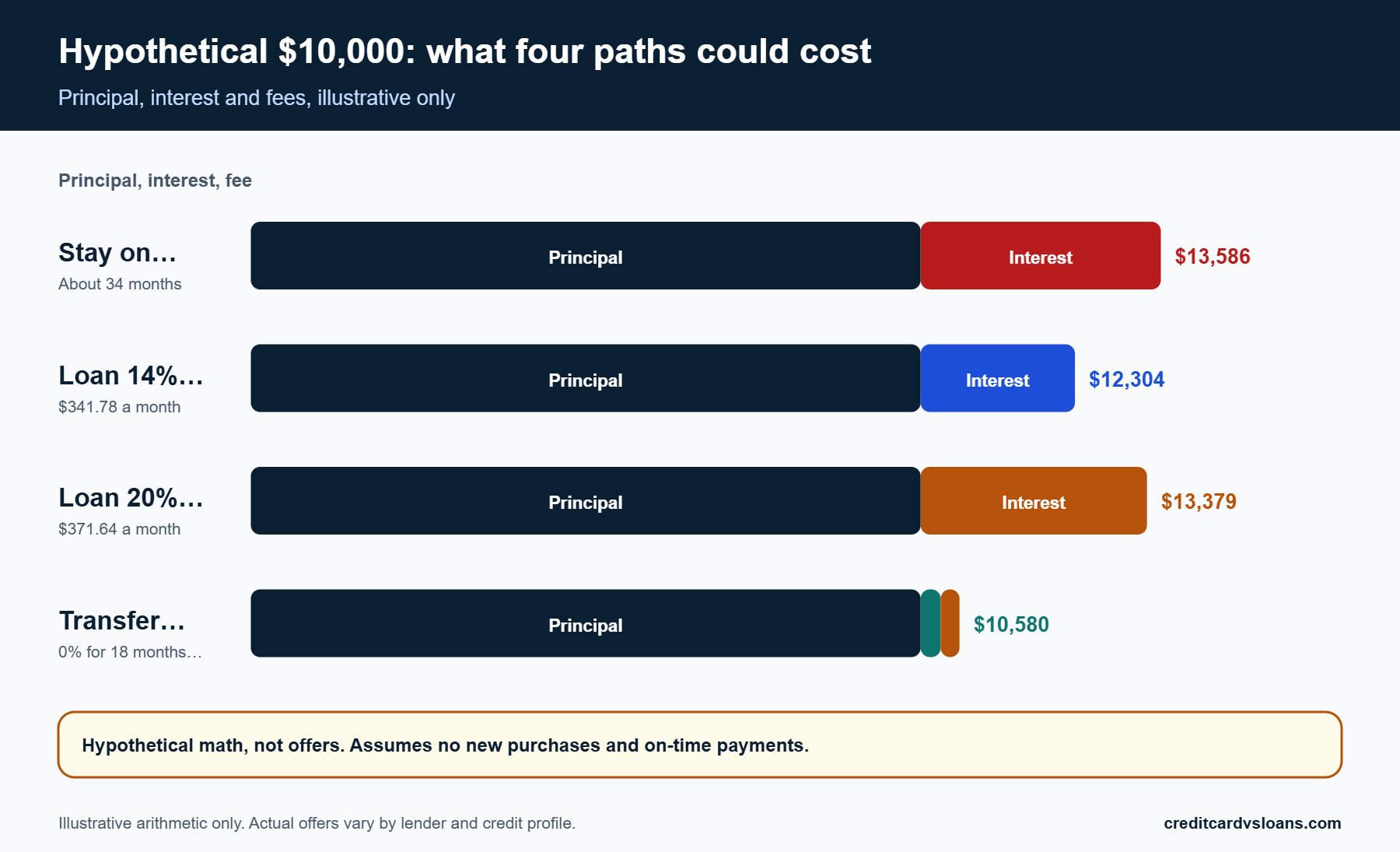
Suppose you keep the $10,000 on a card at 22.36 percent and pay a fixed $400 a month with no new purchases. In this hypothetical, you finish in about 34 months and pay roughly $3,586 in interest. Paying only $250 a month stretches the payoff to about 75 months and roughly $8,522 in interest. The same balance, the same card, and a different monthly amount produce very different outcomes.
That comparison is the benchmark for any loan. A 14 percent loan at $341.78 a month finishes in 36 months for $2,304 in interest, so it beats the $400 card plan on cost. A 20 percent loan with a fee at $391.20 a month costs about $4,083, which is more than the $400 card plan. The takeaway is not that cards beat loans. It is that a payment you can sustain beats any rate you cannot.
Balance transfer math with a fee and a deadline
Now take a hypothetical balance transfer: the $10,000 moves to a card with a 3 percent transfer fee ($300) and an 18-month zero-percent promotion, so you start at $10,300. Paying $572.22 a month clears the balance within the promotion and the cost is just the $300 fee. Paying $400 a month leaves $3,100 when the promotion ends. If the rate then jumps to 22.36 percent, you would finish in about 27 months total and pay about $280 in interest on top of the fee, roughly $580 in all.
The lesson is the catch built into every promotion: the savings depend on the payment, not on the card. If $572 a month is out of reach, the transfer may still help, but treat the post-promotion rate as the one you may actually pay.
Lower Scores: Poor and Fair Credit Paths That Keep You in Control
Poor Credit: Start With Help and Rate Caps
Talk to a nonprofit counselor before you borrow
The Federal Trade Commission says legitimate credit counselors review your whole financial situation before proposing a personalized plan, and that they don’t promise to fix everything or ask for large payments up front. It points to credit unions, universities, military personal financial managers, and Cooperative Extension Service offices as places to find nonprofit help. The CFPB adds that you should check any counselor with your state attorney general and local consumer protection agency, and that a legitimate agency should send free information without demanding details about your finances first.
A first conversation with a counselor can answer questions a score cannot: whether your income covers a payoff plan, whether your creditors will agree to lower rates or waive fees, and whether a different route, such as bankruptcy advice from an attorney, deserves a look. The CFPB’s consolidation guidance suggests asking creditors directly whether they will lower minimums, waive fees, reduce your rate, or move your due date.
Credit union small-dollar loans and payday alternatives
Some federal credit unions offer payday alternative loans, often called PALs. The National Credit Union Administration notes that federal credit unions may charge up to 28 percent on these loans under its regulations. That is not cheap compared with prime-tier loans, but it is a defined cap, and it contrasts with the very high costs the CFPB associates with payday and title-style products. Terms, loan sizes, and eligibility rules vary, and membership is required, so check with the credit union directly.
A PAL or small-dollar loan is a better fit for a short cash crunch than for a large credit card balance. If your debt is much larger than these loans typically cover, a counselor-run plan or a conversation with your issuers may fit better. Our look at approval and rate factors around a 650 score shows how lenders tend to view applications in the credit range where many borrowers start looking.
Fair Credit: Prequalify, Then Compare Against Your Current APR
When a loan can beat the card you already have
If your card charges something near the 22.36 percent preliminary August 2026 average the Federal Reserve reports for accounts assessed interest, a fixed-rate loan in the high teens could beat it on paper. In our hypothetical $10,000 example, a 20 percent loan without fees costs about $3,379 in interest over 36 months, versus about $3,586 for a $400-a-month card plan. That is a modest difference, and it disappears if the loan carries a meaningful origination fee.
The useful test is simple: put the loan’s total cost, including fees, next to the total cost of paying the same monthly amount on the card. If the loan wins by a wide margin and you will not rack up new card debt, it can make sense. If the margin is thin, a free alternative may be better.
When to pause and keep the card strategy
Pause if the offered APR is close to or above the card’s, if the term stretches far beyond the time you would need on the card, or if the lender requires you to pay for add-ons. A longer term lowers the payment but can raise total cost, as the CFPB warns.
Pause as well if a new account would strain the budget. A missed payment on a new loan can hurt your history more than the interest ever helped, and the CFPB notes that payment history is the most important scoring factor. If you aren’t sure, prequalify with two or three lenders and ask a counselor to sanity-check the numbers before you formally apply.
Good and Excellent Credit: Lower Prices, Different Risks
Good Credit: Personal Loan or Transfer Card?
Match the tool to your payoff speed
A rule of thumb helps here. If you can pay the whole balance within the promotional period of a transfer card, the card often wins on cost. If you need three to five years, a fixed-rate loan usually offers more certainty, because the rate and the payoff date are set up front. Hypothetical: with a $10,300 transferred balance and an 18-month promotion, the $572 monthly payment needed to finish on time is far above the $342 payment on a 14 percent, 36-month loan.
That difference in payment is the whole decision. A payment you can’t afford forces you into the post-promotion rate, which is why many borrowers find it clarifying to write down the largest monthly amount they can commit to before comparing products.
Read the terms that hide in the fine print
Ask each lender or issuer for the APR after the promotion, the balance transfer fee, any origination fee, whether the rate is fixed, and whether prepayment is penalized. For cards, ask what happens to the rate if you pay late, since the CFPB notes that being more than 60 days late can let the issuer raise your rate on all balances.
Also confirm what counts as the credit limit on a new card. If the limit is lower than your balance, a transfer may only be partial, and the leftover balance will keep its old rate. Our head-to-head on a balance transfer card versus a personal loan walks through the cost and score trade-offs of each side in more detail.
Excellent Credit: Low Rates Are Not a Payoff Plan
What excellent credit can open, and what it can’t fix
With very strong credit, you may see lower fixed rates, longer promotional periods, or higher limits. Those are real advantages, and they can reduce interest meaningfully. But a low rate does not shrink the principal. If the balance exists because spending outpaced income, the CFPB warns that taking on new debt to pay old debt can postpone the problem unless spending falls or income rises.
Before you chase the lowest rate, write down what created the balance and what has changed since. A consolidation that clears your cards, followed by new card balances, can leave you with the loan and the debt.
Why home equity borrowing deserves extra caution at any score
Excellent credit can make home equity loans or lines look attractive because rates on secured borrowing can be lower. The CFPB’s guidance lists the risks: your home secures the loan, so failure to repay could lead to foreclosure; closing costs can run from hundreds to thousands of dollars; and if home values fall you could owe more than the home is worth.
Turning unsecured credit card debt into debt secured by your home changes the stakes. If you are considering it, compare the all-in cost to unsecured options and think through what happens if your income drops. Many borrowers will conclude that the savings do not justify the added risk.
How Your Payoff Choice Affects Your Score, and Mistakes That Undo the Plan
What Typically Happens to Your Credit
Inquiries, new accounts, and the shopping window
Applying for a new loan or card normally triggers a hard inquiry, and a new account lowers the average age of your accounts, which FICO places in the length-of-history category. The CFPB says a single inquiry has little impact, and that scoring models usually treat several inquiries of the same type made close together as one: generally those 14 to 45 days apart count as no more than one. For the most common models, it adds, certain loan inquiries made within 30 days before scoring have no effect.
The safe reading is that a short, focused shopping window carries limited risk, while scattering applications over many weeks, or applying for several different kinds of credit, can add up. Prequalify with soft pulls wherever you can, and save formal applications for the offers you would actually accept.
Balances, utilization, and the urge to close old cards
Paying down revolving balances reduces how much of your available credit you use. Using a high share of your credit can lower a score, and the CFPB suggests keeping utilization under about 30 percent. Consolidating card balances into an installment loan can drop reported card utilization sharply, but scores respond to your whole profile and no one can promise a particular change.
After paying off cards, resist closing them without thinking it through. The CFPB says closing a card does not reliably raise your score and can raise your utilization ratio. Closing may still make sense if the card has fees that outweigh its value or tempts you to overspend. Our guide to score changes after debt consolidation covers that trade-off.
Mistakes That Undo a Payoff Plan
Running the cards back up
The most common reason consolidation fails is not the math. It is that the cards empty out and then fill again. If the new loan payment is added on top of fresh card balances, the monthly burden rises and the cushion shrinks. Consider keeping one low-limit card for emergencies and storing the others out of easy reach, or setting alerts at a chosen spending level.
A budget that includes a small buffer for surprises tends to help more than good intentions do. The CFPB’s consolidation guidance suggests identifying why the debt built up and building a budget to see whether adjusting spending for a period could pay it off.
Paying for debt relief that charges first
The CFPB cautions that many offers that sound like consolidation are actually debt settlement companies that may charge up-front fees, tell you to stop paying your debts, and direct your money into a special account. It describes stopping payments to creditors as something that can add fees and interest, damage your credit, and invite lawsuits, and notes that forgiven debt may also be taxable. It adds that debt settlement companies that charge before a settlement is reached may be breaking the law.
If an offer asks you to stop paying or to pay before results, walk away and call a nonprofit counselor, your state attorney general, or the CFPB. Reporting suspected fraud is free at ReportFraud.ftc.gov.
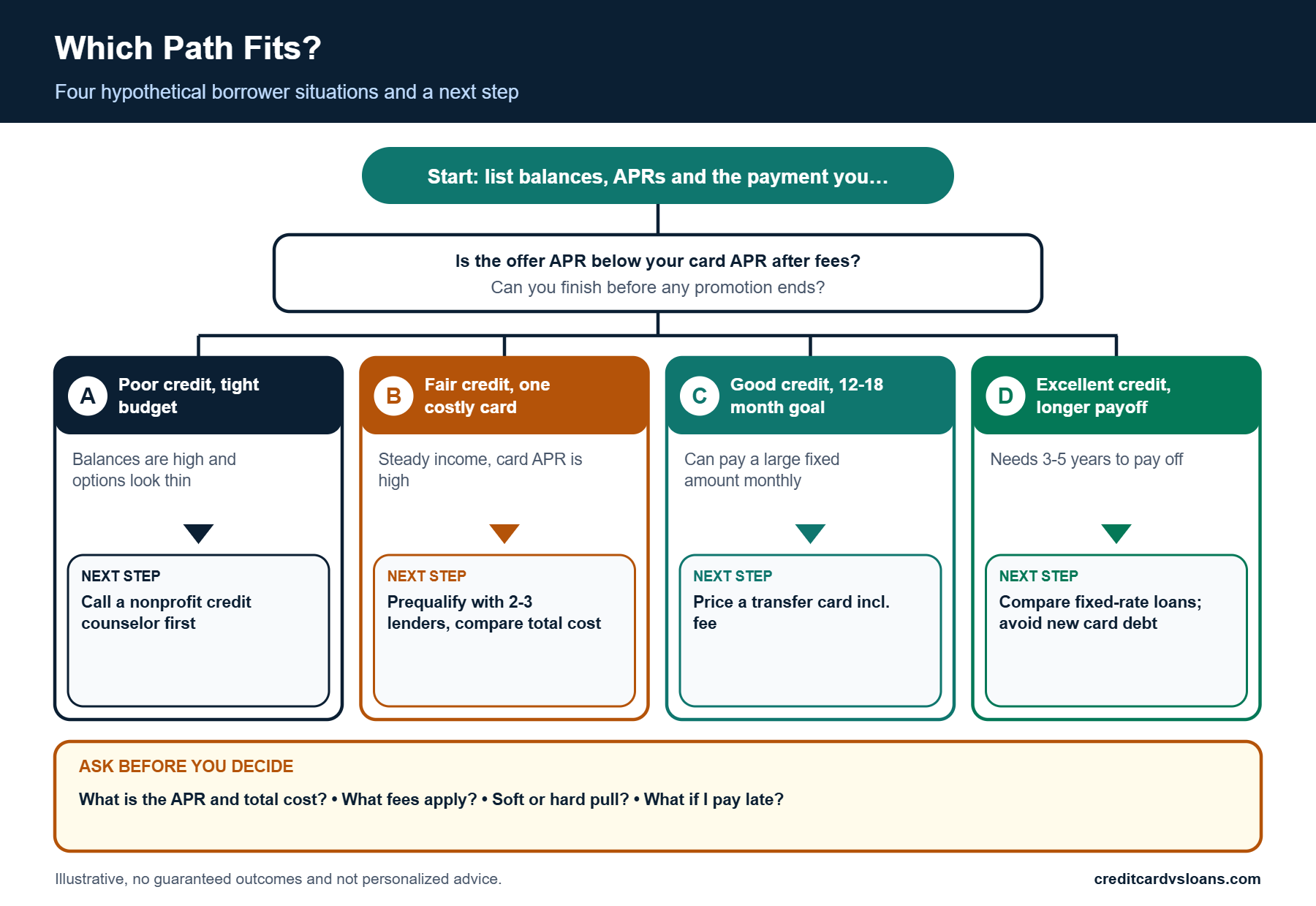
| Borrower scenario | Option to investigate | Why | What to verify | When to avoid it |
|---|---|---|---|---|
| Poor credit, high balances, income is tight | Nonprofit counseling and debt management plan | Structure without a lender’s pricing model | Plan fees, effect on accounts, nonprofit status | Anyone who charges before delivering or says to stop paying |
| Fair credit, steady income, one costly card | Fixed-rate loan after prequalifying | Set payoff date; APR may beat card | APR, origination fee, term, prepayment | If APR is near your card’s or fee is large |
| Good credit, can pay within about 12-18 months | Balance transfer card | Promotion can cut interest | Transfer fee, promo length, post-promo APR, late-payment terms | If you will keep using the old or new card |
| Good to excellent credit, needs 3-5 years | Fixed-rate personal loan | Predictable payment and end date | Total cost with fees, direct payoff of creditors | If the longer term costs more than the card plan |
| Any score, owns a home, tempted by equity | Compare secured and unsecured costs side by side | Rate may be lower | Closing costs, foreclosure risk, changing home values | If a missed payment could put your home at risk |
Your Decision Checklist and Next Steps
Questions to Settle Before You Decide
What if an application is declined?
A decline is information, not a final answer. The FTC notes that if a company denies you credit, a job, or insurance based on your credit report, you can request a free copy of that report within 60 days of the notice. Read it for errors, since disputes are free and both the bureau and the company that reported the item are responsible for fixing mistakes.
Then widen the comparison. Another lender, including a credit union, may price the same profile differently, and a nonprofit credit counselor can help you decide whether to reapply or choose a different path. Avoid applying everywhere at once, since several unrelated applications can add up on your report.
Is a longer term ever the right call?
Sometimes, if the alternative is missing payments. Hypothetically, a $10,000 loan at 14 percent costs $341.78 a month over 36 months and $2,304 in interest, while a 60-month term lowers the payment to $232.68 but raises interest to about $3,961. That is roughly $1,657 more for the breathing room.
If you choose the longer term, confirm that the lender does not charge a penalty for early payoff, and consider paying extra when your budget allows. That way you keep the lower required payment as a safety net without locking in the higher total cost.
How often should you re-check your options?
Your offers can change as balances fall, income changes, and reports update. A fair rule of thumb is to revisit the comparison after a few months of steady payments, or sooner if a major item on your reports changes. Prequalifying with a soft pull lets you see updated terms without adding a hard inquiry, and your free reports let you confirm that paid-down balances are showing correctly.
Keep in mind that refinancing a payoff loan has its own costs and a new account can briefly lower your average account age. Only switch if the total savings, after any new fee, are clear.
Before You Apply for Anything
Questions to answer with real numbers
Work through these in order and write the answers down. They take about an hour, and each one removes options that look good on a marketing page but not on your statement.
- What are the exact balances and APRs on each debt, and what is the total of the minimum payments?
- What is the largest monthly amount you can commit to for the whole payoff period, including months with surprises?
- What would paying a fixed amount on your current cards cost in total, using the highest-APR-first method?
- For each offer, what are the APR, the fees, the term, and the total cost in dollars?
- Does the offer use a soft pull to prequalify, and will a formal application involve a hard pull?
- What happens to the rate if you pay late, and is there a prepayment penalty?
- What changed in your spending so that the balance does not come back?
Documents and checks to gather first
Pull your free credit reports from AnnualCreditReport.com. The FTC says each bureau offers free reports, including weekly access, and that you can dispute errors for free. Fixing an error before you apply can matter if it affects the rates you are offered. Gather recent pay stubs or other proof of income, the latest statements for each debt, and a list of any accounts you want to keep open.
If any of the numbers do not fit together, a nonprofit credit counselor can review them with you. Ask the counselor how fees are charged and get any plan in writing before you agree.
Conclusion: Choosing Your Path
A simple decision rule
Choose the option with the lowest total cost that you can pay for as long as it takes, using actual offers rather than tier labels. Lower scores usually point toward free or low-cost help, rate caps, and cutting costs on existing debt. Higher scores widen the field to loans and transfer cards, where the work shifts to comparing fees and promotional periods. A score tells you where you might start looking. The math tells you where to stop.
If you are close to a score threshold that would change your options, remember that on-time payments and lower balances support your history, but no one can promise a specific result on a specific date.
Next steps
- List every debt with its balance, APR, and minimum payment, and choose a monthly payoff amount.
- Check your credit reports and dispute errors directly with the bureau and the company that reported them.
- Price your current plan: how long and how much interest if you simply pay down the highest-rate card first?
- Prequalify with two or three lenders, including a credit union, and write down APR, fees, and total cost.
- If your score is low or the numbers don’t work, contact a nonprofit credit counselor before you borrow.
- Pick the option with the lowest total cost at a payment you can keep up, and set up automatic payments.
When you want to dig into any one path, our guides to card debt consolidation by credit profile and the score needed for a debt consolidation loan go deeper.
- Personal Loan With a 650 Credit Score: Approval and Rate Factors
- Credit Card Debt Consolidation: Best Options by Credit Profile
- What Happens to Your Credit Score After Debt Consolidation?
- Balance Transfer Card vs. Personal Loan: Best Way to Pay Off Debt?
- What Credit Score Do You Need for a Debt Consolidation Loan?
- CFPB: What is a credit score?
- CFPB: What do I need to know if I’m thinking about consolidating my credit card debt?
- CFPB: What is the difference between credit counseling and debt settlement, debt consolidation, or credit repair?
- CFPB: What is a balance transfer fee?
- CFPB: What kind of credit inquiry has no effect on my credit score?
- CFPB: How does a lender decide what interest rate to offer me on an auto loan?
- CFPB: How to reduce your debt
- CFPB: Does it hurt my credit to close a credit card?
- Federal Reserve: Consumer Credit – G.19 (release of October 7, 2026)
- FTC: Fixing Your Credit FAQs
- NCUA: Permissible Loan Interest Rate Ceiling Extended
- myFICO: What’s in your credit score?
Last updated: October 22, 2026. Rates, fees and lender rules change; verify current terms before acting.
The information on creditcardvsloans.com is provided for general educational and informational purposes only. It is not financial, legal, tax, credit, accounting or investment advice, and reading it does not create an advisor-client, fiduciary or any other professional relationship. Nothing here is an offer, solicitation or recommendation to borrow, lend or apply for any product.
Credit scores, interest rates, fees, eligibility rules, lender policies and laws change frequently and vary by lender, location and individual circumstances. Examples, figures and scenarios are illustrative only, do not predict your results and do not guarantee approval, savings, a particular rate or a credit-score outcome. Always confirm current terms directly with the lender or issuer and read the full agreement before you apply or sign.
Although we aim for accuracy and use reputable sources, we make no representations or warranties, express or implied, about the completeness, accuracy, reliability or timeliness of the content. Content may be drafted with the assistance of automated tools, so errors or omissions may still occur. Links to third-party sites are provided for convenience; we don’t control and aren’t responsible for their content.
To the fullest extent permitted by law, creditcardvsloans.com and its owners, editors, authors, contributors and affiliates disclaim all liability for any loss, damage or expense arising directly or indirectly from your use of, or reliance on, this content. Before making financial decisions, consult a licensed professional, such as a qualified financial advisor, attorney, tax professional or nonprofit credit counselor, who can consider your complete situation.