Taking out a personal loan to build credit is rarely the cheapest way to do it, and it only works if every payment arrives on time. A loan can add a positive payment history and a different type of account to your file, but you pay real interest for a benefit nobody can promise. For most people starting out or rebuilding, lower-cost tools exist, so the honest answer is usually "compare first."
This guide is about that one decision: whether to borrow primarily for the score. It is not a guide to how loans affect scores in general, which we cover in our explainer on the credit score impact of a personal loan, and it is not a month-by-month timeline, which lives in our post-loan score timeline. Here we compare costs, alternatives and risks so you can decide whether the tradeoff makes sense for you.
A word on who this is for. People who ask this question tend to fall into two groups: those with a thin credit file, meaning few or no accounts, and those with a damaged file who want to show better behavior. The advice differs a little between them, and we flag where.
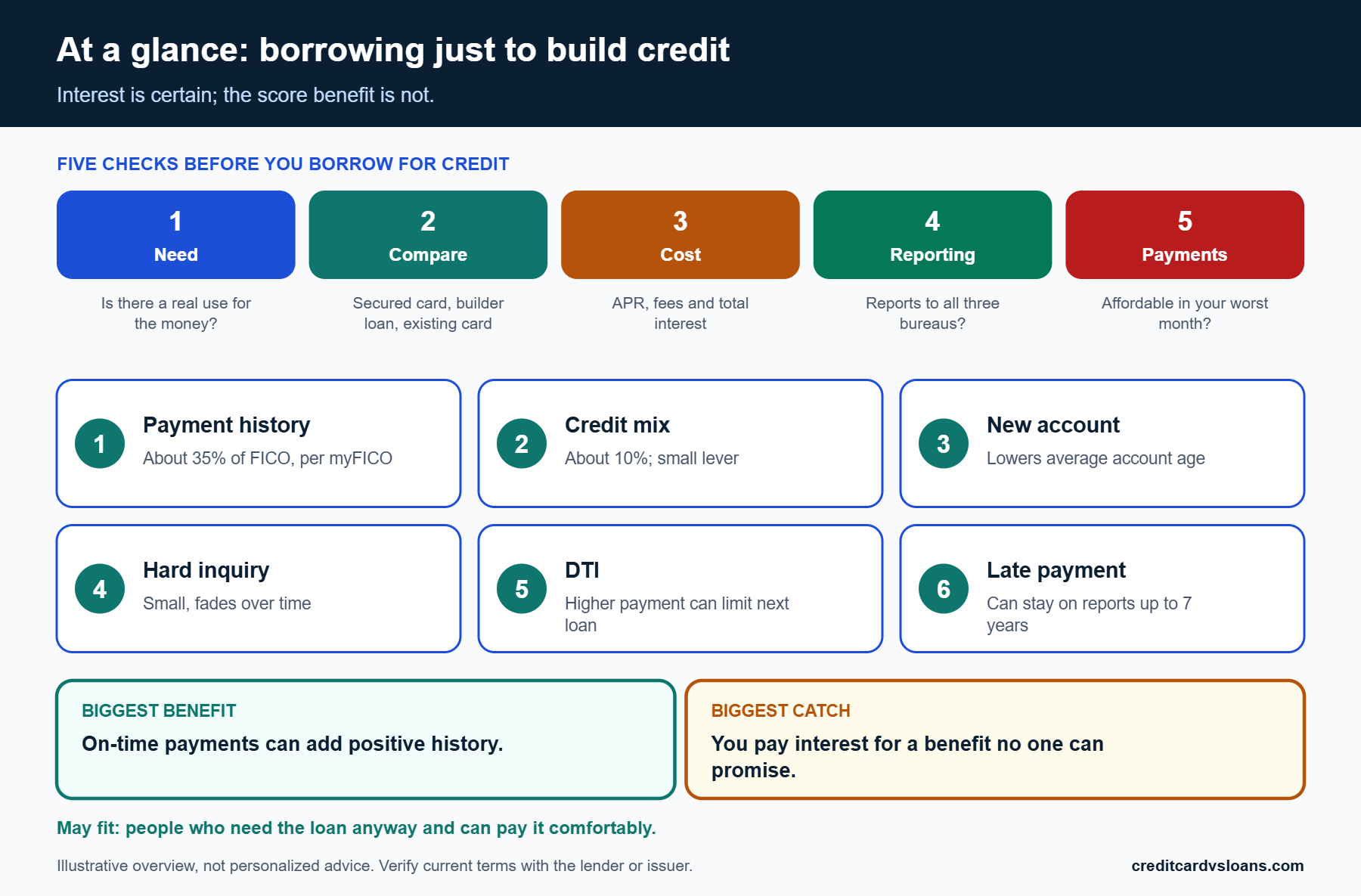
- Interest is certain; the score gain is not. Nobody can promise how a loan will move your score, but the interest and fees on a loan are fixed in a contract.
- Payment history is the engine. myFICO puts payment history at about 35% of the FICO Score. A loan helps only if you pay on time, every time.
- Credit mix is a small piece. It is about 10% of the score, so adding an installment loan to a card-only file is a minor lever.
- Builder products exist for this purpose. The CFPB points people new to credit or rebuilding to secured cards and credit-builder loans.
- Check what gets reported. If the lender does not report to the bureaus, the loan builds nothing.
Score-factor weights come from myFICO. The credit-builder loan findings come from a 2020 CFPB practitioner guide about one credit union's product, so treat them as one data point and not a rule. The market rate reference comes from the Federal Reserve's G.19 release of October 7, 2026.
The short answer: should you take a personal loan to build credit?
A conditional verdict
When the answer leans no
The answer leans no when the loan is optional, the APR is meaningful, and you can build a history another way. Suppose you can open a secured card with a modest deposit or qualify for a student or starter card. Those paths can create the same monthly reporting for little or no interest, as long as you pay the card in full. If the only reason for a personal loan is the score, the interest you pay is the price of a benefit you could often get cheaper.
It also leans no if your budget is already tight. A new fixed payment can create the very late payments you are trying to avoid. The CFPB's credit-builder research found that about 40% of participants made at least one late payment on a credit-builder loan, even though the payments were deposited back into their accounts right away. If a small, designed-for-the-purpose loan produced that many late payments in that study, a larger, interest-bearing loan carries more risk.
When the answer could be yes
The answer could be yes when you already need to borrow for a real purpose, the APR is reasonable for your profile, and the payment fits comfortably. In that case, building credit is a possible side benefit, not the reason. A person with a long, clean file of credit cards who needs to finance a household repair is in a different position than a person who wants an installment loan to diversify.
It can also be yes for a thin-file borrower who has already tried or ruled out secured products, has stable income, and sizes the loan small and short. Even then, treat it as an informed trade, with a cost you can name in dollars.
Why the idea is tempting
The appeal of "credit mix" and history
The pitch sounds logical. Credit scoring looks at payment history, amounts owed, length of history, new credit and mix of credit types. A personal loan seems to touch several categories at once. That is true as far as it goes, and we unpack each factor in the credit score impact guide.
The problem is proportion. The factors are not equal, and the ones a loan helps most (payment history, a bit of mix) can be built with cheaper tools. The ones a loan hurts at first (a new account lowering average age, a hard inquiry, more total debt) show up immediately.
The role of marketing
Lenders sometimes market loans with language about building credit. That is not false, but it is selective. A marketing page rarely shows the total interest on a small loan next to the score benefit. Read the offer as you would any other: APR, term, fees, whether payments are reported to all three bureaus, and whether there is a prepayment penalty.
Be skeptical of any claim of a specific score outcome. Scores vary by model and bureau, as the CFPB explains, so no one can know in advance how yours will respond.
| Your situation | Leaning | Why |
|---|---|---|
| No credit history, can open a secured card | Try the card first | Same monthly reporting, no interest if paid in full |
| Need to borrow anyway, affordable payment | Loan can fit | Credit benefit is a side effect of a real need |
| Tight budget, irregular income | Hold off | A missed payment undoes the point |
| Rebuilding after late payments | Compare carefully | Small, low-cost builder tools may serve better |
| Offer asks for upfront fees | Walk away | A warning sign of a scam or predatory product |
How a loan builds credit, and where the benefit stops
What a loan can actually add
A record of on-time payments
According to myFICO, payment history is the largest category in the FICO Score at about 35%. A personal loan has a fixed monthly payment and a reporting history, so each on-time month adds a positive data point to the account. That is the central mechanism, and it is real.
It is also slow. A single account with a few months of history is a small signal. Time, not just the existence of the account, is what makes a record meaningful, which is why shortcuts that promise fast score jumps deserve suspicion.
A different type of account
Credit mix is about 10% of the FICO Score, per myFICO, and counts credit cards, installment loans, retail accounts, finance company accounts and mortgages. If you have only cards, an installment account adds variety. If you already have a car loan or a student loan, a personal loan adds little on this dimension.
Because mix is a small slice, nobody should pay hundreds of dollars in interest to move it. If you need the loan anyway, accept the mix benefit as a bonus.
Where the benefit stops
The new-account and inquiry drag
Opening any new loan adds a hard inquiry, which the CFPB says can lower your score, and a new account that lowers the average age of your accounts. myFICO says one extra hard inquiry lowers a FICO Score by fewer than five points for most people, and that inquiries are considered for 12 months. These are small and fade, but they happen first.
For someone with a thin file, a new account is a larger share of the whole file, so both the benefit and the drag can feel bigger. That is why watching reports closely in the first few months matters.
Reporting gaps and the missing bureau
Some small lenders report to one bureau or none. A loan that is invisible to the bureaus is a cost with no credit benefit. The CFPB notes that credit-builder lenders report payment history to the three major credit reporting agencies as standard installment loans, which is the model to look for. Ask each lender, in writing if possible, which bureaus it reports to and how often.
After the first full billing cycle, check your own reports. Free reports are available at AnnualCreditReport.com, and the FTC points consumers there. Confirm the account appears with the right balance and status.
What it costs to build credit with a personal loan
The price in dollars
Interest on a small, short loan
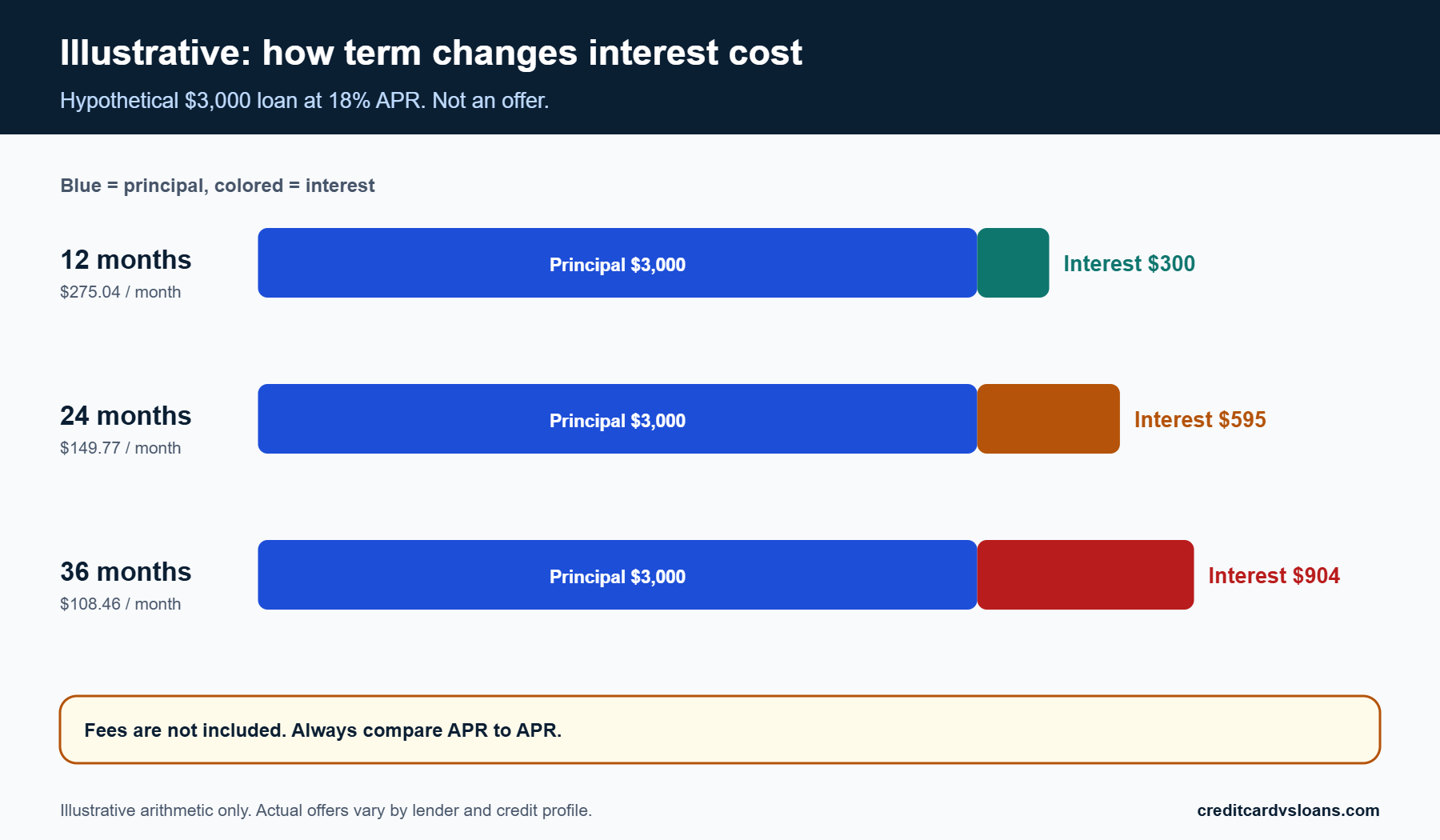
The cost of borrowing a small amount for a short time is easy to underestimate because the percentages sound large but the dollars are modest. The chart below uses a hypothetical $3,000 loan at 18% APR to show how the term changes total interest. These are illustrations with fees excluded, not offers.
The pattern is the thing to notice: a shorter term costs less in interest but carries a higher payment, and a longer term does the reverse. Since the credit benefit comes from on-time payments, not from time spent in debt, a loan that you can repay faster without strain is usually the better structure for this purpose.
Where market rates sit
The Federal Reserve's G.19 release of October 7, 2026 reported a 24-month personal loan rate at commercial banks of 11.90 percent for August 2026 (preliminary, not seasonally adjusted). That is an average across banks and mostly reflects borrowers with stronger credit. If you are borrowing precisely because your file is thin or damaged, your quoted APR may be higher, and the Fed average is not a promise of what you will be offered.
The point of looking at the benchmark is to spot outliers. An offer far above typical levels should prompt a closer read of fees, term and reporting practices, and a comparison with the builder alternatives in the next section.
Costs that do not appear in the APR
The risk of a late payment
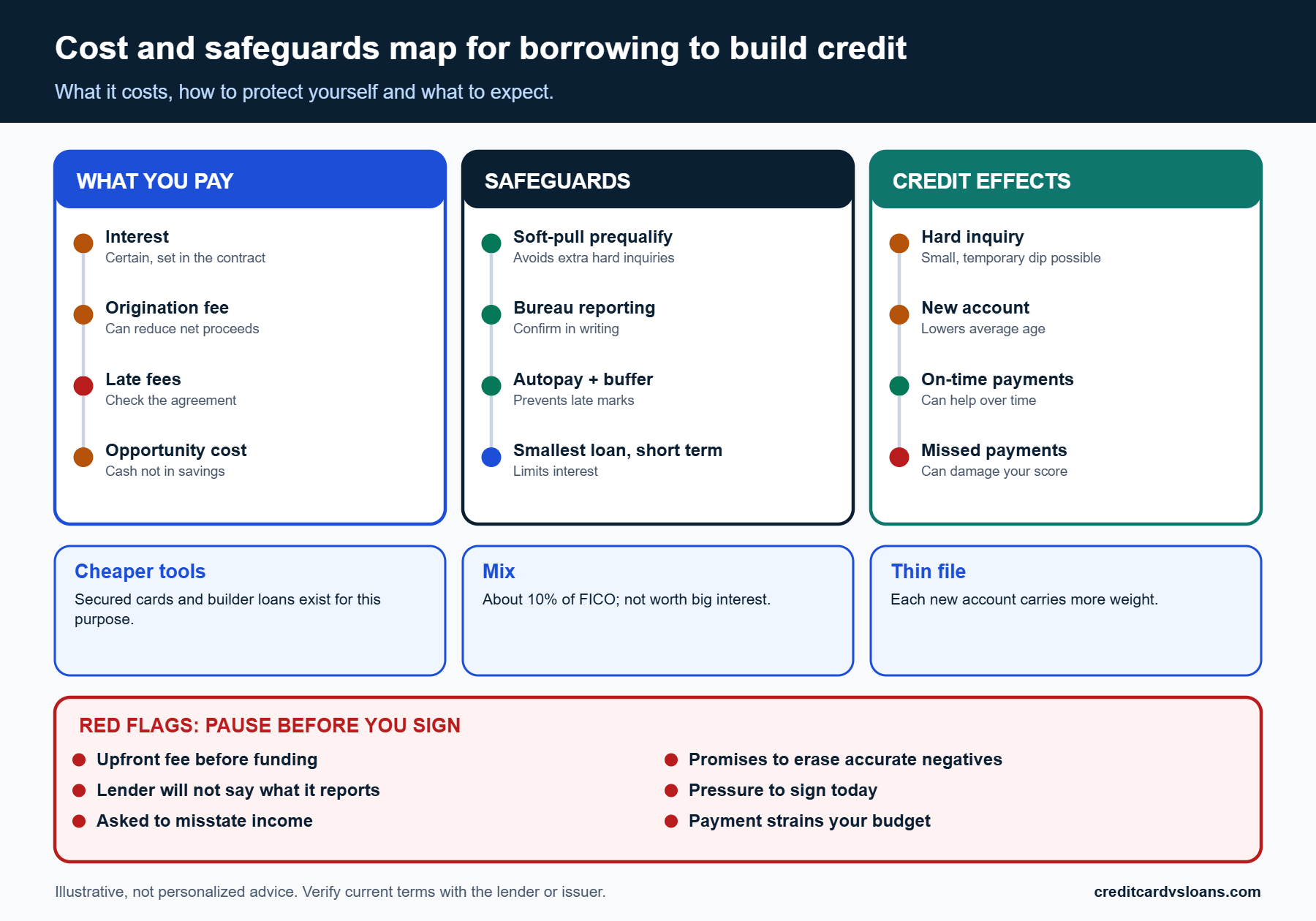
A late payment is the hidden cost. Under the Fair Credit Reporting Act (15 U.S.C. 1681c), most adverse items can be reported for up to seven years, so a delinquency on the very account you opened to build credit can leave a longer mark than the benefit you sought. Late fees add a direct dollar cost on top.
The cheapest protection is automation: autopay from a checking account that reliably holds the funds, a reminder a few days before the due date, and a cushion in the account equal to at least one payment.
Tied-up cash and opportunity cost
Cash that goes to interest and payments is cash that is not in savings. For a person with no emergency fund, committing a monthly amount to a loan payment can force card use when a surprise bill appears, which then raises utilization and can offset what you were trying to improve.
If you do not yet have a small emergency cushion, building even a modest one first often protects your credit better than a new loan would. One surprise expense can undo months of careful payments.
| Term | Monthly payment | Total interest | Trade-off |
|---|---|---|---|
| 12 months | $275.04 | $300.48 | Higher payment, least interest |
| 24 months | $149.77 | $594.54 | Middle ground |
| 36 months | $108.46 | $904.46 | Lowest payment, most interest |
All figures are hypothetical, computed with standard amortization and no fees. A real offer will differ, and an origination fee would add to the cost.
Lower-cost ways to build credit to compare first
Products designed for building
Secured credit cards
A secured card requires a deposit that typically becomes your credit limit, and the card issuer reports activity to the bureaus. Used lightly and paid in full each month, it builds payment history without interest. The CFPB's guidance for people new to credit or rebuilding points to secured cards and credit-builder loans as options.
The catch is fees and terms. Compare annual fees, whether the issuer reports to all three bureaus, how the deposit is returned, and whether the account can move to an unsecured card. We discuss starter-card basics in our guide to student credit cards, which is useful even if you are not a student because it explains how limits and utilization work for new users.
Credit-builder loans
A credit-builder loan works in reverse of a regular loan. The CFPB describes it: the lender places an amount equal to the loan in a locked savings account, you make monthly payments, and the lender returns the payments to you minus interest and fees. These loans were typically $300 to $1,000 in the CFPB's description, and the lender reports payment history to the three bureaus as a standard installment loan.
The CFPB study of one credit union's product found that borrowers with no existing debt were more likely to have a score and saw scores rise by up to 60 points on average, from a starting score of 560. For borrowers with existing debt, benefits were much smaller, and the loan slightly lowered scores on average. The study covered one standalone product from one credit union, so results will vary across programs. It is useful as evidence that the type of borrower matters.
Free or low-cost steps
Fix what is already on your reports
If your problem is not a missing history but a damaged one, the fastest step may be correcting errors. The CFPB says to check your reports at least once a year and dispute suspected mistakes, and the FTC says to dispute errors in writing with the credit bureau and with the business that reported the information. Furnishers generally must investigate and respond within 30 days of receiving your dispute, per the CFPB.
Correcting an inaccurate late payment or an account that is not yours costs only time and can matter more than adding a new account. For deeper recovery steps after a serious event, see our guide to rebuilding credit after bankruptcy.
Use the credit you have, carefully
If you have an existing card, paying on time and keeping utilization low is a free way to build. The CFPB suggests keeping credit use under 30% of your total limit and notes you do not need to carry a balance. Setting a small recurring charge on autopay and paying the statement in full each month produces monthly positive reporting at essentially no cost.
Ask yourself: if I can do this with a card I already have, what does a loan add? In many cases the answer is only a small mix benefit and an interest bill.
| Option | Typical cost | Reported to bureaus? | Main risk |
|---|---|---|---|
| Personal loan | Interest and possible fees | Ask the lender | Payment size and late fees |
| Credit-builder loan | Interest and fees; money returned over time | Typically yes, per CFPB description | Late payments; terms vary |
| Secured card | Deposit; check annual fee | Verify with the issuer | Fees and high utilization |
| Existing card, paid in full | No interest if paid in full | Yes | Overspending |
| Dispute report errors | Free | N/A | Takes time and paperwork |
Who a personal loan for credit building might fit, and who should skip it
Profiles where it can be reasonable
You need the money anyway
The strongest case is a loan you would take regardless of credit: a medical bill, a home repair, a move, or high-rate card debt you want to restructure. Here the credit benefit is incidental and the decision rests on cost and affordability. Compare it against alternatives for that purpose, and use our guide to the credit score you need for a personal loan to gauge what approval typically depends on.
If the loan consolidates card balances, utilization can also fall, which is a separate lever from payment history. That effect depends on keeping the cards low afterward, as explained in our credit score impact guide.
You have tried the cheaper tools and have stable income
Some people cannot qualify for a secured card in their area, or already carry one and want a separate installment account. If your income is steady, your budget has room, and the APR is reasonable, a small, short loan can be defensible. Keep it as small as your need allows.
It helps to write the plan down before you apply: the amount, the term, the payment, the autopay date, and the date you will check your reports. A written plan makes it harder to drift into a larger loan than you intended.
Profiles where it is usually a poor fit
You are borrowing to hold cash in an account
Some people take a loan and park the proceeds in savings so that the payment is covered. That can work mechanically, but you are paying interest on money you are not using, and the savings may earn far less than the loan costs. A purpose-built credit-builder loan does something like this at a smaller scale and a clearer price. A general-purpose loan does it at your expense.
If you want to save and build at once, compare the net cost, meaning loan interest minus what the savings earn, against a credit-builder product.
You already struggle with payments
If your current accounts are running late, a new loan is the wrong tool. The CFPB's credit-builder research noted that, for borrowers with existing debt, the loan appeared to increase late payments on other loans, which suggests the new payment crowded out existing ones. The first job is getting current, not adding accounts.
Consider speaking with a nonprofit credit counselor. The FTC suggests asking your credit union, university or military personal financial manager about nonprofit credit counseling programs.
If you decide to go ahead: a safer structure
Choosing size, term and lender
Size the loan to the need
Borrow the smallest amount that serves the purpose. The interest cost scales with the amount, and so does the harm of a missed payment. If a lender offers more than you asked for, you can say no.
Choose the shortest term whose payment you can pay without squeezing essentials. The table above shows how much a longer term can add in interest on the same principal, with the payment relief as the trade-off.
Verify the lender and the reporting
Confirm in writing which bureaus the lender reports to, whether it reports monthly, and whether there is a prepayment penalty. Ask for the APR, all fees in dollars, and the net amount you will receive. Compare at least two or three offers apples-to-apples, using prequalification tools that use soft pulls where available, because every formal application can add a hard inquiry.
Note that myFICO describes special rate-shopping treatment only for mortgage, auto and student loan inquiries, so do not count on multiple personal loan applications being grouped. Apply formally only where the offer is competitive.
Operating the loan
Automate and monitor
Set autopay for a date a few days after your income arrives, keep one payment of buffer in the account, and calendar a monthly check that the payment cleared. After 60 to 90 days, pull your credit reports and confirm that the account is reporting accurately.
If anything is wrong, the CFPB explains the dispute path: explain the issue in writing to the credit reporting company, include supporting documents, and also dispute it with the furnisher.
Keep the rest of your file steady
While the loan matures, avoid other new credit unless you need it, keep card balances low, and do not close your oldest accounts. The goal is a quiet, consistent file. A flurry of applications in the same months muddies the picture, since the CFPB notes that applying for a lot of credit in a short period can signal financial trouble to lenders.
Once the loan is paid, resist the urge to take another just to keep the activity going. Established payment history will continue to support your file as long as the accounts remain in good standing.
Scams and traps that exploit the "build your credit" pitch
Credit repair and builder pitches
What the FTC says to watch for
The FTC's consumer alert of January 7, 2026 lists these warning signs: companies that offer to remove accurate negative information, requests for payment before any work is done, pressure to misstate information on credit applications, and claims that they can do more than they can. It adds that credit repair companies must give you a written contract with a three-day right to cancel, and that they cannot legally remove correct and up-to-date negative information.
A "credit builder" pitch that wraps these same behaviors in a loan or subscription is still a red flag. Do not pay anything upfront to someone who promises to fix or build your credit.
Fee-first loans and pressure tactics
A legitimate loan comes with written terms, a clear APR and a chance to read before you sign. Offers that require a fee before funding, apply pressure to sign today, or leave blanks in the agreement are the opposite. Our guide to predatory lending warning signs covers the patterns in more detail.
If you are not sure about an offer, do not sign. Take the paperwork to a credit union staff member, a nonprofit counselor, or your state financial regulator for an independent read.
Traps inside legitimate loans
Origination fees and net proceeds
An origination fee, taken out of the loan amount, means you owe the full principal but receive less. On a small loan, the fee can be a meaningful share of the money you actually get. Ask for the net proceeds figure and compare it to the amount you really need.
When you compare offers, use APR to get an apples-to-apples view, because APR folds certain fees into the annual cost, while the interest rate alone does not.
Prepayment penalties and rollover
Some loans penalize early payoff or encourage renewing. If your goal is a short, clean history, a penalty works against you. Ask directly whether a prepayment penalty applies, and avoid any structure where you are encouraged to refinance into a new loan before the old one is paid.
Refinancing repeatedly can add fees and new hard inquiries and may keep you in debt longer than you planned.
If anyone asks you to pay a fee before the loan funds, to put false information on an application, or to hand over online banking credentials, stop. These are not features of a credit-building product.
Common questions about borrowing to build credit
Myths worth clearing up
Do I need to carry a balance to build credit?
No. The CFPB states that you do not need to carry a balance or have any debt to build a good score, and that paying in full each month gives the best scores and lowest interest costs. This matters here because it undercuts the premise that a loan is necessary: a card used lightly and paid in full builds history without interest.
The same reasoning applies to the idea that you must hold many account types. Credit mix is a real scoring factor, but a modest one, and a thin but clean file of on-time payments is a sound foundation.
Will paying the loan off early boost my score?
Paying a loan off early saves interest if there is no penalty, and it is usually the right financial move. It does not reliably raise a score, though. Once an installment account is paid, it is closed, and the active, in-progress payment record stops growing. Depending on your other accounts, the score can stay flat or move slightly either direction.
Our timeline in the post-loan score guide explains what payoff typically looks like in a file. The short version is to decide on payoff using interest savings, not the score.
Practical questions
How long before I should expect to see a difference?
It depends on how much history you already have. A person with no file may appear in the scoring system after the first reported month or two, since the lender reports payment status to the bureaus. A person with a longer file will see the loan as one account among many. In both cases a meaningful record forms over many months, not weeks.
Because scoring models and bureaus differ, as the CFPB notes, the exact score you see may vary from what a lender sees. Judge progress by the reports themselves: right account, right balance, no late marks.
What if the lender does not report to the bureaus?
Then the loan does not build credit, and you should reconsider whether it makes sense. Ask the lender in writing why it does not report and whether it will. If it will not, look for a lender, credit union or builder program that does.
If a lender said it would report and the account does not appear after a couple of months, contact the lender first. If the issue is not resolved, a complaint can be filed with the CFPB.
Special cases: thin files, rebuilding and big upcoming goals
Starting from little or nothing
Young adults and new arrivals with no history
If you have no credit file, the first goal is simply to appear in the system with accurate, positive reporting. The CFPB has published work on people who are credit invisible, and it points those without enough history to build their record with tools like secured cards. A first account of any kind starts the clock on account age, which is part of why starting early with something small and cheap beats waiting for the perfect product.
A student or starter card, used lightly and paid in full, often does that job for less than a loan. See our student credit card guide for how to avoid overspending while you build.
Why a bigger loan does not build faster
It is tempting to think a larger loan builds more credit. Scoring models look at whether you pay as agreed and how your balances compare with limits and original amounts, not at how impressive the number is. A large installment loan with a payment that strains you is riskier than a small one with a comfortable payment. The signal that matters is consistency.
A larger loan also raises your DTI, which the CFPB defines as total monthly debt payments divided by gross monthly income. A higher DTI can make the next application harder, at the very time you hoped the loan would help.
Rebuilding or planning a major purchase
If you are recovering from a serious setback
After bankruptcy, collections or a string of late payments, the instinct to add a new loan quickly is strong. The better order is usually to stabilize, correct errors, and start with small secured tools. We lay out that sequence in our guide to rebuilding credit after bankruptcy. The loan question comes later, and with more evidence of steady payment behavior behind you.
myFICO notes that the effect of negative items lessens over time, especially if you keep paying on time, and that no one can remove a legitimate negative item from your report. Patience and consistency do the work, and there is no purchased shortcut.
If a mortgage or auto loan is on the horizon
If you plan to apply for a mortgage or auto loan within months, think about timing. A new personal loan adds a hard inquiry, a new account and more debt right when a lender will study your file. A lender may also look closely at DTI.
The sensible move is to ask the future lender how a recent personal loan would be viewed, and to avoid opening anything non-essential in the months before. If the loan is for a necessary purpose, go ahead and explain it; just avoid doing it for the score.
| Question | Why it matters | Good answer looks like |
|---|---|---|
| Which bureaus do you report to? | No reporting means no credit benefit | All three, monthly |
| What is the APR and all fees? | Lets you compare apples-to-apples | Written APR, fee in dollars, net proceeds |
| Is there a prepayment penalty? | Affects ability to finish early | No penalty |
| Is the check a soft pull to prequalify? | Avoids unnecessary hard inquiries | Yes, clearly disclosed |
| What happens if I miss a payment? | Late fees and reporting rules | Clear fee and grace period in writing |
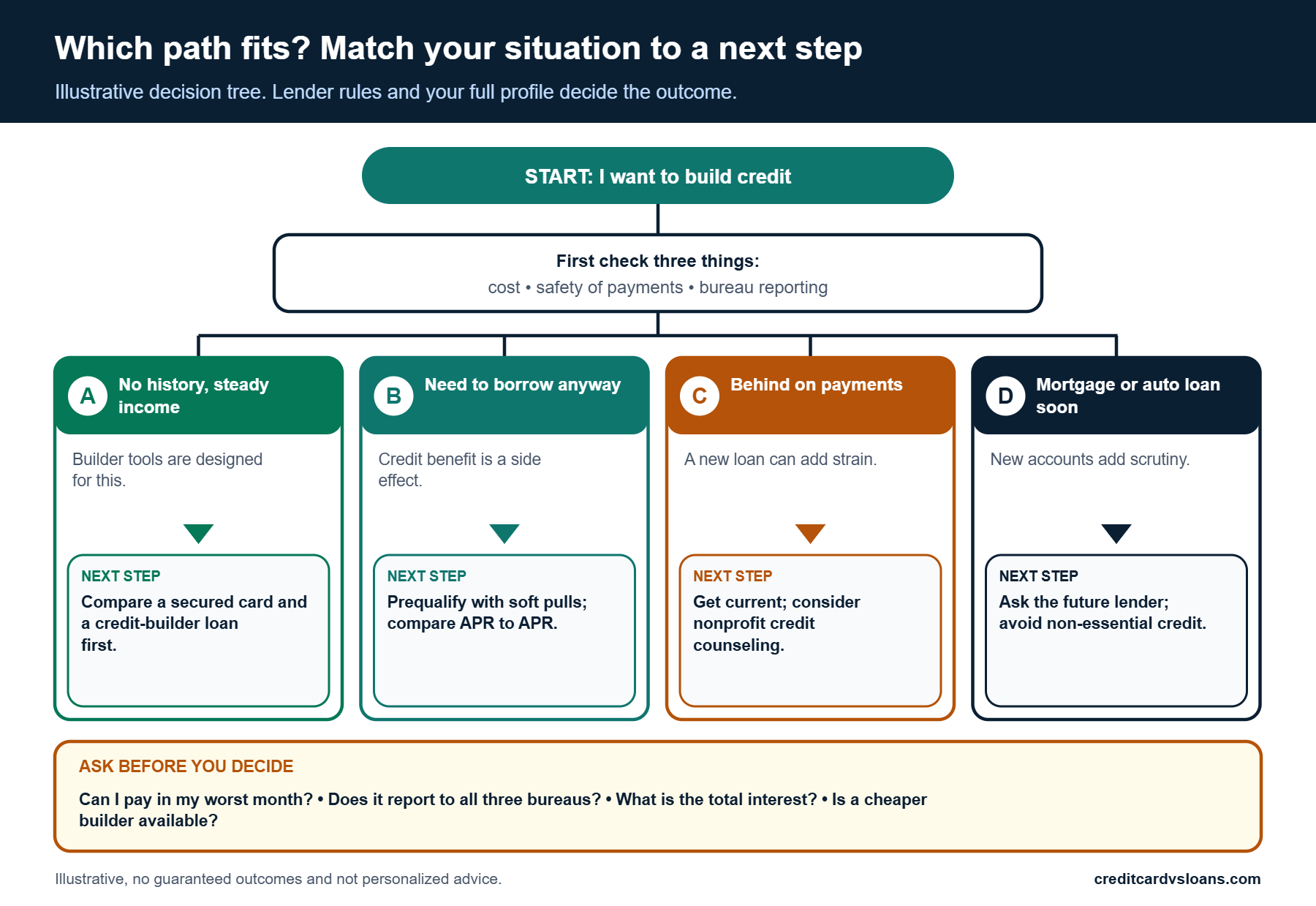
Decision checklist and next steps
The decision in plain terms
Three tests
Run any plan to use a personal loan to build credit through three tests. Cost: have you compared the total interest and fees to a secured card, a credit-builder loan or simply a card used lightly? Safety: can you make every payment on time in your worst normal month, with buffer? Reporting: have you confirmed the loan is reported to the bureaus?
If the plan fails any test, change the plan. If it passes all three and you also have a real use for the money, the loan is defensible.
What you should expect
Expect a small early dip, then slow improvement if payments are on time and the rest of your file is stable. Do not expect a specific number. The CFPB's own research shows large differences depending on whether borrowers already carried debt, which is why advice that ignores your situation should be treated with caution.
The personal loan to build credit decision deserves a comparison, not a reflex, and comparing takes an evening.
A personal loan can build a payment record, but it is usually the pricier route. Try cheaper builder tools first, borrow only what you need, confirm bureau reporting, and automate every payment.
Your next steps
A concrete list
- Pull your reports from AnnualCreditReport.com and dispute any errors in writing.
- Price a secured card and a credit-builder loan, and write down APR, fees and reporting practices.
- If a personal loan is still on the table, prequalify with soft pulls and compare net proceeds, APR and total interest.
- Pick the smallest amount and shortest term you can afford with a month of buffer.
- Set autopay and a calendar reminder the day the loan funds.
- Recheck your reports after one to three months to confirm accurate reporting.
For what happens to your score month by month once a loan is open, continue with our post-loan score timeline.
When to wait
Wait if you are within a few months of a mortgage or auto loan application, if your budget has no slack, or if the only offers available come with upfront fees. Waiting while you build an emergency cushion and clean up your reports is often the stronger credit move.
And if you are already behind on bills, a nonprofit credit counselor is a better first call than a lender.
- CFPB: Credit Builder Loans: Ideas for financial educators and financial practitioners (practitioner guide, July 2020) (Credit-builder loan description and study findings)
- CFPB: How do I get and keep a good credit score?
- myFICO: What is in your FICO Score
- CFPB: What is a credit inquiry?
- myFICO: How to rate shop and minimize the impact to your FICO Scores
- FTC: Spot the scams when fixing your credit (Jan. 7, 2026)
- CFPB: How do I dispute an error on my credit report?
- CFPB: What is the difference between a credit report and a credit score?
- CFPB: What is a debt-to-income ratio?
- Federal Reserve: Consumer Credit – G.19 (Oct. 7, 2026 release)
- Fair Credit Reporting Act: 15 U.S.C. 1681c – Requirements relating to information contained in consumer reports
- myFICO: Reviving my credit after bankruptcy
Last updated: October 22, 2026. Rates, fees and lender rules change; verify current terms before acting.
The information on creditcardvsloans.com is provided for general educational and informational purposes only. It is not financial, legal, tax, credit, accounting or investment advice, and reading it does not create an advisor-client, fiduciary or any other professional relationship. Nothing here is an offer, solicitation or recommendation to borrow, lend or apply for any product.
Credit scores, interest rates, fees, eligibility rules, lender policies and laws change frequently and vary by lender, location and individual circumstances. Examples, figures and scenarios are illustrative only, do not predict your results and do not guarantee approval, savings, a particular rate or a credit-score outcome. Always confirm current terms directly with the lender or issuer and read the full agreement before you apply or sign.
Although we aim for accuracy and use reputable sources, we make no representations or warranties, express or implied, about the completeness, accuracy, reliability or timeliness of the content. Content may be drafted with the assistance of automated tools, so errors or omissions may still occur. Links to third-party sites are provided for convenience; we don’t control and aren’t responsible for their content.
To the fullest extent permitted by law, creditcardvsloans.com and its owners, editors, authors, contributors and affiliates disclaim all liability for any loss, damage or expense arising directly or indirectly from your use of, or reliance on, this content. Before making financial decisions, consult a licensed professional, such as a qualified financial advisor, attorney, tax professional or nonprofit credit counselor, who can consider your complete situation.