A personal loan with 700 credit score is a realistic goal at most mainstream lenders, and a 700 usually puts you in a stronger bargaining position than fair credit does. The honest follow-up question, though, is “how much better?” The answer depends less on the three digits than on your income, your debt load, the loan amount and term, and which lender you ask.
This article is for borrowers who already have a solid score and want to know whether it is worth shopping hard, waiting for a few more points, or skipping the loan altogether. We will look at what 700 means in FICO’s scale, why two people at 700 can see different offers, what the Federal Reserve data can and cannot tell you about pricing, and where the real savings tend to come from.
If you are still deciding where you fall on the score ladder, our guide to credit score requirements for personal loans gives the whole picture. If your score is lower, the articles on a 600 score and a 620 score cover the more constrained options.
- A 700 falls in FICO’s “good” range (670 to 739), which many lenders treat as a mainstream, approvable tier, though no lender is obligated to approve any score.
- The gap between 700 and a higher score is real but not fixed; DTI, income, loan size and term can matter as much as the score itself.
- Rate shopping across banks, credit unions and online lenders is where borrowers at this level often find the biggest price differences.
- A lower APR does not always make a loan the right choice; the best question is whether you need the loan at all and whether a cheaper tool fits.
- Illustrative math in this article is hypothetical; real offers depend on your full profile.
Market context comes from the Federal Reserve’s G.19 consumer credit release of October 7, 2026. For a monthly look at rate conditions, see our credit card and personal loan rate outlook.
The short answer: what a 700 credit score gets you
Where 700 sits on the scale
The “good” tier, with 40 points to the next step
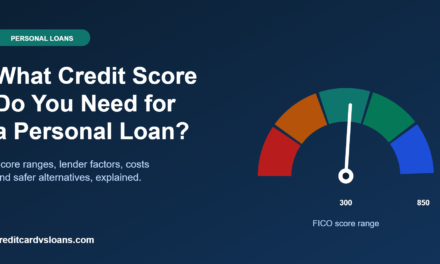
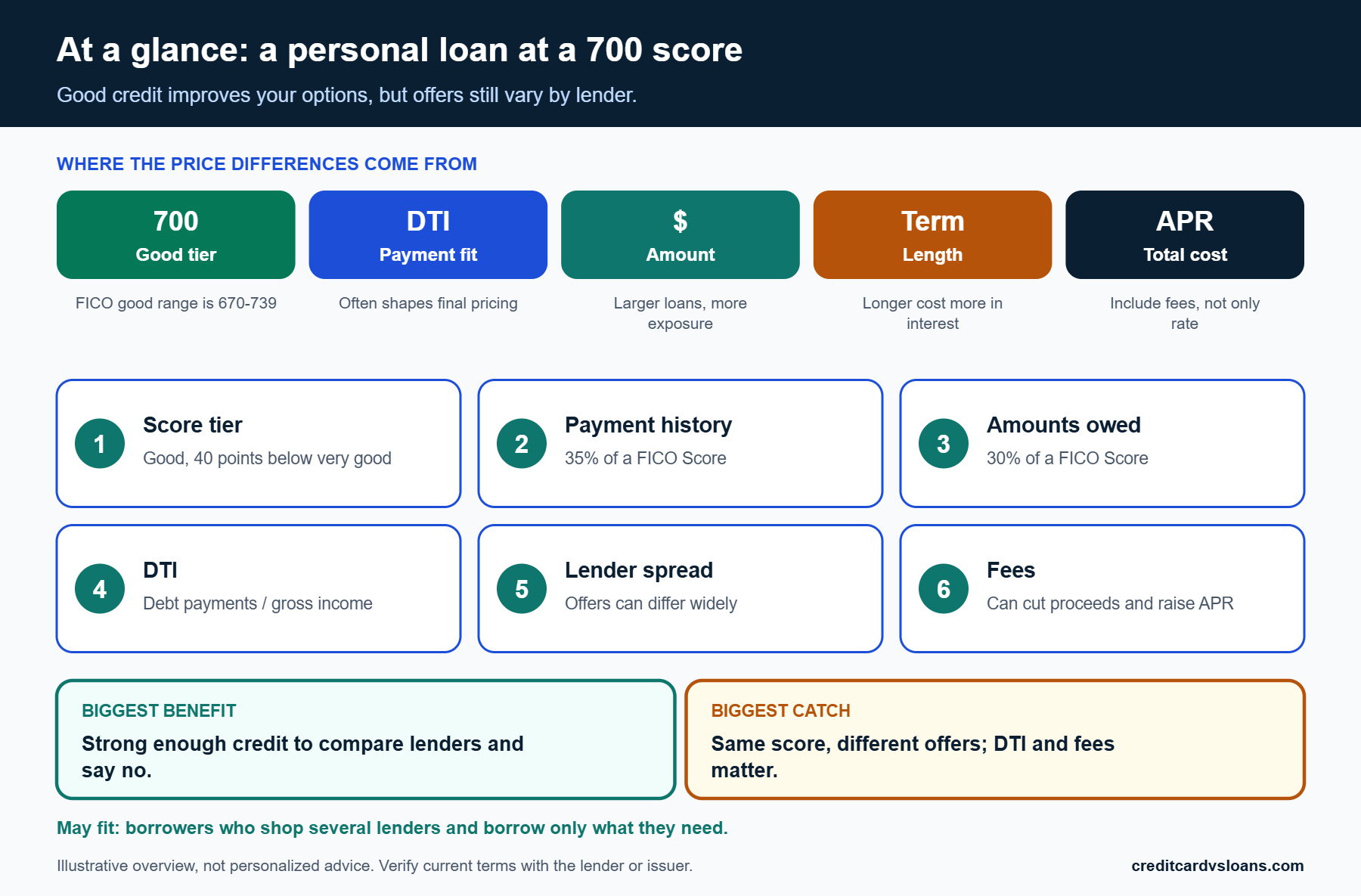
According to myFICO, FICO Scores range from 300 to 850, and the “good” range is 670 to 739. A 700 is comfortably inside it, about 30 points above the bottom and about 40 points below the “very good” tier that starts at 740. Many lenders use their own cutoffs, and those cutoffs are not published, so the labels are best treated as shorthand.
The useful way to think about 700 is that it is past the stage where the question is “will anyone lend to me?” and into the stage where the question is “who will lend to me on the best terms?” That change in question is why this article is about comparison rather than eligibility.
One of many scores
The Consumer Financial Protection Bureau (CFPB) explains that you have many credit scores, and they can differ based on the scoring model, the data source, the loan type and when they are calculated. A 700 on a free dashboard may be 690 or 715 on the version a lender pulls.
That matters when you are near a lender’s internal line. If you are at 700 on one report and 688 on another, do not assume you are in or out of a tier. Ask the lender what score range or model it uses, and expect the answer may be that it considers the whole file.
How much better can rates get?
Better than fair credit, but not a fixed price
It is reasonable to expect that a 700 score opens more doors and better pricing than a 600 does, because lenders use credit history to estimate risk. But there is no single published “rate for 700” that you can count on. Lenders price loans using their own models, and two applicants with identical scores can receive different rates.
What the evidence supports is a comparative statement: stronger credit generally lowers the price lenders ask, but the size of the improvement varies by lender, loan size, term and market conditions. Anything more specific, like a precise rate by score band, would need a source we cannot verify here.
What the Fed data can and cannot tell you
As of the Federal Reserve’s G.19 release of October 7, 2026, the average interest rate on 24-month personal loans at commercial banks was 11.86 percent in the second quarter of 2026 (revised, not seasonally adjusted). The same release showed the average credit card rate at 20.94 percent across all accounts and 22.15 percent for accounts assessed interest.
These are averages across borrowers of every credit profile at commercial banks. They are useful for context, like whether a personal loan is likely to cost less than carrying card debt, but they do not tell you what a specific lender will offer you. Your best data point is a prequalified offer.
A 700 score is a strong starting point, not a promise. The same lender can approve you at one price on Monday and a different one after verifying your income on Thursday.
What separates one 700 borrower from another
Beyond the number
Debt-to-income and income stability
Your debt-to-income ratio, or DTI, is your total monthly debt payments divided by your gross monthly income. The CFPB’s example: $1,500 mortgage, $100 auto loan and $400 in other debts add up to $2,000, and with $6,000 gross monthly income the DTI is 33 percent. The CFPB adds that different loan products and lenders have different DTI limits.
At 700, DTI is often what tips an application from “approved” to “approved with higher pricing” or “declined.” A borrower with a 700 score and a heavy debt load can look riskier than a borrower with a 680 score and plenty of room in the budget.
Amount, term and purpose
A larger loan, a longer term or a debt consolidation request can all change how a lender prices your application. A bigger amount increases the lender’s exposure, and a longer term means more time for things to go wrong, so some lenders price longer terms higher or cap amounts for certain profiles.
That is why it helps to prequalify at a few different amounts and terms. A slightly smaller loan or a shorter term may land in a cheaper pricing tier, and you will see the difference only by testing.
Different lenders, different appetites
Banks and credit unions
Banks and credit unions often do their best work with borrowers who already have accounts with them. Some institutions reward existing customers with preferred pricing or autopay discounts, while others do not. Policies vary and change, so ask directly rather than assuming.
Credit unions are member-owned and are a natural place to start rate shopping; eligibility depends on membership rules that differ by institution. Even a quick prequalification tells you how competitive they are for your profile.
Online lenders
Online lenders can be quick, and they compete on convenience. They may prequalify you in minutes using a soft pull and show a range of terms. Their pricing varies widely, and some charge an origination fee that is deducted from your proceeds, so the net amount you receive can be smaller than the loan amount.
Because their models differ, it is common for a borrower at 700 to see a meaningful spread between lenders on the same day. That spread is the reason to compare at least three offers.
| Factor | Why it matters | What you can do |
|---|---|---|
| Debt-to-income ratio | Shows whether a new payment fits your budget | Pay down debts or request a smaller amount |
| Loan amount | Larger loans increase lender exposure | Borrow only what you need |
| Loan term | Longer terms can mean higher pricing and more total interest | Test two or three terms |
| Income verification | Confirms the ability to repay | Have pay stubs or statements ready |
| Existing relationship | Some lenders reward current customers | Ask about relationship pricing |
| Fees | Origination fees raise APR and cut proceeds | Compare APR and net funding |
How a personal loan with 700 credit score is priced and what it costs
Rate, APR and fees
Compare APR, not just the headline rate
The interest rate is the yearly price of borrowing the principal. The annual percentage rate (APR) is a broader measure that includes certain fees and charges, so it is usually higher than the rate alone, as the CFPB explains. When two lenders quote different rates and different fees, the APR is the number that lets you compare apples-to-apples.
Ask each lender for the APR, the monthly payment, the total of payments and the amount that will actually reach your account. Strong credit can lead to attractive headline rates, but a fee that reduces the proceeds can quietly erode the advantage.
An origination fee in practice
Suppose, hypothetically, that you need $10,000 and a lender charges a 5 percent origination fee deducted from the proceeds. You would receive $9,500 but owe interest on the full $10,000. To net $10,000, you would need to borrow somewhat more, and the interest would rise with it.
This is an illustration, not a typical fee; fees vary by lender and some lenders charge none. The point is the habit: always read the funding line of the disclosure, not only the rate.
Illustrative math: what pricing differences are worth
A hypothetical $15,000 loan over 60 months
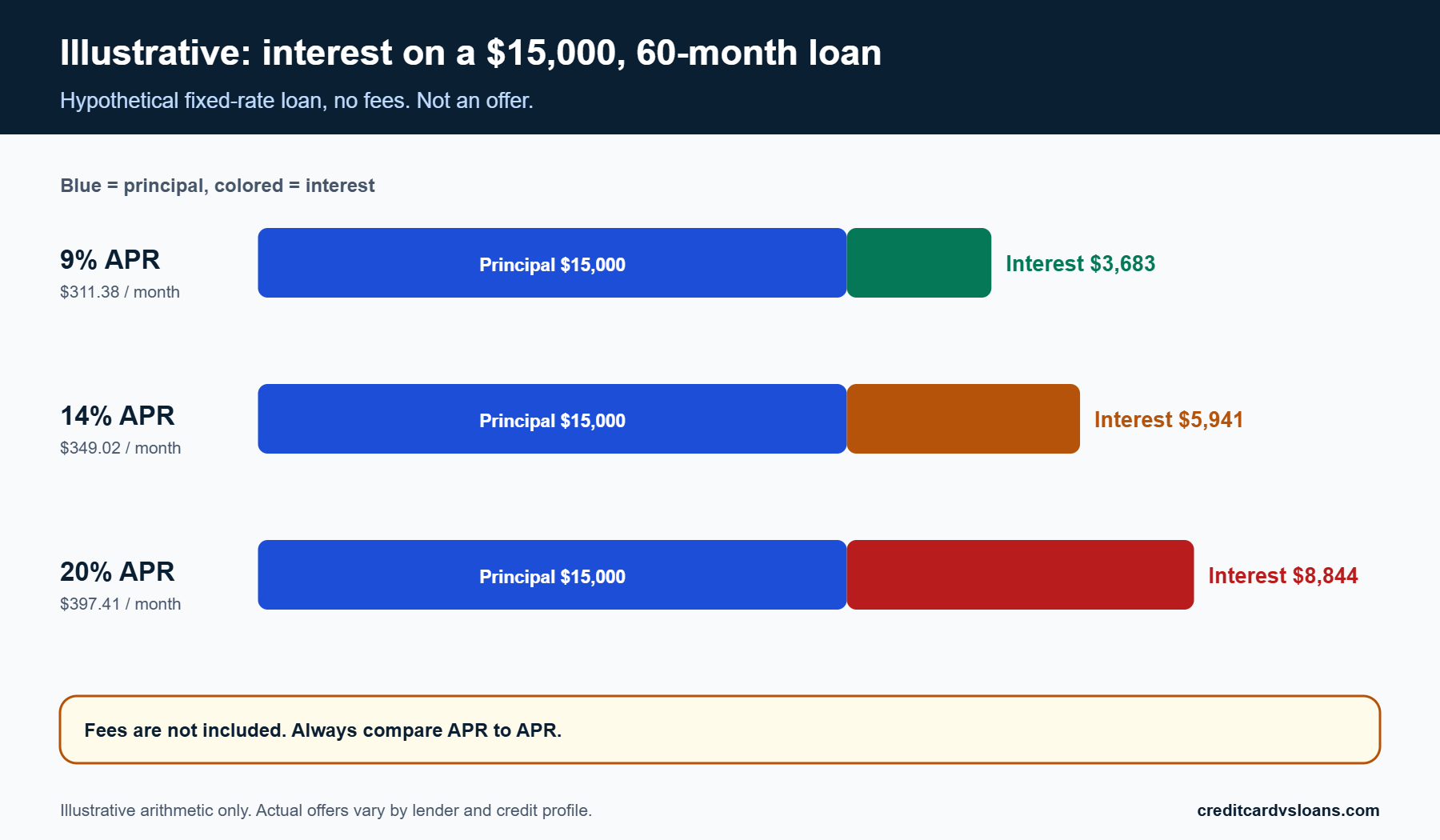
The figures here are hypothetical and assume a fixed-rate, fully amortizing loan with no fees. At 9 percent APR, the monthly payment would be about $311.38 and total interest about $3,683. At 14 percent, the payment would be about $349.02 and interest about $5,941. At 20 percent, the payment would be about $397.41 and interest about $8,844.
The gap between 9 and 14 percent is about $2,258 in interest over five years on this example. That is the practical meaning of “how much better can rates get?” A few percentage points can be worth thousands of dollars on a large loan and much less on a small one.
| APR | Monthly payment | Total interest | Total repaid |
|---|---|---|---|
| 9% | about $311.38 | about $3,683 | about $18,683 |
| 14% | about $349.02 | about $5,941 | about $20,941 |
| 20% | about $397.41 | about $8,844 | about $23,844 |
Term can matter as much as rate
Holding the APR at a hypothetical 12 percent on a $15,000 loan, a 36-month term would cost about $498.21 a month and about $2,936 in interest. A 60-month term would cost about $333.67 a month and about $5,020 in interest. An 84-month term would cost about $264.79 a month and about $7,242 in interest.
That means stretching the term at the same rate can cost more than moving from a mid-range APR to a higher one on a shorter term. If your budget allows it, a shorter term is often the cheapest lever you control.
Choose the shortest term whose payment you can make without strain, and then see if a lender lets you prepay without a penalty so you can pay it off early if your cash flow improves.
Shopping smart with a 700 score
Prequalify, then compare
Soft pull first
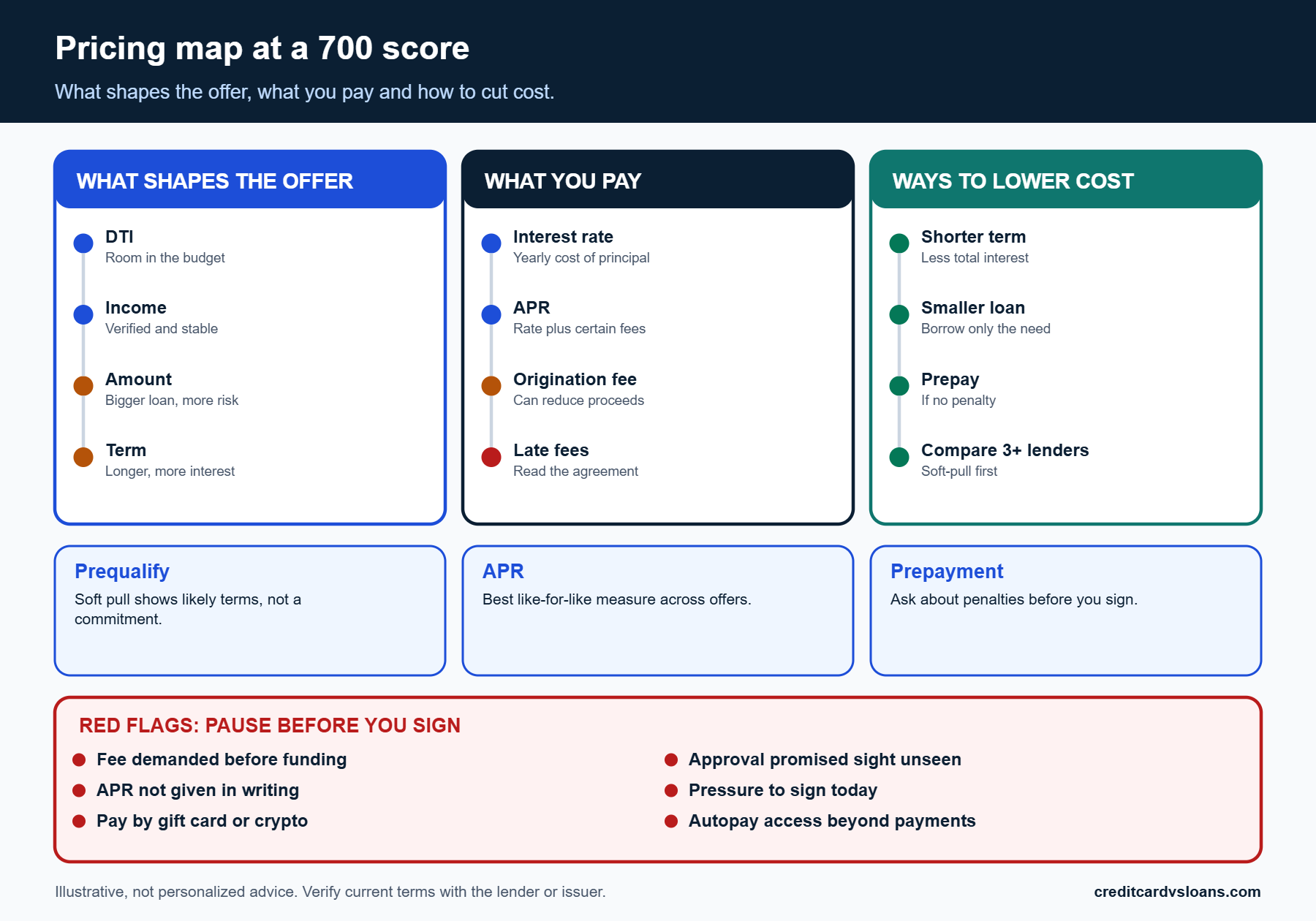
Many lenders let you check your likely rate with a soft pull that does not affect your score. A formal application triggers a hard pull, which is recorded as an inquiry. The CFPB says lender credit checks are recorded as inquiries that typically have a small negative effect on scores, while checking your own credit does not affect your scores.
Prequalified terms are estimates, not commitments, and the final rate can change after verification. Still, with a 700 score you may see a meaningful range of offers, so gather several before you decide.
Cluster formal applications
The CFPB notes that multiple mortgage inquiries within a 45-day window count as a single inquiry. That statement is about mortgages, and the scoring treatment of personal loan inquiries varies by scoring model, so do not rely on a specific window. The conservative approach is to submit formal applications close together and avoid opening other credit lines while you shop.
Our explainer on how a personal loan affects your credit score describes inquiries, new accounts and payment history so you know what to expect during and after the process.
Negotiating and reading the fine print
Ask what could lower your price
Some lenders offer discounts for autopay or for having a deposit account; others do not. Some will adjust terms if you ask for a different amount or term. Asking costs nothing, and the answers go into your comparison sheet.
Be careful with offers that require you to open a new account or take a product you do not want. A discount that comes with a monthly fee or a minimum balance requirement may not be a discount at all.
Check the agreement
Before signing, check that the APR, term and monthly payment match the quote, that there are no blank spaces, and that you understand late fees, returned-payment fees and prepayment terms. Do not agree to anything verbally that differs from the written terms.
If anything feels rushed or unclear, pause. A legitimate lender will give you time to read the paperwork and will not ask you to pay a fee before the loan is funded. The FTC says that any such demand is a reason to walk away.
| Step | What to do | Why |
|---|---|---|
| 1. Check reports | Pull free reports and dispute errors | Errors can cost you in pricing |
| 2. Know your DTI | Add monthly debts and divide by gross income | DTI often shapes the final offer |
| 3. Prequalify widely | Credit union, bank and online lenders | Soft pulls reveal the price spread |
| 4. Test amount and term | Ask for two or three combinations | Small changes can shift the tier |
| 5. Compare total cost | APR, fees, net funding, total repaid | Payment alone hides cost |
| 6. Apply to the finalists | Submit within a short window | Limits repeated inquiries |
Is a personal loan the right tool at all?
Compare it with the alternatives
Credit cards and promotional offers
For some purposes, a credit card with a promotional APR can be cheaper than a personal loan, at least for the length of the promotion. Per the Federal Reserve’s G.19 release of October 7, 2026, the average card rate on accounts assessed interest was 22.15 percent in the second quarter of 2026, which shows how expensive carrying a card balance can be after any promotion ends.
If you are comparing the two for a specific need, read the fine print on promotional periods, balance transfer fees and the rate that applies after the promotion. Our broader comparison articles on the site walk through card and loan trade-offs by situation.
Savings, payment plans and waiting
If the purchase is not urgent, the cheapest loan may be no loan. Saving for a few months, negotiating a payment plan with a provider or reducing the amount you need can lower your cost to zero or close to it.
Borrowers with good credit sometimes take a loan simply because they can, and that is when the cost of the loan becomes the cost of convenience. If a smaller loan or a shorter term would cover it, take that route.
When a loan makes sense
Consolidating higher-cost debt
A personal loan can be a reasonable way to replace higher-cost revolving debt with a fixed payment and a payoff date, if the all-in APR is lower than what you are paying now. Check that the savings are real after fees and that you will not run the cards back up.
The question to ask is whether your behavior will change with the new structure. A fixed schedule helps some borrowers and does nothing for others.
One-time, necessary expenses
For a necessary, one-time expense that you cannot cover from savings, a fixed-rate personal loan with a predictable payment can be easier to plan around than an open-ended card balance. The key is to keep the amount modest and the term as short as your budget allows.
Avoid stacking multiple new accounts at once. A new loan lowers the average age of your accounts and adds a monthly obligation, which is why it is wise to give your budget a few months of breathing room before taking on anything else.
Scenarios: why the same 700 score can lead to different decisions
Two hypothetical borrowers
Steady income and room in the budget
Imagine, purely as an illustration, a borrower at 700 with a long history, steady pay and a DTI that leaves a comfortable cushion. This is the profile most lenders are happy to price competitively, and prequalification may show several offers close to one another. The work here is not finding a yes; it is separating a good yes from an average one.
For this borrower, comparing APR and net funding across three to five lenders is usually enough. Small differences in fees can matter more than small differences in rate, especially on a short-term loan.
The same score with a heavy debt load
Now imagine another hypothetical borrower, also at 700, who already carries a car loan, student loan payments and credit card minimums that eat up a large share of income. A lender may see the new payment as a stretch, and may offer a smaller amount, a higher price or a decline. The score did not change; the room in the budget did.
If that sounds like you, try lowering the requested amount, paying down a card before applying, or asking whether a co-borrower is possible. The CFPB notes that DTI limits differ by lender and product, so a decline at one lender is not the end of the road.
Edge cases worth knowing
Self-employed or variable income
Lenders want to verify income, and irregular pay can complicate that. Be prepared with tax returns, bank statements or contracts that show a consistent pattern. A strong score helps, but documentation often decides how quickly and at what price you are approved.
Be accurate on every application. Overstating income to qualify is a serious problem, and the paperwork you sign often says so in plain language.
A good score on a thin file
A 700 built on a short history can look different from a 700 built on many years. The CFPB defines a thin credit file as one lacking a credit history or enough recent history to generate a score, and observes that millions of Americans have limited or unscorable files. If your 700 rests on one or two accounts, a lender may weigh that when deciding.
That is not a reason to avoid applying. It is a reason to prequalify, to be ready to document income and to check whether a credit union that knows you will look at the whole picture.
| Profile at 700 | Likely lender view | Practical move |
|---|---|---|
| Long history, low DTI | Mainstream, competitive offers are plausible | Compare three to five lenders on APR and fees |
| Long history, high DTI | Payment-fit concerns; smaller amount possible | Reduce the ask or pay down debt first |
| Thin file, steady income | Mixed; documentation matters | Prequalify and try a relationship lender |
| Variable income | Verification may take longer | Prepare tax returns and statements |
Repayment structure and flexibility
Fixed payments and early payoff
What a fixed payment gives you
A typical personal loan has a fixed payment and a fixed end date, which makes budgeting simpler than an open-ended card balance. Knowing the payoff date can also help with motivation, because progress is visible on every statement.
Check whether the rate is fixed for the whole term. If it is not, ask how the rate can change and what the maximum payment could be; surprises are rare in standard personal loans, but you should confirm.
Paying early
If you can pay extra, early payoff reduces total interest. First confirm that the loan has no prepayment penalty and that extra payments are applied to principal. Ask how to submit an extra payment so that it is not treated as an early installment.
Even without a penalty, make sure you are not paying down a low-rate loan while higher-rate card debt remains. Pay the most expensive debt first, unless the lender’s terms say otherwise.
Planning for a rough patch
Ask about hardship before you need it
It is easier to understand a lender’s hardship policies while you are healthy than while you are stressed. Ask whether they offer payment deferrals, reduced payments or due-date changes, and whether those options carry fees or credit reporting implications.
If you do hit a cash crunch, contact the lender before missing a payment. Late payments are among the most damaging events on a credit report, and lenders are often more flexible when you reach out early.
Autopay: convenience and caution
Autopay reduces the chance of a missed payment and may come with a discount at some lenders. It also means money leaves your account on a schedule, so keep a buffer to avoid overdrafts.
Review the authorization language. You should be able to cancel autopay, and the lender should explain how. If a lender insists on unusual access to your account, treat that as a warning sign.
Reading market rate data without over-reading it
What published averages measure
Averages are not offers
The Federal Reserve’s G.19 release is a valuable public reference, but it reports averages. The 11.86 percent figure for 24-month personal loans at commercial banks in the second quarter of 2026 covers many borrowers and loan structures, and it is a quarterly measure. It cannot tell you what a lender will offer you, because it does not break out results by credit score.
When a website, a lender ad or a friend quotes a single number for “good credit,” treat it as a talking point rather than a price. The only figure that applies to you is the APR in a written offer based on your own file.
Why the release date matters
G.19 data are revised and updated on a regular schedule, and the figure for a given quarter can change slightly in later releases; the second-quarter value we cite is marked as revised. If you are reading this long after October 2026, check the latest release at federalreserve.gov before relying on any number.
For a periodic look at conditions, our rate outlook summarizes recent movements in plain language, always with dates attached.
Turning market context into a decision
Use it as a sanity check
If you receive an offer far above the published average and your profile is strong, that is a signal to keep shopping. If an offer is below the average, it might be competitive, but check the fees and the net funding amount before celebrating.
Context can also tell you when not to borrow. If personal loan pricing is close to card pricing and you can pay a card down within a few months, the loan may not add much beyond a new obligation.
Do not time the market with a small loan
Trying to predict rate moves is a poor strategy for an ordinary borrower. For most people, the cost of delay or the cost of a missed need outweighs any hoped-for improvement, and nobody can promise where rates go next.
A more practical approach is to decide based on your needs, your budget and the offers available this week. If conditions improve and your loan allows early payoff without penalty, you may be able to refinance later, though that is a separate decision with its own costs.
Paperwork, timing and what to do if you’re declined
Preparing the application
Documents lenders commonly ask for
Lenders commonly ask for identification, proof of income such as recent pay stubs or tax documents, and your address and employment details. Requirements differ, and some lenders verify income electronically. Having documents ready makes the process smoother and reduces the chance you will be rushed at the end.
Review your application for accuracy before you submit it. Small mismatches, like a misspelled name or an old address, can slow verification and create unnecessary friction.
How long funding takes
Funding speed varies by lender, and some advertise fast turnaround while others take several business days. We do not cite a typical timeline because lenders do not report one in a primary source. Ask each lender for its expected timing, and plan around the slower end if your need has a deadline.
Do not let speed push you into a worse loan. A day or two of extra comparison can matter more than an extra day of waiting for funds.
If the answer is no
Use the notice and your free report
If a lender declines you or offers worse terms because of your credit report, you are generally entitled to a notice. The FTC notes that you may be able to request a free credit report within 60 days of an adverse action notice. Read the stated reasons, check your report for errors and dispute anything inaccurate with both the bureau and the company that supplied the information.
A decline at 700 is unusual enough that it is worth understanding. It may point to DTI, income verification or a report error rather than the score.
Adjust and try again deliberately
Before applying elsewhere, fix what you can: lower the requested amount, pay down a card, add a co-borrower or choose a different lender type. Applying repeatedly without changes can add inquiries and teach you nothing.
Prequalification is the safer way to test changes. If a soft-pull check shows improved terms, then submit a formal application.
Should you wait for a higher score?
What improving from 700 might and might not do
Diminishing returns are plausible, not guaranteed
It is tempting to assume that every extra point trims your rate. In practice, lenders tend to group applicants into tiers, so a move from 700 to 705 may change nothing, while crossing a lender’s internal line could change pricing. Because lenders do not publish those lines, you cannot know in advance where they sit.
This is editorial judgment rather than a sourced finding, so treat it as a framing, not a rule. What you can verify is the offer in front of you. If prequalification shows a price you are comfortable with, the extra months of waiting must be weighed against the cost of delay.
What actually moves a score
FICO says payment history is 35 percent of a score, amounts owed 30 percent, length of credit history 15 percent, new credit 10 percent and credit mix 10 percent. For someone at 700, the most controllable levers are usually keeping every payment on time and keeping card balances low relative to limits.
The CFPB suggests using no more than 30 percent of your card limits and notes that you do not need to carry a balance to build credit. We do not promise any score change from these steps; they are simply the factors the scoring model describes.
The cost of waiting
When waiting is cheap
If the expense can wait and you are close to paying down a card or two, a short delay might improve what lenders see. If your goal is a purchase you can postpone, the cost of waiting is mostly convenience.
It is also reasonable to apply for a prequalification now, to see where you stand, and to repeat it in a few months. Soft pulls do not hurt your score, and the comparison tells you whether the wait is worth it.
When waiting is expensive
If you are carrying high-interest card debt, each month of delay can cost interest. In that case, a 700-score loan that is cheaper than your current rate may beat waiting for a hypothetical improvement.
The same applies to urgent costs like medical or home repairs. Compare the monthly cost of the existing debt with the monthly cost of the loan, and decide on facts rather than on a target score.
Pitfalls even strong borrowers should avoid
Behavioral and contractual traps
Borrowing more than you need
Some lenders pre-approve larger amounts than you asked for, and a good score makes these offers frequent. Borrowing more than you need increases total interest and monthly obligations. Set your amount before you start shopping and stick to it.
Remember that a pre-approved offer in the mail is an invitation to apply, not a final approval, and it may be subject to verification. Treat it as one more quote to compare.
Ignoring the agreement
Strong credit does not protect you from poor contract terms. Late fees, autopay conditions, prepayment penalties and arbitration clauses vary, and you will find them in the paperwork rather than in the marketing.
Our guide to a 620 score and the article on a 600 score show how much more careful fair-credit borrowers need to be; good credit gives you leverage, but it does not remove the need to read.
Scams and look-alike offers
Advance-fee schemes
Scammers target people with all sorts of credit profiles. The FTC warns that legitimate lenders do not promise a loan before reviewing your credit report and application, and that fees demanded before funding, often for “insurance” or “processing,” are a reason to walk away.
It also notes that scammers often ask for payment by cryptocurrency, wire transfer or gift cards, which are hard to recover. If you paid, follow the FTC’s guidance and report it at ReportFraud.ftc.gov.
Look-alike websites and unsolicited offers
Check that you are on the lender’s real site before entering personal information, and verify that the lender is registered in your state. A search for the company name plus “complaint” or “review” is a quick first screen.
Unsolicited calls or texts offering pre-approved loans deserve extra skepticism. If you did not ask, you should not feel pressured to answer.
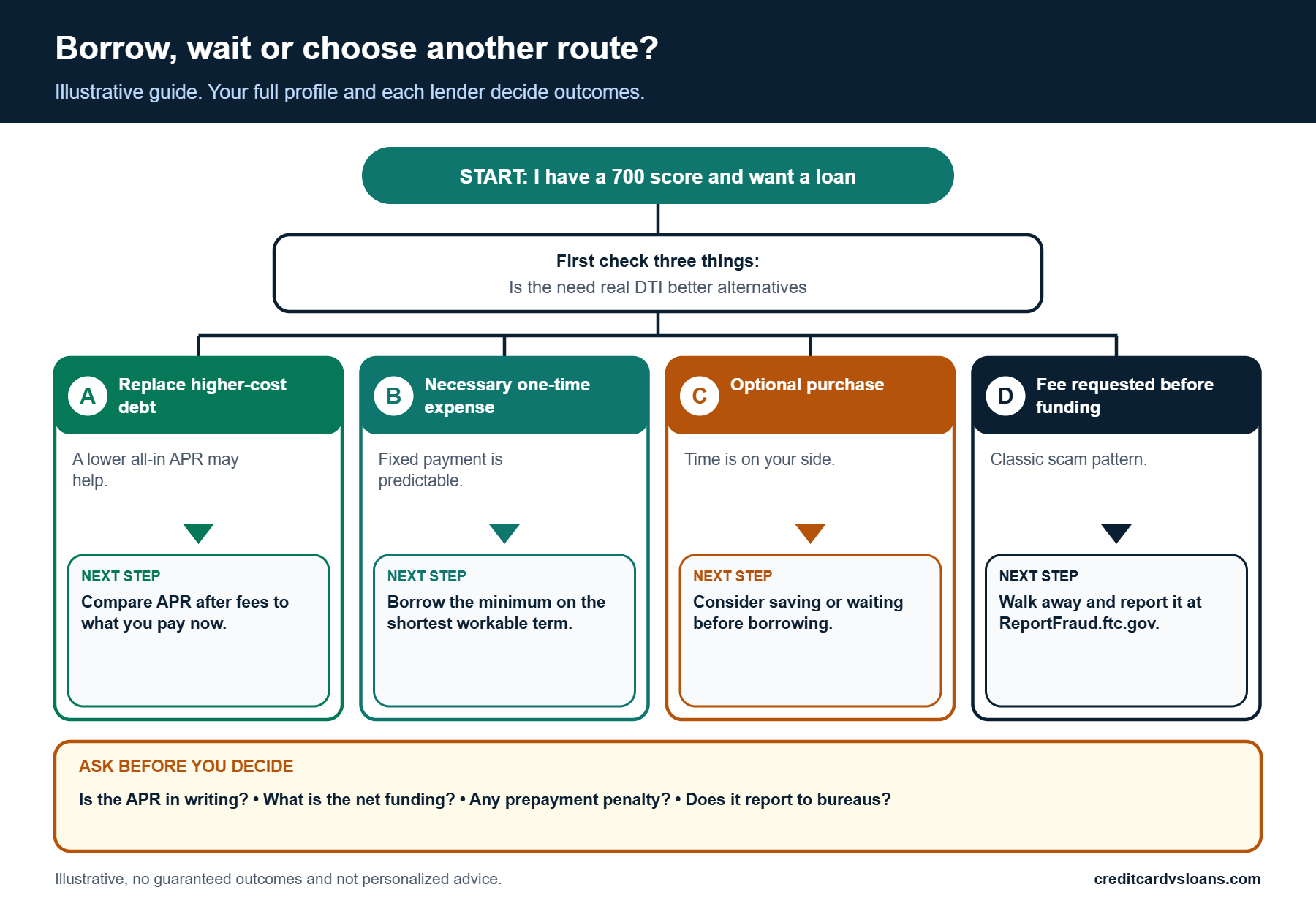
Your checklist and next steps
Decision checklist for a 700-score borrower
Questions to settle before you apply
Decide whether you need the loan, how much and for how long. Pull your free reports at AnnualCreditReport.com, which the FTC identifies as the only authorized site for free annual reports. Calculate your DTI from gross monthly income and the sum of your monthly debt payments.
Then list your alternatives: savings, payment plan, a lower-cost product or a smaller loan. The loan should be better than each of those on total cost and risk, not just easier.
Questions to settle before you sign
Confirm the APR, total repaid and net funding. Check the late fee policy, the prepayment terms and whether the lender reports to all three bureaus. Make sure there are no upfront charges and no blank spaces in the paperwork.
Finally, ask whether the monthly payment still works if your income drops for a month or two. If it does not, adjust the amount or term now rather than after you sign.
The bottom line
When a loan at 700 can make sense
If you have steady income, a manageable DTI and an offer that clearly beats your alternatives on APR and total cost, a personal loan with 700 credit score can be a sensible tool. It works especially well when the loan replaces higher-cost debt or covers a necessary expense you cannot fund from savings.
Nothing here guarantees a particular rate or approval, and the actual offer will reflect your full profile. The advantage of a good score is mainly the ability to say no to a poor offer.
Next steps in order
- Confirm that you need the loan and the smallest amount that solves the problem.
- Pull free credit reports and fix errors.
- Compute DTI from gross income.
- Prequalify with a credit union, a bank and one or two online lenders at two or three terms.
- Compare by APR, net funding and total repaid.
- Read the full agreement and decline any upfront-fee request.
- Submit formal applications for the finalists within a short window, then choose and autopay.
At 700 you are usually shopping, not begging. Use that position: compare several lenders, test amounts and terms, focus on total cost, and borrow only if the loan beats your other options.
- myFICO: FICO Score ranges and scoring factors
- Federal Reserve: Federal Reserve G.19 Consumer Credit release (Oct. 7, 2026)
- CFPB: Key terms: credit reports and scores
- CFPB: What is a debt-to-income ratio?
- CFPB: What is the difference between a mortgage interest rate and the APR? (Used for the general rate-versus-APR distinction)
- CFPB: What is a credit report inquiry? (mortgage credit checks) (Inquiry effects and 45-day mortgage window)
- FTC: What to know about advance-fee loans
- FTC: Free credit reports
Last updated: October 22, 2026. Rates, fees and lender rules change; verify current terms before acting.
The information on creditcardvsloans.com is provided for general educational and informational purposes only. It is not financial, legal, tax, credit, accounting or investment advice, and reading it does not create an advisor-client, fiduciary or any other professional relationship. Nothing here is an offer, solicitation or recommendation to borrow, lend or apply for any product.
Credit scores, interest rates, fees, eligibility rules, lender policies and laws change frequently and vary by lender, location and individual circumstances. Examples, figures and scenarios are illustrative only, do not predict your results and do not guarantee approval, savings, a particular rate or a credit-score outcome. Always confirm current terms directly with the lender or issuer and read the full agreement before you apply or sign.
Although we aim for accuracy and use reputable sources, we make no representations or warranties, express or implied, about the completeness, accuracy, reliability or timeliness of the content. Content may be drafted with the assistance of automated tools, so errors or omissions may still occur. Links to third-party sites are provided for convenience; we don’t control and aren’t responsible for their content.
To the fullest extent permitted by law, creditcardvsloans.com and its owners, editors, authors, contributors and affiliates disclaim all liability for any loss, damage or expense arising directly or indirectly from your use of, or reliance on, this content. Before making financial decisions, consult a licensed professional, such as a qualified financial advisor, attorney, tax professional or nonprofit credit counselor, who can consider your complete situation.