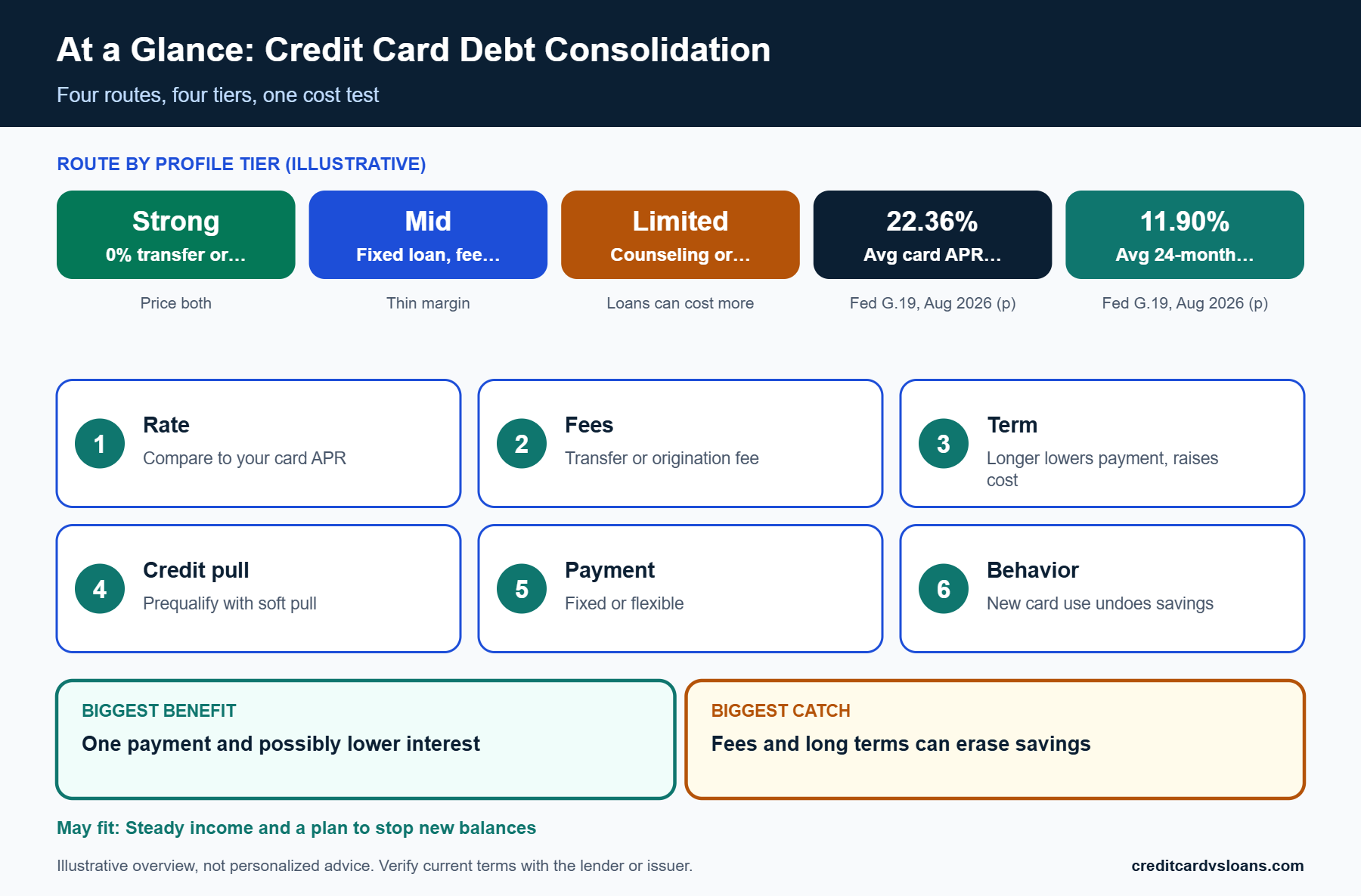
Credit card debt consolidation works best when the option you choose matches your credit profile: a strong profile may qualify for a 0% promotional transfer or a low-rate loan, a middle profile usually lands on a fixed-rate loan with fees that need checking, and a limited profile often does better with a nonprofit plan or a payoff strategy than with a high-cost loan. This guide sorts the main routes by profile tier so you can see which ones are realistic to investigate before you apply.
The idea behind consolidation is simple: you replace several revolving balances with one new account, ideally at a lower total cost. The catch is that the “ideally” depends on three things lenders decide for you, which are your rate, your fees and your term. A consolidation that carries a lower monthly payment can still cost more over time if it stretches the payoff date far enough.
Throughout this article, every dollar example is hypothetical and computed from simple amortization math, not a quote from any lender. Where we cite a current market figure, it comes from the Federal Reserve and is date-stamped. Your own offers will differ, so treat the numbers as a way to see the shape of the trade-offs.
- Your credit profile mostly determines which consolidation routes are open and what they cost, so start by matching the route to the tier rather than shopping every product.
- A 0% transfer can be the cheapest route on paper, but only if you can realistically clear the balance before the promotional period ends.
- A fixed-rate loan helps when its all-in cost, including any origination fee, is clearly below what your cards charge on the same payment.
- With a limited profile, a loan priced near or above your card APR can cost more than leaving the balances where they are.
- Consolidation does not fix the spending that created the balances; new card use after payoff is the most common way the plan fails.
Market figures are from the Federal Reserve’s G.19 consumer credit release of October 7, 2026, which reports commercial bank rates through August 2026 (preliminary). Rates, fees and lender policies change often, so confirm every term in your actual offer.
Credit Card Debt Consolidation at a Glance: Which Route Fits Which Profile
The short answer by credit profile
Strong profiles: promotional transfers and low-rate loans
If your payment history is clean, your balances are moderate relative to your limits and you have a steady income, you are the borrower most issuers and lenders compete for. Two routes are usually worth pricing: a card with a 0% promotional APR on transferred balances, and a fixed-rate personal loan. Which one wins depends on how fast you can repay, not on which sounds better.
A transfer card is built for payoff windows that fit inside the promotional period. A loan is built for balances that need more time and a fixed payment. Our head-to-head comparison of a consolidation loan and a balance transfer card walks through that break point in detail.
Middle profiles: a loan, with the fee math done first
With a fair or mixed profile, such as a few late payments in the past, higher utilization or a short credit history, the 0% offers tend to shrink or disappear, and loan offers come with higher rates and origination fees. A fixed-rate loan can still make sense, but the margin for savings is thinner.
The rule of thumb here is to compare the loan’s all-in cost to what your cards would cost if you paid the same monthly amount. If the loan only wins by a small amount, a simpler payoff plan on the cards you already have may be the safer call. The cost sections below show how narrow that margin can be.
| Route | May fit this profile | Main advantage | Main drawback | Primary cost driver |
|---|---|---|---|---|
| 0% promotional transfer card | Strong, with a payoff plan under the promo window | No interest during the promotion | Rate resets afterward; transfer fee | Transfer fee and any balance left at the reset |
| Fixed-rate personal loan | Strong to fair | Fixed payment and fixed end date | Origination fee; hard pull | APR, term and fee |
| Nonprofit debt management plan | Fair to limited, with steady income | May reduce interest across all cards | Usually 48 months or more; may require closing or not using cards | Agency setup or monthly fees |
| Home-equity borrowing | Homeowners with equity who accept the risk | Often a lower rate than cards | Your home secures the debt | Closing costs and rate |
| Payoff plan on existing cards | Any profile with steady cash flow | No new account or fee | Rates stay high | Card APR and the monthly amount you commit |
What consolidation actually changes, and what it does not
It changes the structure, not the debt
Consolidation moves what you owe into a different container. You still owe the same principal, plus whatever fee the new account charges. What can change is the interest rate, the number of payments and whether the payment is fixed or flexible.
That is why the Consumer Financial Protection Bureau tells people to compare total cost over the full repayment period, not just the monthly payment, and to look at fees such as transfer fees and loan fees. A lower payment is only good news if the total cost does not grow to pay for it.
The market backdrop, with a date stamp
As of the Federal Reserve’s G.19 release of October 7, 2026, the average interest rate on commercial bank credit card accounts that were assessed interest was 22.36% in August 2026 (preliminary), and the average rate on a 24-month personal loan was 11.90%. These are industry averages across all borrowers, not offers you should expect, and the gap between them is what makes consolidation attractive in the first place.
Your own gap depends on your profile. A strong borrower may beat the average loan rate; a borrower with a limited profile may be quoted something far higher, which is the situation covered in our guide to consolidating card debt with bad credit.
How Lenders Sort Borrowers Into Credit Profile Tiers
The inputs behind your profile
Payment history and amounts owed carry the most weight
FICO publishes the broad weights behind its scores: payment history is 35% and amounts owed is 30%. Payment history asks whether you pay on time. Amounts owed looks at how much you owe overall and how much of your available revolving credit you are using. Together they account for roughly two thirds of a typical FICO Score.
This is why card balances matter twice. A high balance relative to your limits can pull the score down, and the same balance is what you are trying to consolidate. Lenders also look at income and existing monthly obligations, which are not part of the score but are part of the decision.
History length, new credit and mix fill in the rest
The remaining weights are length of credit history at 15%, credit mix at 10% and new credit at 10%. A thin credit file, meaning few or young accounts, can keep you out of the strongest tier even with spotless payments. If that describes you, building a first credit history responsibly is a different problem from consolidating existing debt.
New credit matters here because consolidation itself creates new credit activity: an application, possibly a hard pull, and a new account. FICO notes that it counts inquiries from the past 12 months, though they stay on the report for two years.
Why there are no universal cutoffs
Every issuer and lender sets its own lines
You will see lists online that say a certain score opens the door to a certain product. Treat those as rough folklore, not rules. Each issuer and lender has its own scoring models, risk appetite and product design, so the same profile can be approved at one lender and declined at another.
That is useful, not just frustrating. It means a decline from one lender does not define your options, and it is a reason to compare several offers using soft-pull tools before submitting a full application. For a deeper look at score thresholds on the loan side, see our look at the credit score a 0% APR card tends to require and the related loan guides linked below.
Prequalify first, apply second
Many lenders let you prequalify, which typically uses a soft pull that does not affect your score, and shows an estimated rate range. A full application usually triggers a hard pull. Prequalification is not an approval, and the final rate can differ, but it lets you rate shop without stacking hard inquiries.
Use prequalified offers to fill in the comparison table later in this guide: rate, fee, term, payment and total cost. If a lender will not show you the fee and term before a hard pull, treat that as a signal to keep looking.
Credit Card Debt Consolidation Options for Strong Credit Profiles
0% promotional transfer cards
How the math works on a $12,000 balance
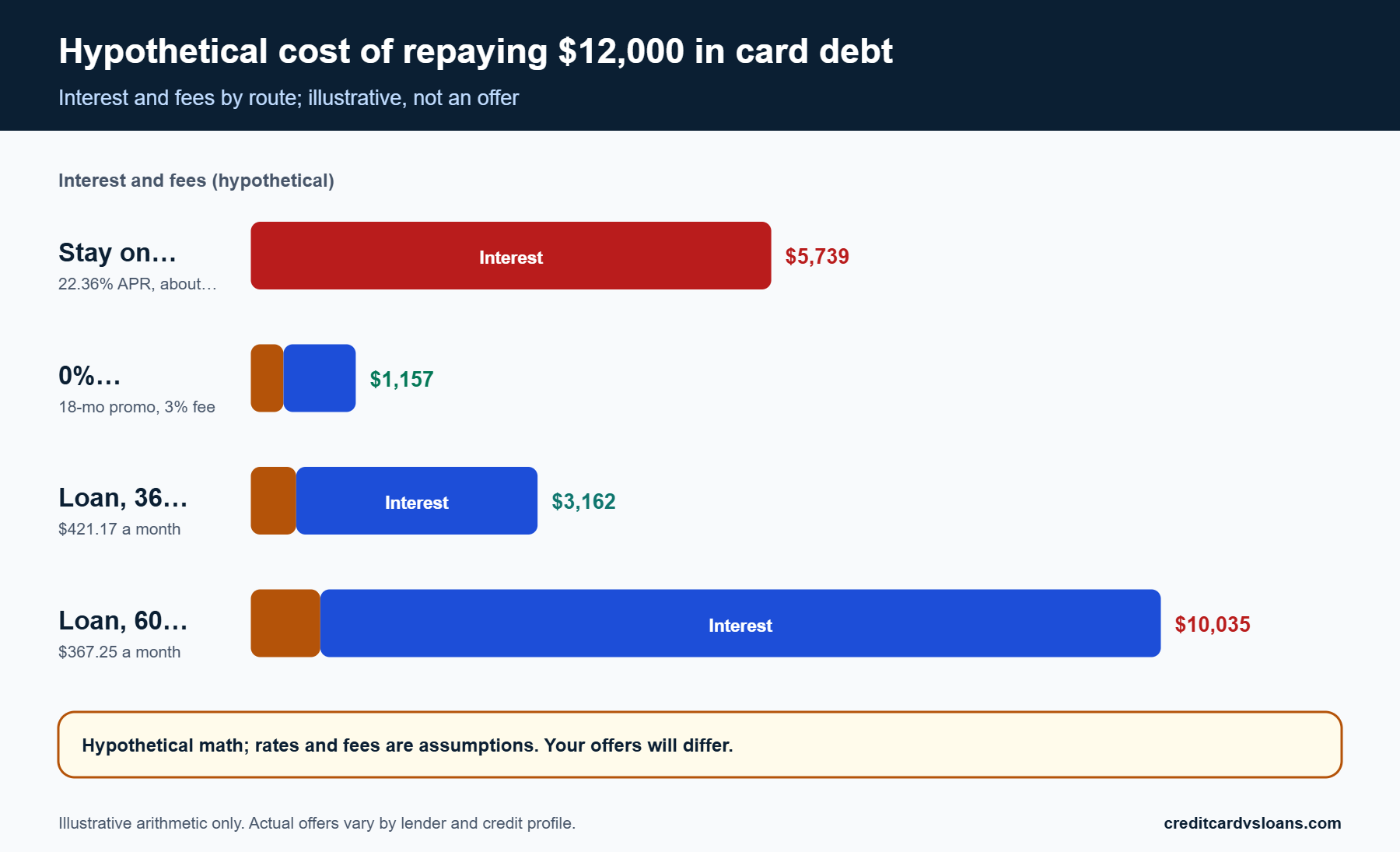
Suppose a hypothetical borrower carries $12,000 across several cards at an average of 22.36%, the Federal Reserve’s August 2026 figure for accounts assessed interest, and pays $400 a month. Left alone, that plan takes about 45 months and costs roughly $5,739 in interest.
Now suppose a transfer card offers 0% for 18 months with a 3% fee. The fee is $360, so the new balance is $12,360. Paying $686.67 a month clears it in 18 months at a total cost of $360. If the borrower keeps paying only $400, about $5,160 is left when the promotion ends, and another 15 months at 22.36% adds roughly $797 in interest, for a total cost near $1,157. Those are illustrative figures, not an offer.
The fine print that decides whether it works
The CFPB lists the main traps: a transfer fee, a rate increase when the promotional period ends, and the loss of a grace period on new purchases. It also warns that a payment more than 60 days late can trigger a higher rate on all balances. Read the cardmember agreement, not just the marketing page, for the exact promotional length, the fee and what happens on a late payment.
Approval and the credit limit are separate hurdles. The limit you receive may be smaller than your total balance, so a transfer can cover only part of the debt. Our guide to the score a 0% APR card tends to need explains why the strongest promotional offers go to the strongest profiles.
Low-rate fixed personal loans
What a good loan offer looks like in numbers
For the same $12,000, imagine a 36-month loan at 11.90% with no origination fee. This rate matches the Fed’s August 2026 average for a 24-month personal loan, used here only as a reference point; many borrowers will be quoted more, some less. The payment would be $398.00 and the total interest about $2,328, against about $5,739 for staying on the cards at $400 a month.
The loan wins because its rate is lower and because the fixed payment forces the balance to zero on a set date. The cards, at a similar payment, would take about 45 months. That date certainty is the real product you are buying.
When a loan can beat a transfer card
A loan tends to beat a transfer card when you cannot clear the balance inside the promotional window, when you want a payment that cannot be lowered to the minimum, or when the transfer limit is too small. A transfer card tends to win when you can repay comfortably inside the promotional window and the fee is small relative to the interest you would otherwise pay.
Many people also benefit from splitting: transfer what the new card limit allows and loan-fund the rest. Whatever you do, keep one comparison honest by using the same monthly payment for every option, which is the apples-to-apples test used in the rest of this guide.
What Credit Card Debt Consolidation Costs for Mid-Range Profiles
How fair-credit offers tend to be built
Origination fees and the true cost of the loan
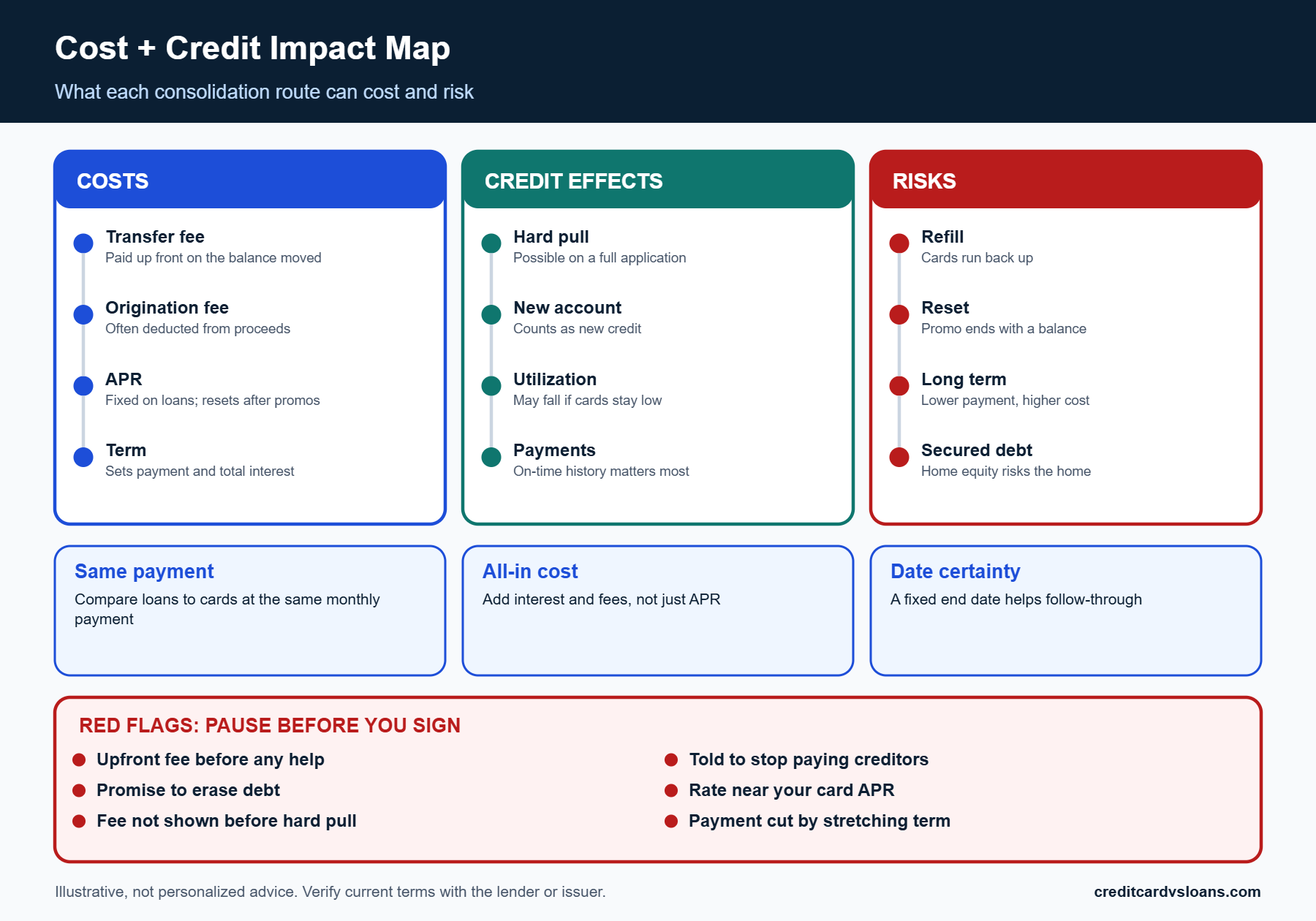
Many personal loans charge an origination fee, which is typically deducted from the loan proceeds. To receive $12,000 net, a borrower with a 4% fee has to borrow $12,500, and interest accrues on the larger amount. In the examples below, fees are hypothetical percentages chosen to show the effect, because actual fees vary by lender and profile.
The practical lesson is to compare the all-in cost, meaning interest plus fees, not just the headline APR or the monthly payment. A loan at 13% with a 4% fee costs about $3,162 over 36 months in our example, which is $500 of fee plus $2,662 of interest.
Requirements lenders commonly check
Lenders typically verify identity, income and employment, look at your existing monthly obligations and review your credit report. Some ask for pay stubs, bank statements or tax documents. Requirements differ by lender, so check each lender’s published criteria and use prequalification where offered.
If your debt-to-income ratio is high, a lender may offer a smaller amount than you asked for. That can leave a partial consolidation, which is workable as long as you still have a plan for the cards that remain.
Running the numbers across the tiers
One table, one payment standard
Table 2 lines up the same hypothetical $12,000 across seven paths, with every figure computed from standard amortization math. The cost column adds interest and fees. The debt management plan row assumes an illustrative 8% rate and excludes any agency fees, which a counselor will quote for your situation.
| Route (illustrative) | Rate type and fee | Monthly payment | Months to payoff | Interest plus fees | Flag |
|---|---|---|---|---|---|
| Stay on cards at $400 | Variable, 22.36% avg | $400.00 | 45 | $5,739 | Baseline |
| 0% transfer, 18 months, 3% fee | 0% promo, then variable | $400 (or $686.67 to finish in 18) | About 33 at $400; 18 at $686.67 | $1,157 at $400; $360 at $686.67 | Needs approval and a limit large enough |
| Loan, 36 months, 11.9%, no fee | Fixed | $398.00 | 36 | $2,328 | Strong profile pricing |
| Loan, 36 months, 13%, 4% fee | Fixed | $421.17 | 36 | $3,162 | Fee is $500 |
| Loan, 36 months, 18%, 5% fee | Fixed | $456.66 | 36 | $4,440 | Savings margin is thin |
| Loan, 60 months, 24%, 6% fee | Fixed | $367.25 | 60 | $10,035 | Costs more than the cards at the same payment |
| Debt management plan, 8%, 60 months | Negotiated, assumed | $243.32 | 60 | $2,599 plus agency fees | Rate and fees set case by case |
The same-payment test
The last loan row deserves a second look. At $367.25 a month, the 24% loan takes 60 months. If the same $367.25 went to the cards at 22.36%, they would be paid off in about 51 months at an interest cost near $6,673. In this example the loan is the worse choice by roughly $3,400, even though it feels like progress because it has one payment and a fixed date.
This is the single most useful check in the whole topic. Take the payment a loan would require and ask what the cards would cost at that same payment. If the loan does not beat that number clearly, after fees, it is not saving you money.
When Your Credit Profile Is Limited: Consolidation With Caution
Why loan pricing can turn against you
Pricing close to your card APR leaves no room for savings
Lenders price risk, and a limited profile carries more of it. Offers can come back with rates near or above what your cards already charge, plus a higher origination fee. In our hypothetical, a 60-month loan at 29% with an 8% fee on a $12,000 net need costs about $12,841 in interest and fees, and the monthly payment is $414.02. At that same payment, the cards would be paid off in about 43 months for roughly $5,418 in interest.
When that happens, the honest answer is that the loan is not consolidation in any useful sense. It is a larger, longer debt that happens to have one due date. The next section of this guide, and the dedicated page on consolidating card debt with bad credit, cover what tends to work better.
Offers that call themselves consolidation but are not
The CFPB warns that some companies advertising debt consolidation are actually debt settlement firms. They may charge upfront fees, tell you to stop paying your creditors and have you deposit money into a special account, which can be risky. A real consolidation loan pays your creditors in full and replaces them with one new debt.
If an offer asks for money before it does anything, promises to erase what you owe or tells you to stop talking to your creditors, treat that as a red flag. The FTC lists the same warning signs and explains where to report suspected scams.
Routes that tend to hold up better
Nonprofit credit counseling and debt management plans
Credit counseling agencies, usually nonprofits, review your budget and can set up a debt management plan. Under a plan, you make one monthly payment to the agency, which pays your creditors, and the goal is typically lower interest and fees across your cards. The FTC notes these plans often take 48 months or more and may require you to stop using credit.
The CFPB advises asking about fees in writing and confirming with your creditors that they have accepted the plan before you pay the agency. Our guide on how a debt management plan affects your credit covers the score side of this route in detail.
Talking to your card issuers first
The CFPB suggests asking your creditors whether they will lower payments, waive fees, reduce your interest rate or move your due date. Results vary, and nothing about this call is a promise, but it costs nothing and does not create a new account or a hard pull. Write down who you spoke to and get any agreement in writing.
If an older balance has already gone to a collector, the rules change. Time limits on lawsuits and the effect of partial payments vary by state, which is covered in our explanation of the statute of limitations on credit card debt. Check the rules where you live before you pay anything on an old account.
Credit Card Debt Consolidation and Your Credit Score
What can move in the short term
A new application and a new account
Applying for a loan or card can create a hard inquiry, and a new account is new credit activity. FICO assigns 10% of a score to new credit and counts inquiries from the past 12 months. For many borrowers, the effect of a single inquiry is modest and temporary, but it is not zero, and it can matter more if your file is thin or you have been applying for several things at once.
This is the practical case for prequalifying with soft pulls first and submitting one full application, not four.
What happens to the old cards
Paying off cards does not require closing them. Keeping them open preserves their limits, which supports a lower utilization ratio, and keeps account age intact; length of history is 15% of a FICO Score. The risk is behavioral: open cards with zero balances can be tempting.
Some people ask the issuer to lower a limit or close a card to remove the temptation. That is a reasonable personal call, but understand it can reduce available credit and change utilization on the cards you keep.
Utilization and the longer view
A simple utilization illustration
Imagine total card limits of $20,000 with $12,000 owed. That is 60% utilization, a high share of available credit in use. If a loan pays those cards to zero and the cards stay open, revolving utilization on those cards goes to 0%, and the new installment loan is a separate kind of account. FICO’s amounts owed category rewards lower use of available credit, so this change can help a profile.
No outcome is certain. Scoring models differ, and if balances build up on the cleared cards again, the benefit disappears quickly.
On-time payments do the heavy lifting
Payment history is 35% of a FICO Score, and a consolidation loan gives you one more account that either builds an on-time record or damages it. Automatic payments from your checking account, set for at least the required amount, are a simple safeguard. The CFPB also notes that a payment more than 60 days late on a card can trigger a higher penalty rate on all balances.
Over a year or two, steady on-time payments and lower revolving balances are the factors most likely to help your profile. Neither one can promise a particular score change, and the size of any effect varies by person.
Risks and Alternatives to Credit Card Debt Consolidation
The main risks, in order of how often they bite
Running the cards back up
The most common failure is not a bad rate; it is a repeat balance. Consider a borrower who uses a loan to clear $12,000 in cards, then runs the cards back up to $6,000 over the next year. At a blended 22.74% and a $250 monthly payment, that new card balance takes about 33 months and roughly $2,079 in interest to clear, on top of the loan payment. The borrower is now paying on two debts.
The CFPB makes the same point plainly: consolidating does not help if you keep adding new debt. A budget that covers the gap between income and spending has to come first.
Lower payments that cost more
A longer term lowers the payment but raises the total cost. Table 3 shows the same $12,000 at a hypothetical 14% fixed rate with no fee across different terms.
| Term | Monthly payment | Total interest | What it means |
|---|---|---|---|
| 24 months | $576.15 | $1,828 | Highest payment, lowest cost |
| 36 months | $410.13 | $2,765 | Balanced for many budgets |
| 48 months | $327.92 | $3,740 | Lower payment, more interest |
| 60 months | $279.22 | $4,753 | Cash flow relief with a real cost |
| 84 months | $224.88 | $6,890 | Interest approaches 57% of the amount borrowed |
Cutting the term from 84 to 36 months in this example saves about $4,125 in interest while raising the payment by about $185 a month. Whether that trade works depends on your budget, which is why a cash-crunch borrower should be wary of choosing the longest term just because it fits.
Alternatives worth weighing
Paying the cards down on a structured plan
If your balances are manageable, a structured payoff on the cards you already have avoids fees, hard pulls and new accounts. Two common methods are paying the highest-rate card first and paying the smallest balance first. The first minimizes interest; the second can keep motivation up. The comparison depends on your balances and rates, and our overview of how debt consolidation works puts these methods next to the consolidation routes.
Because card rates are high on average, even modest extra payments make a difference. The structured plan loses its edge only when the rate on your cards is very high and your credit profile qualifies for something much cheaper.
Home equity and other secured borrowing
The CFPB notes that borrowing against your home may offer lower rates, but you could lose the home if you cannot repay, closing costs can be high and the equity may not be there for emergencies. The FTC adds that consolidation loans secured by your home put the house at risk if you fall behind. Turning unsecured card debt into secured debt is a serious step, and it deserves a second opinion from a housing or credit counselor.
The same caution applies to any loan that uses your car or savings as collateral. Make sure you understand what the lender can take and how fast.
Choosing a Path: A Decision Matrix by Borrower Scenario
Matching scenarios to routes
The decision matrix
Table 4 pairs common situations with a route to investigate, not a recommendation. It assumes you have already listed your balances, rates and monthly budget.
| Borrower scenario | Route to investigate | Why | What to verify | When to avoid it |
|---|---|---|---|---|
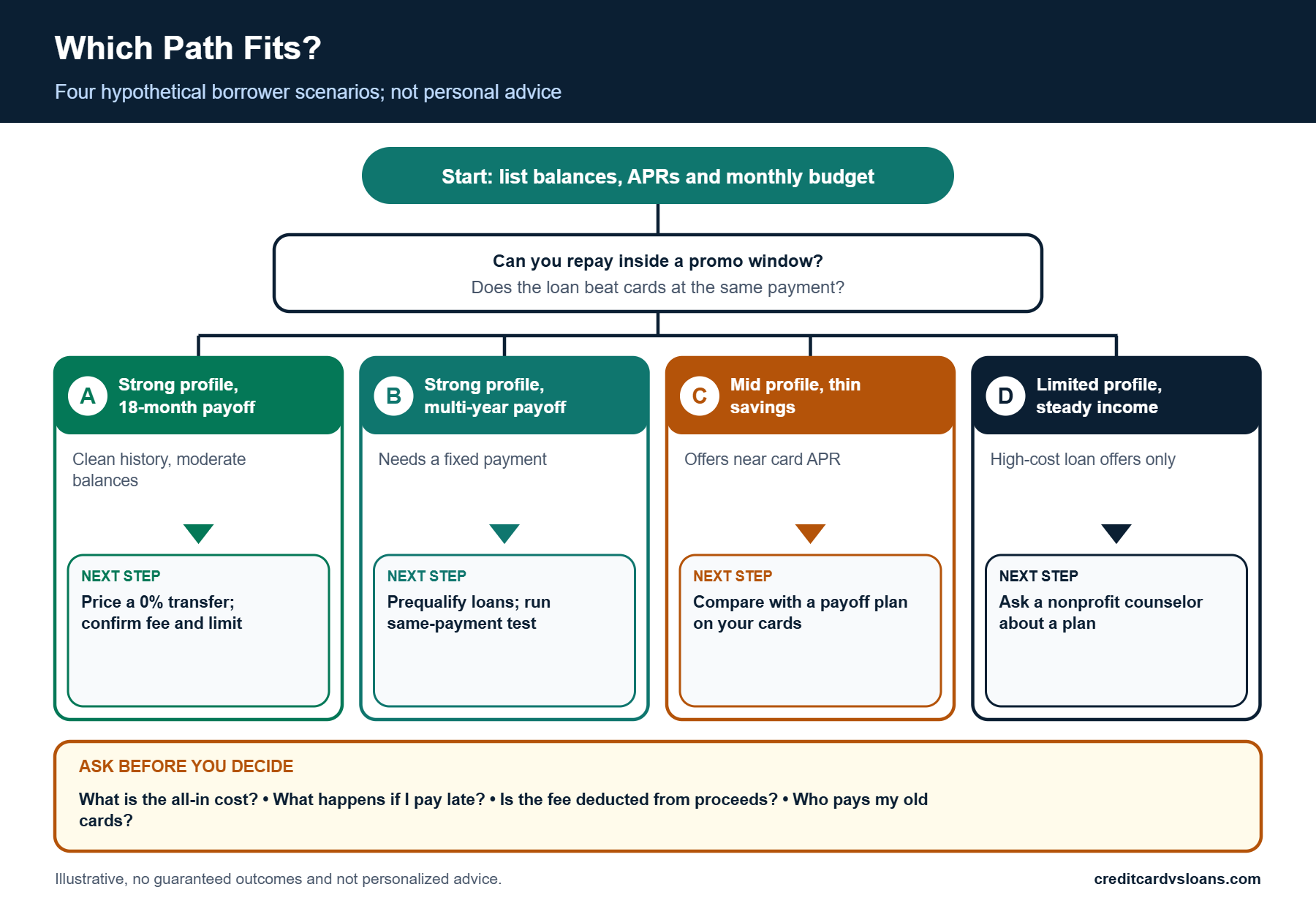
| Strong profile, can repay in about 18 months | 0% transfer card | Interest-free window and a small fee | Promo length, fee, limit, post-promo APR | If you cannot clear it in the window |
| Strong profile, needs several years | Fixed-rate loan | Fixed payment and end date | APR, fee, term, prepayment terms | If the all-in cost does not beat your cards at the same payment |
| Fair profile, steady income | Loan after prequalifying | Can still beat card APR if fees are modest | Fee, rate, total cost versus cards | If the rate is near your card APR |
| Limited profile, steady income | Nonprofit counseling and a debt management plan | May lower interest without a new loan | Fees, creditor acceptance, plan length | If an agency demands upfront payment before help |
| Homeowner with equity | Home-equity borrowing, as a last resort | Rate can be lower | Closing costs and what secures the loan | If losing the home is not a risk you can carry |
| Manageable balances, good cash flow | Payoff plan on current cards | No fee or new account | Whether a higher payment is sustainable | If a much cheaper option is available |
Reading the matrix without over-trusting it
Real borrowers straddle rows. A fair profile with a stable job and a small balance may do fine with a payoff plan, while a strong profile with an irregular income might prefer a fixed payment over a flexible one. Use the matrix to narrow the field, then price two or three routes with real offers.
If you land in the limited-profile rows, our guide to debt payoff options by credit score compares more routes across the score range.
Questions to ask before you commit
For a transfer card
Ask what the promotional APR is and exactly when it ends, what the transfer fee is and whether it is charged per transfer, what APR applies afterward, whether new purchases lose their grace period, and what happens if a payment is late. Confirm the credit limit before you count on it, and confirm how long a transfer takes so you do not miss payments on the old cards meanwhile.
Keep paying the old card until the transfer posts. A missed payment during a transfer is an avoidable mistake.
For a loan
Ask for the APR, the origination fee and whether it comes out of the proceeds, the term, the monthly payment, whether there is a prepayment penalty and whether the lender pays your creditors directly or sends the money to you. A direct payment to creditors removes one temptation. Compare the total cost across offers using the same payment standard as above.
Check what late fees apply and whether autopay earns any rate change. If you cannot get a straight answer about the fee, move on.
Your Decision and Next Steps for Credit Card Debt Consolidation
A practical sequence
Build your own numbers first
List every card with its balance, APR, minimum payment and credit limit. Add the monthly amount you can reliably put toward debt without borrowing again. These few numbers tell you the baseline cost of doing nothing different, which is the figure every consolidation offer has to beat.
Then write down a realistic payoff date for the baseline. If the date is already close and the interest cost is modest, the best move may be to keep going on the cards and skip the new account.
It also helps to separate the debts that cost the most from the ones that cost the least. A card at 29% and a card at 17% do not deserve equal attention, and a plan that targets the first and leaves the second alone can capture most of the savings with less disruption.
Price two or three routes with real offers
Match your profile to the rows in the decision matrix, prequalify where soft pulls are offered and record the rate, fee, term and payment for each. Run the same-payment test on each loan and compare the cost of any transfer card plan with a repayment date that you can actually hit. If you are comparing a transfer card with a loan directly, this side-by-side guide shows how to line them up.
Take your time. A day spent comparing is cheap relative to a multi-year loan.
After you consolidate
Keep the cards from refilling
Decide in advance what the cards are for. Some people keep one card for emergencies and put the others away; some move the cards out of their wallet and digital wallet so spending takes an extra step. Whatever you pick, set a spending limit that your budget can support so you are paying cash flow, not debt, for new purchases.
If you notice balances creeping back, treat it as an early warning about the budget, not a failure of the plan, and adjust quickly.
Consider what you will do with the monthly cash that consolidation frees up. If the new payment is lower than your old total, the difference is the easiest money to lose to ordinary spending. Sending even part of it back to the loan principal or an emergency fund keeps the plan on track and reduces the odds that a surprise bill ends up on a card.
Schedule a check-in
Put a reminder on your calendar for 90 days out and again before any promotional period ends. At the 90-day check, confirm that payments are posting, that the old accounts show zero balances and that your credit reports are accurate. You are entitled to free reports, and fixing a reporting error is something you can do yourself at no cost.
If the plan is not working, contact the lender or a nonprofit counselor early. Options narrow when you wait until payments are missed.
Questions people often miss
Can I consolidate only some of my cards?
Yes. Partial consolidation is common, especially when a transfer limit is smaller than your total debt or a lender offers less than you asked for. Aim the new money at the highest-rate balances first, because that is where the interest savings are largest.
Then apply your freed-up monthly cash to the remaining cards instead of spending it elsewhere. That keeps your total monthly debt payment steady while the balances fall faster.
One more point: consolidation does not erase the original accounts. They stay on your reports, with their history, even when the balances are zero, and that history keeps counting toward the length of your credit file.
What if I am declined?
A decline does not mean you are out of options. Ask the lender for the specific reasons, check your reports for errors, and consider whether a smaller request, a co-borrower where the lender allows one, or a nonprofit plan makes more sense. Do not respond to a decline by accepting the first high-cost offer that appears.
If your situation is closer to the limited-profile rows, the bad-credit guide and the guide to legitimate relief options and red flags are the next stops.
Match the route to your profile, then test it with the same-payment check: a consolidation is worth doing when its all-in cost clearly beats your cards at the payment you would make anyway. If it does not, a nonprofit plan or a structured payoff on your current cards is a legitimate answer, not a consolation prize.
- List balances, APRs, limits and a realistic monthly payment.
- Prequalify with soft pulls and record rate, fee, term and payment.
- Run the same-payment test on every loan offer.
- Confirm promotional length, transfer fee and post-promo APR for any card.
- Choose the route, set autopay and keep paying old cards until payoffs post.
- Check your credit reports and the payment plan after 90 days.
- Debt Consolidation Loan vs. Balance Transfer Card: Which Saves More?
- How Debt Consolidation Works: Loans, Balance Transfers and Other Options
- Student Credit Cards: How to Build Credit Without Overspending
- What Credit Score Do You Need for a 0% APR Credit Card?
- Credit Card Debt Statute of Limitations: What It Means and What It Doesn’t
- CFPB: What do I need to know about consolidating my credit card debt?
- CFPB: What is the difference between credit counseling and debt settlement, debt consolidation, or credit repair?
- CFPB: What is credit counseling?
- FTC: How To Get Out of Debt
- Federal Reserve: Consumer Credit – G.19 (release of October 7, 2026)
- myFICO: What’s in your credit score?
Last updated: October 22, 2026. Rates, fees and lender rules change; verify current terms before acting.
The information on creditcardvsloans.com is provided for general educational and informational purposes only. It is not financial, legal, tax, credit, accounting or investment advice, and reading it does not create an advisor-client, fiduciary or any other professional relationship. Nothing here is an offer, solicitation or recommendation to borrow, lend or apply for any product.
Credit scores, interest rates, fees, eligibility rules, lender policies and laws change frequently and vary by lender, location and individual circumstances. Examples, figures and scenarios are illustrative only, do not predict your results and do not guarantee approval, savings, a particular rate or a credit-score outcome. Always confirm current terms directly with the lender or issuer and read the full agreement before you apply or sign.
Although we aim for accuracy and use reputable sources, we make no representations or warranties, express or implied, about the completeness, accuracy, reliability or timeliness of the content. Content may be drafted with the assistance of automated tools, so errors or omissions may still occur. Links to third-party sites are provided for convenience; we don’t control and aren’t responsible for their content.
To the fullest extent permitted by law, creditcardvsloans.com and its owners, editors, authors, contributors and affiliates disclaim all liability for any loss, damage or expense arising directly or indirectly from your use of, or reliance on, this content. Before making financial decisions, consult a licensed professional, such as a qualified financial advisor, attorney, tax professional or nonprofit credit counselor, who can consider your complete situation.