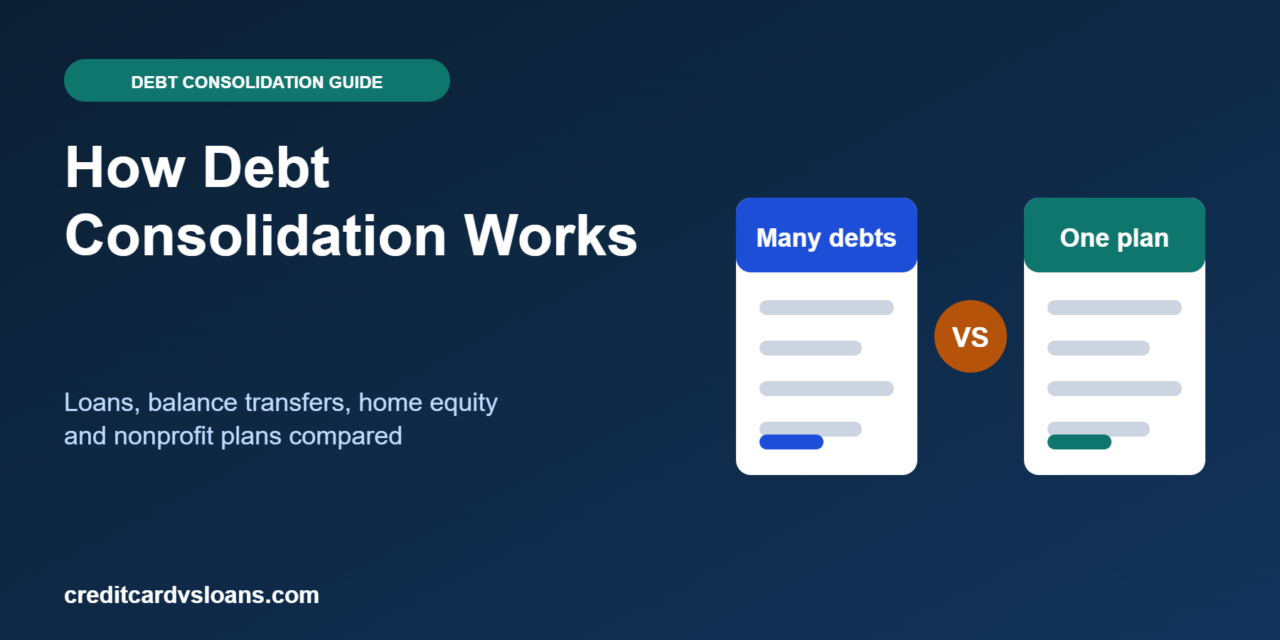
How debt consolidation works comes down to one move: you replace several debts with a single new one, ideally with a simpler payment and a lower total cost. That new debt might be a personal loan, a balance transfer credit card, a home equity loan, or a debt management plan run through a nonprofit counselor. Each path changes your interest rate, your payment, your timeline and your credit file in different ways, so the label "consolidation" tells you very little until you see the terms.
Consolidation does not erase what you owe. It reshuffles the debt, and whether that reshuffle helps depends on three things: the rate and fees on the new debt, the length of the repayment term, and whether the habits that created the balance have changed. A lower monthly payment can feel like relief while quietly costing more over time if the term stretches out.
This guide explains each main option in plain English, shows hypothetical math you can follow with a pencil, and lays out the checks to run before you apply. It is general education, not personal advice, and it never assumes it knows your finances. Links to related guides on this site are included where a topic deserves a deeper look, such as what credit score a consolidation loan may require and how a debt management plan can show up on your credit.
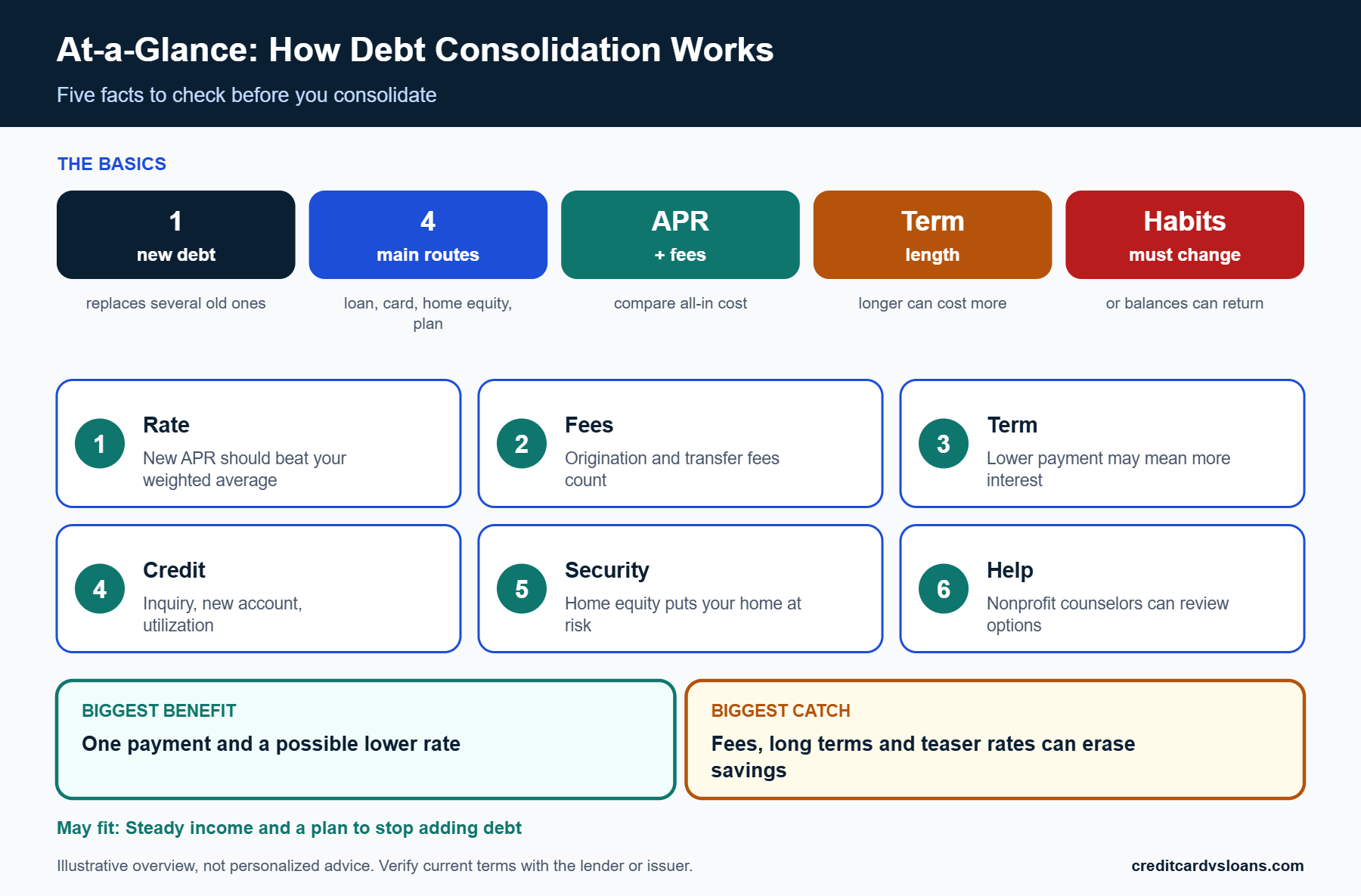
- Consolidation swaps many debts for one. It helps most when the new rate and fees are lower than what you pay now and you stop adding new balances.
- The four common routes are a personal (debt consolidation) loan, a balance transfer card, a home equity loan or line, and a nonprofit debt management plan. Each has a different catch.
- A longer term lowers the monthly payment but can raise the total interest. Compare the total cost, not only the payment.
- A balance transfer fee can apply even on a 0% offer, and a promotional rate is temporary.
- Secured options, such as home equity, put the asset on the line if you cannot repay.
- Be wary of companies that ask for fees up front or tell you to stop paying creditors. Many ads that say "consolidation" are really debt settlement.
Rate references in this guide come from the Federal Reserve's G.19 Consumer Credit release of Oct. 7, 2026, and consumer guidance from the CFPB and FTC as published in 2024 through 2026. Lender rates, fees and approval standards change often, so always rely on the disclosures in your own offer.
How Debt Consolidation Works in Plain English
The basic mechanics
One new debt pays off several old ones
At its simplest, you take on a new financial product, use it to pay off two or more existing debts, and then repay the new product on its own schedule. The Consumer Financial Protection Bureau describes a debt consolidation loan as a loan from a bank, credit union or other lender used to pay off several separate debts, leaving you with a single loan to repay over time.
The appeal is practical. Instead of tracking five due dates, five interest rates and five minimum payments, you track one. Many people also hope the new interest rate will be lower than the average across the old accounts, which is where real savings can come from.
The catch is that the mechanics only help if the numbers work. A single payment is easier to manage, but easier is not the same as cheaper. The rest of this guide is about telling those two things apart.
Where the money actually goes
With a loan, the lender usually sends the funds to you or, in some cases, directly to your creditors. You then pay the old balances to zero. With a balance transfer card, the card issuer pays the old card issuers on your behalf and the amount appears as a balance on the new card. With a debt management plan, you send one monthly payment to a nonprofit counseling agency, and the agency distributes it to your creditors under terms it has arranged.
In every case, the old accounts show a zero balance afterward but typically stay open unless you close them. Whether you keep them open, close them or start using them again is one of the biggest factors in whether consolidation works out. A card paid to zero and then refilled leaves you with the new consolidated debt plus a fresh balance.
What consolidation can and cannot change
What it can change
Consolidation can change your interest rate, your monthly payment, your payoff date, the number of bills you juggle, and the type of debt you carry. Revolving debt, like credit cards, has no fixed end date and a minimum payment that shrinks as the balance falls. An installment loan has a fixed term and a set payment, which creates a clear finish line. For some borrowers, that structure alone is the benefit.
It can also change how your credit file looks. Moving card balances to a loan can lower the share of your available card limits that you are using, which is one of the factors credit scoring models consider. We cover that in detail in the credit impact section below.
What it cannot change
It cannot reduce the principal you borrowed. It cannot make a spending gap disappear. The CFPB makes this point directly: if your debt is growing because you spend more than you earn, consolidation alone will not fix it unless you also cut spending or raise income. Taking new debt to repay old debt often only delays the problem if spending stays the same.
It also cannot guarantee a lower rate. Past credit problems can keep you from qualifying for the low rates that advertising features, and the offer you receive may not be cheaper than what you pay now. That is why the comparison step comes before the application.
Consolidation versus the things it gets confused with
Consolidation is not debt settlement
Debt settlement companies are for-profit businesses that offer to negotiate with creditors to accept less than you owe. They often tell clients to stop paying creditors and deposit money into a separate account while they negotiate. The CFPB warns that many firms advertising "debt consolidation" are actually settlement companies, and that stopping payments can lead to late fees, added interest, credit damage, collection calls and even lawsuits.
The FTC adds that fees charged before a debt is actually settled are a red flag. Real consolidation borrows new money to pay old balances in full. Settlement tries to pay less than the full balance, with more risk. We return to this in the section on counseling, plans and scams.
Consolidation is not credit repair or bankruptcy
Credit repair companies promise to fix your credit reports, usually by disputing negative items, which is something you can do yourself for free. Accurate negative information generally stays on your report for years regardless of who disputes it. Consolidation does not remove history. It adds a new account and changes the status of old ones.
Bankruptcy is a legal process that can discharge certain unsecured debts through a court order. The FTC describes it as a last resort that can stay on your credit report for 10 years. Consolidation sits at the opposite end of that spectrum: it is a voluntary financing choice for borrowers who can still repay in full but want better terms or a simpler plan.
The Main Ways to Consolidate Debt
Four common routes
Personal loans, balance transfer cards, home equity and plans
Most consolidation paths fall into four buckets. A personal loan (often called a debt consolidation loan) is an unsecured installment loan with a fixed payment. A balance transfer card moves card balances onto a new card, often with a promotional low or 0% rate for a limited time. A home equity loan or line of credit borrows against your home. A debt management plan (DMP) is arranged through a credit counseling agency, which negotiates with your creditors and collects one payment from you.
There are other routes, such as borrowing from family or asking creditors directly for lower payments. The CFPB suggests asking creditors first: some will lower minimum payments, waive fees, reduce an interest rate or move a due date to better fit your pay schedule. That call costs nothing and can sometimes solve the problem without a new account.
A side-by-side overview
The table below summarizes what each route is, who it may fit, and the main trade-off. It is a starting map, not a recommendation, and every lender's terms differ.
| Route | What it is | May fit if | Main advantage | Main drawback |
|---|---|---|---|---|
| Personal loan | Unsecured installment loan with a fixed term | You want a set payoff date and can qualify at a rate below your current average | Predictable payment and finish line | Origination fee and a longer term can raise total cost |
| Balance transfer card | New card that pays off old card balances | Your balances are mostly on cards and you can pay them off within the promotional window | Low or 0% promotional APR | Transfer fee, temporary rate, higher regular rate afterward |
| Home equity loan or HELOC | Borrowing secured by your home | You own a home with equity and have a stable repayment plan | Rates are often lower than unsecured debt | Your home is collateral; closing costs may apply |
| Debt management plan | Nonprofit-arranged repayment of unsecured debts | You struggle with payments but can repay in full on a negotiated schedule | One payment, possible lower rates or waived fees | Often runs 48 months or more; you may need to stop using new credit |
Choosing the lens that matters most
Cost, speed, risk and flexibility
When people compare consolidation options, they often fixate on the monthly payment. A better frame is four questions: What will this cost in total? How soon is the debt gone? What happens if my income dips? How much flexibility do I keep?
A loan gives you certainty but little flexibility. A card gives you a short, cheap runway followed by a potential cliff. Home equity gives you low rates but high stakes. A DMP gives you structure and a negotiated rate but asks for discipline. None of these is universally better, and the right one depends on facts only you can see.
When a specific expense is the trigger
Sometimes the debt came from a single event, such as a vet bill or school costs, and the question is how to pay it off rather than how to merge many balances. Our guides on financing a veterinary emergency and financing back-to-school costs compare lower-cost options for those moments. If you already carry card balances from those events, consolidation may come second, after you decide how to stop adding new charges.
Start With an Inventory of What You Owe
Listing every debt and its terms
The information to gather first
Before you compare any consolidation offer, build a one-page list of every debt you might include. For each account, write down the current balance, the APR, the minimum payment, the due date, and any promotional rate that is about to expire. Statements and online account pages list this information. The goal is a clear baseline so you can tell whether an offer beats what you have, rather than guessing from memory.
Include debts you do not plan to consolidate too, such as a mortgage or a car loan, because lenders will count them when they calculate your debt-to-income ratio. Also note any account where a creditor has offered hardship terms. The CFPB suggests that some creditors may lower minimum payments, waive fees, reduce interest or move a due date, so a call before consolidating can change the baseline.
Finding the weighted average rate
A weighted average rate tells you what you are really paying across all the debts together. The example below is hypothetical: three cards totaling $15,000. The weighted average comes from multiplying each balance by its rate, adding those products, and dividing by the total balance.
| Account (illustrative) | Balance | APR | Yearly interest at that rate |
|---|---|---|---|
| Card A | $6,000 | 24% | $1,440 |
| Card B | $5,000 | 21% | $1,050 |
| Card C | $4,000 | 18% | $720 |
| Total | $15,000 | 21.4% weighted average | $3,210 |
In this illustration, a consolidation offer would need an APR clearly below 21.4%, after counting fees, to reduce the interest cost. If the best offer you can get is 20%, the difference is small, and a fee of a few percent could cancel it. The weighted average is a quick filter, not a final answer, because term length and fees still matter.
Setting a realistic payment target
What you can afford each month
Start with your take-home pay and subtract essential costs: housing, utilities, food, transportation, insurance and any court-ordered obligations. What remains is the pool for debt repayment and savings. The FTC recommends tracking income and spending by gathering bills and pay stubs, which shows where money goes and where you may cut back.
Choose a payment that leaves a cushion. A plan that uses every spare dollar will break the first time a car repair or medical bill appears, and a missed payment on a consolidation loan or promotional card costs more than the same miss on an old account. Aim for a payment you could still make in a lean month.
Matching the payment to the timeline
Once you know the payment you can sustain, work backward to the timeline. At a given rate and payment, the number of months follows. If your sustainable payment is well below what a 36-month loan requires, a longer term or a plan through a counselor may be the more realistic route, even though the total cost is higher. If your sustainable payment is above the 36-month payment, you may be able to choose a shorter term and pay less interest.
Whichever way it falls, the aim is a payoff date you can defend. A plan that repays the debt in four years with margin for error is better than one that promises two years and fails in month nine.
Requirements: What Lenders and Issuers Look At
The approval factors behind how debt consolidation works
Credit history and score
Whether you qualify for a consolidation loan or a balance transfer card, and at what rate, depends heavily on your credit file. Lenders generally look at payment history, how much of your available credit you are using, the age of your accounts, recent applications and the mix of account types. FICO publishes the weights for its score categories: payment history 35%, amounts owed 30%, length of credit history 15%, new credit 10% and credit mix 10%. Other scoring models weigh things differently, and each lender sets its own cutoffs.
Because lenders do not publish a single universal minimum, anyone who tells you "you need exactly this score" is simplifying. Our guides on the credit score a debt consolidation loan may call for and the score range balance transfer cards tend to look for explain the typical patterns and why offers vary so much. The CFPB also notes that past credit problems may prevent you from qualifying for low rates on any consolidation option.
The practical takeaway is to treat the advertised "as low as" rate as the best case for the strongest applicants. Your offer may be higher, and it may not beat your current average rate. That is why prequalifying, where available, is worth doing before you commit.
Income, debt-to-income and employment stability
Lenders also want proof you can repay. They typically review income, employment, and your debt-to-income ratio (DTI), which compares your monthly debt payments with your monthly income. A lower DTI generally signals more room in your budget. Consolidation can improve the picture if it lowers your required monthly payments, but a new loan also adds a fixed obligation, and some lenders count it right away.
Documentation requirements vary. Many lenders ask for pay stubs, tax documents or bank statements, and they may verify employment. If your income is irregular, having a longer record to show can help. Keep in mind that a lender approving you for a loan does not prove the loan is affordable for you. Only your own budget can show that.
Hard pulls, soft pulls and rate shopping
Prequalification versus a formal application
Many lenders offer a prequalification step that uses a soft pull, a type of credit check that is not visible to other lenders and generally does not affect scores. Prequalified terms are estimates. When you submit a formal application, the lender usually runs a hard pull, which is recorded on your report as an inquiry and can have a small, temporary effect.
FICO notes that its scores only count inquiries from the past 12 months, although inquiries remain on the report for two years. Opening several new accounts in a short span can look riskier, especially if your credit history is short. Compare estimated terms first and apply formally only when you intend to proceed.
Comparing offers on an apples-to-apples basis
Lay offers side by side using the same checklist: the annual percentage rate (APR), any origination fee, the term in months, the monthly payment, the total of payments, and any prepayment rules. The APR is the standard way to compare because it folds certain fees into one yearly rate for loans. For a balance transfer card, the fee and the length of the promotional period matter as much as the headline rate.
If one offer has a lower payment but a longer term, calculate the total of payments before calling it cheaper. The next section shows how to do that with a worked example.
Some teaser rates apply only for a limited time, after which the lender can raise the rate and your payment can increase, according to CFPB guidance. A lower payment can also simply reflect a longer repayment period. Read the full terms before accepting.
What Debt Consolidation Costs: APR, Fees and Term
Reading the rate and the fees
Where average rates stand
It helps to know the market backdrop. The Federal Reserve's G.19 Consumer Credit release of Oct. 7, 2026 reports average interest rates at commercial banks. These are averages across all borrowers, not offers you can count on, and individual rates range widely with credit profile and lender.
| Period | 24-month personal loans | Credit card plans, all accounts | Credit card plans, accounts assessed interest |
|---|---|---|---|
| 2025 Q4 | 11.63 | 20.97 | 22.30 |
| 2026 Q1 | 11.36 | 21.00 | 21.52 |
| 2026 Q2 (revised) | 11.86 | 20.94 | 22.15 |
| 2026 August (preliminary) | 11.90 | 21.19 | 22.36 |
Read this carefully. As of that release, the average personal loan rate sat roughly ten percentage points below the average rate on card accounts assessed interest. That gap is the reason consolidation is attractive for people carrying revolving balances. But averages hide the spread: a borrower with a thin credit file or recent late payments may be offered a rate near or above their current card rate, which would erase the benefit.
Origination fees, transfer fees and closing costs
Fees are where "cheaper" can quietly become "not cheaper." An origination fee is a one-time charge for creating a loan, often a percentage of the amount borrowed and sometimes subtracted from the proceeds, so you receive less than you borrowed but repay the full amount. A balance transfer fee is a charge for moving a balance to a new card. The CFPB states plainly that a card company is permitted to charge a balance transfer fee even on a zero percent offer, and typically it is a percentage of the amount moved or a flat amount, whichever is greater.
Home equity loans can come with closing costs that the CFPB says may run from hundreds to thousands of dollars. Some personal loans and cards charge late fees or other fees. The actual percentages vary by lender, so use the numbers in your offer rather than a rule of thumb.
Term length and total cost
Why a lower payment can cost more
Stretching a loan over more months lowers each payment but lets interest accrue for longer. The same balance at the same rate costs far more in total over 60 months than over 36. That trade-off is the single most common way consolidation backfires: the payment drops, the relief feels real, and the total cost climbs.
The CFPB specifically cautions that a lower monthly payment may simply reflect a longer repayment period and that, once fees and costs are included, you may pay more overall than under your original debts. Keep the original payoff timeline in mind as a yardstick. If you could eliminate the debt in 40 months on your current path, a 72-month loan needs a very low rate to be worth it.
A worked, hypothetical example
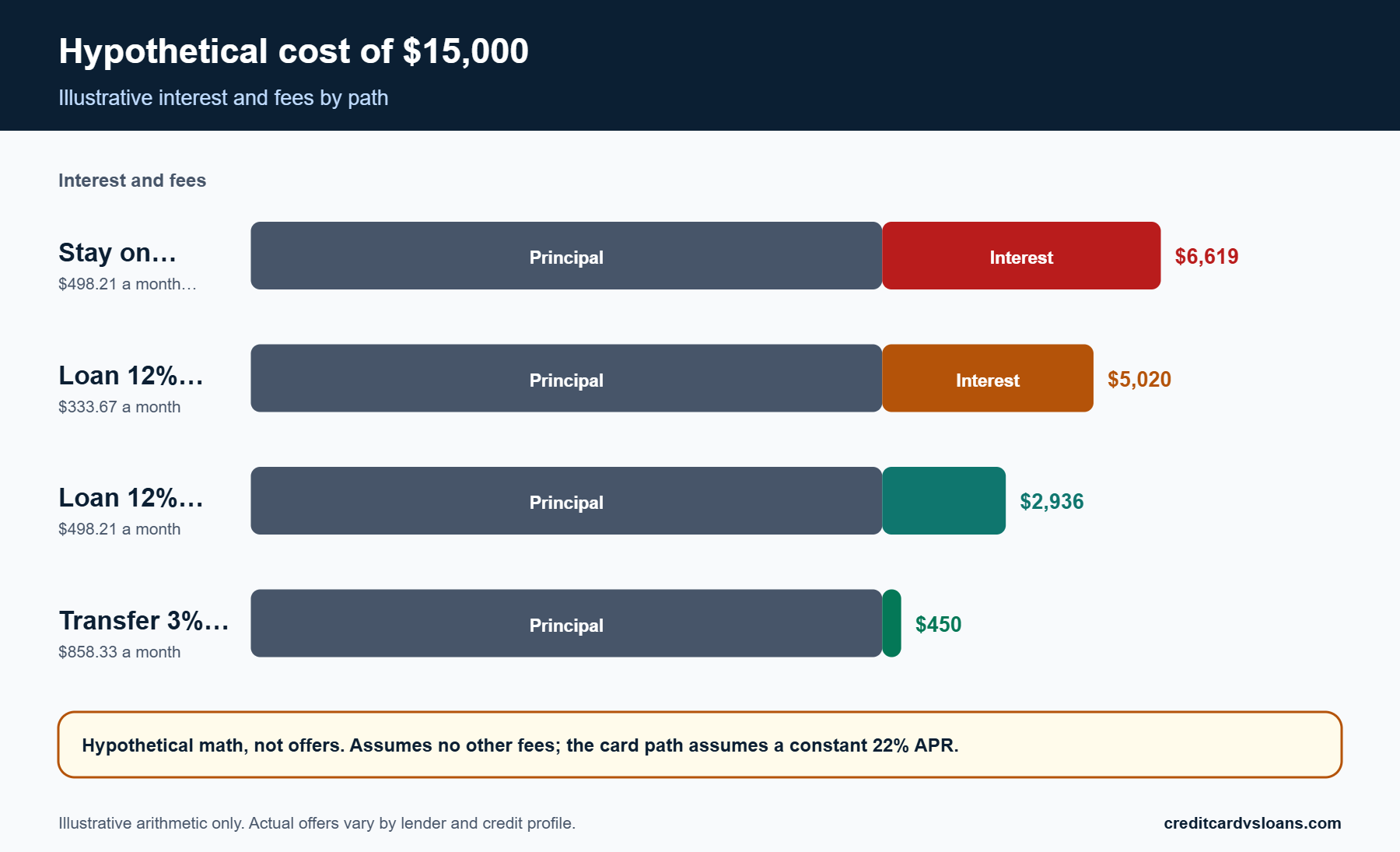
The numbers below are hypothetical and illustrative only. They assume a $15,000 balance, a 22% APR on the current cards, a 12% APR personal loan, and a card payment equal to the 36-month loan payment. They are not offers, forecasts or quotes.
| Path (illustrative) | Monthly payment | Months to pay off | Total interest and fees | Note |
|---|---|---|---|---|
| Stay on cards at 22% APR, pay $498.21 a month | $498.21 | 45 | About $6,619 | Same payment as the 36-month loan, but interest keeps compounding |
| Loan at 12% APR, 36 months | $498.21 | 36 | About $2,936 | No origination fee assumed |
| Loan at 12% APR, 60 months | $333.67 | 60 | About $5,020 | Lower payment, but roughly $2,084 more interest than the 36-month term |
| Loan at 12% APR, 36 months, 5% origination fee taken from proceeds | $524.44 | 36 | About $3,880 | Borrow about $15,789 to net $15,000; fee is part of the cost |
| Balance transfer, 3% fee, 0% for 18 months, paid in full in 18 months | $858.33 | 18 | $450 fee | Requires a payment far higher than the cards' minimums |
The figures illustrate a pattern, not a promise. If the card were left unpaid beyond the promotional window or the rate on the new loan were closer to 20%, the picture would change. The next paragraph explains why.
Two inputs move these results more than any others: the interest rate you are actually offered and the number of months you take to repay. In the first row, the cards are charged 22% and the payment is held at $498.21; in the loan rows, the rate falls to 12% and the term sets the payment. Change either input and the ranking can flip. A 20% loan over 36 months, for example, would carry a payment of about $557.45 and about $5,068 of interest on the same $15,000, which is not far from the cost of staying put.
What shifts the math
The rate you receive, not the rate you saw
Advertised ranges describe the best offers to the strongest applicants. The rate you receive may be several points higher, and the gap between "as low as" and your actual offer can wipe out most of the savings. This is why the sequence matters: gather your current balances and rates first, then compare real prequalified offers against that baseline.
A useful rule of thumb is to compute your weighted average APR across the debts you plan to consolidate. Multiply each balance by its rate, add the results, and divide by the total balance. If the new loan's APR, including fees, is not clearly below that weighted average, consolidation is unlikely to reduce your cost. Also confirm whether any of your current accounts carry a promotional rate that would be lost by paying them off.
Behavior after consolidating
The most important variable is not in any loan agreement. If the cards you just paid off fill back up, you end up with the consolidation loan plus new card debt, which is often worse than the starting point. People handle this in different ways. Some keep one card for emergencies and put the rest away. Some ask the issuer to lower the limit. Others close accounts, although closing can affect the share of available credit you are using and the age of your accounts, so there are trade-offs to weigh.
The CFPB suggests building a budget and checking whether you could pay off the debt by temporarily changing your spending, before taking on any new credit. For many households, the choice of product matters less than whether the monthly cash flow supports the plan.
If your monthly budget has no room even for the lower payment, adding a new loan can compound the problem. A nonprofit credit counselor can review the full picture, and the CFPB recommends starting there.
Putting cost, credit and risk in one view
A cost checklist for every option
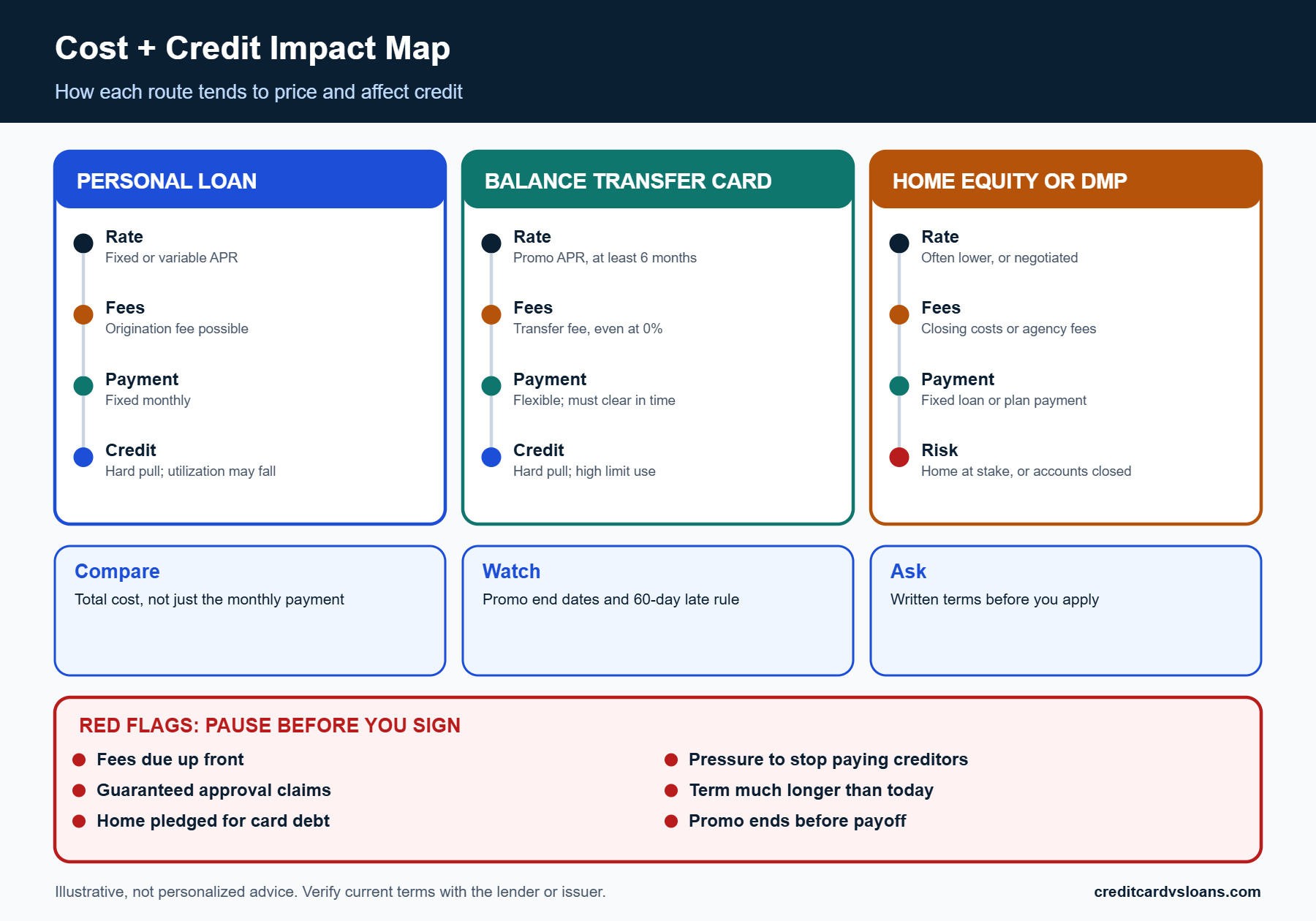
Before comparing anything else, write down five numbers for each option: the APR after the promotional period ends, the one-time fees, the term in months, the monthly payment, and the total of payments. If an offer cannot state all five, ask the lender or issuer to provide them in writing. For balance transfer cards, add the length of the promotional period and the rate that applies when it ends, which the issuer must disclose.
It is also worth checking whether paying early is allowed without a penalty, what happens if you miss a payment, and whether the rate can change. The CFPB notes that being more than 60 days late can let a card issuer raise the rate on all balances, including a transferred balance, and can end a promotional rate.
Seeing the whole map
The graphic at the end of the credit section below pulls the cost, approval and credit effects into a single map, with the main risk flags highlighted, so you can see how each factor connects to the others.
How Consolidation Affects Your Credit
Short-term effects
The application and the new account
Applying for a loan or card usually produces a hard inquiry, and opening the account adds a new tradeline, which lowers the average age of your accounts. Both effects are usually small and tend to fade as the account ages, though your own result depends on your credit file and the scoring model. For people with a thin credit file, a new account can have a bigger relative impact than for someone with many established accounts.
This is why it is smart to avoid stacking several applications in a short window. Prequalify where you can, choose the one or two offers worth pursuing, and apply deliberately. Our guide on whether a balance transfer hurts your credit score walks through the short-term effects of that specific route.
Utilization on the old cards
Utilization is the share of your available revolving credit that you are using. When a loan pays off card balances, your reported card utilization can drop sharply, because the same limits now carry smaller balances. FICO describes the "amounts owed" category, 30% of its score, as covering total debt and how much available credit you use, and notes that a high usage rate can suggest you are stretched thin.
Whether this helps your score depends on the model and on what else changes. It is an effect to understand, not a promise. If the cards fill back up, the benefit disappears and your total debt rises.
Long-term effects
On-time payments over time
Payment history is the largest FICO category at 35%. A consolidation loan with a fixed due date gives you a repeating chance to pay on time, and each on-time payment can support your history. The reverse is also true: a missed payment on the new loan can do real damage, and a missed payment on a promotional card can end the promotion.
Setting up automatic payments from your bank, where the lender permits it, is a simple safeguard. Pair it with a calendar alert a few days before the due date so a low balance does not trigger a failed payment.
Closing accounts and credit mix
After consolidating, you may be tempted to close paid-off cards. Closing a card removes its limit from your total available credit, which can raise your utilization on any remaining cards, and over time it may shorten your average account age. Credit mix, meaning the types of accounts you hold, makes up 10% of the FICO score, so FICO says it is unlikely to be decisive alone.
There is no single right answer. Some borrowers keep cards open but unused, and others close them to remove temptation. If keeping the card open makes it too easy to spend, a closed account may be the safer choice even if the score effect is slightly negative. Our guide on how a debt management plan affects your credit covers the special case of plans that ask you to close accounts.
| Action | Factor involved | Possible short-term effect | Possible longer-term effect |
|---|---|---|---|
| Formal application | New credit (10%) | Hard inquiry may cause a small dip | Inquiries count for 12 months in FICO scores; they stay on the report two years |
| New loan or card opened | Length of history (15%) | Lowers average account age | Effect fades as the account ages |
| Card balances paid down by a loan | Amounts owed (30%) | Card utilization may fall | Benefit reverses if balances are rebuilt |
| On-time payments on new account | Payment history (35%) | Neutral at first | Builds a record of on-time payments |
| Missed or late payment | Payment history (35%) | Can damage scores and end promotional rates | Late payments can remain on reports for years |
| Closing old cards | Amounts owed and history | Total available credit drops | Average age may fall over time |
Debt Consolidation Loans: Fixed Payments and a Finish Line
How a consolidation loan is structured
Fixed rate, fixed term, fixed payment
A personal loan used for consolidation is usually an installment loan: you receive a lump sum, then repay it in equal monthly payments over a set number of months. Many such loans carry a fixed interest rate, which means the payment does not change, although some lenders offer variable rates, so check which one you are being offered. The fixed structure is the main reason borrowers choose a loan over cards. You can see the exact month the debt ends, and the minimum-payment trap that keeps card balances alive for years does not apply.
That structure also removes flexibility. Unlike a card, you cannot choose a smaller payment in a tight month without missing the due date. If your income varies, build a buffer before committing, and ask whether the lender offers hardship options or lets you change the due date. The CFPB points out that creditors and lenders sometimes prefer lower payments to receiving nothing, so it can be worth asking before trouble starts.
Who offers them and how they differ
Banks, credit unions, online lenders and installment lenders all make consolidation loans. The CFPB lists banks, credit unions and installment lenders as typical sources. Credit unions are member-owned nonprofits, and federal credit unions operate under a rate cap set by the National Credit Union Administration, which makes them worth including in your rate shopping if you are eligible for membership. Check the current cap on the NCUA site rather than relying on a remembered figure.
Lenders differ in origination fees, rate ranges, minimum and maximum loan sizes, and whether they send funds directly to your creditors. Direct payment to creditors can remove the temptation to spend the proceeds elsewhere, so it is a feature worth asking about. Whatever you choose, compare at least two or three prequalified offers on the same basis.
Deciding whether the loan clears the bar
The break-even test
A consolidation loan clears the bar when, after fees, its total cost is clearly lower than your current path and the monthly payment fits your budget with room to spare. Use the hypothetical figures in Table 4 as a template. Add the origination fee to the interest, compare the total with what you would pay by staying on your current accounts at a payment you can actually sustain, and make sure you compare equal timelines.
Also compare against a realistic alternative, such as paying the highest-rate card first with extra cash. If your cards carry a rate near what a loan would charge, consolidation may only simplify the bills without lowering cost. Simplicity has value, but it should be a conscious trade.
When a loan is a poor fit
A loan tends to be a poor fit if the offered APR is close to or above your current average, if the origination fee would consume most of the interest savings, or if you expect to keep using the cards. It can also be a poor fit if the only way to reach an affordable payment is a very long term. A lower payment bought with a longer term can leave you paying more overall, as the CFPB cautions.
Finally, loans from lenders that advertise guaranteed approval, charge fees before funding, or pressure you to sign quickly deserve extra scrutiny. Legitimate lenders give you written terms before you commit, and you should be able to compare them without time pressure.
Balance Transfers and Home Equity: Two Very Different Bets
Balance transfer cards
How the promotional rate works
A balance transfer card lets you move balances from existing cards onto a new one, often with a low or 0% promotional APR. The CFPB says an introductory rate must last at least six months, and the issuer must tell you how long it lasts and what rate applies afterward. The rate can end early if you are more than 60 days late on a payment, and a variable introductory rate can still move with its index.
The strategy works best when you can realistically repay the transferred balance before the promotional period ends. If you cannot, the leftover balance starts accruing interest at the card's regular rate, which may be as high as, or higher than, your old cards. Our guide on what score a balance transfer card may call for covers approval, and the credit effects of a transfer covers the score side.
The fee and the purchase trap
The transfer fee is real money: on the hypothetical 3% fee in Table 4, moving $15,000 costs $450 up front, and a 5% fee would cost $750. These percentages are illustrations only, because fees vary by issuer and offer. The CFPB also warns that if you make new purchases on the same card, those purchases may not get a grace period, so you could owe interest on them until the full balance, including the transferred amount, is paid.
The simplest defense is to use the card only for the transfer, set up automatic payments sized to clear the balance within the promotional window, and keep a different payment method for everyday spending. If a transfer card limit is lower than your total debt, you may only be able to move part of the balance, so confirm the limit before assuming the full amount fits.
Home equity borrowing
Lower rates, higher stakes
A home equity loan or home equity line of credit (HELOC) lets homeowners borrow against the equity in their home. The CFPB notes that these loans often carry lower rates than unsecured debt, but that you are putting your home on the line: failing to repay could lead to foreclosure. The FTC similarly warns that secured loans put your home at risk if you cannot pay.
The CFPB also lists other drawbacks: closing costs from hundreds to thousands of dollars, the risk of owing more than the home is worth if values fall, and the loss of equity you might have needed for emergencies or repairs. Turning unsecured credit card debt into secured debt changes what a missed payment can cost you, which is a major shift in risk even if the rate is attractive.
Questions to ask before pledging your home
Ask whether the rate is fixed or variable, what the total closing costs are, whether there is a prepayment penalty, and what happens to the payment if rates rise. Ask what your payment would be if your income fell by a meaningful share. If you would struggle to cover the payment in that case, an unsecured option or a plan arranged through a counselor may carry less downside.
The CFPB recommends comparing the advantages and risks of each option and consulting a nonprofit counselor before deciding. Consider also whether a smaller secured loan covering only the highest-rate debt might reduce exposure while still lowering cost.
Debt Management Plans, Counseling and Settlement
Credit counseling and debt management plans
What a counselor does and what a plan involves
The CFPB describes credit counseling as typically nonprofit: organizations that advise consumers on managing money and debts, often with free educational materials and workshops. An initial session usually lasts about an hour, with follow-ups available. If a plan makes sense, the counselor can set up a debt management plan covering your unsecured debts. You make one monthly payment to the counseling organization, which pays your creditors.
According to the FTC, the counselor sets a payment schedule with you and your creditors, and creditors may lower interest rates or waive fees. The plans generally cover unsecured debts like credit cards, student loans and medical bills, not secured debts like a mortgage or car loan. They often last 48 months or more, and you may have to stop using or applying for new credit during the plan. Counselors cannot erase debts, and they may charge fees, so ask for fee quotes in writing.
A plan is not right for everyone. It requires consistent, on-time payments, and the FTC advises confirming with your creditors that they offer the modifications the counselor describes. If a counselor says a DMP is your only option without reviewing your finances, look for another counselor.
How to vet a counseling agency
Nonprofit status alone does not guarantee low fees or legitimacy, according to the FTC. Good signs include free information before you share details, a thorough review of your finances, certified or accredited counselors, written fee quotes, and no charges in advance for services not yet provided. Credit unions, universities, Cooperative Extension offices and military personal financial managers often offer low-cost help.
Check your state attorney general and consumer protection agency, and search the organization's name with words like "complaint" or "review." Get every promise in writing and read contracts before signing. For the credit side of plans, including how closed accounts may be noted, see our guide to debt management plans and credit.
Debt settlement and how to spot a scam
Why settlement is a different animal
Debt settlement is a for-profit service in which a company negotiates with creditors to accept a lump sum smaller than the balance. Clients typically save money in a dedicated account until a settlement can be paid, and the programs often encourage you to stop paying creditors. The FTC and CFPB both warn about the consequences: added late fees and interest, damaged credit, collection efforts and lawsuits, with wage garnishment or liens possible if a creditor wins a judgment.
Not every debt can be settled, creditors are not required to negotiate, and forgiven or saved amounts may be taxable income. You can negotiate directly with creditors for free. If you are considering settlement because you cannot afford your debts at all, the CFPB suggests consulting a bankruptcy attorney as part of weighing your options.
Red flags that a "consolidation" offer is not what it says
The FTC's consumer alert of March 2026 lists the red flags clearly: demanding payment before any debt is settled or any plan is set up, promising to settle all your debts or secure fast loan forgiveness, and unsolicited calls or texts that ask for personal or financial information. Other warning signs include claims of a special "government" program, enrolling you without reviewing your finances, and telling you to stop talking to creditors without explaining the consequences.
Under the FTC's description of the rules, settlement companies cannot collect fees before they settle your debts, and money in a dedicated account remains yours, held by an independent third party, with the right to withdraw at any time. If you encounter a debt relief scam, report it at ReportFraud.ftc.gov and to your state attorney general.
| Feature | Nonprofit credit counseling or DMP | Debt settlement company | Consolidation loan or card |
|---|---|---|---|
| Who runs it | Usually a nonprofit agency | For-profit company | Bank, credit union, lender or card issuer |
| What happens to the balance | Repaid in full on a negotiated schedule | Negotiated for less than owed, if creditors agree | Repaid in full through the new debt |
| Typical advice on payments | Keep paying through the plan | Often told to stop paying creditors | Keep paying the new account on time |
| Fee timing | Ask for written fee quotes; no charges in advance for work not done | Fees before settlement are a red flag | Origination or transfer fees shown in your offer |
| Credit risk | Accounts may be closed; on-time payments help | Missed payments, collections, lawsuits possible | Inquiry and new account; utilization may change |
| Tax note | Usually does not affect taxes, per the CFPB | Forgiven debt may be taxable | Not applicable |
Pros, Cons and When Consolidation Backfires
Weighing the pros and cons
The upside, honestly stated
The benefits are real for the right borrower. One payment is easier to track and less likely to be missed. A lower rate can cut the interest cost, and a fixed term can end the debt on a known date instead of letting it linger on minimum payments. A structured plan can bring discipline, and moving off high-rate revolving debt can reduce stress and free up breathing room in a monthly budget.
For borrowers who have the cash flow to repay but are losing money to a high card rate, the math can be compelling. Table 4 shows how a lower rate over a short term can change the total cost substantially, in a hypothetical case.
The downside, honestly stated
The drawbacks are just as real. Fees can eat into savings. Longer terms can raise total cost. Teaser rates end. Secured loans raise the stakes. Applications generate inquiries. And there is a behavioral risk: freeing up card limits can invite new spending. The CFPB's caution that taking new debt to repay old debt often only delays the problem unless spending also decreases is the single most important sentence in this guide.
Consolidation also does not address the cause of the debt. If the cause was a one-time event, such as a medical bill or car repair, a payoff plan may be enough. If the cause was ongoing shortfalls, the plan needs to include income or spending changes too.
Warning signs that it may backfire
Signs in the numbers
It may backfire if the new APR plus fees is not clearly below your weighted average rate, if the term is much longer than your current payoff timeline, if you would lose a promotional rate on an existing account, or if the payment would leave you without a cash buffer. Another sign is when the savings depend on perfect behavior, like paying off a transferred balance in exactly the last month of the promotional window with no room for a surprise expense.
If the numbers only work under optimistic assumptions, add a margin: assume a higher rate or a lower income and see if the plan still holds. If it does not, look at alternatives with more room for error.
Signs in the process
The sales process can be a warning too. Be wary of pressure to act today, requests for payment before any service, promises of guaranteed approval or guaranteed savings, vague answers about fees, and refusal to put terms in writing. The FTC and CFPB both advise that offers sounding too good to be true deserve skepticism.
A legitimate provider will let you take the offer home, compare it, and ask questions. If you are rushed, that is useful information in itself.
Consolidating Different Kinds of Debt
Credit cards, medical bills and store accounts
Unsecured debts that fit most plans
Credit cards are the most common target for consolidation because their rates are usually the highest among consumer debts. The Federal Reserve's G.19 release of Oct. 7, 2026 shows an average of 22.36% on card accounts assessed interest in August 2026 (preliminary), compared with 11.90% on 24-month personal loans, so the potential gap is large for borrowers who qualify for rates near the average. Medical bills and store accounts are also unsecured, and the FTC notes that debt management plans can cover unsecured debts including medical bills.
Before moving a medical bill into a loan or onto a card, ask the provider about payment plans and financial assistance. A provider payment plan may carry no interest, and turning that bill into card debt could make it more expensive. That is a case where the original debt may already be the cheaper form of borrowing.
Accounts that are already behind
If accounts are past due, the picture changes. The FTC explains that missing minimum payments hurts your credit score, and after four to six months of missed payments the creditor may charge off the debt. You still owe it, and it may be sold to a collector, but creditors may still negotiate after a charge-off. Applying for a new loan with delinquent accounts can mean a higher rate or a denial.
For very old debts, the FTC notes that a statute of limitations sets how long a collector can sue, that the period depends on the debt type and state law, and that in some states a payment or written acknowledgment can restart the clock. If you are dealing with old debt, learn the rules in your state before paying anything.
Student loans and secured debts
Student loans follow separate rules
Federal student loans have their own repayment and forgiveness programs, which the FTC says are free to apply for through StudentAid.gov or your servicer. The CFPB has separate guidance on consolidating federal loans into a Direct Consolidation Loan and on refinancing student loans with a private lender. Moving federal loans into a private consolidation loan can mean giving up federal protections, so look at those programs closely before mixing student loans into a general consolidation plan.
You do not need to pay for help with student loan options. If a company asks for an upfront fee to enroll you in a federal program, that is a reason to stop and check studentaid.gov.
Mortgages and car loans
Secured debts like mortgages and car loans are generally not covered by debt management plans, according to the FTC. If you are behind on a mortgage, the FTC advises contacting your lender immediately and using free, HUD-approved housing counselors, and never paying upfront for mortgage relief. For a car loan, lenders can repossess a car without notice after a default, and selling the car yourself may cost less than repossession.
Because these debts are tied to assets, mixing them into a general consolidation can change what you risk. It is usually better to handle them separately, with the lender or an approved counselor, and consolidate only the unsecured accounts.
Common Mistakes That Undo the Savings
Mistakes before you borrow
Judging by the payment instead of the total cost
The most frequent error is choosing the offer with the smallest monthly payment. That payment is often lower because the loan lasts longer, and the extra months carry extra interest. Always multiply the payment by the number of months, subtract the amount you actually received, and compare that figure across offers. Include any origination fee in the cost, since a fee deducted from the proceeds means you repay more than you receive.
A related mistake is ignoring the payoff timeline you are already on. If you are paying down a card faster than the minimum, a 72-month loan can make you slower than your current plan even at a lower rate. Use the same timeline for every comparison, or note clearly where the timelines differ.
Skipping the creditor conversation and the counselor
Many borrowers go straight to a new product without asking existing creditors what they can do. The FTC notes that you can call a card issuer, ask for a lower rate, and propose an affordable payment plan for free, and that you should keep records of every conversation and get any agreement in writing. The answer may be no, but the call costs nothing and takes minutes.
The CFPB also recommends talking to a nonprofit credit counselor before choosing among consolidation options, partly because a counselor can see the whole picture, including options you did not know existed. A first session is often free or low cost, and you are under no obligation to sign up for a plan.
Mistakes after you consolidate
Rebuilding card balances
Paying cards to zero creates a powerful temptation. Available credit looks like free money, and a budget that was strained before may still be strained afterward. If the balances rebuild, the household carries both the consolidation payment and new card payments, which can be worse than the original situation. Decide in advance how you will handle everyday spending, and whether to keep the cards for emergencies only.
Some people find it helpful to remove saved card numbers from shopping apps, set up spending alerts, or switch to a debit card for routine purchases. These steps will not fix an income gap, but they reduce impulse use.
Missing the end of a promotional period
With a balance transfer card, the promotional window is a deadline. Put the expiration date on your calendar with a reminder two months ahead, divide the remaining balance by the months left, and check whether your payment is on track. If you cannot clear the balance in time, look at the rate that will apply afterward and consider whether a second transfer or a loan makes sense, keeping in mind that each new account has its own fees and inquiries.
Also remember the CFPB's caution that a late payment of more than 60 days can end the promotional rate. An automatic payment for at least the minimum, combined with a larger manual payment, protects against accidents.
Which Path May Fit Which Situation
Matching situations to options
A decision matrix to start from
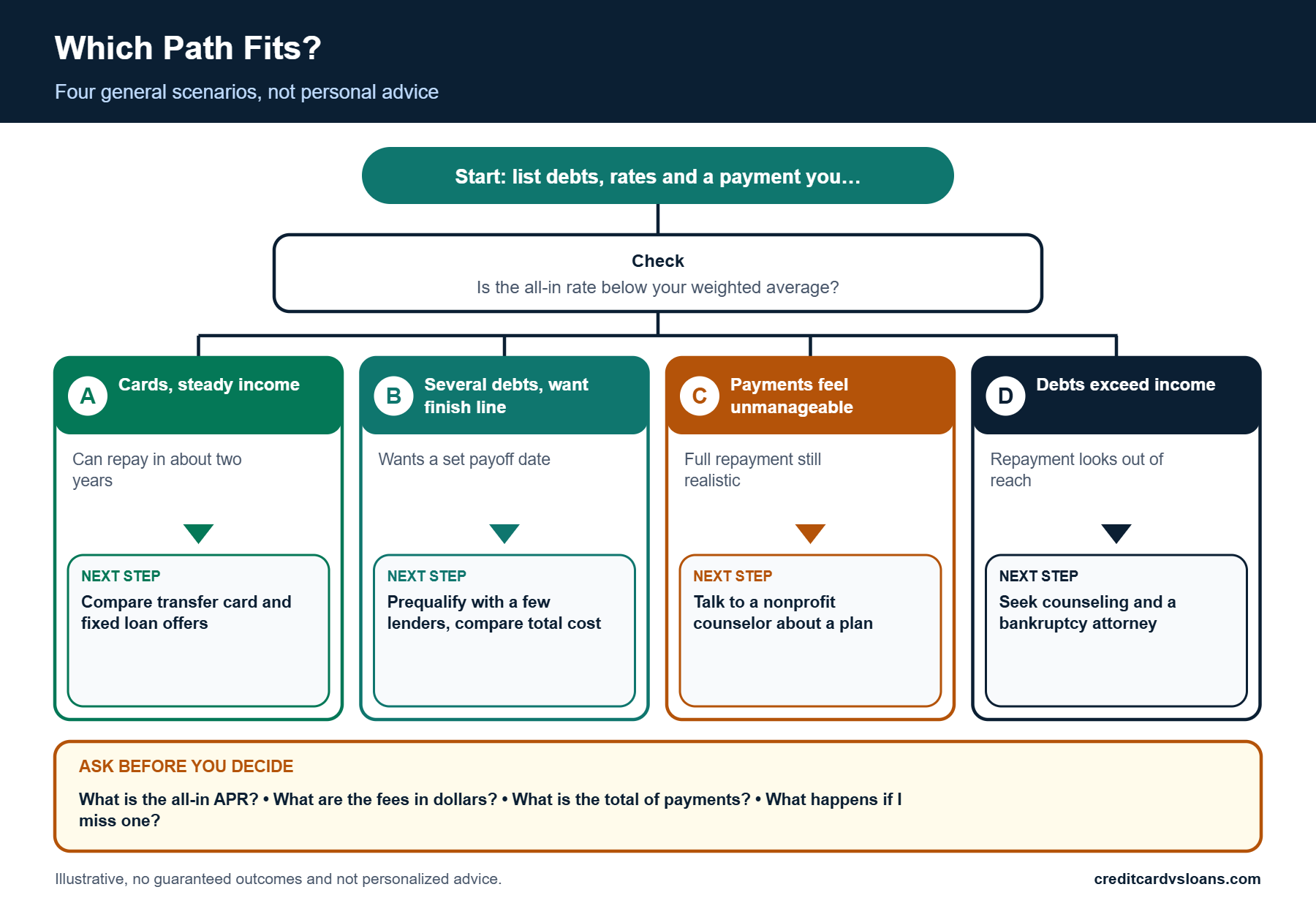
No table can pick the right option for your finances, but a matrix can narrow what to investigate. The rows below describe general borrower situations, not real people, and the "option to investigate" is a starting point for research rather than a recommendation.
| Situation | Option to investigate | Why | What to verify | When to avoid it |
|---|---|---|---|---|
| Mostly card debt, steady income, can repay within about two years | Balance transfer card | A promotional rate can cut interest if the balance clears in time | Transfer fee, promo length, regular APR, credit limit | If the balance cannot be repaid before the promo ends |
| Several debts, steady income, wants a set payoff date | Personal consolidation loan | Fixed payment and term create a finish line | APR, origination fee, term, total of payments | If the offered APR is near your current average |
| Homeowner with equity and a firm repayment plan | Home equity loan or HELOC | Rates are often lower than unsecured debt | Closing costs, rate type, prepayment terms | If a missed payment could put the home at risk you cannot absorb |
| Payments feel unmanageable but full repayment is realistic | Nonprofit counseling and a DMP | Creditors may reduce rates or waive fees | Agency fees, which creditors participate, plan length | If you need to keep using new credit |
| Debts are far beyond what income can repay | Talk to a bankruptcy attorney and a counselor | Consolidation may only delay the problem | Credit counseling and legal requirements | Do not rely on a company promising to erase debt |
| Balance is small and could be paid within months | Pay it down directly | New accounts may cost more than they save | Whether any creditor will lower the rate | If fees would exceed interest saved |
Using the matrix honestly
Match yourself to the row that fits, then run the numbers for that option and one alternative. If two options come out close, favor the one with less downside: unsecured over secured, a shorter promotional cliff over a longer one, a plan with more flexibility over one with less. If your situation fits no row, that is a signal to talk to a counselor rather than force a fit.
Scenarios to test your thinking
Scenario: steady income and card balances
Imagine a hypothetical borrower with $15,000 across three cards at an average of 21.4% and a budget that can support about $500 per month. With a balance transfer card at 3% and 0% for 18 months, $500 a month clears $9,000 of the $15,450 transferred balance, leaving $6,450 to carry at the regular rate. At an illustrative 22%, paying $500 a month on the remainder would take roughly 15 more months and add about $904 of interest, on top of the $450 fee. A loan at 12% over 36 months would need about $498 a month and carry about $2,936 of interest. The two paths cost different amounts and carry different risks, and the better one depends on the actual offers.
This is the kind of scenario where comparing real written offers is worth an hour. The numbers are illustrations, and your results will differ.
Scenario: tight budget and rising stress
Now imagine a hypothetical household where minimum payments absorb most of the income and a missed payment is likely within months. A new loan would add a fixed payment to an already strained budget. In that case the more useful first step may be a conversation with a nonprofit counselor, who can review the budget and discuss a debt management plan, creditor hardship programs, or, if debts are unmanageable, a referral to a bankruptcy attorney.
The FTC notes that bankruptcy can discharge unsecured debts like credit cards and medical bills, halts collection activity, and stays on a credit report for 10 years. It is a serious step with consequences, but for some households it is the realistic option, and it is better to learn about it from a professional than from advertising.
Your Checklist Before You Apply or Sign
Questions to answer about the offer
The numbers
Write the answers down, because a clear written comparison is the best protection against a persuasive sales pitch. For every offer, record the APR, including the rate that applies after any promotional period; the origination or transfer fee in dollars; the term in months; the monthly payment; the total of payments; and whether there is a penalty for paying early. Then compare the total of payments with the cost of your current path over the same period.
- Is the all-in cost clearly lower than my weighted average rate across the debts?
- Does any account I am paying off carry a promotional rate I would lose?
- If the rate is variable, what happens to the payment when it changes?
- Can I make the payment in a lean month, not only a good one?
- Do the proceeds go to my creditors directly, or to me?
The terms and the lender
Check that the lender or issuer is one you can verify. Look for the terms in writing before you apply formally, confirm what hard pull will occur, and read how late payments, defaults and hardship requests are handled. If a company asks for payment before it does any work, promises to settle everything, or contacts you unprompted, treat that as a stop sign, in line with the FTC's warnings.
For home equity products, confirm the closing costs and what the lender can do if you fall behind. For counseling agencies, confirm nonprofit status, certification of counselors, and fee quotes in writing, and check your state attorney general or consumer protection agency.
Red flags that mean stop and rethink
Pause the process if any of these appear: a request for payment before any service is delivered, a guarantee of approval or of a specific savings amount, pressure to sign the same day, unwillingness to put fees in writing, or a suggestion that you stop paying your creditors without a clear explanation. The FTC identifies upfront fees, guarantees and unsolicited offers as the classic signs of a debt relief scam.
Legitimate offers survive scrutiny. If you want a second opinion, a nonprofit credit counselor or a trusted credit union can look at the written terms with you, often at little or no cost. Taking a day to sleep on a decision rarely costs anything, and it often saves a lot.
Questions to answer about yourself
Why did the debt build up?
This is the question the whole decision turns on. If a one-time event caused the debt, such as a medical bill or a repair, then paying it off on a clear schedule may be enough. If the cause is a recurring gap between income and spending, the plan needs to address that gap, or the debt will return. The CFPB is direct on this point, and it is better to hear it before you borrow than after.
Ask what would have to change for the balances not to rebuild. A written budget, a smaller number of cards, an emergency cushion, or additional income are all possible answers. Without one, even an excellent loan can end up as a pause rather than a solution.
What is my fallback if things go wrong?
Think through the bad month before it happens. If income dropped for three months, what would you do? Could you ask the lender for hardship terms, draw on savings, or lean on a nonprofit counselor? The answers affect which option is safest. A secured loan with no fallback is riskier than an unsecured loan with a hardship option.
Having a plan B costs nothing and often changes which plan A you choose. If the only fallback is missing a payment, pick the option with the lowest downside, even if it is not the cheapest on paper.
How to compare offers in ten minutes
Open a simple table with one row per offer and the columns APR, fee in dollars, term, payment and total of payments. Fill in the current path as the first row, using a payment you can actually keep up. Highlight the row with the lowest total cost, then look at the row with the lowest risk, and ask whether they are the same. If they are not, decide how much extra cost you are willing to pay for less risk.
This quick exercise often reveals that the "best" offer on the page is not the best one for you. A slightly higher rate with no fee and a short term can beat a lower advertised rate with a large fee. Writing it down is what makes the difference visible.
You have a written comparison of at least two offers, a weighted average of your current rates, a payment that leaves a cushion, and a plan for what happens to the cards you pay off.
Follow-Up Questions Worth Asking
About cost and timing
How long does consolidation take?
The application and funding timeline varies by lender, product and how quickly you supply documents, so there is no single answer. A balance transfer card typically requires approval and then a transfer request, which can take some time to post, so keep paying the minimums on the old cards until the transfer shows on your statements. A missed payment while a transfer is pending can still cause damage.
A debt management plan takes longer to set up because creditors must agree to the terms. Ask the counselor how long enrollment takes and which of your creditors participate before you assume your rates will drop.
Can I consolidate more than once?
Nothing prevents it in principle, but each new account carries its own fees, an inquiry and a new set of terms. Repeated consolidation can be a sign that the underlying cause has not been addressed. If you are thinking about a second transfer because a promotional rate is ending, compare the new fee against the interest you would pay on the remaining balance, and ask whether a loan with a fixed payoff date would be a steadier path.
About credit and safety
Will consolidating hurt my credit?
It can cause small, temporary effects from an inquiry and a new account, and it can help or hurt later depending on how you handle payments and balances. No one can promise a particular score change. The sections above on short-term and long-term effects explain the mechanics, and the guide on balance transfers and your score covers that route in more detail.
If your score is a concern, check your credit reports for errors first. You can dispute genuine errors yourself at no cost, as the FTC notes, and you should be wary of any company charging for what you can do for free.
How do I know an offer is legitimate?
Legitimate lenders give written terms, do not ask for payment before funding, and let you compare offers without pressure. Search the company's name with words like "complaint," check your state attorney general and consumer protection agency, and be skeptical of any unsolicited contact asking for personal information. If something goes wrong, report it at ReportFraud.ftc.gov.
Conclusion: How to Decide and What to Do Next
Rules of thumb for the decision
Simple rules that hold up
Consolidation is usually worth investigating when the new all-in rate is clearly below your weighted average, the term is not much longer than your current payoff path, the payment fits your budget with a cushion, and you have a plan to stop adding balances. It is usually worth pausing when the offered rate is close to your current one, when savings depend on perfect execution, or when the payment would strain the budget.
Prefer unsecured to secured when the numbers are close. Prefer a shorter term when you can afford it. Prefer a nonprofit counselor over a for-profit settlement company when you need help negotiating. And be skeptical of any offer that guarantees results.
When to get outside help
If you cannot find an option that fits, or if the numbers keep failing, that is not a personal failure. It is a reason to talk with a nonprofit credit counselor, ask your creditors about hardship options, or speak with a bankruptcy attorney if the debts are beyond what your income can repay. Resources the FTC lists include credit unions, universities, Cooperative Extension offices and military personal financial managers, which often offer low-cost counseling.
Your state attorney general and consumer protection agency are also places to check whether a company is legitimate. The CFPB and FTC both publish free guidance on these choices.
How debt consolidation works is simple to describe and easy to get wrong in practice. It helps when the total cost falls, the payment is sustainable and the spending habits change. It hurts when fees, long terms or secured collateral hide the real price. Compare written offers, keep a cushion, and get free counseling before paying for help.
A next-step list
This week
- List every debt with its balance, APR, minimum payment and any promotional end date.
- Compute your weighted average APR and set a realistic monthly payment with a cushion.
- Call your current creditors and ask about lower rates, waived fees or a different due date, and keep written notes.
- Schedule a free or low-cost session with a nonprofit credit counselor if the budget is tight.
Before you apply
- Prequalify with two or three lenders or issuers, using soft pulls where available.
- Compare APR, fees, term, payment and total cost in one table, on the same basis.
- Decide what happens to the paid-off cards before the money moves.
- Set up automatic payments and a calendar reminder for any promotional end date.
If the answer still looks unclear, revisit the guides on credit scores for consolidation loans, balance transfers and your score, balance transfer card requirements and debt management plans and credit to deepen the part that matters most to your situation.
- What Credit Score Do You Need for a Debt Consolidation Loan?
- How a Debt Management Plan Affects Your Credit
- How to Finance Back-to-School Costs: Credit Cards, Loans and Lower-Cost Options
- How to Finance a Veterinary Emergency: Credit Cards, Loans and Lower-Cost Options
- Does a Balance Transfer Hurt Your Credit Score?
- What Credit Score Do You Need for a Balance Transfer Card?
- CFPB: What do I need to know about consolidating my credit card debt?
- CFPB: What is the difference between credit counseling and debt settlement, debt consolidation, or credit repair?
- CFPB: I have seen a lot of advertisements for companies that consolidate credit card debt. Are these legitimate?
- CFPB: What is a balance transfer fee? Can it be charged on a zero percent offer?
- CFPB: How long can I keep a low rate on a balance transfer or other introductory rate?
- FTC: How To Get Out of Debt
- FTC: Looking for debt relief? Here is how to avoid a scam (March 2026)
- Federal Reserve: Federal Reserve G.19 Consumer Credit (release of Oct. 7, 2026)
- myFICO: What is in your FICO Score
Last updated: October 22, 2026. Rates, fees and lender rules change; verify current terms before acting.
The information on creditcardvsloans.com is provided for general educational and informational purposes only. It is not financial, legal, tax, credit, accounting or investment advice, and reading it does not create an advisor-client, fiduciary or any other professional relationship. Nothing here is an offer, solicitation or recommendation to borrow, lend or apply for any product.
Credit scores, interest rates, fees, eligibility rules, lender policies and laws change frequently and vary by lender, location and individual circumstances. Examples, figures and scenarios are illustrative only, do not predict your results and do not guarantee approval, savings, a particular rate or a credit-score outcome. Always confirm current terms directly with the lender or issuer and read the full agreement before you apply or sign.
Although we aim for accuracy and use reputable sources, we make no representations or warranties, express or implied, about the completeness, accuracy, reliability or timeliness of the content. Content may be drafted with the assistance of automated tools, so errors or omissions may still occur. Links to third-party sites are provided for convenience; we don’t control and aren’t responsible for their content.
To the fullest extent permitted by law, creditcardvsloans.com and its owners, editors, authors, contributors and affiliates disclaim all liability for any loss, damage or expense arising directly or indirectly from your use of, or reliance on, this content. Before making financial decisions, consult a licensed professional, such as a qualified financial advisor, attorney, tax professional or nonprofit credit counselor, who can consider your complete situation.