There is no single credit score for a personal loan that guarantees approval, and no universal cutoff that automatically rules one out. Each lender sets its own rules, and many publish only a “starting at” figure or nothing at all. As a rule of thumb, scores in FICO’s “good” range (670 or higher) open the widest set of mainstream offers, scores in the fair range (580 to 669) can still qualify with some lenders at a higher price, and scores below 580 usually mean fewer unsecured options and a greater risk of running into costly offers.
But the score is only the opening act. Lenders also weigh your income, your debt-to-income ratio (DTI), the details on your credit report, the loan amount and the term. This guide explains how those pieces fit together, how lenders use your credit score for personal loan approvals and pricing, what a loan may cost at different points on the credit spectrum, how applying affects your score, and what to do if your number isn’t where you’d like it to be.
It’s written for people comparing a personal loan with other ways to borrow, including a credit card. The goal isn’t to steer you toward any product. It’s to help you ask better questions, spot the fine print and avoid the offers that cost more than they should.
- There’s no universal minimum score. Lenders set their own cutoffs, and the same score can get different answers at different lenders.
- A score of 670 or higher sits in FICO’s “good” tier or better, which many lenders treat as mainstream territory. It still isn’t a promise of approval or a low rate.
- Income and DTI matter almost as much as the score. A strong score paired with heavy existing debt can still end in a “no.”
- Compare APR to APR. An origination fee can make a loan with a lower quoted rate cost more than one with a higher rate and no fee.
- Prequalify first. A soft pull typically doesn’t affect your score, while a formal application usually triggers a hard pull.
- With a low score, upfront-fee “guaranteed approval” offers are a red flag. Slow down and look at credit unions, secured options or nonprofit counseling first.
Score ranges and rate benchmarks in this article were checked against the sources listed at the end in October 2026. Rates and lender rules change often, so treat every number as a dated snapshot and confirm current terms with the lender before you act.
What Credit Score Do You Need for a Personal Loan? The Short Answer
The honest short answer is “it depends on the lender, the loan and the rest of your file.” What you can do is understand the ranges lenders use to describe borrowers and then look at what usually happens in each range. That’s a more useful frame than hunting for one magic number.
What Lenders and Regulators Actually Say
The CFPB’s View: Higher Scores Generally Help, but Rules Vary
The Consumer Financial Protection Bureau (CFPB) describes a credit score as a number that summarizes the information in your credit reports and helps lenders estimate how likely you are to repay what you borrow. In its consumer guidance on credit scores, the agency makes the broad point that higher scores typically make it easier to qualify for credit and to get better terms.
What the CFPB does not do is name one minimum score for personal loans. That’s because lenders decide their own credit policies within the law. So when an article, an ad or a forum post says “you need a 640 for this,” treat it as a market observation or a single lender’s policy, not a rule.
Why You Rarely See One Published Minimum
Lenders differ in how much risk they’re willing to take, how they fund their loans and which borrowers they target. A large bank, a credit union, an online lender and a finance company can all look at the same applicant and reach different conclusions. Some lenders publish a “minimum score” on their websites. Others reveal it only after you prequalify or apply.
There’s another wrinkle: the same lender’s cutoff can shift with the loan amount, the term, your state and your income. Think of a published minimum as a door that may open, not a key that always works.
FICO Score Ranges and What Each Tier Tends to Mean
The Five FICO Tiers at a Glance
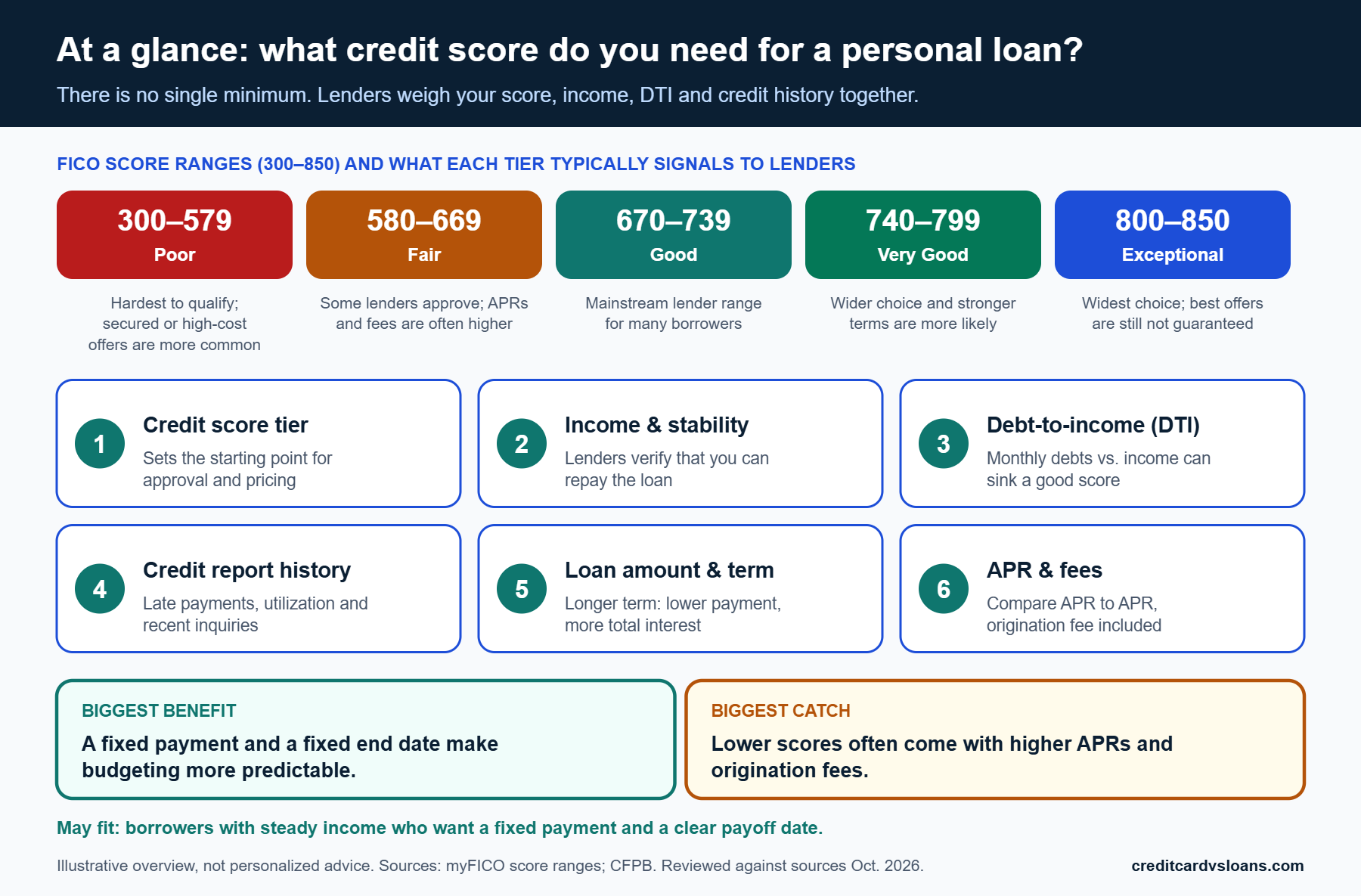
FICO scores run from 300 to 850 and are grouped into five bands. The table below pairs each band with how lenders often view it and what the personal-loan landscape tends to look like. The “landscape” column is a general pattern, not a prediction for any one borrower.
| FICO tier | Score range | How lenders often read it | Typical personal loan landscape |
|---|---|---|---|
| Poor | 300 to 579 | Higher perceived risk of missed payments | Fewer unsecured options; secured, co-signed or credit-builder routes are more common; higher cost likely |
| Fair | 580 to 669 | Below the U.S. average and more variable | Some banks, credit unions and online lenders may approve; APRs and fees are often higher |
| Good | 670 to 739 | Near or slightly above the U.S. average | Mainstream lender range; more competing offers to compare |
| Very good | 740 to 799 | Dependable borrower | Broader choice and often better pricing |
| Exceptional | 800 to 850 | Very low risk | Widest choice; the best advertised rates still depend on income, DTI, amount and term |
These ranges match the bands FICO publishes and that major issuers reproduce. Keep in mind that a lender can set a cutoff anywhere. A 668 and a 671 sit on opposite sides of a tier line, yet a lender may treat them almost identically, or a different lender’s cutoff may fall between them.
FICO vs. VantageScore: Why Your Numbers Can Differ
FICO isn’t the only scoring family. VantageScore also uses a 300 to 850 scale, but it labels its bands differently. One common VantageScore table calls 661 to 780 “good” and 781 to 850 “excellent,” while FICO’s “good” starts at 670 and its top tier starts at 800. A single credit profile can therefore get a different label depending on whose chart you read.
It gets more layered. FICO has several versions (including industry-specific ones for auto lenders and card issuers), and each of the three credit bureaus (Experian, Equifax and TransUnion) may hold slightly different information about you. The score on a free app might not be the one a lender pulls. Use your score as a range, not a point, and ask which model and bureau a prequalification used.
How Lenders Decide Beyond Your Credit Score
If the credit score were the whole story, every borrower in the same tier would get the same answer. They don’t, because underwriting (the lender’s process of evaluating risk) looks at your ability to repay as well as your history of repaying. The table below shows the main inputs and what you can do about each one before you apply.
| Factor | What the lender looks at | Why it matters | What you can check first |
|---|---|---|---|
| Income and employment | Pay stubs, tax returns, bank statements, job history | Shows whether you can cover a new monthly payment | Gather recent documents; note any income that is irregular |
| Debt-to-income (DTI) | Monthly debt payments compared with gross monthly income | A high ratio can limit approval or the amount offered | List every monthly debt payment and divide by gross income |
| Payment history | Late payments, collections, charge-offs, bankruptcies | The strongest signal of how you’ve handled past credit | Review all three credit reports for accuracy |
| Utilization | How much of your revolving limits you’re using | Heavy card use can signal strain | Check balances against limits on each card |
| Credit history length and mix | Age of accounts and types of credit | A thin credit file gives lenders less to judge | Note your oldest account and avoid needless closures |
| Recent inquiries | Hard pulls and new accounts in the last year or two | Many new applications can look like credit hunger | Count your recent applications |
| Loan amount and term | How much you want and for how long | Larger and longer loans carry more risk for the lender | Decide the smallest amount and shortest term you can afford |
Income, Employment and Debt-to-Income Ratio
Verifiable Income and Stability
Most lenders want proof that money is coming in, and they usually want it in writing. Salaried employees can typically document income with recent pay stubs or a W-2. Self-employed borrowers, gig workers and people with seasonal income may be asked for tax returns, bank statements or 1099s covering a longer period, because their income can swing from month to month.
This is where a strong score can still run into trouble. If your income is hard to document, recently changed or looks thin next to the loan you want, an underwriter may cut the amount, lengthen the term, add a co-borrower requirement or decline. Having your paperwork organized before you apply is one of the few things entirely within your control.
Debt-to-Income Ratio, Explained
Your debt-to-income ratio (DTI) compares your monthly debt payments with your gross monthly income. It’s calculated by dividing the first number by the second. Illustrative example: if your debts (rent or mortgage, car payment, student loan, minimum card payments) add up to $2,000 a month and you earn $5,000 a month before taxes, your DTI is 40 percent.
Lenders usually estimate how your DTI would look after adding the new loan payment. There isn’t one industry-wide limit. Each lender chooses its own comfort zone, and that zone can move with your credit score, the loan type and the size of the loan. Don’t rely on someone else’s “magic DTI” number. Ask the lender how it evaluates DTI, and compute yours before you apply.
Why DTI Can Sink a Strong Score
Picture two borrowers with the same excellent score, as an illustration. One carries almost no other debt. The other has a mortgage, two car loans and large card balances that eat up most of their income. Their credit reports might look similar on payment history, yet the second borrower has far less breathing room to absorb a new payment. A cautious lender may approve the first and decline or downsize the second.
The flip side is encouraging: if your DTI is the obstacle, paying down existing debt, choosing a smaller loan or adding a qualified co-borrower may help more than chasing a few extra score points. That’s a decision worth running past a lender or a nonprofit credit counselor, since the right answer depends on your numbers.
What Lenders Read on Your Credit Report
Payment History and Delinquencies
Payment history is typically the single most influential category in FICO’s model. FICO has said it makes up roughly 35 percent of a FICO score, with the other categories weighted lower. Late payments, accounts in collections, charge-offs and bankruptcies are the entries lenders worry about most, and they weigh how recent and how severe they are.
A single 30-day late payment from three years ago reads very differently from a 90-day delinquency last quarter. If you have negative marks, check that each one is accurate, correctly dated and tied to you. Errors happen, and an inaccurate negative item can quietly push you into a higher-cost tier.
Utilization, Credit Age and Credit Mix
Credit utilization is the share of your revolving credit limits that you’re using. FICO says the amounts you owe account for roughly 30 percent of a score, length of credit history roughly 15 percent, new credit roughly 10 percent and credit mix roughly 10 percent. These weights describe the general model; they’re not a promise about how any single change will move your score.
You’ll often hear a “keep utilization under 30 percent” rule of thumb. It’s a handy guideline, not an official cutoff, and lower balances generally look better to scoring models. A personal loan is an installment loan, so it adds a different kind of account to your mix. That can help or be neutral depending on your file, but no one should borrow just to improve credit mix.
Thin Files and Recent Inquiries
A thin credit file means you have few accounts or a short history, so there isn’t much for a scoring model to analyze. Thin files can make approval harder even when you’ve never missed a payment. Some lenders, especially newer online lenders, may consider additional information such as education or cash-flow data, though practices vary and you should ask directly.
Recent inquiries matter too. A cluster of hard pulls over a short stretch can suggest you’re seeking a lot of credit at once. That’s another reason to prequalify (which usually involves a soft pull) rather than submit multiple formal applications.
The Loan Itself: Amount, Term and Purpose
Amount and Term
The size and length of the loan change the lender’s risk. A larger loan over a longer period gives more time for things to go wrong, so lenders may ask for stronger credit or a lower DTI to approve it. Most lenders also set their own minimum and maximum loan amounts and a menu of terms, such as 24, 36, 48 or 60 months, so your ideal structure may not match what’s offered.
If you’re borderline on approval, a smaller amount or a shorter term can sometimes tip the decision, though a shorter term raises the monthly payment. Ask the lender what combinations it can approve before you submit a formal application.
Purpose Restrictions and Fine Print
Many personal loans are advertised as flexible, but the agreement may restrict how you can use the money. Some lenders prohibit using proceeds for business or commercial purposes, for certain education costs or for buying securities. Read the use-of-proceeds language in the agreement, not just the marketing page.
Also read the sections on late fees, prepayment (paying the loan off early) and how the lender reports to the credit bureaus. The fine print is where a “great rate” sometimes turns into an average deal.
Personal Loan Costs by Credit Tier: APR, Fees and Total Cost
Score affects price as well as approval. Lenders typically charge more to borrowers they see as riskier, and that can show up as a higher APR, an origination fee or both. This section separates what’s known from what’s illustrative so you can judge an offer without guessing.
What Federal Reserve Data Say About Personal Loan Rates
The G.19 Benchmark (Dated)
The Federal Reserve’s monthly G.19 consumer credit release includes a quarterly survey of interest rates at commercial banks. According to the June 5, 2026 release, the average APR on 24-month personal loans at commercial banks was in the 11 percent range during recent periods; secondary reporting of the same table puts the first-quarter 2026 figure at 11.40 percent. The same release series has shown credit card accounts assessed interest at rates above 21 percent in recent quarters.
This is a snapshot, not today’s rate and not your rate. The Fed releases newer data regularly, and later releases may revise or update these averages. Confirm the latest G.19 figures on the Federal Reserve’s site before quoting any benchmark.
Why Your Offer Can Differ From Any Average
An average blends many borrowers: strong credit and weak, big loans and small, banks that serve their own customers and lenders that compete on price. It tells you roughly where the market sits, not where you will land. Borrowers in the fair or poor tiers may see APRs well above the average, and borrowers with excellent credit may see lower ones, but the spread depends on the lender, the term, your income and your DTI.
The reliable way to learn your own pricing is to prequalify with several lenders and compare the written offers. A published average is a sanity check, not a quote.
APR vs. Interest Rate: Reading the Fine Print
What the CFPB Says About APR
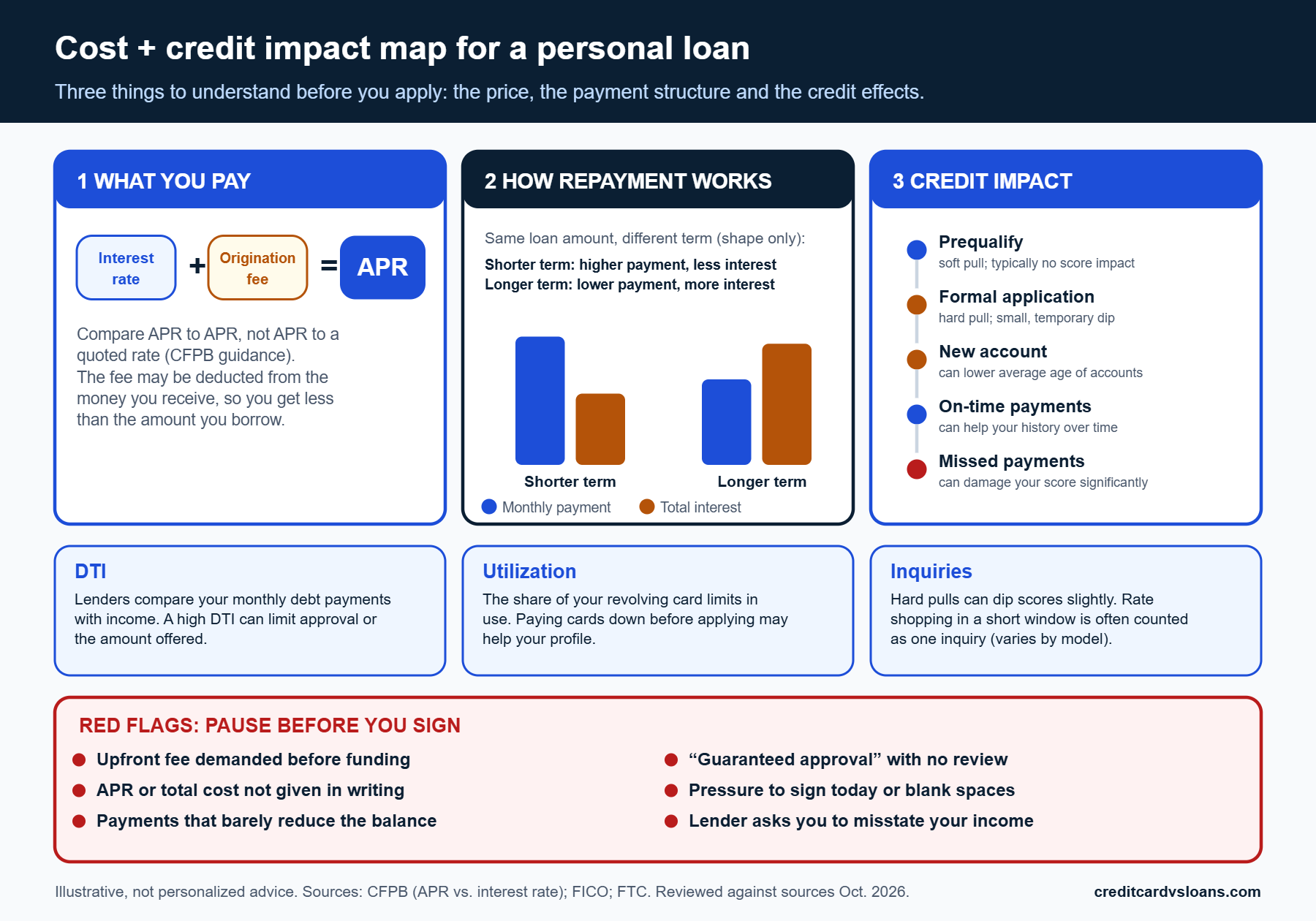
The CFPB explains that a loan’s interest rate and its APR are not the same thing. The interest rate is the cost of borrowing the principal. The annual percentage rate (APR) expresses the broader yearly cost, including certain fees such as an origination fee, so it’s usually equal to or higher than the interest rate on the same loan.
The practical advice is to compare APR to APR across lenders for loans of the same type, not one lender’s APR to another’s quoted rate. Keep in mind that your monthly payment depends on the loan amount, the interest rate and the term, so APR is a comparison tool rather than a payment predictor.
Origination Fees and How They Change Your Cost
An origination fee is a charge for processing the loan, often expressed as a percentage of the amount borrowed. Lenders set their own, and some charge none. Illustrative example: on a $10,000 loan, a 5 percent origination fee is $500. If the lender deducts it from the proceeds, you’d receive about $9,500 but still owe payments on the full $10,000.
That’s why a loan with a lower interest rate and a fee can cost more than a loan with a slightly higher rate and no fee. Ask for the net amount you’ll receive and the total amount you’ll repay, not just the rate. If those numbers aren’t in writing, treat that as a red flag.
Total Cost: The Same Loan at Different APRs (Illustrative)
The Math Behind the Chart
To see how much APR matters, consider a hypothetical $10,000 loan repaid over 36 months with a fixed rate and no fees. The three APRs below are examples chosen to show the size of the gap. They are not predictions of what any credit score will receive, and they don’t reflect any specific lender’s offer.
| Hypothetical APR | Monthly payment | Total interest | Total repaid |
|---|---|---|---|
| 12% | $332.14 | $1,957 | $11,957 |
| 18% | $361.51 | $3,014 | $13,014 |
| 24% | $392.31 | $4,123 | $14,123 |
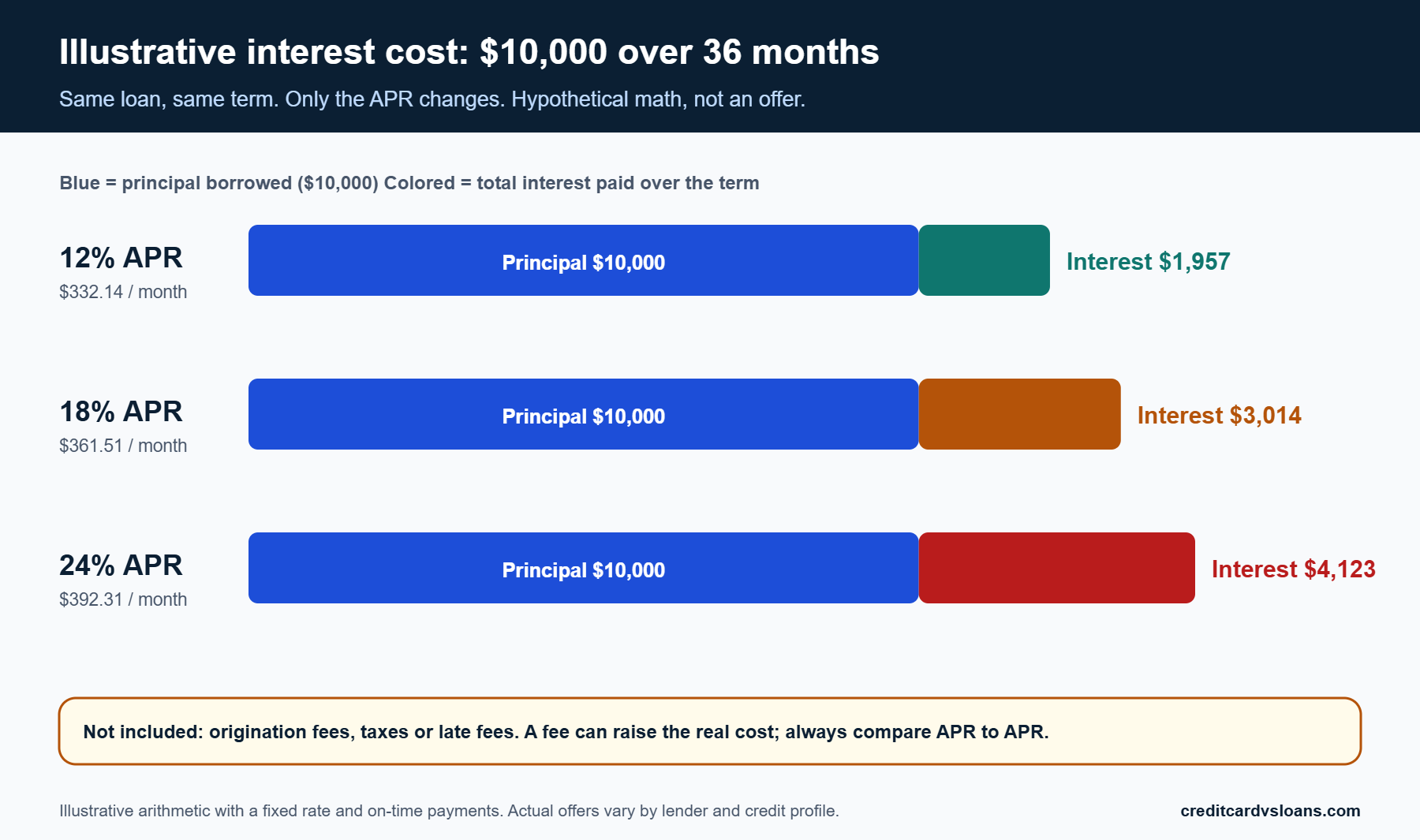
Going from the lowest to the highest example adds about $2,166 in interest on the same $10,000 over three years. That gap is the reason shopping around, and in some cases improving your profile before you apply, can be worth the effort.
Term Length Trade-Offs
Stretching a loan over more months lowers the monthly payment, which can feel like relief during a cash crunch. The catch is that you pay interest for longer, so the total cost rises, sometimes by a lot. Shortening the term does the reverse: a higher payment but less interest overall.
A sensible approach is to pick the shortest term whose payment still leaves real room in your budget, then check that payment against your DTI. If the only way to afford the loan is a very long term, that may be a sign the loan is too big or that another option fits better.
How Applying for a Personal Loan Affects Your Credit Score
Most people worry about two moments: the day they apply and the months after they borrow. Both can move your score, usually modestly, and the direction depends on how you handle the loan. This section stays focused on the application decision. Other guides cover long-term score effects in more depth.
Prequalification, Soft Pulls and Hard Pulls
Soft Pulls: How Prequalification Typically Works
Many lenders let you check an estimated rate through prequalification. The CFPB notes that some kinds of credit inquiries have no effect on your credit score, such as checking your own credit or a lender’s preapproval-style look. These are soft inquiries.
The catch is that practices vary. Some “check your rate” tools use a soft pull and some don’t, and the wording can be vague. Look for a clear statement that checking your rate will not affect your credit score before you enter your Social Security number. If the language is unclear, ask.
Hard Pulls and Rate Shopping Windows
When you submit a formal application, the lender usually runs a hard inquiry. A hard inquiry can lower a score slightly for a time, and the effect tends to be small for most people, though it varies by profile. Hard inquiries remain on your credit report for a couple of years, but scoring models generally pay attention to them for a shorter period.
Scoring models often treat several inquiries for the same type of loan within a short “rate shopping” window as one, so comparing offers doesn’t have to punish you. The length of that window differs by scoring model and version, commonly cited as somewhere between 14 and 45 days. Because the window varies, compress your formal applications into a short span rather than spreading them over months.
After You Borrow: What Happens to Your Credit
New Accounts, Average Age and Credit Mix
A new loan lowers the average age of your accounts, which can nudge a score down at first. It also adds an installment account to your mix, which may help if you mostly have credit cards. Neither effect is large on its own, and which one dominates depends on your existing file.
If you use the loan to pay off credit cards, your revolving utilization may drop, and that often helps scores. But it only helps if the cards stay paid down. Running the balances back up after consolidating leaves you with the loan payment and the card debt together, which is the opposite of breathing room.
On-Time Payments and Missed Payments
The loan will be reported to the credit bureaus in most cases, so every on-time payment becomes part of your history, and every missed one does too. Over time, a record of on-time installment payments can strengthen a credit profile. A payment that’s 30 or more days late can do serious damage and may stay on your reports for years.
That’s the part no lender can promise away. Setting up autopay for at least the minimum, and keeping a small cash cushion, is one of the simplest ways to protect yourself. No guarantee of a particular score outcome exists for any borrower.
If Your Score Is Lower Than You’d Like: Ways to Strengthen Your Application
A lower score doesn’t mean a dead end, but it does mean you should be more deliberate. The steps below range from free and quick to slower and more involved. Which ones make sense depends on how urgently you need the money.
Steps You Can Take Before You Apply
Check Your Credit Reports for Errors
You can get free credit reports from each of the three nationwide bureaus through AnnualCreditReport.com, the site authorized under federal law. Read each report line by line. Look for accounts that aren’t yours, wrong balances, payments marked late that you made on time and old negative items that should have aged off.
If you find an error, dispute it in writing with the bureau and the company that reported it, and keep copies. Fixing a genuine error is free and can matter more than any other step on this list. Be wary of companies that charge fees to “repair” credit, since you can dispute errors yourself at no cost.
Reduce Revolving Balances and Keep Payments Current
If you carry high balances on credit cards, paying them down can improve both your utilization and your DTI. Even partial progress can help your profile, though how quickly a score responds depends on when your issuers report balances and what else is in your file.
Make every payment on time while you prepare. If you’re already behind on something, contact the creditor about options before it escalates. A hardship arrangement can be better than a missed payment.
Time Your Applications
If your need isn’t urgent, waiting a few months while you pay down balances, correct errors or build a longer on-time record may produce a better offer. If it is urgent, limit yourself to prequalifying with a handful of lenders, then apply formally only where the offer looks competitive.
Avoid applying for several other credit products at the same moment. Each hard pull adds a small mark, and a cluster can look like financial stress to an underwriter.
Other Routes When Approval Is Difficult
Co-Signers and Co-Borrowers
Adding a co-signer or co-borrower with stronger credit can improve approval odds and pricing. The trade-off is serious: that person is legally responsible for the debt, and a missed payment can damage their credit as well as yours. Only consider it if both of you understand the commitment.
Credit Unions, Secured Loans and Credit-Builder Loans
Credit unions are member-owned and sometimes more flexible with borrowers whose scores are in the fair range. Federal credit unions are generally subject to a cap on loan APRs set by their regulator, so verify the current limit with the credit union you’re considering. A secured loan is backed by collateral, such as a savings account or a vehicle, which can improve approval odds but means you could lose the collateral if you stop paying. A credit-builder loan works differently: the funds are typically held while you make payments, so you don’t get the cash upfront.
Nonprofit Credit Counseling vs. Other “Debt Help”
Not all debt relief is alike, and the differences matter. A consolidation loan replaces several debts with one new loan. A debt management plan (DMP), offered through nonprofit credit counseling agencies, is a repayment arrangement where the agency negotiates with creditors and you make one monthly payment. Debt settlement is a different and riskier approach that involves negotiating to pay less than you owe and can seriously damage credit.
Be cautious with any company that promises to wipe out debt quickly, tells you to stop paying creditors or charges big fees before delivering results. A nonprofit counselor can review your full situation and explain which of these paths, if any, fits.
| Option | May fit when | Main benefit | Main catch |
|---|---|---|---|
| Wait and improve your file | The need isn’t urgent | No new debt; may unlock better pricing later | Takes time; results aren’t guaranteed |
| Credit union loan | You’re a member or can join | Often more flexible underwriting | Membership and product limits apply |
| Co-signer or co-borrower | Someone with stronger credit is willing | May improve approval and rate | Shared legal liability; relationship risk |
| Secured loan | You have savings or an asset to pledge | Easier to qualify for | You can lose the collateral |
| Credit-builder loan | You mainly want to build history | Builds an on-time record | You don’t get the cash upfront |
| Nonprofit credit counseling | Debt is hard to manage | Objective review; possible DMP | May include program fees; closes some cards |
Personal Loan vs. Credit Card: How Your Score Shapes the Choice
Because this site compares credit cards and loans, it’s worth asking how your score tilts the decision. In many situations, both products depend on your credit, but they behave very differently once you’re in them.
When a Credit Card May Be the Better Tool
Smaller, Short-Term Purchases You Can Repay Quickly
If you can pay a card’s statement balance in full each month, you may avoid interest entirely thanks to the grace period, and you might earn rewards. That’s hard to beat for planned, modest expenses. Some cards also offer a promotional APR on purchases or balance transfers, though the best promotional offers usually go to borrowers with good or better credit and they come with fees and expiration dates.
Watch out for deferred-interest promotions, which are common on store cards. If you don’t pay off the full balance by the end of the promotional period, interest may be charged back to the purchase date. Read the terms carefully.
Flexibility and the Revolving Trap
Cards are flexible, and that flexibility cuts both ways. Minimum payments are low by design, and carrying a balance gets expensive because card APRs are typically higher than personal loan APRs. In the Federal Reserve data cited above, the average rate on card accounts assessed interest has run above 21 percent recently.
If you tend to carry a revolving balance, a card can become a slow-moving debt. A fixed-term loan has a built-in end date, which some borrowers find helpful.
When a Personal Loan May Be the Better Tool
Larger One-Time Costs With a Payoff Date
For a single large expense, like a major repair or a medical bill, a personal loan offers a fixed payment and a set end date. That predictability can make budgeting easier, and the APR on a loan is often lower than the card APR a borrower with similar credit would pay.
The trade-off is the origination fee, possible prepayment terms and a hard pull. A loan also locks you into the payment even when money is tight.
Consolidating Higher-APR Revolving Balances
Borrowers sometimes use a personal loan to consolidate card debt. It can work if the loan’s APR (fees included) is meaningfully lower than the cards’ APR, if the payment fits your budget and if you stop adding to the cards. It can backfire if the fee eats the savings or if the cards fill up again. The CFPB offers guidance on consolidating credit card debt, and it’s worth reading before you decide.
| Your situation | A card may fit if… | A personal loan may fit if… | Check first |
|---|---|---|---|
| Good or better score, small planned purchase | You’ll pay the balance in full or within a 0% window | You want a fixed payment and a payoff date | Promo length, fees, what happens when the promo ends |
| Good or better score, large one-time expense | You can clear it within a promotional period | You need a longer, predictable repayment | APR including origination fee |
| Fair score, existing card balances | Approval and promo offers may be limited | Only if the all-in APR is clearly lower | Whether you’ll keep using the cards |
| Poor score or thin file | Options are mostly secured or high-APR | Unsecured offers may be costly | Credit union, secured, co-signer or counseling first |
| Urgent cash need, any score | Only if you can repay fast | Only if costs and terms are fully disclosed | Payment plan or hardship options with the creditor |
Red Flags and Predatory Offers When Your Credit Is Thin or Damaged
Borrowers with lower scores are the main target of questionable lenders, and urgency makes it easier to miss warning signs. A few minutes spent checking an offer can save months of repayment trouble. This section is deliberately direct, because the downside of getting it wrong is real.
Warning Signs to Take Seriously
Upfront Fees and “Guaranteed Approval” Promises
Legitimate lenders disclose origination fees and typically deduct them from the loan proceeds or build them into the loan. A different situation is a “lender” who demands payment before you receive any money, especially by gift card, wire transfer, cash app or prepaid card, in return for a guaranteed loan. The Federal Trade Commission (FTC) has warned consumers about advance-fee loan scams of exactly this kind.
No lender can honestly guarantee approval before reviewing your information. If an offer says “guaranteed,” “no credit check” or “instant approval” and then asks you to pay first, stop. Verify the company independently through your state’s financial regulator rather than through the contact details in the offer.
Missing Disclosures and Pressure Tactics
You’re entitled to see the APR, the finance charge, the payment amount, the number of payments and the total you’ll repay before you sign. Be wary of any lender that won’t put these in writing, uses blank spaces in the agreement, rushes you to sign “today only” or pushes you to borrow more than you asked for.
Also be wary of requests to misstate your income or employment on an application. That can turn a risky loan into a legal problem for you. If something feels off, walk away. A legitimate offer will still be there after you take a day to read it.
Higher-Cost Products to Approach With Caution
Payday, Title and “No-Credit-Check” Loans
Short-term payday loans, auto title loans and some no-credit-check installment loans can carry APRs in the triple digits. Because the repayment window is short and the payments are large, borrowers often roll the loan over or borrow again, and fees pile up. With a title loan, your vehicle is the collateral and can be repossessed if you can’t pay.
These products are sometimes marketed as the only option for people with damaged credit. They rarely are. The steps below are usually worth trying first, even when they feel slower.
Safer First Calls When Money Is Tight
Before turning to a high-cost loan, ask the creditor or biller for a payment plan or hardship arrangement, since many will work with you if you call before you fall behind. Look into local assistance programs, a nonprofit credit counselor or a credit union’s small-dollar options. If you’re facing a medical bill, ask about financial assistance and itemized charges.
If an offer makes you feel pressure, ask yourself three things: Can I afford the payment if my income dips? Is every cost in writing? Is there a lower-cost option I haven’t tried? Honest answers usually make the decision clearer.
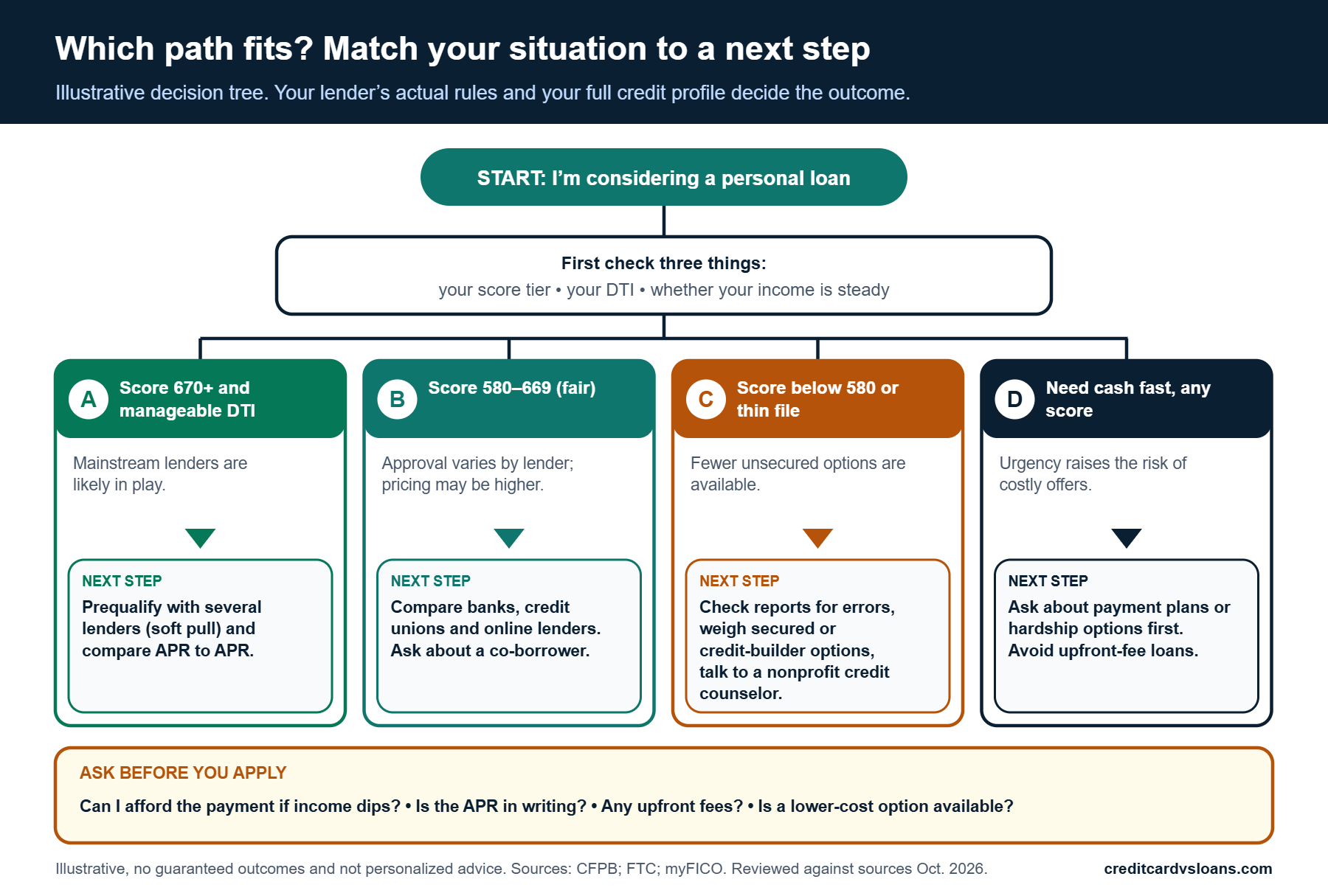
Your Pre-Application Checklist and Next Step
Everything above comes down to a short list of checks. Work through it before you submit anything formal, and keep the lender’s written terms handy as you compare.
Checklist Before You Apply
Verify the Lender and the Offer
Confirm that the lender is licensed to lend in your state, that its website and contact details are real and that the offer arrives in writing. Check the complaint history if a regulator or consumer agency makes it available, and read independent reviews with a skeptical eye, since reviews can be unreliable.
Then read the actual loan agreement or disclosure box, not just the summary. The items that matter most are the APR, the origination or other fees, the term, the payment amount, late fees, any prepayment penalty and the funding timeline.
Compare Apples-to-Apples
To compare offers fairly, line them up at the same loan amount and the same term, and compare APR to APR. Then check the total you’ll repay and the net amount you’ll receive. A lower payment from a longer term is not automatically cheaper.
Finally, test the payment against your budget with a cushion. A loan you can only afford if nothing goes wrong isn’t a good fit, however good the rate looks.
| Verify | Where to find it | Pause if… |
|---|---|---|
| APR and total cost | Loan disclosure or agreement | APR isn’t stated or doesn’t match the quote |
| Origination and other fees | Fee schedule; net proceeds line | Fees are vague or demanded upfront |
| Term and payment | Payment schedule | Payment strains your budget |
| Prepayment and late-fee rules | Agreement fine print | Penalties for paying early |
| Credit check type | Prequalification disclosure | Unclear whether it’s a soft or hard pull |
| Lender’s identity and license | State regulator; company records | You can’t verify who the lender is |
Quick Answers to Common Questions
Can I Get a Personal Loan With a 600 Credit Score?
It’s possible. A score near 600 sits in FICO’s fair range, and some lenders approve applicants there, usually at a higher APR than borrowers with stronger credit. Whether you qualify depends on your income, DTI and the specific lender. The most useful step is to prequalify with several lenders and compare written offers.
Does Checking My Own Credit Score Hurt It?
No. Looking at your own credit report or score is a soft inquiry and doesn’t lower your score, according to the CFPB’s guidance on inquiries. The inquiries that can matter are the hard pulls lenders run when you formally apply for credit.
The Bottom Line and Your Next Step
The Decision in One Paragraph
There isn’t one credit score that decides a personal loan. A score of 670 or higher usually opens mainstream options, a fair score can work with the right lender at a higher price, and a poor score calls for extra caution and alternatives. Your income, DTI and the all-in APR often shape the outcome as much as the score does. Compare offers at the same amount and term, read the fees and walk away from anything that asks you to pay first.
A Simple Next-Step Sequence
- Pull your credit reports and correct any genuine errors.
- List your monthly debt payments and calculate your DTI.
- Prequalify with three or four lenders, confirming each uses a soft pull.
- Compare APR, fees, term and total repayment side by side.
- Read the final agreement closely, then decide whether the payment fits your budget with room to spare.
- CFPB: What is a credit score?
- CFPB: What is the difference between a loan interest rate and the APR?
- CFPB: What kind of credit inquiry has no effect on my credit score?
- CFPB: Consolidating credit card debt
- Federal Reserve: G.19 Consumer Credit, release of June 5, 2026 (see also the August 7, 2026 and September 8, 2026 releases)
- FICO score ranges as published by FICO and reproduced by major issuers; VantageScore ranges as reproduced by independent publishers
- FTC consumer guidance on advance-fee loan scams
Last updated: October 22, 2026. Review status: Rates, fees and lender rules change; verify before acting.
- Personal Loan With a 600 Credit Score: Rates, Approval and Alternatives
- Personal Loan With a 620 Credit Score: What to Expect
- Personal Loan With a 700 Credit Score: How Much Better Can Rates Get?
- Personal Loan With a 580 Credit Score: Realistic Expectations
- How a Personal Loan Can Affect Your Credit Score
- Personal Loan Agreement Red Flags to Check Before Signing
The information on creditcardvsloans.com is provided for general educational and informational purposes only. It is not financial, legal, tax, credit, accounting or investment advice, and reading it does not create an advisor-client, fiduciary or any other professional relationship. Nothing here is an offer, solicitation or recommendation to borrow, lend or apply for any product.
Credit scores, interest rates, fees, eligibility rules, lender policies and laws change frequently and vary by lender, location and individual circumstances. Examples, figures and scenarios are illustrative only, do not predict your results and do not guarantee approval, savings, a particular rate or a credit-score outcome. Always confirm current terms directly with the lender or issuer and read the full agreement before you apply or sign.
Although we aim for accuracy and use reputable sources, we make no representations or warranties, express or implied, about the completeness, accuracy, reliability or timeliness of the content. Content may be drafted with the assistance of automated tools and is reviewed by human editors, but errors or omissions may still occur. Links to third-party sites are provided for convenience; we don’t control and aren’t responsible for their content.
To the fullest extent permitted by law, creditcardvsloans.com and its owners, editors, authors, contributors and affiliates disclaim all liability for any loss, damage or expense arising directly or indirectly from your use of, or reliance on, this content. Before making financial decisions, consult a licensed professional, such as a qualified financial advisor, attorney, tax professional or nonprofit credit counselor, who can consider your complete situation.