A true 0% APR credit card is usually cheaper than a personal loan when you can repay the whole balance, plus any transfer fee, before the promotional period ends. A personal loan is usually cheaper, or at least safer, when payoff will take longer than any 0% window you can get. That is the heart of the 0% APR credit card vs personal loan question, and the answer turns on your repayment timeline far more than on the headline rates.
The reason is simple arithmetic. A 0% card charges no interest during the promotion, but it may charge a fee and it hands you a ticking clock. A personal loan charges interest from day one, yet it gives you a fixed payment and a firm end date. When the clock is long enough, zero beats everything. When it is not, the leftover balance can land on a card rate in the twenties.
This guide stays focused on cost: how to compare the two with real numbers, and where each one can go wrong. For the general card-versus-loan question, see our broader credit card vs personal loan guide. Nothing here is a lender offer or a promise of approval, rates or savings.
- A true 0% APR period means no interest accrues on the promotional balance, but a balance transfer fee can still apply.
- The cheaper option depends on whether you can clear the balance before the promotion ends. Divide the amount plus any fee by the number of promotional months to test it.
- Do not confuse deferred interest ("no interest if paid in full") with true 0%. Interest on a deferred plan can be charged back to the purchase date.
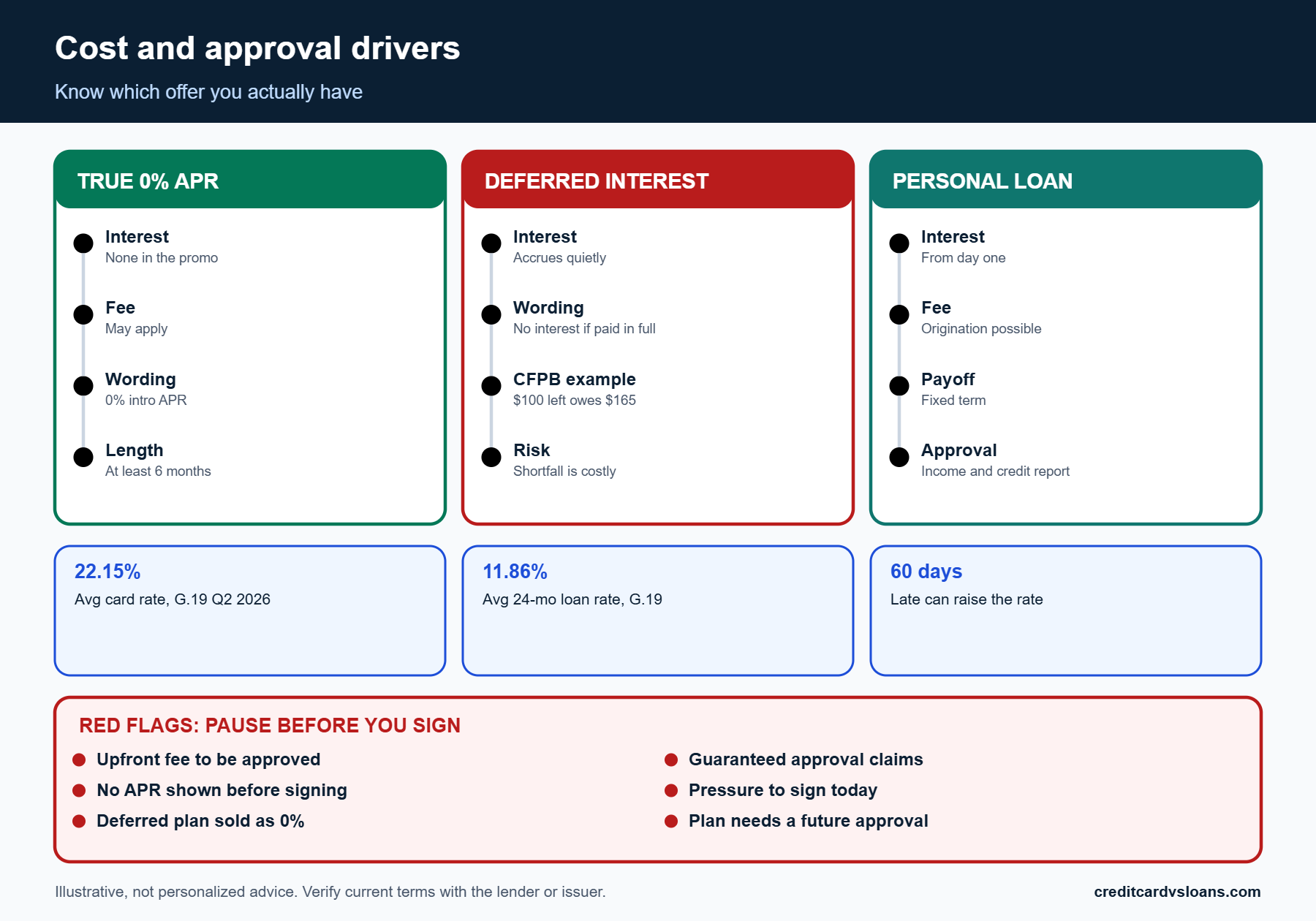
- As of the Federal Reserve's G.19 release of Sept. 8, 2026, the average rate on card accounts assessed interest was 22.15% and on 24-month bank personal loans 11.86% (Q2 2026). Those are averages, not offers.
- If you will miss the deadline, a fixed-rate loan can beat a 0% card that reverts to a high rate.
Rate averages come from the Federal Reserve's G.19 Consumer Credit release dated Sept. 8, 2026. Offers change often, so use the math here as a method and plug in the terms you are actually quoted.
The Short Answer: When Each Option Is Cheaper
A verdict you can test in two minutes
Use the divide-by-months test
Take the amount you plan to borrow, add the transfer or upfront fee if the card charges one, and divide by the number of months in the promotional period. The result is the monthly payment you need to finish at zero interest. If that number fits comfortably in your budget, the 0% card has a real shot at being cheaper than a loan.
If it does not fit, the card is a gamble on your income improving or on negotiating later. A loan with a longer term spreads the payment, and you pay for that convenience in interest. Neither outcome is a failure; the point is to know the price before you commit.
Where a loan wins even when the card says 0%
A loan can come out ahead when the promotional window is short compared with the time you need, when the card's fee is large, or when you are unsure you will resist adding new purchases to the card. New purchases on a card with a promotional balance can accrue interest at the regular rate, and the CFPB notes that new purchases on a card used for a balance transfer may not get a grace period.
A loan also keeps the debt separate. Many people find it easier to pay down one fixed obligation than to track a promotional balance inside an everyday card.
Where the card wins even when the loan rate is low
Even a low loan rate charges interest every month. If you can finish a payoff inside the promotional period, the card avoids that interest entirely, and the only cost is the fee, if any. That fee is often smaller than a loan's interest over the same stretch, especially on larger balances held for a year or more.
The catch is execution. The benefit depends on on-time payments and a payoff date you actually hit, because the CFPB notes that being more than 60 days late can end a promotional rate early.
What cheaper really means
Cost is interest plus fees minus any rewards
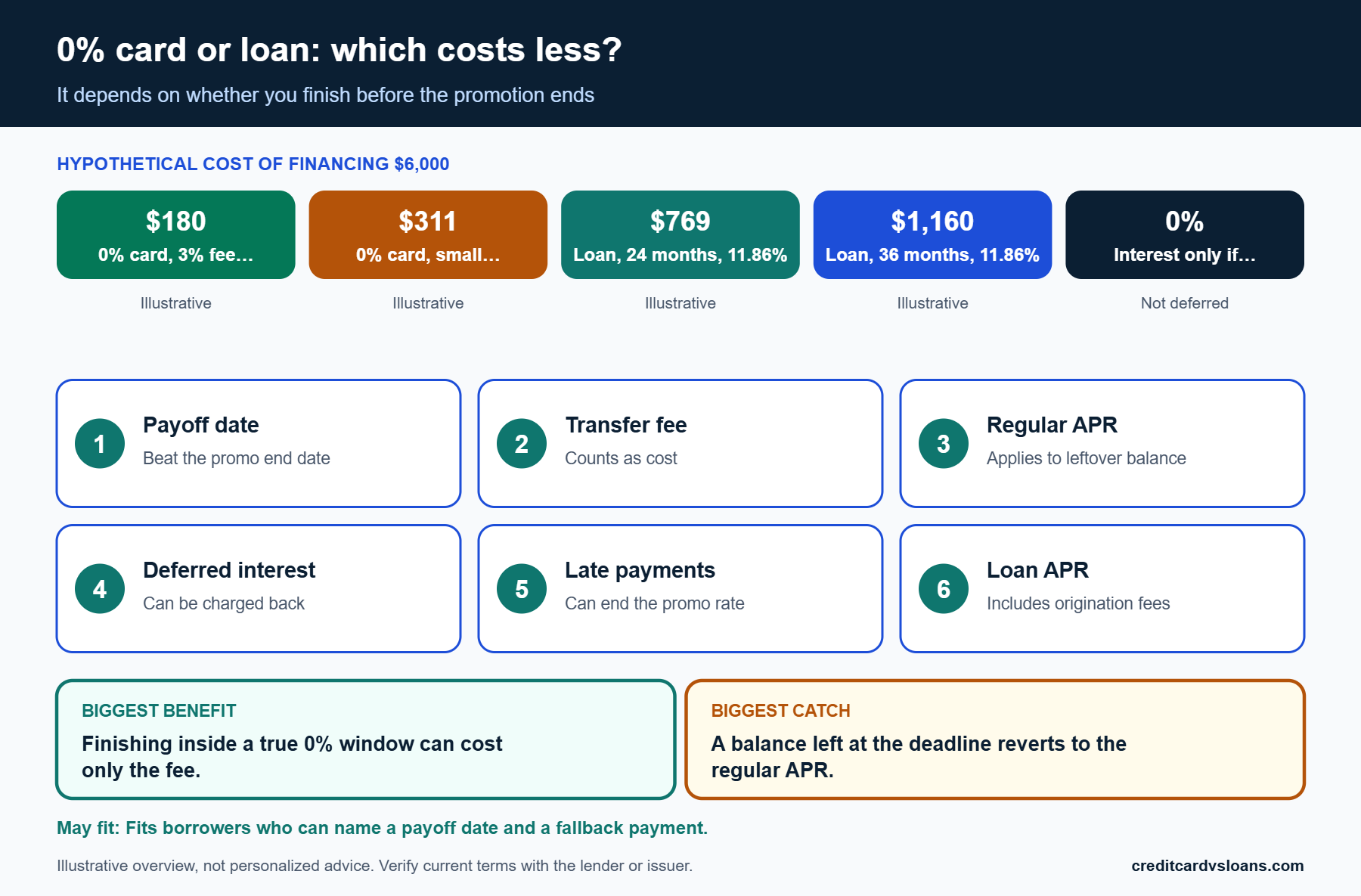
Cheaper means the lowest total of interest and fees over the whole time you carry the debt. A card with a 3% fee on a $6,000 balance costs $180 up front, while a 24-month loan at the G.19 average rate would cost about $769 in interest on the same amount, as the table later in this guide shows. The comparison reverses if the card leaves a balance that reverts to a high rate.
Be careful with rewards. A rewards rate of a percent or two rarely offsets a balance transfer fee, and spending on a card to chase rewards while you carry a balance can cancel the benefit.
Cheaper is not always safer
A loan's fixed rate and fixed payment are predictable. A 0% offer is cheap only if conditions hold: on-time minimums, no new interest-bearing balances and a payoff before the deadline. Safer can mean paying a little more for a plan that survives a bad month.
Think of the difference as insurance. If an unexpected bill would force you to skip a payment, the loan's structure may protect you better than a card whose rate can reset if you fall far behind.
How a 0% APR Card and a Personal Loan Each Work
What a true 0% APR offer includes
Zero interest on the promotional balance
The CFPB describes a zero-percent promotion this way: no interest accrues on the promotional balance during the promotional period, and if you still owe money when it ends, interest applies only to the remaining balance, starting from the end date. That is the best case for a borrower, and it is why a true 0% card can beat any loan on interest cost.
Check whether the 0% applies to purchases, balance transfers or both, because the length and terms often differ. The card issuer must disclose how long the introductory rate lasts and the rate that applies afterward.
The fee that sits underneath the zero
The CFPB states that a card company is permitted to charge a balance transfer fee on a zero percent offer. The fee is typically a percentage of the amount moved, and it is added to your balance. The percentage varies by issuer, so read the offer terms rather than assuming.
Treat the fee as the price of the loan. A card with a 3% fee on $6,000 costs $180 for the privilege of 0% financing. That is a hypothetical fee for illustration, not a quote, but it shows why the fee belongs in every comparison.
What happens when the promotion ends
Any balance left at the end of the promotion begins accruing at the card's regular APR. The CFPB says a promotional rate must generally last at least six months, but the rule does not protect you if you are more than 60 days late. After the promotion, the rate that applies is in your agreement and may be variable.
Many issuers let you pay more than the minimum and aim extra at the promotional balance, but extra payments may be applied to the higher-rate balance first. If you hold several balances, ask how the issuer allocates payments.
What a personal loan includes
Interest from day one, with a fixed end date
A personal loan charges interest on the declining balance from the first month, and your payment is set so that the loan is fully repaid by the end date. The Federal Reserve reported an average 11.86% rate on 24-month personal loans at commercial banks for Q2 2026, though your rate depends on your credit, income, lender and term.
The CFPB notes that APR includes the lender's fees, such as origination charges, so APR is the number to compare across offers. A lender must disclose it under the Truth in Lending Act.
A side-by-side snapshot
Table 1 lays out the structural differences. Notice that neither option is free: one charges a fee, the other charges interest, and each has a failure mode.
| Feature | 0% APR credit card | Personal loan |
|---|---|---|
| Interest during the plan | None on the promotional balance | Charged from day one |
| Upfront cost | Balance transfer fee may apply | Origination fee may apply |
| Length | Fixed promotional window, then regular APR | Term you choose, rate fixed in most cases |
| If you run late | Promotional rate can end early after 60 days late | Late fees and credit damage |
| Flexibility | Payment can vary; minimums are low | Payment is fixed |
| Danger point | Balance left at promotion end | Interest on a long term |
0% APR Credit Card vs Personal Loan: The Cost Math
Working through a $6,000 example
The assumptions behind the table
Table 2 is hypothetical. It assumes a single $6,000 balance, no new spending, on-time payments, a 3% transfer fee on the card and the Federal Reserve's average rates (22.15% for the card after the promotion, 11.86% for the loan) as stand-ins. None of these is a quote, and your actual terms could be better or worse.
| Scenario | Assumptions | Monthly payment | Total interest and fees |
|---|---|---|---|
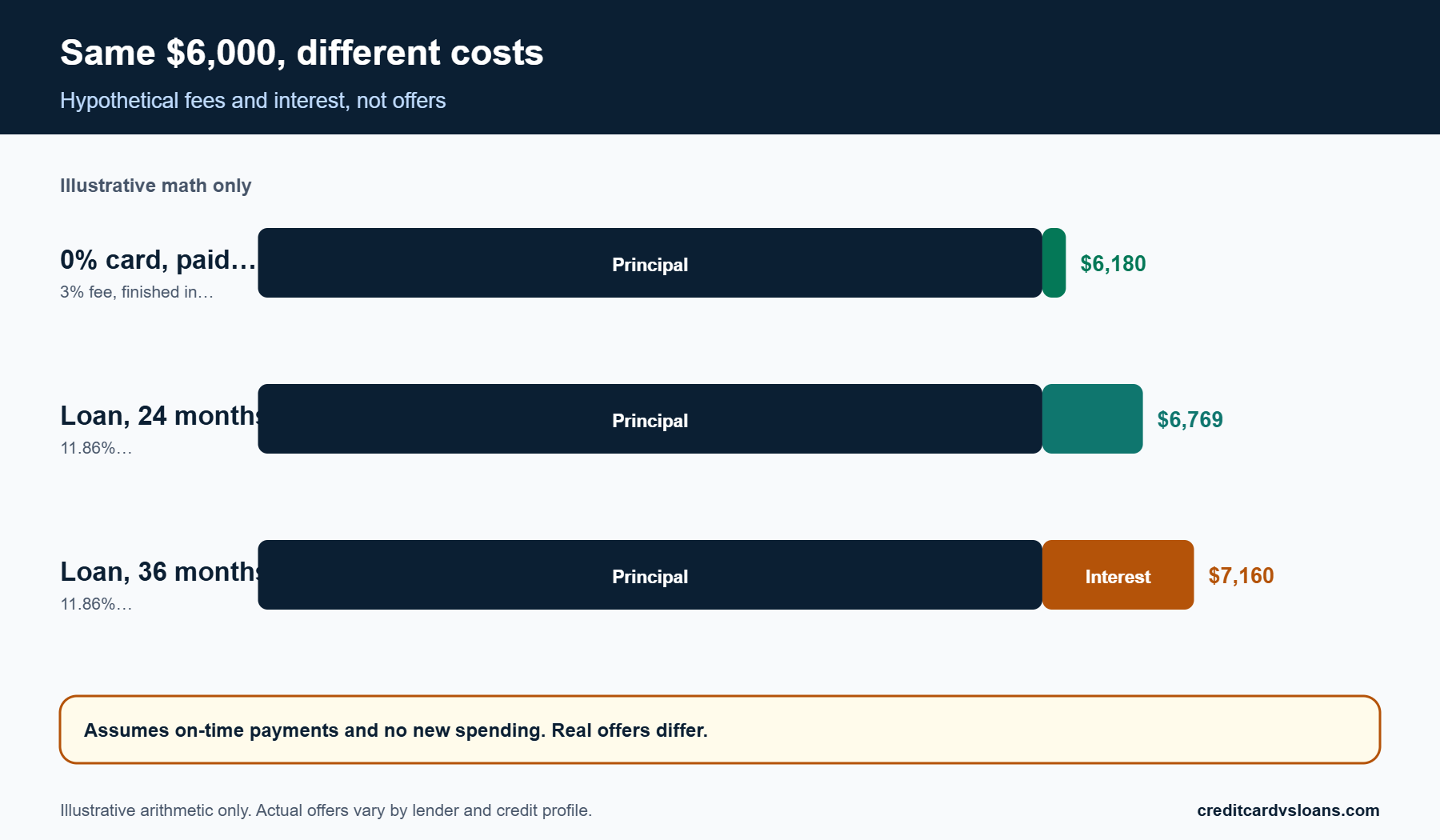
| 0% card, paid off in 15 months | 3% fee ($180) on the transfer, then 0% for 15 months | $412.00 | $180.00 |
| 0% card, paid off in 18 months | 3% fee, 0% for 18 months | $343.33 | $180.00 |
| 0% card, $250 per month, 18-month promotion | $1,680 left at the end, then 22.15% APR | $250.00 | About $311 (fee plus about $131 interest), done in 26 months |
| Loan, 24 months | 11.86% APR, no origination fee | $282.05 | $769.17 |
| Loan, 36 months | 11.86% APR, no origination fee | $198.88 | $1,159.86 |
| Loan, 24 months, 5% origination fee | 11.86% interest on $6,315.79 so you receive $6,000 | $296.89 | $1,125.44 |
What the table shows
When the card is paid off inside its window, it is far cheaper than either loan: $180 against $769 or more. The fee is a flat, known cost, while the loan's interest scales with time. The loan's payment is lower, though, which is the real price of the card's advantage: you must find a bigger monthly payment.
The third row is the warning. Paying $250 a month instead of $343.33 leaves $1,680 at the end of the promotion, which then accrues at the regular rate. The card still costs less than the loans in this example, because the leftover balance is small. The result flips if the leftover is large or the post-promotion rate is higher.
How the break-even works
Compare the card's fee with the loan's interest. In the 24-month example, the loan costs $769.17 in interest on $6,000, so the card's fee would have to exceed about 12.8% of the amount to lose on fee alone. Fees on offers are usually much lower, which is why timeline, not fee size, decides most comparisons.
The more useful question is what a missed deadline costs. Estimate the balance you would carry past the promotion and multiply by the regular APR for a few months. If that figure is small, the card's risk is limited. If it is large, favor the loan.
What can change the outcome
Payment size, term length and the regular APR
Three levers move the result: how big a payment you can afford, how long the promotion lasts and how high the post-promotion APR is. A longer promotion raises the odds of finishing. A lower required payment makes the card feel affordable while leaving more balance behind.
Run the math with two payment levels, your target and a fallback that assumes a tougher month. If the fallback still looks acceptable, the plan is sturdier.
New purchases on the same card
The CFPB notes that after a balance transfer, new purchases on the same card may not get a grace period and can accrue interest until the full balance is paid. Using the card for groceries while a promotional balance sits on it can add interest cost and complicate payment allocation.
The simple fix is to keep everyday spending on a different payment method until the promotional balance is gone.
Deferred Interest vs True 0% APR: The Difference That Costs Money
Two offers that look alike and behave differently
How the CFPB describes each
The CFPB separates the two. In a zero percent promotion, no interest accrues during the promotional period, and if you still owe money when it ends, interest applies only to the remaining balance from the end date. In a deferred interest promotion, interest still accrues during the period but is deferred, and if you do not pay the entire promotional balance by the end, interest is charged retroactively to the original purchase date and added to what you owe.
Both are still loans you must repay, and both may require on-time minimum payments. The difference is what happens if you come up short, and it can be large.
The CFPB $400 example in numbers
The CFPB's example involves a $400 television, $25 monthly payments, $100 left after 12 months and a 25% APR. With a zero-interest promotion, you owe the $100 and pay interest only on that amount going forward. With deferred interest, you owe $165, the $100 balance plus $65 of deferred interest.
That is a $65 penalty for being $100 short, and it grows on bigger purchases or longer promotions. The example is the CFPB's, and the exact figures on any real offer depend on the APR and the payments you make.
A quick comparison
Table 3 puts the two side by side. The lesson for the 0% APR credit card vs personal loan decision is that only a true 0% offer deserves the comparison with a loan on the terms in this guide. A deferred plan should be compared as if there were a real chance of paying the retroactive interest.
| Question | True 0% APR promotion | Deferred interest promotion |
|---|---|---|
| Typical wording | "0% intro APR for 12 months" | "No interest if paid in full in 12 months" |
| Interest during the promotion | None accrues | Accrues in the background |
| If you owe $100 of a $400 purchase at the end (25% APR example) | You owe $100 | You owe $165: $100 plus $65 deferred interest |
| Interest after the promotion | Only on the remaining balance, from the end date | Charged back to the purchase date, then continues |
| Paying it off on time | Pay the full balance by the deadline | Pay the full balance by the deadline |
How to tell which one you are being offered
Read the wording and the agreement
The CFPB points out that an "if" in the promotion, as in "no interest if paid in full," signals deferred interest. A phrase like "0% intro APR" points to a true zero rate. Store cards and some financing offers at checkout often use the deferred model, though not always.
Do not rely on the marketing banner. Look for the disclosure box on the application and the cardholder agreement, which spell out how interest is handled if the balance is not cleared.
Ask the issuer before you borrow
If the wording is ambiguous, ask the issuer directly whether interest is waived or deferred, what the regular APR is and how payments are applied when you carry several balances. The CFPB notes that extra payments usually go to the higher-rate balance, and you may need to ask your issuer to direct them to a deferred balance.
Write down the answer and the date. For a big purchase such as furniture, our comparison of 0% APR cards and loans for a furniture purchase shows how a deferred plan can play out in practice.
Approval, Credit Scores and What Each Option Does to Your File
Who tends to qualify, and for what
Why 0% offers often go to stronger files
Issuers generally reserve the longest promotional periods for applicants they consider lower risk, but each sets its own standards and changes them. No public cutoff exists, and anyone quoting a precise score as a guarantee is guessing. The CFPB explains that scores vary by model, data source and date, so the number a lender sees may differ from the one you do.
If you are unsure, read our guide to what credit score a balance transfer card usually requires. The same logic applies to purchase-focused 0% cards.
Why a loan may be easier or harder
Personal loan lenders look at income and existing debt alongside your credit report. A borrower with a thin credit file may find loans available at higher rates than a 0% card would require, or the reverse. Compare actual prequalified offers rather than assuming, and prequalify with a soft pull when possible.
The CFPB notes that soft inquiries do not affect your scores, while hard inquiries made when you apply can lower them because models consider how recently and how often you apply for credit.
Do not pay to be approved
Any company that charges upfront fees to guarantee a card or loan should raise a red flag. The FTC warns about advance-fee schemes in credit and debt relief.
If a deal is real, the lender will show you the APR, fees and total cost before you commit and will not ask for payment in gift cards or transfers.
Score effects to expect, without promises
Hard inquiry, new account and utilization
Both options usually involve a hard inquiry and a new account. A 0% card also adds available credit, and if you move a loan or card balance onto it, your utilization, the share of your limit in use, could be high on the new card. According to myFICO, amounts owed make up 30% of a FICO Score and payment history 35%, so a high balance on a new card matters.
A personal loan adds an installment account, and using it to pay off cards can lower revolving utilization. Results vary, and no one can promise a direction. Our guide to whether a balance transfer hurts your credit score covers the card side in more detail.
Why payment history outweighs the product choice
The product matters less than whether you pay on time. A cheap 0% card with a missed payment is worse for your file than a pricier loan paid perfectly. Set autopay for at least the minimum on whichever you choose.
Keep the old accounts open unless there is a reason to close them, and avoid new applications until the dust settles.
Risks and Red Flags on Both Sides
The 0% card risk list
The cliff at the end of the promotion
The promotion ends on a date, not when you feel ready. If balance remains, the regular APR applies to the remainder. Put the end date on your calendar and set a mid-promotion check to confirm you are on track.
Compute the monthly amount needed to finish, including the fee, and pay that amount, not the minimum. The minimum is usually designed for flexibility, not for a payoff on your timeline.
The 60-day trap
The CFPB says an issuer can raise the rate on existing balances if your minimum payment is not received within 60 days after the due date. A promotional rate protected by the six-month rule can also end early in that case. After such an increase, six consecutive on-time minimum payments generally require the issuer to restore the old rate.
The practical lesson: one missed payment is bad, two can be expensive. Autopay and alerts are cheap protection.
If life does interfere, contact the issuer before the due date rather than after. Hardship options differ by issuer, and an early call keeps more doors open than a silent miss. Ask what the issuer can do, get any agreement in writing and confirm that the promotional terms stay in place.
Mixing new purchases with a promotional balance
Adding purchases to a card with a transferred balance can add interest and make it harder to know how much of each payment reduces the promotional amount. Use a different card or a debit card for everyday spending while you pay the balance down.
If you must use the same card, pay each statement in full for the new purchases and the planned amount for the promotional balance.
The personal loan risk list
Fees, add-ons and a longer term than needed
Origination fees come out of the proceeds, and optional add-ons raise the cost. A longer term lowers the payment and raises total interest, as the CFPB notes for consolidation loans.
Choose the shortest term you can afford, then keep a small cash buffer so one surprise does not trigger a late payment.
Predatory offers aimed at stressed borrowers
High-pressure lenders target people in a cash crunch with guaranteed approval claims, upfront fees or vague terms. Our guide to warning signs of predatory lending lists patterns to avoid.
Report suspected fraud to the FTC at ReportFraud.ftc.gov or your state attorney general.
A simple screen helps: a legitimate lender can explain the APR, the fees, the total you will repay and the consequences of paying late in plain language, in writing, before you sign. If any of those answers is vague, the price is probably hiding somewhere, and you are entitled to walk away and compare another offer without penalty.
Scenarios: Putting the Comparison to Work
Three hypothetical borrowers
Someone with a predictable bonus coming
Imagine a hypothetical borrower who needs $4,500 for a home repair and expects a bonus that would clear most of it within a year. A true 0% card with a 12-month window and a modest fee can be an efficient bridge, because the bonus covers the end of the plan. The borrower should still set a fallback: if the bonus is smaller, the leftover will accrue at the regular APR.
Any borrower who relies on a lump sum should treat it as a bonus, not a certainty, and run the math with a payment they can make from regular income as well.
Someone who needs to spread payments over three years
Now picture a hypothetical borrower with a $10,000 project that will take three years to repay. No 0% window is likely to cover that, so a fixed-rate loan is the straightforward choice. The cost of the loan is interest, but the cost of a card in that situation could be far higher, as the revolving example in our broader guide to credit cards vs personal loans shows.
A shorter promotional card for the first slice, with a loan for the rest, can work, but adds moving parts and should only be used if the savings are clear.
A parent budgeting for seasonal costs
Seasonal costs such as school supplies are small and come at predictable times, which suits a 0% card if the balance will be gone quickly. For that specific case, see our back-to-school 0% APR vs personal loan guide rather than this general comparison.
The difference from a big purchase is scale: with small balances, the fee on a transfer can matter more than the interest saved.
A decision table for the repayment picture
How to use Table 4
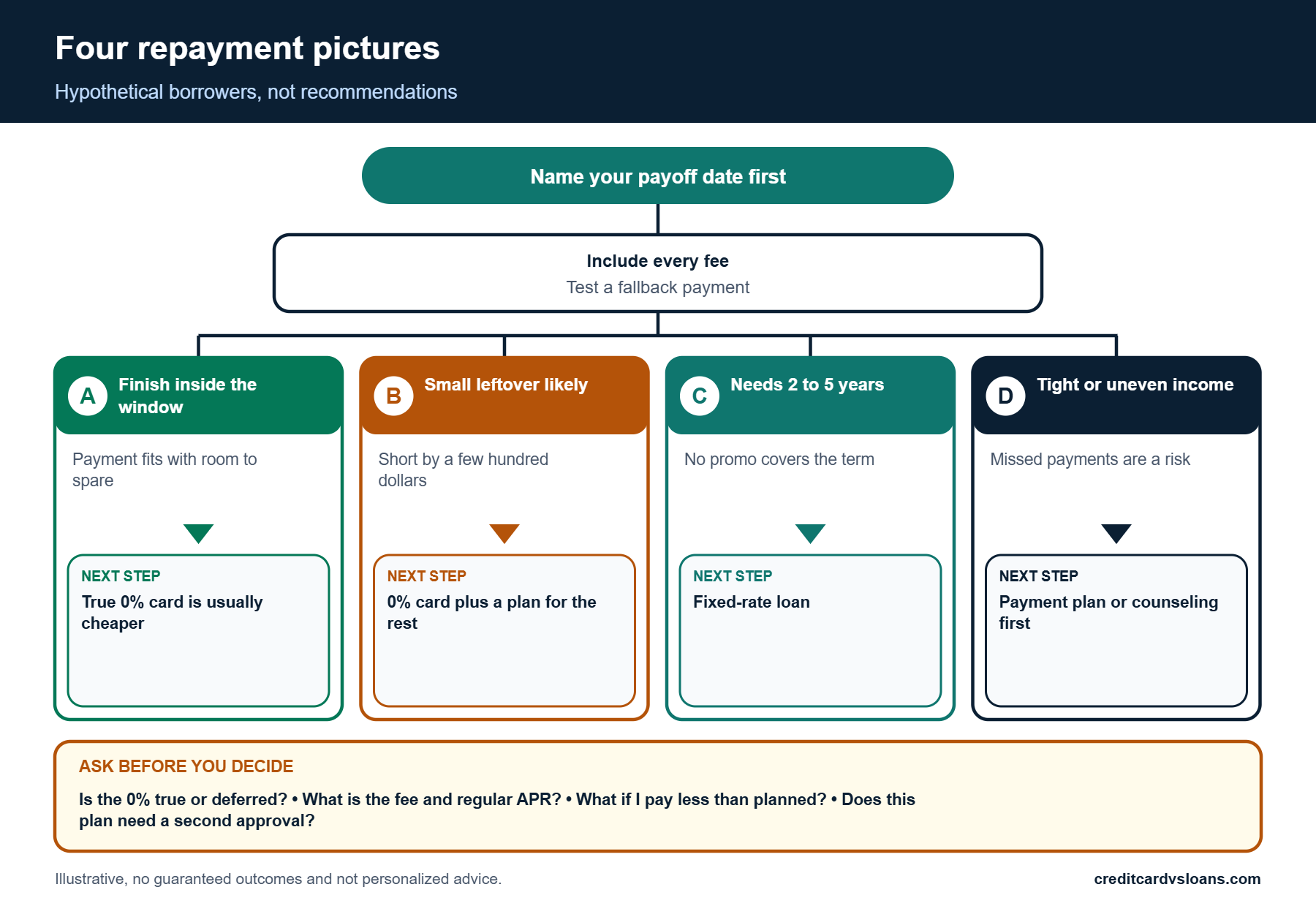
Find the row that matches how you expect to repay, not how you hope to. If you fall between rows, pick the safer one. The table is a starting point for comparison shopping, not a verdict on any offer.
| Your repayment picture | Leans toward | Why |
|---|---|---|
| Can clear the full balance and fee inside the promotion with room to spare | True 0% APR card | Only the fee, if any, is paid in cost |
| Can clear most of it but expect a small leftover | 0% card, with a plan for the remainder | Leftover accrues at the regular APR from the end date |
| Need two to five years to repay | Fixed-rate personal loan | Term and payment are set, no cliff |
| Offer is a deferred interest plan and a shortfall is possible | Loan, or a smaller purchase | Interest can be charged back to the purchase date |
| Budget is tight or income is irregular | Neither until a payment plan is checked | Missed payments can raise rates or add fees |
A note on stacking offers
Some borrowers chain promotions, moving a balance from one 0% card to another. That is a separate strategy with its own fees, credit effects and approval risk, and it depends on being approved again. Do not plan around a future approval you do not have.
If your plan only works if a second offer arrives, it is a hope, not a plan.
One practical safeguard is to write the plan as a sentence: "I will pay this amount each month, on this date, from this account, and finish by this date." If you cannot complete that sentence with real numbers, the offer is not ready for you yet, and a few more days of comparison shopping cost far less than a rushed application and a surprise at the deadline.
Your Decision Checklist and Next Steps
Before you apply
Gather the numbers
List the amount, the date you need it and a payoff date you can defend. Write down the promotional length, the transfer or purchase fee, the regular APR and what happens if you are late. For a loan, record the APR, origination fee, term, monthly payment and total of payments.
Putting both offers on one page makes the comparison obvious. If a lender or issuer will not give you the terms in writing before you apply, treat that as a signal.
Run the three tests
First, the divide-by-months test: amount plus fee divided by promotional months. Second, the fallback test: what happens to the total if you pay a bit less than planned. Third, the stress test: could you still make the payment if your income dropped for two months?
If the card passes all three, it is likely the cheaper path. If it passes only the first, a loan may be safer.
A next-step list
Follow the sequence below.
- Check your own credit reports for errors at AnnualCreditReport.com.
- Prequalify for at least one loan and one card using soft pulls where offered.
- Confirm whether the card promotion is true 0% or deferred interest.
- Compute total cost for each option at your target payment and at a fallback payment.
- Choose, apply once and set autopay and a calendar reminder for the promotion end date.
- Keep new purchases off the promotional card until the balance is gone.
Finish with a review a month before the promotional period ends to confirm you will make it.
How to decide if the numbers are close
Prefer the option you are least likely to break
When costs are within a hundred dollars or so, choose the product whose failure mode you can live with. A loan fails slowly, through interest. A 0% card fails suddenly, through a rate reset. If you can manage the card's discipline, it can save money, and if not, the loan is a fair price for peace of mind.
Also consider how you respond to flexibility. Some people pay faster with a flexible card, while others drift.
If neither fits
If neither payment fits comfortably, the best answer may be to borrow less, ask the biller for a payment plan or talk to a nonprofit credit counselor. The FTC advises contacting creditors early and choosing an accredited counselor who quotes fees in writing and charges nothing before doing work.
Borrowing is a tool, not a requirement. A smaller plan you can finish beats a bigger plan that breaks.
The bottom line
If you can finish inside a true 0% window, the card is usually the cheaper tool; if you cannot, a fixed-rate loan is usually the safer one.
Test the plan with your payoff date, include every fee, and confirm the offer is true 0% rather than deferred interest before you choose.
Questions that decide close calls
Should you use a 0% card for part of the amount and a loan for the rest?
Splitting can make sense when a promotion covers a slice of the need and a loan covers the remainder. A borrower might put the portion they can clear within the window on the card and finance the larger, slower part with a fixed-rate loan. The combination avoids interest on the fast part while keeping the slow part on a predictable schedule.
The cost is complexity: two applications, two hard inquiries, two due dates and two sets of fees. Only do it if the savings clearly outweigh that extra work, and keep one calendar that shows both payoff dates. If a payment slips on either account, the savings can disappear quickly.
What if you already carry a card balance?
If you already carry a revolving balance at a regular rate, the question changes. Moving it to a 0% card is a balance transfer, and the CFPB notes that the fee, the promotional length and the rate afterward all matter. A personal loan is another way to consolidate, with a fixed payment and no cliff, which is covered in more depth in our guide to balance transfers and credit scores and in the debt consolidation guides on this site.
Whichever route you take, the underlying problem still needs solving. The CFPB advises identifying why you fell into debt, because consolidation alone will not help if spending exceeds income. Build a budget first, then choose the tool.
How do you know the offer in your mailbox is worth reading?
Mailed offers and checkout prompts are marketing, and the CFPB has warned card companies against deceptively marketing promotional offers, including deferred interest and balance transfers. That does not make every offer bad. It means the headline is the beginning of the research, not the end.
Look for the disclosure box, the length of the promotion, the fee, the regular APR and whether interest is waived or deferred. If the offer does not state these clearly, move on. A real opportunity will still be there after you read the terms, and a pressure tactic will not.
What should you do in the final month of a promotion?
Treat the last month as a checkpoint. Log in, read the statement and confirm the promotional balance, the end date and the amount needed to reach zero. If the number is larger than expected, because a fee was added or a payment was applied elsewhere, you still have time to react.
If you will fall short, you have a few honest options: pay the remainder from savings if that does not leave you exposed, move the leftover into a fixed-rate loan with a clear end date, or ask the issuer what hardship or payment programs exist. Do not assume a new 0% offer will be available. Approval depends on your file at that time, and the CFPB reminds borrowers that the rate after a promotion is whatever your agreement says.
Whatever you choose, keep paying on time. A late payment during the last stretch can bring a rate increase on existing balances once you are more than 60 days past due, and it is the one mistake that turns a good plan into an expensive one.
Finally, write down what you learned about your own habits. If you finished early, you can aim for a bigger promotion next time. If you struggled, a fixed loan may serve you better in the future, and that is a perfectly sensible conclusion to draw.
- 0% APR Credit Card vs. Personal Loan for Back-to-School Spending: Which Wins?
- Credit Card vs. Personal Loan: Which Is Better for Borrowing?
- 0% APR Credit Card vs. Personal Loan for Furniture: Which Wins?
- Does a Balance Transfer Hurt Your Credit Score?
- What Credit Score Do You Need for a Balance Transfer Card?
- Federal Reserve: Consumer Credit – G.19 (release of Sept. 8, 2026) (Average card and 24-month personal loan rates, Q2 2026)
- CFPB: How to understand special promotional financing offers on credit cards (True 0% versus deferred interest)
- CFPB: What is a balance transfer fee?
- CFPB: How long can I keep a low rate on a balance transfer or other introductory rate?
- CFPB: When can my credit card company increase my interest rate?
- CFPB: What do I need to know about consolidating my credit card debt?
- CFPB: What is the difference between a loan interest rate and the APR?
- CFPB: What is a credit inquiry?
- CFPB: What is a credit score?
- FTC: How To Get Out of Debt
- myFICO: What’s in your credit score (Category weights)
Last updated: October 22, 2026. Rates, fees and lender rules change; verify current terms before acting.
The information on creditcardvsloans.com is provided for general educational and informational purposes only. It is not financial, legal, tax, credit, accounting or investment advice, and reading it does not create an advisor-client, fiduciary or any other professional relationship. Nothing here is an offer, solicitation or recommendation to borrow, lend or apply for any product.
Credit scores, interest rates, fees, eligibility rules, lender policies and laws change frequently and vary by lender, location and individual circumstances. Examples, figures and scenarios are illustrative only, do not predict your results and do not guarantee approval, savings, a particular rate or a credit-score outcome. Always confirm current terms directly with the lender or issuer and read the full agreement before you apply or sign.
Although we aim for accuracy and use reputable sources, we make no representations or warranties, express or implied, about the completeness, accuracy, reliability or timeliness of the content. Content may be drafted with the assistance of automated tools, so errors or omissions may still occur. Links to third-party sites are provided for convenience; we don’t control and aren’t responsible for their content.
To the fullest extent permitted by law, creditcardvsloans.com and its owners, editors, authors, contributors and affiliates disclaim all liability for any loss, damage or expense arising directly or indirectly from your use of, or reliance on, this content. Before making financial decisions, consult a licensed professional, such as a qualified financial advisor, attorney, tax professional or nonprofit credit counselor, who can consider your complete situation.