A rewards credit card vs low interest credit card comparison has a simple dividing line: if you pay your statement in full every month, rewards can save you money, and if you often carry a balance, a lower interest rate almost always saves more. The reason is arithmetic. Interest is charged on what you owe, while rewards are earned on what you spend, and typical card interest rates are large enough to overwhelm a rewards rate of one or two percent.
That does not make rewards cards a trap or low-rate cards a bargain. It means the right card depends on a number you already have in your statements: your average carried balance. This guide gives you a way to find the balance at which the two options tie, using clearly labeled hypothetical figures, and then explains the fine print that moves the answer.
It focuses on the choice between these two card types. For the fee side of rewards cards, see the annual-fee versus no-annual-fee comparison and the guide to judging annual fees against rewards value; both cover how to price the cost of earning rewards.
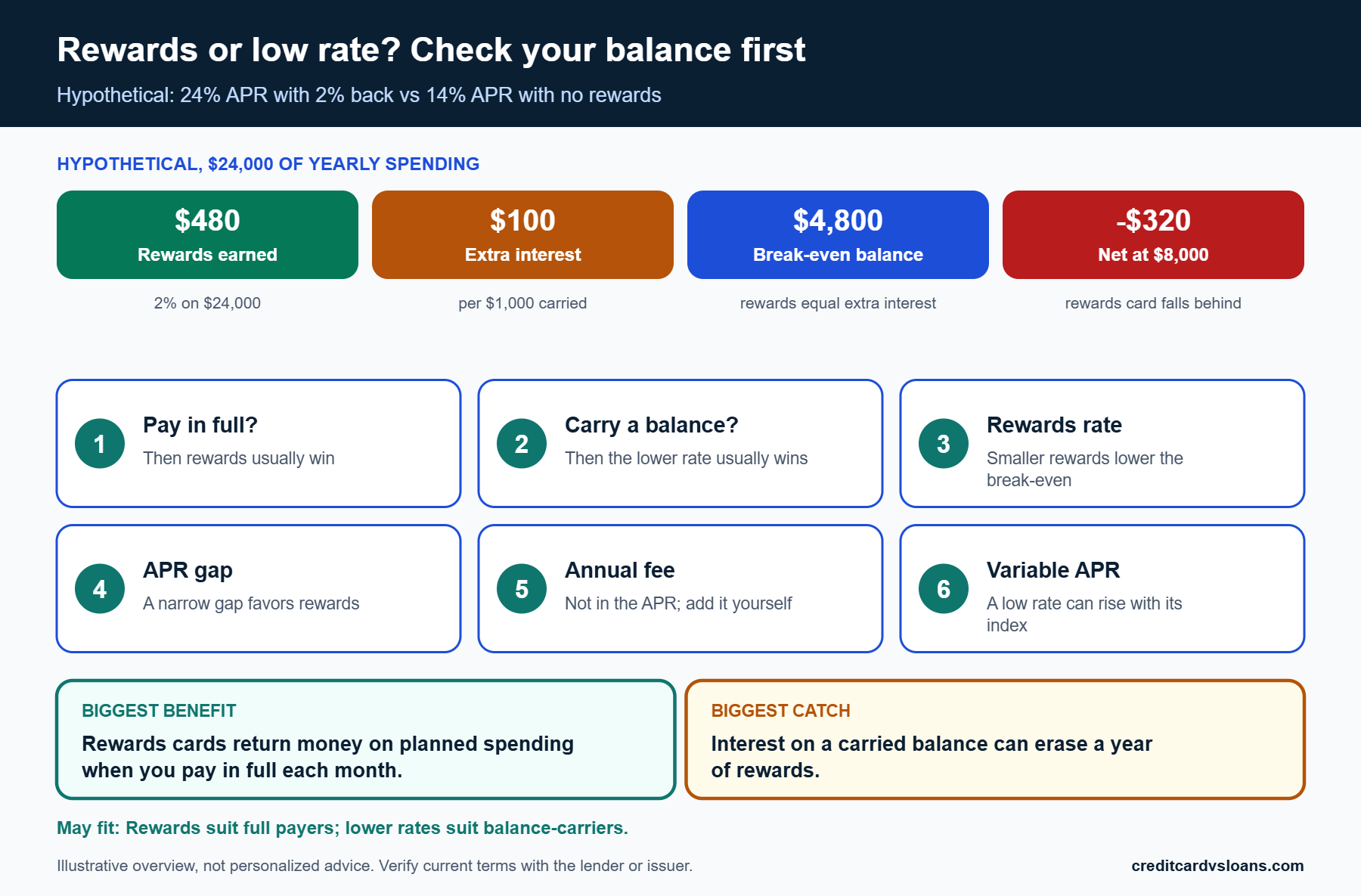
- In the hypothetical example, a rewards card (24% APR, 2% back) beats a low-interest card (14% APR, no rewards) on $24,000 of spending only while your average balance stays under about $4,800.
- Each $1,000 of average balance costs about $100 more per year on the higher-rate card in that example, so a $500 rewards haul vanishes quickly.
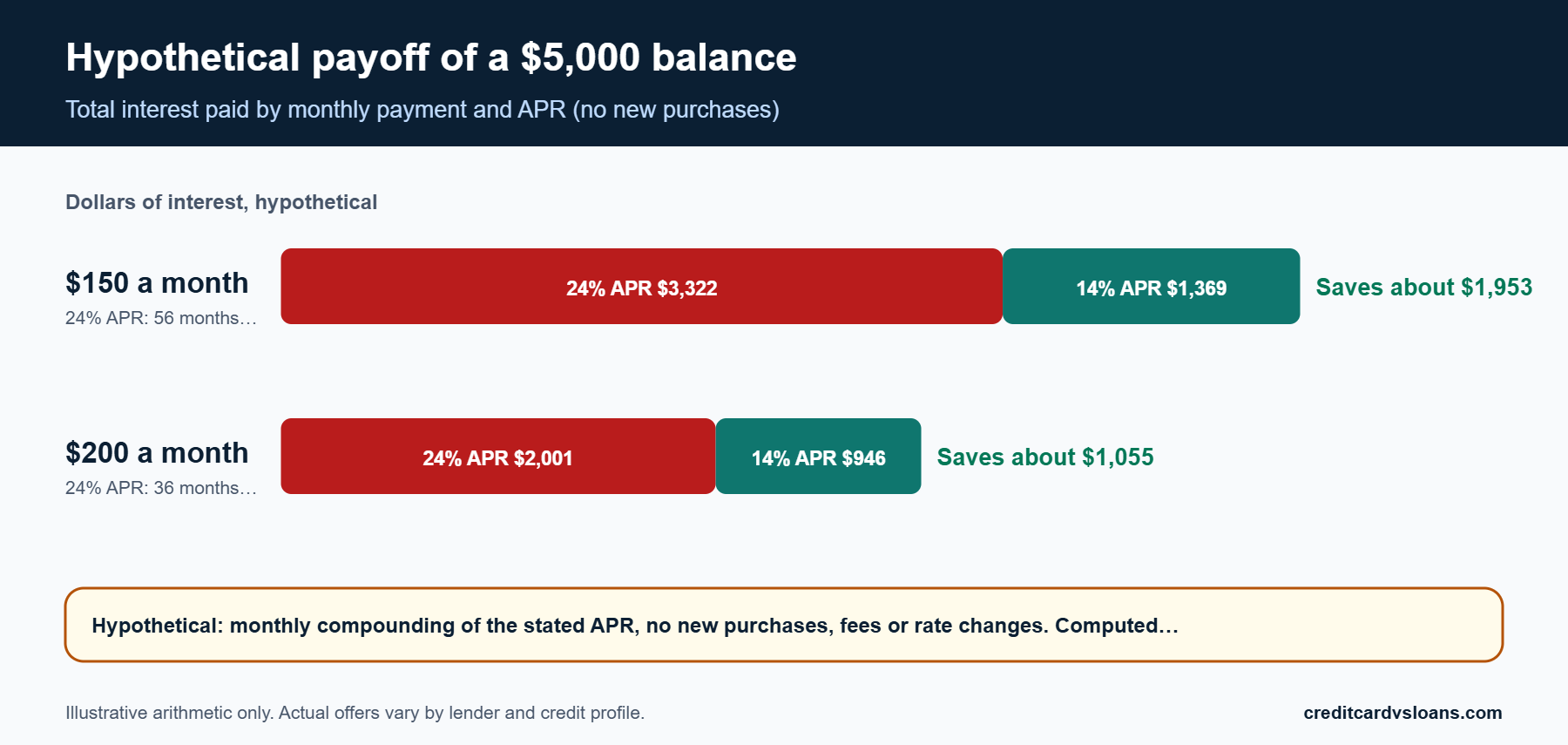
- Paying off a $5,000 balance at $150 a month takes 56 months at a 24% APR and 43 months at 14%, with about $1,950 less interest at the lower rate (hypothetical, no new purchases).
- The grace period only works if you pay in full. Carrying a balance one month can also cost you interest-free purchases the next.
- If you cannot say whether you will pay in full, treat the low-interest card as the safer default.
The Federal Reserve’s G.19 release of Oct. 7, 2026 reported an average rate of 22.36% on credit card accounts assessed interest at commercial banks in August 2026 (preliminary). Individual offers vary widely. All other dollar figures here are hypothetical and were computed for illustration.
Table of contents
Rewards Credit Card vs Low Interest Credit Card: The Short Answer
Which card saves more depends on your balance
Full payers: rewards usually win
If you pay the full statement balance by the due date every month, you generally pay no interest on purchases, which the CFPB describes as the benefit of a grace period. In that case the APR is nearly irrelevant to your costs, and a card that returns a percentage of your spending leaves you better off than one that pays nothing. A rewards card then acts as a small, steady discount on spending you already planned.
The caveat is discipline. The strategy works only when you truly pay in full, including in months with unexpected bills. One slip can bring interest on new purchases and erase several months of rewards.
Balance-carriers: the lower rate usually wins
If you regularly carry a balance, the interest rate becomes your biggest cost. A 10-point difference in APR costs about $100 a year per $1,000 of average balance (simple annual math), and that gap scales with the size of the balance. A rewards card returning 2% on $24,000 yields $480, so a carried balance near $4,800 cancels the entire benefit.
For many households the sensible move is to choose the lower rate, build a payoff plan and revisit rewards once the balance is gone. A lower-rate card is not a license to carry a balance, only a way to make it cheaper while you pay it down.
Why the question is more subtle than it looks
Spending and balance are not independent
People often carry balances because they spend more than they can pay immediately, so higher spending and higher balances travel together. A rewards structure can quietly encourage more spending, and more spending can raise the balance. That is the loop that turns a rewards card into the more expensive choice for some households.
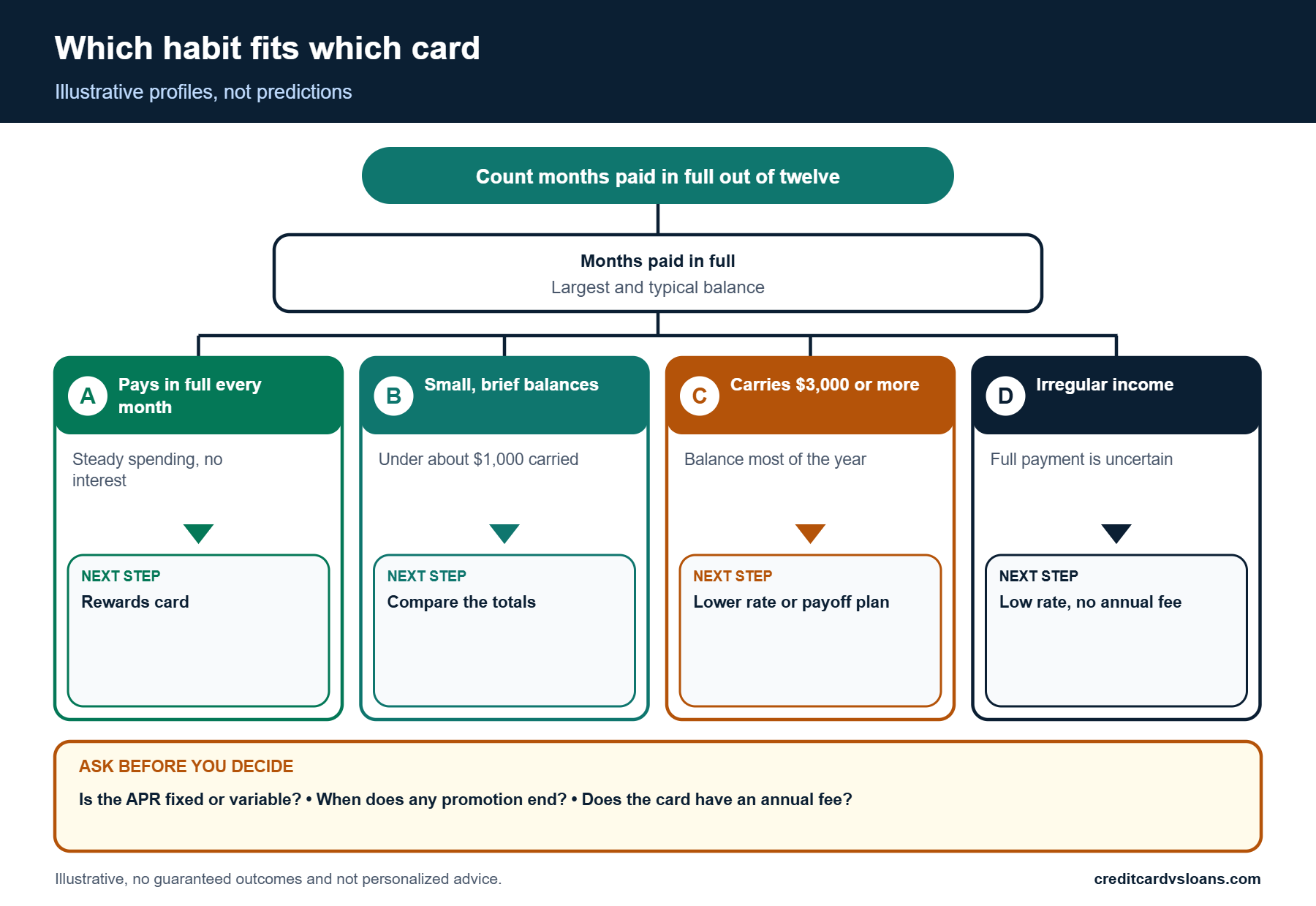
Look at your behavior over a year, not a month. If you can say with confidence that you carried a balance in zero or one months, rewards are in play. If it was several months, rate comes first.
Offers differ by applicant
The rates and rewards you see advertised are often ranges, and the offer you receive depends on your credit and the issuer’s decision. A prequalification check with a soft pull can show likely terms without a hard pull, but it does not guarantee approval. Treat the ranges as marketing and the final disclosure as the truth.
The credit score you need for a rewards card is covered in the guide to credit scores for rewards cards, and the approval tradeoffs between card types are discussed again below.
What Each Card Is Designed to Do
The rewards card
How rewards cards earn their keep
A rewards card returns cash back, points or miles on purchases, so it is built for people who spend heavily on the card and pay it off. Many have annual fees, though many do not, and some carry interest rates at or above the market average.
The rewards are earned on purchases only. Balance transfers, cash advances and fees typically do not earn rewards, so a card used mainly to carry a balance earns little.
What the fine print can hide
Check the category caps, the rotating categories that require activation, the minimum redemption amounts and the conditions on any sign-up bonus. These shape what you will really earn. A headline rate can be a fraction of your blended rate once caps and exclusions apply.
Also check how rewards are treated when you carry a balance or miss a payment. Some programs can reduce or forfeit rewards under certain conditions. Terms vary by issuer, so read the program rules.
The low-interest card
What a low ongoing rate buys
A low-interest card is designed to reduce the cost of carrying a balance. It may have a lower purchase APR than a typical rewards card, and it often has fewer perks and an easier fee structure. The saving comes from lower interest, not from bonuses.
The CFPB distinguishes fixed from variable rates: a fixed APR does not fluctuate with an index, while a variable APR moves with an index such as the prime rate. A low variable rate can rise, so a lower starting number is not the same as lower cost over time.
Why promotions are a different category
A card with a 0% introductory APR is not the same thing as a card with a low ongoing APR. The introductory rate ends after a set period, after which the standard rate applies to the remaining balance. See 0% intro APR versus a low ongoing APR for a head-to-head comparison.
When you compare a rewards card to a low-interest card, make sure you are comparing the ongoing rates, since that is what applies after any promotion.
The Math: When Rewards Beat Interest Savings
The break-even balance
Setting up a hypothetical comparison
Take two hypothetical cards. The rewards card has a 24% APR and returns 2% on purchases. The low-interest card has a 14% APR and returns nothing. Assume $24,000 of yearly purchases on either card, which earns $480 in rewards on the first. These figures are illustrative, chosen for easy arithmetic, and are not offers.
The interest difference is 10 percentage points on whatever balance you carry. Using simple annual math on the average balance, each $1,000 carried costs $100 more on the rewards card. The break-even balance is the rewards divided by that gap: $480 divided by 0.10 equals $4,800.
Reading the table
The table shows the net result of choosing the rewards card at several average balances. At zero balance the rewards card is $480 ahead. At $2,000 the lead shrinks to $280. At $4,000 it is $80. At $5,000 the rewards card is $20 behind, and at $8,000 it trails by $320.
If the rewards card paid only 1.5%, the rewards would be $360 and the break-even would fall to $3,600. The lower the reward rate and the bigger the rate gap, the smaller the balance you can carry before the lower-interest card wins.
| Average balance carried | Extra interest on rewards card | Rewards earned | Net advantage of rewards card |
|---|---|---|---|
| $0 | $0 | $480 | +$480 |
| $500 | $50 | $480 | +$430 |
| $1,000 | $100 | $480 | +$380 |
| $2,000 | $200 | $480 | +$280 |
| $4,000 | $400 | $480 | +$80 |
| $5,000 | $500 | $480 | -$20 |
| $8,000 | $800 | $480 | -$320 |
What the balance costs over time
A payoff comparison
The year-by-year math understates the problem for a large balance, because paying it down takes years. Suppose you owe $5,000 and pay a fixed $150 a month with no new purchases. At a 24% APR the balance takes 56 months to clear and costs about $3,322 in interest. At 14% it takes 43 months and about $1,369. The lower rate saves roughly $1,953 and about 13 months.
At $200 a month the gap narrows but remains: 36 months and about $2,001 in interest at 24%, versus 30 months and about $946 at 14%, a difference of roughly $1,054. These are hypothetical, with monthly compounding of the stated APR, and they ignore new purchases, fees and rate changes.
Why bigger payments change the answer
Paying more each month shortens the time and cuts the interest on either card. A household that pays $200 instead of $150 a month at a 24% rate saves about $1,321 in interest compared with the $150 plan. That is a larger effect than switching cards in some situations, which is why a payoff plan matters at least as much as the rate.
The practical lesson is that rewards do not belong in a debt payoff plan. Once a balance is on the card, the decision should be about interest and monthly cash flow, not points.
| Monthly payment | APR | Months to pay off | Total interest |
|---|---|---|---|
| $150 | 24% | 56 | $3,322 |
| $150 | 14% | 43 | $1,369 |
| $200 | 24% | 36 | $2,001 |
| $200 | 14% | 30 | $946 |
Putting the Federal Reserve numbers in context
What typical card rates look like
The Federal Reserve’s G.19 release of Oct. 7, 2026 reported an average of 22.36% on credit card accounts assessed interest at commercial banks for August 2026 (preliminary), and 21.19% across all accounts, including those that pay in full. The gap between those two figures reflects the many accounts that were not assessed interest at all. It is a reminder that a large share of cardholders avoid interest entirely by paying in full.
The same release put the average rate on 24-month personal loans at commercial banks at 11.90%. Averages are not offers, but they show why a fixed-rate loan can be cheaper than card debt for people who carry a balance. The consolidation loan versus balance transfer card comparison shows how that works.
Why averages are only a starting point
An average blends many borrowers with very different credit profiles. Your rate may be higher or lower, and your rewards may differ from the example. Use the hypothetical figures here to learn the shape of the trade-off, then rerun them with the numbers on a real offer.
If you are unsure which APR applies, check your statement or the issuer’s disclosure. The rate that matters is the one you will actually pay on purchases after any promotional period ends.
How the break-even moves
When the rewards rate is smaller
Break-even balance equals yearly rewards divided by the APR gap. With the same 10-point gap and $24,000 of spending, a 1.5% card yields $360 and breaks even at a $3,600 balance, and a 1% card yields $240 and breaks even at $2,400. Smaller rewards leave less room for a balance before the lower-rate card wins.
When the rate gap is smaller
If the rewards card’s APR is only 5 points higher, the break-even balance doubles. At 2% back the break-even is $9,600, at 1.5% it is $7,200 and at 1% it is $4,800. A narrow gap favors rewards for moderate balances, which is why comparing real offers matters more than comparing card types in the abstract.
| Rewards rate | Yearly rewards | With a 10-point APR gap | With a 5-point APR gap |
|---|---|---|---|
| 2.0% | $480 | $4,800 | $9,600 |
| 1.5% | $360 | $3,600 | $7,200 |
| 1.0% | $240 | $2,400 | $4,800 |
The Fine Print That Moves the Answer
Interest mechanics
The grace period and when it disappears
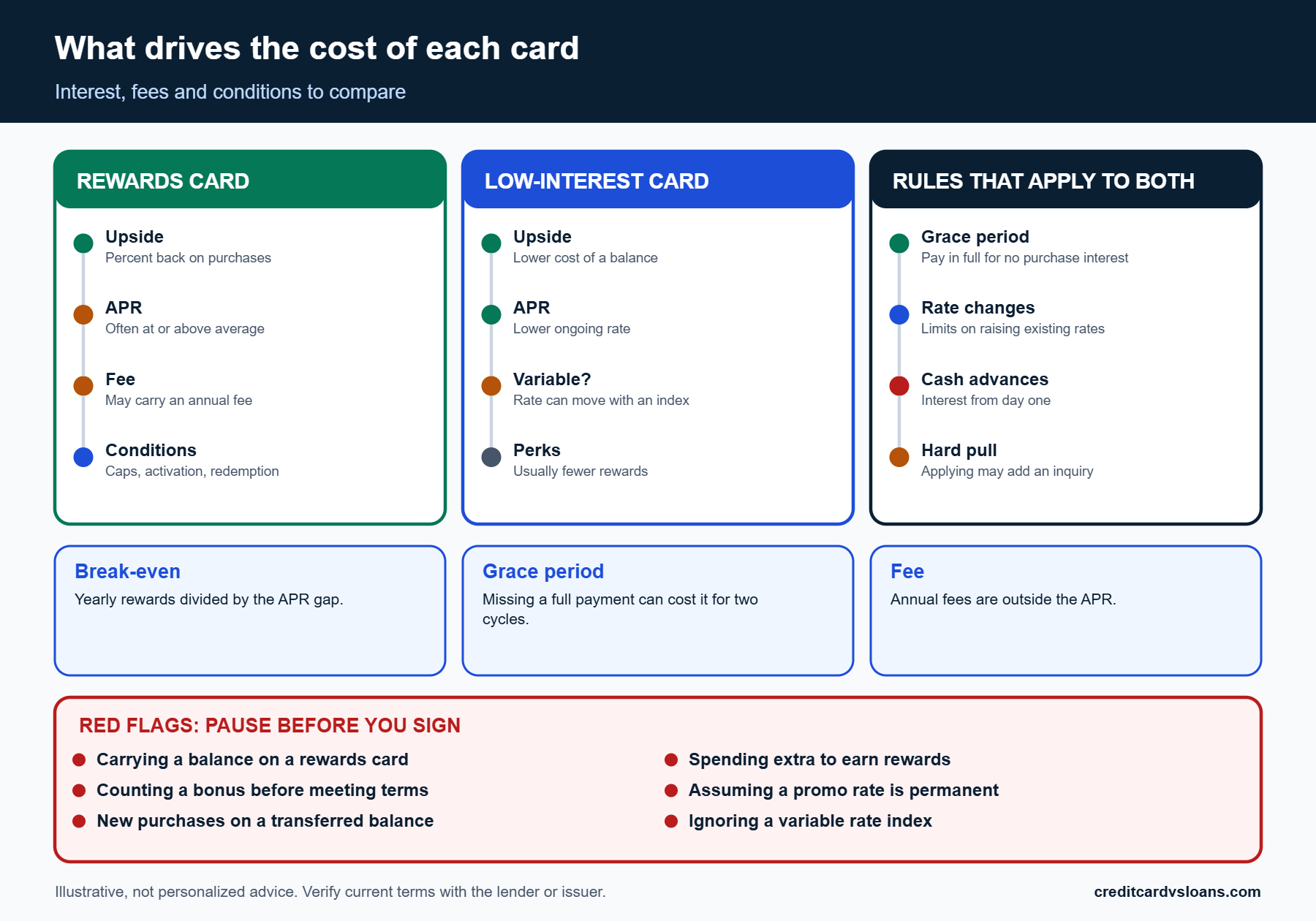
The CFPB explains that a grace period is the time between the end of a billing cycle and the payment due date, and that paying your full balance by the due date generally means no interest on purchases. Issuers are not required to offer it, though most do for purchases, and it usually does not apply to cash advances, which typically accrue interest from the transaction date. Issuers must also deliver your bill at least 21 days before the payment is due.
If you do not pay in full, interest applies to the unpaid amount and new purchases generally begin accruing interest from the day they are made. Paying in full only occasionally can cost you the grace period for the month you did not pay in full and the next month too. For a rewards strategy that depends on paying in full, that detail is crucial.
Fixed, variable and penalty rates
A fixed APR does not move with an index, while a variable APR changes when its index, such as the prime rate, changes. Under Regulation Z, an issuer generally cannot raise the APR on existing balances except in defined circumstances, including the end of a disclosed promotional period of at least six months, an index-driven change on a variable rate, or a delinquency of more than 60 days on a required payment. Many other increases apply only to new transactions after advance notice.
That framework explains why a low advertised rate is not a promise of a low rate forever. Read the rate section of the disclosure and note whether it is variable. The rule text is at 12 CFR 1026.55.
Fees and rewards conditions
Annual fees on either card
Rewards cards more often carry annual fees, but so can low-rate cards, and the fee is separate from the APR. Under Regulation Z, annual and membership fees on open-end credit are excluded from the finance charge, and the APR calculation leaves out charges tied to opening or continuing an account. A $95 annual fee therefore does not appear in the APR, but it is as real as interest.
Add the fee to your cost line for each card. For the first year, Regulation Z also caps covered fees at 25% of the credit limit at opening, which can matter on a low limit. See how to weigh an annual fee against rewards value for the full method.
Rewards that disappear when you carry a balance
Some rewards programs reduce, suspend or forfeit rewards after a missed payment or when an account is closed. Others require you to redeem rewards within a window. These conditions are in the program terms rather than the main disclosure table, so read both.
If your goal is to keep borrowing costs low while still earning something, a no-fee card with a competitive flat rate is often the middle path. It is covered in the fee versus no-fee guide.
Credit, Approval and Account Management
Applying for either card
Hard pulls and prequalification
A formal application usually triggers a hard pull, which is a credit inquiry that can have a small, temporary effect on some people’s scores. A prequalification check that uses a soft pull does not affect your credit, but it does not guarantee approval or the final terms. Using prequalification across a few candidates is a sensible way to compare without stacking inquiries.
If you have a thin credit file, a few recent applications can stand out more than they would for someone with a long history. Limit your applications to the cards you would actually accept.
Who tends to qualify for which offer
Issuers price offers on risk, so the lowest advertised rates are typically reserved for stronger applicants, and rewards cards with premium features can also require a solid credit profile. That does not mean you will be approved or denied for either; it means the offer you receive may differ from the headline. The details are in the rewards card credit score guide.
If your offer is worse than expected, compare it with what you have now. Sometimes the best move is to keep the current card and negotiate or pay down the balance first.
Using the cards well after you open them
Utilization and limits
Credit utilization, the share of your available revolving credit that you are using, is one of the factors scoring models consider. A new card adds to your total limit, which can lower utilization if your balances stay the same. It does not help if the new card encourages more spending and higher balances.
Keep balances modest relative to limits on every card, whether it is a rewards card or a low-rate card, and pay on time. Payment history is typically the heaviest factor in scoring models.
When to move a balance or change cards
If you carry a balance on a rewards card, a balance transfer to a lower-rate or promotional card, or a fixed-rate loan, may cost less. Transfers often involve a fee, and the promotional rate expires, so run the numbers first. The comparison is covered in the consolidation loan versus balance transfer card guide.
Whichever route you choose, avoid adding new purchases to the balance you are paying down. New spending slows progress, and rewards on that spending will rarely offset the interest.
Mistakes That Make Either Card Expensive
Mistakes with rewards cards
Spending more because it earns something
The most expensive rewards mistake is buying what you would not otherwise buy. Earning 2% on a $300 purchase you did not need returns $6 and costs $294. Rewards are a discount on planned spending, and any spending you add to chase them should be counted as a cost, not a gain.
A simple guard is to ask whether you would have bought the item on a debit card. If not, the rewards did not justify it.
Treating a sign-up bonus as income
A bonus that requires a minimum amount of spending in the first few months is a conditional reward. If meeting the threshold means carrying a balance, the interest can exceed the bonus. At a 24% APR, a $3,000 balance carried for three months costs roughly $180 in interest using simple math, which can consume a good share of a $200 bonus.
Take the bonus only when the required spending matches purchases you have already planned and you can pay the card in full.
Mistakes with low-interest cards
Treating a lower rate as permission to carry a balance
A low rate reduces the cost of borrowing, but it does not make it free. At 14% a $5,000 balance still costs about $700 a year in simple interest. The lower rate is a tool for paying a balance down more cheaply, and the best use of it is a plan with an end date.
Set a monthly payment above the minimum and pick a payoff date. The earlier hypothetical shows how a $200 payment cuts the time and interest compared with $150.
Assuming the promotional rate is the standard rate
Some low-rate offers are promotional and end after a set period. When a promotional period ends, the standard rate applies to the remaining balance, and that rate can be much higher. Read the disclosure for both rates and the length of the promotion, and mark the end date on your calendar.
If you cannot clear the balance before then, compare other options before the promotion ends rather than after.
Alternatives to Choosing Between the Two
Cards that split the difference
A flat-rate no-fee card
A no-fee card with a modest flat cash-back rate gives you something back without an annual fee. Its APR may sit near the market average rather than at the low end, so it works best for people who pay in full. If you carry a balance only rarely, it is a reasonable compromise, with small rewards and no fee to recoup.
Use the break-even idea from earlier: multiply your yearly spending by the rewards rate, then ask how many months of carried balance would erase that amount at the card’s APR.
Using two cards deliberately
Some households keep a rewards card for planned purchases they pay off immediately and a low-rate card for the occasional larger expense they need time to repay. This separates the two jobs and keeps interest off the rewards card. The risk is complexity: two due dates, two sets of terms and more chances to miss a payment.
If you try this approach, automate full payments on the rewards card and set reminders for the other. Do not let the low-rate card become a place to park new spending.
Borrowing options outside the two cards
0% intro offers and balance transfers
If you already carry a balance, a card with a 0% introductory APR on balance transfers may reduce interest during the promotional period. Transfers commonly carry a fee, and the standard rate applies to whatever remains when the promotion ends. Under Regulation Z, an issuer can apply the post-promotion rate when a disclosed promotional period of at least six months ends, so confirm the length and the later rate.
Whether the fee is worth it depends on your balance and payoff speed, a topic covered in the guide to 0% intro APRs versus low ongoing APRs.
A fixed-rate personal loan
A personal loan has a fixed payment and end date, which can help if you struggle to pay a card down. Rates vary with credit, and some loans charge an origination fee. The Federal Reserve’s G.19 release of Oct. 7, 2026 gave an average of 11.90% for 24-month personal loans at commercial banks in August 2026 (preliminary), but your rate may differ.
Compare the total cost, not just the monthly payment. The consolidation loan versus balance transfer card comparison walks through the trade-offs for people who are paying down card debt.
Four Illustrative Cardholder Profiles
Profiles that favor rewards
The full payer with steady spending
A household that spends $2,000 a month on a card and has paid in full for years is the textbook rewards user. At 2% back it earns about $480 a year, with no interest. The risk is not the rewards, but complacency about a bad month. An emergency fund that can cover a full statement keeps the strategy safe.
For this household, the annual fee question matters more than the APR. See the fee versus no-fee comparison for that part of the decision.
The paycheck-timing user
Some people carry a balance for a few days because their paycheck arrives after their statement closes. Paying in full before the due date keeps them within the grace period, so the timing alone should not push them toward a low-rate card. The key is that the statement balance is paid by the due date.
If paying in full is only possible by skipping other bills, treat it as carrying a balance for the purpose of this decision.
Profiles that favor a low rate
The regular balance-carrier
A household that carries around $3,000 most of the year at a high APR pays hundreds of dollars a year in interest. In the hypothetical example, the difference between 24% and 14% on that balance is $300 a year, which would erase most of a $480 rewards haul and more if the rewards rate is lower. A lower rate, a balance transfer or a fixed-rate loan can all be worth comparing.
The goal should be to pay the balance down, after which rewards can come back into play.
The irregular-income earner
Seasonal or variable income can make full payment unpredictable. In that case the downside of a missed full payment is larger than the upside of rewards, so a lower rate with no annual fee provides a cushion. The cost of the cushion is the rewards you give up, which in a normal year is a modest amount.
Build savings first if you can. A buffer that covers one statement makes either card safer.
| Payment habit | Tends to fit | Why | Watch-out |
|---|---|---|---|
| Pays in full every month | Rewards card | No interest, so rewards are pure gain | Annual fee and category caps |
| Pays in full, but not always on time | Low-rate or no-fee flat card | Late payments cost the grace period | Late fees and penalty terms |
| Carries under about $1,000 | Either; compare totals | Interest gap is small | Balance tends to grow |
| Carries $3,000 or more | Low-rate option, transfer or loan | Rate gap outweighs rewards | New spending slows payoff |
| Irregular income | Low rate, no annual fee | Protects against a missed full payment | Variable APR can rise |
Questions Readers Ask Next
About rewards and payments
Do balance transfers and cash advances earn rewards?
Often they do not, though programs differ. Rewards are typically tied to purchases, and the program terms list exclusions. Cash advances also usually start accruing interest on the transaction date with no grace period, as the CFPB notes, so they are poor candidates for a rewards strategy.
Check the terms of your specific card before assuming a transaction type earns anything.
What if I pay the minimum one month by accident?
Pay the remaining balance as soon as you can and expect some interest. The CFPB notes that paying in full inconsistently can cost you the grace period for the month you did not pay in full and the following month, so interest may apply to new purchases for a cycle or two. Call the issuer if the charge is large, though any adjustment is discretionary.
Afterward, set autopay for the full statement balance with a buffer in your checking account.
About switching
Should I move my balance to a low-rate card?
It can help if the savings exceed any transfer fee and you can pay the balance before a promotional rate ends. Compare the total cost of staying put against the transfer fee plus remaining interest. The comparison is similar to the fee-versus-interest trade-off in the intro APR guide.
Avoid adding new purchases to the transferred balance, since new spending can undercut the savings.
Can I have both card types?
Yes, and many people do. The key is assigning each card a clear job and making sure the rewards card is always paid in full. Keep track of both due dates and fees, and review the setup annually.
If managing two cards would strain your attention, one flat-rate no-fee card is a simpler path.
Checklist: Decide in One Sitting
Gather the facts
Your own payment history
Look at the last twelve statements and count the months you paid in full. Note the largest balance, the typical balance and the interest charged. If you cannot find interest charges, your statement groups them under a heading such as interest charged, which Regulation Z requires to be itemized and totaled for the period and the year to date.
This number, not the card’s marketing, tells you which side of the break-even line you are on.
The offer terms
For each card, write down the purchase APR and whether it is fixed or variable, the annual fee, the reward rate and caps, the length of any promotional period and the rate that follows. Note the penalty terms for late payments. If a figure is a range, use the less favorable end until you see your actual offer.
Prequalify with a soft pull where it is offered, and remember that a prequalification result does not guarantee approval.
Run the comparison
Two quick calculations
First, multiply your yearly spending by the rewards rate to get the yearly rewards. Second, multiply your average balance by the APR gap to get the extra interest. If the second number is larger, the lower-rate card wins. If the first is larger, the rewards card wins, subject to any annual fee.
Check that your average balance is realistic. A balance that is zero in most months but spikes briefly counts for far less than one that sits there all year.
Decide, then set guardrails
Pick the card, then set guardrails: autopay for the full statement balance if you chose rewards, or a payoff plan with a fixed date if you chose a low rate. Add a calendar reminder for the end of any promotion and for any fee anniversary. Revisit the decision once a year, or when your income or spending changes.
If you are still unsure, choose the lower-rate card. It limits the cost of being wrong.
Conclusion: Let Your Balance Decide
The rule of thumb
What the numbers say
If you pay in full, a rewards card usually saves more because it returns money and interest never applies. If you carry a balance, a low-interest card usually saves more because interest outweighs rewards at typical rates. The hypothetical break-even balance was about $4,800, but yours will differ with your rewards rate, spending and the rate gap.
The Federal Reserve’s G.19 release of Oct. 7, 2026 put the average card rate for accounts assessed interest at 22.36% in August 2026 (preliminary), which is why balances matter so much.
What should make you reconsider
Reconsider if your balance grows, if the promotional rate nears its end, if the annual fee rises or if your spending changes. Reconsider too if your credit improves and you qualify for a better offer. The right card today may not be the right card next year.
For the broader borrowing picture, see debt consolidation loan versus balance transfer card and 0% intro APR versus a low ongoing APR.
Your next steps
A short list for this week
- Count the months you paid in full out of the last twelve.
- Find your average balance and the interest you were charged.
- Compute rewards: yearly spending times the reward rate.
- Compute the extra interest: average balance times the APR gap.
- Choose the card that comes out ahead, or the lower-rate card if you are unsure.
- Set autopay or a payoff date, and a reminder for any fee or promotion deadline.
Where to read next
To judge a rewards card’s annual fee, read annual fee versus rewards value and annual-fee versus no-annual-fee cards. To check what credit profile a rewards card tends to need, see the rewards card credit score guide.
The CFPB’s credit card resources at consumerfinance.gov explain your rights and the terms to look for before you accept an offer.
- Debt Consolidation Loan vs. Balance Transfer Card: Which Saves More?
- Annual-Fee vs. No-Annual-Fee Credit Card: Which Is Worth It?
- Credit Card Annual Fee vs. Rewards Value: How to Judge the Tradeoff
- 0% Intro APR vs. Low Ongoing APR: Which Is Better Long Term?
- What Credit Score Do You Need for a Rewards Credit Card?
- CFPB: 12 CFR 1026.55 Limitations on increasing annual percentage rates, fees and charges
- CFPB: 12 CFR 1026.52 Limitations on fees
- CFPB: 12 CFR 1026.14 Determination of annual percentage rate
- CFPB: 12 CFR 1026.7 Periodic statement
- CFPB: What is a grace period for a credit card?
- Federal Reserve: Federal Reserve G.19 Consumer Credit (Oct. 7, 2026 release)
Last updated: October 22, 2026. Rates, fees and lender rules change; verify current terms before acting.
The information on creditcardvsloans.com is provided for general educational and informational purposes only. It is not financial, legal, tax, credit, accounting or investment advice, and reading it does not create an advisor-client, fiduciary or any other professional relationship. Nothing here is an offer, solicitation or recommendation to borrow, lend or apply for any product.
Credit scores, interest rates, fees, eligibility rules, lender policies and laws change frequently and vary by lender, location and individual circumstances. Examples, figures and scenarios are illustrative only, do not predict your results and do not guarantee approval, savings, a particular rate or a credit-score outcome. Always confirm current terms directly with the lender or issuer and read the full agreement before you apply or sign.
Although we aim for accuracy and use reputable sources, we make no representations or warranties, express or implied, about the completeness, accuracy, reliability or timeliness of the content. Content may be drafted with the assistance of automated tools, so errors or omissions may still occur. Links to third-party sites are provided for convenience; we don’t control and aren’t responsible for their content.
To the fullest extent permitted by law, creditcardvsloans.com and its owners, editors, authors, contributors and affiliates disclaim all liability for any loss, damage or expense arising directly or indirectly from your use of, or reliance on, this content. Before making financial decisions, consult a licensed professional, such as a qualified financial advisor, attorney, tax professional or nonprofit credit counselor, who can consider your complete situation.