A 0 apr balance transfer vs 0 apr purchase offer is a choice between two different promises: one covers debt you move onto the card, the other covers new spending. A card can offer either, both, or neither, and the wrong match can leave your money earning a regular rate while you think it is free.
The confusion is understandable. Marketing often says “0% intro APR” without saying which transactions qualify, and the fine print usually sits in the account-opening table and the offer terms. Two cards with the same headline can behave very differently once the first statement arrives.
This guide is about telling the offers apart before you apply and keeping them straight afterward. It explains what each promotion covers, how payments are applied when both sit on one card, and what to check in your terms. If you want the step-by-step payoff plan, see our guide to using a 0% transfer card without falling into a debt trap. This article is general information, not personal advice, and offers vary by issuer and applicant.
- A balance transfer APR applies to debt you move from another account. A purchase APR applies to new spending. Each has its own rate, its own length and its own start date.
- Having one 0% promotion does not mean you have the other. A card with 0% on transfers can still charge its regular rate on purchases from day one.
- The CFPB says that, for most cards, purchases accrue interest from the transaction date when you carry a balance, even if another balance is at 0% from a transfer.
- When you pay more than the minimum, federal rules generally send the extra to the highest-APR balance first. That can leave your 0% balance untouched.
- Your statement lists each balance category with its own APR, which makes it the best place to confirm what you have.
Rules cited are Regulation Z provisions and CFPB consumer guidance as of October 2026. Average-rate figures come from the Federal Reserve’s G.19 release of October 7, 2026. Card terms change, so confirm every detail against your own offer.
Table of contents
Quick Answer: 0 APR Balance Transfer vs 0 APR Purchase
Same zero, different job
What each promotion covers
A 0% balance transfer offer covers a balance you move from another credit account to the new card. It is built for paying down existing debt, which is why the offer usually comes with a transfer fee. The CFPB defines a balance transfer as moving a balance from one credit card to another, usually for a fee.
A 0% purchase offer covers new purchases made on the card, usually for a stated number of months. It is built for financing spending, such as a large planned expense, and it often comes without a transfer fee because no balance is being moved. If you are weighing a purchase against a loan, our comparison of a 0% card versus a personal loan for a big purchase shows how the math can look.
Why a card can have one but not the other
Issuers set the two promotions separately. Some cards advertise both for the same number of months, some offer a longer transfer window than purchase window, and some offer only one. Even when both are 0%, the start dates can differ: one clock may run from account opening and another from the date a transfer posts, depending on the issuer’s terms.
That is why the headline is not enough. Look for the exact words in the offer, such as “on purchases” or “on balance transfers,” and write down each promotion’s length and the rate that follows. If the offer only mentions one, assume the other is at the regular rate until the terms say otherwise.
How to tell which offer you have
Start with the account-opening table
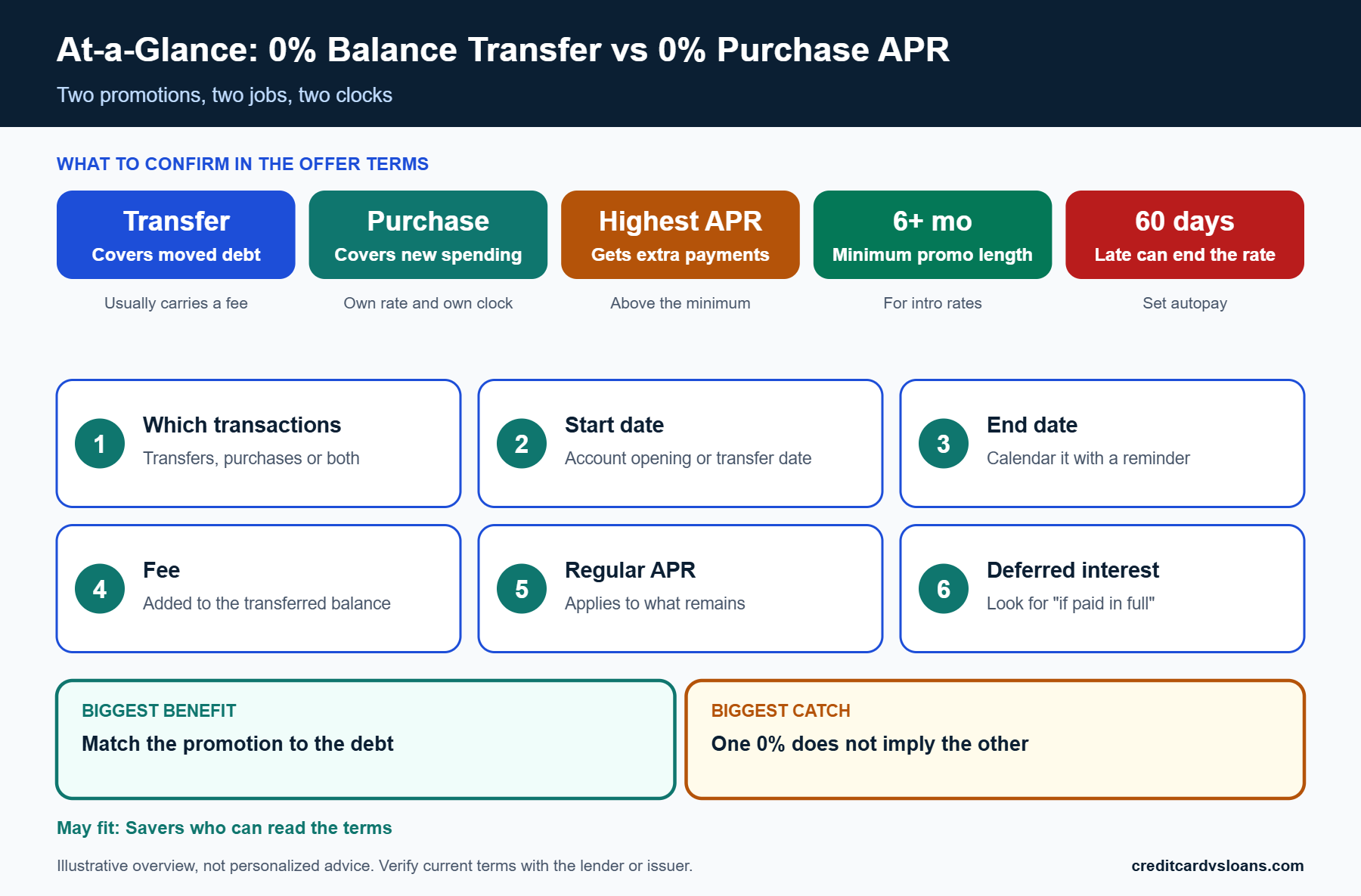
Federal rules require card issuers to disclose key terms in a table at account opening, including the rates for purchases and for balance transfers and any fee imposed to transfer a balance, with the fee shown in bold. The table typically lists the introductory rate and its duration alongside the regular APR for each transaction type.
Read the purchase row and the balance transfer row separately. If a row shows a lower rate with a time limit, that is the promotion. If it shows only the regular rate, there is no promotion for that type of transaction on that card.
Confirm on your statement
After you open the card, your statement is the proof. The CFPB notes that statements must list each balance category with its own APR and balance, so a transferred balance and a purchase balance should appear on separate lines, each with its rate. If something doesn’t match the offer, contact the issuer promptly and ask where the rate came from.
Check the statement the first month a transfer posts. A transfer can take days to complete, and in the meantime you may still owe a payment on the old account. Keep paying that account until it shows a zero balance.
How Each Promotion Works Behind the Scenes
The balance transfer promotion
Fee, window and the rate that follows
A transfer promotion usually has three parts: a fee, a promotional period and a regular APR afterward. The CFPB says a card issuer is permitted to charge a balance transfer fee on a zero percent offer, and its glossary adds that the fee is typically a percentage of the amount or a fixed amount, whichever is higher. For a deeper look at the math, see the companion explainer on using a transfer card responsibly.
A promotional period on a balance transfer must last at least six months under federal rules, and the issuer must tell you how long it lasts and what rate applies afterward. When the period ends, the remaining balance can be charged the regular rate.
What counts as a transfer
Not every move of money onto a card qualifies as a balance transfer. Cash advances, convenience checks and some other transactions may be treated as separate categories with their own rates and fees, and a promotion on transfers might not apply to them. The terms should spell out which transactions are included.
If you plan to pay something other than a standard credit card balance, such as a loan, ask the issuer how the transaction will be coded before you rely on a 0% rate. A transaction that looks like a transfer to you can be a cash advance to the issuer, which is a very different cost.
The purchase promotion
Interest-free spending and the grace period
On a card with a 0% purchase offer, new purchases carry the promotional rate for the stated period. After that, the regular APR applies to any remaining purchase balance. The offer can be useful for planned spending that you can repay on a schedule, as long as the payment plan is real.
The grace period, which is the stretch between the end of a billing cycle and the due date when paying in full avoids interest, works differently. The CFPB says a grace period usually applies only to new purchases and only if you were not already carrying a balance. During a 0% purchase period it matters less, but when the promotion ends it comes back into play.
Where the clock starts
Purchase promotions often begin when the account opens, which means every month you wait to use the card shortens the useful window. Some issuers apply the purchase rate only to purchases made in an initial period. The offer terms should state whether the period is measured from account opening or from each purchase date.
Because details vary, the practical advice is to treat the first statement as a checkpoint. Record the date each promotion ends, and set a reminder 60 days earlier. If you have both promotions, you may have two end dates, and they won’t always match.
| Feature | 0% balance transfer APR | 0% purchase APR |
|---|---|---|
| Applies to | Debt moved from another account | New purchases on the card |
| Who it may fit | Someone paying down existing card debt | Someone financing a planned expense |
| Typical fee | Transfer fee, often percent or flat amount | Usually none specific to the promotion |
| Main drawback | Fee added to the balance; deadline | Easy to overspend; balance left at the regular rate |
| Primary cost drivers | Fee, length of window, regular APR after it | Length of window, regular APR, how fast you repay |
Paying Down Both: The Real Cost of Mixing Offers
How payments are applied when a card has two rates
The highest-APR rule
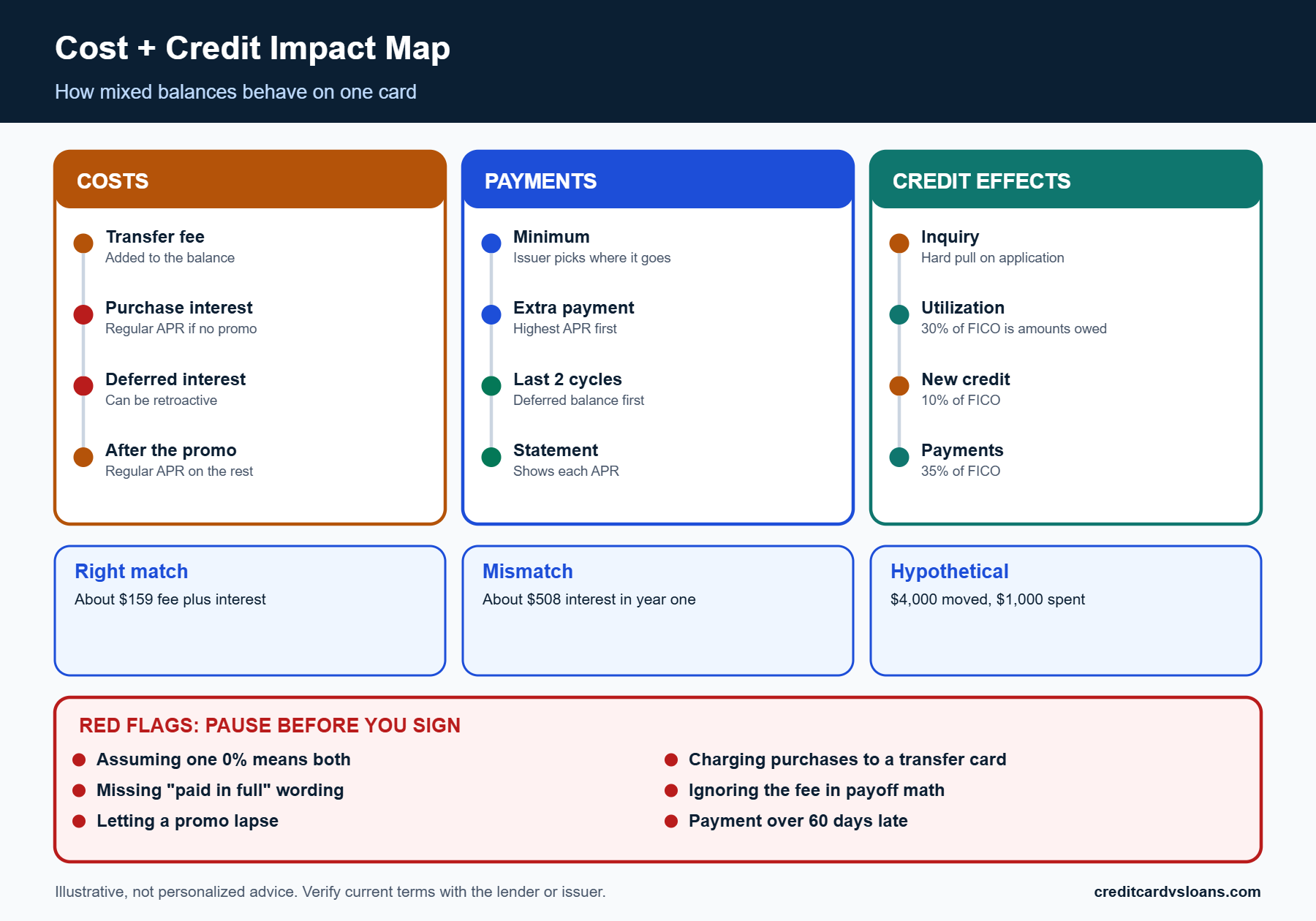
Under Regulation Z, when you pay more than the minimum on a card with different balances, the amount above the minimum generally goes first to the balance with the highest APR, then to the others in descending order. The issuer generally decides how to apply the minimum portion. That means a purchase balance at a regular rate can absorb your extra payments while a 0% transfer balance waits.
That is not a bad outcome in itself, since paying the expensive balance first saves interest. The problem is when you misread the situation and think your extra payments are retiring the transferred balance. They might not be, and the promotional deadline can arrive with the transferred balance barely touched.
A special rule for deferred interest
There is an exception worth knowing. For balances in a deferred interest program, where accrued interest is waived only if you pay in full by a deadline, the rules require the issuer to apply the extra payment to that deferred balance first during the last two billing cycles before it expires. In earlier cycles, the general rule applies.
Deferred interest is not the same as a true 0% APR. The CFPB explains that with deferred interest, interest accrues during the promotion and is charged retroactively from the purchase date if the balance isn’t paid in full on time. When you read an offer, look for phrases like “no interest if paid in full,” which usually signal deferred interest rather than a true 0% rate.
A hypothetical example with both promotions in play
The right card for a transfer plus some new spending
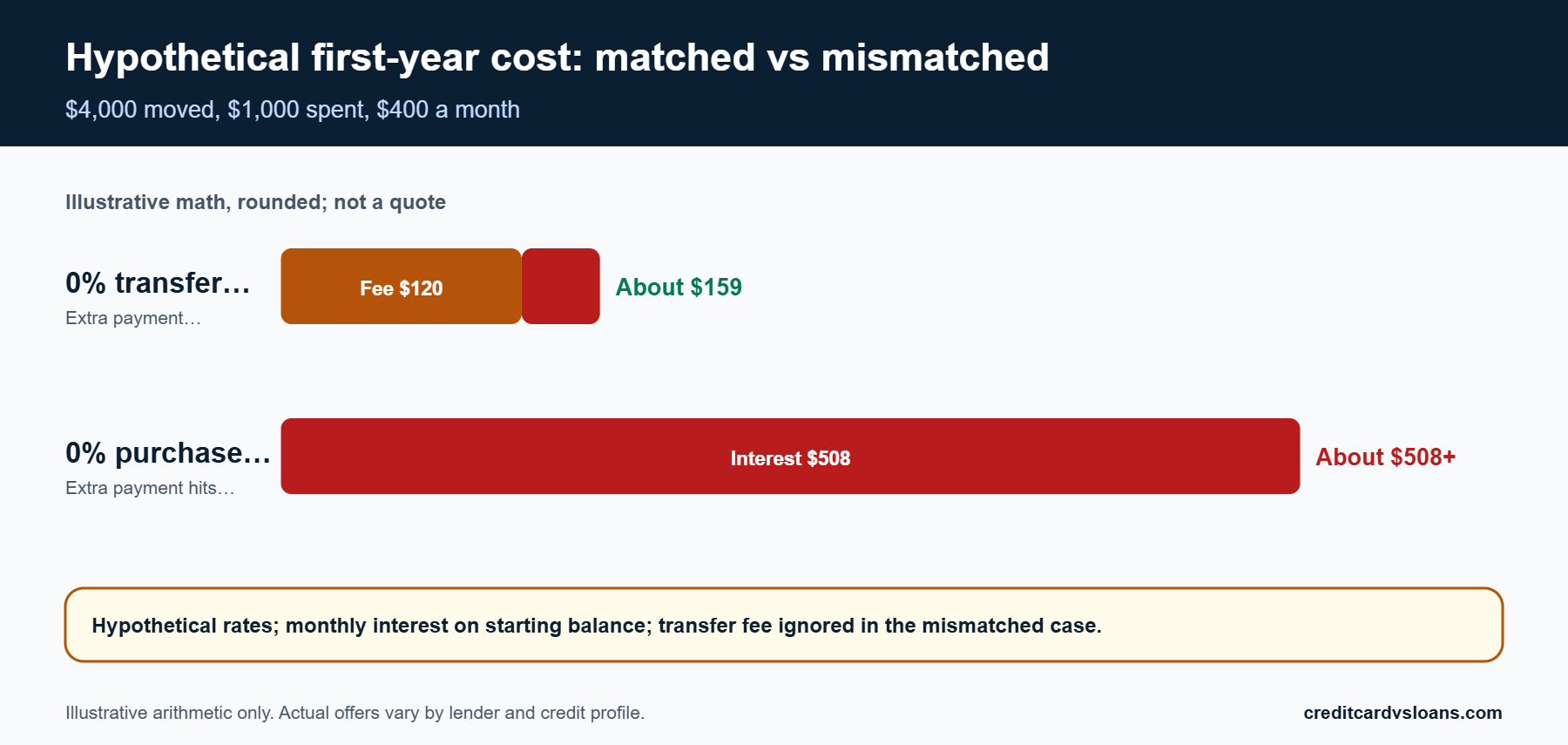
Suppose you move $4,000 to a card with 0% on transfers for 15 months, a 3% fee of $120, and a 24% regular APR on purchases. You also charge $1,000 in purchases right away and pay $400 a month, with a $35 minimum applied to the transferred balance. All numbers are hypothetical and approximate, and they use monthly interest on the starting balance.
Under the highest-APR rule, the $365 above the minimum goes to the purchase balance first. The purchases are cleared in about three months at a cost of roughly $39 in interest, and the remaining payments go to the transferred balance, which is gone by month 13. Fee plus interest comes to about $159 over the whole plan.
The mismatched card
Now imagine you picked a card that offers 0% on purchases but charges 24% on transfers. You move the same $4,000, put the $1,000 of purchases on the card, and pay $400 a month. The highest-APR rule now sends the extra payment to the transferred balance, and the 0% purchases wait. Over the first 12 months, interest on the transferred balance alone would be roughly $508, and you would still owe about $708 on purchases. That ignores any transfer fee, which would make it worse.
The comparison is the point: the same borrower, the same payment and the same total debt, but one card costs about $159 and the other about $508 in the first year. The difference comes entirely from matching the promotion to the type of debt.
| Item | 0% on transfers, 24% on purchases | 0% on purchases, 24% on transfers |
|---|---|---|
| Debt moved | $4,000 plus $120 fee | $4,000 (fee ignored) |
| New purchases | $1,000 at 24% | $1,000 at 0% |
| Payment | $400 a month | $400 a month |
| Where extra payments go | Purchases first (highest APR) | Transfer balance first (highest APR) |
| Interest in the first 12 months | About $39 | About $508 |
| Fee plus interest | About $159 | About $508 or more |
| Balance left at month 12 | About $359 (transferred balance) | About $708 (purchases) |
What to do if the numbers don’t match your offer
Swap in your own rates
Use the same structure with your terms. List each balance, its APR, the promotional end date and the fee. Apply your payment first to the minimum on each balance, then to the highest APR, and see which balance is still standing when each promotion ends.
If the highest-APR balance is the one with a deadline, you are in good shape. If the highest-APR balance is the one without a deadline, the 0% balance could expire while your payments went elsewhere. That is the situation to design out before you apply.
Ask the issuer how payments will be applied
The CFPB tells cardholders with other balances on a card to ask the issuer to apply payments above the minimum to a deferred interest balance when relevant, and the general rule on allocation is set by regulation. For ordinary 0% balances, the allocation is mostly mechanical, but the minimum payment portion is the issuer’s choice. A phone call or secure message can confirm how your issuer handles it.
Save the answer. If there is any dispute later about where a payment went, you will have a written record of what you were told and when.
Credit Score and Utilization Effects
What a new card does to your profile
Inquiry and new account effects
Applying for a card usually creates a hard inquiry. According to myFICO, new credit accounts for 10% of a FICO Score, FICO considers inquiries from the past 12 months, and opening several accounts in a short period can be viewed as riskier. The type of promotion you pick doesn’t change that; the application does.
If you aren’t sure you would be approved, a prequalify tool can show likely offers through a soft pull. It is not a guarantee, and final terms can differ. Our explainer on credit scores for 0% APR cards describes what issuers tend to weigh.
Utilization under each offer
myFICO puts amounts owed at 30% of a FICO Score, including how much of your available revolving credit you use. A transfer moves an existing balance and adds available credit, so total utilization could fall if the old card remains open and unused. A purchase promotion adds new debt, so utilization rises as you spend, even though the interest rate is zero.
That distinction matters when you plan a major application, such as a mortgage or auto loan, in the near future. A 0% purchase balance still counts as a balance on the report. Pay it down on schedule rather than leaning on the promotional period to the end.
Protecting your credit through the promotion
Payment history first
Payment history is the largest FICO factor at 35%, and a payment more than 60 days late can also end a promotional rate, according to the CFPB. Autopay for the minimum on every card involved is the baseline. Add your planned extra payment as a separate scheduled transfer so you do not have to remember it.
When the transfer posts, you might also have a temporary period where both cards show balances. Keep both current until the old one reads zero, then let the statements confirm it.
Watch the limit
Putting purchases on the same card as a transferred balance can push you near the credit limit, which is a utilization signal and a practical problem if a payment fails. Leave headroom. If you expect to use the purchase promotion heavily, a separate card might be cleaner than layering everything onto one account.
Also remember that the transfer fee is added to the balance and uses up limit. Subtract the fee from your available room before you plan purchases.
Eligibility and Choosing the Right Offer for Your Goal
Matching the promotion to the debt
Existing card debt points to the transfer offer
If your goal is to pay down balances that already carry interest, a transfer offer is the match. The fee is the price of moving the balance, and the promotional window is the time you have to clear it. The right questions are how long the window is, whether the fee is smaller than your expected interest, and whether the new limit will hold the whole balance.
If you are comparing this against a lower rate that lasts, look at the cornerstone article on 0% intro APR versus a low ongoing APR. A promotional rate rewards fast payoff, while a lower permanent rate rewards a longer one, and the better choice depends on your timeline.
Planned spending points to the purchase offer
If your goal is to finance a purchase you have already budgeted for, a purchase offer can be a match. The test is whether you could pay the purchase off before the promotion ends, with a monthly amount that is already in your budget. A 0% rate does not make an unaffordable purchase affordable; it only removes interest during the window.
It also helps to compare the card with other ways to pay. For furniture or other big-ticket buys, our guide on a 0% card versus a personal loan discusses fixed-payment structure as a counterweight to revolving credit. A fixed payment can make it harder to drift.
Approval, limits and what to check before applying
Approval factors are the same for both offers
The offer type usually doesn’t change what issuers look at: income, existing debt, payment history and recent applications. Cards with promotional rates are typically aimed at applicants with stronger credit, though cutoffs aren’t published and no outcome is guaranteed. Our overview of score expectations for 0% APR cards goes into what applicants should expect.
If you apply and are declined, the denial notice explains why. Use it to fix specific issues, rather than reapplying immediately. A cluster of applications can count against you under the new credit factor that myFICO describes.
Limits matter more with a transfer
A transfer needs credit limit equal to the balance plus the fee. A purchase offer needs limit for the spending you plan, plus a cushion. If the limit comes in lower than expected, a transfer might only partially move your balance, and a purchase plan might not fit at all.
Ask yourself what you will do if the limit is half what you hoped. If the answer is a plan B, you are fine. If the answer is panic, wait to apply until you can prequalify or choose a different product.
Mistakes and Red Flags to Avoid
Confusing offers on the marketing page
Assuming one promotion implies the other
The most common mistake is assuming that a 0% balance transfer offer also means 0% on purchases, or the reverse. The CFPB warns that on most cards, purchases accrue interest from the transaction date if you carry a balance, even when another balance is at 0% because of a transfer. A shopper who puts groceries and gas on a transfer card can quietly run up interest that undoes the savings.
The reverse mistake is moving a card balance onto a purchase-only offer and discovering that the transferred amount is charged at the regular rate. Either one comes from reading the headline instead of the table.
Missing deferred-interest language
Some promotions use the phrase “no interest if paid in full,” which describes deferred interest rather than a true 0% rate. According to the CFPB, with deferred interest the interest is charged retroactively from the purchase date if you do not pay the balance in full on time. In its example, a $400 purchase with $300 paid during the promotion left $165 owed under deferred interest, compared with $100 under a true zero-interest offer.
The way to avoid the surprise is to read the offer language and divide the promotional balance by the months in the promotion, then pay at least that much each month. Minimum payments usually will not clear it. These offers are more common on store cards, which the CFPB notes often carry higher rates.
Operational errors
Letting the promotion lapse without a plan
Promotions end on specific dates, and the grace period can disappear if a balance remains. When a transferred balance rolls to the regular rate, the issuer can charge that rate to the balance still unpaid. If your purchase balance also remains, you may be paying a high rate on both.
Create a reminder for each promotion’s end date. Sixty days before, check the remaining balance against your payment schedule. If you will not make it, you have time to adjust, ask about options or move the balance elsewhere.
Ignoring the fee in the payoff math
Many borrowers calculate the payoff using only the amount they moved. The fee is added to the balance, so the real number is higher, and the payment needed to clear it by the deadline is higher too. In the earlier hypothetical, the $120 fee raised the balance from $4,000 to $4,120.
The same oversight applies to purchase offers when there is a fee on something like a cash advance, a foreign transaction or a late payment. Read the complete fee schedule, not just the promotional line.
Decision Matrix: Which Offer Fits Which Situation
Comparing the two against common goals
A quick decision table
The table below maps common goals to the offer type to investigate. It is a starting point for your own comparison, and the details of every row depend on your specific terms.
| Scenario | Offer to investigate | Why | What to verify | When to avoid it |
|---|---|---|---|---|
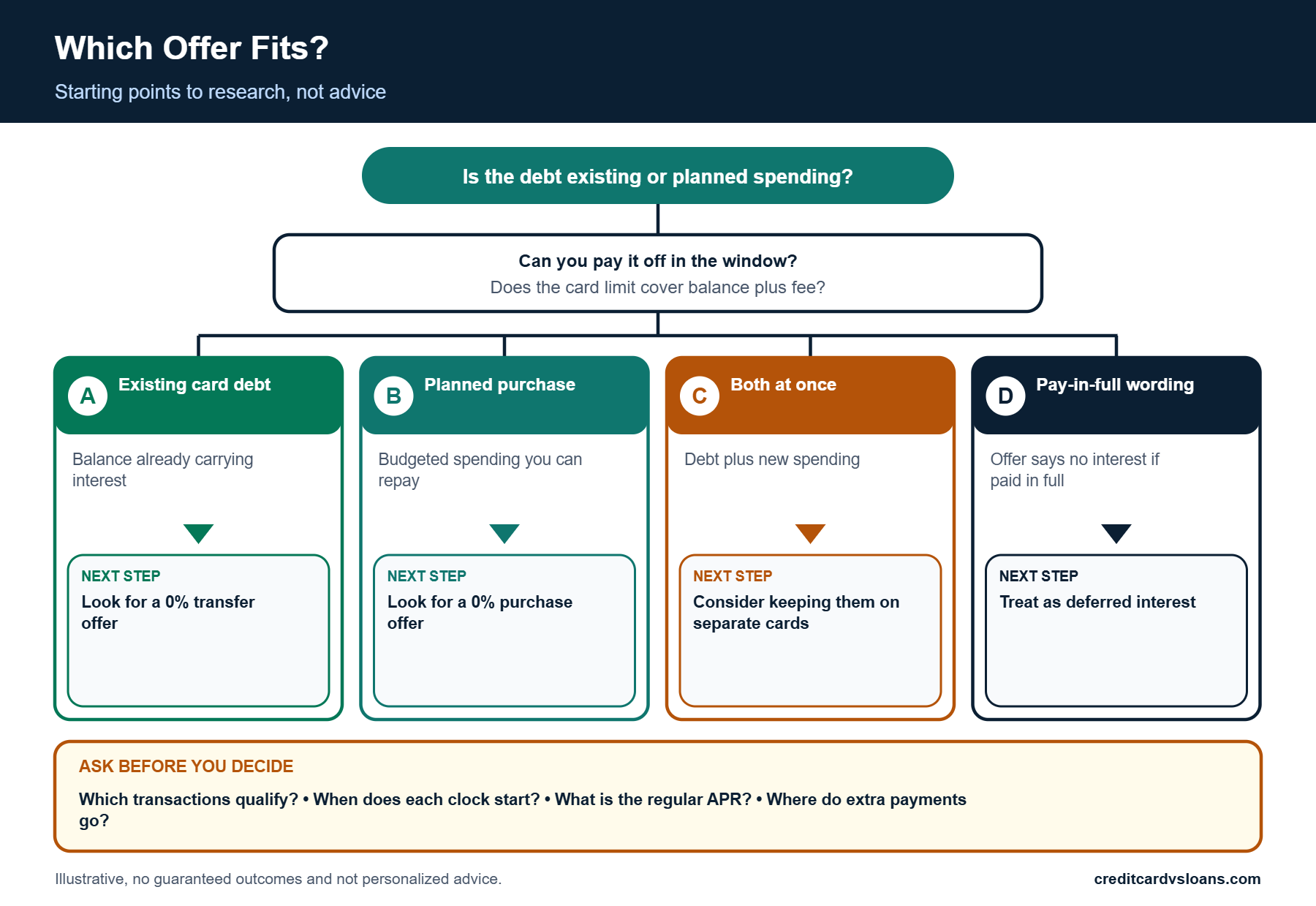
| Paying down an existing high-rate card balance | 0% balance transfer | Interest stops during the window | Fee, window, regular APR, limit | If you cannot pay it off in time |
| Financing a planned purchase you can repay | 0% purchase | No interest on the spending | Window start date, regular APR | If the purchase is not budgeted |
| Both existing debt and new spending | Card with both, or two separate cards | Keeps promotions matched to debt types | Allocation of payments | If it complicates your payoff plan |
| Offer says no interest if paid in full | Treat as deferred interest | Interest may be charged retroactively | Exact payoff amount and date | If you could miss the deadline |
| Small balance, short payoff | Paying it directly | A transfer fee may cost more than interest saved | Fee versus interest | If the fee is most of the savings |
The fee-versus-interest comparison is covered in the sibling guide to using a transfer without a debt trap. The logic is short: estimate how much interest you would pay in the time you need, subtract the fee, and see whether the result is meaningfully positive.
When one card with both offers is not enough
If you have both existing debt and planned spending, a single card with two promotions can be tidy, but it also invites mixing. A separate card for purchases keeps balances clean and means the payment you aim at the transferred debt cannot be diverted by the allocation rules. The trade-off is another application and another account to manage.
Commercial and business cards have their own terms, so check those separately if the spending is for a business.
Reading two offers side by side
Normalize the terms first
To compare offers fairly, put each into the same format: promotion type, length, start date, fee, regular APR and fixed or variable. An offer with a longer window and a larger fee is not automatically better or worse than one with a shorter window and a smaller fee. It depends on how fast you can pay, which is why the monthly target matters more than the headline number of months.
A useful shortcut is to compute the total cost of each offer under your own payment plan, adding the fee to any interest you would pay if a balance remained at the end. The lower total is the better fit for that plan, and a different plan could reverse the answer.
Count what you will really use
Some features of an offer only matter if you use them. A long purchase window is valuable if you plan large purchases early; a long transfer window is valuable if your balance is big enough to need it. If you will use only one promotion, do not pay extra for the other in the form of a higher fee or a weaker rate elsewhere.
Also check whether the promotion applies to the first purchases only, or only to purchases made within a set period after account opening. Terms like these can shrink the practical value of a long headline window.
Planning for the Day a Promotion Ends
What the rules say about expiring rates
The six-month floor and advance disclosure
Regulation Z lets an issuer raise a rate when a specified period of six months or longer expires, provided the length of the period and the rate that applies afterward were disclosed clearly in writing before the period began. When the period ends, the issuer cannot apply a rate to the balance that exceeds the rate disclosed in advance. If an issuer advertises a waiver or rebate of interest and later stops it, that counts as an increase under the same rules.
For you, the takeaway is practical: the post-promotion rate is already written down somewhere. Find it in the account-opening table before you apply, and write it beside the end date so that neither number is a surprise.
Notice before other changes
Outside of an expiring promotion, issuers generally must give 45 days’ advance notice before raising the rate on new purchases, and they generally cannot raise the rate on new transactions during the first year of the account. Existing balances are generally protected, with exceptions that include an expired temporary rate, a rise in a variable rate’s index, and a payment more than 60 days late.
These protections do not replace careful reading. They set a floor on how and when rates change, and the details of your card still decide what you pay. If your notice arrives and looks different from your expectations, ask the issuer to explain which rule applies.
Choosing an exit when the balance will not be gone
Pay down the balance you can
As the end date approaches, focus first on the balance that will be charged the highest rate afterward. If both the transferred and purchase balances will remain, compare the post-promotion APR for each. The allocation rule will push your extra payment toward the higher rate regardless, which usually aligns with saving interest.
If the leftover balance is manageable, finishing it at the regular rate may cost little. If it is large, run the arithmetic: multiply the remaining balance by the regular APR, divide by 12, and see what each month will cost. That figure often motivates a better plan than a vague worry does.
Consider other tools before the deadline
Options include another promotional offer, a fixed-rate loan, or a conversation with the issuer about a hardship plan. Each has trade-offs and none is guaranteed. Our overview of transfer-card payoff planning discusses how to set checkpoints that make these choices earlier and calmer.
If you think about a second promotion, remember that it brings another fee and another hard pull. Make it a deliberate step with a payoff plan attached, not a reflex when the first deadline arrives.
Special cases worth a second look
Balances from the same issuer
Many issuers do not allow transfers between their own accounts, so a balance on one bank’s card may have to move to a different bank’s card. If you hold several cards from the same issuer, confirm the rule before you apply. Otherwise you could be approved for a transfer offer you cannot use for the debt you have in mind.
If the issuer will not accept the transfer, a purchase-only offer might still be useful for new spending, but it will not help the balance you wanted to pay down. This is another reason to read the terms before the application, not after.
Offers received by mail or email
Pre-selected offers sent to your mailbox or inbox can be genuine, but they follow the same disclosure rules as any other offer, and the details are in the terms. Treat a marketing message as a prompt to look at the table, not as a promise. Be careful about links in unsolicited emails and apply through an issuer’s official site.
If an offer asks for your information before showing any terms, or pushes urgency, that is a red flag. A legitimate card offer states its rates and fees in clear tables, and you should be able to read them before you share sensitive details.
Checklist and Next Steps
Questions to answer before you apply
The offer terms
- Does the card offer 0% on balance transfers, on purchases, or both?
- How long does each promotion last, and when does each clock start?
- What is the transfer fee formula, and is it added to the balance?
- What is the regular APR for transfers and purchases after the promotion, and is it fixed or variable?
- Does the offer use the phrase “no interest if paid in full”?
- What happens to the promotional rate if a payment is late?
Write the answers beside your own numbers. If two cards differ on any line, compare the cost of that difference using the hypothetical example above as a template.
Your payment plan
- Pick the debt the promotion is meant to cover and keep other spending off that card.
- Set a monthly target equal to the promotional balance (including any fee) divided by the months in the window.
- Turn on autopay, then schedule the extra payment separately.
- Use the statement to confirm each balance category, its APR and its end date.
- Set reminders 60 and 30 days before each promotion ends.
If these lines look manageable, the offer can be a useful tool. If they look shaky, you have learned something valuable without paying a fee.
Conclusion: match the offer to the debt
The decision in one paragraph
A 0% balance transfer offer is for debt you already carry, and a 0% purchase offer is for spending you have already planned. Mixing them up is where the surprises happen, because the other kind of transaction may be sitting at the regular rate. Choose the card whose promotion matches the job, keep the two types of balances visibly separate, and treat the end date as a deadline.
No offer is guaranteed, and approval, limits and rates depend on your profile and the issuer. The sound approach is to compare terms, run the numbers with the fee included, and apply only when your plan works on paper.
Your next steps
- List every balance you want to pay down or finance and label each as existing debt or new spending.
- Read the account-opening table for each card you consider and note the promotion on each line.
- Run the highest-APR allocation exercise from the hypothetical example with your own numbers.
- Read the pros and cons of balance transfers for the broader trade-offs, and the intro APR versus low APR comparison if you expect a long payoff.
- Apply only once the payment schedule is set and automated.
- What Credit Score Do You Need for a 0% APR Credit Card?
- 0% Intro APR vs. Low Ongoing APR: Which Is Better Long Term?
- Balance Transfer Pros and Cons: When 0% APR Helps and When It Doesn’t
- 0% Balance Transfer Credit Cards: How to Use Them Without a Debt Trap
- 0% APR Credit Card vs. Personal Loan for Furniture: Which Wins?
- CFPB: What is a balance transfer fee?
- CFPB: Do I pay interest on new purchases after I get a zero or low rate balance transfer?
- CFPB: How long can I keep a low rate on a balance transfer or other introductory rate?
- CFPB: How does my credit card company calculate the amount of interest I owe?
- CFPB: When can my credit card company increase my interest rate?
- CFPB: How to understand special promotional financing offers on credit cards
- eCFR: 12 CFR 1026.6 Account-opening disclosures
- eCFR: 12 CFR 1026.53 Allocation of payments
- eCFR: 12 CFR 1026.55 Limitations on increasing annual percentage rates, fees, and charges
- myFICO: What is in my FICO Score?
Last updated: October 22, 2026. Rates, fees and lender rules change; verify current terms before acting.
The information on creditcardvsloans.com is provided for general educational and informational purposes only. It is not financial, legal, tax, credit, accounting or investment advice, and reading it does not create an advisor-client, fiduciary or any other professional relationship. Nothing here is an offer, solicitation or recommendation to borrow, lend or apply for any product.
Credit scores, interest rates, fees, eligibility rules, lender policies and laws change frequently and vary by lender, location and individual circumstances. Examples, figures and scenarios are illustrative only, do not predict your results and do not guarantee approval, savings, a particular rate or a credit-score outcome. Always confirm current terms directly with the lender or issuer and read the full agreement before you apply or sign.
Although we aim for accuracy and use reputable sources, we make no representations or warranties, express or implied, about the completeness, accuracy, reliability or timeliness of the content. Content may be drafted with the assistance of automated tools, so errors or omissions may still occur. Links to third-party sites are provided for convenience; we don’t control and aren’t responsible for their content.
To the fullest extent permitted by law, creditcardvsloans.com and its owners, editors, authors, contributors and affiliates disclaim all liability for any loss, damage or expense arising directly or indirectly from your use of, or reliance on, this content. Before making financial decisions, consult a licensed professional, such as a qualified financial advisor, attorney, tax professional or nonprofit credit counselor, who can consider your complete situation.