Credit card debt consolidation bad credit options exist, but they are narrower and pricier than the ones advertised to strong borrowers, so the realistic move is to compare each route against what your cards would cost at the same monthly payment before you sign anything. For many people with damaged credit, the choices that hold up best are negotiating with card issuers, a nonprofit debt management plan, a carefully priced loan from a credit union and a structured payoff of the cards they already have.
Bad credit is not one number or one lender’s opinion. It can mean a history of late payments, high balances relative to limits, an account in collections or a thin file, and each of those leads to different offers. What they have in common is that lenders charge more to cover the risk, and the extra cost is where consolidation either helps or quietly backfires.
All dollar examples here are hypothetical and computed with standard amortization math. They show how rates, fees and terms interact; they are not quotes, and your terms will differ. Where we cite market data or rules, we name the source and date.
- With damaged credit, a loan that looks like a fix can cost more than leaving the balances on your cards, so test every offer against the cards at the same payment.
- Nonprofit credit counseling and a debt management plan are legitimate routes that can lower interest without a new loan, though they usually run four years or more and may involve fees.
- Federal credit unions face a temporary 18% interest rate ceiling on loans, which can make them a place to ask about a loan, but membership and approval rules still apply.
- Upfront fees, instructions to stop paying creditors and promises to erase debt are red flags for settlement or scam operations.
- Consolidation does not fix the gap between income and spending; budget changes decide whether any route works.
Market figures are from the Federal Reserve’s G.19 consumer credit release of October 7, 2026 (rates through August 2026, preliminary). The credit union rate ceiling is from an NCUA announcement dated February 6, 2026. Confirm any rate, fee or rule with the lender or agency before you act.
Table of contents
Credit Card Debt Consolidation Bad Credit: The Short Answer
What “realistic” means when your credit is damaged
Fewer doors, higher prices
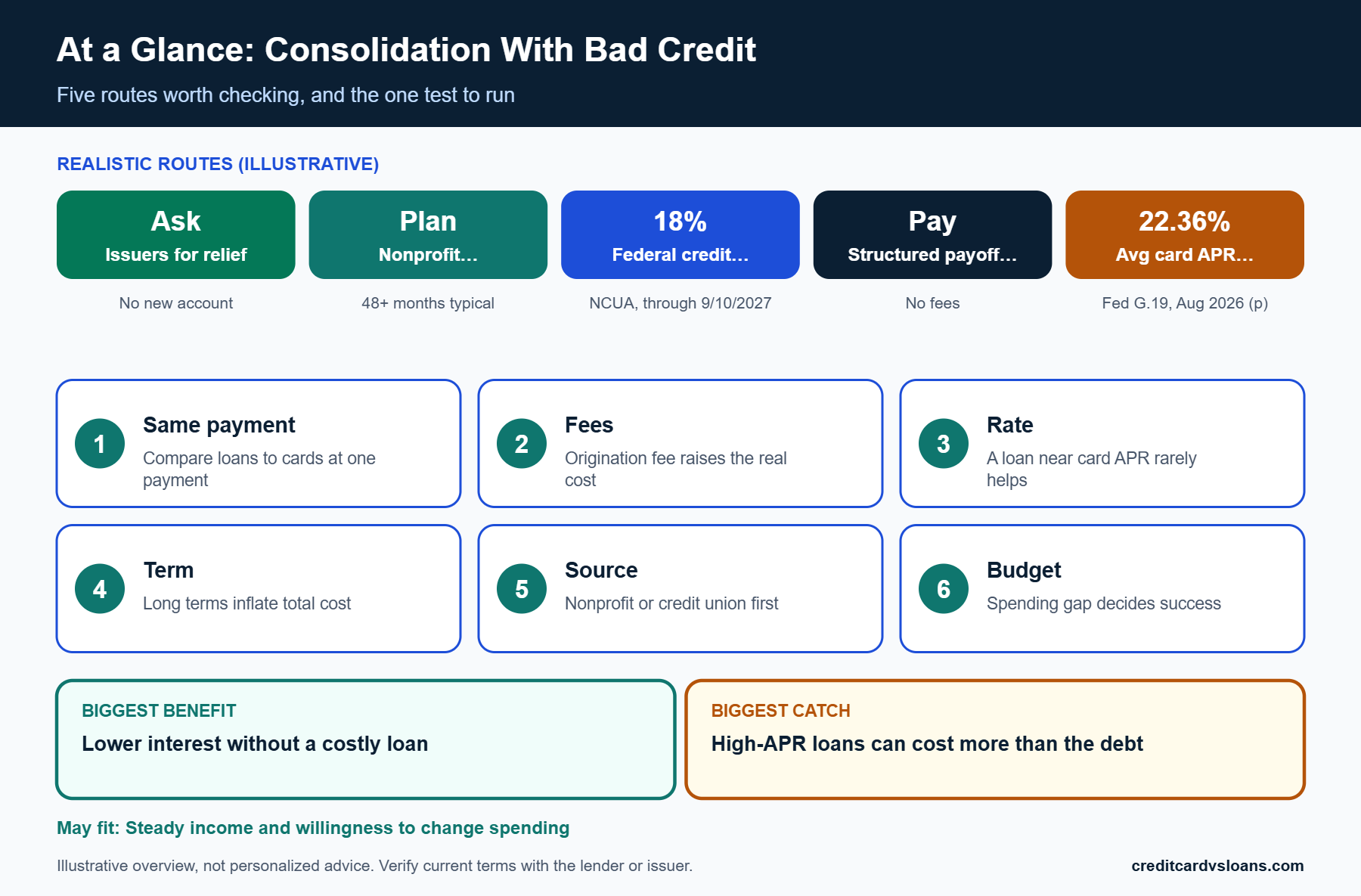
When your profile is weak, the 0% transfer offers you see advertised usually are not available, and personal loan offers tend to come with high rates and origination fees. Federal Reserve data gives context for the starting point: as of the G.19 release of October 7, 2026, the average rate on credit card accounts assessed interest was 22.36% in August 2026 (preliminary). A borrower with damaged credit may already be paying well above that average, and loan offers may be priced higher still.
That is why the first question is not “which lender will approve me?” but “would this loan actually cost less than what I am paying now?” Approval alone tells you nothing about savings.
The one test that sorts good offers from bad
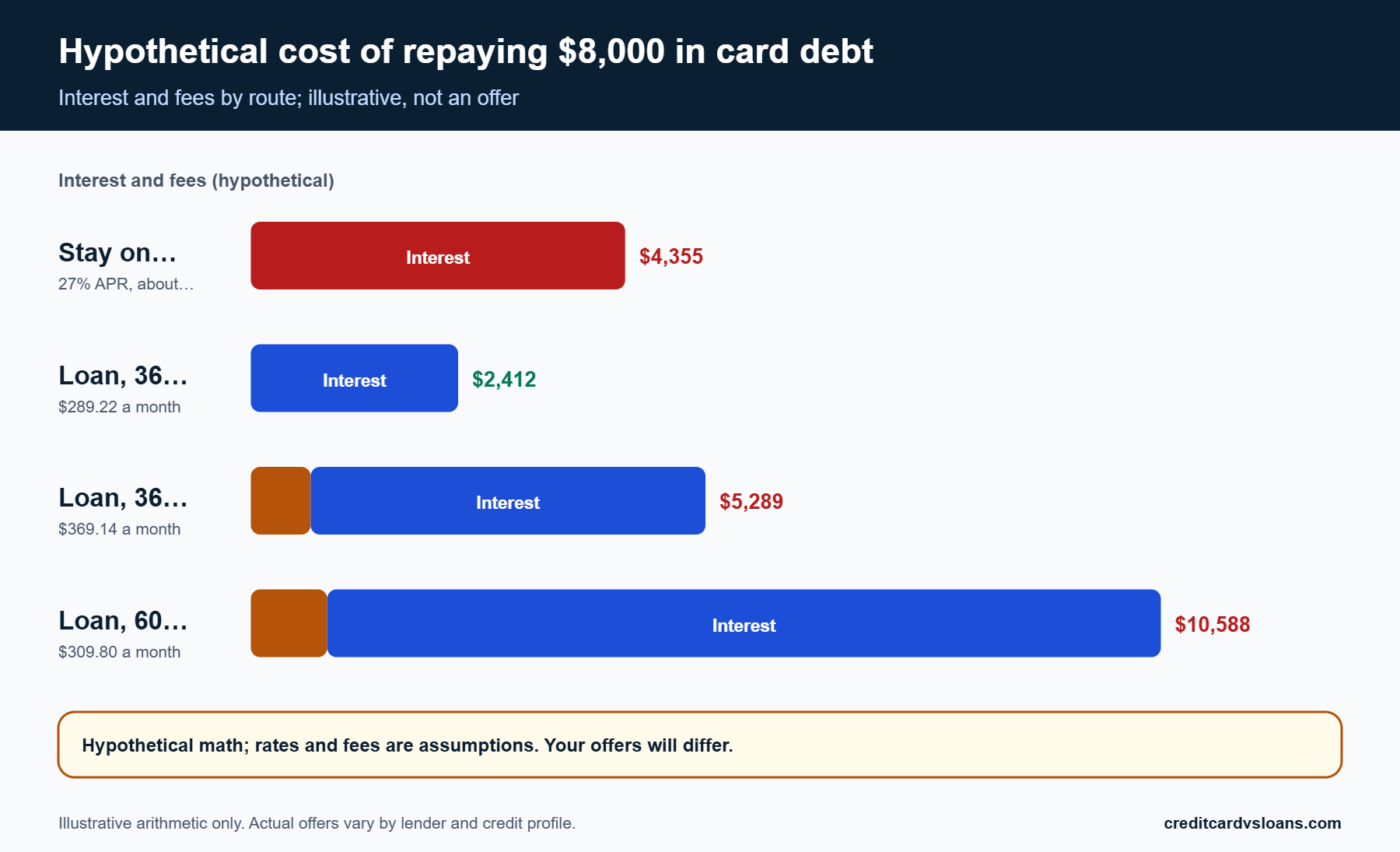
Take the monthly payment a loan would require and ask what your cards would cost if you paid that same amount. Imagine a hypothetical $8,000 across cards at 27%. At $300 a month the cards take about 42 months and cost roughly $4,355 in interest. A loan that costs more than that at a similar payment is a worse deal, however tidy it looks.
Keep this test in mind for every credit card debt consolidation bad credit offer you see. For a wider look at how strong, fair and limited profiles compare, see our guide to consolidation options by credit profile.
The payment has to be the same in both columns of the comparison because a larger monthly payment shortens any debt. If you compare a loan payment of $370 with a card payment of $300, the loan will look faster for reasons that have nothing to do with the loan. Matching the payment isolates the thing you actually want to know, which is whether the new rate, fee and term cost less than the old ones.
Your realistic routes at a glance
The routes worth investigating
Five routes tend to be realistic for damaged credit: asking your card issuers for relief, a nonprofit debt management plan, a loan from a credit union, a structured payoff of the cards you already hold and, for some people, a loan with a co-borrower. Which fits depends on your income stability, your balances and how much room your budget has.
| Route | What it is | Main advantage | Main drawback | Cost driver |
|---|---|---|---|---|
| Ask issuers for relief | Request lower payments, waived fees, a lower rate or a new due date | No new account or hard pull | Issuers may say no | Whatever terms you agree to |
| Nonprofit debt management plan | One payment to an agency that pays your creditors | May lower interest across cards | Often 48 months or more; cards may be restricted | Agency setup or monthly fees |
| Credit union loan | Fixed-rate installment loan, if you qualify for membership | Federal credit unions have an 18% ceiling for now | Approval still depends on your profile | Rate, fee and term |
| Structured payoff of current cards | Extra payments on the highest-rate card first, or the smallest balance first | No fees | Rates stay high | Card APR and monthly amount |
| Loan with a co-borrower | A second person shares responsibility | May improve pricing | The co-borrower is on the hook | Rate, fee and relationship risk |
Routes to be careful with
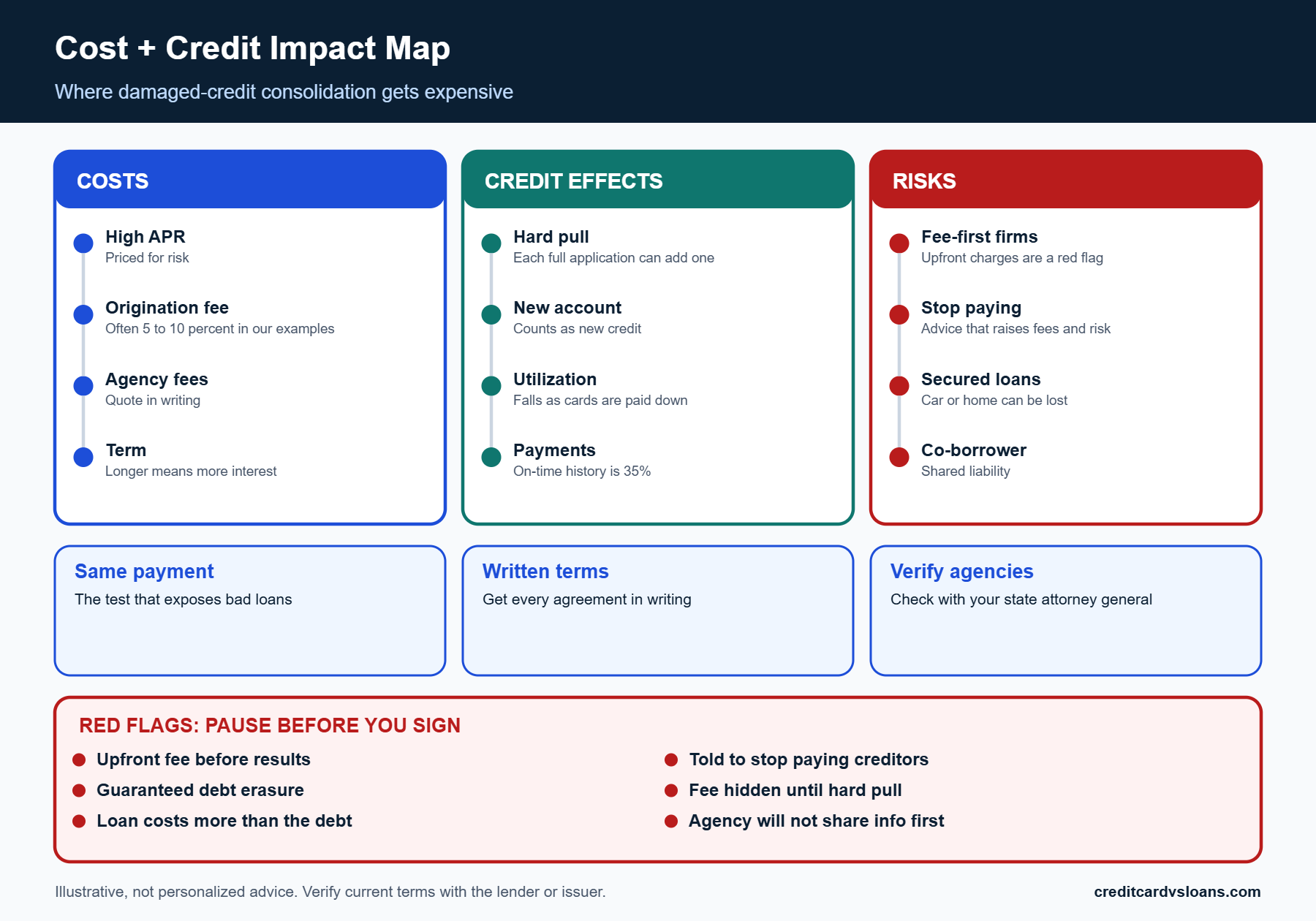
High-APR installment loans, loans secured by a car or home, and any company that charges before it delivers results all deserve a hard look. The FTC and the CFPB both warn about upfront fees and about firms that tell you to stop paying your creditors. Later sections explain how to spot them.
If your balances are already past due or in collections, the picture changes again, and our guide to legitimate relief options and red flags is the better starting point.
What Bad Credit Does to Your Consolidation Offers
Pricing and fees
Why a higher rate and a fee can wipe out the savings
Lenders usually price in two ways: the interest rate and an origination fee, which is commonly deducted from the loan proceeds. To net $8,000 with an 8% fee you have to borrow about $8,696, and interest runs on that larger number. In our hypothetical, a 36-month loan at 30% with an 8% fee has a payment of $369.14 and costs about $5,289 in interest and fees.
Paying that same $370 a month on the 27% cards would take about 30 months and cost roughly $3,083 in interest. The loan costs about $2,200 more, in this example, to get a single payment. Rates and fees here are assumptions for illustration only.
The lower-payment illusion
If your budget is tight, stretching the term is tempting. A 60-month loan at 34% with a 10% fee has a payment of $309.80 and a total cost near $10,588 in interest and fees on an $8,000 need. The payment looks manageable; the price is a bill that exceeds the debt you started with.
A lower payment helps only if it solves a real cash crunch and the total cost is tolerable. Otherwise you are paying a premium for breathing room that a different route could provide for less.
Approval factors beyond the score
Income, debt load and recent activity
Lenders typically weigh your income and employment, your existing monthly obligations and the recency of any late payments or collections. Two borrowers with the same score can get different offers if one has stable income and a lower debt load. Recent problems usually weigh more than older ones.
FICO’s published weights show why: payment history is 35% of a score and amounts owed is 30%, so recent lates and high card utilization both pull in the same direction. Improving either one before applying can change the offers you see.
When a thin file is the problem
If your credit is limited because you have few accounts rather than because of missed payments, the issue is different. You may qualify for fewer products, but your path to better terms is building history, not paying down distress. Make sure you know which problem you have before choosing a route.
A free look at your credit reports from each bureau will show payment history, balances, collections and any errors. Correcting errors is something you can do yourself at no cost, as the CFPB notes.
Route One: Work With Your Issuers and a Nonprofit Counselor
Start with the companies you already owe
What to ask for on the phone
The CFPB suggests asking your creditors whether they will lower payments, waive fees, reduce your interest rate or move your due date. None of this is certain, and an issuer’s willingness depends on its policies and your account history. But the call is free, it does not create a new account and it does not trigger a hard pull.
Be specific. Say what you can afford each month, say how long you have had the account and ask what hardship or payment programs exist. Specific requests get specific answers more often than a general plea for help.
Get every agreement in writing
The FTC advises keeping records and getting any agreement in writing. A verbal promise about a lowered rate or a waived fee is easy to misremember and hard to prove. Ask the representative to confirm the new terms in writing or in your online account before you change your payment.
Keep paying at least the required amount until the written terms arrive. A missed payment while you wait on a promise can cost you more than the call saved.
Debt management plans through nonprofit agencies
How these plans work
Credit counseling agencies are usually nonprofits. They review your budget and, if a plan fits, they set up a debt management plan: you make one monthly payment to the agency, and it pays your creditors, often at reduced interest. The CFPB notes the goal is usually a lower payment through longer terms or lower rates, not smaller balances. The FTC adds that plans often take 48 months or more and may require you to stop using credit.
Fees can apply. The CFPB advises getting a specific quote in writing, confirming with your creditors that they have accepted the plan before you pay the agency, and being cautious of any agency that refuses to send information unless you first share personal details.
What the numbers could look like
Suppose the same hypothetical $8,000 is enrolled in a plan at an assumed 8% rate over 48 months. The monthly payment would be $195.30 and total interest about $1,375, excluding any agency fees. Compare that with the cards at 27% and a payment of $300, which cost about $4,355 in interest over 42 months.
The plan’s lower payment only works because of the lower rate. If your cards stayed at 27%, a $195.30 payment would take roughly 115 months and cost about $14,354 in interest. The rate is doing the work, which is why you confirm in writing what the creditors actually agreed to. The rate in this example is an assumption; your actual rate and fees will be set case by case.
Before enrolling, ask what happens if you miss a plan payment, whether any creditor may change its terms and whether you can leave the plan without a penalty. Understand which accounts are included, since a plan covers only the unsecured debts you list. A plan is a commitment of several years, so the terms deserve the same reading time you would give a loan agreement.
Route Two: Loans When Your Credit Is Damaged
Credit unions and the 18% ceiling
What the ceiling does and does not mean
On February 6, 2026, the NCUA announced that it extended the temporary 18% interest rate ceiling on loans made by federal credit unions through September 10, 2027. That ceiling limits what a federal credit union can charge, which gives it more room to lend to members with weaker profiles than a lender pricing at 30% or more. It does not mean you will be approved, and it does not apply to banks or online lenders.
State-chartered credit unions follow their own rules, which vary by state. If a credit union is on your list, ask directly about its rate range, fees, membership requirements and how it treats applicants with past late payments.
Practical steps for approaching a credit union
Check whether you qualify for membership, which may depend on where you live, work or worship, or on an association. Ask whether the credit union offers prequalification or a soft-pull estimate, and ask for the fee schedule in writing. Credit unions are member-owned, but they are still lenders, and the loan still has to pass your same-payment test.
A smaller loan amount, a shorter term and a co-borrower, where the lender allows one, can each improve the chance of approval. Treat these as options to ask about, not as promises.
Ask whether the credit union reports your loan payments to the credit bureaus, because on-time payments only help your profile if they are reported. Ask also whether it offers any free budgeting or counseling help for members who are struggling, since many credit unions do, and whether a loan can be paid off early without a penalty so that you can send extra when your budget allows.
Running the numbers on higher-APR loans
Hypothetical offers against the baseline
Table 2 compares the hypothetical $8,000 across several paths. The 18% row is an example of what a loan under the federal credit union ceiling could look like; the higher-rate rows show what the market for weaker profiles can look like. All fees and rates are assumptions chosen for illustration.
| Route (illustrative) | Rate and fee | Monthly payment | Months | Interest plus fees | Flag |
|---|---|---|---|---|---|
| Stay on cards at $300 | 27% variable | $300.00 | 42 | $4,355 | Baseline |
| Loan, 36 months | 18%, no fee | $289.22 | 36 | $2,412 | Cards at the same payment: about 44 months, $4,659 |
| Loan, 36 months | 30%, 8% fee | $369.14 | 36 | $5,289 | Cards at $370: about 30 months, $3,083 |
| Loan, 48 months | 30%, 8% fee | $313.10 | 48 | $7,029 | Longer term raises the cost |
| Loan, 60 months | 34%, 10% fee | $309.80 | 60 | $10,588 | Costs more than the debt itself |
| Debt management plan | 8% assumed, 48 months | $195.30 | 48 | $1,375 plus agency fees | Depends on creditor acceptance |
What the table says in plain terms
For credit card debt consolidation bad credit borrowers, the table shows the gap clearly. The 18% loan beats the cards because its rate is well below 27% and it has no fee. The 30% loan with an 8% fee does not, because the fee and the rate together exceed what the cards charge. The 34% loan is worse still. The pattern is simple: once a loan’s all-in rate is near or above your card rate, the single payment buys convenience at a high price.
If every loan offer you receive looks like the bottom rows of the table, the answer is not a better-looking loan; it is a different route. Comparing a transfer card with a personal loan and the consolidation loan versus balance transfer guide explain when those two products help, and both generally assume a stronger profile than the one in this article.
Route Three: Pay Down the Cards You Already Have
Highest rate first or smallest balance first
A hypothetical three-card comparison
Consider three hypothetical cards: $2,500 at 29.99%, $3,500 at 24.99% and $2,000 at 19.99%, for $8,000 in total. Assume a total monthly budget of $300, with each card’s minimum set at the greater of $25 or 2% of its balance, and the remainder aimed at one target card at a time. Paying the highest-rate card first clears everything in about 39 months with roughly $3,542 in interest. Paying the smallest balance first takes about 41 months and roughly $4,083.
| Method | Target order | Months to payoff | Total interest | Trade-off |
|---|---|---|---|---|
| Highest rate first | 29.99%, then 24.99%, then 19.99% | 39 | $3,542 | Lowest interest; first win may take longer |
| Smallest balance first | $2,000, then $2,500, then $3,500 | 41 | $4,083 | Faster early wins; about $541 more interest |
Which method fits which person
The highest-rate method saves more interest in this example, which is the usual pattern when the rates differ widely. The smallest-balance method can feel better because accounts close sooner, and some people stick with a plan longer when they see progress. If you are likely to quit a plan that has no quick wins, the slightly costlier method that you finish beats the cheaper one you abandon.
Either way, pay at least the required minimum on every card, because a late payment can bring fees and a higher penalty rate. The CFPB notes that a payment more than 60 days late on a card can trigger a higher rate on all balances.
A hybrid approach works for some people: put the full extra amount on the highest-rate card, but clear one very small balance first if it removes a payment and its due date from your month. Fewer accounts to track means fewer chances for a missed payment. Set every card to autopay at least the minimum so that the extra payment is the only thing you manage by hand.
Making room in the budget
Find the cause before you pick a route
The CFPB tells people to figure out why they are in debt, because if you spend more than you earn, consolidation alone will not fix it. Write down a month of spending and compare it with take-home pay. The gap, or the lack of a gap, tells you whether you need more income, less spending or a structured plan.
Small, repeatable changes tend to hold up better than dramatic cuts. A fixed weekly spending limit, for instance, is easier to keep than a vague promise to spend less.
Stop adding to the balances
No route works if new charges outpace payments. Many people with damaged credit find it helps to pay for everyday spending with a debit card or cash for a period, while keeping one card in reserve for true emergencies. Whatever you do, measure it monthly: the sum of the balances should be falling, not holding steady.
If your income is short even after trimming, that is a conversation to have with a nonprofit counselor, who can look at the whole picture and suggest options beyond cards.
Credit Score Effects and Rebuilding While You Pay Down
What each route can do to a damaged profile
New accounts and inquiries
A new loan or card application can create a hard inquiry, and a new account counts as new credit, which is 10% of a FICO Score. FICO counts inquiries from the past 12 months, and they stay on the report for two years. If your score is already fragile, a series of applications in a short window can make it worse.
Calling your issuers, using a nonprofit counselor or paying down cards you already hold does not require a new loan application, which is one reason those routes are worth considering first. Your own situation will vary, and a plan can still affect accounts and credit reports in other ways, so ask any agency how it works.
Utilization and age of accounts
Amounts owed is 30% of a FICO Score, and heavy use of your credit limits can signal strain. If your cards sit at 80% of their limits, say $8,000 on $10,000, paying them down is likely to help over time. Keeping paid-off cards open, where the issuer allows it and you can resist using them, preserves account age and available credit.
Debt management plans may involve closing cards or limiting new credit as a condition. Ask how that would work for each of your accounts before you enroll.
Rebuilding as you go
On-time payments come first
Payment history is the largest single factor at 35%. Autopay at the required amount, plus a calendar reminder for the date, is the simplest defense against a late payment. Over months and years, a run of on-time payments is the core of recovery.
Nobody can promise how fast a score will move or by how much, so measure progress by behavior you control: payments made, balances reduced, no new late fees.
Check your reports and avoid shortcuts
You can get your credit reports and dispute errors for free. The CFPB explains that accurate negative information generally stays on a report for about seven years, that no shortcuts exist for building strong credit, and that credit repair companies often do things you can do yourself. A company that offers to remove accurate items is making a promise it cannot keep.
Review each report for accounts you do not recognize, balances that look wrong and payments marked late that were on time. Fixing a real error helps; chasing a fake fix costs money.
If you do find an error, dispute it with the credit bureau and the company that reported it, in writing, and keep copies of everything you send. Attach evidence such as a statement showing an on-time payment. Follow up if you do not hear back within the time the bureau states, and check the report again after the dispute closes to be sure the correction took hold.
Red Flags, Scams and Last-Resort Options
How to spot trouble early
Upfront fees and instructions to stop paying
The CFPB explains that debt settlement companies negotiate lump-sum payoffs for less than you owe, often asking you to save money in an account first, and that many tell customers to stop paying creditors. That can increase fees, interest and credit damage, and can expose you to lawsuits. The agency adds that upfront fees are a red flag; they are permitted only after a successful result, a signed agreement and at least one payment made.
The FTC lists similar warning signs: upfront fees, claims that you can erase all your debt, and pressure to stop talking to creditors. If any of these appear, pause and check the company with your state attorney general or consumer protection agency.
Secured loans put an asset at stake
Some lenders offer loans secured by a car title or by your home to borrowers with damaged credit. The FTC notes that missed payments on a secured loan can lead to losing the collateral, including your home, and that lenders can repossess a car without notice after a default. Turning unsecured card debt into secured debt shifts the risk from your credit report to your property.
If you consider this, get an independent view from a nonprofit or HUD-approved housing counselor first, especially if the collateral is your home.
When the debt is unmanageable
Settlement and its costs
Settlement is a real, if risky, option for some people. The FTC lists the risks: growing late fees, collection lawsuits, credit damage, possible wage garnishment or liens, debts that stay unsettled and taxes on forgiven amounts. Fees should not be charged before a debt is settled.
If you go this way, understand every term in writing, and keep in mind that creditors are not required to accept settlement offers. Our guide to debt relief options and red flags goes through how to tell legitimate help from a scheme.
Bankruptcy as a last resort
According to the FTC, bankruptcy is usually a last resort because it stays on your credit report for 10 years. Chapter 7 may involve selling non-exempt assets, while Chapter 13 sets up a three- to five-year repayment plan, and credit counseling is required before filing. Most student loans, most taxes and child support are generally not erased.
The rules are technical and depend on your state and your situation. If you are seriously considering it, speak with a bankruptcy attorney or a legal aid organization before deciding.
Choosing Your Path With Bad Credit: A Decision Matrix
Matching situations to routes
The decision matrix
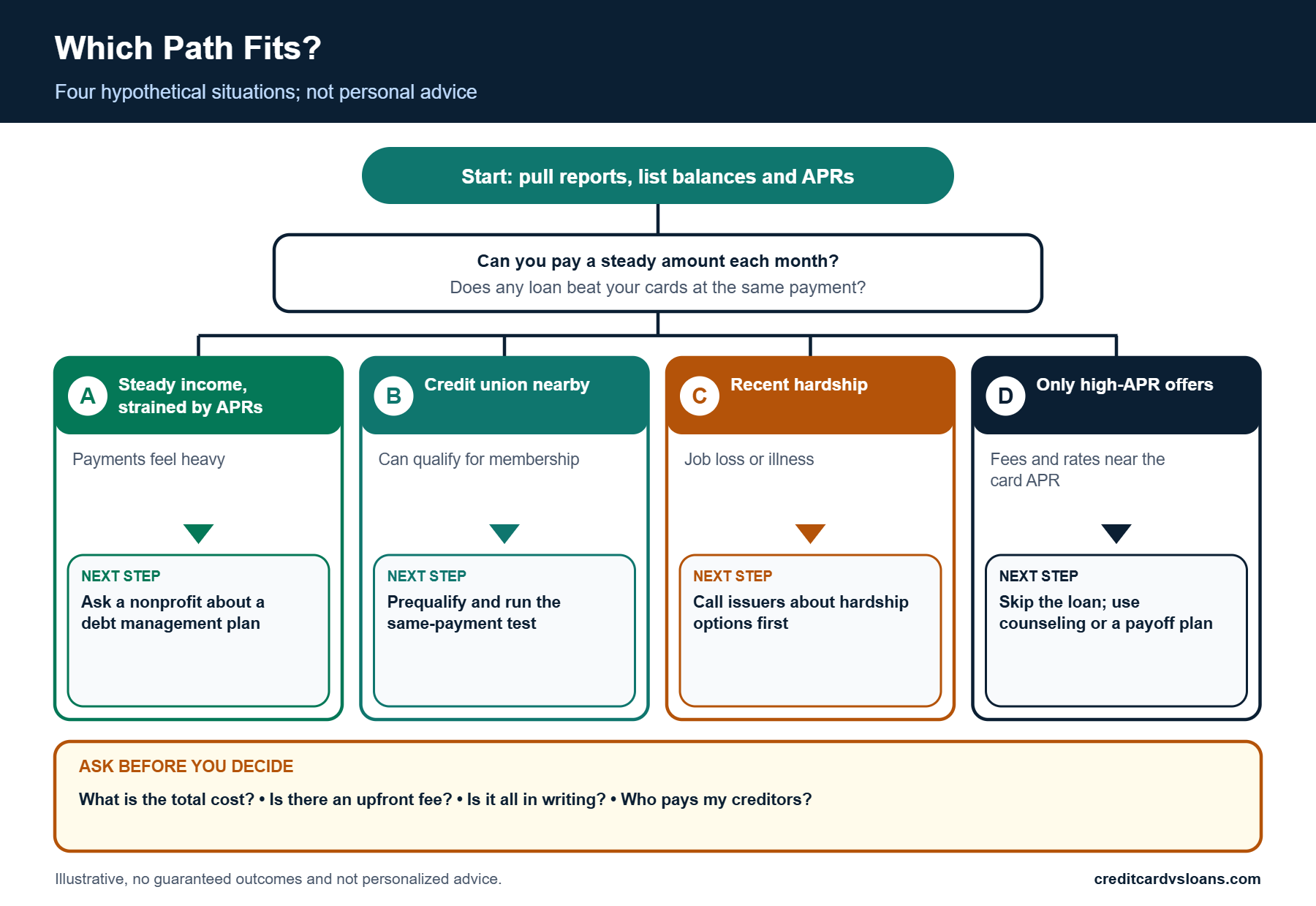
Table 4 pairs common situations with the route to investigate first. It is a starting point for your own research, not advice for your finances.
| Situation | Route to investigate | Why | What to verify | When to avoid it |
|---|---|---|---|---|
| Steady income, payments strained by high APRs | Nonprofit counseling and a debt management plan | May lower interest without a new loan | Fees in writing; creditor acceptance | If the agency demands payment before explaining services |
| Manageable balances, some budget room | Structured payoff on current cards | No fee or new account | That the monthly amount is sustainable | If a clearly cheaper option is on the table |
| Credit union membership available | Loan under the federal credit union ceiling | Rate cap can leave room versus card APRs | Rate, fee, term and approval criteria | If the all-in cost does not beat the cards at the same payment |
| Recent hardship (job loss, illness) | Call issuers about hardship options | Possible lower payments or fee waivers | Written terms; effect on rate and reporting | If you are told to stop paying and wait |
| Offers only at very high APR with big fees | Pay down plan or counseling instead | The loan may cost more than the debt | Same-payment test | Almost always |
| Overwhelming debt, falling behind | Counselor, then legal advice if needed | Broader options, including legal ones | Credentials, fees, licensing | If a firm promises specific outcomes |
Using the matrix honestly
You may land in more than one row. A person with steady income and a credit union nearby can price both a plan and a loan, then compare the real numbers. If you want more options by score range, our guide to payoff options by credit score places these routes alongside the ones available to stronger profiles.
Whichever row fits your credit card debt consolidation bad credit search, avoid deciding on the first offer. A week of comparing is cheap next to several years of payments.
Questions to ask before you sign or enroll
For a lender
Ask for the APR, the origination fee and whether it is taken from the proceeds, the term, the payment, whether there is a prepayment penalty and who receives the money. Ask whether the lender can pay your cards directly. Then run the same-payment test on the numbers you are given.
If the answers are vague or the lender pushes you to commit before you have seen the terms in writing, walk away.
For a counseling agency
Use the CFPB’s list of questions: what services are offered, what the fees are in writing, whether you will sign a contract, what the counselors’ credentials are and how employees are paid. Ask whether the agency will discuss options other than a debt management plan. A good agency will not insist on a single answer.
Confirm that your creditors have accepted the plan before you send the agency any money, and check the agency with your state attorney general.
Your Next Steps When Consolidating Card Debt With Damaged Credit
A sequence that protects you from expensive mistakes
Get the facts on your own accounts
Pull your credit reports and list each card with its balance, APR, limit, minimum payment and status. Mark anything past due or in collections. Then write down what you can pay each month without borrowing again, using actual spending rather than an ideal budget.
This baseline is the number every offer has to beat. Knowing it also makes you harder to rush, because you can see in seconds whether a proposal helps.
Contact your issuers and one nonprofit agency
Before any application, call your issuers about hardship options and speak with a reputable nonprofit credit counselor. Both are free or low cost to start, and neither adds a hard pull. A counselor can also tell you whether a debt management plan fits your numbers or whether another route makes more sense.
Keep notes on who you spoke to, what they offered and the date. If a counselor or company asks for money before explaining anything, move on.
If you decide to apply for a loan
Rate shop narrowly and carefully
Use prequalification tools that rely on soft pulls where they are offered, and limit full applications to one or two lenders you have already compared. Record the rate, fee, term and payment, then run the same-payment test. If you are also weighing a card route, this comparison of a transfer card and a personal loan shows how the pieces fit together.
A credit union under the federal ceiling is a reasonable place to ask. Remember that the ceiling is a cap, not a quote.
Put a stop on new balances
If a loan pays off your cards, decide immediately how you will use them. A common approach is to keep cards open for the account age but remove them from daily use. The point is to ensure the new loan replaces your old debt rather than adding to it.
Check in with yourself after 90 days. If balances are creeping up, change the plan then, not after the second year.
Know what progress looks like. In the first few months, the signs that a plan is working are modest: payments posting on time, balances edging down, no new late fees and no new card charges. Larger changes, such as a lower utilization ratio or a visible shift in your reports, take longer. Judge the plan by the behaviors you control and give the numbers time to follow.
Questions people ask next
Can I consolidate if some accounts are already in collections?
Possibly, but the options narrow. Lenders see the collection as recent evidence of risk, and many loans will not pay accounts that are already with a collector. A nonprofit counselor can explain what is realistic, and the CFPB and FTC both describe your rights when dealing with collectors, including the right to verify that a debt is yours.
Do not make a payment on an old debt or sign anything until you know how that debt is being handled, because in some states a payment can restart the clock on a lawsuit.
Is it better to wait and improve my credit first?
It depends on how much the debt is costing you. If your cards are charging 27% or more, waiting can be expensive too, and an interim step such as a hardship call or a structured payoff can cut the interest while you rebuild. If you are close to qualifying for much better terms, a short wait may pay off.
Use your own numbers: compare the monthly cost of waiting with the savings you expect from better terms, and be realistic about how long improvement takes.
In credit card debt consolidation bad credit cases, the strongest move is often not a loan: ask your issuers for relief, talk to a nonprofit counselor and test every loan against your cards at the same payment. If a loan passes that test after fees, it can help; if it does not, you are better off with a plan that lowers the rate or a payoff you can keep up.
- Pull your reports and list balances, APRs, limits and status.
- Call your issuers about hardship options and write down what they offer.
- Speak with a nonprofit credit counselor and get fees in writing.
- Prequalify at a credit union or other lenders and run the same-payment test.
- Avoid any firm that charges upfront or tells you to stop paying creditors.
- Set autopay, stop new card use and review your plan after 90 days.
- Credit Card Debt Consolidation: Best Options by Credit Profile
- Credit Card Debt Relief: Legitimate Options and Red Flags
- Debt Consolidation Loan vs. Balance Transfer Card: Which Saves More?
- Best Debt Payoff Options by Credit Score: From Bad Credit to Excellent
- Balance Transfer Card vs. Personal Loan: Best Way to Pay Off Debt?
- CFPB: What do I need to know about consolidating my credit card debt?
- CFPB: What is the difference between credit counseling and debt settlement, debt consolidation, or credit repair?
- CFPB: What is credit counseling?
- FTC: How To Get Out of Debt
- NCUA: NCUA Board Extends Loan Interest Rate Ceiling (February 6, 2026)
- Federal Reserve: Consumer Credit – G.19 (release of October 7, 2026)
- myFICO: What’s in your credit score?
Last updated: October 22, 2026. Rates, fees and lender rules change; verify current terms before acting.
The information on creditcardvsloans.com is provided for general educational and informational purposes only. It is not financial, legal, tax, credit, accounting or investment advice, and reading it does not create an advisor-client, fiduciary or any other professional relationship. Nothing here is an offer, solicitation or recommendation to borrow, lend or apply for any product.
Credit scores, interest rates, fees, eligibility rules, lender policies and laws change frequently and vary by lender, location and individual circumstances. Examples, figures and scenarios are illustrative only, do not predict your results and do not guarantee approval, savings, a particular rate or a credit-score outcome. Always confirm current terms directly with the lender or issuer and read the full agreement before you apply or sign.
Although we aim for accuracy and use reputable sources, we make no representations or warranties, express or implied, about the completeness, accuracy, reliability or timeliness of the content. Content may be drafted with the assistance of automated tools, so errors or omissions may still occur. Links to third-party sites are provided for convenience; we don’t control and aren’t responsible for their content.
To the fullest extent permitted by law, creditcardvsloans.com and its owners, editors, authors, contributors and affiliates disclaim all liability for any loss, damage or expense arising directly or indirectly from your use of, or reliance on, this content. Before making financial decisions, consult a licensed professional, such as a qualified financial advisor, attorney, tax professional or nonprofit credit counselor, who can consider your complete situation.