Balance transfer vs personal loan is mostly a payoff-speed question: how fast can you realistically clear the balance, and what does each month of delay cost? A balance transfer card can charge 0% interest for a limited promotional period, but you pay a transfer fee and face a higher regular APR if any balance remains when the promotion ends. A personal loan charges interest from day one, but it gives you a fixed payment and a fixed payoff date.
The short version of the trade-off is this: when your monthly payment is high enough to finish inside the promotional window, a transfer card is usually the cheaper route in hypothetical math. When it isn’t, the loan’s schedule can protect you from the slow, expensive tail. This balance transfer vs personal loan comparison builds a payoff race with computed numbers to show where that line sits, rather than arguing in general terms.
If your debt is spread across many accounts and the question is which product can absorb all of them, start with our companion guide on the debt consolidation loan vs. balance transfer card decision. Here we focus on one balance and one clock.
- The monthly payment you can sustain decides the winner more than the headline APR. A transfer needs a payment of about the balance (plus fee) divided by the promotional months.
- In the hypothetical $8,000 example, the 0% transfer cost far less than the 12% loan at any payment above roughly $250 a month, but it cost more at very low payments.
- Below a break-even payment of roughly $200 to $250 a month in this example, the loan finished sooner and cost less than the transfer would have.
- Both products charge upfront fees: the CFPB says a balance transfer fee can apply even on a zero percent offer, and a loan’s APR includes lender fees on top of the interest rate.
- If you are more than 60 days late on a card, the issuer can raise the rate on all balances, including a promotional one.
Market averages cited here come from the Federal Reserve’s G.19 Consumer Credit release of October 7, 2026 (preliminary August 2026 data). Every dollar example is hypothetical and calculated for illustration. Your offers will differ.
Balance Transfer vs. Personal Loan: The Short Answer on Payoff Speed
The one number that decides it: your monthly payment
Why payment size matters more than the headline rate
A 0% promotional APR means that during the promotion, every dollar you pay goes to principal (after the fee is added to the balance). A personal loan at 12% sends a share of each payment to interest, especially early on. That makes the transfer faster per dollar, but only while the 0% window is open.
Once the promotion ends, the remaining balance is charged the card’s regular APR. The CFPB notes that promotional rates usually expire and that the rate may then rise. So the same $8,000 can be a bargain at $460 a month and an expensive trap at $200 a month, even though the card’s terms are identical.
The payment needed to clear a transfer in time
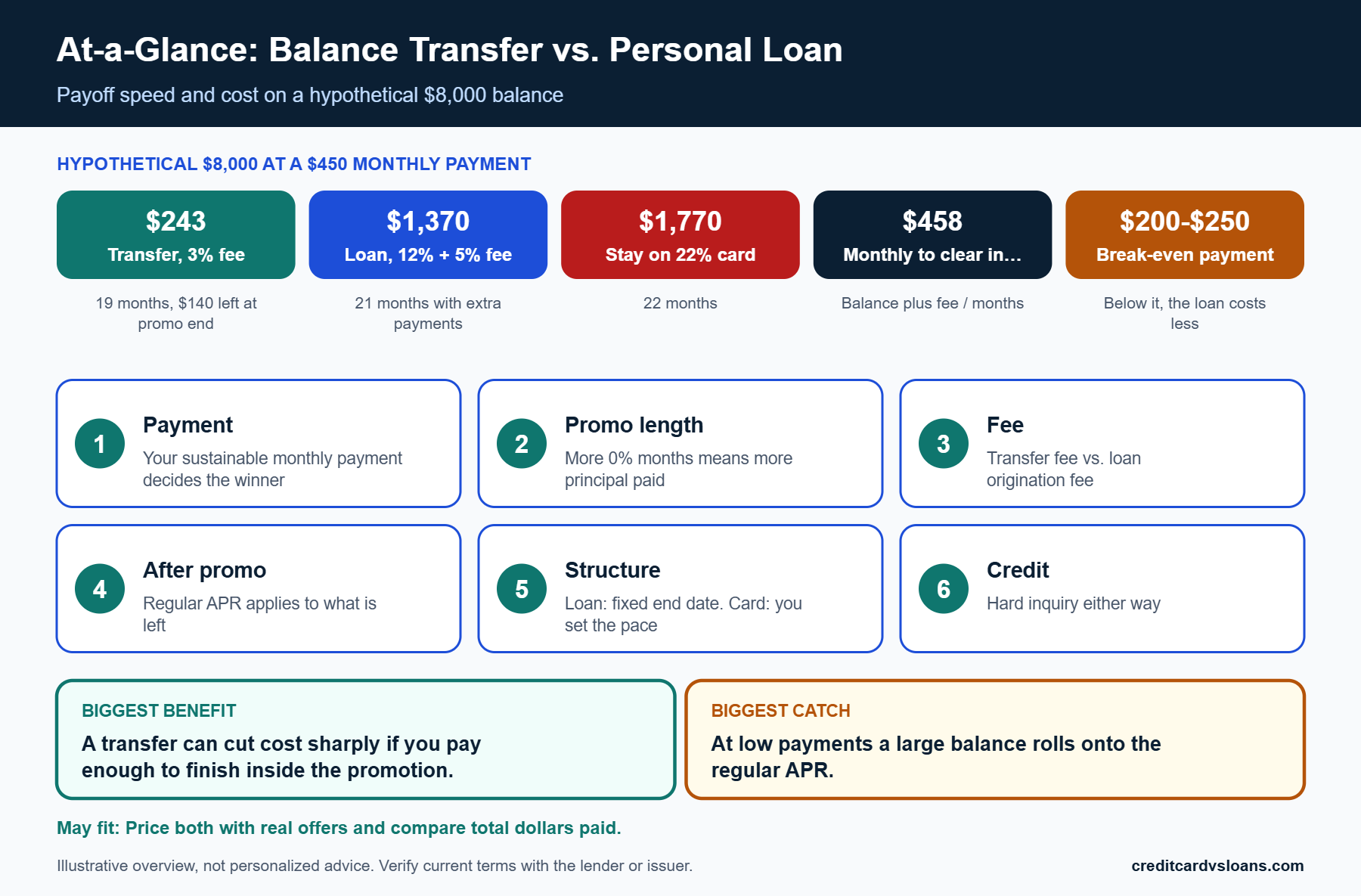
A simple rule of thumb: take the balance, add the transfer fee, and divide by the number of promotional months. In this example, a $8,000 transfer with a 3% fee starts at $8,240. Clearing it in 12 months takes about $687 a month; in 15 months, about $549; in 18 months, about $458; in 21 months, about $392.
If the figure for your promotional length is more than you can pay, the transfer isn’t automatically a bad idea, but part of the balance will roll onto the regular APR. The question then becomes how large that remainder is and how quickly you can finish it. The next sections put numbers on it.
Where each option usually wins
When the transfer tends to come out ahead
The transfer tends to win when you can pay enough to clear most or all of the balance in the promotion, when the fee is modest relative to the interest you would otherwise pay, and when you can avoid new charges on the card. It also tends to win for smaller balances, where a modest monthly payment can finish quickly.
It is also the more flexible tool: if a bonus or tax refund arrives, you can pay a lump sum without worrying about loan prepayment terms. Check your offer’s terms, because rules on fees and promotional periods vary by issuer.
When the loan tends to come out ahead
The loan tends to win when your realistic payment is below what the promotion requires, when you value a guaranteed finish line, or when you can’t be approved for a card limit that covers your balance. It also wins when you suspect you’d keep using the card, since the loan separates the debt from your day-to-day spending.
The loan’s cost is predictable. You know the payment, the number of payments and the total repayment amount before you sign. For a related angle on using a loan for card debt, see whether a personal loan makes sense for paying off credit cards.
| Feature | Balance transfer card | Personal loan |
|---|---|---|
| Interest on the balance | Often 0% or low for a limited promotional period | Charged from the first payment; fixed rate is common (confirm in your offer) |
| Upfront fee | Balance transfer fee, a percentage or flat amount, whichever is greater (CFPB) | Origination fee on some loans; included in APR |
| Payment pattern | Flexible minimum; you set the pace | Fixed installment with a set end date |
| Payoff deadline | Promotional period end (not a legal finish line) | Loan term |
| Risk if you fall behind | Regular APR on the remainder; rate can rise after 60 days late | Late fees and credit reporting; the term does not change on its own |
| Who it may fit | Borrowers who can pay enough to finish in the promotion | Borrowers who want a fixed schedule and a firm end date |
How Each Option Actually Pays Down a Balance
How a personal loan amortizes
Fixed payments and where the interest goes
The CFPB describes a personal installment loan as a closed-end loan in which you receive the money up front and repay in fixed installments over a set period. In the early months, a larger share of each payment is interest because the balance is high. Over time, the share shifts toward principal.
In the hypothetical, a 12% rate over 36 months with no fee would carry a payment of about $266 on $8,000 and total interest of about $1,566. Add a fee, and both the payment and total cost rise. Because the schedule is fixed, a loan is hard to underpay and easy to plan around.
How an origination fee changes the starting balance
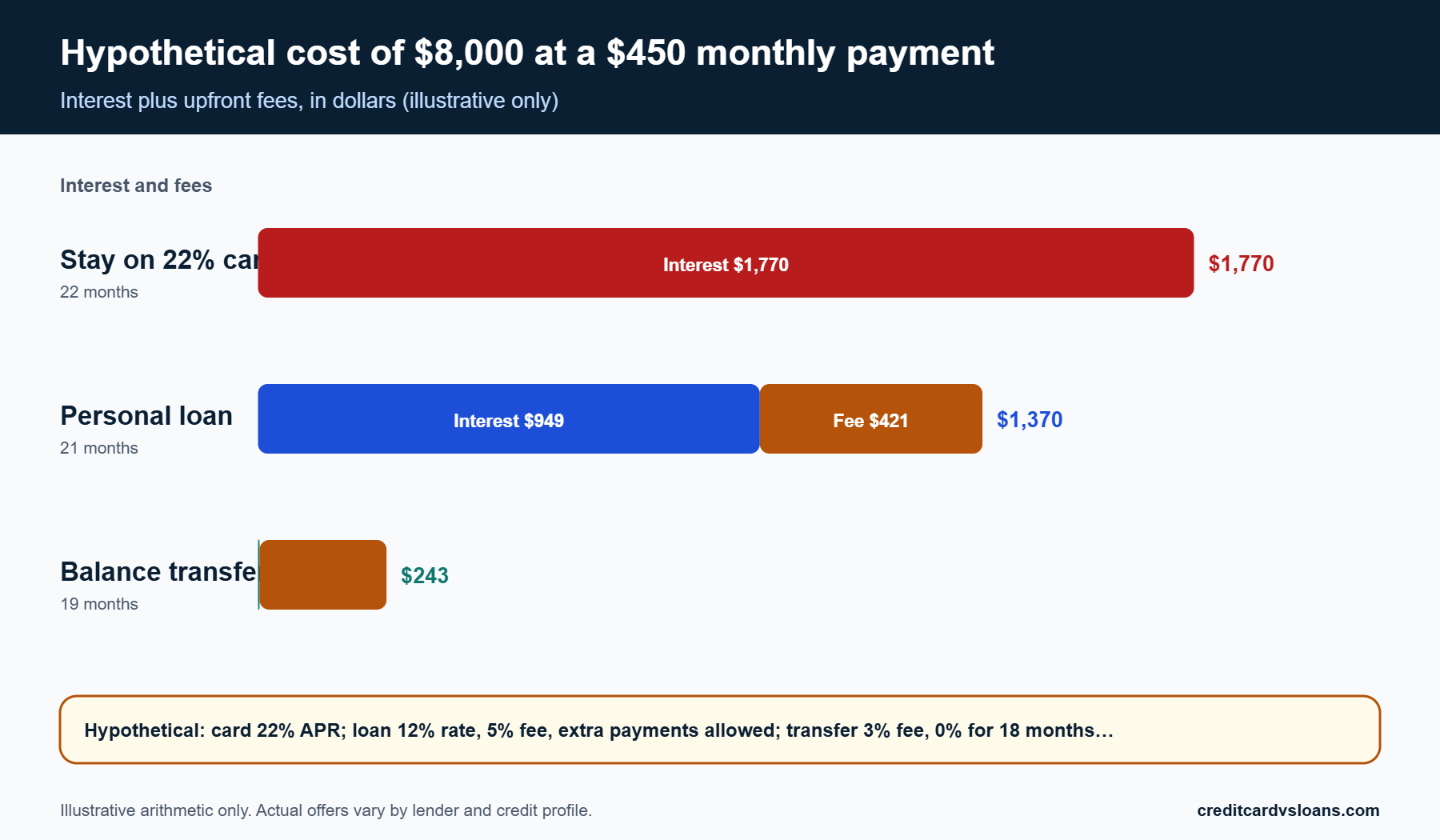
If a loan carries a 5% origination fee that is deducted from the proceeds, you have to borrow more than you need to net $8,000. At 5%, the loan principal is about $8,421, the fee is about $421, and the payment over 36 months is about $280. Total cost, interest plus fee, comes to roughly $2,069.
The CFPB says the APR is the interest rate plus additional fees charged by the lender, so a loan quoted at 12% with a 5% fee has an APR higher than 12%. Always compare APR to APR when shopping, and ask for the total repayment amount in dollars.
How a transfer card pays down a balance
Inside the promotional period
On a transfer card, the fee is typically added to the balance, so you begin with, say, $8,240. During a 0% period, interest doesn’t add to that figure, so each payment reduces principal dollar for dollar. The CFPB notes that a promotional rate must last at least six months under federal rules, and offers commonly run longer. Check the exact length in the issuer’s disclosures.
One practical detail is where your payments go if you also carry other balances on the same card. Under Regulation Z, amounts above the minimum payment generally go to the balance with the highest APR first, and the rest follows in descending order of rate.
What happens at month 13, 16 or 19
When the promotion ends, whatever remains starts accruing interest at the card’s regular APR. The CFPB warns that new purchases on the same card may not receive a grace period while a promotional balance is open, so interest can accrue on those purchases from the day you make them.
In the hypothetical, a regular APR of 24.99% on $3,740 left after 18 months adds roughly $78 in interest the very first month. That is why the balance remaining at the end of the promotion is the figure to watch, not the monthly payment alone.
A Hypothetical $8,000 Payoff Race
The setup and the assumptions
One balance, three ways to pay it
Picture a hypothetical borrower, not a real person, with $8,000 on credit cards at a 22% APR. That sits near the 22.36% the Federal Reserve’s G.19 release of October 7, 2026 reported as the preliminary August 2026 average for card accounts assessed interest. The borrower can keep paying the card, move the balance to a transfer card, or take a personal loan.
The transfer card in this example charges a 3% fee (about $240), offers 0% for 18 months, and then charges 24.99%. The loan carries a 12% interest rate, a 36-month term and a 5% origination fee, which raises the loan principal to about $8,421 so the borrower nets $8,000. These figures are illustrations, not market quotes, and were computed in Python with monthly compounding.
Why we test several monthly budgets
Because payoff speed depends on how much you pay, the example runs four monthly budgets: $250, $350, $450 and $600. The loan has a fixed required payment of about $280, so at the $250 budget it simply isn’t available. At higher budgets we assume the lender allows extra payments without a penalty, which is common but not universal, so confirm the terms in your offer.
In every row the borrower pays the same amount each month and puts every dollar toward the balance. That keeps the balance transfer vs personal loan comparison apples-to-apples on cash out of pocket, and shows how far each product’s cost moves with payment size.
What the race shows
Cost and speed at each budget
At $450 a month, the transfer path finishes in about 19 months at a total cost of roughly $243, with about $140 still owed when the promotion ends. The loan path, with extra payments, finishes in about 21 months for about $1,370, and staying on the card takes about 22 months and costs roughly $1,770. At $600, the transfer costs the fee alone, about $240, and the loan about $1,120.
At $350, the transfer is still cheaper (about $383) but leaves about $1,940 when the promotion ends. The loan, with extra payments, costs about $1,681 and takes 28 months. The loan’s cost gap is the price of paying interest from the first day.
| Monthly budget | Stay on card (22% APR) | Balance transfer | Balance left when promo ends | Personal loan (12% + 5% fee) |
|---|---|---|---|---|
| $250 | 49 months, $4,158 | 37 months, $1,028 | $3,740 | Not available; fixed payment is about $280 |
| $350 | 30 months, $2,463 | 24 months, $383 | $1,940 | 28 months, $1,681 (if extra payments are allowed) |
| $450 | 22 months, $1,770 | 19 months, $243 | $140 | 21 months, $1,370 |
| $600 | 16 months, $1,259 | 14 months, $240 | $0 | 16 months, $1,120 |
What happens at the loan’s own payment
Suppose the borrower pays exactly the loan’s required $279.70 on the transfer card instead. The transfer path takes about 32 months and costs about $735, compared with 36 months and about $2,069 for the loan. But about $3,205 is still owed when the 18-month promotion ends, and it accrues interest at 24.99% from that point.
That illustrates the central trade-off. The transfer wins on cost at the same payment, but the loan guarantees the finish line, and the transfer’s savings depend on a plan to attack the remaining balance quickly once the regular APR begins.
Break-Even: When the Loan Overtakes the Transfer
Finding the break-even payment
The loan’s cost is fixed; the transfer’s is not
The loan’s total cost in this example, about $2,069 in interest and fees over 36 months, doesn’t change if you pay on schedule. The transfer’s total cost depends on how much of the balance is still outstanding when 0% ends. That makes the break-even a payment amount, not a rate.
Searching payments from $100 up, a 3% fee with 12 promotional months only drops the transfer’s total cost below the loan’s at about $250 a month. With 15 months the break-even is about $220, and with 18 months about $200. Below those payments, the transfer’s total cost in this example is higher than the loan’s.
Why the break-even payment still isn’t a good plan
At a $200 payment with 18 promotional months, the transfer costs about $2,004 and takes about 51 months. At $175, it costs about $3,052 and takes 64 months; at $150, about $5,369 and 90 months. The loan, at $280 a month, finishes in 36. In other words, on the break-even payment the two options cost about the same but the transfer takes far longer.
The practical reading: if the monthly payment you can sustain is near or below the break-even, a transfer’s flexibility works against you, and the loan’s structure helps. If you can pay well above it, the transfer is difficult to beat on cost.
What moves the break-even
Promotion length and fee size
Longer promotions help because more months are interest-free. Higher fees hurt: with a 5% fee and a 12-month promotion, the transfer didn’t beat the loan at any payment we tested up to $250, and with 18 months the break-even moved to about $210. A 2-point difference in fee equals about $160 on this balance.
That’s why the fee matters most on shorter promotions and smaller payments. For options beyond these two products, see credit card debt consolidation options by credit profile.
The regular APR after the promotion
If the borrower pays $300 a month and the promotion lasts 12 months, about $4,640 remains at the end. Total cost over the full payoff, including the fee, comes to about $1,010 if the regular APR is 19.99%, about $1,259 at 24.99% and about $1,539 at 29.99%, versus about $3,083 for staying on the 22% card at the same payment.
So the regular APR matters, but it matters less than whether most of the balance was cleared during the 0% months. Check the regular APR in the card’s disclosures, since the CFPB notes the rate may rise when the promotion ends.
Fees, APR and what the Federal Reserve data adds
Reading APR across loans and cards
The CFPB explains that the interest rate is the lender’s charge for borrowing and the APR is the interest rate plus additional fees charged by the lender. It recommends comparing APR to APR. For a loan, that makes the origination fee visible in one number. For a card, the pricing table lists the promotional and regular APRs and the balance transfer fee separately, so you need to add them yourself.
A rough method is to estimate total dollars paid for each plan at the payment you can sustain, as we did above. That tends to be more informative than comparing rates alone.
Averages are context, not offers
The Federal Reserve’s G.19 release of October 7, 2026 reported preliminary August 2026 averages of 22.36% for card accounts assessed interest and 11.90% for 24-month personal loans at commercial banks. Averages blend all borrowers, so your offered rate could be higher or lower depending on your credit profile and the lender.
If you want to see how loans and cards compare more generally, our article on credit card vs. personal loan for a defined purchase works through the same ideas from a spending angle.
Credit Score Impact and Approval: What Each Option Asks of You
Approval and limits
What a personal loan lender looks at
The CFPB says most personal loan lenders consider your credit score and credit reports, income, debts, the loan amount and length, interest rates permitted by state law, and sometimes your bank account transactions. A strong profile may mean a lower rate and a bigger amount, while a thin credit file or high existing debt may lead to a higher rate or a smaller offer.
Prequalify with several lenders where possible, since a soft pull lets you see estimated terms without affecting your scores. Record the APR, fee, term and total repayment amount from each, then compare the totals.
Why a card’s limit can decide the question
A transfer can only move as much as the new card’s credit limit allows, and the fee usually counts against that limit. If the card you’re approved for has a limit below your balance plus fee, you’ll only be able to move part of the debt. That is the point at which a loan, a smaller transfer, or a combination becomes worth comparing.
Our guide to choosing between a debt consolidation loan and a balance transfer when you owe several accounts looks at the partial-transfer and hybrid options in more detail.
How each choice can show up on your credit reports
Inquiries and new accounts
The CFPB explains that a hard inquiry usually occurs when you apply for credit, that most scoring models consider how recently and how frequently you apply, and that soft inquiries such as prescreening or checking your own reports do not affect your scores. Both a loan application and a card application typically involve a hard inquiry.
The size and duration of any score change varies by person and scoring model, so treat any claim about an exact number of points skeptically. Spacing out applications and using prequalification tools can limit the number of hard inquiries.
Utilization, mix and payment history
Credit scoring models generally look at how much of your available revolving credit you are using. A transfer may move a balance from several cards to one new card with a higher utilization on that account, while a loan can move revolving debt into an installment account. Either could look different on a credit report than it does on your statement.
Payment history is typically the most consequential factor over time. A missed payment on either product can hurt more than any inquiry, so autopay for at least the minimum is a protective habit.
Risks That Change the Math
Risks specific to a balance transfer
When the promotion ends with a balance left
The core risk is simple and visible in Table 2: at a $250 monthly payment, about $3,740 of the $8,240 balance remains when the 18-month promotion ends. From that point, interest at 24.99% adds roughly $78 in the first month alone, and the balance can take many months to clear.
The CFPB warns that promotional rates usually expire and that the rate may then rise. Federal rules require the issuer to disclose the length of a promotional period and the rate that will apply afterward, so find those two items in your offer before you apply.
Late payments, penalty rates and new purchases
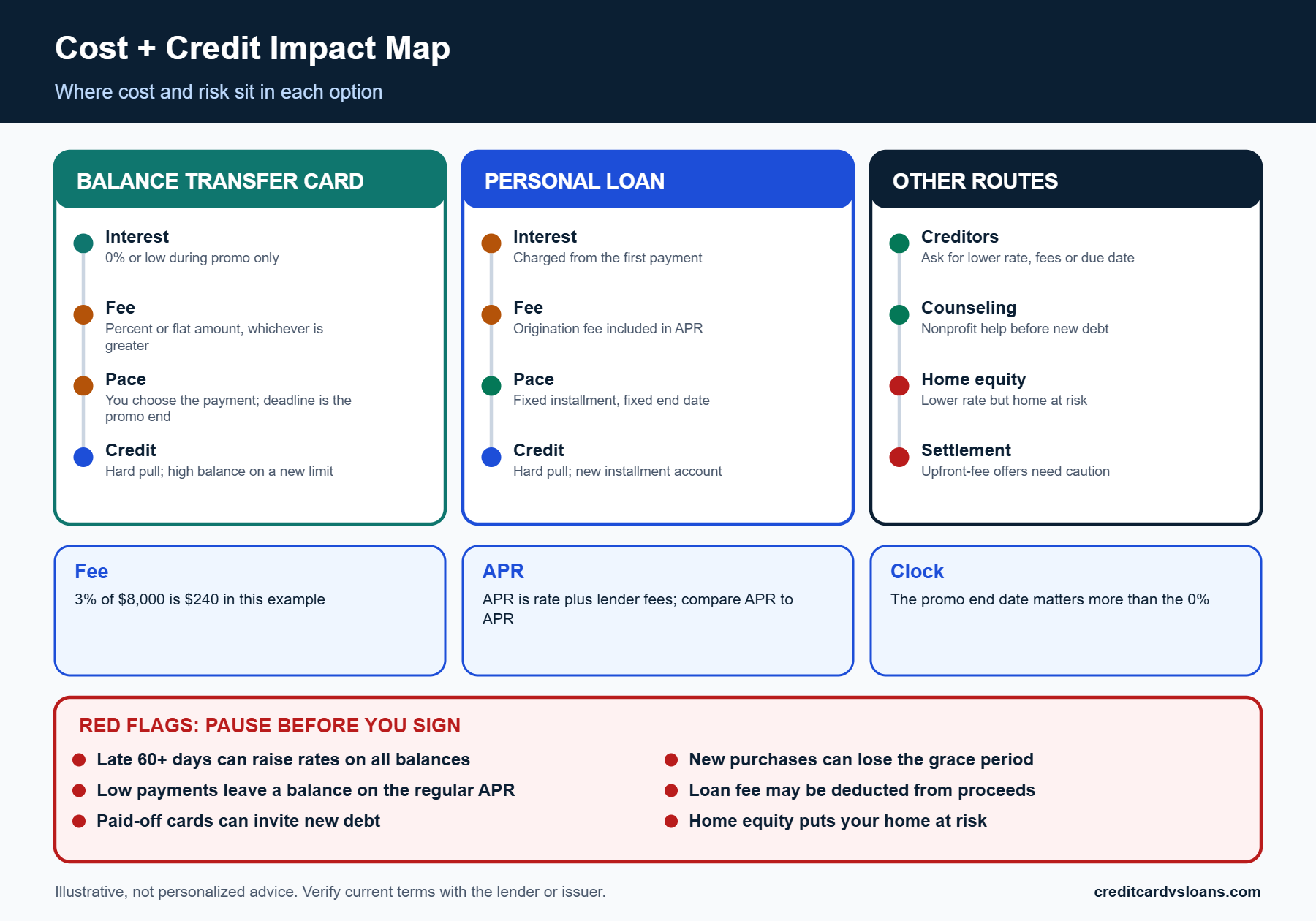
The CFPB says that if you are more than 60 days late, the issuer can raise the interest rate on all balances, including the transferred one. Under Regulation Z, the earlier rate must be restored only after six consecutive on-time payments following the increase. A higher rate applied to a large remaining balance can erase much of a promotion’s savings.
New purchases are another trap. The CFPB advises that carrying a promotional balance can cost you the grace period, so interest may accrue on new purchases from the day you make them. Use another payment method until the promotional balance is gone.
Risks specific to a personal loan
Interest starts on day one, and the fee is real
A loan has no interest-free window. In the example, the interest-plus-fee cost of about $2,069 is guaranteed if you pay on schedule, and it is higher than the transfer’s cost at nearly every payment above the break-even. If you can pay your debt off faster than 36 months, the loan’s cost drops, but a fee you’ve already paid doesn’t come back.
Check whether the lender allows extra payments without a penalty and whether the origination fee is deducted from the proceeds, which affects how much you actually receive. If your loan nets less than your balance, a gap remains on the card.
Paid-off cards and the temptation to spend
One of the most common problems is using the freed-up credit lines. The CFPB cautions that taking on new debt to pay old debt may only postpone the problem if spending doesn’t change. A loan on top of newly refilled cards leaves you worse off than before.
Before you borrow, decide what the paid-off cards will be used for, if anything, and consider a plan for emergencies that doesn’t depend on revolving balances. Our guide to using a personal loan to pay off credit cards discusses this risk at greater length.
Alternatives and How to Choose
Other ways to clear a balance
Talking to creditors and credit counselors
The CFPB suggests contacting creditors to ask whether they will lower your minimum payments, waive fees, reduce your interest rate or move your due date, and notes that nonprofit credit counselors can help you manage money and pay down debt. These steps don’t require a new account or a hard pull.
They can also be the right first move if your credit has been damaged, since the CFPB notes that damaged credit may keep you from getting low-rate transfers or consolidation loans. Ask counselors about fees before you commit.
Home equity borrowing and the risk it adds
Home equity loans can carry lower rates, but the CFPB warns that using home equity to pay credit card debt is risky because failure to repay could lead to foreclosure and loss of the home. Closing costs can run from hundreds to thousands of dollars.
Turning an unsecured card balance into a debt secured by your home changes the stakes of a missed payment. If you’re weighing this path, compare the full cost and consider what happens if your income falls.
Choosing in practice
Match the product to the payment you can sustain
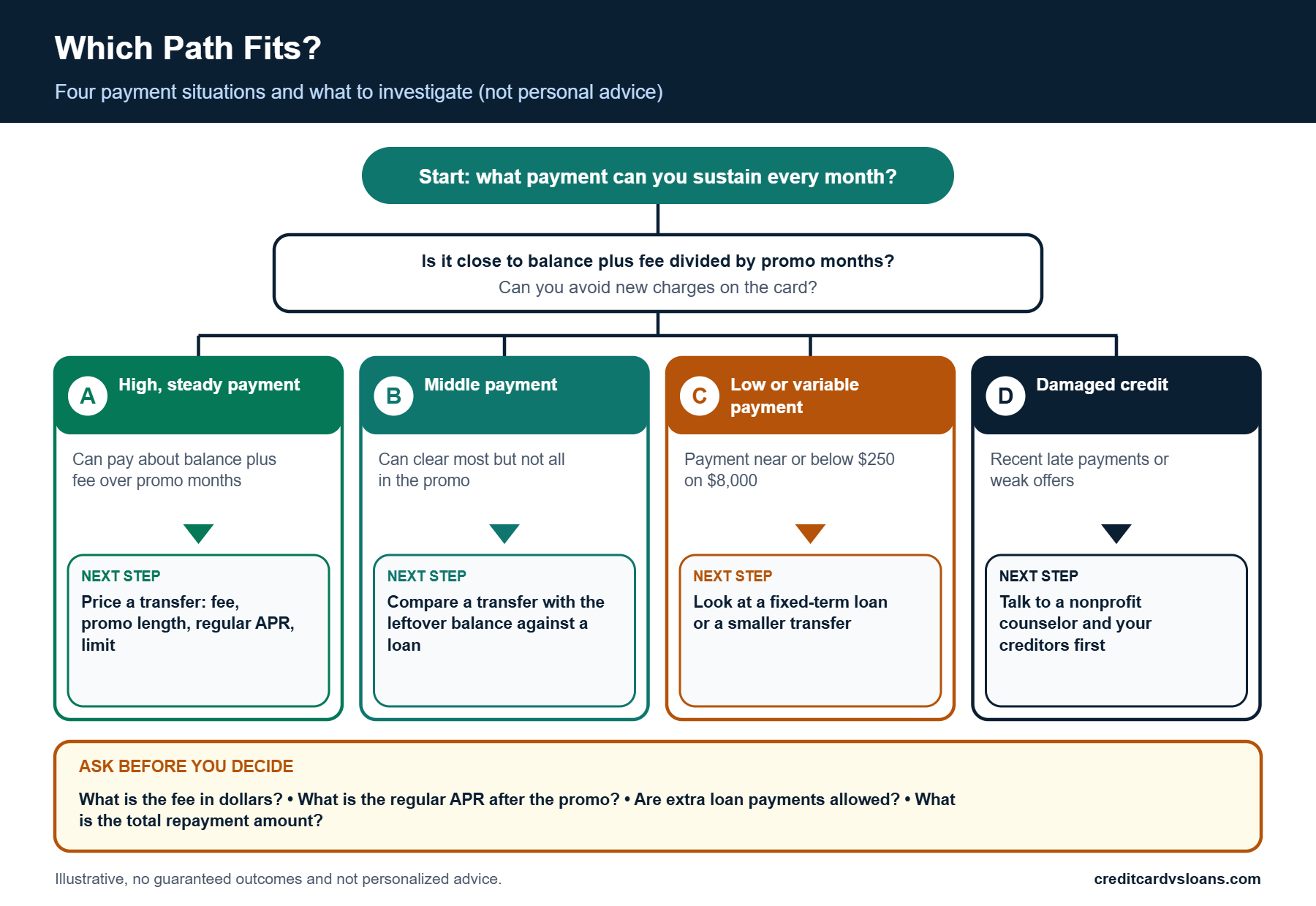
In a balance transfer vs personal loan decision, if you can comfortably pay the amount needed to finish within the promotional window, a transfer is worth pricing in detail. If the required payment is a stretch or your spending is unpredictable, a loan’s fixed schedule or a smaller transfer plus a payoff plan may be more reliable.
For other kinds of borrowing decisions, such as equipment purchases for self-employment, the same payment-first logic applies; see how to compare borrowing options for freelance equipment.
| Scenario | Option to investigate first | Why | What to verify | When to avoid it |
|---|---|---|---|---|
| Can pay roughly balance divided by promo months | Balance transfer card | Interest-free months go straight to principal | Fee, promo length, regular APR, credit limit | If new card spending is likely |
| Can pay well below the promo-required amount | Personal loan | Fixed schedule limits the slow tail at a high APR | APR, origination fee, total repayment, prepayment terms | If the fee and rate leave little saving |
| Balance larger than any likely card limit | Loan or partial transfer plus payoff plan | Limit caps the transfer | How the fee counts against the limit | If tracking two products is hard |
| Irregular income | Loan with no prepayment penalty | Predictable minimum, flexibility to pay extra | Whether extra payments reduce principal | If the required payment is already tight |
| Recent late payments or damaged credit | Credit counseling or creditor outreach | New credit may be costly or unavailable | Counselor’s nonprofit status and fees | Offers that ask you to stop paying creditors |
Stress-test the plan before you apply
Ask what happens if your income dips for two months, if an unexpected expense hits the transfer card, or if your payment date falls before payday. A plan that survives one of these is stronger than one that only works in perfect conditions.
It also helps to compare against the do-nothing path. In Table 2, staying on the card was the most expensive option at every budget, but the gap shrinks as the payment grows. At $600 a month the loan saves only about $140 versus the card in this example, while the transfer saves about $1,000.
Three hypothetical borrower snapshots
The steady earner with room in the budget
Imagine a hypothetical borrower who can set aside $600 a month for an $8,000 balance and rarely uses the card for anything else. In the example numbers, a transfer path costs about $240 in fees and clears in about 14 months. The loan path costs about $1,120 and clears in about 16 months with extra payments, or 36 months if the borrower pays only the required amount.
For this borrower the transfer is worth pricing carefully. The questions to settle are the card’s approval odds, the credit limit and whether the issuer will count the fee against that limit.
The borrower with a tight, variable budget
Now imagine a hypothetical borrower whose spare cash runs from $200 to $350 depending on the month. On a transfer, a $250 average leaves about $3,740 at month 18 in the example, and a rough month could push it further. On a loan with a roughly $280 required payment and a stable end date, the plan is easier to follow, though the total cost is higher than a transfer would be at a stable $350.
This borrower might consider a smaller transfer of the highest-rate balance, a loan for a portion, or a conversation with a nonprofit credit counselor. The deciding factor is not which tool is cheaper in the best case, but which fails more gently in the worst case.
Checklist, Conclusion and Next Steps
What to confirm before you apply
Numbers to write down for each offer
For a transfer card, record the credit limit, the transfer fee in dollars, the promotional APR and its length, the regular APR, and whether new purchases get a grace period. For a loan, record the APR, the origination fee, the term, the monthly payment, the total repayment amount, and whether extra payments are allowed without a penalty.
Then compute your payoff plan: the monthly payment you can sustain, the month the balance reaches zero, and the dollar total of interest and fees. If an offer can’t be summarized in those terms, ask for the missing details before applying.
Habits that protect the plan
Set up autopay for at least the minimum payment on every account involved. Put the promotional end date on your calendar, with a reminder three months earlier. Keep making payments on old accounts until each one reaches a zero balance on a statement.
Avoid new purchases on a card with a promotional balance, and decide in advance how you will handle an emergency expense. For a broader view of consolidation structures, our guide to debt consolidation loans versus balance transfer cards covers what to do when you owe several accounts.
The bottom line on balance transfer vs personal loan
How to decide between a balance transfer and a personal loan
If you can pay about the balance plus fee divided by the promotional months, a balance transfer is usually the cheaper route. If your realistic payment is well below that, a personal loan’s fixed schedule can be the safer one. Compare real offers using total dollars paid and the month you’d be debt-free, not just the headline rate.
In this balance transfer vs personal loan example, the transfer’s advantage grew with every extra dollar of monthly payment and disappeared below roughly $200 to $250. Your own break-even will depend on the actual fee, promotional length, regular APR, loan rate and loan fees you’re offered.
Next steps you can take this week
- List every balance you plan to pay off, with APR and minimum payment.
- Decide the monthly payment you can sustain, including a cushion for a bad month.
- Compute the payment needed to finish within a promotional period: balance plus fee, divided by months.
- Prequalify for personal loans with soft pulls and record APR, fees and total repayment.
- Read the card’s pricing disclosures for the regular APR and what triggers a higher rate.
- If neither option fits, call your creditors or a nonprofit credit counselor before opening a new account.
Common mistakes to avoid
Choosing on the headline rate alone
A 0% label is attractive, but it covers only the interest during the promotional months. The fee, the length of the promotion, the regular APR and your payment all shape the total cost. In the hypothetical $8,000 example, the same 0% card cost about $243 at a $450 payment and about $1,028 at a $250 payment, with $3,740 still owed.
The same caution applies to loans. A low quoted rate with a high origination fee can cost more than a slightly higher rate with no fee, which is why the CFPB points borrowers to the APR for comparisons. Convert every offer into dollars paid and months to payoff.
Ignoring what happens after the first payment
Many plans fail not at approval but in month three, month eight or month fourteen. A late payment, a new purchase on the transfer card or a skipped autopay can change the cost. Federal rules limit when a card issuer can raise your rate, but the CFPB notes that a payment more than 60 days late can allow an increase on existing balances, including a promotional one.
Treat the first month as a test. Confirm the old account was paid, the new balance matches the offer, the promotional end date is what you expected, and autopay is working. Catching a mismatch early is much easier than fixing it after a deadline passes.
Questions readers ask next
Can you combine a transfer and a loan?
Yes, with trade-offs. Some borrowers move the highest-rate balance to a transfer card and take a smaller loan for the rest, or take a loan and later use a transfer for a new balance. Each product adds a fee and an inquiry, so the savings have to justify both. The fewer moving parts, the easier it is to stay on schedule.
Does a loan or a transfer make more sense for a smaller balance?
Smaller balances favor transfers because a modest payment can clear them inside the promotional window, and a flat minimum fee can matter more on a small transfer. The CFPB says the fee can be a percentage or a flat amount, whichever is greater, so check the minimum in the card’s pricing table before assuming a percentage.
- Debt Consolidation Loan vs. Balance Transfer Card: Which Saves More?
- Should You Use a Personal Loan to Pay Off Credit Cards?
- Credit Card Debt Consolidation: Best Options by Credit Profile
- Credit Card vs. Personal Loan for Back-to-School Spending: Which Is Better?
- Best Way to Pay for Freelance Equipment: Compare Borrowing Options Before You Commit
- CFPB: What do I need to know about consolidating my credit card debt?
- CFPB: What is a balance transfer fee? Can it be charged on a zero percent offer?
- CFPB: What is a personal installment loan?
- CFPB: What is the difference between a loan interest rate and the APR?
- CFPB: What is a credit inquiry?
- CFPB: When can my credit card company increase my interest rate?
- CFPB (Regulation Z): 12 CFR 1026.55 Limitations on increasing APRs, fees, and charges
- CFPB (Regulation Z): 12 CFR 1026.53 Allocation of payments
- CFPB: You could still end up paying interest on a zero percent interest credit card offer (2014 archived post)
- Federal Reserve: Consumer Credit – G.19 (release of October 7, 2026)
Last updated: October 22, 2026. Rates, fees and lender rules change; verify current terms before acting.
The information on creditcardvsloans.com is provided for general educational and informational purposes only. It is not financial, legal, tax, credit, accounting or investment advice, and reading it does not create an advisor-client, fiduciary or any other professional relationship. Nothing here is an offer, solicitation or recommendation to borrow, lend or apply for any product.
Credit scores, interest rates, fees, eligibility rules, lender policies and laws change frequently and vary by lender, location and individual circumstances. Examples, figures and scenarios are illustrative only, do not predict your results and do not guarantee approval, savings, a particular rate or a credit-score outcome. Always confirm current terms directly with the lender or issuer and read the full agreement before you apply or sign.
Although we aim for accuracy and use reputable sources, we make no representations or warranties, express or implied, about the completeness, accuracy, reliability or timeliness of the content. Content may be drafted with the assistance of automated tools, so errors or omissions may still occur. Links to third-party sites are provided for convenience; we don’t control and aren’t responsible for their content.
To the fullest extent permitted by law, creditcardvsloans.com and its owners, editors, authors, contributors and affiliates disclaim all liability for any loss, damage or expense arising directly or indirectly from your use of, or reliance on, this content. Before making financial decisions, consult a licensed professional, such as a qualified financial advisor, attorney, tax professional or nonprofit credit counselor, who can consider your complete situation.