Business loan requirements come down to one question every lender is trying to answer: does this business produce enough dependable cash to repay the loan, and what happens if it does not? Revenue, time in business, credit history, existing debt, collateral and paperwork are all different ways of answering that question, and each lender weighs them differently.
There is no single national checklist. A bank, a credit union, an online lender and an SBA-backed lender can look at the same business and reach different answers, because they set their own minimums, price risk differently and hold different documents to different standards. That is why a denial from one lender tells you very little about the next one.
This guide explains what lenders look at, in the order they usually matter, and how to test your own situation before you apply. It covers revenue and cash flow, time in business, personal and business credit, collateral and personal guarantees, what SBA programs publish about their rules, how cost and fees fit in, and what to do when you do not meet a requirement yet. Everything here is general education, not a prediction of what any lender will decide for your business.
- Cash flow is the center of the file. Revenue, margins and existing debt payments tell a lender whether a new payment fits. Credit score and time in business support that story; they rarely replace it.
- Minimums are lender-specific. The SBA publishes program rules, but the lender that funds you sets its own credit, revenue and documentation standards.
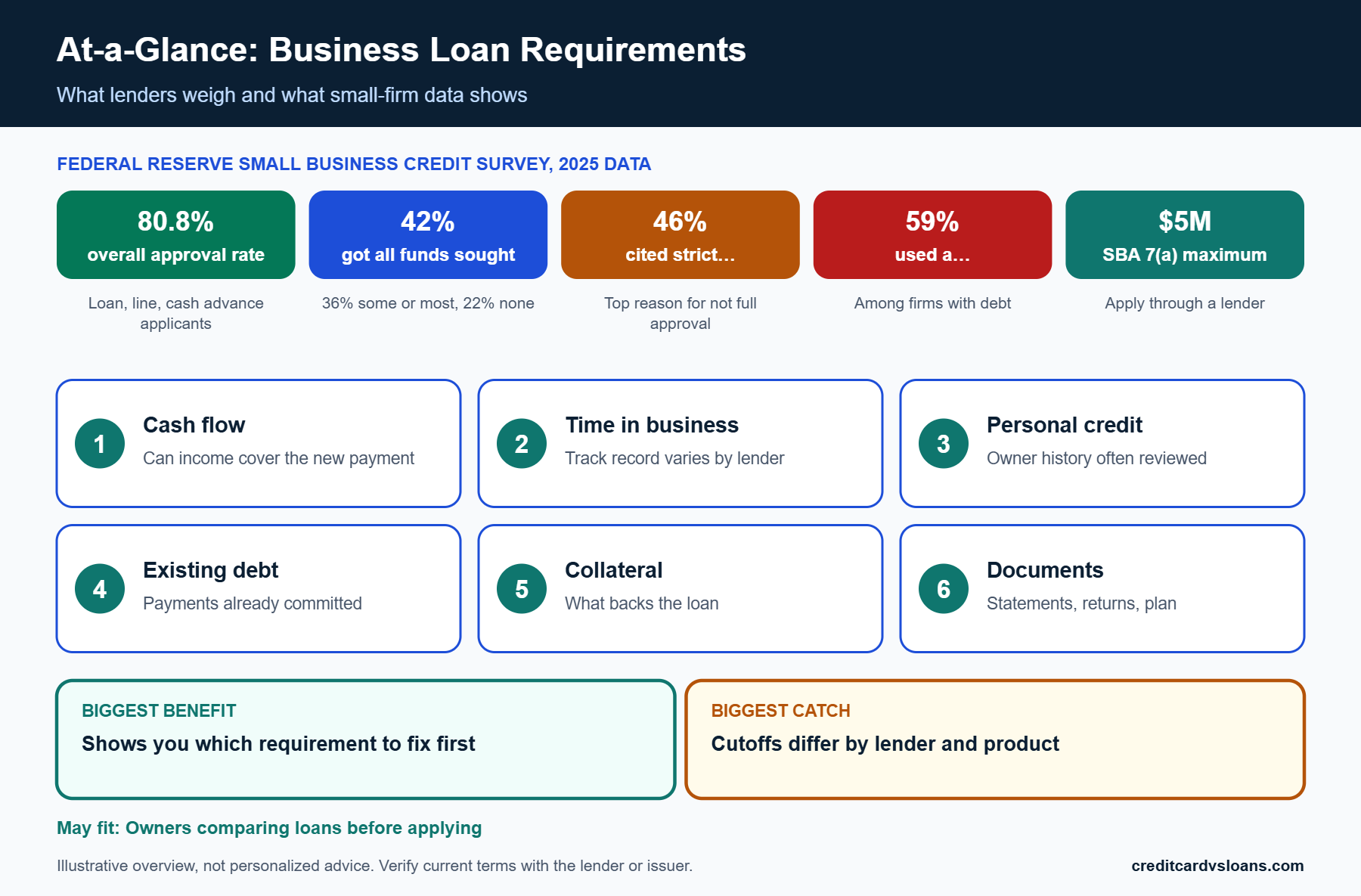
- Many owners are asked to back the loan personally. In the Federal Reserve’s 2025 Small Business Credit Survey, 59% of firms with debt reported using a personal guarantee.
- The most common denial reasons are fixable. Strict lender requirements, too much existing debt, low credit scores and thin collateral led the list, and several of them can be addressed before you reapply.
- Compare total cost, not just approval. Rates, fees and repayment pattern can change what a loan really costs by tens of thousands of dollars on the same amount.
Program details come from SBA pages as they read in October 2026 (the SBA 7(a) page was last modified July 27, 2026). Survey figures come from the Federal Reserve Banks’ 2025 Small Business Credit Survey, fielded September 3 to November 14, 2025. Lender minimums, rates and fees change often, so treat every number here as context and confirm the live terms on any offer you receive.
Business Loan Requirements at a Glance: What Lenders Check First
The Short Version of What Lenders Want
Repayment ability comes first
Almost every business loan decision starts with repayment ability. SBA describes the standard for its flagship 7(a) program in plain terms: the business must be creditworthy and demonstrate a reasonable ability to repay the loan. Private lenders use their own wording, but the idea is the same.
In practice that means a lender wants to see recent revenue, the costs that come out of it, and what is left over to cover a new payment. A business with steady deposits and modest margins can look stronger than a faster-growing business whose cash comes and goes unpredictably. Growth helps your story only when the cash eventually shows up in the bank account.
Everything else is supporting evidence
Credit scores, time in business, industry, collateral and the owner’s financial history are supporting evidence for repayment. They show how you have handled obligations before, how long the business has survived, and what the lender can fall back on if the plan does not work. A strong score does not offset weak cash flow, and strong cash flow can sometimes outweigh a so-so score, depending on the lender.
Think of the file as a set of questions: can you pay, have you paid before, how stable is this, and what is the exit if it goes wrong? Each requirement you will see below maps to one of those four questions.
A Quick Comparison of the Core Requirements
Table 1: the requirements in one view
The table below lists the requirements lenders most often use, what each one is trying to measure, and what you can usually do about it. It is a framework, not a set of cutoffs, because cutoffs differ by lender and product.
| Requirement | What the lender is measuring | What you can usually do |
|---|---|---|
| Revenue and cash flow | Whether the business can cover a new payment after existing costs | Gather statements and show a consistent pattern; reduce avoidable costs first |
| Time in business | Whether the business has a track record | Cannot be rushed; consider smaller or secured products while you build history |
| Personal credit | How the owner has handled past obligations | Check reports, correct errors, lower revolving balances |
| Business credit | How the company has paid vendors and lenders | Pay on time, keep accounts in the business name |
| Existing debt | How much of the cash flow is already committed | Pay down or refinance before applying |
| Collateral and guarantee | What the lender can recover if the loan defaults | Decide in advance what you will and will not pledge |
| Documentation | Whether the numbers can be verified | Organize statements, returns and a clear use of funds |
How to use the table
Read down the third column and mark the rows where you have the most room to improve in the next 30 to 90 days. Those are the rows worth acting on before you apply. Rows like time in business are fixed by the calendar, so the practical move is to choose a product whose requirements match the stage you are in.
If you are still deciding whether a loan is even the right tool, compare a business credit card against a business loan before you spend time on applications. The two products test different things and fail for different reasons.
What the Federal Reserve’s Survey Shows About Approval
How many firms apply and how many are approved
The Federal Reserve Banks’ Small Business Credit Survey is one of the largest regular looks at how small firms borrow. The 2025 employer-firm report, fielded from September 3 to November 14, 2025, drew 6,525 responses from firms with 1 to 499 employees. It is a convenience sample, not a random one, so it describes the respondents rather than every business in the country.
In that survey, 60% of firms sought some kind of financing in the prior 12 months, and 38% applied for a loan, line of credit or merchant cash advance. The overall approval rate for those applicants was 80.8%. Among all financing applicants, 42% received all the funding they sought, 36% received some or most, and 22% received none.
Why that matters for your expectations
An 80.8% approval rate sounds comfortable, but notice the split inside it. Only 42% of applicants received everything they asked for, and many received less. An approval for a smaller amount, or on different terms, can still leave you short of what the project needed.
The practical lesson is to size your request to your cash flow before the lender does it for you. Asking for an amount the numbers support improves your odds of getting what you asked for, and it avoids the hard inquiries that come with repeated attempts.
How Lenders Decide: Underwriting in Plain English
The Questions Behind Every Application
The four questions a credit officer asks
Underwriting is the lender’s process for deciding whether to lend and on what terms. It sounds technical, but a credit officer is usually working through four questions. Can the business repay from its own cash flow? Does the owner have a record of repaying obligations? Is the business stable enough to last through the loan term? And if repayment fails, what can the lender recover?
Your application is a set of answers to those questions, and gaps in one answer can sometimes be offset by strength in another. A newer business with strong deposits and a large owner investment, for example, may be able to answer the stability question differently than a seasoned business with thin margins.
Where a human reviewer can change the outcome
Some lenders, especially online lenders, run applications through automated models that weigh bank data and credit data quickly. Others, including many community banks and credit unions, put a person in the loop who can read an explanation of a bad quarter. If your numbers have a one-time dip with a clear cause, a lender that reads context may treat it differently than a model that only sees the dip.
That does not mean one type of lender is easier. It means the same facts can be evaluated differently, so the way you present your file and the lender you choose both matter.
How Lender Type Changes the Odds and the Experience
What the Fed survey found by lender type
The 2025 Small Business Credit Survey reported outcomes by lender type for loan, line of credit and cash advance applicants. Small banks showed a 57% full-approval share, with 23% partially approved and 20% denied. Finance companies showed 50% fully approved, 31% partial and 19% denied, and credit unions showed 44% fully approved, 26% partial and 29% denied.
Online lenders ranked below large and small banks on full approval, according to the report. The report also found that medium- and high-risk applicants were much more likely than low-risk applicants to apply at online lenders, which helps explain part of that pattern.
Table 2: outcomes and experience by lender type
| Lender type | Fully approved | Partially approved | Denied | Satisfied / dissatisfied |
|---|---|---|---|---|
| Small banks | 57% | 23% | 20% | 65% / 6% |
| Finance companies | 50% | 31% | 19% | 57% / 12% |
| Credit unions | 44% | 26% | 29% | 76% / 3% |
| Large banks | Reported in the survey; chart values not reproduced here | 64% / 8% | ||
| Online lenders | Lower full-approval share than large and small banks | 35% / 15% | ||
Source: Federal Reserve Banks, 2025 Report on Employer Firms (Small Business Credit Survey). Respondents are a convenience sample, so read the numbers as indicators, not forecasts for your application.
Revenue Requirements: How Much Is Enough and How Lenders Read It
Why There Is No Universal Revenue Minimum
Minimums belong to the lender, not the law
You will see published revenue minimums on many lender websites, and they differ widely. No federal rule sets a single revenue floor for private business loans, and the SBA’s own program pages do not list one for 7(a) loans; they focus on whether the business is operating, for-profit, small under SBA size standards and able to repay. Any number you see is a lender’s choice, and it can change with the product, the loan size and the lender’s appetite for risk.
That is useful because it means a revenue shortfall at one lender is not a verdict on the business. It is a mismatch between the business and a particular product. A lender that serves very small firms will frame the question differently than a lender built for larger equipment purchases.
Revenue size versus revenue quality
Lenders care about the quality of revenue as much as the amount. Recurring or contracted income, a diversified customer base and steady monthly deposits all make revenue more believable. Revenue concentrated in one customer, or revenue that swings sharply by season, usually triggers more questions.
If your revenue is seasonal, say so up front and show twelve months or more of history so the lender sees the full cycle. A landscaper whose income peaks in summer, for instance, should expect the lender to look at the annual picture and the payment schedule together, and may ask whether a seasonal repayment structure is available.
How Lenders Turn Revenue Into a Decision
From gross revenue to money available for payments
Gross revenue is only the starting line. Lenders subtract the cost of goods, payroll, rent and other operating costs to estimate what is left, and then compare that with all debt payments, old and new. The result is a measure of how much cushion exists if sales dip.
For this reason, a business with higher revenue and thin margins can look weaker than a smaller business with healthy margins. Before you apply, calculate your own margin from your last twelve months of statements and see which costs have grown faster than sales.
What bank statements reveal that tax returns do not
Tax returns show what you reported for a year, and they can reflect deductions that lower taxable income without reducing cash. Bank statements show the timing: when money arrives, how often the balance drops low, and whether overdrafts or returned payments appear. Many lenders review both, and online lenders often lean heavily on bank-connected data.
A pattern of frequent negative balances is one of the quickest ways to weaken an otherwise solid file. If you see that in your own accounts, a few months of steadier balances before applying may matter more than any single document you assemble.
Strengthening a Revenue Story Before You Apply
Practical steps that cost little
Start by separating business and personal money, if you have not already. A clean business account makes revenue easy to verify, and mixed accounts make lenders question what belongs to the business. Next, reconcile your books so that the revenue on your statements matches your income statement.
Then look at timing. If a large invoice is about to be paid, waiting until it clears may produce a stronger statement period. This is not about dressing up the numbers; it is about letting an accurate picture reflect the real strength of the business instead of a temporary gap.
When revenue is the weak point
If revenue is simply too low or too uneven for the loan you want, consider whether a smaller amount or a different product fits better. Microloans, for example, are designed for smaller needs: SBA reports that microloans go up to $50,000, with an average of about $13,000, and are made through intermediary lenders that set their own terms. A business card can also cover small purchases without a term-loan underwriting process, as discussed in the business credit card versus loan comparison.
The trade-off is cost and flexibility. Smaller or shorter products can carry higher costs per dollar borrowed, so compare the total repayment before you decide that smaller is safer.
Time in Business: How Long Lenders Expect You to Operate
What Time in Business Tells a Lender
A track record is a form of evidence
Time in business is a shortcut for stability. A business that has operated through slow months, price changes and staffing issues has shown it can survive them, and that lowers the lender’s uncertainty. Newer businesses have less history to evaluate, so lenders rely more on the owner’s personal credit, outside experience and collateral.
No single minimum applies everywhere. Some lenders ask for a year or more, others ask for longer on larger products, and some programs are designed for startups. The SBA’s 7(a) Working Capital Pilot, for example, states that applicants should have at least one year of operating history, along with the ability to produce timely financial statements and agings and inventory reports.
How the clock is counted
Lenders usually count from the date the business began operating and earning revenue, not necessarily the date you registered the entity. A company formed in January that made its first sale in October may be treated as having a shorter history than the registration date suggests. Ask each lender how it measures the start date, because a few months can change which products you qualify for.
Buying an existing business or taking over a family business can change this too. Lenders often consider the operating history of the acquired business, along with your own experience, which is why change-of-ownership is a recognized use of SBA 7(a) funds.
Working With a Short Operating History
Substitutes lenders may accept
If your history is short, you can offset it with other evidence. Examples include prior industry experience, a detailed business plan with realistic projections, signed customer contracts, a meaningful personal cash investment, and collateral. None of these is a requirement everywhere; they are the kinds of support lenders tend to weigh when the track record is thin.
Be honest about projections. Lenders compare them against your actual months of data, and a plan that assumes a sudden jump in sales with no support tends to reduce credibility rather than raise it.
Products that fit an earlier stage
Early-stage owners often start with products that carry less underwriting friction: a business credit card, equipment financing where the equipment itself is the collateral, or a small microloan. Each has trade-offs. Cards can carry high variable rates if balances are carried, equipment loans tie you to a specific asset, and microloans depend on the intermediary’s terms, which SBA says generally run from 8% to 13% in interest.
Matching the product to the stage is usually more productive than applying for the largest loan available and collecting denials. Our guide on how to choose between a business card and a loan walks through this decision using cash flow patterns.
Credit Requirements: Personal Score, Business Credit and Report Details
Personal Credit and the Owner
Why your personal credit matters to a business lender
For most small businesses, the owner’s personal credit is part of the application. Newer or smaller companies often have little or no business credit history, so lenders look at how the owner has handled personal loans, cards and bills. Many lenders also run a personal credit check because the owner is expected to sign a personal guarantee, which makes the owner’s finances part of the repayment picture.
Depending on the lender, the check may be a soft pull during prequalification and a hard pull at formal application. A hard pull is recorded as an inquiry on your report, so ask before you submit whether a lender will run one at the prequalify stage, and rate shop within a short window so the inquiries are easier to explain.
What the Fed survey used to define credit risk
The 2025 Small Business Credit Survey groups firms by credit risk using either a business credit score or the owner’s personal score. In its definitions, low risk means a business score of 80 to 100 or a personal score of 720 or above, medium risk means 50 to 79 or a personal score of 620 to 719, and high risk means 1 to 49 or a personal score below 620. Among respondents with credit scores, 72% were low risk, 22% medium and 6% high.
These bands are survey categories, not lender cutoffs. A lender may approve a medium-risk file or decline a low-risk one for reasons unrelated to the score. Still, they give you a rough sense of where your own score sits in the landscape that lenders see.
Business Credit and How It Differs
Business credit reports and scores
Business credit is tracked separately from personal credit, and it is built from the company’s payment history with vendors, lenders and card issuers. Different reporting companies use different scoring ranges, and not every vendor reports to every bureau, so a business can have a thin file even when it pays on time. The SBA suggests building both personal and business credit and monitoring your credit reports as part of planning for funding.
If you have never looked at your business credit file, check what exists before you apply. Errors, outdated addresses or accounts that belong to a similarly named company can create confusion. Our guide on how to build business credit with the right product mix covers the practical steps in more depth.
Why a business credit score rarely stands alone
Even a strong business credit file often does not replace the owner’s personal credit review, especially for smaller loans. Lenders treat the two as complementary: the business file shows company behavior, and the personal file shows the person standing behind it. If the two disagree, expect questions.
That is why keeping business accounts in the company’s name and paying them on time matters. It also helps keep personal and business obligations from blurring together, which can matter for liability and for how lenders interpret your reports.
What Credit Problems Lenders Notice Most
The usual red flags
Recent late payments, collections, charge-offs, tax liens, judgments and bankruptcies tend to draw the most attention, because they speak directly to repayment behavior. High balances on revolving accounts also matter, since they suggest less breathing room. A single old issue that has been resolved is often easier to explain than a pattern of recent ones.
In the Federal Reserve’s 2025 survey, 30% of applicants who were not fully approved cited a low credit score as a reason. That is a meaningful share, but it was not the leading reason; strict lender requirements and existing debt ranked higher.
How to prepare your reports
Pull your credit reports from all three bureaus through the free reporting channel provided by federal law, review every account, and dispute anything that is wrong. If your personal score is lower than you would like, paying down revolving balances and avoiding new hard inquiries before applying are common steps, though no one can promise a particular score change.
If you are comparing personal and business borrowing at lower score ranges, our articles on a personal loan with a 620 credit score and a personal loan with a 580 credit score show how lenders treat those tiers on the consumer side, which can help you gauge the personal credit side of a business application.
Cash Flow and Debt Service Coverage: The Math Behind Approval
Understanding Debt Service Coverage
What the ratio means
Many lenders use a debt service coverage ratio, often shortened to DSCR, to test whether a business can afford a new payment. The basic idea is simple: divide the cash the business has available for debt payments by the total annual debt payments, including the new loan. A ratio above 1.0 means available cash covers the payments; below 1.0 means it does not.
Lenders usually want a cushion above 1.0 rather than a ratio that barely passes, because real-world sales fluctuate. The exact cushion they want is a lender decision, and different lenders define cash available for debt service differently, so ask how your target lender calculates it.
A hypothetical example
Suppose a business wants a $100,000 term loan at a 10% annual rate, repaid over five years. The monthly payment on that hypothetical loan would be about $2,125, or roughly $25,496 a year. That figure is illustrative only; your rate and term would come from an actual offer.
If the business has $40,000 a year available for debt payments, the ratio is about 1.57. At $30,000 it is about 1.18, and at $25,000 it falls to about 0.98, which means the business would be short of covering the payment from operations alone.
Reading the Illustration
Table 3: how the same loan looks at different cash levels
| Cash available for debt payments | Ratio | What a lender may conclude |
|---|---|---|
| $40,000 per year | About 1.57 | Payment fits with room to spare, subject to the lender’s own standard |
| $30,000 per year | About 1.18 | Thin cushion; may need a smaller amount, longer term or added support |
| $25,000 per year | About 0.98 | Payment is not covered; likely a smaller loan or different product |
The point of the table is the direction, not the thresholds. Lenders set their own, and other debts you already carry count in the denominator.
Levers you can pull
If your ratio is tight, there are three ways to change it: raise the cash available by improving margins or collecting receivables faster, reduce the payment by borrowing less or choosing a longer term, or reduce other debts. Each has a cost. A longer term lowers the payment but increases total interest, and cutting expenses too hard can hurt sales.
Existing debt and the second payment problem
Existing business debt, equipment leases and owner loans all compete for the same cash flow. In the Fed’s 2025 survey, 37% of applicants who were not fully approved cited having too much debt already. If you are carrying several short-term obligations, consider whether consolidating them into a single longer-term payment would improve the ratio before you apply for new money, and whether the extra interest is worth the breathing room.
What Meeting the Requirements Costs: APR, Fees and Repayment Terms
Rates, Fees and the Real Price of a Loan
Why the stated rate is only part of the cost
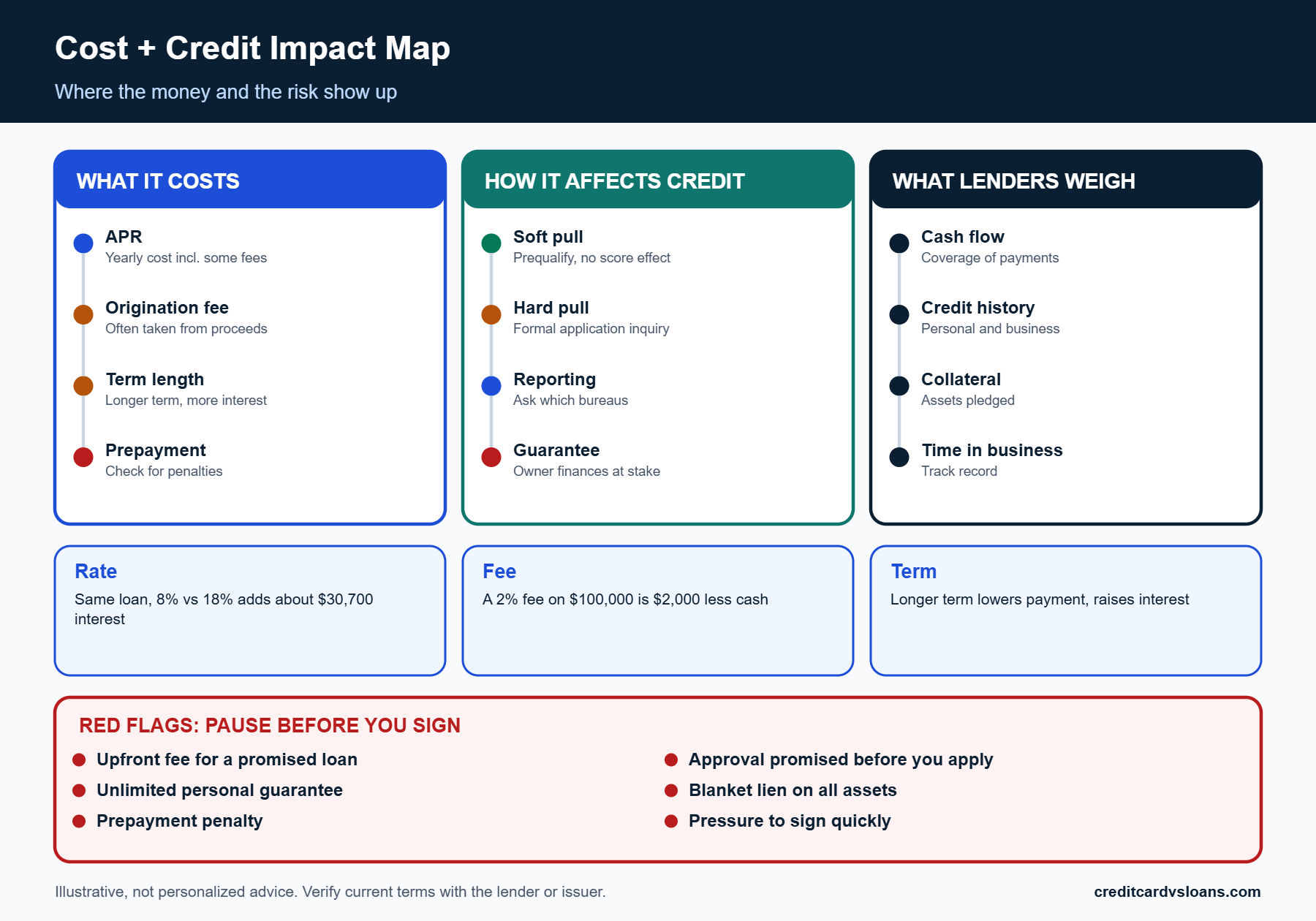
Qualifying for a business loan is only half of the decision; the other half is what the loan costs. A stated interest rate does not include origination fees, packaging or closing fees, or other charges that a lender may add, and the annual percentage rate, or APR, is meant to fold some of those costs into a single yearly figure. When you compare offers, ask for the APR, the full list of fees, the payment schedule and any prepayment terms in writing.
Some business products, such as certain cash advances and short-term loans, are priced with factor rates or fixed fees instead of an APR, and these can be hard to compare with a traditional term loan. If an offer quotes a flat fee or a factor, convert it to the total dollars you will repay and divide by the amount you actually receive. That one comparison often shows more than the headline rate.
Origination fees reduce what you receive
An origination fee is a charge for processing the loan, often deducted from the proceeds. As a hypothetical, a 2% fee on a $100,000 loan is $2,000, so you would receive $98,000 while still repaying interest on the full $100,000. That is an illustration, not a typical fee; actual fees vary by lender and product.
The catch is that a fee reduces the money available for your project. If you need exactly $100,000 for equipment, you would need to borrow more to net that amount, which increases the payment and the total interest. Build the fee into your amount before you apply.
How Term Length and Rate Change Total Repayment
The same amount at different rates
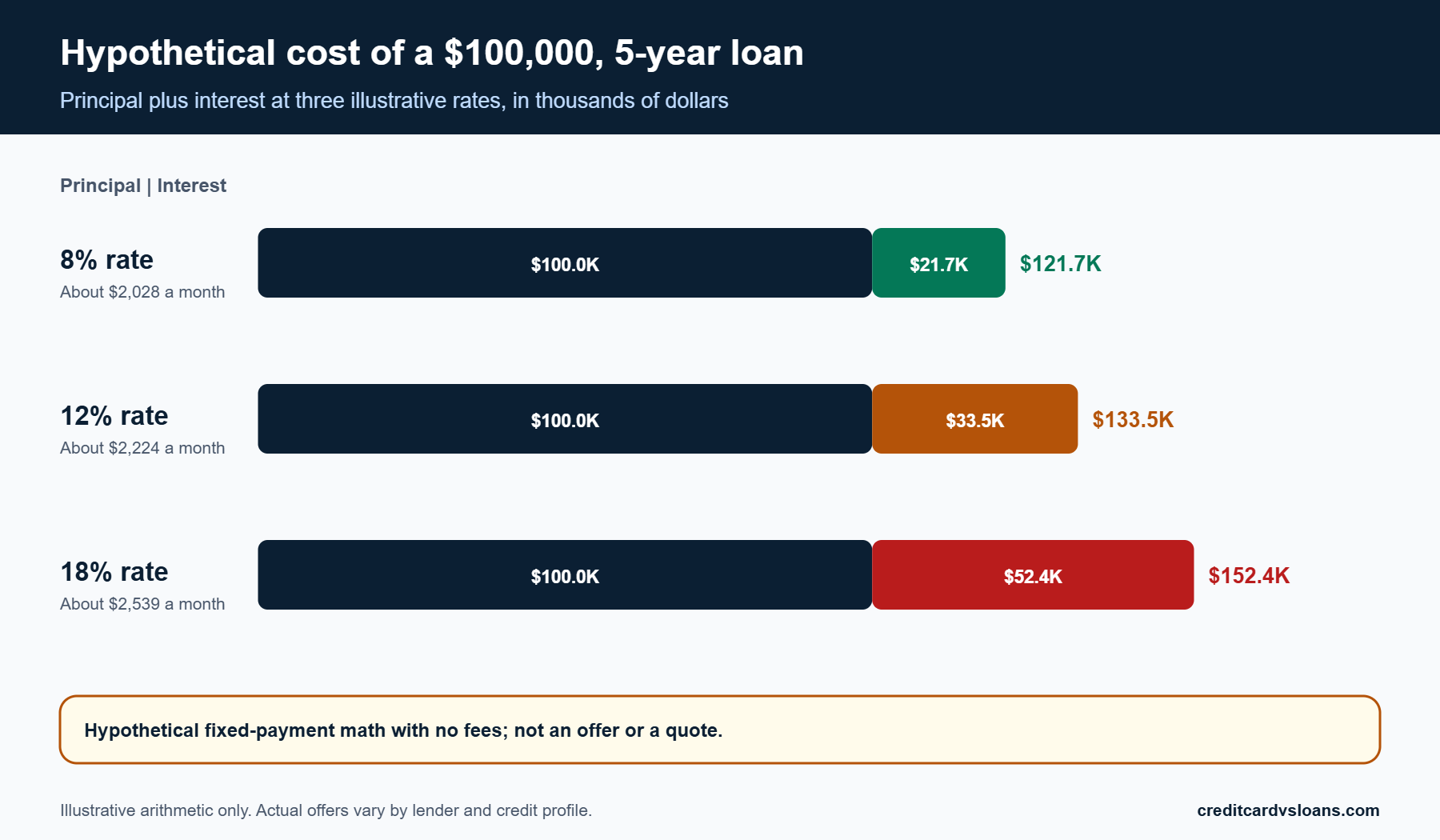
Rate differences can look small in percentage points but large in dollars. The hypothetical comparison below shows a $100,000 loan repaid over five years at three illustrative rates. It is computed with a standard fixed-payment formula and ignores fees.
| Illustrative annual rate | Monthly payment | Total interest | Total repaid |
|---|---|---|---|
| 8% | About $2,028 | About $21,658 | About $121,658 |
| 12% | About $2,224 | About $33,467 | About $133,467 |
| 18% | About $2,539 | About $52,361 | About $152,361 |
Moving from 8% to 18% in this example adds roughly $30,700 in interest on the same $100,000 and the same five years. These are not quotes. They show why comparing offers matters even when you are likely to be approved by more than one lender.
The same amount over different terms
Term length works in the opposite direction from the rate. Take a hypothetical $50,000 loan at 9%. Over 36 months the payment would be about $1,590 and total interest about $7,240. Over 60 months the payment drops to about $1,038 and interest rises to about $12,275, and over 120 months the payment falls to about $633 while interest reaches about $26,005.
A longer term can make a payment affordable and improve your debt service ratio, but you pay for that relief in interest. If you take a longer term, check whether the lender allows extra payments without a penalty, so you can shorten the loan when cash flow improves.
Variable Rates, Prepayment and Other Terms to Read
Fixed versus variable payments
SBA explains that most term loans are repaid with monthly principal and interest payments from business cash flow. Fixed-rate payments stay the same for the life of the loan, while variable-rate payments can change when the underlying rate changes. A variable rate may start lower, but it adds uncertainty to your budget, so ask what index it follows, how often it adjusts and whether there is a cap.
For current rate context, see our credit card and personal loan rate outlook, which summarizes how borrowing costs have moved. Business loan pricing is lender-specific, so use that article as background, not as a quote.
Prepayment penalties, covenants and default terms
Read the sections of the agreement that apply when things change: prepayment penalties, financial covenants that require you to maintain certain ratios, cross-default clauses that make one missed payment trigger others, and late fees. These terms rarely show up in an advertisement, but they determine how flexible the loan is when your business has a rough quarter.
If anything is unclear, ask the lender to explain it in writing, and consider having an attorney or a free counselor from an SBA resource partner review it. The SBA points owners to free business counseling through those partners.
SBA Loan Requirements: What the Government Programs Publish
The Main SBA-Backed Loan Programs
How SBA loans work
The SBA does not lend most of the money itself. It provides a guarantee to participating lenders, which can make some loans possible that a lender might not make on its own, and you apply through a lender rather than the SBA directly. The SBA’s Lender Match tool helps connect owners with interested lenders, and the SBA describes the range of its guaranteed loans as running from $500 to $5.5 million.
Because the lender makes the credit decision, an SBA-backed loan still has to satisfy the lender’s own standards on top of the program rules. A business can meet the SBA’s eligibility criteria and still be declined by a lender that finds the cash flow too thin.
Table 5: SBA programs and published rules
| Program | Published maximum | Typical use | Who lends | Notes from SBA |
|---|---|---|---|---|
| 7(a) | $5 million | Working capital, equipment, real estate, refinancing, change of ownership | SBA 7(a) lenders | Business must be creditworthy and show reasonable ability to repay; must not be able to get the credit on reasonable terms elsewhere |
| 504 | $5.5 million | Buildings, land, long-life equipment, qualified debt refinancing | Certified Development Companies with a senior lender | Maturities of 10, 20 or 25 years; working capital and inventory are not allowed |
| Microloan | $50,000 (average about $13,000) | Working capital, inventory, supplies, equipment | Intermediary lenders | Maximum term seven years; rates generally 8% to 13%; cannot pay existing debts or buy real estate |
| 7(a) Working Capital Pilot | $5 million (monitored line of credit) | Working capital | SBA 7(a) lenders | At least one year of operating history; maturity up to 60 months; rate caps over the base rate depend on loan size |
Program rules can change, so confirm each one on SBA.gov or with a participating lender before you rely on it.
Eligibility Rules That Apply Across SBA Programs
The common eligibility checklist
Across the 7(a), 504 and microloan programs, SBA lists a similar set of basic requirements: the business must be operating, for profit, located in the United States, small under SBA size standards, and not an ineligible business type. For 504 loans, SBA also lists qualified management, a feasible business plan, good character and the ability to repay. Size standards depend on the industry, so check where your business falls before assuming you qualify.
Two other points matter. For 7(a), SBA states the business must be unable to get the desired credit on reasonable terms from non-federal, non-state and non-local government sources, often described as the credit elsewhere test. And SBA identifies credit history as one of the key factors in eligibility.
What SBA pages do not say
The SBA’s public program pages do not publish a minimum credit score, minimum revenue or minimum time in business for 7(a), 504 or microloans, and the 504 page does not state a down payment. Those details are set by the lender or the Certified Development Company, and they can differ from one to the next. If you see a specific number claimed as an SBA requirement, ask for the source before you rely on it.
That gap is not a flaw; it reflects how the program is built. The agency sets the framework and the guarantee, and the lender decides whether your file fits.
Collateral and Personal Guarantees: What You May Be Asked to Pledge
Personal Guarantees Explained
What a personal guarantee is
A personal guarantee is a promise by an owner to repay a business debt from personal assets if the business cannot. In plain terms, it can remove the protection that a limited liability company or corporation normally provides for that particular debt. Lenders ask for it because it gives them a second source of repayment and keeps the owner’s own finances tied to the outcome.
Whether you will be asked to sign one depends on the lender, the loan size and the strength of the business. The Federal Reserve’s 2025 Small Business Credit Survey found that 59% of firms with debt had used a personal guarantee. That tells you it is common, though it does not mean every loan requires one.
Limited and unlimited guarantees
Guarantees come in different forms. An unlimited guarantee makes you responsible for the full balance plus costs, while a limited guarantee caps your exposure at a set dollar amount or percentage. Some guarantees apply only if specific events occur, and some are joint, meaning multiple owners share responsibility.
Before you sign, read the language that defines the scope. Ask whether the guarantee ends when the loan is paid down to a certain level, whether it covers fees and legal costs, and whether a co-owner or spouse would be affected. Consider asking an attorney to review it. This is general information, and the rules on guarantees and spousal liability can vary by state, so check with a licensed professional for your situation.
Collateral and What Lenders Can Take
Business assets versus personal assets
Collateral is property that secures a loan, meaning the lender can claim it if you default. Business collateral may include equipment, inventory, receivables or real estate owned by the company. Some loans are secured by a blanket lien that covers most business assets, and others attach only to the specific asset being financed.
The Fed’s 2025 survey reported that 38% of debtholders used personal assets as collateral, up from 31% in 2019. Insufficient collateral was also cited by 29% of applicants who were not fully approved. If you are short on collateral, ask whether the lender will accept a smaller amount, a partial guarantee or the financed equipment itself as security.
Questions to ask about security
Before accepting a secured loan, ask exactly what is pledged, how it is valued, whether the lender will file a lien and what happens to the lien when you pay the loan off. A blanket lien can limit your ability to take additional financing later, because a second lender will see that the assets are already encumbered.
Also think about your downside. If the business has a bad year, are you comfortable with the lender being able to claim the pledged item or, for personal assets, something that matters to your household? If not, a smaller loan, a longer timeline or an unsecured product may be worth considering even at a higher cost.
Reducing Personal Risk
Structural ways to limit exposure
There are a few common approaches. You can negotiate a limited guarantee, ask for a release after a period of on-time payments, or choose a smaller loan that the business’s cash flow clearly supports. Separately, keep personal and business finances separate and maintain proper records, because commingling can create problems regardless of the guarantee.
Insurance does not replace a guarantee, but life or disability coverage can protect your family from certain events that could otherwise leave debt behind. Ask an insurance professional what fits, and do not assume any policy covers loan payments unless you confirm it.
When a guarantee is a signal to pause
A guarantee request is not a red flag by itself, but an unusually broad one is worth a closer look. Examples include a guarantee that covers unrelated debts, a requirement to pledge your primary residence for a modest loan, or terms that change after signing. If the lender will not explain the terms in plain language, consider that a warning sign.
Compare at least two offers, and if the guarantee terms differ, treat that as part of the cost. A slightly higher rate with a limited guarantee can be a better deal for some owners than a lower rate with unlimited personal exposure.
Documents and Application Prep: What to Gather Before You Apply
The Typical Document Package
Financial documents lenders commonly request
Lenders decide which documents they need, and the list varies by product. Common requests include several months of business bank statements, recent business and personal tax returns, profit and loss statements, a balance sheet, a schedule of existing debts and a list of owners with their ownership percentages. Larger or SBA-backed requests tend to need more, including projections and a business plan.
The SBA notes that traditional business plans are what lenders and investors often request, while shorter lean plans are available for earlier planning. Even if your lender does not demand a full plan, a one- or two-page summary of what the money is for and how it will be repaid can make the file easier to read.
Legal and identity documents
Expect to provide formation documents, an employer identification number, business licenses where applicable, a lease or proof of ownership of your location, and government-issued ID for owners. Lenders verify who they are lending to, and missing or mismatched names across documents can slow things down.
Check that your legal business name, address and ownership details match across tax filings, bank accounts and registrations. Small inconsistencies are among the most avoidable reasons for delay.
Preparing Before You Submit
A pre-application review
Before you apply, review your own file the way a credit officer would. Read your last twelve months of statements for overdrafts, look at your largest customers, total your monthly obligations and compare them with your cash flow. Fix what you can, and prepare a short explanation for what you cannot.
Also decide the amount, purpose and repayment source. A clear sentence such as “this equipment will increase capacity by a stated amount and the added revenue will cover the payment” is more persuasive than a general request for working capital. Keep the explanation factual and realistic.
Prequalifying and limiting hard pulls
Many lenders offer prequalification with a soft pull, which does not affect your credit scores, and then run a hard pull only when you proceed. Ask each lender which type of check applies at which stage. If you plan to compare several offers, try to submit formal applications in a short window and keep notes on what each lender asked for.
Avoid paying anyone an upfront fee to find you a loan before you have a written offer from a real lender. The section on warning signs below explains why.
If You Do Not Meet the Requirements Yet: Alternatives and Next Moves
Financing Options With Different Requirements
Business credit cards and lines of credit
A business credit card or a line of credit tests the same ability to repay, but through a revolving structure rather than a fixed term. Cards often have simpler applications and may suit smaller, shorter-term spending, while a line of credit lets you draw as needed and pay interest only on what you use. In the Fed’s 2025 survey, business lines of credit applicants were 45% fully approved, 31% partially approved and 24% denied.
The catch with revolving credit is that balances carried month to month can become expensive, and high utilization can affect your personal credit if you guaranteed the account. Our comparison of a business credit card versus a business loan explains when each structure tends to fit.
Equipment financing, microloans and community lenders
Equipment financing uses the purchased equipment as collateral, which can make approval easier for businesses with limited other assets. Microloans from SBA intermediaries are meant for smaller needs and early-stage owners, with a maximum of $50,000 and terms set by the intermediary. Community-focused lenders, credit unions and nonprofit lenders may also offer products designed for newer or smaller firms.
In the Fed’s survey, credit unions had the highest share of borrowers who accepted approved financing and the highest satisfaction among lender types, but they also had a higher denial share than small banks. That is a reminder to compare outcomes for your type of file, not just reputations.
Using Personal Credit Products With Care
Why mixing personal and business borrowing is risky
Some owners consider a personal loan or a personal credit card to fund a business need. It can work for small amounts, but it puts personal credit and household finances directly on the line, and it may not carry the same legal or tax treatment as a business product. Terms and uses can also be restricted, so read the personal loan agreement before using funds for a business.
Our guides on the credit card versus personal loan decision and on whether to take out a personal loan just to build credit cover the consumer side of that trade-off. For a business purchase, the key question is whether the repayment comes from the business or your household budget.
When to wait and build
Sometimes the best move is to delay the application by a few months while you fix the issue that would lead to a denial. That might mean paying down revolving balances, resolving a collections account, building three to six months of cleaner bank statements, or waiting for a large receivable to arrive. Waiting has a cost too, so weigh it against the opportunity you might miss.
If you do apply and are declined, ask for the reason. Lenders typically provide a notice with the principal reasons for a decline, and those reasons are a map of what to fix before the next attempt.
Turning a Denial Into a Plan
Reading denial reasons
The Federal Reserve’s 2025 survey asked applicants who were not fully approved why. Their most common answers were that lender requirements were too strict (46%), that they already had too much debt (37%), that their credit score was low (30%), that collateral was insufficient (29%), that sales were weak (29%) and that lenders do not approve financing for businesses like theirs (29%).
| Reason given | Share citing it | Possible response before reapplying |
|---|---|---|
| Lender requirements too strict | 46% | Try a lender type or product with different standards; ask about a smaller amount |
| Too much debt already | 37% | Pay down or consolidate; improve the debt service ratio |
| Low credit score | 30% | Correct errors, reduce revolving balances, avoid new inquiries |
| Insufficient collateral | 29% | Consider asset-based or equipment-secured financing |
| Weak sales | 29% | Build stronger statements; request a smaller amount |
| Lenders do not finance businesses like mine | 29% | Look for lenders that serve your industry or business type |
A 90-day improvement plan
Pick the one or two reasons that match your file and build a 90-day plan around them. If debt is the issue, list every obligation with its balance, rate and payment, and decide which to pay down first. If credit is the issue, request your reports, dispute errors and schedule payments so nothing goes late.
Document what changed, because lenders respond to evidence. A short note that says your balances are down, your deposits are steadier and the one-time expense that hurt last quarter has ended gives a credit officer a reason to look again.
Warning Signs, Scams and Your Rights as a Small Business Borrower
Spotting Business Loan Scams
Upfront-fee and guaranteed-approval pitches
The Federal Trade Commission has long warned about advance-fee loan scams. Its red flags include being asked for an up-front fee in exchange for a promised loan, claims that you are certain to qualify before you apply, promises of money quickly or in a set time, and vague claims of connections to financing sources. The FTC notes that legitimate lenders do not promise a loan or credit card in advance, especially to people with weak credit.
Be cautious about giving out your bank account, card or Social Security number to anyone you did not contact and cannot verify. If you suspect a scam, you can report it at ReportFraud.ftc.gov.
Verifying a lender
Before you share documents, confirm that a lender is real: look for a physical address and a phone number you can verify independently, check your state’s business or financial regulator for licensing where applicable, and search for complaints. For SBA loans, the agency says you apply through participating lenders, and you can use Lender Match to find them, so be wary of anyone who claims to be the SBA and asks for a fee.
Also be careful with unsolicited offers by phone or email that say you are preapproved. A real preapproved offer should come with clear terms in writing and no payment demanded before closing.
Rules, Data and Where to Get Help
What the CFPB’s small business lending rule is about
Section 1071 of the Dodd-Frank Act directs the Consumer Financial Protection Bureau to require certain lenders to collect and report information about small business credit applications. The CFPB’s page describes the rule’s purpose as showing whether lenders are serving small businesses’ credit needs in their communities, and as of its April 6, 2026 update it said the reporting platform was offline while the Bureau considered proposed revisions announced in November 2025.
For a borrower, the practical point is that this is a data-reporting rule for lenders, not a rule that guarantees an approval or sets your terms. Its status has been changing, so check the CFPB’s site for the current position.
Where to find free help
The SBA points owners to free counseling through its resource partners, and Lender Match is available for connecting with SBA lenders. Your state’s financial regulator can help verify a lender’s license, and the CFPB accepts complaints about financial products and services.
Keep copies of everything: the application, the offer, the signed agreement and any communications. If something goes wrong later, a clear record makes it far easier to resolve.
Special Situations: Startups, Seasonal Firms, Acquisitions and Equipment
Newer and Seasonal Businesses
Startups and very young businesses
Startups face the hardest version of the requirements puzzle, because the evidence lenders prefer, such as time in business, tax returns and stable deposits, does not exist yet. Lenders often shift their attention to the owner: personal credit, industry experience, the amount of personal money invested and any collateral that can be offered. Programs and lenders built for early-stage firms may weigh these factors more heavily than conventional banks do.
If you are preparing to launch, the SBA’s planning pages suggest estimating startup costs, running a break-even analysis, and building personal and business credit before you seek funding. A realistic plan that shows how the first months of revenue will cover costs is more useful to a lender than optimistic projections.
Seasonal and project-based income
Businesses with uneven income, such as landscaping, tourism, tax preparation or construction, often look weaker on a single-month snapshot than on an annual view. Provide at least a full year of statements, mark the busy and slow months, and explain how you manage cash in the off-season. If a lender offers a repayment pattern that follows your cycle, compare its total cost with a standard fixed payment.
A line of credit can help bridge slow periods, but it works best when you plan to repay it in the strong months. Using it to cover permanent losses can leave you carrying a balance that grows.
Buying a Business or Major Equipment
Change of ownership
Buying an existing business changes the underwriting questions. Instead of only your history, the lender looks at the target’s financial statements, its customer base, the purchase price and how much you will put in yourself. SBA lists a change of ownership as one of the eligible uses of 7(a) funds, and lenders usually require thorough documentation of the seller’s financials.
Because the purchase price may rest on the business’s earnings, check how your lender values the company and what happens if earnings drop after the sale. Keep in mind that an acquisition loan often comes with a personal guarantee, so the downside belongs to you as well as the business.
Equipment and real estate
For equipment and real estate, the asset itself usually supports the loan. SBA’s 504 program is aimed at buildings, land and long-life equipment, with maturities of 10, 20 or 25 years, and it does not permit working capital or inventory. The 7(a) program can also finance equipment, including AI-related expenses according to the SBA’s current page, along with real estate and working capital.
Match the loan term to the useful life of what you are buying. A short term on a long-lived asset strains cash flow, while a long term on a short-lived asset leaves you paying for something you no longer use.
Sole Proprietors, Home-Based and Online Businesses
Sole proprietors and the line between owner and business
If you operate as a sole proprietor, there is no legal separation between you and the business, which changes how lenders view your file. Your personal tax return typically carries the business income, your personal credit is the main credit record, and any loan is effectively your personal obligation whether or not a guarantee is signed. That can make approval simpler in some ways, because there is only one set of documents to review, but it also means the risk to your household is direct.
Because the income shows up on a personal return, deductions matter more than many owners expect. Business expenses that reduce taxable income also reduce the net income a lender sees, so a year of aggressive deductions can make the business look smaller on paper than it is in practice. Talk with a tax professional about how your return will read to a lender before you file, if a loan is on your horizon.
Home-based, online and gig-style income
Home-based and online businesses are common borrowers, and most lenders will work with them, but income can be harder to verify. Payments may arrive through several platforms, processors or marketplaces, and they may show up in your bank account as net deposits after platform fees. Keep reports from each platform, reconcile them against your bank statements and be ready to explain refunds, chargebacks and the timing of payouts.
Some lenders limit certain industries or business types, which is one reason 29% of not-fully-approved applicants in the Fed’s 2025 survey said lenders do not approve financing for businesses like theirs. If your model is unusual, look for lenders that explain how they evaluate it, and be skeptical of anyone who promises certainty before reviewing your documents.
Which Path Fits? Scenarios and a Decision Matrix
Four Illustrative Borrower Profiles
How to read these profiles
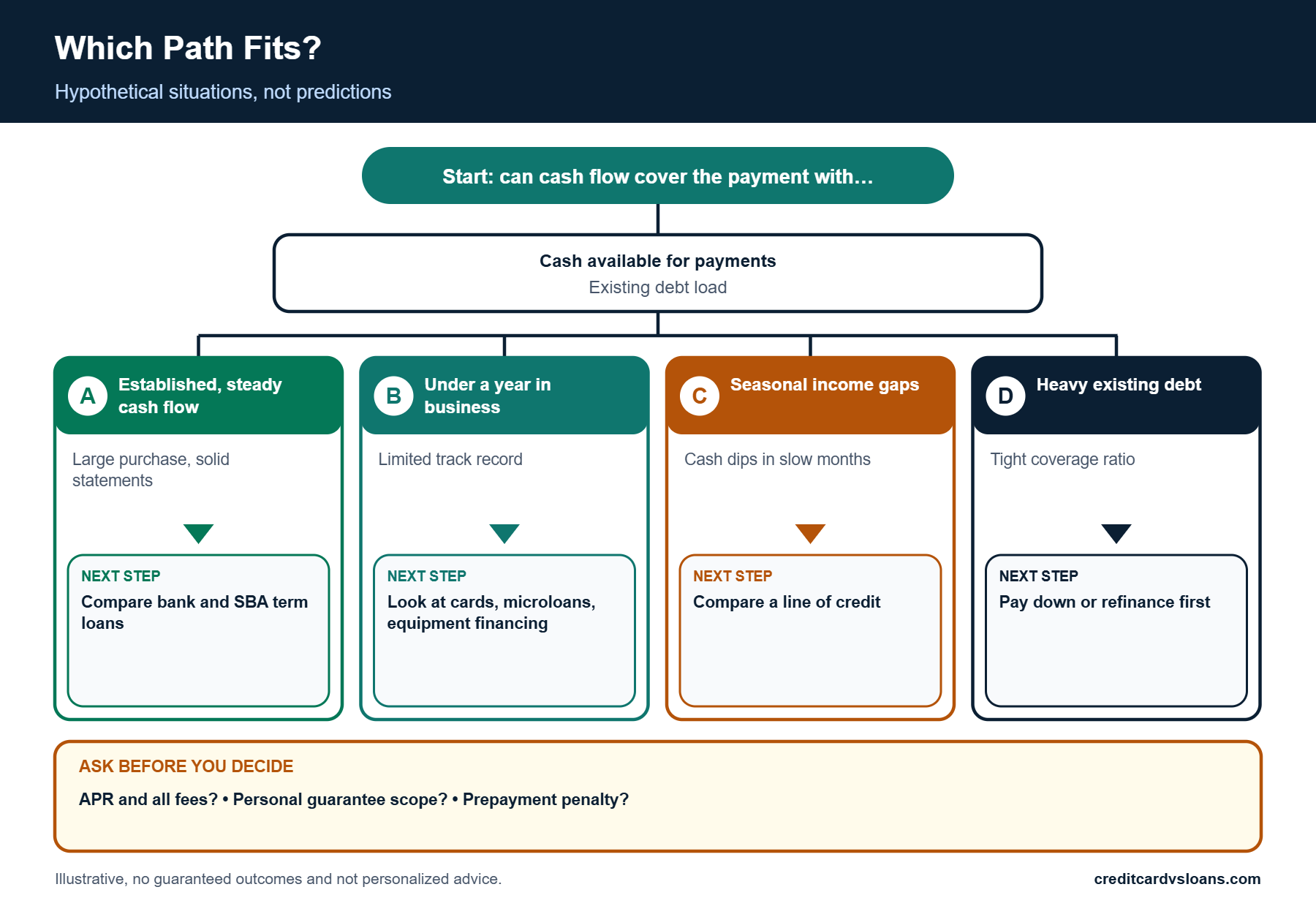
The profiles below are hypothetical illustrations, not real borrowers and not predictions. Each shows how the requirements discussed above can point toward different products to investigate. Use them to organize your own thinking, then confirm everything with actual offers.
Notice that the best next step is usually to fix or match one thing, not everything at once. A business rarely needs to be perfect on every requirement; it needs to be strong where its chosen lender looks hardest.
The matrix
| Situation | Products to investigate | Why | What to verify | When to avoid |
|---|---|---|---|---|
| Established business, steady cash flow, wants a large purchase | Bank or SBA-backed term loan | Cash flow supports a fixed payment | APR, fees, guarantee scope, prepayment terms | If the payment leaves almost no cushion |
| Under a year old, limited history | Business card, microloan or equipment financing | Lower reliance on track record | Variable rate, intermediary terms, collateral | If you would need to carry a large card balance |
| Seasonal income with cash gaps | Line of credit | Draw only when needed | Renewal terms, fees, draw limits | If the gap is a permanent shortfall |
| Heavy existing debt, tight ratio | Refinance or smaller loan after paydown | Improve coverage before borrowing more | Total cost of refinancing, any penalties | If new debt only delays the problem |
| Real estate or long-life equipment | SBA 504 or equipment loan | Long terms match the asset | Down payment, fixed or variable rate, lien terms | If you need working capital or inventory funding |
| Offer requires fee before funding | Pause and verify | Advance-fee pitches are a known warning sign | Lender identity, written terms | Always, until verified |
Applying the Matrix to Your Own Numbers
A fast self-check
Take your last twelve months of data and answer five questions. What is my monthly cash available for debt payments? What would the new payment be at a realistic rate and term? What share of my existing cash flow is already committed? What would I have to pledge? And what happens to the business if revenue falls by a fifth for a few months?
If the answers leave you comfortable, you are in a good position to shop. If they raise concerns, you have identified the lever to work on before approaching lenders.
Stress-testing the plan
Lenders test whether a business can handle a bad month, and you should too. Run the numbers with revenue reduced and costs unchanged, and see whether the payment still fits. A loan that only works if everything goes right is a loan that can create the cash crunch it was meant to prevent.
Write down the decision rule you will follow, for example the largest payment you are willing to carry, before an enthusiastic loan officer or a time-limited offer influences you.
Your Business Loan Checklist, Common Mistakes and Next Steps
Mistakes That Quietly Weaken Applications
Applying before the numbers are ready
The most common avoidable mistake is applying before you know your own numbers. Owners who cannot state their monthly revenue, margin, existing debt payments and intended use of funds without checking tend to produce files that raise questions rather than answer them. A lender who has to guess will usually guess conservatively.
Spend a few hours on a one-page summary: revenue by month for the past year, fixed and variable costs, every current debt with balance and payment, and the amount you want with a sentence on why. That page becomes your guide for every conversation and every form.
Shotgunning applications
Submitting many formal applications in a scattered way can produce multiple hard inquiries and leave you managing conflicting offers. A better approach is to prequalify with a handful of lenders that fit your profile, learn their requirements, and submit full applications to the best matches within a short window. Keep a simple log of each lender, what was requested and what was offered.
Also avoid changing the story between lenders. If one lender is told the loan is for equipment and another for working capital, the inconsistency can surface when documents are compared, and credibility is hard to rebuild.
Questions to Ask Every Lender
About the loan itself
Ask the questions that surface cost and flexibility before you sign. A short list is below; keep it with you during calls.
- What are the APR, interest rate type and every fee, including origination, closing, servicing and late fees?
- Is the payment fixed or variable, and if variable, what index, adjustment schedule and cap apply?
- Is there a prepayment penalty, and can I make extra payments?
- Will you run a soft pull or a hard pull at this stage?
- When are funds disbursed, and are they paid in one amount or in stages?
About security and guarantees
Then ask about what you are putting on the line. These questions help you compare the true risk of two offers that look similar on rate.
- Is a personal guarantee required, and is it limited or unlimited?
- What collateral is required, and will you file a blanket lien?
- Under what conditions can the lender call the loan early?
- Are there financial covenants I must meet, and what happens if I miss one?
- Will you report my payments to business and personal credit bureaus?
A 30-60-90 Day Plan
Days 1 to 30: get oriented
In the first month, collect your documents and pull your credit reports. Review the reports for errors, list every debt, build the one-page summary and decide what amount and term the business can comfortably support. Separate business and personal finances if they are still mixed.
Also check whether you qualify as a small business under the SBA’s size standards for your industry, and use Lender Match to see which lenders are interested in your profile if an SBA-backed loan is on your list.
Days 31 to 90: improve, compare and decide
Use the second and third months to act on the weakest requirement. Pay down revolving balances, resolve any open collections, let a few cleaner months of statements build and compare at least two or three offers. Prequalify where possible, then submit full applications within a short window.
When offers arrive, compare total repayment, not just the monthly payment. Re-run the stress test with your actual numbers, and be ready to walk away from an offer that only works in the best case.
Questions Owners Often Ask After a Decline or an Offer
How soon can I apply again after a denial?
There is no universal waiting period set by law for private lenders; each lender has its own policy, and some will reconsider quickly if something material has changed. The more useful question is what changed. A new application with the same numbers and the same credit file is likely to get the same answer, and it adds another inquiry. Fix the cited reason first, document the improvement and then reapply, ideally with a different lender or product if the first lender’s standards were the barrier.
Should I accept a smaller amount than I asked for?
It depends on whether the smaller amount still solves the problem. In the Federal Reserve’s 2025 survey, 36% of applicants received some or most of what they sought, which means partial approvals are common. A partial approval can be a sensible fit if the project can be phased, but it can be a trap if the shortfall forces you into a second, more expensive loan. Ask yourself what you would do with the remaining gap before you accept.
Do online lenders have lower requirements?
Sometimes the requirements differ rather than drop. Online lenders often move faster and may lean on bank-connected data, and medium- and high-risk applicants were much more likely to apply to them in the Fed’s survey. But online lender borrowers also reported more challenges, with high interest rates the most common, and 60% of online lender borrowers said the cost was higher than expected, compared with 37% at small banks and 32% at large banks. Speed can be worth paying for when time matters, but price the convenience before you accept.
After You Borrow: Records, Reporting and Staying on Track
Keep the loan healthy
Set up automatic payments from the business account, keep a cushion equal to at least one payment, and review your debt service coverage each quarter. If revenue starts to dip, talk to the lender early, because many lenders are more flexible before a payment is missed than after. Keep records of every payment and every communication.
Use the loan to strengthen your next application
A loan repaid on time can become part of your story for the next one, provided the lender reports to the bureaus that matter. Ask at the start whether payments are reported to business credit bureaus, personal bureaus or both. Over time, a documented record of on-time payments, steady revenue and declining debt is the most persuasive requirement any lender can see.
Conclusion: Matching Your Business to the Right Requirement Set
The bottom line
Business loan requirements are less a pass-fail exam than a fit test. Strong cash flow, a reasonable track record, credit you have checked, a manageable debt load and honest documentation give most lenders what they look for, and when one piece is weak you can often shift to a product or lender that weighs it differently. Compare total cost, understand what you are pledging, and be wary of anyone who asks for money before offering a loan.
If you remember one rule of thumb, make it this: borrow the amount your cash flow clearly supports, on terms you have read in full, from a lender you have verified.
Your next steps
- Write a one-page summary of twelve months of revenue, costs, debts and the amount you need.
- Pull your personal credit reports and check your business credit file; dispute errors.
- Compute your own debt service coverage with a realistic payment and a one-fifth revenue dip.
- Decide what you will and will not pledge, and read any guarantee in full.
- Prequalify with a few lenders of different types, including an SBA lender if you fit, and log what each requires.
- Compare APR, fees, total repayment and flexibility, then decide whether a card, line of credit or term loan fits best, using our guide to business cards versus business loans if you are unsure.
- Never pay an upfront fee for a promised loan, and report suspected scams at ReportFraud.ftc.gov.
- Business Credit Card vs. Business Loan: Which Fits Your Cash Flow?
- Should You Take Out a Personal Loan Just to Build Credit?
- Credit Card and Personal Loan Rate Outlook: September 2026 Borrower Brief
- Personal Loan With a 620 Credit Score: What to Expect
- Personal Loan With a 580 Credit Score: Realistic Expectations
- Credit Card vs. Personal Loan: Which Is Better for Borrowing?
- SBA: 7(a) loans (Maximum amount, eligibility, working capital pilot)
- SBA: 504 loans (Uses, eligibility and maturities)
- SBA: Microloans (Amounts, terms and intermediary lenders)
- SBA: Loans overview and Lender Match (Program overview and how to apply)
- SBA: Plan your business (Business plans, startup costs and business credit)
- Federal Reserve Banks: 2026 Report on Employer Firms: Small Business Credit Survey (2025 data) (Applications, approvals, denial reasons and personal guarantees)
- CFPB: Small business lending data (Section 1071) (Purpose and status of the small business lending data rule)
- FTC: FTC action and guidance on advance-fee loan scams (Red flags for advance-fee loan offers)
Last updated: October 22, 2026. Rates, fees and lender rules change; verify current terms before acting.
The information on creditcardvsloans.com is provided for general educational and informational purposes only. It is not financial, legal, tax, credit, accounting or investment advice, and reading it does not create an advisor-client, fiduciary or any other professional relationship. Nothing here is an offer, solicitation or recommendation to borrow, lend or apply for any product.
Credit scores, interest rates, fees, eligibility rules, lender policies and laws change frequently and vary by lender, location and individual circumstances. Examples, figures and scenarios are illustrative only, do not predict your results and do not guarantee approval, savings, a particular rate or a credit-score outcome. Always confirm current terms directly with the lender or issuer and read the full agreement before you apply or sign.
Although we aim for accuracy and use reputable sources, we make no representations or warranties, express or implied, about the completeness, accuracy, reliability or timeliness of the content. Content may be drafted with the assistance of automated tools, so errors or omissions may still occur. Links to third-party sites are provided for convenience; we don’t control and aren’t responsible for their content.
To the fullest extent permitted by law, creditcardvsloans.com and its owners, editors, authors, contributors and affiliates disclaim all liability for any loss, damage or expense arising directly or indirectly from your use of, or reliance on, this content. Before making financial decisions, consult a licensed professional, such as a qualified financial advisor, attorney, tax professional or nonprofit credit counselor, who can consider your complete situation.