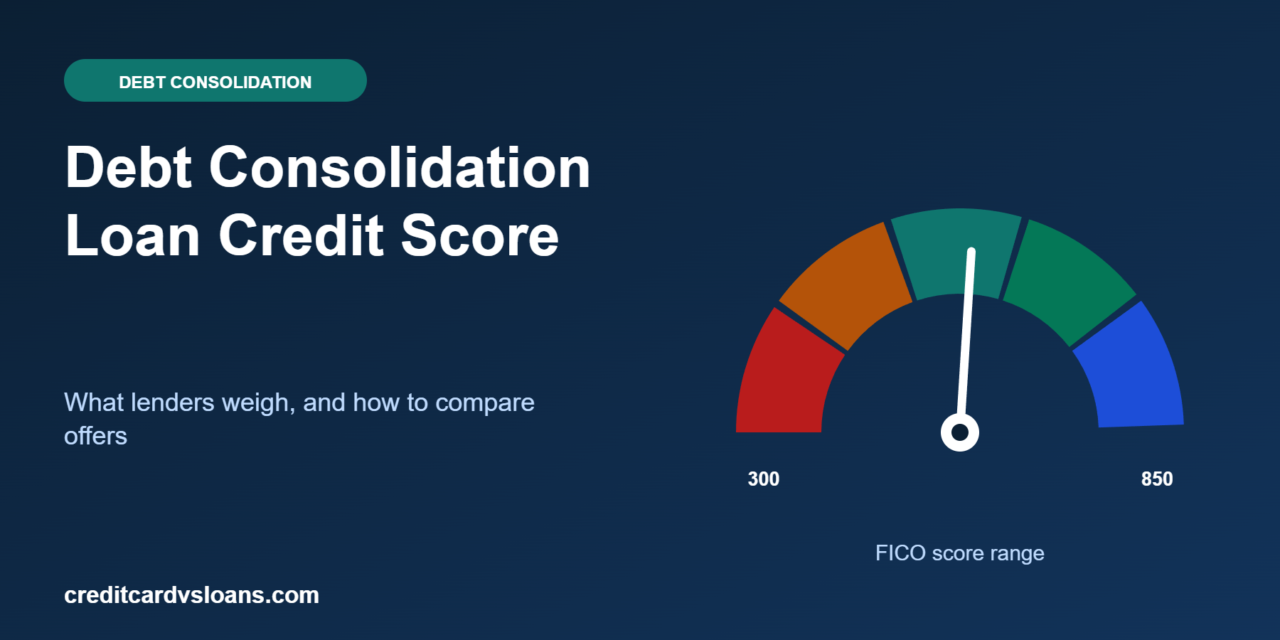
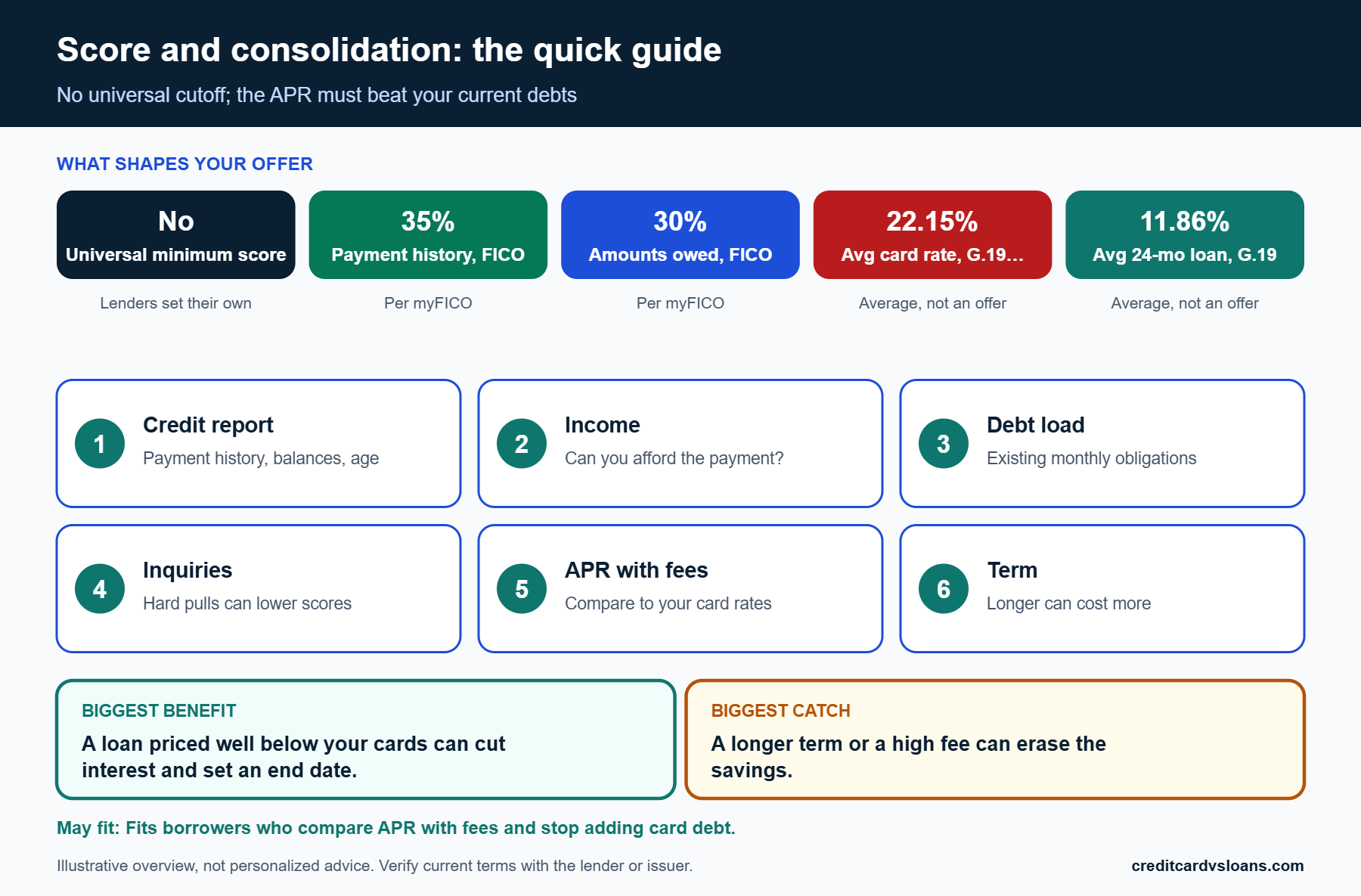
There is no single credit score that guarantees you a debt consolidation loan, and no official minimum that every lender uses. The practical answer to "debt consolidation loan credit score" questions is that lenders set their own standards, and a higher score generally gives you more options and better pricing, while a lower score tends to mean higher rates, smaller amounts or a denial. What matters is whether the loan you can actually get costs less than the debt you are trying to replace.
That last point is the one people skip. A consolidation loan is only a win if its APR, fees included, is meaningfully below what your cards charge and you stop adding new card balances. If your score pushes the loan's rate close to your card rates, the loan may simplify payments without saving money, and in some cases it can cost more.
This guide covers the credit score side: what lenders look at, how your score affects the price, what consolidation does to your score and what to do if your score is not where you want it. For the related question of a standard personal loan, see what credit score you need for a personal loan. Nothing here is a lender offer, and no one can promise approval, a rate or a score change.
- There is no universal minimum score. Lenders decide for themselves, and scores vary by model, data source and date, according to the CFPB.
- Lenders also weigh income, existing debt and your credit report details, not only the score.
- Compare the loan's APR with fees to the rates on the debts you would repay. The Federal Reserve's G.19 of Sept. 8, 2026 reported an average 22.15% on card accounts assessed interest and 11.86% on 24-month bank personal loans for Q2 2026. Those are averages, not offers.
- Consolidation can lower the payment by lengthening the term, which can raise total cost, as the CFPB warns.
- If the score is a barrier, nonprofit credit counseling and direct negotiation with creditors are worth checking first.
Rate averages come from the Federal Reserve's G.19 Consumer Credit release dated Sept. 8, 2026. Dollar examples are hypothetical and show method, not quotes.
The Short Answer: What Score Do You Need to Consolidate Debt?
Why there is no magic number
Each lender sets its own standards
Banks, credit unions and online lenders each use their own underwriting rules. They may use different scoring models, different cutoffs and different combinations of other factors. The CFPB notes that you do not have just one score, and that scores vary by model, data source and calculation date, so the number you see may not be the number a lender sees.
Anyone who says a particular score always qualifies, or never qualifies, is oversimplifying. A score is a signal that sits alongside income, debt and the story in your credit report.
What a higher or lower score tends to mean
The CFPB says higher scores generally make approval easier and can qualify you for better rates and terms. In practice, applicants with stronger files often see more offers, lower APRs and larger amounts, while applicants with weaker files may see fewer offers, higher APRs or requests for collateral or a co-signer.
Those are tendencies, not guarantees. A borrower with a strong score and a heavy debt load can be declined, while a borrower with a modest score and steady income can be approved.
Why the loan must beat your current rates
The point of consolidating is to pay less or to make repayment manageable. If the best offer you can get has an APR close to your cards', there may be no savings on interest. In that case, a lower monthly payment would come from a longer term, which the CFPB says can raise total cost.
Do the comparison before applying: list each debt, its balance and its APR, then compare the weighted average to the loan APR including any origination fee.
Which debts people consolidate
Credit card balances
Revolving card balances are the most common target. The Federal Reserve's G.19 shows average card rates well above average personal loan rates, which is why consolidation can save money for some borrowers. Your own rates, not the averages, decide whether it does.
If your cards are at a promotional or modest rate already, the math may not work. Check each statement before assuming.
Other debts to be careful with
Medical bills, payday-type loans, student loans and secured debts each have their own rules and protections. Moving federal student loans into a private loan, for example, may give up protections that the federal program provides. Check the rules before you convert one kind of debt into another.
If you are unsure, the CFPB and the FTC both recommend talking to a nonprofit credit counselor before making a move.
What Lenders Look at Besides Your Credit Score
The pieces of a credit decision
The credit report behind the number
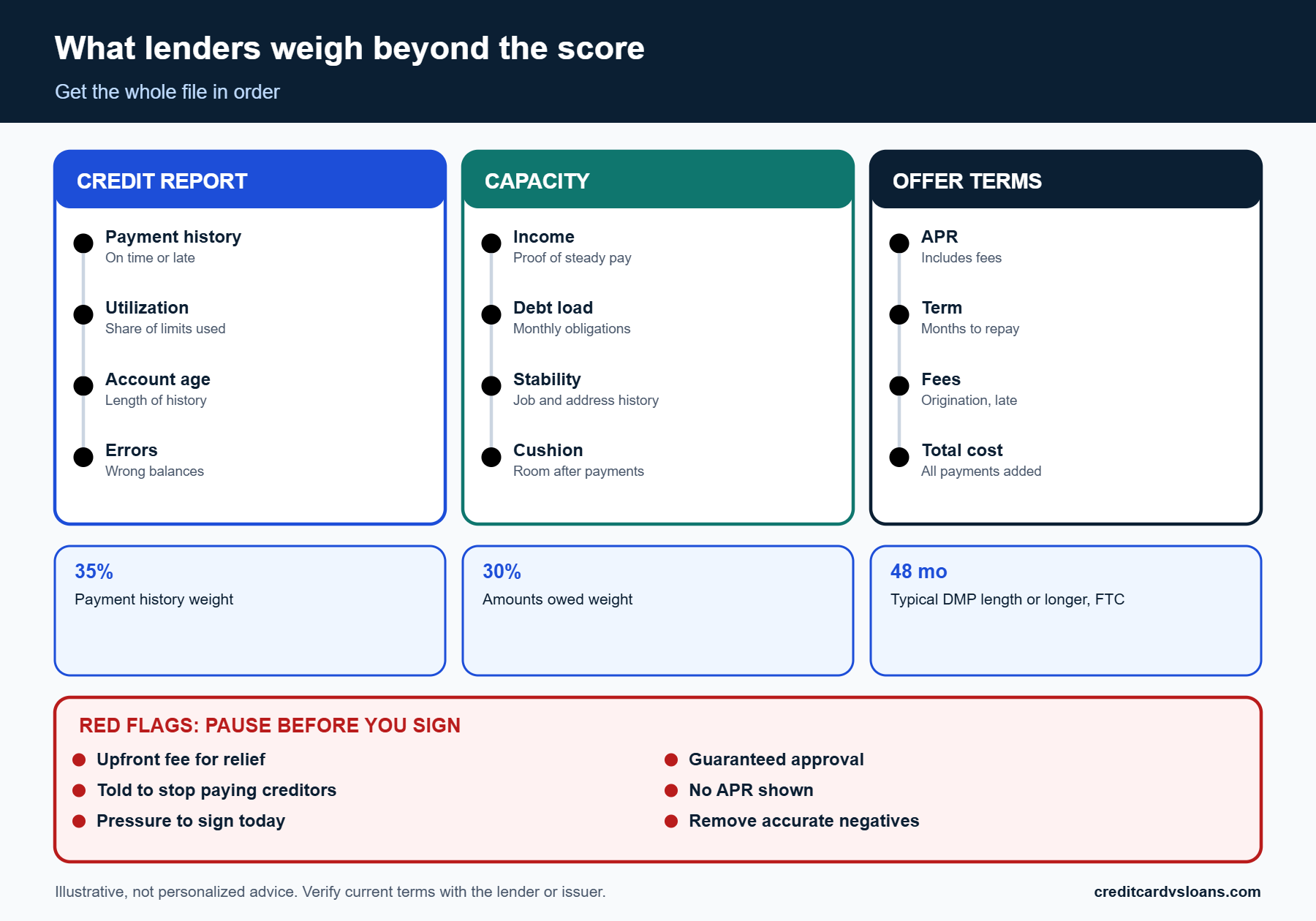
A score is calculated from your credit report. The CFPB lists the factors: payment history, current unpaid debt, the number and types of accounts, the age of your accounts, the share of available credit you are using, recent applications, and collections or bankruptcies and how recently they occurred. Two people with the same score can have very different reports.
Lenders can see the underlying detail. A single recent late payment, a collection or a maxed-out card can matter more to a particular lender than the headline number.
Income and debt-to-income
Lenders also care whether you can afford the payment. They typically compare your income with your existing monthly debt obligations, a ratio often called debt-to-income. Each lender sets its own limits, and none is universal.
If your debt payments already take a large share of your income, a consolidation loan may still be approved if it lowers your total monthly obligations. Lenders may ask for proof of income, so gather recent documents before you apply.
Why a good score does not guarantee approval
A strong score paired with a high debt load, short job history or thin documentation can still lead to a denial or a smaller loan. Conversely, a borrower with a lower score and a clear ability to repay may qualify, at a price.
The practical takeaway: get the whole file in order, not only the score. A summary view appears in Table 1.
| Factor | What it tells the lender | What you can do |
|---|---|---|
| Payment history | Whether you pay on time; the largest factor in FICO Scores at 35%, per myFICO | Fix errors, set up autopay, bring accounts current |
| Amounts owed and utilization | How much of your revolving limits you use; 30% of a FICO Score, per myFICO | Pay balances down before applying where possible |
| Income and stability | Whether you can afford the new payment | Gather pay stubs, tax records, proof of other income |
| Existing debt load | How much of your income is already committed | Avoid new debt before applying |
| Recent applications | Hard inquiries can lower scores, per the CFPB | Prequalify with soft pulls, then apply once |
| Report errors or collections | Negative items and how recent they are | Check all three reports and dispute mistakes |
Where to see your own file
Your free reports and scores
You can request your credit reports for free and check them for errors. The CFPB says only you can see soft inquiries, such as when you check your own report, and they do not affect your scores. Some banks and card issuers also show a score at no charge, though it may be a different model from the one a lender uses.
Look for accounts you do not recognize, wrong balances, payments marked late that you made on time, and old items that should have aged off. Disputing real errors can help, but be wary of any company that offers to remove accurate negative information.
Prequalification and what it shows
Many lenders offer prequalification with a soft pull, which shows estimated rates and amounts without a hard inquiry. A prequalified offer is not a final approval, and the final rate can change after full underwriting.
Collect several prequalified offers, record the APR, term, fees and monthly payment of each, and compare them against your existing debts before you apply for any.
How Your Score Changes the Price of a Debt Consolidation Loan
Score tends to move the rate, which moves the total
Illustrative math on $15,000 of card debt
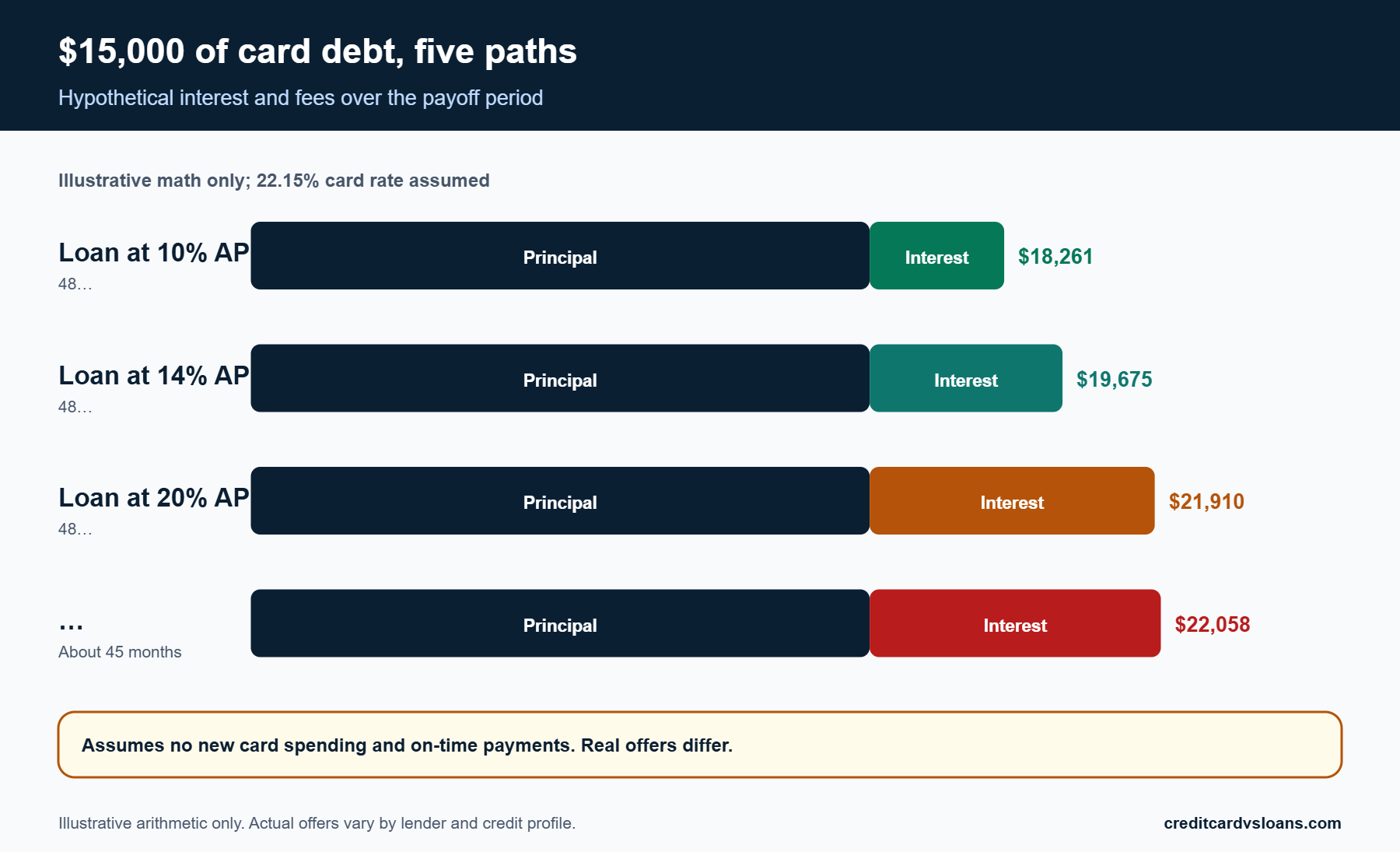
Table 2 compares a hypothetical $15,000 of card debt kept on cards at the Federal Reserve's 22.15% average, paid at two payment levels, with 48-month loans at three APRs. The loan APRs of 10%, 14% and 20% are placeholders for a range of outcomes a borrower might see, not quotes, and your real offers could fall outside them.
| Scenario | Monthly payment | Total interest and fees | Compared with keeping the cards at 22.15% |
|---|---|---|---|
| Loan at 10% APR | $380.44 | $3,261.06 | Large savings if the cards would take years |
| Loan at 14% APR | $409.90 | $4,675.06 | Savings, if the cards stay at zero |
| Loan at 20% APR | $456.46 | $6,909.86 | Little rate advantage; the fixed end date is the benefit |
| Loan at 14% with a 6% origination fee | $436.06 | $5,930.92 | Fee eats part of the savings |
| Cards, $500 per month at 22.15% | $500.00 | About $7,058 over about 45 months | Baseline |
| Cards, $400 per month at 22.15% | $400.00 | About $10,769 over about 65 months | Baseline |
What the table shows
At 10% or 14%, the loan cuts total interest by thousands of dollars compared with the cards in this example, and the payment is set so the debt ends in four years. At 20%, the interest savings shrink, because the rate is close to the card rate, though the fixed end date still has value if you would otherwise pay only minimums.
The fee row matters for borrowers with lower scores, who may be offered higher origination fees. With a 6% fee in this example, the total cost climbs by roughly $1,255 compared with the no-fee 14% loan. Compare APR, not just the interest rate.
The role of the card baseline
The two card rows show why the baseline is a range. Paying $500 instead of $400 a month shortens payoff by about 20 months and saves about $3,700 in interest in this example. The best alternative to a consolidation loan is not always paying minimums; it can be a higher fixed card payment.
If you can already afford $500 a month, a loan at a similar payment is only a win if its total cost is lower and it keeps you from running the cards back up.
Reading offers without being misled
APR beats the interest rate
The CFPB explains that APR includes the lender's fees, such as origination charges, on top of the interest rate, and lenders must disclose it under the Truth in Lending Act. Compare APR to APR across lenders and against the rates on your cards.
If an advertisement shows only a monthly payment, ask for the APR, term, fees and total of payments before you go further.
Beware of the lower-payment trick
A lower monthly payment often means a longer term, which the CFPB says can raise total cost. A 72-month loan will look gentler than a 48-month loan and cost more in interest at the same rate.
Pick the shortest term whose payment you can sustain with a cushion. A rule of thumb is to avoid stretching a loan so long that you are still paying for yesterday's spending in several years.
What a Debt Consolidation Loan Can Do to Your Credit Score
The mechanics, step by step
The application and the new account
Applying usually triggers a hard inquiry, which the CFPB says can lower your score because most models consider how recently and how often you apply for credit. A funded loan adds a new installment account, which can lower the average age of your accounts. These effects are usually modest and tend to fade, though results vary, and no one can promise them.
Prequalify with soft pulls first so that you apply only once. Several scoring models treat clustered inquiries for the same loan type more leniently, but the rules vary by model, so do not rely on it.
What happens to utilization
When loan proceeds pay off credit card balances, your revolving utilization, the share of your card limits in use, falls. Amounts owed make up 30% of a FICO Score, according to myFICO, which is why this change can matter. Our guide to credit utilization explains how it works.
The benefit depends on keeping the cards low afterward. If balances creep back up, the loan payment is added on top of new card debt, and the situation is worse than before.
Payment history is the long game
A consolidation loan gives you a new set of payments to make on time. On-time payments build positive history, and late payments damage it. Payment history is the largest category in a FICO Score at 35%, per myFICO.
Set up autopay and keep a small buffer in the account that funds it. See how a personal loan can affect your credit score for a deeper walk-through of the typical pattern over time.
Choices that protect your score
Keep old cards open, but quiet
Closing paid-off cards reduces your total available credit, which can raise utilization on the remaining ones and shorten your credit history over time. Unless an account has fees or you are tempted to misuse it, many borrowers keep it open and use it for a small recurring charge paid in full.
If the temptation to spend is strong, consider locking the card away or removing it from stored payment methods rather than closing the account.
Do not take on new debt during the process
New credit applications before or right after consolidating can complicate approval and can pile on hard inquiries. Avoid financing new purchases while you are mid-application.
If a lender asks for documents, respond promptly, since delays can push the closing date and leave your cards accruing interest for longer.
If Your Score Is Holding You Back: Options to Consider
Paths that do not depend on a high score
Credit counseling and debt management plans
The FTC explains that a credit counselor can review your finances and build a plan, and that a debt management plan can pay unsecured debts like credit cards, usually over 48 months or more, and may require you to avoid new credit. Look for an accredited counselor who gives fee quotes in writing and does not charge before doing any work.
Our guide to how a debt management plan affects your credit covers what to expect. A plan can be a fit when a loan is out of reach or too expensive, though it comes with its own trade-offs.
Talking to your creditors directly
The FTC advises contacting creditors early, before a debt collector gets involved, to ask for a lower interest rate or a payment plan you can afford. You can do this yourself for free. Keep records and get any agreement in writing.
The CFPB suggests asking about lower rates, lower payments, fee waivers or a due date that better fits your pay schedule. Not every creditor will agree, but the request costs nothing.
Balance transfers as a partial route
A balance transfer card with a promotional rate can handle a slice of the debt. The CFPB notes that the rate may rise after the promotion ends and that a transfer fee usually applies. Approval depends on your file, and our guides on credit scores for balance transfer cards and whether a balance transfer hurts your credit score explain the odds and effects.
This route works best when you can clear the transferred amount inside the window.
Building toward better terms
Steps that can help over months
Bring any past-due accounts current, pay down revolving balances, keep payments on time and fix errors in your reports. These steps tend to help a credit profile over time, though no one can promise how much or how fast.
If you are not in a hurry, rebuilding for several months before applying may produce better offers. If cards are accruing high interest right now, weigh the cost of waiting against the cost of a higher-priced loan.
A comparison of the options
Table 3 summarizes the main paths and what to watch for with each. The right choice depends on how much debt you have, how quickly you can repay and what your budget allows.
| Option | How it can help | What to watch |
|---|---|---|
| Nonprofit credit counseling | Review of your finances and possibly a debt management plan | Choose an accredited counselor with written fee quotes and no upfront charge, per the FTC |
| Negotiate with creditors | May get a lower rate or an affordable payment plan | Contact them early and get any agreement in writing |
| Balance transfer card | 0% window may cover part of the debt | Transfer fee, approval needed, and the rate after the promotion |
| Co-signer or secured loan | May improve approval odds or pricing | Another person or an asset is at risk if you fall behind |
| Home equity loan | Rates may be lower | Your home is at risk, per the CFPB |
| Wait and rebuild | Time, on-time payments and lower balances can improve a file | Cards keep accruing interest while you wait |
Risks, Scams and Red Flags in Debt Consolidation
Loan-side risks
The longer-term trap
The CFPB warns that a lower monthly payment from a consolidation loan often means a longer repayment term, which can raise total cost, and that fees can add to the expense. A loan that feels like relief can quietly cost thousands more than a faster payoff.
Ask for the total of payments and compare it with what you would pay on the cards at a payment you can actually make.
Running the cards back up
The most common way consolidation fails is that the cleared cards fill up again. The CFPB notes that consolidation alone will not help if spending exceeds income, and recommends identifying why you fell into debt and building a budget.
Consider a plan for the freed credit: a lower card limit, a locked card, or a rule that new card spending is paid in full each month.
Secured and home-based options
The CFPB says home equity loans may carry lower rates but put your home at risk, and closing costs can run from hundreds to thousands of dollars. If home values drop, you could owe more than the home is worth.
Turning unsecured card debt into secured debt changes what you stand to lose if things go wrong. Weigh that carefully.
Scam patterns to avoid
Advance fees and guaranteed results
The FTC warns against companies that demand upfront fees for debt relief or settlement, guarantee to settle all your debts, or tell you to stop talking to creditors without explanation. It also warns of offers to remove accurate information from your credit report.
A legitimate lender does not charge you before the loan funds and does not guarantee approval before reviewing your application. Our guide to predatory lending warning signs has a longer list.
Where to report problems
The FTC suggests reporting scams at ReportFraud.ftc.gov, to your state attorney general or to your local consumer affairs office. Keep copies of ads, emails and contracts.
If you have already paid a questionable company, stop sending money, gather your records and report it promptly.
Scenarios: What the Numbers Mean for Different Borrowers
Three hypothetical cases
The borrower with a strong file and large card balances
Imagine a hypothetical borrower with $15,000 on cards, steady income and a solid payment history. If prequalified offers land near the lower APR in Table 2, consolidating could cut interest meaningfully and end the debt in four years. The key risk is behavioral: the cards are now empty and tempting.
The borrower might lower card limits, move card autopay to full-balance payments and set a rule for any new card spending. Without that, the loan can add to the debt rather than replace it.
The borrower with a fair file
Now imagine a hypothetical borrower with the same balances, but with a few past late payments and high utilization. Offers might arrive at much higher APRs with origination fees. Table 2 suggests that at a 20% APR the interest savings versus 22.15% cards may be small.
This borrower should look at the whole picture: a fixed end date may have value, but credit counseling, a negotiated rate or a partial balance transfer might serve better. Rebuilding the file for a few months and reapplying is also an option.
The borrower on the edge
Consider a hypothetical borrower whose debt payments already consume most of their income. A consolidation loan may not fix the underlying gap, and being approved for a loan is not the same as being able to afford it. A nonprofit counselor can review the whole budget and discuss a debt management plan or other solutions.
Our guide to debt management plans and credit describes that path in more detail.
A profile table
How to use Table 4
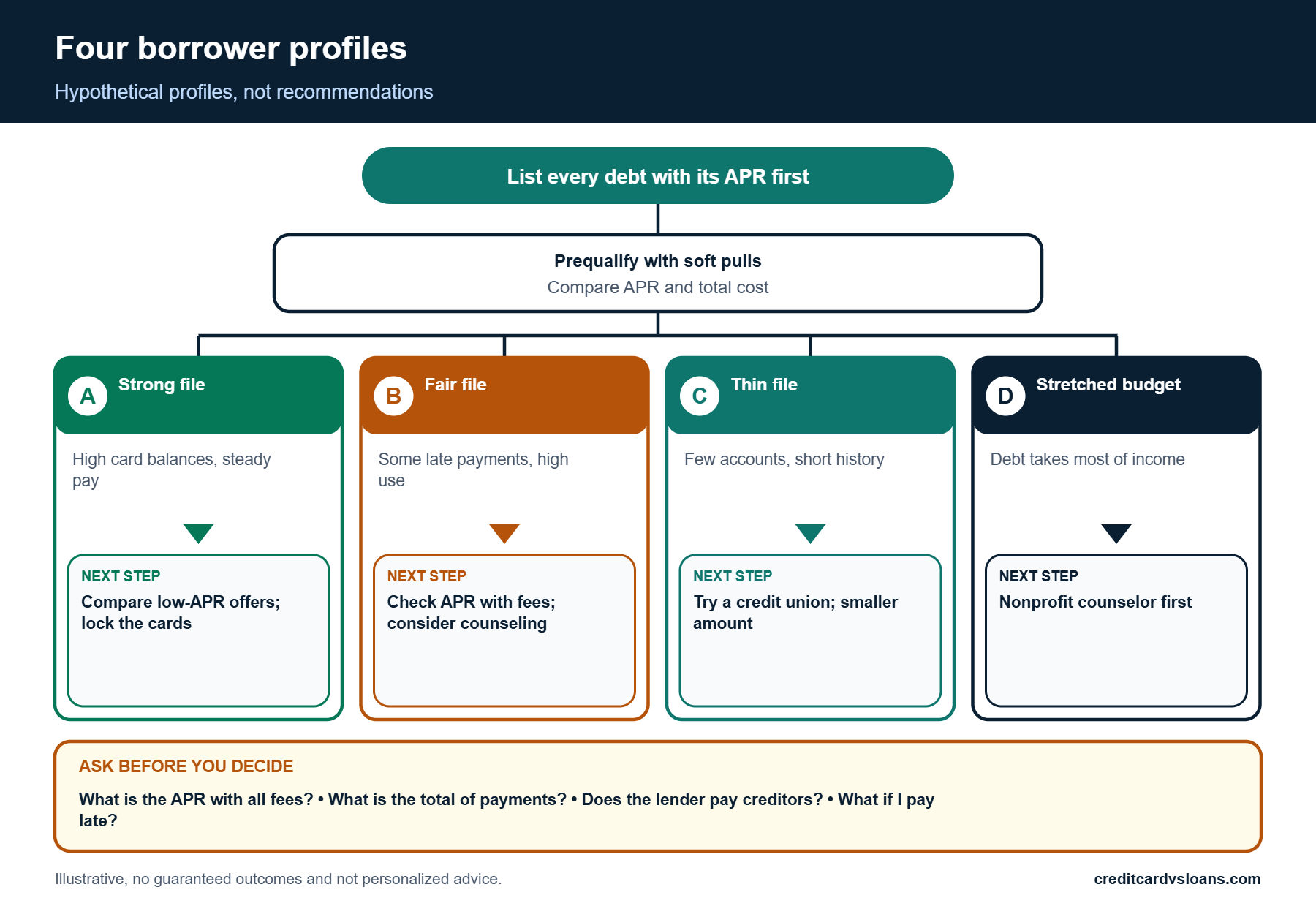
Find the profile closest to yours and read across. The table is a prompt for the right questions, not a prediction of any lender's decision.
| Profile | What may happen at application | Key question |
|---|---|---|
| Strong history, high card balances | More offers, lower APRs likely | Will I stop using the cards once they are paid off? |
| Fair history, steady income | Offers with higher APRs and fees | Is the APR with fees clearly below my card rates? |
| Recent late payments | Fewer offers, possible co-signer request | Should I bring accounts current and wait? |
| Thin credit file | Smaller amounts, higher rates | Would a credit union or a counselor serve me better? |
| Debt exceeds what income can support | Denial, or a loan that deepens the problem | Do I need a debt management plan or other relief first? |
A sensible order of operations
Check your reports, list your debts with their APRs, prequalify, compare APR and total cost, and only then apply. If the numbers do not clearly beat your current path, pause and look at alternatives.
This order protects your score from unnecessary hard inquiries and your budget from a loan that sounds better than it is.
How to Shop for a Consolidation Loan Without Hurting Your Score
Where to look and what to ask
Banks, credit unions and online lenders
Different lender types set different standards and prices. Credit unions and community banks sometimes offer more flexible underwriting for members, while online lenders often advertise quick decisions and prequalification. Rates, fees and eligibility vary, so there is no safe assumption about which will be cheapest for you.
Ask each lender whether prequalification uses a soft pull, what the origination fee is, whether there is a prepayment penalty and whether the lender pays your creditors directly. Direct payment to creditors can reduce the temptation to spend the money elsewhere.
Questions worth asking every lender
Request the APR, term, fees, monthly payment and total of payments in writing. Ask what happens if you pay late, whether there are autopay discounts and how quickly funds are disbursed. Ask whether the lender reports to all three credit bureaus, since reporting on-time payments is part of how a loan helps a file.
Keep a simple comparison sheet. Seeing three offers side by side often makes the best choice obvious, and it reveals lenders whose answers are vague.
Timing your applications
Do your prequalification within a short stretch so that you can compare offers on the same day and with the same credit information. When you are ready, submit one application, to the best option. Multiple hard inquiries can lower scores, according to the CFPB, and models treat them differently.
If a prequalified offer disappears after full underwriting or comes back worse, ask for the reason. You may be entitled to an explanation, and the answer can point to something in your report worth fixing.
Preparing your file before you apply
Documents and details to gather
Collect recent pay stubs, tax documents or other proof of income, a list of debts with balances and APRs, and identification. Having these ready can speed up underwriting and reduce back-and-forth.
Make sure the personal details on your reports and applications match exactly, including addresses and employer names. Small mismatches can slow approval.
Small moves that may help before applying
Paying a card down before the statement closes can lower reported utilization. Bringing any past-due account current and avoiding new credit applications for a short stretch can also help. Results vary, and no step guarantees approval or a particular rate.
Do not take drastic steps, such as closing accounts or opening new ones, in a rush. Keep it simple and focus on on-time payments and accurate information.
Your Debt Consolidation Checklist and Next Steps
Decide whether a loan is the right tool
The three-number test
Compare three numbers: the weighted average APR of the debts you would repay, the APR of the loan including fees, and the total of payments under each plan. If the loan does not beat the current path on total cost and keep the payment affordable, think twice.
Add one qualitative test: will the loan help you change behavior? A fixed end date helps some people, and others only shift the problem to a new account.
What to do if the answer is no
If the numbers do not work, a nonprofit credit counselor, a negotiated payment plan or a balance transfer for part of the debt may serve better. The CFPB recommends talking to a nonprofit credit counselor for free guidance.
If you are in trouble with payments, act early. Options narrow as accounts go further past due.
A next-step list
Work through this list in order.
- Pull your credit reports and dispute any errors.
- List every debt with its balance, APR and minimum payment.
- Prequalify with soft pulls at two or three lenders, including a credit union if you can.
- Compare APR, fees and total of payments against your current plan.
- If a loan wins, apply once, set autopay and have the lender pay creditors directly if offered.
- Lower card limits or lock the cards, and set a rule for new card spending.
Review the plan again in three months to confirm that balances are falling.
Final guidance
What your score does and does not decide
Your score influences your options and your price, but it does not decide whether consolidation is a good idea. A well-priced loan with a plan to avoid new debt can help. A poorly priced loan, or any loan without a spending plan, can make things worse.
Treat the score as one input. The decision rests on APR, fees, total cost and your ability to keep the payments going.
If you want to read next
For the broader question of how a loan interacts with your score, see how a personal loan affects your credit score. For nonprofit options, see debt management plans and credit. For warning signs, see predatory lending and debt relief red flags.
Each of those goes deeper than this guide can without repeating itself.
The bottom line
There is no universal score cutoff, so shop with prequalified offers, compare APR and total cost against your current debts, and borrow only if the loan clearly beats the alternative.
Let the loan's APR with fees, its total cost and your plan for the cards decide, not the score alone.
Questions that decide close calls
Should you consolidate if you only have two or three cards?
With a handful of cards and a clear payoff plan, simplicity may matter less than price. If one card has a much higher APR than the others, paying that one first, sometimes called the avalanche approach, can capture most of the interest savings without a new loan. A consolidation loan is more useful when you have many accounts, scattered due dates or rates that are uniformly high.
Consider the cost of a new loan, including fees and a hard inquiry, against what you would save. If the savings are small, a focused payoff plan may be enough.
Whichever approach you pick, automate it. A plan that depends on remembering several due dates every month will eventually fail, and a single autopay removes that failure point.
Does it matter which debt you pay off first with the loan?
If the loan does not cover everything, use it on the highest-APR debts first, since each dollar there costs the most. Leave low-rate debts alone unless you have a reason to move them. Check whether any debt carries a prepayment penalty or special protections you would lose by paying it off early.
Direct payment from the lender to your creditors, where offered, lowers the chance that the funds drift to other spending. If the money lands in your account, pay the targeted balances the same day.
How long until you can tell whether it worked?
A good sign appears within the first few months: card balances are near zero, the loan payment is on time, and your monthly cash flow is steadier. Score changes vary by person, and you should not expect a particular outcome or timing.
At the three-month mark, review your statements. If card balances are creeping up, adjust right away, by cutting card spending, lowering limits or revisiting the budget. A quick correction costs far less than a year of drift.
Finally, keep your payoff date in view. Each on-time payment shortens the road, and the date on which the loan ends is the goal that makes the whole plan worth it.
What if you are denied?
A denial is information. Lenders generally have to tell you the main reasons they turned you down, and you can use them to decide what to fix. Common themes include high utilization, recent late payments, thin history or an income that does not support the requested amount.
Ask for the specific reason, check your reports for errors and consider a smaller loan amount, a different lender type, or a co-signer if someone you trust is willing and understands the risk to their own credit. Avoid applying everywhere at once, since each hard inquiry can lower scores according to the CFPB.
If the denial reflects a budget that cannot support the debt, the better move may be a nonprofit credit counselor or a direct request to your creditors for a hardship arrangement. Those routes do not depend on your score in the same way, and they address the root of the problem rather than shifting it.
Give yourself a plan and a date to reapply or to reassess. Writing down what you will change and by when turns a disappointing answer into a concrete next step.
One more safeguard is worth the effort: after the loan funds, take a screenshot or note of each paid-off card showing a zero balance, and check the next statement to confirm the payoff posted. Occasionally a payment is applied late or a small residual balance remains, and a leftover few dollars of interest can quietly keep an account open on the books.
Also keep the loan agreement, the payoff confirmations and the lender's contact details together in one place. If a payment is ever misapplied, those records make the correction quick, and they give you a clear paper trail if a dispute arises later.
Finally, remember that a loan is a tool and not a verdict on you. Plenty of careful people carry card balances after an emergency, a job change or a rough year, and the useful question is always forward-looking: which path gets you to zero at the lowest total cost with a payment you can keep paying.
- Federal Reserve: Consumer Credit – G.19 (release of Sept. 8, 2026) (Average card and 24-month personal loan rates, Q2 2026)
- CFPB: What do I need to know about consolidating my credit card debt?
- CFPB: What is a credit score?
- CFPB: What is a credit inquiry?
- CFPB: What is the difference between a loan interest rate and the APR?
- CFPB: What is the difference between credit counseling and debt settlement, debt consolidation, or credit repair?
- FTC: How To Get Out of Debt
- myFICO: What’s in your credit score (Category weights)
Last updated: October 22, 2026. Rates, fees and lender rules change; verify current terms before acting.
The information on creditcardvsloans.com is provided for general educational and informational purposes only. It is not financial, legal, tax, credit, accounting or investment advice, and reading it does not create an advisor-client, fiduciary or any other professional relationship. Nothing here is an offer, solicitation or recommendation to borrow, lend or apply for any product.
Credit scores, interest rates, fees, eligibility rules, lender policies and laws change frequently and vary by lender, location and individual circumstances. Examples, figures and scenarios are illustrative only, do not predict your results and do not guarantee approval, savings, a particular rate or a credit-score outcome. Always confirm current terms directly with the lender or issuer and read the full agreement before you apply or sign.
Although we aim for accuracy and use reputable sources, we make no representations or warranties, express or implied, about the completeness, accuracy, reliability or timeliness of the content. Content may be drafted with the assistance of automated tools, so errors or omissions may still occur. Links to third-party sites are provided for convenience; we don’t control and aren’t responsible for their content.
To the fullest extent permitted by law, creditcardvsloans.com and its owners, editors, authors, contributors and affiliates disclaim all liability for any loss, damage or expense arising directly or indirectly from your use of, or reliance on, this content. Before making financial decisions, consult a licensed professional, such as a qualified financial advisor, attorney, tax professional or nonprofit credit counselor, who can consider your complete situation.