When you compare a credit card vs personal loan for holiday spending, the card usually wins if you can pay the bill in full within a couple of billing cycles, and a personal loan or a true 0 percent promotion usually wins if you need several months and want a fixed finish line. Neither is the right tool if the plan depends on carrying a balance into next summer, because holiday gifts do not hold value the way a car or a house does, and interest makes every present cost more.
The decision comes down to four questions: how much you will spend, how fast you can repay it, what rate and fees you would actually pay, and how much structure you need to stay on track. This guide compares both tools side by side using hypothetical math and the average rates published by the Federal Reserve, and it adds lower-cost alternatives to consider first.
The examples are general education, not advice about your finances. Offers vary by lender and by borrower, so treat the numbers as a yardstick for questions to ask, not as a promise about what you will be offered.
- Cards fit short, planned payoffs. If you will clear the balance within one to three statements, a card can cost little and offers payment protections.
- Loans fit longer payoffs. A fixed payment and end date help if you need six to twelve months, but an origination fee can wipe out the rate advantage on a small amount.
- The average card rate is high. At an illustrative 22.36 percent, $3,000 of gifts repaid over 12 months adds about $376 in interest.
- A 0 percent promotion is not always free. Deferred-interest offers can charge interest back to the purchase date if the balance is not paid in full by the end.
- Plan first, borrow last. A spending plan that lists recipients and a budget before shopping often removes the need to borrow at all.
Rate figures come from the Federal Reserve’s G.19 consumer credit release of October 7, 2026, which reports August 2026 data as preliminary. They are averages, not offers, and your own rate may be higher or lower.
Table of contents
The short answer: credit card vs personal loan for holiday spending
How the two tools usually compare
When a credit card is the better fit
A card is the better fit when the amount is modest, the payoff is quick and you value flexibility. You can spread purchases across many stores, you do not need a separate application for each one, and a balance that is cleared by the due date may not cost interest at all, as long as you normally pay your statement in full. The Consumer Financial Protection Bureau also points out that cards can offer consumer protections, for example when an item arrives broken, which is useful for online gift shopping.
The weakness appears the moment a balance carries over. Rewards earned on holiday purchases are small compared with interest at typical card rates, and the minimum payment can stretch a balance across years. If you cannot name the month in which the balance will be zero, the card is probably the wrong tool.
When a personal loan is the better fit
A personal loan is a better fit when the amount is larger, you need more than three or four months to repay, and you want a fixed payment with a clear end date. It also separates the holiday debt from your everyday card, which makes it easier to track. For borrowers who qualify near the Federal Reserve’s 11.90 percent average for a 24-month personal loan, the interest can be roughly half of the average card rate.
The catch is fees and timing. Some lenders charge an origination fee, funding can take days, and minimum loan sizes may be higher than a small gift budget. A loan also adds a hard inquiry and a new account. Compare it carefully with the alternatives in our guide to choosing between a credit card and a personal loan.
Why holiday spending is a different kind of borrowing
Nothing comes back
Borrowing for a refundable deposit or a car that holds value is different from borrowing for gifts, food and travel that are gone by January. There is no asset to sell and no refund to apply to the balance, which means the debt must be paid entirely from future income. That is why even a modest interest rate matters more than it first appears: every dollar of interest is a dollar spent on nothing you can see.
The practical consequence is to keep holiday borrowing small and short, and to treat the payoff date as part of the gift budget, not as something to figure out in January.
Many small purchases add up
Holiday spending is spread across gifts, food, decorations, travel, shipping and events. Because each purchase feels small, the total is easy to underestimate. A realistic list of recipients and costs often reveals that the total is higher than expected, and that is the moment to adjust the plan rather than reach for credit. Our guide on using a 0 percent APR card for holiday spending explains how promotional offers fit into that plan.
Keep a running total in a notes app or spreadsheet as you shop, so the card statement never surprises you.
Plan your holiday budget before choosing a way to pay
Start with the spending plan
Budget, list and limits
The CFPB’s five-step holiday spending plan, published in an archived blog post, starts with a budget. It suggests covering regular bills and rent first, adding known holiday costs such as hosting or travel, and treating what is left as gift money. It also recommends making a list of recipients, checking it before you shop, and adopting a personal rule such as skipping anything not on the list. Those habits can reduce the amount you need to borrow before any lender is involved.
Add a line for shipping, wrapping, event tickets and tips, which often fall outside the gift list. A plan that leaves out these items is the most common source of a surprise balance in January.
Track spending as you go
The same CFPB plan recommends tracking what you buy and checking periodically whether you are sticking to your budget. A simple weekly check against the total can catch overspending when it is still small. If you are running ahead of plan by mid-December, cut a category or scale back a gift, rather than adding to a balance you will carry for months.
This is also the point to decide how you will pay for each category: cash from the budget, a card you will clear in full, or, for a larger planned expense, a loan with a set repayment schedule.
Decide how to pay with a plan to finish
Cash, debit and credit have different trade-offs
The CFPB notes that carrying only the cash you planned to spend keeps you within budget, while credit cards offer protections and spare you from carrying large amounts of cash. If you use a card, it advises having a specific plan to pay the bill and setting the money aside in your budget. That last part is the one most people skip. Putting the payment in your budget in October is easier than finding it in January.
Debit cards and cash do not create debt, but they also offer fewer protections on purchases in some situations. Compare what matters most to you: protection, rewards or avoiding interest.
A payoff date is part of the plan
Before you borrow, write the date on which the balance will be zero and the monthly amount needed to get there. If the amount does not fit, shrink the spending or lengthen the timeline with a lower-cost structure, such as a short loan with a fixed payment. Our guide on whether to borrow now or wait for a better credit score explains how timing affects cost.
A written payoff date also makes it easier to see when a 0 percent promotion is expiring, which matters for the offers discussed next.
Using a credit card for holiday spending
What a card does well
Flexibility, protections and rewards
A card lets you buy as needed across many merchants, tracks every purchase on one statement and typically lets you dispute a charge if a problem arises. Some cards offer rewards, which can offset part of the cost if you pay the statement in full. The benefit disappears if you carry a balance, so rewards should not drive the decision to borrow. Our comparison of rewards cards and low-interest cards looks at how the choice changes depending on whether you pay in full.
Because cards are revolving credit, there is no fixed end date. You choose the payment each month, which is both the flexibility and the risk.
Introductory 0 percent offers
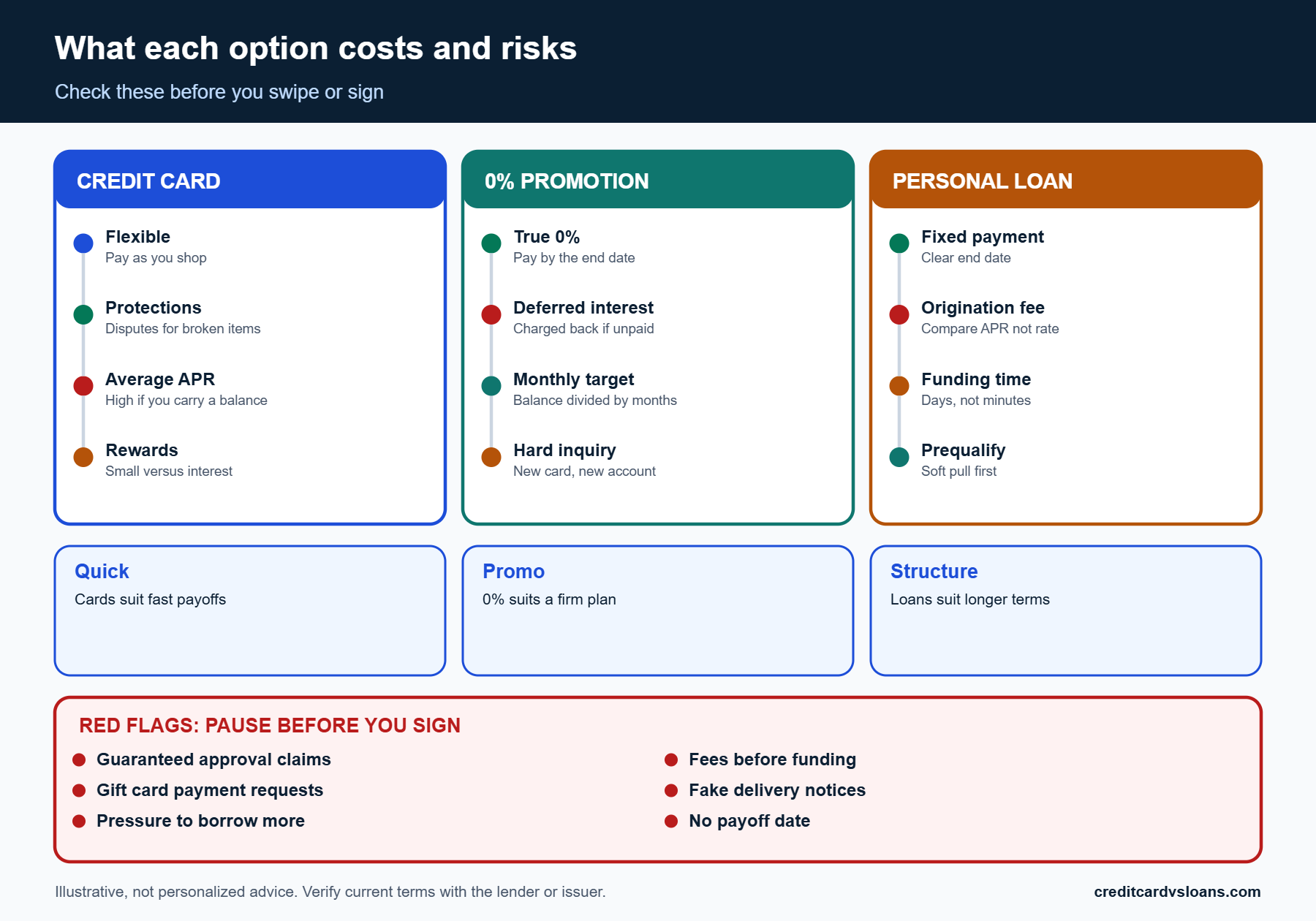
Some cards advertise 0 percent on purchases for a set period. If you repay before the promotion ends, you pay no interest. The CFPB explains that a deferred-interest plan is different: interest still accrues during the period but is waived only if the full balance is paid on time, and if not, it can be charged back to the original purchase date. Check the terms, mark the end date and divide the balance by the number of months to set a monthly target.
Hypothetically, suppose you charge $3,000 on a deferred-interest card and pay $200 per month for 12 months. You would still owe $600 at the end, and interest accrued on the balances you carried during the promotion, roughly $425 at an illustrative 22.36 percent rate, could be added. Paying $250 per month would have cleared it.
What a card costs if you carry a balance
The Federal Reserve’s average card rate
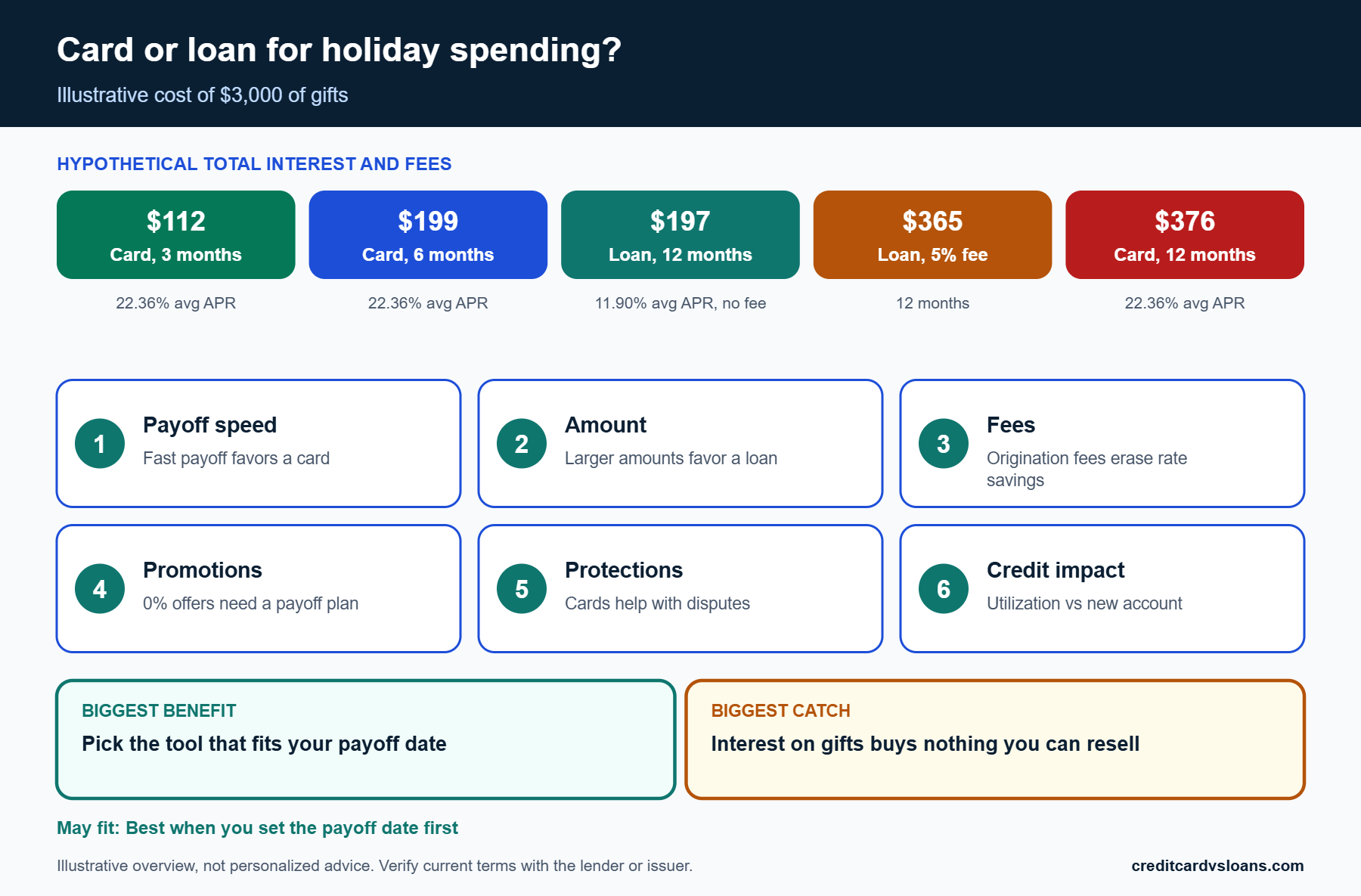
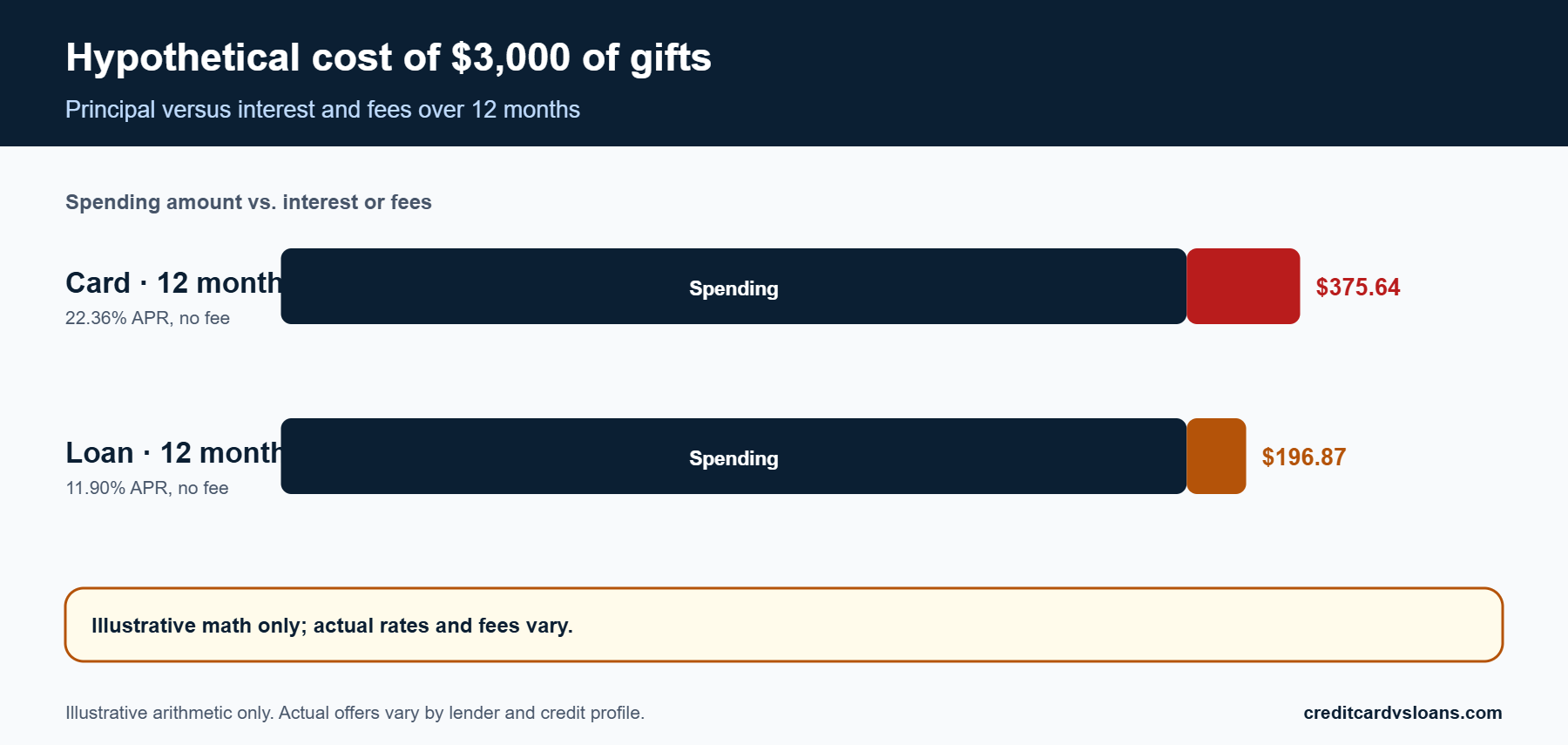
The Federal Reserve’s G.19 release of October 7, 2026 reports an average credit card interest rate of about 22.36 percent for accounts assessed interest in August 2026 (preliminary), compared with 22.15 percent in the second quarter. At that illustrative rate, $3,000 repaid over 3 months costs about $1,037.50 per month and $112.49 in interest. Over 6 months it is about $533.11 per month and $198.66 in interest. Over 12 months it is about $281.30 per month and $375.64 in interest.
Why slow payoff multiplies the cost
Interest is charged on the balance you carry, so slower payoff means more months of interest. Paying only the minimum on a $3,000 balance can stretch the payoff across years. Pick a fixed monthly payment, not the minimum, and automate it. If you also use the card for everyday spending, track the holiday balance separately so it does not disappear into the totals.
| Repayment period | Monthly payment | Total interest | Share of spending lost to interest |
|---|---|---|---|
| 3 months | $1,037.50 | $112.49 | 3.7% |
| 6 months | $533.11 | $198.66 | 6.6% |
| 12 months | $281.30 | $375.64 | 12.5% |
Using a personal loan for holiday spending
How a personal loan works for a one-time seasonal expense
A fixed payment and a firm end date
A personal loan pays a lump sum that you repay in equal monthly installments. That structure removes the temptation to make minimum payments, and it gives the holiday debt a clear finish line, such as next November or the following spring. If you know a balance will take most of a year to clear, that predictability can be worth more than the flexibility of a card.
The Federal Reserve’s G.19 release of October 7, 2026 reports an average 24-month personal loan rate of about 11.90 percent for August 2026 (preliminary), compared with 11.86 percent in the second quarter. At that illustrative rate, $3,000 repaid over 12 months costs about $266.41 per month and $196.87 in interest, before fees.
Timing and minimums
Funding can take from one to several business days after approval, and some lenders set minimum loan amounts that exceed a small gift budget. If your holiday shopping starts this week, a loan may arrive after the best sales have ended. The better use of a loan is a planned, larger expense, such as travel or hosting costs, where you can apply a few weeks ahead and compare offers calmly. Our guide on comparing a card and a loan for back-to-school expenses works through the same timing question for another seasonal bill.
Prequalify with a soft pull where available so you can compare real offers without a hard inquiry on your credit report.
Fees, terms and what changes the math
Origination fees on small loans
An origination fee is a percentage of the loan charged by some lenders. On a small loan, a fee can cost as much as the interest you save. Hypothetically, a 5 percent fee means borrowing about $3,158 to receive $3,000. The 12-month payment becomes about $280.43, and the total cost beyond $3,000 is about $365.13, nearly the same as the $375.64 on the card over the same period. The rate looked better, but the fee closed the gap.
Always compare offers by annual percentage rate, which includes fees, and confirm whether early repayment is allowed without a penalty.
Longer terms lower the payment and raise the cost
A 24-month term on the same $3,000 at 11.90 percent lowers the payment to about $141.08 but raises total interest to about $385.93, and with a 5 percent fee the total cost is about $564.14. Holiday gifts will be long gone while you are still paying for them. Choose the shortest term whose payment fits comfortably in your budget, and avoid stretching the payments past the point where the debt feels like a bill for something you no longer remember buying.
If the payment on a short term does not fit, that is a signal to reduce spending, not to extend the loan.
| Option | Illustrative rate | Term | Monthly payment | Total cost beyond the $3,000 |
|---|---|---|---|---|
| Card, paid fast | 22.36% APR | 6 months | $533.11 | $198.66 interest |
| Card, slow payoff | 22.36% APR | 12 months | $281.30 | $375.64 interest |
| Personal loan, no fee | 11.90% APR | 12 months | $266.41 | $196.87 interest |
| Personal loan, 5% fee | 11.90% APR | 12 months | $280.43 | $365.13 fee and interest |
| Personal loan, no fee | 11.90% APR | 24 months | $141.08 | $385.93 interest |
| Personal loan, 5% fee | 11.90% APR | 24 months | $148.51 | $564.14 fee and interest |
Head to head: which tool fits which holiday situation
When the card tends to win
Small budgets and fast payoff
If your total holiday spending is $1,500 or less and you will repay it within three months, a card is hard to beat. At an illustrative 22.36 percent rate, $1,500 repaid over 3 months costs about $518.75 per month and $56.24 in interest, while a loan may not be available at that size without a fee. A card also avoids a new application and a hard inquiry if you already have a suitable one.
The condition is discipline: the same flexibility that makes a card convenient makes it easy to add more spending and push the payoff date back.
You will earn protections and rewards you can use
If you pay the statement in full, rewards and purchase protections are real advantages. A rewards card can return a small percentage of spending, and the CFPB notes that cards can help if an item arrives broken. The benefit applies to the purchases themselves, not to the interest you pay if you carry a balance, so treat rewards as a bonus rather than a reason to borrow.
Compare rewards with the cost of carrying a balance before relying on them. At an average rate above 22 percent, even a generous rewards rate is quickly outweighed by interest.
When the loan tends to win
Larger budgets and a longer timeline
If you plan to spend $3,000 or more and need six to twelve months to repay, a personal loan can give you structure and potentially a lower rate than the average card. For borrowers who qualify near the Federal Reserve’s 11.90 percent average, the interest on a 12-month, $3,000 loan is about $197, roughly half the card’s $376 over the same period, provided there is no origination fee.
If your credit profile leads to a rate near the card’s, or the fee is high, the advantage shrinks. Compare quotes before assuming the loan is cheaper.
You want the debt separated and capped
A loan can help if you tend to let card balances drift. It keeps holiday spending in one account with one payment, and it prevents new charges from getting mixed in. Our guide to 0 percent APR cards compared with personal loans explains how a promotional offer can sit between the two options when the timeline is short.
If you already have other debts, a new loan can add to your monthly obligations, so check that the payment fits comfortably before you apply.
| Feature | Credit card | 0% promotional card | Personal loan |
|---|---|---|---|
| Best amount | Under about $1,500 | Any amount you can clear by the end date | $3,000 or more |
| Repayment | Flexible, no end date | Fixed promotional window | Fixed payment and end date |
| Typical cost | High average APR | No interest if paid in time | Interest plus any fee |
| Speed | Immediate | Days to apply | Days to fund |
| Main catch | Carrying a balance | Deferred interest if unpaid | Fees and a hard inquiry |
Credit score effects, January bills and the risks of borrowing for the holidays
How borrowing can touch your credit profile
Utilization and statement timing
A large holiday charge can push a card’s utilization, the share of the limit in use, higher than usual, and the balance reported on the statement date is what scoring models tend to see. If you can pay the card down before the statement closes, the reported balance may be lower. A personal loan is installment credit, so it does not count toward revolving utilization in the same way, but it adds a new account and a hard inquiry. No one can promise how a particular score will react, because it depends on the rest of your file.
If you expect to apply for a mortgage, auto loan or apartment in the next few months, consider how new accounts and high balances might look to that lender, and time your borrowing accordingly.
Payment history matters more than the tool
Whichever tool you use, on-time payments are the part of your credit profile you control most directly. Set up automatic payments for at least the minimum, plus a reminder for the larger payment you planned. A missed payment can mean a late fee and a negative mark, which costs more than most holiday interest. If you must miss a payment, call the lender before the due date, because many offer hardship options.
The risks that show up in January
The holiday debt hangover
The most common risk is not a dramatic loss but a slow drag. A $3,000 card balance paid at only the minimum can follow you into the next holiday season, when you will want to spend again. Each year the unpaid balance raises the starting point, which is how seasonal spending turns into long-term revolving debt. Set a payoff date that comes before the next season, and treat it as non-negotiable.
If you already carry a balance from earlier in the year, consider whether holiday spending should be reduced. Adding to existing debt at a high rate is the costliest combination.
Pressure, scams and impulse buys
Black Friday and year-end sales create urgency that can lead to overspending, and scammers use the same season to send fake delivery notices, phony retailers and gift card requests. Use a card, which generally offers stronger dispute options than a debit card or a cash transfer, and avoid paying a stranger by gift card or wire. Our guides on gift and seasonal spending, including 0 percent card offers for the holidays, include practical checks.
A rule of thumb is to wait a day before any purchase that was not on your list. The sale will often still be there, and your budget will thank you.
Be cautious of lenders who promise guaranteed approval, charge fees before funding, or push you to borrow more than your plan needs. A legitimate lender discloses the APR, fees and total cost before you sign. If you are unsure, pause and compare more offers.
| Question | Why it matters | Where to check |
|---|---|---|
| What is my total budget and payoff date? | Prevents open-ended borrowing | Your spending plan |
| Is the 0% offer deferred interest? | Interest may be charged back if unpaid | Card terms and disclosures |
| What is the APR including fees? | Fees change the real cost of a small loan | Loan disclosure |
| Can I repay early without a penalty? | Lets a bonus or refund shorten the debt | Loan or card agreement |
| Does the payment fit after January bills? | Avoids missed payments | Your budget |
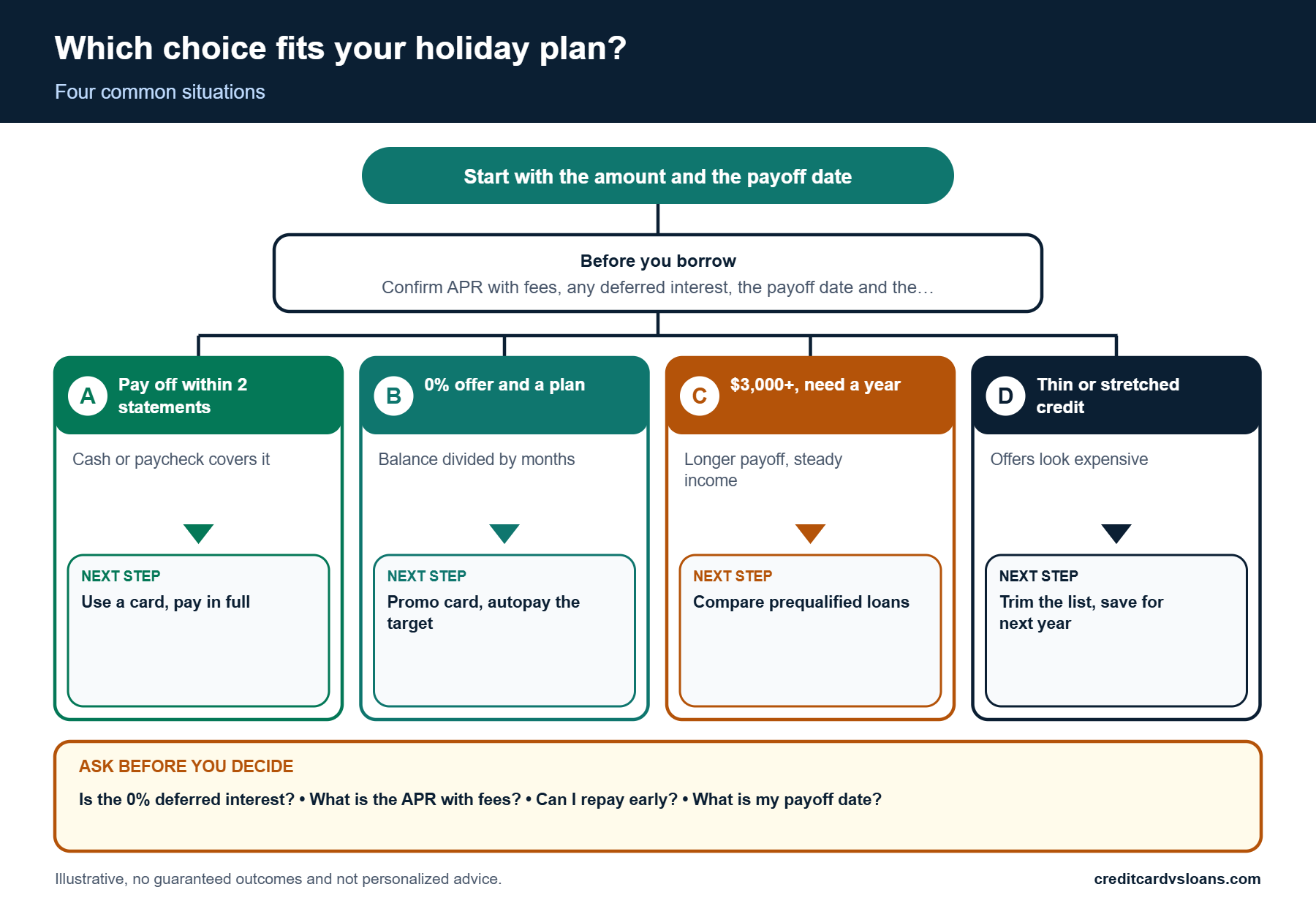
Four holiday-spending situations and the choice that tends to fit
When you can repay quickly
You will pay the whole bill within one or two statements
If your paycheck, bonus or savings will clear the holiday spending within a couple of months, use the card you already have and skip the loan. The interest will be small or zero if you pay the statement in full, and you keep the purchase protections. Put the payoff amount in your budget on the day you make the purchase, and avoid adding unrelated charges to the same card.
At the illustrative 22.36 percent rate, even $1,500 left for three months costs about $56 in interest, which is a modest price for convenience but still money you could have used for another gift.
You have a clear 0 percent promotion and a plan
A true 0 percent introductory rate on purchases can make the cost of a few months close to zero, as long as you divide the balance by the number of promotional months and pay that amount on time. Treat deferred-interest offers with extra caution, because missing the payoff can add back interest from the purchase date. Our guide on 0 percent APR cards for holiday spending covers the fine print.
If you do not already hold a suitable card, weigh the cost of a hard inquiry and a new account against the interest you would save.
When you need months, not weeks
You will spend $3,000 or more and need a year
For a larger planned expense repaid over six to twelve months, a personal loan at a competitive APR can give you a fixed schedule at a lower rate than the average card. Prequalify with several lenders, compare APR including fees, and ask about early repayment. The illustrative 12-month cost of $3,000 is about $197 without a fee and about $365 with a 5 percent fee, so the fee can decide the winner.
If every quote includes a significant fee or a high rate, scale back the spending instead of accepting expensive terms.
Your credit is thin or your budget is already stretched
If your credit is limited or you already carry balances, borrowing for gifts can be costly or unavailable. Focus on lower-cost options such as a smaller gift list, shared gifts, homemade presents, a savings plan for next year, or help from family. Payday-style and title loans carry costs far above the options in this guide and are a poor match for a seasonal expense.
A secured card or a credit-builder product can be a better long-term step than a rushed holiday loan. It builds a payment history that helps you qualify for better rates next year.
If the numbers still do not work
Trim the plan before you add debt
If the payment you would need for a short payoff does not fit your budget, the cheapest fix is a smaller plan. Cut the gift list, set a per-person limit, agree on a group gift exchange, or move part of the spending to a later month. Reducing a $3,000 plan to $2,000 cuts the illustrative 12-month card interest from about $376 to about $250, and it removes a month of worry.
Spread the cost earlier next year
A separate savings account with a small automatic transfer each payday can turn next year’s holiday spending into cash. Saving $100 every two weeks from January builds about $2,600 by December, with no interest and no January bills. It is a slow answer to this year’s problem, but it is the most reliable way to avoid facing the same decision next season.
Write down your total holiday budget, the cash you have, the amount you can add by your next paycheck and the gap. Borrow only the gap, for the shortest term your budget supports, and decide the payoff date before you swipe or sign.
Your holiday borrowing checklist and the bottom line
A step-by-step way to decide
Before you shop or apply
Write the total budget and the list of recipients. Add shipping, wrapping, travel and event costs. Check how much you can pay from cash and from the next two paychecks, and compute the gap. Decide the payoff date first, then compare a card you already hold, a 0 percent promotion and a prequalified personal loan by APR, fees and total cost. If you also face other one-time bills, compare the whole picture with our guide on credit cards and personal loans.
Ask each lender or card issuer for the APR, fees, repayment term and any early payoff rules in writing. Do not accept a rate you cannot explain.
After you choose a plan
Set automatic payments, log every purchase and review the balance weekly. Keep receipts and delivery confirmations in one folder in case you need to dispute a charge. Put any tax refund, bonus or gift money toward the highest-interest balance first. In January, confirm the statement matches your tracking, and adjust the payoff plan if spending ran over.
If your income changes, call the lender early. A hardship conversation before a missed payment keeps more options open than one afterward.
Frequently asked questions
Is a credit card or a personal loan cheaper for holiday spending?
It depends on the amount, the term and the fees. For a short payoff, a card you already have may cost the least. For a larger balance repaid over many months, a personal loan with a competitive APR and no fee can cost less than the average card rate. Compare the total cost of each offer before choosing.
Can a personal loan hurt my credit more than a card?
Each has effects. A card raises utilization if the balance is high, and a loan adds a hard inquiry and a new account. Both can lower a score briefly, and both can help over time if you pay on schedule. The effect depends on your whole credit file, so no one can promise a specific result.
Should I use a 0 percent card for holiday spending?
It can be a low-cost bridge if you know the offer’s terms, divide the balance across the promotional months and pay on time. If the offer is deferred interest, missing the payoff can add back interest from the purchase date. Our comparison of 0 percent APR cards and personal loans explains the differences.
What if I cannot repay by the end of the promotion?
Plan for that possibility before you start. Know the rate that applies after the promotion, check whether deferred interest applies, and consider moving the remaining balance to a lower-cost option if you qualify. Paying more than the minimum each month is the simplest protection.
Does a personal loan make sense for under $1,000 of gifts?
Usually not. Many lenders set minimum amounts, and an origination fee on a small loan can cost more than the interest you would save over a card. For a few hundred dollars, a card you will clear within a couple of statements, a smaller gift list or a payment from your next paychecks is typically cheaper and faster than a new loan.
When should I start planning holiday spending?
As early as you can, ideally months before the shopping season. Even a modest weekly transfer into a separate account lowers the amount you might borrow, and starting early gives you time to compare offers without the pressure of a sale ending tomorrow. If you are reading this in late November, write the plan today and decide the payoff date before your first purchase.
Whatever you decide, write the numbers down: the budget, the gap, the rate, the fee and the date the balance reaches zero. A plan you can see is a plan you are more likely to follow.
Final answer: choose the cheapest, shortest path
How to put the pieces together
The order that usually costs least
For most households, the lowest-cost order is a spending plan and cash first, a card you will clear in full second, a true 0 percent promotion third, and a personal loan last for larger, longer repayments. That is the practical answer to credit card vs personal loan for holiday spending: use the cheapest tool that fits your timeline and keeps the payoff date firm.
Each step adds cost or risk, so move down the list only as far as the budget requires.
Next steps
- Set a total holiday budget and a recipient list.
- Pick a payoff date before you borrow.
- Compare APR and fees on a card, a promotion and a prequalified loan.
- Check whether any 0 percent offer is deferred interest.
- Set automatic payments and review the balance weekly.
Mistakes that make holiday debt more expensive
Paying the minimum and hoping for a refund
A tax refund or bonus is not a plan unless it has already arrived. Paying only the minimum and waiting for a windfall leaves interest running and can push the payoff date past the next holiday. Use fixed payments instead.
Mixing holiday spending with everyday charges
When holiday spending shares a card with groceries and fuel, it is hard to know how much remains. Track the holiday balance separately, or use a separate card or loan so you can see the payoff progress.
Choose a credit card when you can clear the bill in a few statements, a true 0 percent offer when you can divide the balance by the promotional months, and a personal loan when you need a longer, fixed schedule at a lower all-in cost. Whichever you pick, set the payoff date before you borrow.
- Credit Card vs. Personal Loan for Back-to-School Spending: Which Is Better?
- Credit Card vs. Personal Loan: Which Is Better for Borrowing?
- 0% APR Credit Cards for Holiday Spending: Smart Tool or Debt Trap?
- Rewards Credit Card vs. Low-Interest Card: Which Saves More?
- 0% APR Credit Card vs. Personal Loan: Which Is Cheaper?
- Borrow Now or Improve Your Credit First? A Cost-Based Decision Guide
- Federal Reserve: Federal Reserve G.19 Consumer Credit release (October 7, 2026) (Average card and personal loan rates, August 2026 preliminary)
- CFPB: A five-step spending plan to avoid holiday debt (Budget, list, payment method and tracking (archived blog))
- CFPB: What is a deferred interest promotion? (How deferred-interest promotions charge back interest)
Last updated: October 22, 2026. Rates, fees and lender rules change; verify current terms before acting.
The information on creditcardvsloans.com is provided for general educational and informational purposes only. It is not financial, legal, tax, credit, accounting or investment advice, and reading it does not create an advisor-client, fiduciary or any other professional relationship. Nothing here is an offer, solicitation or recommendation to borrow, lend or apply for any product.
Credit scores, interest rates, fees, eligibility rules, lender policies and laws change frequently and vary by lender, location and individual circumstances. Examples, figures and scenarios are illustrative only, do not predict your results and do not guarantee approval, savings, a particular rate or a credit-score outcome. Always confirm current terms directly with the lender or issuer and read the full agreement before you apply or sign.
Although we aim for accuracy and use reputable sources, we make no representations or warranties, express or implied, about the completeness, accuracy, reliability or timeliness of the content. Content may be drafted with the assistance of automated tools, so errors or omissions may still occur. Links to third-party sites are provided for convenience; we don’t control and aren’t responsible for their content.
To the fullest extent permitted by law, creditcardvsloans.com and its owners, editors, authors, contributors and affiliates disclaim all liability for any loss, damage or expense arising directly or indirectly from your use of, or reliance on, this content. Before making financial decisions, consult a licensed professional, such as a qualified financial advisor, attorney, tax professional or nonprofit credit counselor, who can consider your complete situation.