A 0 apr card for holiday spending can be a sensible way to spread a planned gift budget over several months, or a slow-motion debt trap, and the difference usually comes down to one thing: whether you have a payoff date in writing before the first purchase. The interest-free window helps only if every dollar is repaid inside it. This guide answers “0 apr card holiday spending” directly, then shows the numbers and trade-offs behind it.
The season makes this harder than it sounds. Offers arrive just as spending peaks, the first bill lands in January when other costs are high, and promotional language varies from true 0% to “no interest if paid in full,” which behaves very differently if you miss the deadline. Add rewards, store discounts and urgency, and it is easy to charge more than you meant to.
This guide is about the holiday use case specifically: how to size the spending, what the offer really promises, how to schedule the payoff, and when to skip the card altogether. For the difference between a transfer promotion and a purchase promotion, see our explainer on 0% balance transfer APR versus 0% purchase APR. Everything here is general information, not personal advice, and card terms vary by issuer.
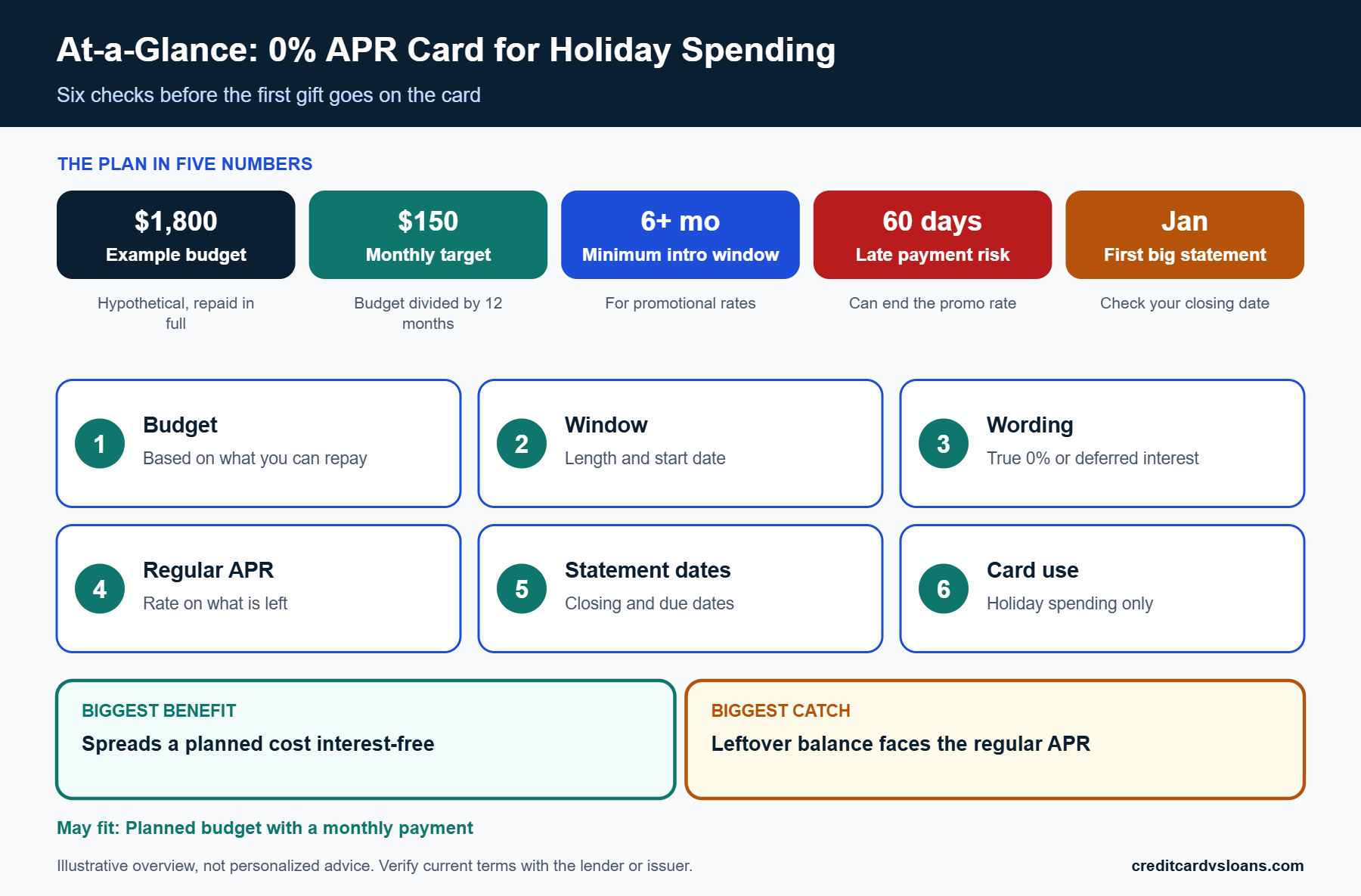
- A 0% purchase window is a payment schedule with a deadline. Divide the total by the number of months in the window to find your monthly target.
- A true 0% offer charges interest only on what remains after the window. Deferred interest can charge interest back to the purchase date if the balance isn’t paid in full.
- If you carry a balance, purchases on most cards can accrue interest from the transaction date, so a holiday card is easiest to manage when it holds only holiday spending.
- The first holiday statement can arrive in December or January depending on your billing cycle. Check your statement dates before you shop.
- If you can’t name the monthly payment and the end date, the safer path may be a smaller budget funded from cash flow.
Rate averages come from the Federal Reserve’s G.19 consumer credit release of October 7, 2026. Rules cited are Regulation Z provisions and CFPB consumer guidance as of October 2026. Offers and card terms change often, so confirm every detail in the terms of the card you are considering.
Table of contents
Quick Answer: Smart Tool or Debt Trap?
When a 0 apr card for holiday spending can be a tool
You have a budget and a payoff date
The offer works best for spending you already planned. If you’ve set a gift and travel budget, know your monthly income after bills, and can name the number of months in which you’ll repay, a 0% window lets you smooth the cost without interest. A $1,800 holiday budget over a 12-month window is $150 a month, and that number is the plan.
It also helps when cash is tight in December but dependable later, such as when a bonus or tax refund is expected. Even then, treat the expected money as uncertain until it arrives and set the monthly target so that you can meet it without relying on a windfall.
You keep the card for the planned purchases only
A dedicated card makes the arithmetic easy. When the card holds only holiday purchases, the balance on the statement is the balance you owe, and each payment visibly reduces it. If the card also carries an older balance, the picture is muddier, and the CFPB notes that on most cards purchases can accrue interest from the transaction date when you carry a balance.
If you do have an older balance, consider whether a transfer offer is the better tool. The step-by-step approach in our guide to using 0% balance transfer cards without a debt trap applies to that situation, not to holiday gifts.
When it tends to become a trap
The budget grows because the interest is zero
A zero rate removes the immediate cost of borrowing, which is exactly why spending drifts upward. A $1,800 plan turns into $2,600 because each purchase feels cheap. The 0% promise only covers the interest, not the principal, and the principal still has to be repaid out of future income.
A practical guardrail is to set the budget before you look at the card’s limit. Decide the total you can repay by the end date, then choose the number of months, then compare cards. If the card’s limit is higher than your plan, treat the difference as unused room, not extra budget.
January arrives with other bills
Holiday charges usually show up on statements in December or January, when many households also face heating bills, insurance renewals or tax-season costs. If the monthly payment you planned is tight in that month, the plan has no buffer. Build the payment into your January budget at the start of the season, not after the statement arrives.
Also remember that the minimum payment is not the plan. The minimum is set to keep the account current, not to clear the balance by the end of the window. If you pay only the minimum, a balance will likely remain when the promotion ends.
How 0% Holiday Offers Work
True 0% purchase APR basics
The promotional window and the regular rate
A 0% purchase offer sets a promotional rate on new purchases for a stated number of months, followed by the card’s regular APR on any remaining balance. Under federal rules a promotional rate on a new card must last at least six months, and the issuer has to disclose its length and the rate that follows. Many offers run longer than six months; the exact length is in the offer terms.
The Federal Reserve’s G.19 release of October 7, 2026 reported an average credit card rate of 22.15% for accounts assessed interest in the second quarter of 2026. Your regular APR may differ, but a rate in that neighborhood shows what is at stake for any balance left when the window ends.
Grace periods and carrying a balance
A grace period lets you avoid interest on new purchases by paying the full balance by the due date, but the CFPB explains that it generally applies only if you weren’t already carrying a balance. During a 0% purchase window, you aren’t paying interest anyway, so the grace period matters less, but it can matter again when the window ends.
The practical lesson is to keep track of two dates: the end of the promotion, and the statement due dates leading up to it. A late payment can bring a fee and credit report consequences, and a payment more than 60 days late can end the promotional rate entirely.
Deferred interest is a different animal
How it works and the CFPB’s example
Some holiday promotions, especially on store cards, say “no interest if paid in full” within a stated period. The CFPB explains that with deferred interest, interest accrues during the promotion but is waived only if you pay the full promotional balance on time; if you don’t, interest is charged retroactively from the purchase date. In the CFPB’s example, a $400 television with $300 paid during a 12-month promotion left $100 owed under a true zero-interest offer but $165 under deferred interest.
The CFPB’s 2015 research, as described in its 2017 announcement, found that more than half of consumers with deferred-interest charges and other purchases on the account paid more than the full promotional balance during the promotional period, and more than a third paid over 150 percent of it. Many people who missed the deadline paid off the remainder soon after, suggesting the charges came as a surprise.
Why store cards deserve extra attention
The CFPB notes that store cards often carry higher regular rates than standard bank cards, and its 2017 announcement referred to rates of about 25 percent on retail cards using deferred interest. That is why a missed deadline can be costly. If you see a promotion at the register, ask whether it is a true 0% rate or deferred interest, and read the terms before you sign.
Check also whether the promotion applies to the purchase in front of you. Some offers apply only to purchases above a certain amount, and the promotional period can vary by purchase size. A promotion that looks flexible on the shelf can be narrower in the agreement.
| Feature | True 0% purchase APR | Deferred interest (“no interest if paid in full”) |
|---|---|---|
| How interest works | None during the window; charged only on what remains afterward | Accrues in the background; charged back to purchase date if not paid in full |
| Who it may fit | Planned spending with a monthly target | Only buyers certain to clear the full balance on time |
| Main advantage | Missing the deadline costs less | Can be interest-free if paid in full |
| Main drawback | Regular APR on any leftover balance | One missed dollar can trigger months of interest |
| Primary cost drivers | Window length, regular APR, payoff pace | Regular APR, purchase size, exact payoff amount and date |
What Holiday Borrowing Really Costs
A hypothetical $1,800 holiday budget
Three ways to pay for the same gifts
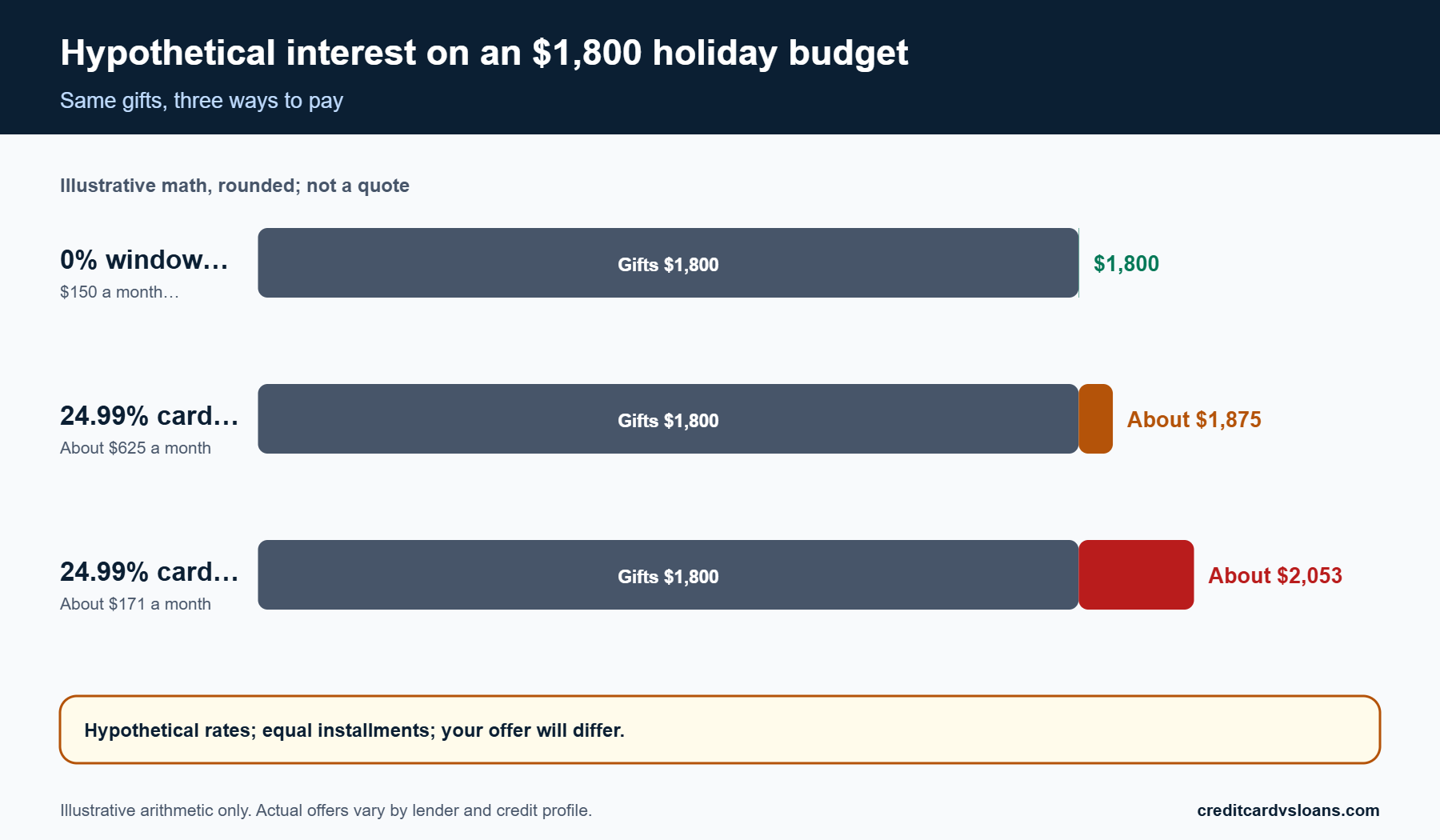
Here is an illustration, not a quote. Suppose you charge $1,800 in gifts, travel and food. On a card with a hypothetical 0% purchase window of 12 months, a $150 monthly payment clears it with no interest. On a card charging a hypothetical regular rate of 24.99%, paying the same $1,800 off in 12 equal installments would cost about $253 in interest, and paying it off in three installments would cost about $75.
The calculations use standard installment math at the stated rate and are rounded. The point isn’t the exact dollars; it is the scale. At rates in the low-to-mid 20s, which is close to the Federal Reserve’s reported average of 22.15% for accounts assessed interest in the second quarter of 2026, interest on a holiday balance repaid over a year adds up quickly, and a 0% window removes it only if you stay on schedule.
What the monthly target does for you
Dividing the total by the months in the window gives a target you can test against your budget. For $1,800, that’s $300 a month over six months, $200 over nine, or $150 over twelve. If the shortest schedule you can afford is longer than the window, the offer doesn’t fit and the budget is too high for the plan.
Then add a buffer. If you can reasonably pay $200 and your target is $150, you have room for a month when income dips. If your target equals your maximum, a single surprise expense can push the balance past the deadline.
What a missed deadline costs
Deferred interest: a $1,200 illustration
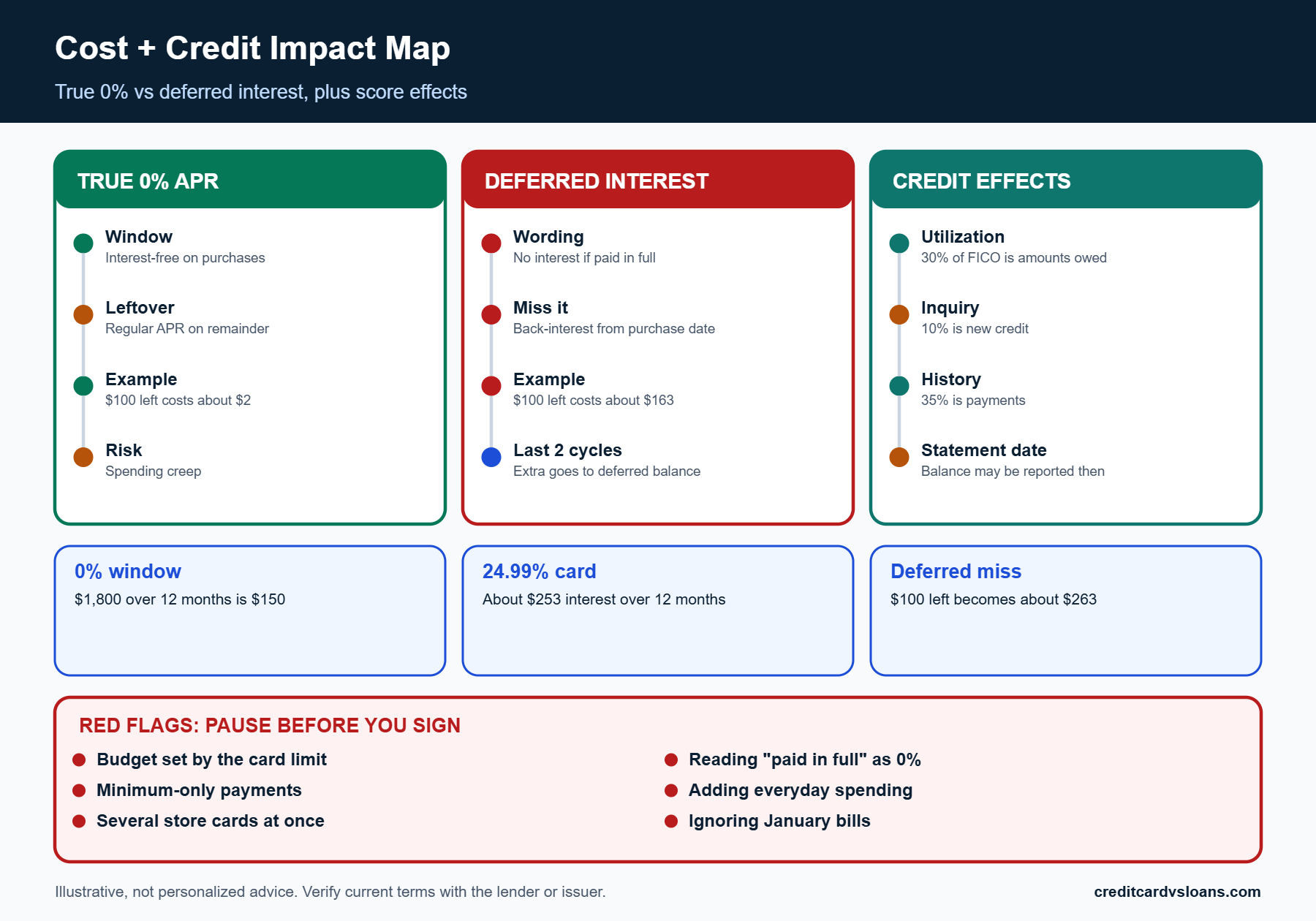
Take a hypothetical $1,200 purchase on a deferred interest promotion for 12 months, with a hypothetical 25% regular rate. You pay $100 a month for 11 months and have $100 left when the window closes. Estimating interest monthly on the declining balance, about $162.50 would have accrued during the promotion, so the remaining amount owed would be roughly $262.50 rather than $100.
The same purchase on a true 0% offer would leave $100 owed at the end, and the 25% rate would apply going forward at about $2.08 for the first month. Same payments, same leftover, very different outcomes. The difference is one of structure, and it’s why the wording of an offer matters more than the headline.
Minimum payments will not clear the balance
The CFPB warns that minimum payments usually won’t pay off a promotional balance in time. Federal rules require periodic statements to include a minimum payment warning and estimates of how long minimum-only payments would take. For many accounts, the statement also shows the payment needed to repay the balance in 36 months.
A 36-month figure is longer than most promotional windows, so it understates what you need to hit a 6-, 9- or 12-month deadline. Calculate your own number from the promotional balance and the end date, and use the statement’s figures only as a reference.
| Scenario | Rate type | Payment pattern | Interest cost | Risk flag |
|---|---|---|---|---|
| $1,800 on true 0%, 12 months | 0% purchase APR | $150 a month | $0 if on schedule | Leftover charged at regular APR |
| $1,800 on standard card, 3 months | 24.99% APR | About $625 a month | About $75 | Short schedule, higher payment |
| $1,800 on standard card, 12 months | 24.99% APR | About $171 a month | About $253 | Interest on the declining balance |
| $1,200 deferred interest, $100 left | 25% retroactive | $100 a month for 11 months | About $162 accrued | Balance jumps from $100 to about $263 |
| $1,200 true 0%, $100 left | 0% then 25% | $100 a month for 11 months | About $2 in month one | Interest only on the remainder |
Notice what the table says about timing. A short schedule on a standard card costs relatively little in interest, which is a useful reality check: if you can afford to repay in three months, the 0% window may save less than you expect, and a 0% card may not be necessary. If you need a year, the window matters much more.
How the offer compares with other ways to pay
Paying from cash flow or savings
Spending from a holiday savings fund costs no interest and no risk of a missed deadline. If you’ve put aside even part of the budget, use it first, and then see what remains to finance. That shrinks the amount you owe and makes the monthly target smaller.
For anyone starting from zero, a rule of thumb is to work backward from the date. If the spending is two months away, saving $300 a month covers $600; the rest is what the card would carry. Writing that out makes the decision concrete.
Rewards are not a reason to overspend
Cards with rewards often go on offer during the holidays, and rewards can feel like a discount. But rewards rates are modest relative to interest if a balance lingers. Our comparison of travel rewards versus cash back explains how to judge what a card’s rewards are worth, but the point to remember here is that a 1-2% reward doesn’t offset a missed 0% deadline.
If rewards are part of your decision, check whether the card offers them during the promotional period and whether any annual fee applies. A card can have an introductory rate and still be a poor fit over the long run.
Costs beyond the interest rate
Fees that can ride along with the promotion
A 0% rate says nothing about the rest of the fee schedule. A card may charge an annual fee, a late fee, or fees on certain transactions, and the account-opening table is where those are listed. Add any annual fee to the cost of the plan, because a fee paid to unlock a 12-month window is part of what the window costs you.
For a small holiday budget, that can change the answer. An annual fee larger than the interest you’d pay on a short schedule on a card you already own means the new card costs more than it saves. Run the comparison with every fee included, not only the interest line.
The payment you give up elsewhere
Every dollar sent to a holiday balance in January is a dollar not going to savings, an emergency fund or another debt. If you carry a higher-rate balance elsewhere, the order of payments matters: the 0% balance costs nothing to carry, so a higher-rate balance may deserve the extra dollars first, as long as you still reach the promotional deadline.
That balancing act is easy to describe and hard to run in real life, which is why a simple schedule helps. Write both payments down, add them up, and make sure the total fits inside your monthly budget before you commit to the purchase plan.
Credit Score and Utilization During the Holidays
Why holiday statements can move your numbers
Utilization at the statement date
According to myFICO, amounts owed make up 30% of a FICO Score, and utilization, the share of your available revolving credit that you are using, is part of that factor. Card balances are often reported to bureaus around the statement closing date, so heavy holiday spending can show up as high utilization even if you plan to pay in full later.
No one can promise a specific effect, and models differ. But if you are planning a major application, such as a mortgage or auto loan, in early January, it’s worth knowing how the timing of statement dates and balances could look on a report. Paying down before the statement closes can reduce what gets reported.
New accounts and inquiries
A new card usually means a hard inquiry and a new account. myFICO notes that new credit is 10% of a FICO Score, that inquiries are considered for 12 months and remain on reports for two years, and that opening several accounts in a short time can look riskier. A holiday scramble for multiple store cards can produce exactly that pattern.
If you’re not certain about approval, a prequalify tool that uses a soft pull can narrow options before you apply. For an overview of how issuers weigh credit profiles for these offers, see what credit score a 0% APR card tends to require.
Protecting your payment history
Autopay and calendar dates
Payment history is the largest part of a FICO Score at 35%, according to myFICO. An on-time payment every month is the core of the plan, and automatic payments for at least the minimum protect you from an oversight in the busy weeks around the holidays. Then schedule your target payment separately.
The rules also help you: card issuers must mail statements at least 21 days before the payment due date, which leaves time to review and pay.
Holiday fraud and statement review
Busy shopping seasons are also busy for scammers. Review each statement for charges you don’t recognize, and report them to the issuer promptly. Read your issuer’s guidance on how to report unauthorized charges so you know the steps before you need them.
If you notice a charge you did not make, do not wait for the next statement. Contact the issuer through the number on the back of the card or the official app.
Approval, Timing and Application Strategy
What issuers consider
Approval is not guaranteed, and offers differ
Cards with 0% purchase windows are generally pitched to applicants with solid credit histories, but issuers do not publish exact cutoffs and nothing guarantees approval. They weigh payment history, existing debt, income and recent applications. The CFPB notes that issuers must consider an applicant’s ability to make the required payments before approving a card.
If you have a thin credit file or recent late payments, a decline is possible, and a string of applications in the holiday rush can make your profile look riskier. Start with a prequalify tool where one exists, since it typically uses a soft pull, and treat a prequalified result as a hint, not a promise.
Ask what the limit will cover
The limit you receive may be lower than the amount you hoped to charge. A plan built around a $2,000 limit that comes back at $1,000 has to change, and it is better to learn that before the shopping starts. Think about what you’d do with the shortfall: save more, spend less, or use a second payment method.
Remember that a high utilization on a new card can also affect how the account looks on your report. Leaving headroom on the limit helps with both the practical risk of a declined payment and the optics of the balance.
Timing the application
Apply before the rush, not during it
Applying weeks ahead of your main shopping gives you time to read the terms, compare offers and find out the limit. It also gives time for the card to arrive and for the account to be set up with autopay before the first purchase. Rushed applications at checkout are where the worst surprises tend to happen.
Check how the promotional period is measured. If the clock runs from account opening, every week you wait to use the card shortens the useful window; if it runs from each purchase date, the timing matters less. The terms will say which.
Plan around billing cycles
Holiday purchases land on a statement based on your billing cycle, which is set by the issuer. A purchase made just after the statement closing date will not appear until the next statement, which shifts the first due date. Knowing your closing date helps you forecast when the first payment is due and how large the first statement will be.
Write the closing date and due date on the same calendar as the promotion end date. Three dates, one place, and the whole schedule is easier to see.
Alternatives to Financing Holiday Spending
Lower-risk ways to cover the season
Trim the budget to match the cash flow
The most reliable alternative is a smaller plan. Cut the gift list, set per-person limits, or shift to shared gifts and experiences. This is the least exciting option and the only one that guarantees no interest and no deadline. If the budget you want requires borrowing, ask whether the borrowing is needed or just convenient.
If you carry debt already, consider that new holiday debt might make an existing problem harder. Our overview of using a 0% transfer card without a debt trap covers how to approach existing balances, and a holiday card is not a substitute for that plan.
Using a card you already have
If you have a card with a low regular APR and a payment plan that clears the balance in a few months, using it can be simpler than opening a new account. Compare the likely interest with the table above. For short schedules, the difference between a regular card and a 0% card can be small. A longer-lasting lower rate may also beat a short 0% window if you expect to carry the balance for a while, as we discuss in the cornerstone on 0% intro APR versus low ongoing APR.
The trade-off is that an existing card may already carry a balance, and in that case purchases usually accrue interest from the transaction date. Use the one that keeps the holiday balance separate.
Other products to compare
Fixed-payment loans
A personal loan converts a purchase into an installment debt with a set payment and payoff date. That structure reduces the temptation to carry a balance, though loans carry their own APR, and some include an origination fee. Compare the total cost, not only the monthly payment.
For borrowers who are likely to drift on a revolving card, the fixed schedule is the feature, not the rate. If you are unsure which kind of promotion a card actually offers, our explainer on transfer APR versus purchase APR shows how to read the terms.
Business cards for business gifts
If part of your spending is for a business, such as client gifts or team events, a business card may be the right place for it, and the promotional terms differ from consumer cards. Our look at 0% APR business credit cards explains the cash-flow trade-offs. Keep personal and business spending on separate accounts so that records and payoff plans stay clean.
Whether any expense is deductible is a tax question, and you should confirm it with the IRS guidance or a tax professional rather than assume it.
Decision Matrix: Is a 0% Holiday Card Right for You
Matching your situation to the tool
A scenario table
The table below maps common holiday situations to the option worth investigating first. It’s a starting point for your own research, not a recommendation, and each answer depends on your actual offer terms.
| Scenario | Option to investigate | Why | What to verify | When to avoid it |
|---|---|---|---|---|
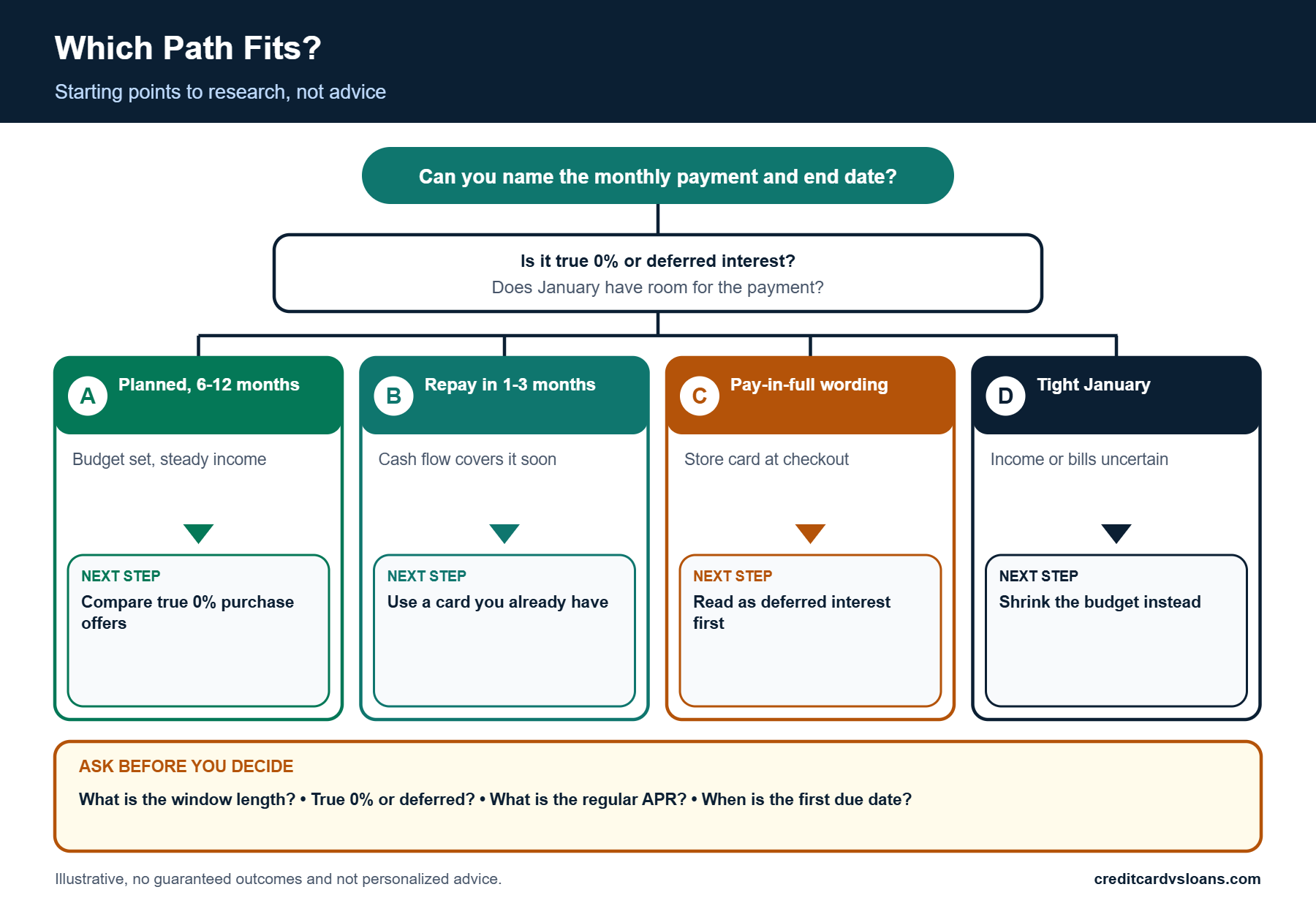
| Budget of $1,500 or more, steady income, repay in 6-12 months | True 0% purchase card | Spreads the cost without interest | Window length, regular APR, start date | If you cannot name the monthly payment |
| Can repay within one to three months | Existing card or cash flow | Interest cost is small on a short schedule | Current APR, statement dates | If the existing card already has a balance |
| Store card offers “no interest if paid in full” | Read as deferred interest | Interest may be charged retroactively | Exact payoff amount and date | If you might miss the deadline |
| Income uncertain in January | Smaller budget | Avoids a payment you may not make | Savings available for gifts | If the borrowing is for non-essentials |
| Spending is for a business | Business card, kept separate | Separates records and payoff plans | Business card terms and fees | If you would mix personal spending |
Questions to settle before you buy
Before you charge anything, ask yourself four things. What is the total I will charge? What is the monthly payment that clears it before the window ends? Where does that payment come from in my budget? What will I do if the first statement is bigger than I expected?
If you can answer all four in a sentence each, the plan is real. If any answer is “I’ll figure it out later,” that’s a signal to slow down before you apply.
Reading the offer on the day you apply
The fine print that decides the outcome
Look for five items in the terms: the promotional length and start, the regular APR and whether it is fixed or variable, any deferred interest wording, fees including annual and late fees, and any condition that ends the promotional rate early. The CFPB says a payment more than 60 days late can end an introductory rate, so a late payment is not a small risk.
Federal rules also require the account-opening table to disclose key fees and rates. That table is a more reliable summary than the advertisement, and it’s the document to keep when you want to check your statement later.
A short note on the day-of decision
Retail checkout is a poor place for a financial decision. If a cashier offers a store card with a discount, you can say no and read the terms at home. Pressure at the register tends to push people toward promotions they haven’t read, and a discount isn’t worth a card you haven’t compared.
The same applies to online checkout pop-ups. Take the time to read the table and compare it with a card you already know, and apply only if the offer fits the plan.
Building the January Payoff Plan
Turning the window into a schedule
Set the monthly target and automate it
Once the holiday spending is done, total the balance and divide by the months left in the window. Set up an automatic payment for that amount, in addition to making sure the minimum is covered. If the number feels uncomfortable, adjust it now, while you still have months to spare, rather than in the last one.
Check each statement for the promotional balance, its APR and the end date. The CFPB notes that statements list each balance category with its own APR, which makes the statement a reliable cross-check on what you were promised.
Keep new spending off the card
Once the holiday purchases are on the card, use a different payment method for everyday spending. On most cards, if you carry a balance, new purchases accrue interest from the transaction date, so adding groceries to a holiday card can undermine the plan. It also muddies which dollars belong to which balance.
Keep a simple tracker, even a note on your phone, with the starting balance, the monthly payment and the remaining balance. Watching the number fall is a useful motivator, and it flags a problem early.
If the plan slips
Act before the deadline, not after
Set a reminder 60 days before the promotion ends. At that checkpoint, divide the remaining balance by the remaining months and see whether your payment still works. If it doesn’t, you have time to adjust: increase payments, cut other spending, or call the issuer.
For deferred interest, remember the special payment rule: in the last two billing cycles before the promotion ends, the issuer must apply amounts above the minimum to the deferred balance first. Earlier in the promotion, ask the issuer whether it will apply extra payments to the deferred balance if you also carry other balances on the card.
What the regular rate means for the leftover
If a balance remains when the window ends, a true 0% offer charges the regular APR only on the remainder, and a deferred-interest offer may charge back-interest on the full amount. Look at your terms to see which applies. The difference can be hundreds of dollars on a balance that seems small.
If you cannot clear it, compare options before the date: a transfer to another promotional offer, a fixed-rate loan, or a conversation with the issuer. Each has fees and eligibility conditions, and none is guaranteed. The sibling article on score requirements for 0% APR cards describes what issuers look at if you apply for another card.
Checklist and Next Steps
Before you swipe
Numbers and terms to write down
- Total holiday budget you can repay, not the card limit.
- Promotional window length, start date and end date.
- Whether the offer is true 0% or deferred interest (“no interest if paid in full”).
- Regular APR after the window and whether it is fixed or variable.
- Monthly target: total divided by months, plus a buffer.
- Statement closing date and payment due date.
With those six items, the offer becomes a schedule you can test against your budget. If any item is missing from the terms, find it before you apply.
Habits that protect the plan
- Autopay at least the minimum, plus a scheduled target payment.
- Use the card for holiday purchases only.
- Reminders at 60 and 30 days before the promotion ends.
- Review each statement for the promotional balance and unfamiliar charges.
- Skip register offers you haven’t read.
None of these steps is complicated, but each one removes a common way a seasonal tool turns into an expensive habit.
Conclusion: a deadline you can meet
When it makes sense
A 0 apr card for holiday spending makes sense when the spending is planned, the offer is a true 0% window, the monthly payment fits your budget with room to spare, and you will keep the card for that purpose only. It deserves caution when the wording is “no interest if paid in full,” when January is already tight, or when the limit is driving the budget.
No outcome is guaranteed. Approval, limits, rates and credit effects depend on your profile and the issuer, so treat every number here as a starting point and replace it with the figures in your own offer.
Your next steps
- Set a holiday budget based on what you can repay, then pick the number of months.
- Prequalify where available and compare at least two offers on window, wording and regular APR.
- Read the difference between purchase and transfer promotions if you also have a balance to move.
- Schedule autopay and the target payment before the first purchase.
- Put the end date and a 60-day reminder on your calendar.
- 0% Balance Transfer APR vs. 0% Purchase APR: Know Which Offer You Have
- What Credit Score Do You Need for a 0% APR Credit Card?
- 0% Balance Transfer Credit Cards: How to Use Them Without a Debt Trap
- 0% APR Business Credit Cards: Useful Tool or Cash-Flow Trap?
- 0% Intro APR vs. Low Ongoing APR: Which Is Better Long Term?
- Travel Rewards vs. Cash Back: Which Card Fits Your Spending?
- CFPB: How to understand special promotional financing offers on credit cards
- CFPB: CFPB encourages retail credit card companies to consider more transparent promotions
- CFPB: How long can I keep a low rate on a balance transfer or other introductory rate?
- CFPB: How does my credit card company calculate the amount of interest I owe?
- CFPB: Do I pay interest on new purchases after I get a zero or low rate balance transfer?
- eCFR: 12 CFR 1026.53 Allocation of payments
- eCFR: 12 CFR 1026.7 Periodic statement
- Federal Reserve: Consumer Credit – G.19 (release of October 7, 2026)
- myFICO: What is in my FICO Score?
Last updated: October 22, 2026. Rates, fees and lender rules change; verify current terms before acting.
The information on creditcardvsloans.com is provided for general educational and informational purposes only. It is not financial, legal, tax, credit, accounting or investment advice, and reading it does not create an advisor-client, fiduciary or any other professional relationship. Nothing here is an offer, solicitation or recommendation to borrow, lend or apply for any product.
Credit scores, interest rates, fees, eligibility rules, lender policies and laws change frequently and vary by lender, location and individual circumstances. Examples, figures and scenarios are illustrative only, do not predict your results and do not guarantee approval, savings, a particular rate or a credit-score outcome. Always confirm current terms directly with the lender or issuer and read the full agreement before you apply or sign.
Although we aim for accuracy and use reputable sources, we make no representations or warranties, express or implied, about the completeness, accuracy, reliability or timeliness of the content. Content may be drafted with the assistance of automated tools, so errors or omissions may still occur. Links to third-party sites are provided for convenience; we don’t control and aren’t responsible for their content.
To the fullest extent permitted by law, creditcardvsloans.com and its owners, editors, authors, contributors and affiliates disclaim all liability for any loss, damage or expense arising directly or indirectly from your use of, or reliance on, this content. Before making financial decisions, consult a licensed professional, such as a qualified financial advisor, attorney, tax professional or nonprofit credit counselor, who can consider your complete situation.