
The real value of a cash back credit card is the cash you keep after annual fees, interest and the rewards you never get around to claiming, expressed as a percentage of what you spend. A cash back credit card advertising 5 percent can be worth less than one advertising 1.5 percent once your own spending, the caps and the fees are plugged in.
This guide is a method, not a ranking. It shows how to turn any cash back offer into a yearly dollar figure you can compare apples-to-apples with another offer, how to spot the details that shrink that figure, and when a different tool makes more sense. If you want the mechanics of how points, miles and cash back work in general, our overview of how rewards credit cards work covers that ground, and this article builds on it.
Cash back looks simple because one cent earned is one cent redeemed. The complexity sits around it: bonus categories that change, caps that run out, exclusions for certain purchases, and a purchase APR that can dwarf the rebate if you carry a balance. A fair comparison puts all of that on the same page.
- Compare cash back cards by net yearly dollars on your own spending, not by the highest percentage in the ad.
- Convert tiered and rotating rates into an effective rate by weighting each tier by your actual share of spending.
- Subtract the annual fee and any recurring costs, and ignore sign-up bonuses unless you would meet them without extra spending.
- Interest changes everything: the Federal Reserve reported an average rate of 22.15 percent on accounts assessed interest in the second quarter of 2026, which is far larger than typical rebates.
- Check how cash back is paid out, what voids it and whether returns reduce it before you count it as yours.
Interest-rate figures come from the Federal Reserve’s G.19 consumer credit release of Sept. 8, 2026. Rewards market figures come from CFPB publications dated 2024. Every dollar example here is hypothetical and meant to show a method, not to describe a real card.
Table of contents
What cash back credit cards are worth, in one pass
The definition of real value
Net cash, not headline percentage
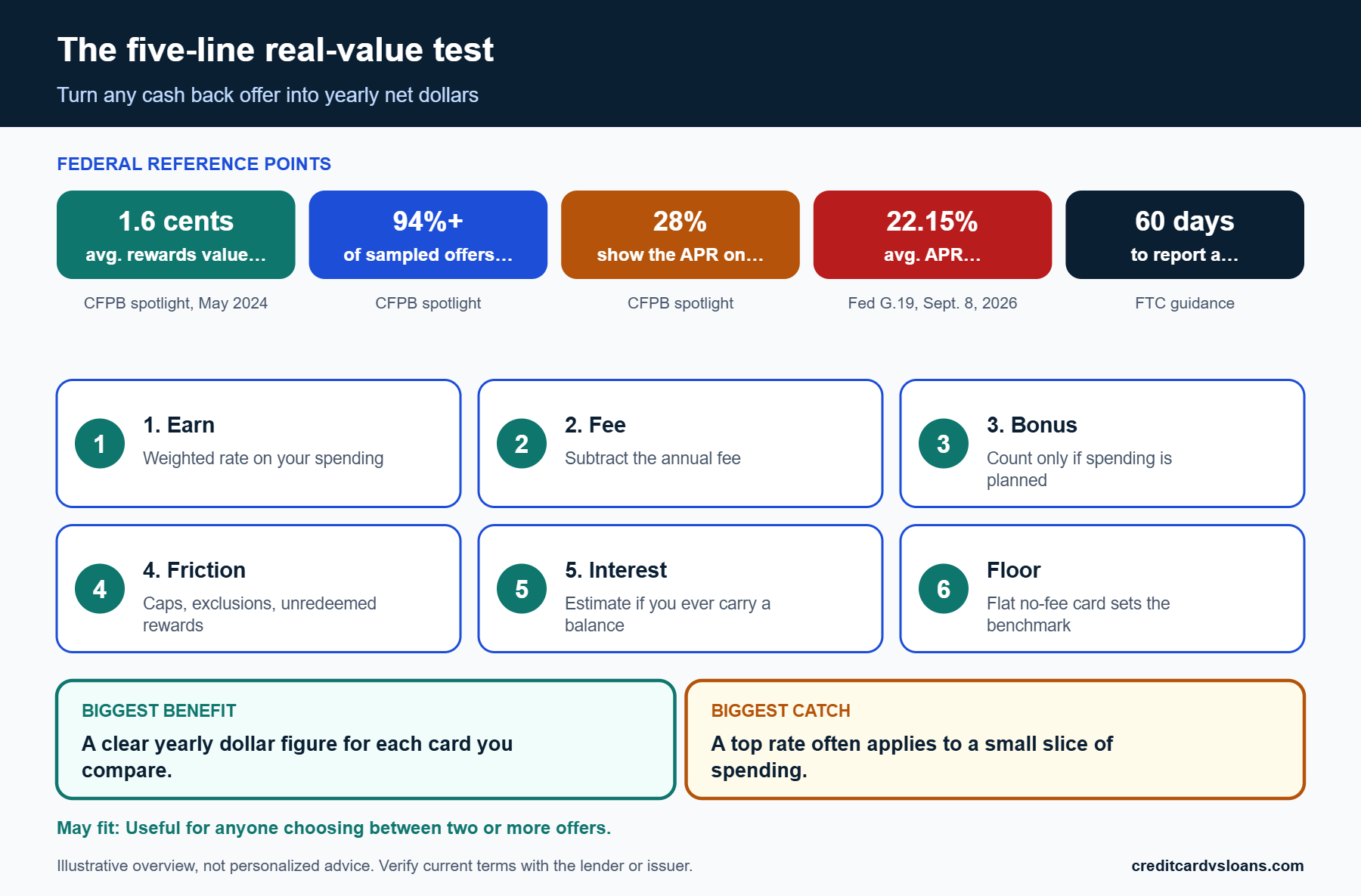
Real value is what is left after costs. Take the rewards you will earn on your own spending over twelve months, subtract the annual fee, subtract any interest and fees the card will cost you in the way you actually use it, and you have the net figure. Divide it by your annual spending to get a real-value rate you can compare across cards.
The CFPB reported in its May 2024 rewards spotlight that average rewards value on major issuers’ general purpose cards rose from 1.4 cents per dollar spent in 2019 to 1.6 cents in 2022. That is an average across many kinds of cards and spenders, so it works as a reality check on headline rates rather than a target.
Why the headline rate misleads
The CFPB spotlight noted that rewards appear on the front page of sampled credit card offers more than 94 percent of the time, while the APR shows up on the front page only about 28 percent of the time. Marketing emphasizes what you earn and tucks away what you pay. A rate like 5 percent usually has a category, a cap, a quarter or an activation attached to it.
Treat the headline as an upper bound that applies to a slice of your spending. The rest of your spending earns the base rate, and that base rate often does most of the work over a year.
A five-line test you can run on any offer
Lines one to three: earn, fee and bonus
Line one is the rewards you will earn on your annual spending, computed with the effective rate. Line two is the annual fee, entered as a negative number. Line three is any sign-up bonus, entered only if you would meet the spending requirement without changing your behavior. The bonus is a one-time item, so many people divide it across two or three years or exclude it from the steady-state comparison.
These three lines give you a gross-minus-fee figure. They already knock several attractive-looking cards out of contention when the spending is spread broadly.
Lines four and five: friction and interest
Line four covers friction: rewards you will not redeem, purchases that do not earn, and refunds that reverse the rebate. Line five covers interest: if you may carry a balance, estimate the interest and subtract it. If you will always pay in full, line five is zero, and you can skip it, but it helps to see how large it would be.
Because interest is charged on a balance while cash back is earned on spending, the line-five number is often larger than everything above it combined. That is the main reason a lower-rate or promotional-rate option sometimes beats any cash back card for a person who revolves.
If a cash back credit card does not clearly beat a simple flat-rate card with no annual fee on your own spending, it is probably not worth the extra complexity. Let the flat card set the floor, and make every other card prove itself above it.
The shapes cash back takes: flat, tiered, rotating and merchant offers
Flat-rate and tiered cards
Flat rate: the baseline for every comparison
A flat-rate card pays the same percentage on every eligible purchase. Its strength is that the effective rate equals the headline rate, which means there is nothing to calculate and nothing to track. It also makes a clean benchmark: if you know a no-fee flat card pays 1.5 percent, then every other card has to clear that number by enough to cover its extra costs.
The weakness is the ceiling. A flat rate rarely matches the bonus rates on cards that target a category, so a household with large grocery or gas spending may leave something on the table.
Tiered cards: weighting by your budget
Tiered cards pay one rate on a named category and another elsewhere. The correct way to read them is as a weighted average. Take the share of your spending that falls in each tier, multiply by the tier’s rate, and add them up. Ignore the share of your spending that is not in a bonus category at your peril: it is usually the largest slice.
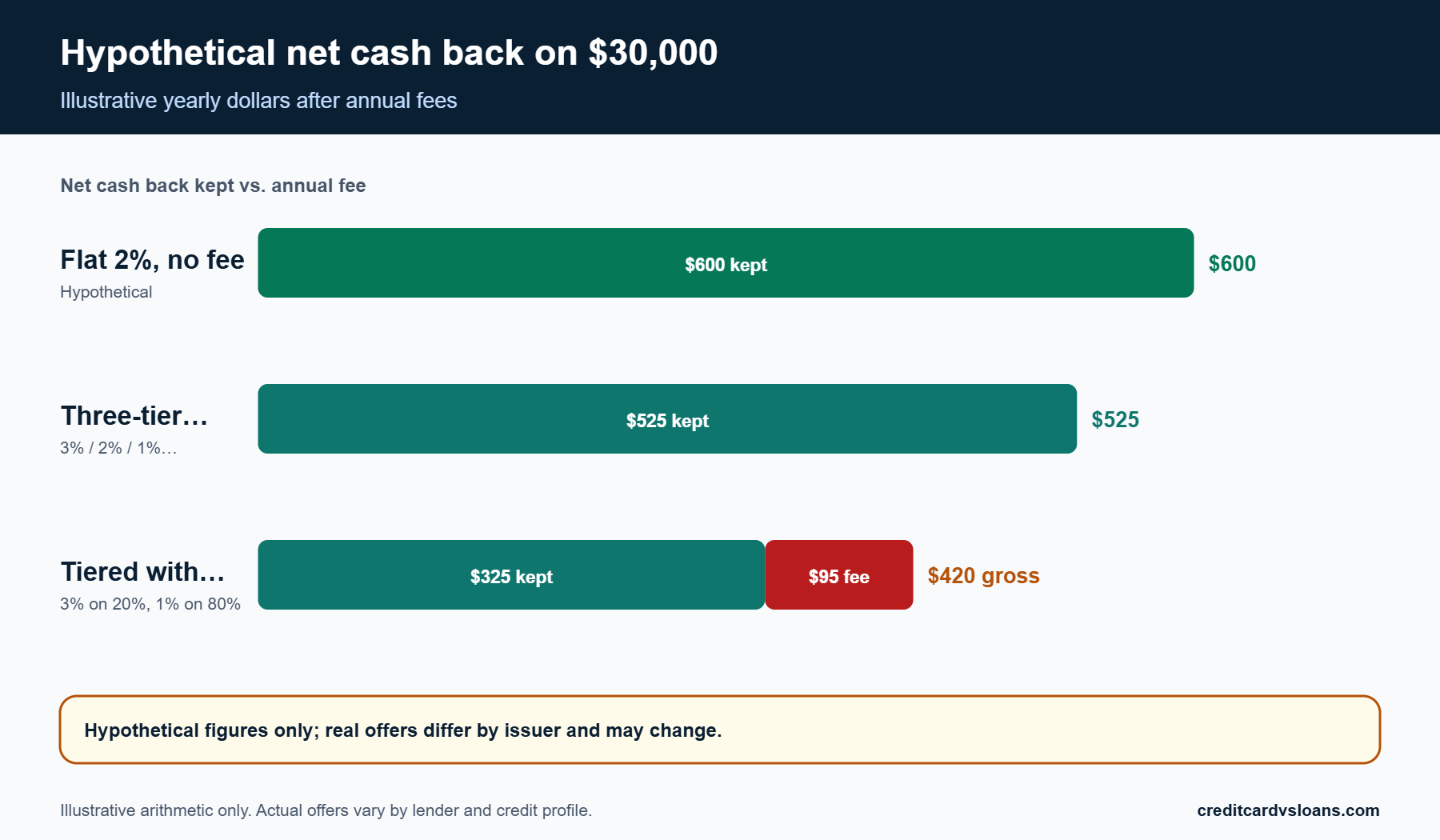
Hypothetical example: a card pays 3 percent on 20 percent of spending and 1 percent on the remaining 80 percent. The effective rate is 0.20 times 3 plus 0.80 times 1, which is 1.4 percent. On $30,000 of spending that is $420, well below the $600 a flat 2 percent card would pay on the same dollars.
Rotating categories and merchant offers
Rotating categories and the cap problem
Rotating-category cards offer an elevated rate on categories that change each quarter. They often have a cap on the amount that earns the bonus rate and may require you to activate each quarter. If you plan to chase the bonus, calendar the activation dates and check whether your normal spending fits the categories before you count the bonus.
In a hypothetical case, a 5 percent bonus on up to $1,500 per quarter pays at most $75 per quarter, or $300 a year, on the bonus spending. Everything above the cap earns the base rate, so the bonus is a fixed dollar amount and not a percentage of your whole budget.
Offers tied to merchants or portals
Some programs add extra cash back for purchases through a shopping portal or with a selected merchant. Those offers can add value, but they also add steps and often have their own limits, such as a maximum reward per offer or a requirement to click through the portal first. Count them only if you would shop at the merchant anyway.
The same caution applies to merchant-funded deals: a discount is only a saving if you wanted the item at the regular price in the first place.
| Structure | Headline | What to extract | Hypothetical yearly cash back on $30,000 |
|---|---|---|---|
| Flat rate, no fee | 2% on everything | Any exclusions or caps | $600 |
| Tiered, annual fee | 3% on 20% of spending, 1% elsewhere, $95 fee | Weighted rate 1.4%, minus the fee | $420 gross, $325 after the fee |
| Three-tier, no fee | 3% on 25%, 2% on 25%, 1% on 50% | Weighted rate 1.75% | $525 |
| Rotating, capped | 5% on up to $1,500 per quarter, 1% elsewhere | Activation and quarterly cap | $540 |
Building your own comparison, step by step
Map your spending before you look at any card
Pull twelve months from your statements
Start with data you already have. Download or list a year of card and bank transactions and sort them into a handful of groups: groceries, dining, gas and transit, bills and subscriptions, travel, online shopping and everything else. A rough split is fine; the goal is to find out which two or three groups hold most of the money.
Most people discover that spending is less concentrated than they assumed. Large, irregular items such as insurance premiums, rent or tuition often cannot be put on a card at all, or incur a fee if they can. Exclude those from your card spending number so you are not rewarding yourself on dollars the card will never see.
Decide what really belongs on a card
Cash back only exists on money you spend with the card. If you are considering moving spending onto a card to earn rewards, be honest about whether that spending can be repaid in full from the same month’s income. A card is a payment tool that defers the cost by a few weeks; it is not extra purchasing power.
The CFPB’s grace period guidance explains why this matters: if you pay the full balance by the due date you generally are not charged interest on purchases, but carrying a balance means you lose the grace period and new purchases accrue interest from the day they post. Put on the card only what you will pay in full.
Compute the effective rate and the net figure
The effective rate formula
For each card, list its rate for each spending group, multiply by your spending in that group, apply caps where they bind and add the results. The sum is your gross cash back for the year. Dividing by total card spending gives the effective rate.
Caps are easy to forget. If a card pays 6 percent on groceries up to $6,000 a year and your household spends $9,000 on groceries, only the first $6,000 earns the high rate and the remaining $3,000 earns whatever the base rate is. Write the cap next to the rate so it does not disappear from the arithmetic.
A worked hypothetical, with a flat card as the floor
Suppose a household puts $30,000 a year on a card, including $6,000 of groceries. Hypothetical Card F pays a flat 2 percent with no annual fee: $600. Hypothetical Card G pays 6 percent on up to $6,000 of groceries and 1 percent on everything else, with a $95 annual fee: $360 plus $240, or $600 gross, which is $505 after the fee. The flat card wins by $95, even though Card G has the tempting 6 percent.
Change the facts and the answer changes. If groceries were $12,000 of the $30,000 and the cap still held at $6,000, Card G’s gross figure would be the same $600 before the fee, because the cap limits the bonus, while its base rate would apply to the extra spending. The method is what matters: write it down and compute it on your own numbers.
| Line | Card F: flat 2%, no fee | Card G: 6% groceries to $6,000, 1% elsewhere, $95 fee |
|---|---|---|
| Bonus-category earnings | $120 (2% of $6,000) | $360 (6% of $6,000) |
| Everything else | $480 (2% of $24,000) | $240 (1% of $24,000) |
| Gross cash back | $600 | $600 |
| Annual fee | $0 | $95 |
| Net before interest | $600 | $505 |
| Real-value rate on spending | 2.0% | 1.7% |
The cost side: interest, fees and the price of carrying a balance
Interest is the number that can overwhelm the reward
What the Federal Reserve’s figures say
The Federal Reserve’s G.19 consumer credit release of Sept. 8, 2026 reported that the average credit card interest rate was 22.15 percent for accounts assessed interest in the second quarter of 2026, and 20.94 percent when all accounts were counted. These are national averages, and individual rates vary by issuer, card and credit profile, so read your own offer.
At roughly 22 percent, a simple annual estimate of the interest on a $1,500 balance held all year is about $330. A cash back rate of 1.5 percent on $24,000 of spending earns $360. In that hypothetical, a balance of $1,500 consumes almost the entire reward.
Why a revolving balance reverses the logic
Cash back is a percentage of purchases, while interest is a percentage of a balance that accumulates across months. If the balance keeps rolling over, you pay interest on interest and on purchases that are not yet due. The CFPB spotlight reported that revolving cardholders pay about 94 percent of total interest and fees but receive less than 30 percent of rewards benefits.
If you already carry card debt, the cheaper first move is usually to reduce or relocate the balance. Our guide to 0% balance transfer cards explains how a promotional rate works, and credit card debt consolidation options compares the other routes. Cash back can wait.
Fees that cut into the cash
Annual fees and break-even spending
The annual fee is the easiest number to include and the one most often waved away with a bonus. To check a fee, divide it by the difference in effective rates between the fee card and your no-fee benchmark. In a hypothetical case where a fee card earns 2.5 percent and the benchmark earns 1.5 percent, a $95 fee is covered once spending reaches $9,500 a year. On $30,000 of spending the fee card would earn $300 more than the benchmark before the fee.
If the fee card earns the same or less than the benchmark at your spending, no amount of additional spending can justify the fee, and you can stop evaluating it.
Other charges that reduce net cash back
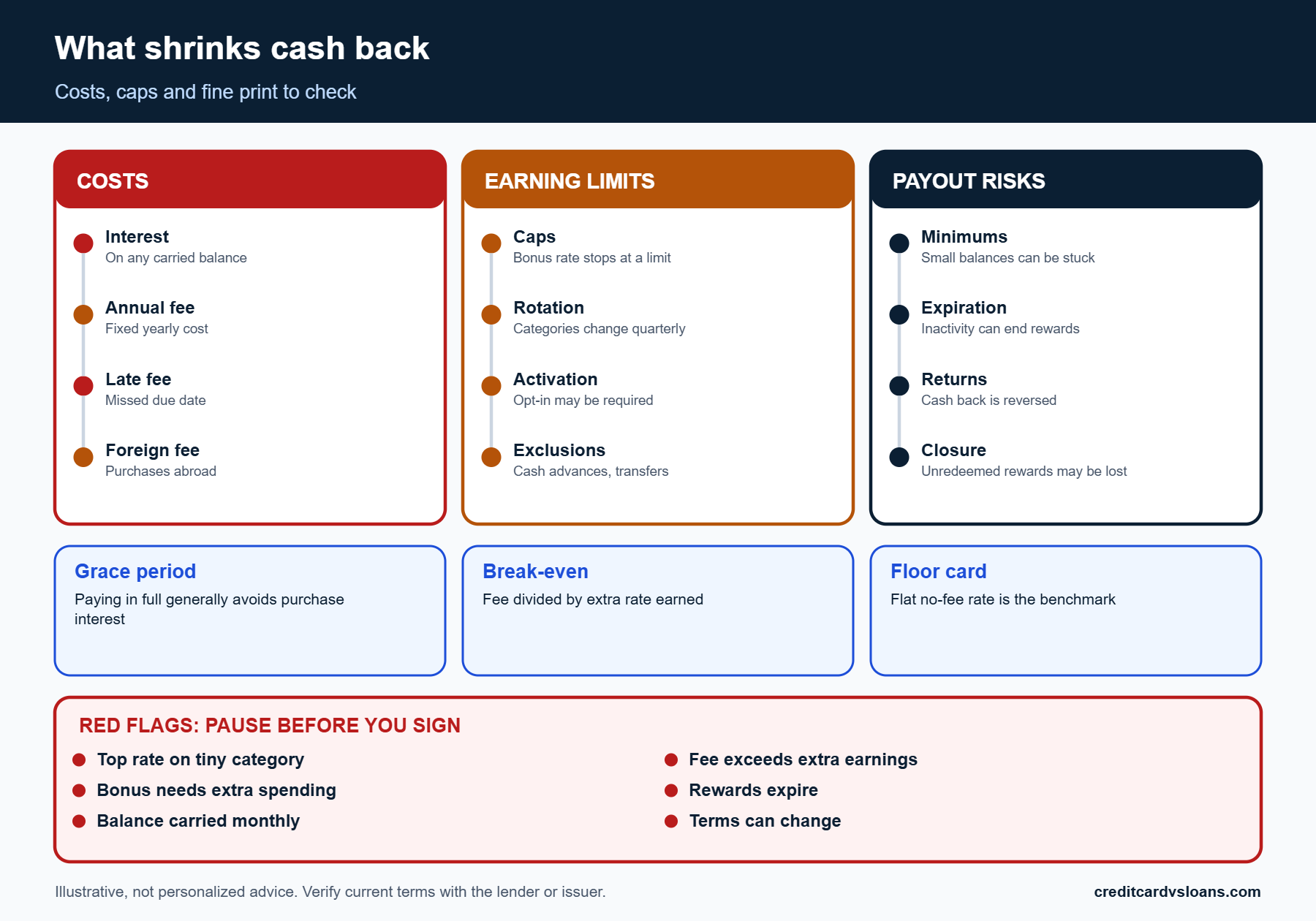
Late fees, returned-payment fees and foreign transaction fees do not earn cash back and are often larger than a month’s rebate. Cash advances typically carry a fee and generally accrue interest from the transaction date with no grace period, according to the CFPB. A single late payment can wipe out a quarter’s worth of rewards.
Use the terms page to list each fee, then ask which ones are realistic for you. Autopay for at least the minimum payment, with a reminder for the full statement balance, prevents the most common ones.
| Fee card effective rate | Annual fee | Break-even annual spending | Reading |
|---|---|---|---|
| 2.0% | $95 | $19,000 | Needs a high spending level to pay for itself |
| 2.5% | $95 | $9,500 | Pays off at moderate spending |
| 3.0% | $95 | $6,333 | Pays off at modest spending |
| 2.0% | $250 | $50,000 | Needs very high spending |
| 1.5% or lower | Any fee | Never | No spending level makes the fee worthwhile |
Reading the rates-and-fees table
The lines that matter for a cash back comparison
Credit card offers include a standardized table of rates and fees, and it is the quickest way to compare cost across issuers. Look first at the purchase APR, which may be a range tied to your credit, and at whether the rate is variable, meaning it can move with a benchmark rate. Then look at the annual fee, the late payment fee, the foreign transaction fee and the cash advance terms.
If the offer shows a range of APRs, assume the upper end applies to you until the issuer tells you otherwise. That is a conservative way to price the downside, and it avoids the disappointment of being approved at the high end after planning around the low end.
Promotional rates and what happens when they end
Some cash back cards include an introductory APR on purchases. A promotional rate is temporary by design, and the regular rate applies after it ends. If you plan to finance a purchase during the promotional period, divide the amount by the number of months so you know the monthly payment that clears it in time.
Do not let a short promotional period convince you that the card is cheap. The comparison that matters is what the card costs over the year in which you will actually use it, including the period after the promotion.
Fine print that changes what the cash is worth
How the cash gets to you
Payout method and timing
Cash back can be delivered as a statement credit, a deposit to a bank account, a check, or credit toward a purchase. Each has a different practical value. A statement credit lowers your balance but may or may not count as your payment for the month, so a person who relies on it to cover the due amount could end up late. A deposit is the cleanest form because it is money you can spend anywhere.
Timing matters too. Some programs pay automatically once a threshold is reached, while others require you to request it. Rewards you forget to claim are rewards you do not have, so set a recurring reminder if your issuer needs you to act.
Minimums, expiration and what happens at closure
The CFPB spotlight reported that most issuers with rewards programs have expiration policies, commonly tied to account inactivity, and that definitions of inactivity are inconsistent. It also quoted a complaint in which an issuer would not pay out a balance of about $20 because of a $25 minimum. One complaint is not a market statistic, but it shows how a small minimum can hold back a small balance.
Closing a card can forfeit earned but unredeemed cash back, depending on the terms. Redeem the balance before you close or downgrade an account, and keep a screenshot of the balance if you want a record.
Where cash back is reduced or reversed
Returns, disputes and exclusions
If you return an item, the cash back earned on it is generally reversed, so a return reduces your rewards balance as well as your statement. Purchases classified as cash advances, balance transfers or certain payment-service transactions are commonly excluded from earning. Terms differ, so look for a list of excluded transaction types in the rewards agreement.
Also check how the card treats large one-time purchases, gift cards and bill payments. Whether those earn at the full rate, at a reduced rate or not at all can change your effective rate more than any bonus category.
Program changes and devaluation
Rewards programs are contracts that issuers can often amend. The CFPB’s Circular 2024-07, published Dec. 18, 2024, says that cutting the value of rewards a consumer has already earned can be unfair or deceptive, and that fine print reserving a right to change the program does not necessarily resolve the issue. A circular describes the agency’s view of existing law and does not itself create new rights.
For cash back, the risk is lower than with points because one cent remains one cent, but the earn rates going forward can change. Revisit your comparison annually, and move spending if a card’s rate falls below your benchmark.
| Question | Where to look | Why it matters |
|---|---|---|
| How is cash back paid and when? | Rewards terms | Affects whether you can use it as real cash |
| Is there a minimum redemption? | Rewards terms | Small balances can be stuck |
| Does it expire or get forfeited? | Rewards terms | Inactivity or closure can cost you the balance |
| What purchases are excluded? | Rewards terms | Can lower the effective rate |
| Can the issuer change the program? | Cardmember agreement | Rates going forward can change |
| What are the APR and fees? | Rates and fees table | Interest can outweigh the rewards |
Credit score impact and who qualifies
How a cash back card touches your credit
Application and new-account effects
A formal application usually causes a hard pull, which can lower scores by a small amount for a limited time. If an issuer offers a prequalification check, it generally uses a soft pull that does not affect your score, although it does not promise approval. Adding a new account also changes the average age of your accounts.
These are the same effects any credit card has. The cash back itself does not appear on your credit reports and cannot raise or lower a score.
Utilization is the lever you control
Credit utilization, the share of your limit that your reported balance represents, is typically measured on the statement balance. A cash back habit that pushes more spending through a card can raise reported utilization unless you pay before the statement closes. A higher limit helps only if your spending does not rise with it.
If your goal is to build credit rather than to earn the most cash back, a plain card used lightly and paid in full is enough. Our guide to student credit cards and building credit without overspending explains the habit in more detail.
Requirements and approval realities
What issuers look at
Issuers weigh your credit history, income, existing debts and sometimes your relationship with the bank. Cards with richer cash back rates or lower fees tend to go to applicants with established credit. People with thin files or recent delinquencies may see offers that cost more or earn less.
Because requirements are set by each issuer, there is no universal score cutoff. Treat a lender’s displayed range as a rough guide and not as a promise.
Applying without wasting inquiries
Compare terms before you apply. Use prequalification where it is offered, apply for one card at a time, and give each application a purpose. Several hard pulls in a short window can add up and may lead to more denials, and denial does not mean you did anything wrong. It is a signal to check your reports and try again later.
If your credit has taken a hit and you are using cash back as a lure to take on new debt, pause. Repair and paydown usually matter more than a rebate.
Reading an approval decision
If you are approved at different terms
An approval does not always match the headline offer. Issuers can approve you with a lower credit limit, a higher APR within the advertised range or a different card from the same family. Run your worksheet again with the actual terms before you accept, and keep in mind that the card does not have to be used heavily to remain open.
A lower limit also raises the risk of high utilization, because the same spending is a larger share of a smaller limit. That is another reason to pay before the statement closes if you want a low reported balance.
If you are declined
A decline is information, not a verdict. The notice you receive will usually give the main reasons, and you can check your credit reports for errors from the official free source. Wait before applying elsewhere, and focus on the drivers: late payments, high utilization or a thin credit file.
In the meantime, a cheaper and simpler product may serve you better than a premium cash back card. Revisit the comparison after your reports improve.
Cash back is only as good as the discipline around it. If a bonus category tempts you to buy things you would not otherwise buy, you are paying full price for a small refund.
Pros, cons and the mistakes that cost the most
A fair accounting of the trade-offs
What cash back does well
Cash back is the easiest reward to understand and to redeem. There is no conversion table, no award chart and no transfer partner to research. The value is visible on your statement, and for a person who pays in full it works as a small, steady rebate on spending that would happen anyway.
It also pairs well with simple budgeting. A flat-rate card gives you one number to track, and it removes the temptation to rearrange your spending around categories.
Where cash back falls short
The simplicity has a price. Cash back cannot reach the occasional high-value travel redemption that some points holders look for, and bonus categories on cash back cards often come with caps. A card that advertises a high rate can leave you with a lower-than-expected total once the caps bind.
The bigger shortfall is behavioral. Rewards make spending feel less costly, and the CFPB spotlight reported that consumers eligible for a promotional bonus often failed to meet the requirements: about one in four did in 2022. Chasing a bonus is a common way to end up with a balance.
Mistakes worth avoiding
Spending to hit a bonus or category
If you buy something you did not need to get a 5 percent return, you spent 95 percent more than you had to. Set a rule: count a bonus only on spending that was already in the budget. The comparison from earlier gives you a number for planned spending, so use that number and nothing more.
The same rule applies to sign-up offers. A bonus that requires several months of heavy spending is an incentive to overspend, and it is smartest to skip it if the required spending is not already in your plan.
Ignoring debt while collecting rewards
People who carry balances sometimes keep using a rewards card because the rebate feels like progress. At an average rate of 22.15 percent for accounts assessed interest, according to the Federal Reserve’s Sept. 8, 2026 release, progress usually means reducing the balance first. If the debt feels unmanageable, be careful with offers that promise to make it disappear; our article on what is real and what is a scam in credit card debt forgiveness explains the warning signs.
Legitimate help exists, including nonprofit credit counseling and consolidation, but it works through documented terms and not through promises.
| Mistake | What it costs | Replace it with |
|---|---|---|
| Counting the top rate as your rate | Overstates earnings | Use the weighted effective rate |
| Ignoring the annual fee | Can cancel the gain | Run the break-even test |
| Carrying a balance for rewards | Interest exceeds the rebate | Pay in full or lower the rate first |
| Letting rewards sit unclaimed | Risk of expiration or forfeiture | Redeem on a schedule |
| Chasing a sign-up bonus | Extra spending and possibly debt | Count it only if spending was planned |
Alternatives when cash back is not the right tool
Cheaper ways to carry or move debt
Promotional-rate and low-rate options
If your first problem is a balance, a promotional rate or a lower ongoing rate may be a better first tool than a rebate. Read the length of the promotional period, any transfer fee, and the rate that applies afterward. Our guide to using 0% balance transfer cards without falling into a debt trap shows what to check.
A promotional rate is a temporary pause on interest, and it works only if you have a plan to repay the balance before it ends.
Consolidation and structured repayment
A fixed-rate installment loan can replace several revolving balances with a single payment and an end date. The savings depend on the rate you qualify for and any origination fee, and consolidation does not help if the cards are used again. Compare options in our overview of credit card debt consolidation by credit profile.
If you are told your credit will not qualify for standard options, consolidation with bad credit looks at what is realistic and what is a red flag.
Other ways to get value from everyday spending
Debit and bank accounts
Some bank accounts and debit cards offer modest benefits for direct deposit or balance minimums. They do not carry the interest risk of a credit card, and they do not carry the dispute rights that the Fair Credit Billing Act gives credit card users, which the FTC describes in its guidance on disputing charges.
Weigh those protections when deciding where to put large online purchases.
Saving instead of earning
A simple alternative is to skip the rebate and put the money into savings. If a household would earn $600 in cash back on $30,000 of spending, setting aside a small automatic transfer toward an emergency fund can do more for a thin cash cushion than a rewards balance can. This is a general budgeting point and not personal advice.
Either way, the right comparison is the one you make with your own numbers.
Your decision checklist and next steps
Turning the method into a decision
A one-page worksheet
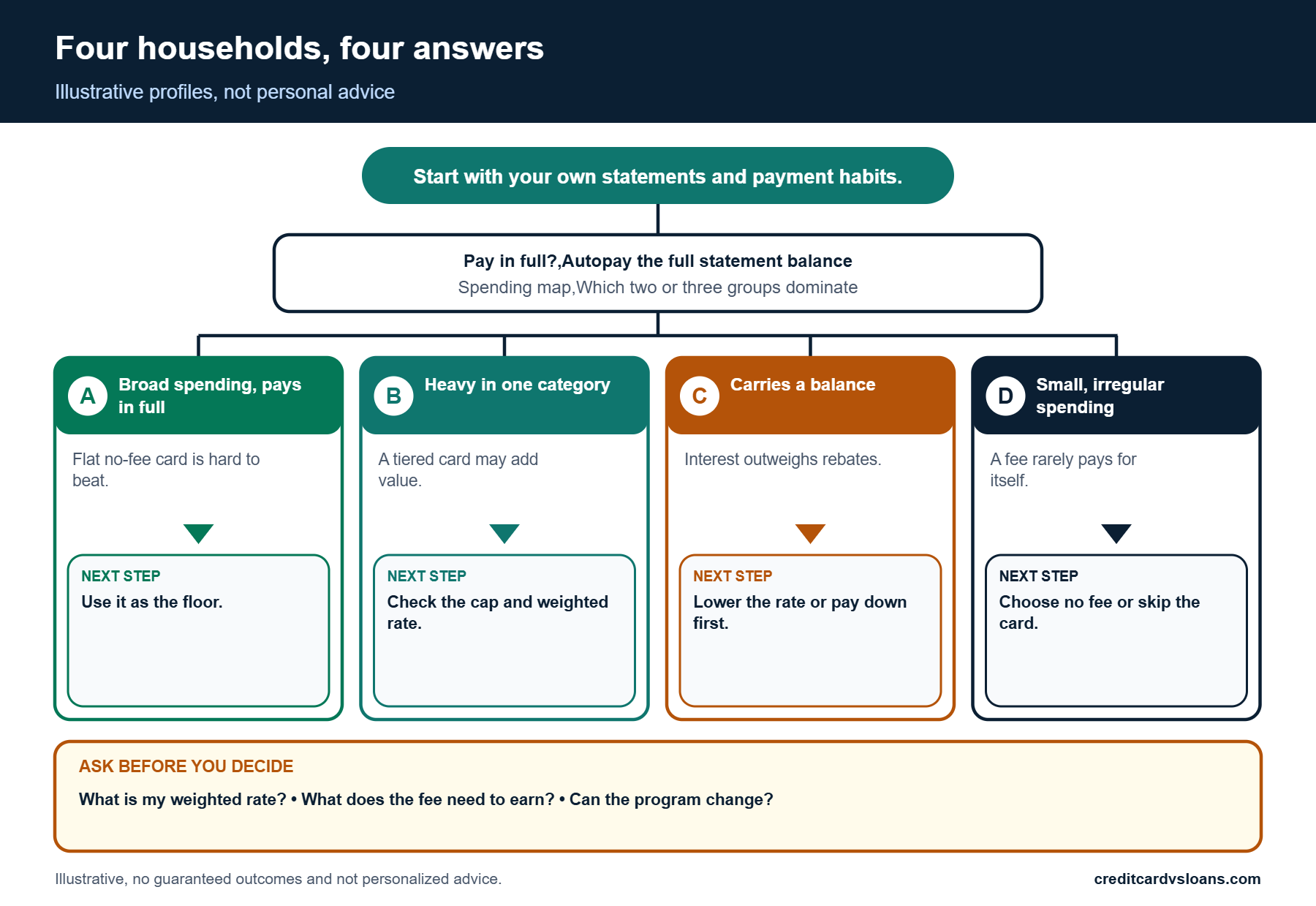
Write your annual card spending and the share in each category on one page. For each card you are considering, fill in four lines: gross cash back using the weighted rate, the annual fee, the first-year bonus counted only if it needs no extra spending, and a note on any cap or exclusion that applies to you. Add a fifth line for interest only if you expect to carry a balance.
Circle the card with the highest net figure, then compare it to the flat no-fee floor. If the margin is less than about the cost of the hassle, such as tracking categories or activating bonuses, take the simpler card.
When the answer is no card at all
Sometimes the sensible output of the worksheet is to skip a new card. If you are carrying a balance, your credit is still being repaired, or your spending is low enough that no rebate beats a fee, a new cash back card may add cost without adding value. Say no, or revisit when your situation changes.
That is not a failure of the method. It is the method working.
Next steps
Before you apply
- List twelve months of spending by category using your own statements.
- Compute the effective rate for each card and subtract the annual fee.
- Read the redemption, expiration and exclusions terms.
- Look up the purchase APR and decide whether you will pay in full every month.
- Prequalify with a soft pull if the issuer offers it, and apply to one card at a time.
After you have the card
- Set autopay for the full statement balance if your bank allows it.
- Redeem on a schedule, and note any activation dates.
- Review your spending and the card’s rate once a year, and move spending if another option clearly beats it.
- Keep records of disputes, and send billing error notices in writing within 60 days of the statement that shows the mistake, as the FTC explains.
The right cash back credit card for you, if there is one, is the one that nets the most dollars on your own spending after fees and without a revolving balance. Start with a flat-rate floor, test every alternative against it, and let interest and discipline decide the rest.
- Rewards Credit Cards: How Points, Miles and Cash Back Really Work
- 0% Balance Transfer Credit Cards: How to Use Them Without a Debt Trap
- Credit Card Debt Forgiveness: What Is Real and What Is a Scam?
- Student Credit Cards: How to Build Credit Without Overspending
- Credit Card Debt Consolidation: Best Options by Credit Profile
- CFPB: Credit card rewards: Issue spotlight (May 2024)
- CFPB: Consumer Financial Protection Circular 2024-07: Design, marketing, and administration of credit card rewards programs
- CFPB: What is a grace period?
- Federal Reserve: Consumer Credit – G.19 (release of Sept. 8, 2026)
- FTC: Using credit cards and disputing charges
Last updated: October 22, 2026. Rates, fees and lender rules change; verify current terms before acting.
The information on creditcardvsloans.com is provided for general educational and informational purposes only. It is not financial, legal, tax, credit, accounting or investment advice, and reading it does not create an advisor-client, fiduciary or any other professional relationship. Nothing here is an offer, solicitation or recommendation to borrow, lend or apply for any product.
Credit scores, interest rates, fees, eligibility rules, lender policies and laws change frequently and vary by lender, location and individual circumstances. Examples, figures and scenarios are illustrative only, do not predict your results and do not guarantee approval, savings, a particular rate or a credit-score outcome. Always confirm current terms directly with the lender or issuer and read the full agreement before you apply or sign.
Although we aim for accuracy and use reputable sources, we make no representations or warranties, express or implied, about the completeness, accuracy, reliability or timeliness of the content. Content may be drafted with the assistance of automated tools, so errors or omissions may still occur. Links to third-party sites are provided for convenience; we don’t control and aren’t responsible for their content.
To the fullest extent permitted by law, creditcardvsloans.com and its owners, editors, authors, contributors and affiliates disclaim all liability for any loss, damage or expense arising directly or indirectly from your use of, or reliance on, this content. Before making financial decisions, consult a licensed professional, such as a qualified financial advisor, attorney, tax professional or nonprofit credit counselor, who can consider your complete situation.