The credit score needed for a rewards card depends on the kind of rewards card you want: entry-level cash back cards are generally built for a broad range of credit profiles, while premium travel cards with higher annual fees tend to be aimed at applicants with stronger credit. No issuer is required to publish a minimum score, so treat any range you see as a target for planning, not a rule.
It also helps to ask a second question before you ask about the score: can the rewards actually pay off for you? The CFPB has found that people who carry a revolving balance pay most of the interest and fees in the system while capturing a smaller share of the rewards, which makes the approval question only half the decision. This guide covers both halves, starting with what the score tiers mean for rewards cards and then moving to the economics that decide whether a rewards card is worth having.
If you are comparing this with other cards, the tier-by-tier logic is explained in more detail in the guide to score tiers for 0% APR cards, and the non-score approval factors, such as income and existing debts, are covered in the companion guide on approval factors. The same principles carry over to rewards cards.
- There is no official minimum score for rewards cards. Entry-level cash back and premium travel cards serve different audiences, and issuers set their own criteria, so terms vary by lender.
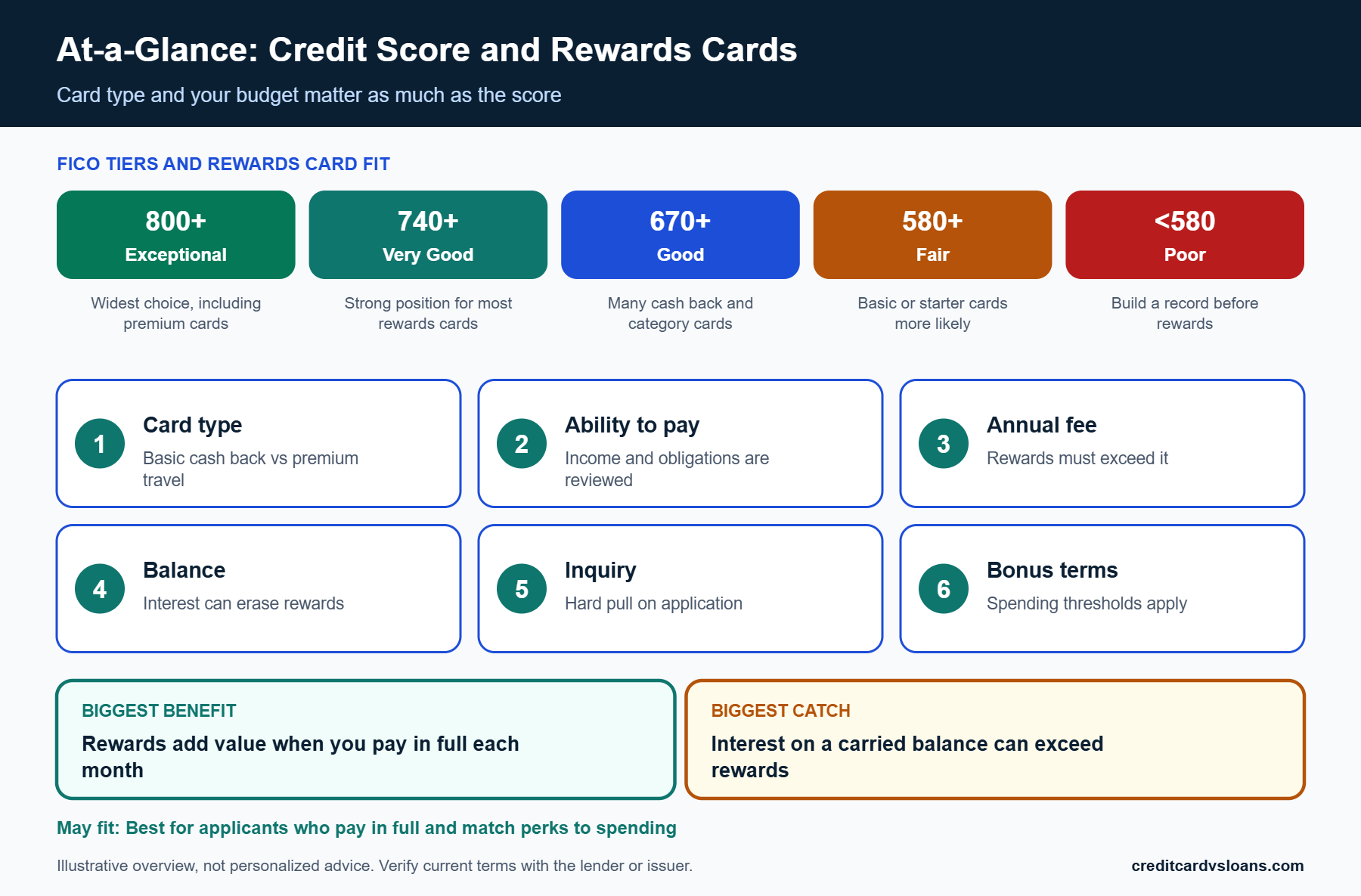
- FICO labels 670 to 739 as Good, 740 to 799 as Very Good and 800 and above as Exceptional. Higher tiers generally widen the set of cards you can compare, but they do not guarantee approval.
- Federal rules require issuers to consider your ability to make minimum payments based on your income or assets and your obligations, so score alone does not decide.
- The CFPB advises comparing the yearly value of the rewards you will actually use with any annual fee, and focusing on low interest rates instead of rewards if you tend to carry a balance.
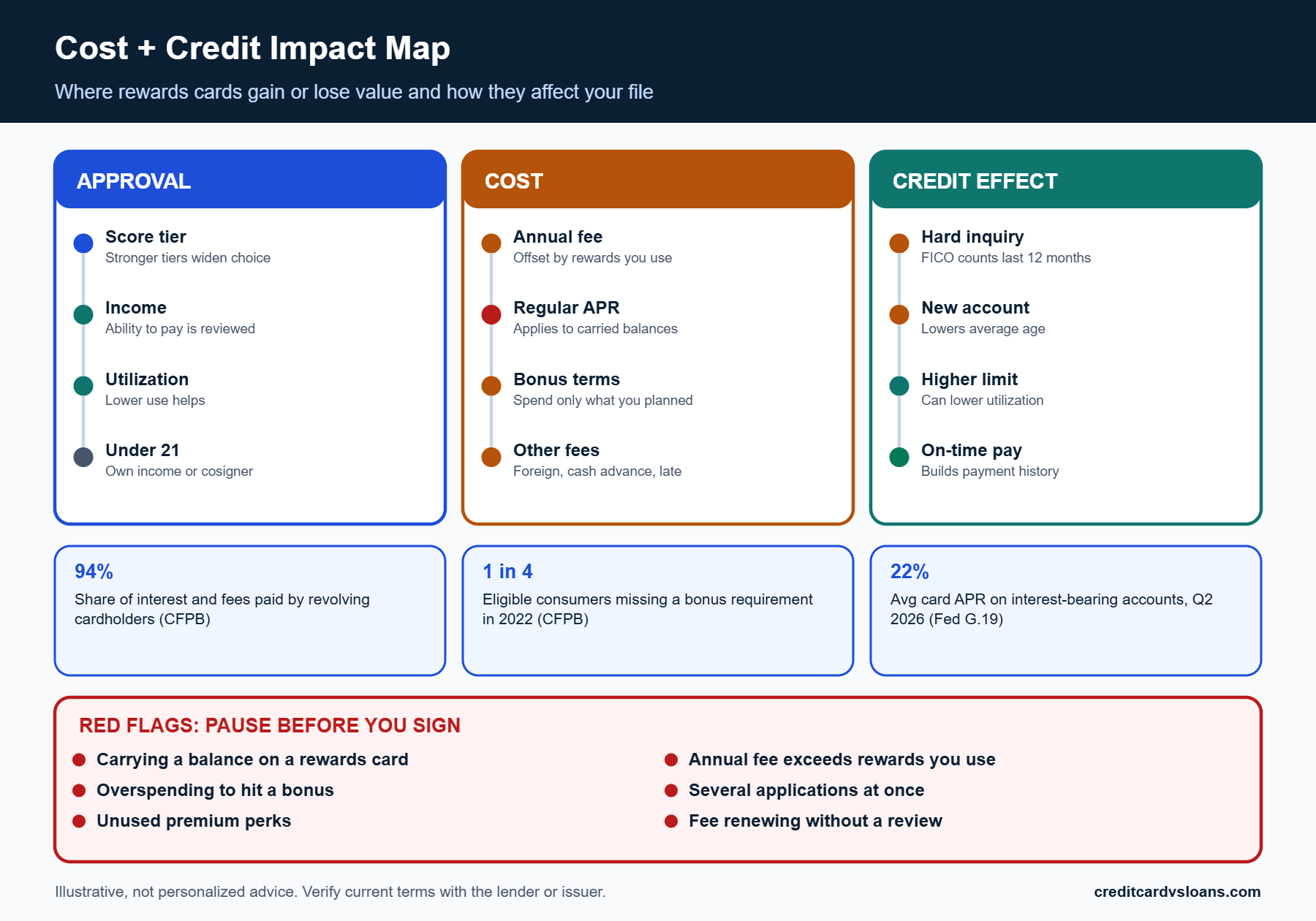
- Applying adds a hard inquiry. FICO considers inquiries from the last 12 months, though they stay on your report for two years.
Information is current as of October 2026. The Federal Reserve’s G.19 release of October 7, 2026 reported average card rates of 22.15% on accounts assessed interest and 20.94% across all accounts for the second quarter of 2026. Rewards rates, annual fees and sign-up offers change often, so check the issuer’s current terms.
Table of contents
Credit Score Needed for Rewards Card: What to Expect
Rewards cards are a broad category
Basic cash back versus premium travel cards
A rewards card can mean a no-annual-fee card that returns a small percentage of purchases, a card that pays more in selected categories, or a premium product that bundles travel benefits and charges a significant annual fee. The CFPB’s May 2024 issue spotlight on rewards says about three in four general purpose credit card accounts are rewards cards, which is a reminder that the category covers a wide range of products and audiences.
Because premium cards cost issuers more to run and usually carry higher fees, it is reasonable to expect them to be marketed to stronger profiles. Entry-level products may be open to a wider range. That is a pattern to plan around, and each issuer decides for itself.
Why “excellent credit required” is not a rule
Card pages often include a suggested credit range such as good or excellent. These descriptions tell you who the card was designed for. They do not describe the issuer’s decision model, and they do not promise approval to someone in the range or rule it out for someone outside it.
What the issuer does have to do is consider your ability to make the required minimum payments before opening the account, based on income or assets and current obligations, under 12 CFR 1026.51(a). Your score is one part of the file.
Score tiers and what they usually mean here
The five FICO tiers
myFICO lists the FICO tiers as follows: below 580 Poor, 580 to 669 Fair, 670 to 739 Good, 740 to 799 Very Good and 800 and above Exceptional. The CFPB adds that most scores fall between 300 and 850 and that you have many scores that can differ by model, loan type, data source and date.
FICO also says your lender may use a different FICO Score than the one you can see, and notes that card issuers and auto lenders assess creditworthiness differently, which is why industry-specific scores exist. So place yourself in a tier, then allow for a gap.
What to expect by tier
As a planning guide, applicants in the Good tier and above generally have more rewards cards to compare, including some premium products. Applicants in the Fair tier may see fewer options and smaller limits, with basic cash back or starter products more likely to fit. Applicants below Fair may find that building a record with a secured or starter card comes first.
These are patterns, not promises. Utilization, income and recent applications can move an outcome in either direction.
| Card type | Who it tends to suit | Main advantage | Main drawback | Check first |
|---|---|---|---|---|
| Basic cash back, no annual fee | Wide range of profiles | Simple, no fee to offset | Lower reward rate | Regular APR and reward terms |
| Category or tiered rewards | Good tier and above is a common target | Higher rates on your top categories | Caps and rotating rules | Whether your spending fits the categories |
| Premium travel card | Stronger profiles; fees are higher | Travel perks, richer points | Large annual fee | Yearly value of benefits you will use |
| Starter or secured with rewards | Thin or rebuilding files | Builds history | Limited rewards, possible fees | Reports to all three bureaus |
The right-hand column matters most: what you check before applying is what protects you from a costly mismatch.
What Issuers Weigh Besides the Score
Ability to pay and income
What the rule requires
Under Regulation Z, a card issuer must consider whether you can make the required minimum payments before opening an account, using your income or assets and your current obligations. Issuers must keep reasonable written procedures and include at least one measure, such as debt to income, debt to assets or income remaining after obligations. A card issued with no review of that information, or to someone with no income or assets, is considered unreasonable.
So a high score alone is not enough, and a modest income can limit the credit limit offered even with strong credit.
Applicants under 21
For applicants under 21, the regulation requires a written application and either financial information showing independent ability to make payments, or a signed agreement from a cosigner, guarantor or joint applicant who is 21 or older. If you are under 21 and interested in a rewards card, ask about the issuer’s rules for independent income and cosigners before applying.
Rewards should not be the reason to take on a cosigner. The cosigner’s credit and liability are involved.
Payment history, utilization and new credit
The factors with the biggest weight
myFICO says payment history is 35% of a FICO Score and amounts owed 30%, with credit utilization, the percentage of your revolving credit you are using, inside the latter. Length of history is 15%, new credit 10% and credit mix 10%. Together these explain why paying on time and keeping balances low are the most direct ways to improve a rewards-card profile.
For a deeper look at how these approval factors interact with a promotional card, see this guide to 0% APR card approval factors.
Recent applications
Sign-up bonuses encourage people to apply for several cards at once. That can work against you: myFICO notes that opening several accounts in a short period is seen as riskier, and each application adds a hard inquiry. The CFPB also advises applying only for the credit you need.
If your goal is a sign-up bonus, read the requirements and make sure you can meet them without extra spending that you would not otherwise do.
Existing relationships and the details around the score
Your bank or credit union may be a good first stop
The CFPB suggests starting your card search with your bank or credit union, because an existing relationship may get you a better offer, and asking your current issuer to match or beat a competing offer. For rewards cards this is practical advice: an institution that already sees your deposits and payment behavior may be more comfortable approving you, and a product you already hold may have an upgrade path.
That does not mean you should accept the first offer. Compare the reward structure, the annual fee and the regular APR against at least one other card, using the same assumptions about how much you spend and whether you carry a balance.
What you can control in the weeks before you apply
You cannot change your history overnight, but you can control a few things that sit on top of it. Pay down card balances so that the amounts reported are lower, avoid new applications for a stretch, and make sure the income and obligations you list on the application are accurate and current.
It also helps to gather what you need in advance: your income details, your housing costs and a list of your current debts. An application completed carefully tends to go more smoothly, and accuracy matters more than speed, because the issuer must consider your ability to pay.
Rewards Economics: Fees, Interest and Who Comes Out Ahead
Annual fees against the rewards you will actually use
Compare yearly value with the fee
The CFPB’s guidance on comparing cards is direct: always compare the value of the rewards you expect to receive, and use, each year with the annual fee you might pay. A card that returns a higher rate in categories you rarely spend in is worth less to you than a plainer card whose rewards match your actual budget.
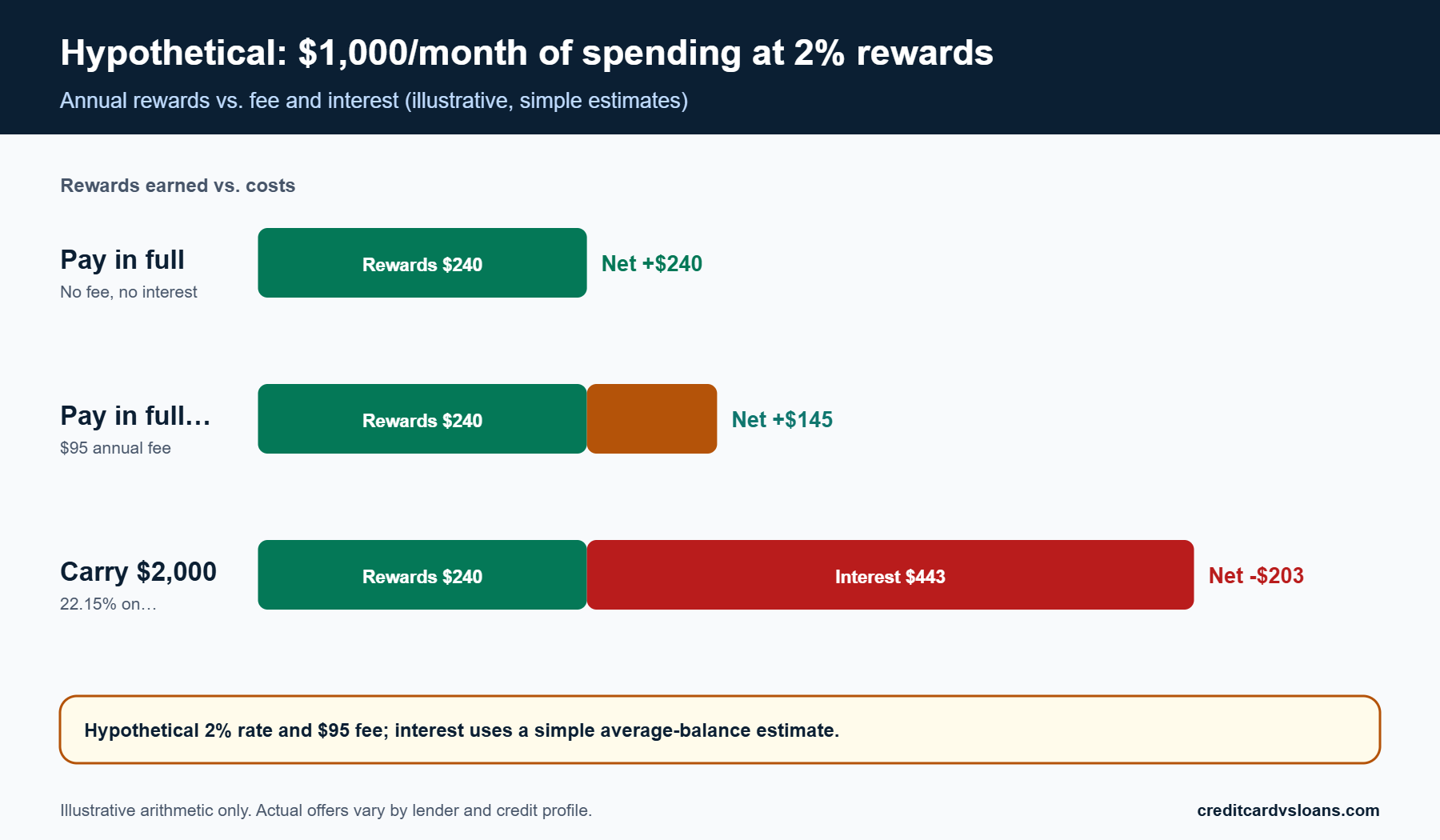
As a hypothetical, a card that earns 2% on a household’s $1,000 of monthly spending returns $240 a year. If that card charges a $95 annual fee, the net is $145 before any other costs, and the net falls further if the fee exceeds what you earn. The numbers shift with your own spending, so work from your own statements.
Premium benefits count only if you use them
High-fee cards often bundle benefits such as travel credits or lounge access. The CFPB’s issue spotlight observes that for high-fee cards the value depends heavily on those affiliated benefits, and that issuers increasingly restrict some of them. A benefit you will not use is not a discount on the fee.
Before applying, list the benefits you would use in a normal year and put a realistic dollar value on each. If they do not clearly exceed the fee, a lower-fee card is usually the more cost-effective choice.
Interest can erase rewards
What the data says about balances and rewards
According to the CFPB’s May 2024 spotlight, which cites its 2023 market report, revolving cardholders pay 94% of total interest and fees yet capture less than 30% of the rewards benefits. It also cites a Federal Reserve working paper finding that near-prime and subprime cardholders typically pay more in interest and fees on rewards cards than on non-rewards cards, even after counting the rewards they earn.
The simplest reading is that rewards are designed for people who pay in full. If you carry a balance, the interest charge can easily exceed the value of the points.
A hypothetical comparison
Take the same $240 in annual rewards. If you carry an average balance of $2,000 at 22.15%, the rate the Federal Reserve’s G.19 release of October 7, 2026 reported for accounts assessed interest in the second quarter, you would pay roughly $443 in interest over a year (a simple estimate using the average balance). That outweighs the rewards by a wide margin.
Sign-up bonuses and redemption risk
Bonuses with conditions
The CFPB’s spotlight reports that, in 2022, about one in four consumers eligible for a promotional bonus failed to meet its requirements. Sign-up bonuses are typically tied to a minimum amount of spending within a set period, so a bonus can tempt you into spending you would not otherwise do.
Read the conditions on the page you actually apply from. The CFPB also describes consumers who said the offer they saw advertised differed from the one linked in the application, so confirm the terms before you submit.
Devaluation, redemption and forfeiture
The same report received more than 1,200 rewards-related complaints in 2023, with themes including unexpected promotional conditions, devaluation, redemption problems and revocation. Devaluation means the points needed for a given reward can rise after you have earned them. Some issuers reserve the right to claw back bonuses if an account is closed or downgraded within 12 months.
The practical lesson is to redeem earned rewards on a regular basis rather than banking them for years, and to check the program rules on expiration and forfeiture when you close an account.
Matching the reward structure to your spending
Flat-rate versus category rewards
A flat-rate card pays the same percentage on everything, which is easy to track and rarely leaves value on the table. A category card pays more on selected spending but often comes with caps, activation steps or rotating categories. The extra return is real only if your spending lands in the favored categories and you remember to use the right card.
Look at three months of statements and sort your spending. If most of it sits in one or two categories, a category card might earn meaningfully more. If it is spread across many, a flat-rate card is often simpler and more reliable.
Keep the arithmetic honest
It is easy to overestimate rewards by counting a category that you rarely use or by assuming points are worth more than the issuer’s redemption options allow. The CFPB’s spotlight notes that a point is typically estimated at about one cent, which is only a rule of thumb, and the value you get depends on what you redeem for.
Use a conservative figure, subtract the annual fee and any foreign transaction or other fees you would incur, and only then compare cards. If two cards come out close, the one with the lower fee and simpler rules is usually the safer pick.
| Cost or credit item | Basic cash back | Premium rewards card | Why it matters |
|---|---|---|---|
| Annual fee | Often none | Can be substantial | Rewards must exceed it to come out ahead |
| Regular APR if you carry a balance | Applies to what remains | Applies to what remains | Interest can exceed the rewards |
| Sign-up bonus conditions | Usually a spending threshold | Usually a spending threshold | Do not overspend to qualify |
| Credit inquiry | Hard inquiry on application | Hard inquiry on application | Counts in FICO’s 12-month window |
| Utilization effect | Higher limit can lower utilization | Higher limit can lower utilization | Only if balances stay low |
| Key risk | Low reward rate | Fee plus unused perks | Match the card to your spending |
How Applying for a Rewards Card Affects Your Score
Hard inquiries and new accounts
What happens when you apply
The CFPB explains that hard inquiries usually happen when a lender reviews your credit after you apply, and that they can affect your score because scoring models consider how recently and how often you apply for credit. FICO adds that its scores consider inquiries from the last 12 months and that inquiries stay on your report for two years.
A new account also lowers the average age of your accounts and adds to new credit, which is 10% of a FICO Score. Over time, on-time payments and a higher total limit can work in your favor, but the first months are when you are most likely to see a dip.
Soft-pull previews
Some issuers let you check likely fit without a hard inquiry. The CFPB lists prescreened offers and your own report requests as soft inquiries that do not affect your scores. A preview is not a commitment to approve, but it is a sensible way to avoid applying where you are unlikely to qualify.
Look for wording that tells you whether continuing past the preview triggers a hard inquiry.
Protecting your score while you chase rewards
Pace your applications
A steady approach to rewards cards is one application at a time, with enough time between to see the effect on your file. The CFPB notes that applying for many cards in a short period can lower your credit scores. If you have a large purchase such as a mortgage or auto loan coming up, rewards cards can generally wait.
Build a short list first, compare on net value, and apply to the one that fits.
Rewards and your credit limit
A higher limit gives you more room, which helps utilization if you keep balances low, but it also raises the amount you could owe. Rewards programs reward spending, so a generous limit can nudge spending upward. Decide in advance how much you intend to charge each month and treat the limit as a ceiling rather than a target.
If the limit you receive is lower than expected, resist the urge to apply elsewhere immediately. A modest limit used carefully and paid in full builds a record that can support a limit increase or a better product later.
Keep utilization low
Even a strong rewards card can hurt you if it runs a high balance. Because amounts owed make up 30% of a FICO Score, paying the statement balance in full is both the cheapest way to use a rewards card and the best for your score. If you carry a balance on other cards, deal with those balances first.
When a rewards card has a low limit, spending near it can look like high utilization, so keep a margin.
If Your Score Is Below the Rewards Tier You Want
Choose a card that matches your current profile
Start with fewer frills
If you are in the Fair tier or building, a basic card with a modest or no annual fee that reports to all three bureaus is a more realistic first step than a premium card. The CFPB says a secured card, a credit builder loan or a retail card are ways to start or rebuild credit, as long as payments are reported to the nationwide bureaus.
Rewards on starter products are typically modest. The real value is building the record that opens better options later.
If you carry a balance, rewards may not be the right goal
The CFPB tells people who carry a balance to focus on low interest rates, noting that low-rate cards usually have no rewards and no annual fee. If your priority is paying down debt, see the guide to credit scores for balance transfer cards, and for a fixed-payment route see the score guidance for debt consolidation loans and the guide to personal loan scores.
Rewards become useful once the balances are gone and you pay in full each month.
Improve the file before you apply
High-impact steps
Pull your free reports, which the FTC says are available weekly from each of the three bureaus at AnnualCreditReport.com, and dispute errors with both the bureau and the company that supplied the data. Pay down revolving balances, make every payment on time and hold off on new applications for a stretch.
None of these steps comes with a promised result, but each one targets a factor that scoring models weigh.
Using a secured or starter card as a bridge
If your record is thin, a secured card or a small starter card can serve as a bridge to rewards. The CFPB notes that with a secured card the deposit you make becomes your spending limit, and that payments on these products are reported to the three nationwide credit bureaus. Used lightly, with the balance paid in full each month, the account builds payment history and keeps utilization low.
After a stretch of on-time payments, check your reports and consider whether a basic rewards card has become a realistic next step. Ask your issuer whether it reviews accounts for an upgrade, since the details vary by lender and are worth confirming rather than assuming. Keep expectations modest and let time do its work.
When to wait
If a preview suggests you are not yet a fit, or you would be approved only for a low limit and a high fee, waiting costs you nothing. Set a review date several months out, check your reports and try again with a stronger file.
A rewards card is a long-term tool, and the right time to apply is when the numbers work.
Red Flags Before You Accept a Rewards Offer
Offer terms that deserve a second look
A high regular APR on a card you may carry a balance on
Rewards cards can carry a regular APR at or above the averages in the Federal Reserve’s G.19 release, and if you ever carry a balance, that rate decides your cost. The CFPB advises asking whether you would still want the card at the highest advertised rate, since an offer may list a range and you will not know your rate until you are approved.
Also check the penalty APR, which the offer must state along with its trigger and duration, and the cash advance and late fees. These sit outside the rewards headline but can change the economics of the card quickly.
Bonus requirements that push you to overspend
A spending threshold for a sign-up bonus is a red flag if reaching it means buying things you did not plan to buy. Interest on a balance you cannot clear can cost more than the bonus is worth. A bonus is a benefit only when the spending was already in your budget.
If you cannot hit the threshold with normal spending in the stated period, treat the bonus as out of reach and judge the card on its everyday value.
Signs the card is the wrong tool right now
You are already carrying balances
If you are paying interest on existing cards, a new rewards card is unlikely to be the best next step. The more useful comparison is how to reduce the interest cost of the balance you have, using tools such as a balance transfer or a fixed-rate loan, and returning to rewards once you pay in full.
Rewards earned while you carry a balance rarely cover the interest, as the CFPB’s figures on who captures rewards suggest.
Your budget has no slack
When monthly cash flow is tight, a higher limit is not extra income. The temptation to spend toward a bigger limit, combined with a card that rewards spending, is a poor mix. If the budget is the problem, a nonprofit credit counseling agency, which the CFPB suggests as a source of help, can look at the whole picture.
A smaller, simpler card that you can pay in full is a safer pick than a feature-rich card you must finance.
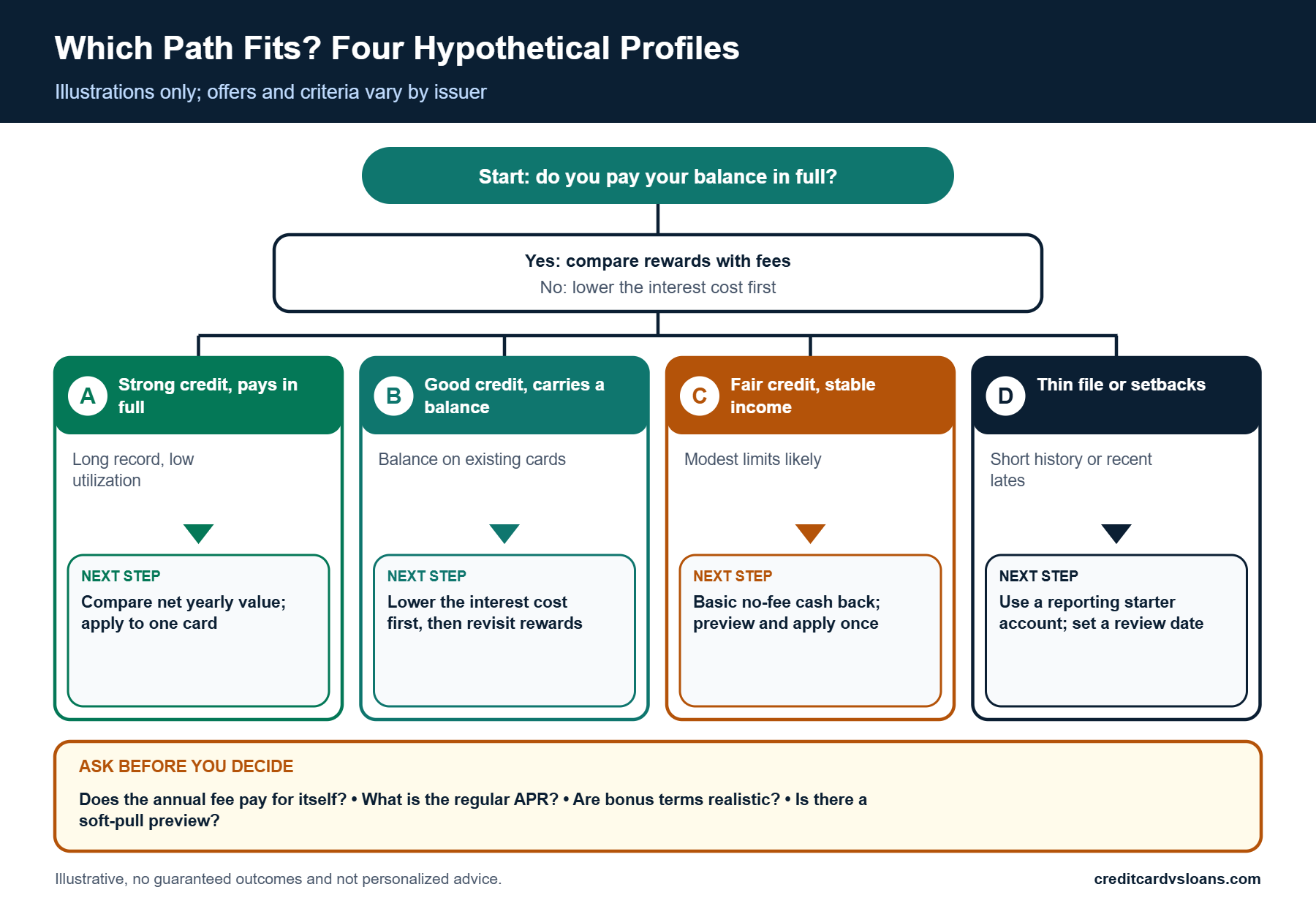
Which Path Fits? Hypothetical Profiles
Four illustrative situations
Profile A: strong credit, pays in full
A hypothetical applicant with a long, clean record and low utilization who pays in full has the most options. The decision becomes one of fit: whether the rewards structure matches their spending and whether any annual fee is covered by benefits they will use.
Next step: compare net yearly value across two or three cards and apply to one.
Profile B: good credit, carries a balance
A hypothetical applicant with a Good-tier score who carries a balance may be approved for a rewards card but is unlikely to come out ahead. Interest tends to outweigh rewards in that situation.
Next step: address the balance first with a lower-rate tool, then revisit rewards.
Two more situations
Profile C: fair credit, stable income
This hypothetical applicant may see fewer rewards options and smaller limits. A basic no-fee cash back card that reports to the bureaus can build the record while returning a small amount.
Next step: use a soft-pull preview, apply once and keep utilization low.
Profile D: thin file or recent setbacks
A hypothetical applicant with a very short history or recent late payments is generally better served by rebuilding. A secured card or credit builder loan, used lightly and paid on time, sets up a stronger rewards application later.
Next step: choose a starter product, set autopay and set a review date.
| Situation | Option to investigate | Why | What to verify | When to avoid it |
|---|---|---|---|---|
| Strong credit, pays in full | Rewards card matched to spending | Rewards come out ahead when no interest is paid | Annual fee versus yearly value | If perks would go unused |
| Good credit, carries a balance | Lower-rate card or loan first | Interest can outweigh rewards | Regular APR and transfer fee | Chasing a bonus with new spending |
| Fair credit | Basic cash back, no annual fee | More realistic fit | Reports to all three bureaus | High-fee premium cards |
| Thin file or setbacks | Starter or secured product | Builds history | Fees and reporting | Many applications at once |
Bottom Line and Your Pre-Application Checklist
The decision in plain terms
What to remember about the score
Good credit or higher gives you the widest choice of rewards cards, but no score guarantees approval. A rewards card pays off when you pay in full and the rewards exceed any annual fee. If you carry a balance, work on lowering that cost first.
The score opens the door and the economics decide whether to walk through it. Check your real scores, choose the card type that matches your spending and apply once.
What to remember about the card
Rewards are a feature, not a discount on borrowing. The CFPB’s own comparison advice puts it plainly: if you tend to carry a balance, look at interest rates first. If you pay in full, compare rewards with fees.
Your checklist
Steps before you apply
- Pull your three free reports at AnnualCreditReport.com and correct errors.
- Check a consistent score and place yourself in a tier, allowing for model differences.
- List your yearly spending by category and estimate the rewards you would really earn.
- Compare that value with the annual fee and the regular APR you might receive.
- Use a soft-pull preview where one is offered, then apply to one card.
- Read the sign-up bonus conditions and the program rules on redemption and expiration.
If you are declined
Read the notice for the stated reasons and check them against your reports. Address the cause, such as high utilization or an error, and wait before applying again. Try a card better matched to your current profile instead of repeating the same application.
Questions worth settling first
Is a rewards card better than a low-rate card?
It depends on whether you pay in full. The CFPB’s comparison guidance says to focus on low interest rates if you tend to carry a balance, and on fees and rewards if you pay in full. For some people a low-rate card without rewards is the cheaper choice overall.
Think about the next twelve months of your budget honestly, then pick the card that fits the way you will actually use it.
Should I redeem rewards right away?
Because the CFPB reports devaluation, redemption problems and forfeiture as recurring complaint themes, redeeming regularly instead of stockpiling is a reasonable way to limit exposure. Check expiration rules and what happens to rewards if you close the account.
Keep a record of your earned rewards so you can notice quickly if redemption values change.
Will a rewards card help me build credit?
A rewards card builds credit the same way any card does: on-time payments, low utilization and time. The rewards themselves have no effect on your score. If building credit is the goal, a simpler card you can pay in full each month does the job.
For the broader question of how a new account affects your file, the factors are the same ones scoring models always weigh: payment history, amounts owed, history length, new credit and mix.
Mistakes that quietly cost rewards cardholders
Paying only the minimum
Rewards earned on a month of purchases can be wiped out by a single month of interest on a carried balance. Paying only the minimum keeps the account in good standing but leaves a balance that accrues interest at the regular APR. If cash flow is tight, the safer pattern is to charge less to the card, not to rely on the rewards to offset the interest.
Setting autopay for the full statement balance, with a backup for the minimum, removes most of the risk of an accidental balance.
Letting a fee renew without a review
Annual fees renew automatically. Put the renewal date in your calendar and, a month before, compare what you earned and used against the fee. The CFPB notes that some consumers report issuers refusing to prorate or refund the annual fee after program changes, so decide before the fee posts, not after.
If the card no longer pays for itself, ask the issuer whether a no-fee version exists. Downgrading is sometimes possible, though the details vary by issuer and the rules on any bonus or rewards balance matter.
Closing a card without checking the effects
Closing an old card can reduce your total available credit and shorten the average age of accounts over time, both of which can matter for scores. It can also mean losing accumulated rewards. Check the program rules on forfeiture before you close an account, and redeem what you can first.
Decide using the fee and your overall limits, not the habit of keeping things tidy.
Ignoring foreign and other fees
Rewards math often leaves out smaller charges that can erode value: foreign transaction fees if you travel, cash advance fees if you use the card for cash, and late-payment fees if a due date slips. The CFPB tells shoppers to check these fees alongside the annual fee and APR before applying.
A card that looks generous on the rewards page can be an ordinary card once you add these costs, so read the fee table in full before you accept an offer.
- CFPB: What is a credit score?
- CFPB: What is a hard inquiry?
- CFPB: Credit Card Rewards Issue Spotlight (May 2024)
- CFPB: How to find the best credit card for you
- CFPB: What are some ways to start or rebuild a good credit history?
- eCFR: 12 CFR 1026.51 Ability to pay
- Federal Reserve: Consumer credit – G.19 (Release of October 7, 2026)
- FTC: Free credit reports
- myFICO: What is a FICO Score?
- myFICO: What’s in my FICO Scores?
Last updated: October 22, 2026. Rates, fees and lender rules change; verify current terms before acting.
The information on creditcardvsloans.com is provided for general educational and informational purposes only. It is not financial, legal, tax, credit, accounting or investment advice, and reading it does not create an advisor-client, fiduciary or any other professional relationship. Nothing here is an offer, solicitation or recommendation to borrow, lend or apply for any product.
Credit scores, interest rates, fees, eligibility rules, lender policies and laws change frequently and vary by lender, location and individual circumstances. Examples, figures and scenarios are illustrative only, do not predict your results and do not guarantee approval, savings, a particular rate or a credit-score outcome. Always confirm current terms directly with the lender or issuer and read the full agreement before you apply or sign.
Although we aim for accuracy and use reputable sources, we make no representations or warranties, express or implied, about the completeness, accuracy, reliability or timeliness of the content. Content may be drafted with the assistance of automated tools, so errors or omissions may still occur. Links to third-party sites are provided for convenience; we don’t control and aren’t responsible for their content.
To the fullest extent permitted by law, creditcardvsloans.com and its owners, editors, authors, contributors and affiliates disclaim all liability for any loss, damage or expense arising directly or indirectly from your use of, or reliance on, this content. Before making financial decisions, consult a licensed professional, such as a qualified financial advisor, attorney, tax professional or nonprofit credit counselor, who can consider your complete situation.