Credit card debt relief covers everything from a free phone call to your issuer to a court-supervised bankruptcy, and the options differ enormously in cost and credit damage. The right one depends on whether you are still current, how much you owe compared with what you earn, and whether you can keep making any payment at all.
Most people start by looking for the cheapest legitimate step and only move to heavier tools when it fails. This guide lays out those steps in order, explains what each one costs, and lists the red flags that mark an offer as something other than relief. It is a map of choices, not a recommendation for any one of them.
Two neighbors go deeper on specific topics: what is real and what is a scam in credit card debt forgiveness and the risks, taxes and credit damage of settlement. Here we compare the whole menu side by side.
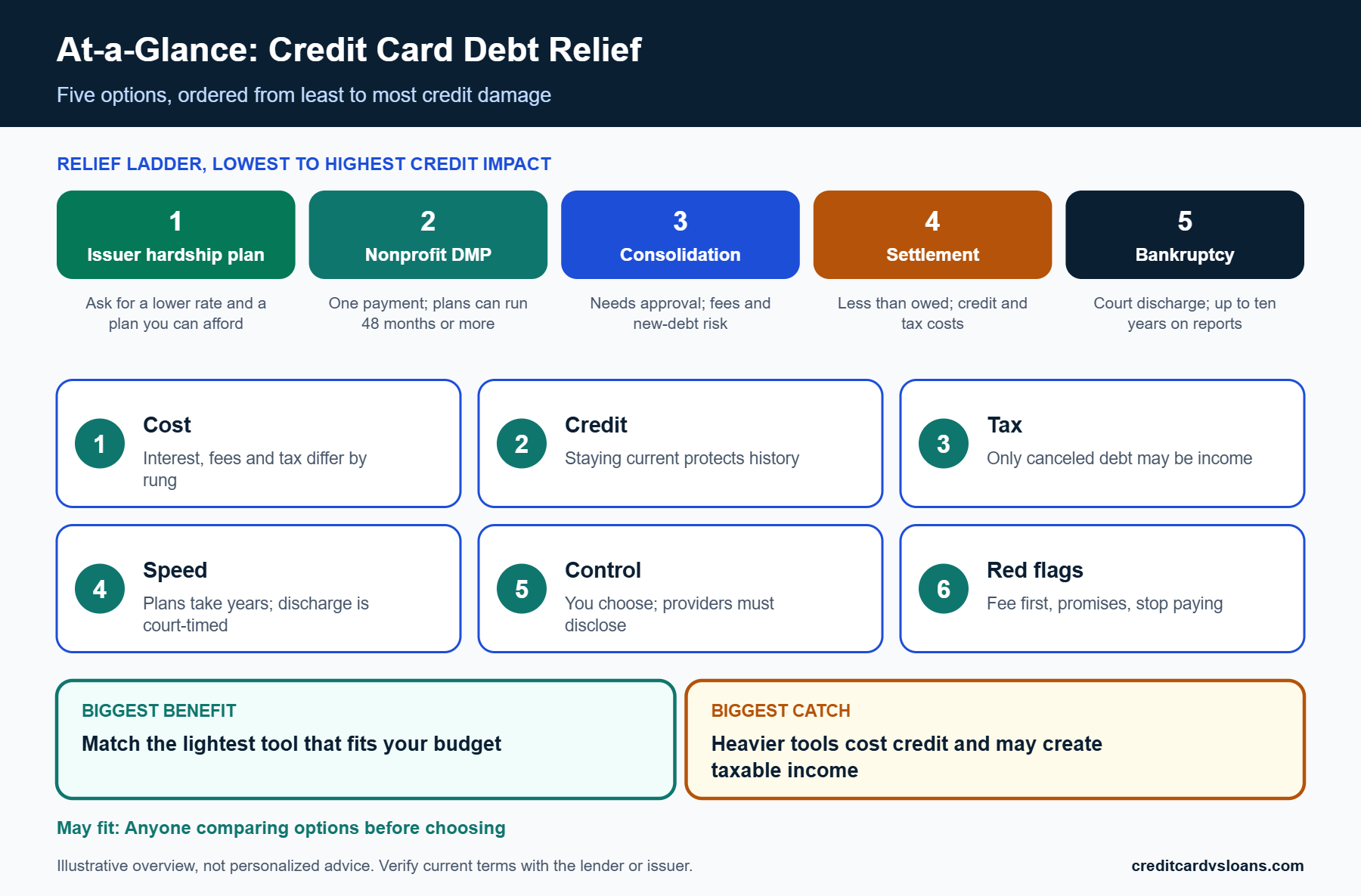
- The lowest-damage options come first: ask your issuer for a lower rate and a payment plan, then consider a nonprofit credit counselor and a debt management plan.
- Consolidation can reduce interest if your credit still qualifies, but it only helps if you stop adding new card debt.
- Settlement and bankruptcy can reduce what you owe, but both leave marks on credit reports and settlement can create a taxable amount.
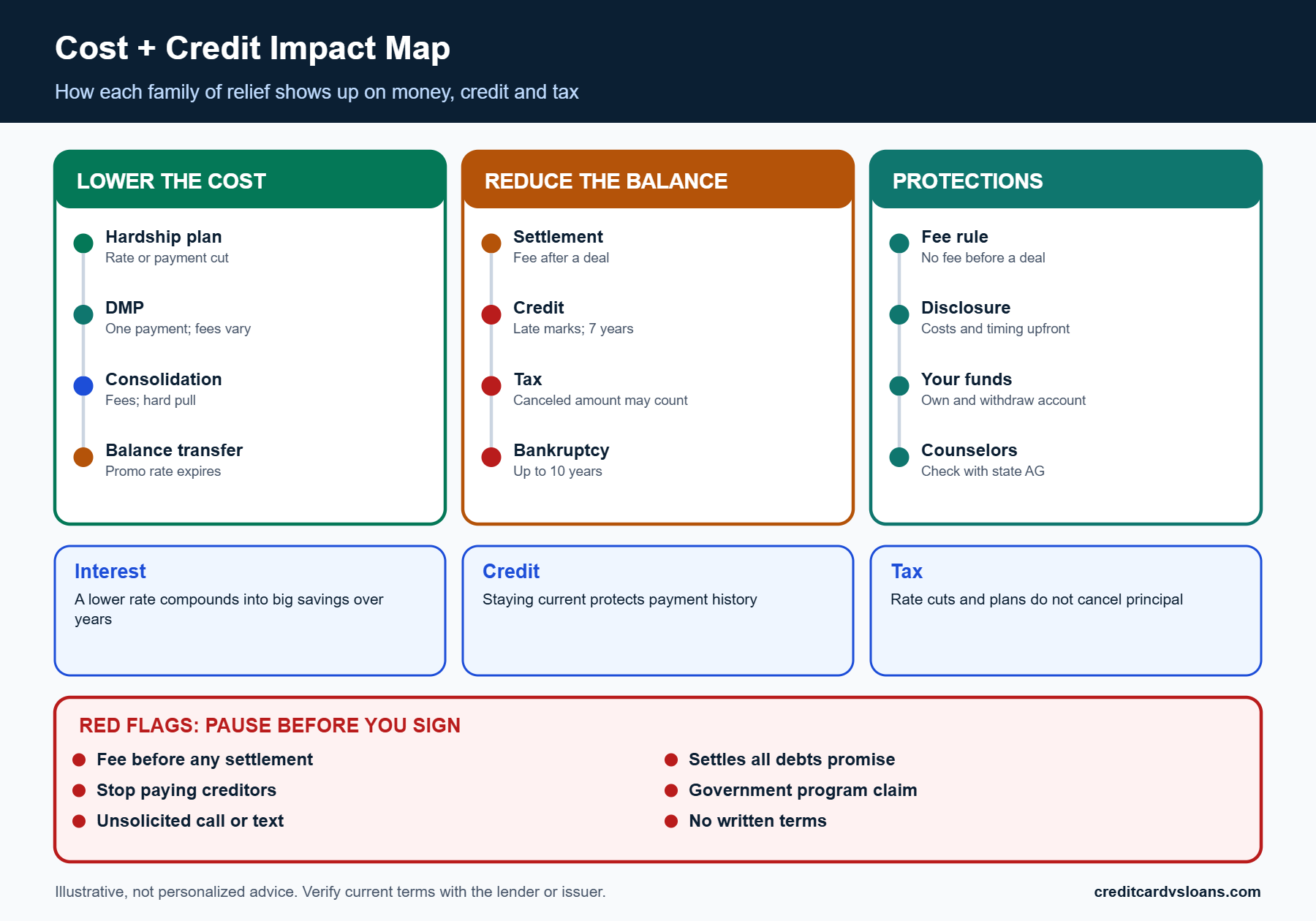
- Red flags include fees before any debt is settled, promises to settle all debts, instructions to stop paying creditors, and claims of a special government program.
- Free, official help is available from the FTC, the CFPB and nonprofit counselors that you can check with your state attorney general.
Figures and rules come from FTC, CFPB and IRS pages as they read in October 2026. Interest rates, fees and lender terms change often, so any numbers below labeled hypothetical are illustrations to compare options, not quotes.
Table of contents
Credit card debt relief: what the term covers and how to triage
Relief comes in two kinds
Relief that lowers the cost of repaying
One family of options leaves the balance mostly intact but makes it cheaper or easier to repay: a lower interest rate, a hardship payment plan, a debt management plan run by a nonprofit, or a consolidation loan. These keep the debt in play, which usually means less damage to your credit file and no forgiven amount for the IRS to treat as income.
They work best when you can still make some payment and the main problem is interest that eats your progress. The FTC’s first suggestion for card debt is simply to call the issuer and ask.
Relief that reduces what you owe
The other family reduces the balance itself: a settlement for less than the amount owed, or a bankruptcy discharge. These can matter when no repayment plan is realistic, but they come with tradeoffs. The FTC says credit damage is likely with settlement programs and that bankruptcy can remain on your credit report for 10 years.
The IRS adds that canceled debt may be taxable income unless an exclusion such as insolvency applies. Because the costs are larger, these options sit lower on the ladder.
A quick triage before you choose
Are you current, or already behind?
If you are current, the best relief is the kind that keeps you current: a lower rate, a counselor-managed plan, or consolidation. Each avoids the late-payment marks that settlement usually requires first. If you are already behind, the question becomes which route stops the damage fastest at a cost you can sustain.
Write down every account, the balance, the rate and the status. You cannot compare options without that list, and any legitimate counselor will ask for it.
Does your budget have room for any payment?
A monthly budget answers most of the triage. If income minus essentials leaves a steady surplus, a payment plan can work even at a high balance. If there is no surplus and none is likely, a repayment plan will only delay the problem, and reduction options may deserve a serious look. A nonprofit credit counselor can review the numbers without selling you a product.
The CFPB suggests listing take-home pay and expenses and leaving room for emergencies, because falling behind on other bills creates bigger problems.
| Option | What it does | Typical cost | Best for | Main catch |
|---|---|---|---|---|
| Issuer hardship plan | Lowers rate or payment | Usually no program fee; terms vary | Borrowers still able to pay something | Terms vary by issuer |
| Nonprofit debt management plan | One payment; possible lower interest and fees | Fees vary; get a written quote | Steady income, several cards | Plans can run 48 months or more |
| Consolidation loan or balance transfer | Replaces several balances with one | Origination or transfer fees may apply | Borrowers who still qualify | Needs approval; new debt can undo the benefit |
| Settlement | Pays less than owed | Company fees only after a qualifying deal | Lasting hardship | Credit damage and a possible tax bill |
| Bankruptcy | Court discharge of eligible debts | Court and attorney fees | No realistic way to repay | Up to ten years on reports |
First rung: ask your card issuer for a hardship plan
What to ask for
A lower rate, a lower payment, or both
The FTC says to call the number on your card or statement and ask for a lower interest rate and a payment plan you can afford. Keep records of every conversation, and ask for any agreement in writing. Issuers vary widely in what they offer, so there is no promise of a particular result, but the call is free and does not require a third party.
Explain what changed, such as reduced hours, a medical expense or a layoff, and what monthly payment you can sustain. A specific number lands better than a general request for help.
What to confirm before you accept
Ask how long the plan lasts, whether the interest rate is reduced for the entire period, whether the card will be closed, and how the account will be reported while you are on the plan. The answers differ between issuers, so do not assume.
If something is unclear, ask for the terms by email or letter. A hardship plan that exists only in a phone representative’s notes is hard to enforce later.
When the issuer is not enough
Charged-off accounts and collectors
If you have missed payments for months, the FTC says the issuer may charge off the debt after four to six months and may sell it to a collector. You still owe the money and creditors may still negotiate. At that point, your counterpart is often a collection agency instead of the issuer.
The CFPB says you may have more room to negotiate with a collector than you did with the original creditor, and that collectors must provide information about the debt within five days of first contacting you.
When the problem is bigger than the interest rate
A lower rate helps when the balance is manageable. It does little if the balance is far larger than your income can service. In that case the next rungs may be a nonprofit counselor, then reduction options.
Signs of this situation include paying minimums for years with the balance barely moving, or using new credit to cover old payments. Either deserves an honest look at the numbers.
Second rung: nonprofit credit counseling and debt management plans
How a debt management plan works
One payment, negotiated terms
The CFPB describes credit counseling organizations as usually nonprofit, with certified counselors who review your finances and may set up a debt management plan. You make one monthly payment to the organization, which pays your creditors. The plan can lower your monthly payments, interest charges and fees.
The FTC adds that creditors may lower interest rates or waive some fees, the plans cover unsecured debts such as credit cards and medical bills, and they can take 48 months or more. You may be asked to stop taking on new credit while you are in the plan.
What a plan does not do
The CFPB’s older guidance notes that counselors usually do not reduce the amount you owe; they lower payments by extending the term or getting creditors to reduce interest. That means a plan is relief of the first family, not a discount on the principal.
It also does not cover secured debts like a mortgage or car loan, according to the FTC. If those are in trouble too, ask the counselor how they fit into the larger picture.
How to choose a counselor safely
What good counseling looks like
Per the CFPB, a reputable organization sends free information without requiring details about your situation, reviews your finances before recommending anything, and offers more than a debt management plan. An initial session typically lasts about an hour. The FTC lists questions worth asking: what will you do for me, what will I pay, do you offer free education, and are you licensed here.
Look for accredited or certified counselors, written fee quotes and a willingness to help even if you cannot pay. Starting points named by the CFPB include the Financial Counseling Association of America, the National Foundation for Credit Counseling and the Department of Justice’s list of approved agencies.
Red flags specific to counseling
The CFPB warns against organizations that push a debt management plan as your only option before analyzing your finances, charge for information, or pay employees more for signing you up. The FTC adds that nonprofit status does not guarantee low fees or legitimacy, and says some plan providers have defrauded people.
Before you send the counselor any money, the CFPB advises contacting your creditors to confirm that they accepted the proposed plan. That single call can prevent the worst outcome, which is paying a provider while your actual accounts go delinquent.
Third rung: consolidation, balance transfers and refinancing the debt
When consolidation fits
The basic idea
The FTC describes debt consolidation loans as combining several debts into one loan with one monthly payment, such as a personal loan from a bank or finance company, a home equity line or a second mortgage. A balance transfer card works on a similar logic by moving balances to a card with a lower or promotional rate.
Consolidation can reduce interest and simplify payments if you qualify for a better rate than you are paying now. Our guide to credit card debt consolidation by credit profile shows how options change with your credit, and best debt payoff options by credit score compares routes from bad credit to excellent.
Conditions that make it worth considering
Consolidation tends to help when your credit is still in decent shape, the new payment fits comfortably in your budget, and you will not run the old cards back up. If any of those fail, the new loan can be just another balance on top of the old ones.
Compare offers apples-to-apples: rate, fees, term and total interest. Prequalify with soft-pull tools where available so you can rate shop without extra hard pulls.
The trade-offs to price in
Fees, collateral and new debt
The FTC warns that some consolidation options use your home as collateral, so missed payments could cost the house. It also notes costs such as interest and, for some loans, points, where each point equals 1 percent of the amount borrowed. A personal loan may carry an origination fee that reduces the net amount you receive.
The biggest risk is behavioral. Paying off cards with a loan and then charging them again can leave you with the loan plus a new card balance.
Approval and credit effects
Applying for a loan or card usually involves a hard pull, which can have a small, temporary effect on scores, and a new account changes your credit mix and average age. If your credit has already been damaged, approval may be limited or pricey, which is one reason borrowers in trouble look to the next rung.
Nothing here promises a score change; the effect varies with your starting point and what else is on your reports.
What credit card debt relief costs: interest, fees, credit and taxes
The money side of each option
Interest is the quiet cost
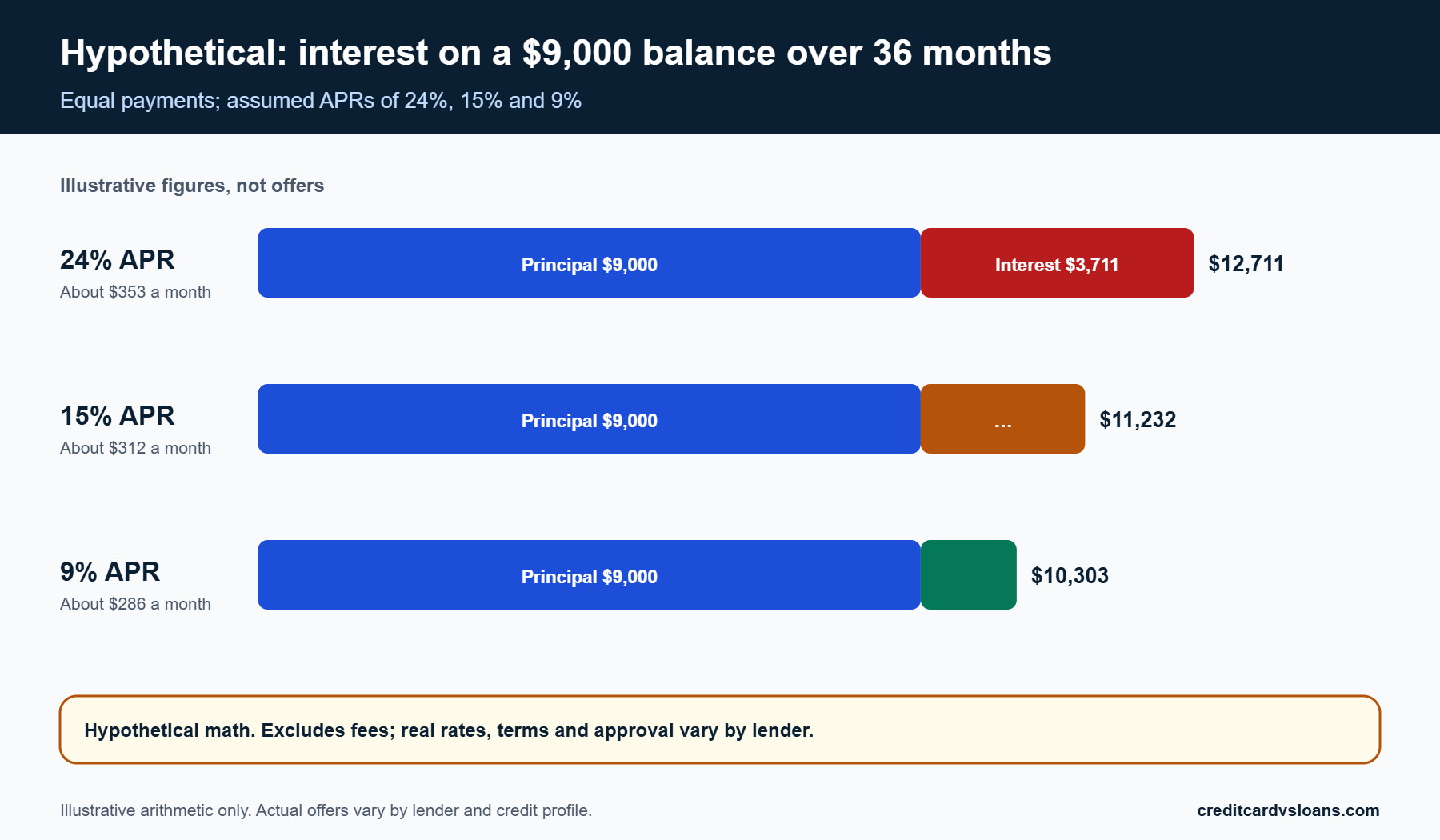
Whatever route you choose, interest is usually the biggest controllable cost, and the difference between rates compounds over years. The hypothetical example below uses a $9,000 balance repaid over 36 months in equal payments at three assumed rates. It is an illustration of how a lower rate changes the total, not a quote or a prediction for any lender.
Fixed payments at 24 percent come to about $353 a month and $3,711 of interest; at 15 percent, about $312 a month and $2,232 of interest; at 9 percent, about $286 a month and $1,303 of interest. The rates are assumptions chosen to show the pattern.
Fees: who can charge what, and when
Fees differ across options. An issuer hardship plan usually has no program fee. A nonprofit counselor may charge fees for some services, and the CFPB advises getting a specific quote in writing. A consolidation loan may carry an origination fee. A for-profit settlement company covered by the FTC’s rule can charge only after a debt is settled, you agree and you make a payment. Bankruptcy has court filing fees and attorney fees.
Whatever the structure, ask for the total cost in dollars. A percentage quoted without an amount is easy to misunderstand.
The credit and tax side
Credit effects by option
Options that keep you current protect your payment history, which most scoring models weigh heavily. Options that follow missed payments, such as settlement and sometimes bankruptcy, put negative information on your reports. The CFPB says most negative information can generally be reported for seven years and bankruptcies for up to ten.
No outcome is promised. Your starting score, the rest of your file and the lender’s reporting all matter. If you plan to apply for new credit soon, read our consolidation guide before opening anything new.
When forgiven debt becomes taxable
Tax enters only when a creditor cancels debt. The IRS says canceled debt is generally taxable income, that a creditor generally files Form 1099-C for cancellations of $600 or more, and that exclusions such as insolvency or bankruptcy can apply. A payment plan, a rate reduction or a consolidation does not cancel principal, so these generally do not create canceled-debt income; a settlement can.
If a creditor sends you a 1099-C, read it carefully and contact the creditor if the amount is wrong. The IRS says you remain responsible for reporting the right amount.
| Option | Rate or fee pattern | Repayment pattern | Credit inquiry or reporting | Tax effect | Risk flag |
|---|---|---|---|---|---|
| Issuer hardship plan | Reduced rate possible; no program fee typical | Lower monthly payment | Varies; ask how it is reported | None, unless principal is canceled | Terms differ by issuer |
| Debt management plan | Counselor fees; creditors may cut interest | One payment, often 48 months or more | Varies by creditor | None, unless principal is canceled | Creditors may not accept |
| Consolidation loan | Fixed rate; origination fee possible | Fixed term payoff | Hard pull; new account | None | Collateral risk on home-secured loans |
| Balance transfer | Transfer fee; promotional rate expires | Pay down before the promo ends | Hard pull; utilization shifts | None | Rate resets if not paid off |
| Settlement | Company fee after a qualifying deal | Lump sum or short plan | Late payments and settled status | Canceled amount may be taxable | Lawsuits; growing balances |
| Bankruptcy | Court and attorney fees | Liquidation or 3-5 year plan | Up to ten years | Discharge handled under bankruptcy exclusion | Not all debts discharged |
Table 2 shows the pattern: the lower rungs cost more in interest and time, while the higher rungs cost more in credit and potential tax.
Heavier tools: settlement and bankruptcy
Settlement for less than the full balance
How it differs from the earlier rungs
Settlement is relief that reduces the balance, so the tradeoffs are larger. The FTC describes programs that negotiate a lump sum smaller than the full debt, often encourage you to stop paying creditors directly, and carry risks such as lawsuits, growing balances and likely credit damage.
The CFPB cautions that some settlement companies promise more than they can deliver, that creditors may refuse to work with them, and that they often cannot settle the debt. You can also negotiate directly, as the CFPB explains. For the full cost picture, read credit card settlement risks, taxes and credit damage.
The rule on fees
Under the FTC’s rule on debt relief services, a for-profit provider covered by the rule cannot collect fees until a debt is settled or reduced, you have agreed to the deal and you have made a payment under it. The FTC says it is illegal to charge before doing anything to relieve your debt.
That rule is the simplest test you can apply to a settlement pitch. If a company wants money first, you do not need to evaluate anything else.
Bankruptcy as a legal reset
What it can and cannot do
The FTC says personal bankruptcy provides a discharge, a court order releasing you from certain debts, and can stop foreclosure, repossession, garnishment and collection activity. Chapter 7 liquidates non-exempt assets under a trustee; Chapter 13 uses a three-to-five-year court-approved plan for people with steady income.
Not everything is erased. The FTC lists child support, alimony, fines, most taxes and most student loans among debts that generally survive, and says liens generally remain unless addressed in a Chapter 13 plan.
Costs and timing
Bankruptcy has real costs: federal court filing fees of several hundred dollars plus attorney fees, mandatory credit counseling from a government-approved agency within six months before filing, and a debtor education course afterward. The FTC says it can stay on credit reports for 10 years and affect credit, housing, insurance and jobs.
It is a legitimate relief tool, not a failure, and for some borrowers it is cheaper overall than years of reduction attempts. An attorney can explain eligibility and exemptions in your state.
Choosing between settlement and bankruptcy
Comparing the total cost
Both tools can reduce what you owe, so compare them on the full bill. For settlement, add the payment, any company fee, interest that built up while accounts were unpaid, and tax on the canceled amount unless an exclusion applies. For bankruptcy, add filing and attorney fees, the counseling and education requirements, and the effect of a long reporting period.
Neither is automatically cheaper. A borrower with one large card balance and a lump sum may fare better with a direct settlement, while a borrower with many unsecured debts and no surplus may fare better with a discharge. An attorney can run both scenarios with your actual numbers.
Comparing the risks along the way
Settlement exposes you to lawsuits and collection while you negotiate, because creditors are not stopped by a pending negotiation. Bankruptcy, by contrast, can stop collection activity once a case is filed, according to the FTC, but it brings its own court process and limits on which debts qualify.
Time matters in both. The FTC notes that settlement can take years, and a bankruptcy plan under Chapter 13 runs three to five years. Plan for the duration, not just the end result.
Free and low-cost help that is easy to overlook
Where legitimate help usually comes from
Public agencies and their free tools
The FTC points readers to consumer.gov for free guidance on budgeting, finding debt help and understanding your rights when debt collectors call. The CFPB publishes plain-language steps for negotiating with collectors and accepts complaints about collection practices. Neither charges for information, and neither will cold-call you to sell a program.
These pages will not tailor advice to your accounts, but they can answer the first round of questions and help you recognize what an honest provider should say.
Counseling through trusted community institutions
The FTC says low-cost credit counseling may be offered through credit unions, universities, community colleges, Cooperative Extension offices and military personal financial managers. Fees are often low, but ask about them before you sign up.
If you are headed toward bankruptcy, the FTC notes that the U.S. Trustee Program keeps a list of counselors approved for pre-bankruptcy counseling, though it does not endorse them.
Checking before you trust
Using your state attorney general
Both the FTC and the CFPB recommend checking organizations with your state attorney general and local consumer protection agency. A call or website search can tell you whether complaints exist, whether licensing is required in your state and whether the organization is registered to operate there.
State rules for debt settlement and credit counseling differ, and some states add licensing or fee limits beyond the federal rule. If the details matter to your decision, the state regulator is the best place to ask.
Keeping your own records
Whatever help you accept, keep a folder with every contract, letter, email and payment receipt, plus notes from phone calls with dates and names. The FTC suggests keeping records of every conversation with creditors.
That record helps with disputes, with any tax form that arrives later, and with complaints if something goes wrong. It costs nothing and is among the most useful steps in the whole process.
Red flags: when an offer is not really debt relief
Red flags in the sales pitch
Contact and promises
The FTC’s March 2026 consumer alert names three signs: being asked to pay upfront before any debts are settled or before entering a debt management plan, promises to settle all your debts or get fast loan forgiveness, and unexpected calls or texts offering quick settlement while asking for personal or financial information. Any one of them is enough to stop.
The CFPB adds companies that tell you to stop communicating with creditors, promise to stop all collection calls and lawsuits, promise a percentage reduction on all your debt, or promote a new government program to erase credit card debt.
Pressure and vague answers
A legitimate provider can explain exactly what it will do, what it costs and what could go wrong, and it will put the answers in writing. Pressure to decide today, reluctance to send terms, or answers that change from one call to the next are all reasons to walk away.
The FTC advises searching the company’s name with the word complaint or review and checking with your state attorney general and local consumer protection office. If you cannot find an independent record of the business, treat that as information too.
Red flags in the contract and the money flow
Fees and who holds the money
Under the FTC’s rule, covered providers cannot collect a fee until a debt is settled, you have accepted the deal and made a payment under it. They must also disclose the cost and timing before you enroll. If a dedicated account holds your savings, it must be at an insured institution, the funds and interest must belong to you, and you must be able to withdraw without penalty.
If the account is controlled by the company, or you are told you cannot withdraw, the arrangement does not meet those conditions.
Instructions that put you at risk
The FTC warns that settlement programs often encourage you to stop paying creditors, and that this can lead to lower credit scores, added fees and interest, collection calls and lawsuits. A provider that tells you to stop paying should be explaining those consequences in detail before you enroll, as the rule requires.
Also be cautious about anything that sounds like credit repair in disguise. The FTC says no one can legally remove accurate negative information from your reports, and that only time does.
If any provider asks for money before a debt has been settled, tells you to stop paying creditors without explaining the consequences, or promises results before reviewing your accounts, do not enroll. You can report it at ReportFraud.ftc.gov. For a deeper look at what separates real forgiveness from fake, see credit card debt forgiveness: what is real and what is a scam.
What to do if you spot a red flag
Stop, document and report
If you spot a red flag, stop the conversation and do not send money or account details. Write down the company name, phone number, website and what was promised, and save any texts or emails. The FTC takes reports at ReportFraud.ftc.gov, and your state attorney general and local consumer affairs office also accept complaints.
If you have already paid, contact your bank or card issuer promptly about the charge. Prompt action does not guarantee a refund, but it improves your options.
Return to the free routes
After a bad pitch, the next step is the same as before: call your issuers, speak with a nonprofit counselor, and compare options in writing. The FTC says legitimate counselors send free information first and do not charge in advance for help they have not yet provided.
A bad experience with one provider does not mean help is unavailable. It means you now know what the warning signs look like.
Matching the relief option to your situation
Four hypothetical borrowers
Current, but the interest is crushing
This borrower is making payments on time, but the balance barely falls. The lowest-damage route is a hardship call to the issuer for a lower rate, followed by a comparison of consolidation or balance transfer offers if credit qualifies. A nonprofit plan is a second option if multiple cards are involved.
Settlement would be a poor fit here because it usually requires falling behind first.
Behind, with a steady paycheck
This borrower has missed payments but has regular income and a workable budget. A nonprofit counselor can review the full picture, and a debt management plan may lower rates and fees without a forgiven amount. Confirm with each creditor that it accepted the plan before paying the counselor.
If the counselor insists a plan is the only option without reviewing the budget, the CFPB suggests looking elsewhere.
Two harder situations
Lasting income loss with a lump sum
This borrower cannot sustain payments and has access to a one-time sum. Direct settlement may be worth investigating, with written terms and a tax estimate. If liabilities exceed assets, the IRS insolvency exclusion may reduce the tax effect; our guide to credit card settlement taxes and credit damage walks through the IRS examples.
Check whether the account might be time-barred before paying, since in some states a payment can revive an old debt.
Debts far beyond any realistic repayment
This borrower has no surplus and no prospect of one, perhaps with a lawsuit pending. A bankruptcy consultation can show whether a discharge would cost less overall than years of reduction attempts. Respond to any lawsuit by the court deadline either way.
Legal aid offices and consumer bankruptcy attorneys can explain eligibility and your state’s exemptions.
| Scenario | Option to investigate | Why | What to confirm | When to avoid it |
|---|---|---|---|---|
| Current, high rate | Issuer hardship plan; consolidation or transfer if you qualify | Keeps payment history intact | Rate, term, fees, reporting | If you may miss the new payment |
| Behind, steady income | Nonprofit counseling and a debt management plan | One payment; possible lower interest and fees | Creditors accepted the plan; written fee quote | If pushed to enroll without a budget review |
| Behind, lump sum available | Direct settlement | Creditor may accept less | Written terms; 1099-C and tax effect | If the debt may be time-barred |
| No realistic repayment path | Bankruptcy consultation | Court process and discharge | Which debts are covered; total cost | If most debts are non-dischargeable |
| Unsolicited relief offer | Do not engage | Matches FTC scam signs | Independent lookup of the company | Always, if money is requested first |
Use the matrix to choose which conversation to have first, not to skip professional advice. State law, your creditors and your assets can change the answer.
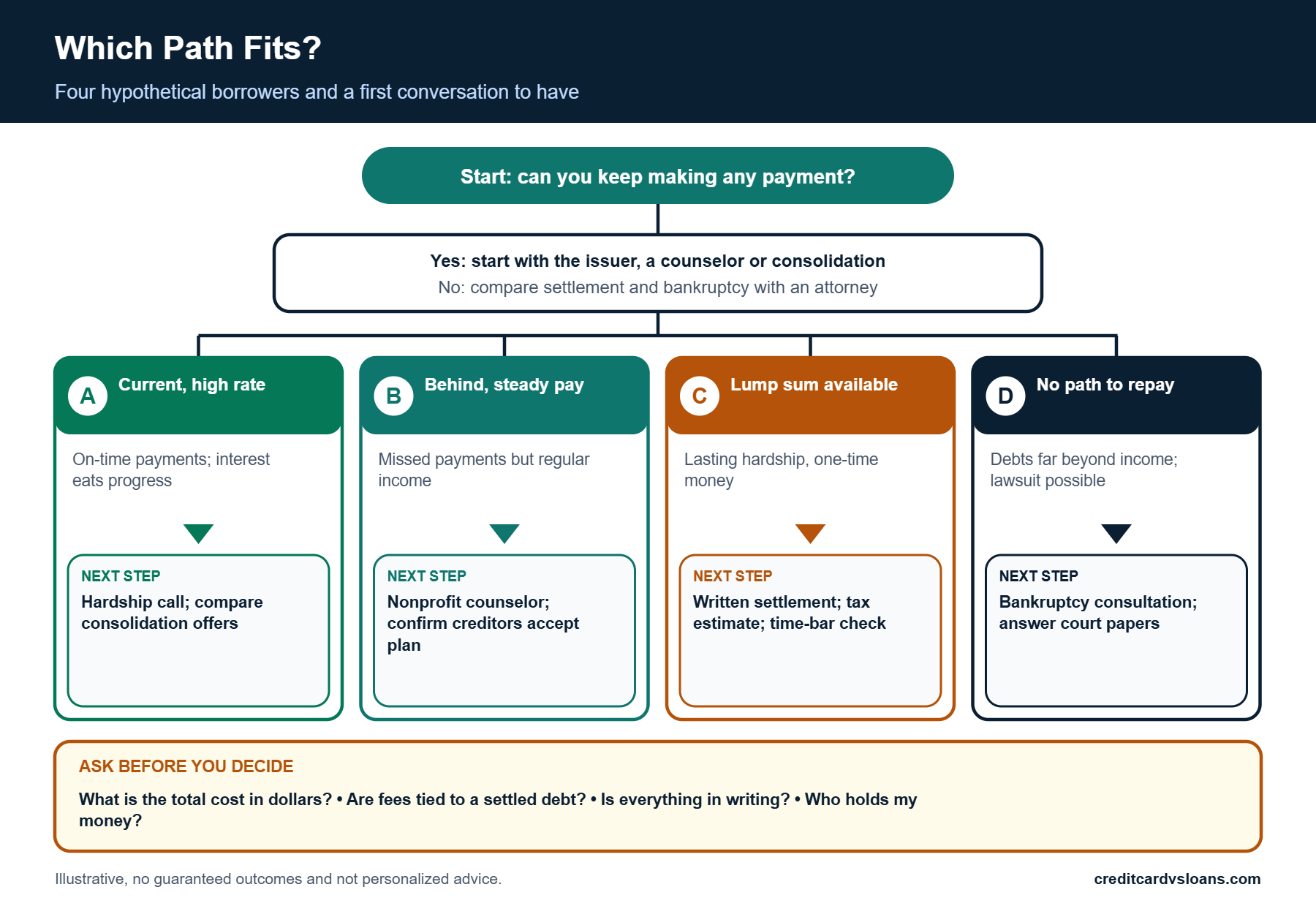
Checklist and next steps for credit card debt relief
Before you commit to any option
Gather your facts
List each account with the balance, rate, minimum payment and status, along with your income and essential expenses. Request written validation of any account held by a collector, and note the date of your last payment on each account because it may matter for the statute of limitations.
Pull your credit reports so you know what lenders and counselors will see, and note any errors to dispute.
Ask the same questions of every provider
- What exactly will you do, and what is the total cost in dollars?
- When are fees due, and are they tied to a settled debt?
- Who holds my money, and can I withdraw at any time?
- What happens to my credit and my accounts while I am enrolled?
- Can I have all of this in writing before I share account details?
A legitimate provider will answer these without pressure. Those answers are also what the FTC’s rule requires covered sellers to disclose.
Mistakes that quietly raise the cost of relief
Waiting too long to ask
Interest and late fees keep building while you wait, and options narrow once accounts are charged off or sold. The FTC encourages contacting creditors early, before a collector gets involved. Many borrowers delay because the call feels embarrassing, but issuers handle hardship requests routinely.
An early conversation can keep you in the lower rungs. A late one may leave only the heavier tools.
Treating one option as the answer to everything
Relief rarely fits a single label. You might use a hardship plan on one card, a counselor-managed plan for the rest, and a negotiated settlement on an old collection account. Each piece needs its own written terms and its own tracking.
Whatever you choose, avoid new card debt while you repay. A plan or loan that removes today’s balance helps little if tomorrow’s charges rebuild it.
Your concrete next steps
This week
- Call your issuers and ask for a lower rate and a payment plan; write down what each says.
- Book a session with a nonprofit credit counselor and confirm the organization with your state attorney general.
- Compare any consolidation offers apples-to-apples before you apply, using soft-pull prequalification where offered.
- If a collector contacts you, ask for written validation before discussing payment.
- Report any pay-first or too-good-to-be-true offer at ReportFraud.ftc.gov.
The bottom line
Credit card debt relief works best in order: start with the cheapest steps that keep your credit intact, and move to settlement or bankruptcy only when repayment is not realistic. Whatever you choose, get the terms in writing, count the full cost including fees, credit and taxes, and treat any pay-first or promise-everything offer as a sign to stop.
If you want to compare how the same balance looks across loan and card strategies, see our guide to the best debt payoff options by credit score, and for what public programs exist, read about government debt relief programs for credit card debt.
- Credit Card Debt Forgiveness: What Is Real and What Is a Scam?
- Credit Card Debt Consolidation: Best Options by Credit Profile
- Credit Card Debt Settlement: Risks, Taxes and Credit Damage
- Best Debt Payoff Options by Credit Score: From Bad Credit to Excellent
- Government Debt Relief Programs for Credit Card Debt: What Exists and What Doesn’t
- FTC: How to Get Out of Debt (FTC publication, December 2025)
- FTC: Looking for debt relief? Here is how to avoid a scam (FTC Consumer Alert, March 2026)
- FTC: Debt Relief Services and the Telemarketing Sales Rule: A Guide for Business
- FTC: Debt Relief Service and Credit Repair Scams
- CFPB: What is credit counseling?
- CFPB: How do I negotiate a settlement with a debt collector?
- CFPB: How to Get a Handle on Debt (CFPB archived blog)
- CFPB: How long do negative items remain on my credit report?
- IRS: Topic no. 431, Canceled debt: Is it taxable or not?
- IRS: About Form 1099-C, Cancellation of Debt
Last updated: October 22, 2026. Rates, fees and lender rules change; verify current terms before acting.
The information on creditcardvsloans.com is provided for general educational and informational purposes only. It is not financial, legal, tax, credit, accounting or investment advice, and reading it does not create an advisor-client, fiduciary or any other professional relationship. Nothing here is an offer, solicitation or recommendation to borrow, lend or apply for any product.
Credit scores, interest rates, fees, eligibility rules, lender policies and laws change frequently and vary by lender, location and individual circumstances. Examples, figures and scenarios are illustrative only, do not predict your results and do not guarantee approval, savings, a particular rate or a credit-score outcome. Always confirm current terms directly with the lender or issuer and read the full agreement before you apply or sign.
Although we aim for accuracy and use reputable sources, we make no representations or warranties, express or implied, about the completeness, accuracy, reliability or timeliness of the content. Content may be drafted with the assistance of automated tools, so errors or omissions may still occur. Links to third-party sites are provided for convenience; we don’t control and aren’t responsible for their content.
To the fullest extent permitted by law, creditcardvsloans.com and its owners, editors, authors, contributors and affiliates disclaim all liability for any loss, damage or expense arising directly or indirectly from your use of, or reliance on, this content. Before making financial decisions, consult a licensed professional, such as a qualified financial advisor, attorney, tax professional or nonprofit credit counselor, who can consider your complete situation.