
The credit card and personal loan rates for September 2026 are best read through the latest official data, and the most recent Federal Reserve G.19 release (October 7, 2026) covers August: cards that assessed interest averaged 22.36% and 24-month bank personal loans averaged 11.90%, both preliminary.
The G.19 covering September had not been published as of October 22, 2026, so August is the freshest reading of what borrowers actually paid. What changed in September itself is the policy rate: the Federal Open Market Committee (FOMC) raised its target range on September 16, 2026, which matters most for anyone carrying a variable-rate card balance.
This brief puts those numbers side by side, explains what they do and do not tell you about your own offer, and walks through what to check before borrowing. For the underlying product comparison, see our credit card vs. personal loan guide.
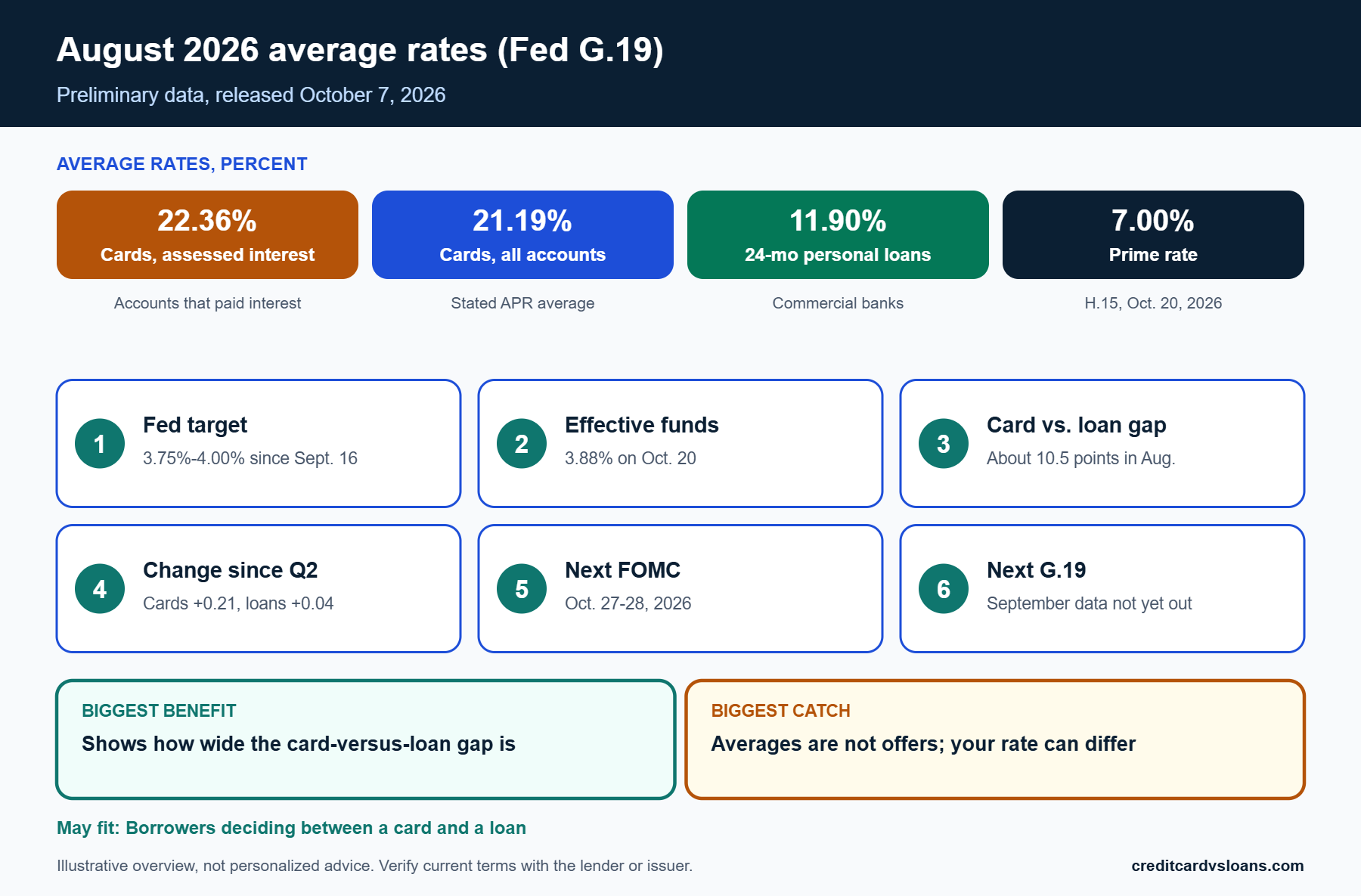
- Fed G.19 (released Oct. 7, 2026): August 2026 averages were 22.36% on credit card accounts assessed interest, 21.19% across all card accounts, and 11.90% on 24-month personal loans (all preliminary).
- Compared with the second quarter of 2026 (22.15%, 20.94% and 11.86%), card rates edged up by about a quarter of a percentage point and personal loan rates barely moved.
- On September 16, 2026, the FOMC voted 12-0 to raise the federal funds target range by a quarter point to 3.75%-4.00%. A card tied to the prime rate may reprice; a fixed-rate personal loan you already have does not.
- The gap between the card and loan averages was about 10.5 percentage points in August. That gap, not the headline level, is why a fixed-rate loan often costs less than carrying a balance, though your own rates may differ sharply.
- National averages are not offers. Prequalify with soft pulls and compare APRs before you decide.
Figures come from the Federal Reserve’s G.19 consumer credit release of October 7, 2026, its H.15 selected interest rates release of October 21, 2026, and FOMC statements of July 29 and September 16, 2026. The next FOMC meeting is scheduled for October 27-28, 2026, so conditions can change after this was written.
Credit Card and Personal Loan Rates in September 2026: The Short Answer
The latest official numbers
What the Fed reported for credit cards
The Federal Reserve publishes two credit card rates. The first is the stated APR averaged across all credit card accounts at reporting banks, which was 21.19% for August 2026 (preliminary). The second is the annualized ratio of finance charges to the average daily balances on which interest was assessed, excluding accounts with no finance charges, which was 22.36%.
The second measure tends to be higher because it includes only accounts that actually paid interest. If you pay your statement balance in full every month, neither figure describes your costs. If you carry a balance, 22.36% is the closer yardstick, though your own APR is printed on your statement and may be higher or lower.
What the Fed reported for personal loans
For personal loans, the G.19 reports the average rate on 24-month loans at commercial banks: 11.90% in August 2026 (preliminary), versus 11.86% in the revised second quarter. That series reflects bank-reported lending and a specific term, so it does not capture every lender type, such as online or nonbank lenders, and it does not tell you what a borrower with a thin credit file would be offered.
Use it as a reference point for how fixed-rate installment borrowing compares with revolving card debt, not as a quote. Rates by credit tier are covered in what credit score you need for a personal loan and personal loan rates with a 700 credit score.
What changed from the second quarter
Small upward drift, not a jump
Between the revised second quarter and August, the card rate on accounts assessed interest rose from 22.15% to 22.36%, a gain of 0.21 percentage points. The all-accounts card rate rose from 20.94% to 21.19%, up 0.25 points. The 24-month personal loan rate moved from 11.86% to 11.90%, up 0.04 points.
These are small changes over a short window, and August figures are preliminary, so they may be revised. The September policy decision came after August, which means its effect on average borrowing rates cannot appear in this data yet.
Why a bigger or smaller average may still not apply to you
An average blends excellent and fair credit, large and small balances, and many different lenders. Your offer depends on your credit history, income, existing debt, the lender and the product. Two borrowers can see rates that differ by more than ten points on the same day.
Treat the national number as context for judging an offer. If an offer is far above the average, ask why and compare alternatives; if it is below, confirm the fees, since a low rate can be offset by an origination fee.
| Series | 2026 Q2 (revised) | August 2026 (preliminary) | Change (points) |
|---|---|---|---|
| Credit card plans, all accounts | 20.94 | 21.19 | +0.25 |
| Credit card plans, accounts assessed interest | 22.15 | 22.36 | +0.21 |
| Personal loans, 24-month | 11.86 | 11.90 | +0.04 |
| New car loans, 60-month | 7.14 | 7.54 | +0.40 |
| New car loans, 72-month | 6.97 | 7.17 | +0.20 |
Source: Federal Reserve Board, G.19 Consumer Credit, release of October 7, 2026. Change column is our arithmetic from the published figures.
What the Federal Reserve Did Around September
The policy rate decisions
July 29: rates held, with dissents
At its July 28-29 meeting, the FOMC kept the federal funds target range unchanged at 3.50% to 3.75%. The vote was 9 to 3, with three members dissenting because they preferred a quarter-point increase. That vote was an early signal that a rise was under discussion, which is an observation about the record, not a forecast.
The federal funds rate is the rate banks charge one another for overnight lending, and it sits underneath many consumer borrowing benchmarks, including the prime rate.
September 16: a quarter-point increase
On September 16, 2026, the FOMC voted 12-0 to raise the target range by one quarter of a percentage point, to 3.75%-4.00%, in a statement released at 2:00 p.m. EDT. The next scheduled meetings are October 27-28 and December 8-9, 2026, per the Fed’s calendar.
A single quarter-point move is modest in dollar terms for most consumers, as the cost examples below show, but it signals the direction of policy and can nudge variable rates upward.
Market rates in October
Federal funds and prime
The Fed’s H.15 release of October 21, 2026 shows the effective federal funds rate at 3.88% on October 20, 2026, which sits inside the new target range. The bank prime loan rate was 7.00% on the same date. The prime rate has long been set at three percentage points above the top of the federal funds target range, so the move to 4.00% is consistent with a 7.00% prime.
Many variable-rate credit cards are tied to prime. The CFPB explains that a variable APR moves with an index such as the prime rate, and your cardholder agreement spells out how and when yours changes.
Treasury yields
On October 20, 2026, the 10-year Treasury constant maturity yield was 5.12% and the 2-year was 4.79%, according to H.15. Longer-term yields influence rates on mortgages and some other long loans more than credit cards, which are tied to short-term benchmarks.
These figures are a single day’s readings and can change daily. They are included for context, not as a prediction of where rates are headed.
| Date | Event or series | Value |
|---|---|---|
| July 29 | FOMC holds target range (9-3 vote) | 3.50%-3.75% |
| September 16 | FOMC raises target range (12-0 vote) | 3.75%-4.00% |
| October 7 | G.19 release; August card rate, accounts assessed interest | 22.36% (prelim.) |
| October 20 | Effective federal funds rate (H.15) | 3.88% |
| October 20 | Bank prime loan rate (H.15) | 7.00% |
| October 27-28 | Next scheduled FOMC meeting | Not yet held |
How Policy Moves Reach Your Card and Your Loan
Variable versus fixed: who feels a rate change
Credit cards: often tied to prime
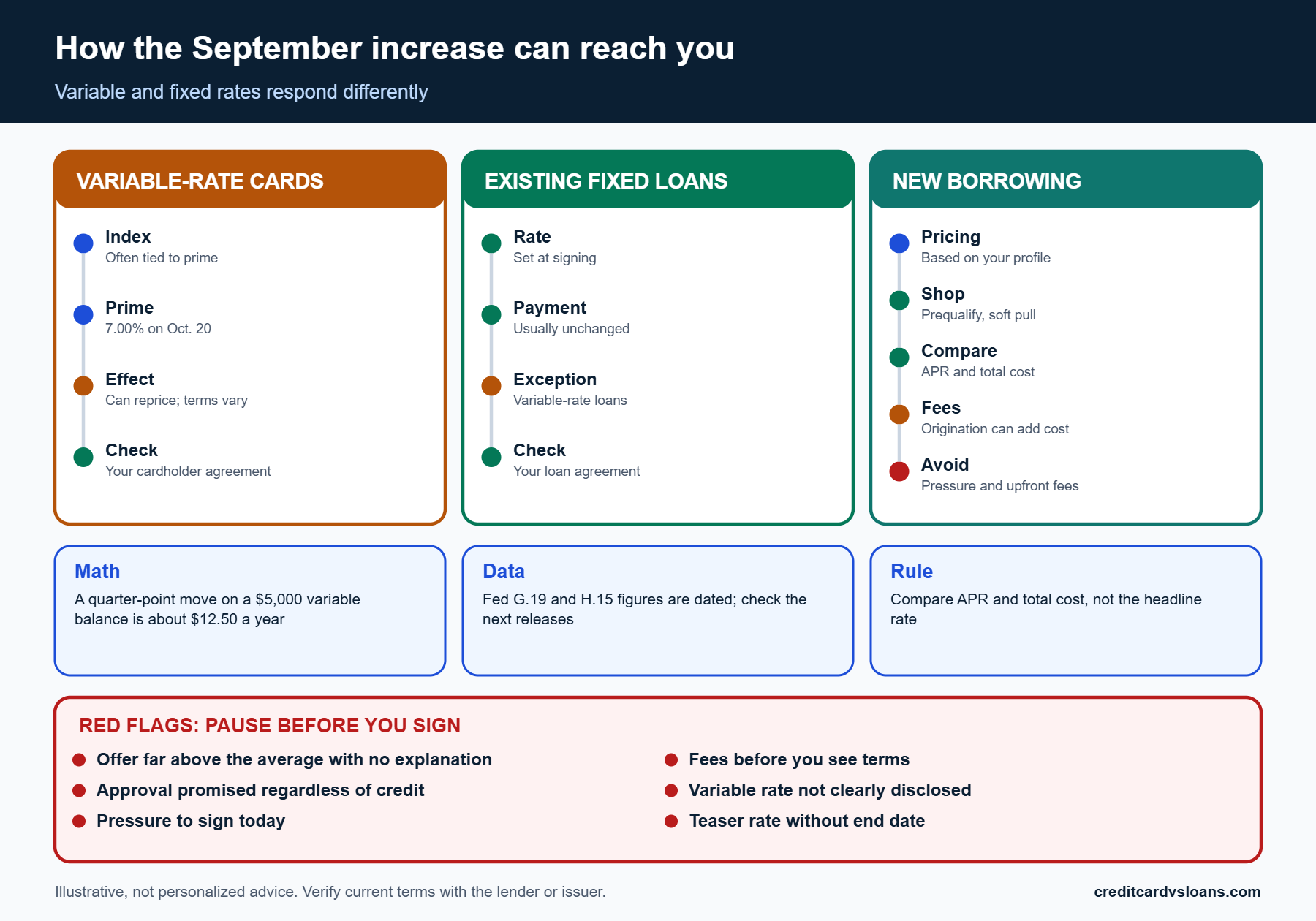
Most credit card APRs are variable, meaning they are built from an index, commonly the prime rate, plus a margin set by the issuer and your credit profile. When the index rises, your APR can rise with it, usually on a lag set out in your cardholder agreement. As a hypothetical, if a card’s APR rose one-for-one with a quarter-point increase, a steady $5,000 balance would cost about $12.50 more per year, or roughly a dollar a month.
That is a small amount for one move, but rate changes can stack, and a larger balance magnifies them. It is also why the amount you owe matters more than any single policy decision. See how card balances affect your credit score for the second cost of a large balance.
Personal loans: fixed at signing for most borrowers
Most personal loans carry a fixed rate, which is set when the loan is made and does not change with later Fed decisions. That is the main reason fixed-rate installment loans appeal to people who want a predictable payment. A rate increase affects the price of new loans, not the loans already on your books, unless your agreement says otherwise, so check yours.
Some personal loans do have variable rates, and some lenders offer both. The agreement should state which applies, and our loan agreement red flag checklist shows where to find it.
The spread: why cards cost more than loans
A ten-point gap in the averages
In August 2026, the Fed’s card rate on accounts assessed interest (22.36%) was about 10.5 points higher than its 24-month personal loan rate (11.90%). In the second quarter, the gap was about 10.3 points. The gap has been wide for a long time, which reflects that cards are unsecured, flexible and revolving, while a loan has a defined payoff date.
The gap makes the comparison simple on paper: for a balance you plan to carry for a year or more, a lower fixed rate can save real money, if you qualify for one. It does not mean a loan is right for everyone, since fees and eligibility matter.
When the card still makes sense
A card is the right tool when you pay in full every month, when you use a true 0% introductory APR and can clear the balance during the promotion, or when you need purchase protections. Our comparison of 0% APR cards and personal loans shows how to test that. If you will carry a balance, the average rate above is the cost you are signing up for.
Be careful with promotional offers that defer interest rather than waive it. The CFPB notes that interest can be charged back to the purchase date if you do not pay in full on time.
What the Averages Cost in Dollars
An illustrative $5,000 balance
Same amount, same term, different rate
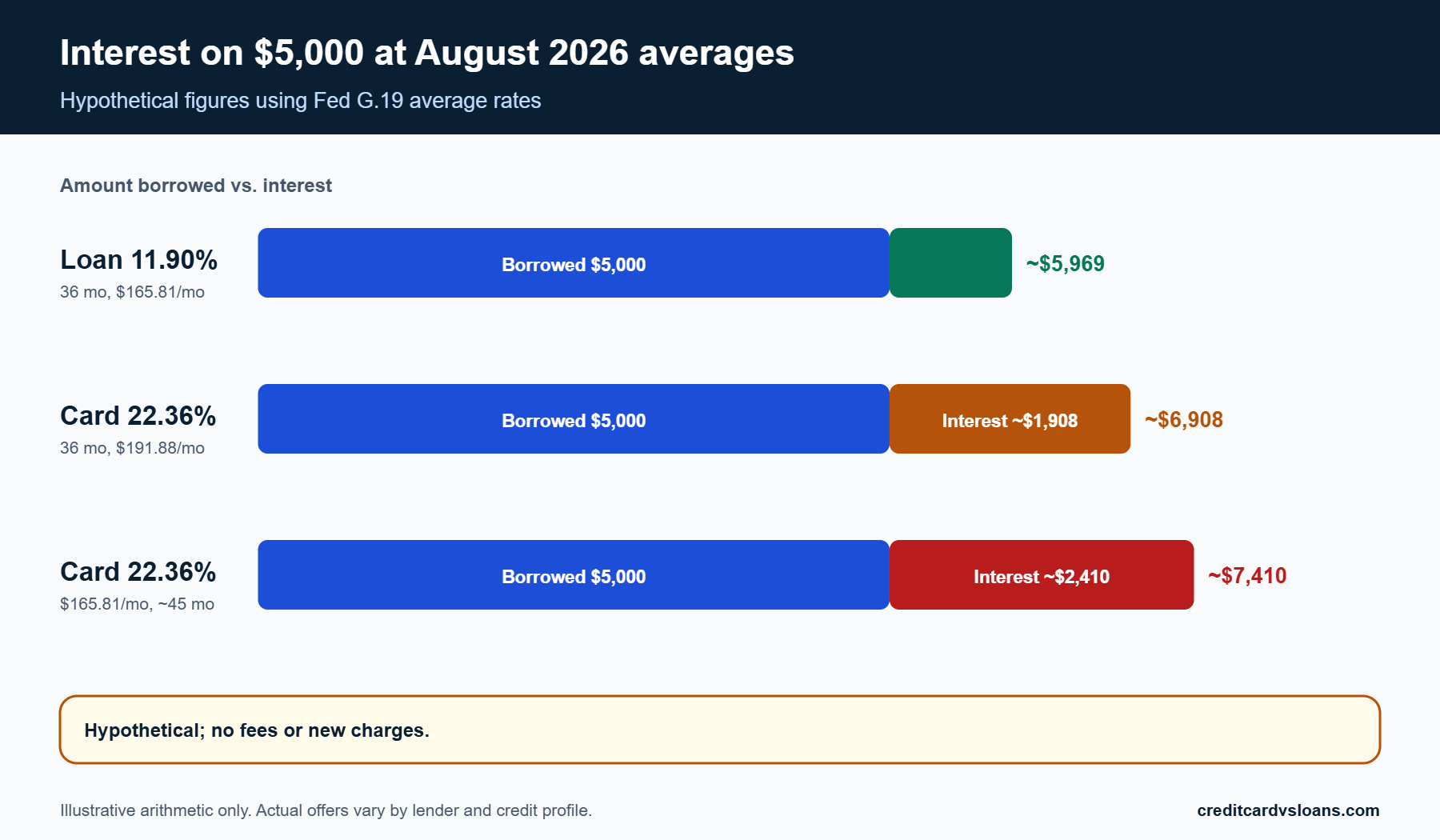
Consider a hypothetical $5,000 borrowed for 36 months. At 11.90%, equal to the Fed’s August average for 24-month personal loans, the monthly payment would be about $165.81 and total interest about $969. At 22.36%, the Fed’s August card average for accounts assessed interest, a fixed 36-month payoff would require about $191.88 a month and total interest of about $1,908.
That is an apples-to-apples comparison of two averages over the same term. It is an illustration and not an offer, and it ignores any origination fee on the loan or new charges on the card.
When the payment is held flat on the card
Many cardholders keep paying a fixed amount rather than a rising one. If someone paying $165.81 a month on a $5,000 card balance at 22.36% made no new purchases, the balance would take about 45 months to clear and cost roughly $2,400 in interest. Minimum payments that shrink as the balance falls can stretch the timeline further.
The lesson is not that cards are bad. It is that the payoff plan matters more than the product label, and a fixed schedule is easier to follow than a flexible one.
| Scenario | Rate used | Monthly payment | Months to pay off | Approx. total interest |
|---|---|---|---|---|
| Fixed-rate personal loan | 11.90% | $165.81 | 36 | $969 |
| Card, 36-month payoff plan | 22.36% | $191.88 | 36 | $1,908 |
| Card, same payment as the loan | 22.36% | $165.81 | About 45 | About $2,410 |
All figures are our own illustrative calculations with no fees, no new purchases and constant rates. Real offers vary.
Fees and the APR
Origination fees change the comparison
Some personal loans charge an origination fee, a one-time cost that is often a percentage of the amount borrowed and is usually deducted from the proceeds or added to the balance. A loan with a lower rate and a high fee can cost more than one with a slightly higher rate and no fee. Compare the APR, which is designed to include such upfront costs.
Fees differ by lender and by borrower, so we do not cite a typical figure here. Ask for the full cost in writing before you accept.
Prepayment, late fees and balance transfers
Check whether a loan allows early payoff without a penalty, because paying ahead is a way to reduce interest. For cards, check late fees, penalty APR triggers and any balance transfer fee if you plan to move a balance to a promotional offer. A transfer fee reduces the savings from a 0% period, so do the math before you apply.
When comparing, a rule of thumb is to add up all costs over the time you will actually hold the debt, not just the first-year rate.
Reading the cost of a carried balance
Monthly interest at the Fed’s average
A rough way to feel an annual rate is to translate it into a monthly figure. At 22.36%, the monthly rate is about 1.86%, so a $1,000 balance that stays constant accrues around $18.63 in interest each month, or about $224 over a year. The same $1,000 at 11.90% would accrue about $9.92 a month. These are simplified illustrations that ignore compounding timing, fees and how issuers calculate average daily balance.
The point is the scale: the difference on a small balance is modest, but it multiplies with the size of the balance and the time it stays unpaid.
Why the payoff plan beats the headline rate
A card with a lower rate that you carry for years can cost more than a higher-rate product you clear in months. Payoff speed, not just APR, drives total interest. Before you compare products, decide how quickly you can realistically retire the debt, because that timeline determines which rate and which structure will cost the least.
It is also worth checking whether your issuer applies payments above the minimum to the highest-rate balance. Rules differ by product, and your agreement explains them.
Balances and Borrowing Trends in the August G.19
What consumers owed in August
Total and revolving credit
The G.19 release of October 7, 2026 reported total consumer credit outstanding of about $5,196.8 billion (seasonally adjusted) in August 2026, up at a 1.9% annual rate. Revolving credit, which includes credit cards, was $1,352.4 billion and fell at a 4.2% annual rate, while nonrevolving credit, which includes most auto and student loans, was $3,844.4 billion and rose at a 4.1% annual rate. All of these are preliminary.
A one-month swing in an annualized rate can overstate or understate the trend and is often revised, so avoid drawing strong conclusions from a single reading.
What these numbers do not tell you
Balances reflect both borrowing and repayment. A decline in revolving credit could reflect people paying down cards, using fewer cards, banks tightening or seasonal patterns. The release does not explain the cause, and neither do we. It also covers consumer credit as a whole, not your credit profile.
For a borrower, the practical takeaway is modest: nothing in these figures changes how to compare a card with a loan, which depends on your rate, fees and payoff plan.
Reading rate data carefully
Preliminary data and revisions
The Fed labels the latest month preliminary, and preliminary figures can be revised. The second-quarter figures in this article carry the Fed’s revised label. If you are citing rates in a decision, note the release date, as this article does.
Not every rate series is available for every month: the October 7 table showed no June or July values for these rates, so do not assume a smooth month-by-month trend.
Average rates versus the rate you will be offered
Lenders price from your risk profile, the product and their own funding costs. Two prequalification quotes from different lenders can differ by several points even for the same borrower. Prequalify with soft pulls where available, compare APRs, and reserve a hard pull for the offer you intend to accept.
If you are unsure how your score affects pricing, what credit score you need for a personal loan explains the typical ranges and what lenders weigh.
What This Means for Different Borrowers
If you already carry a balance
Know your actual APR and how it can change
Start with your statement. Find the purchase APR, whether it is variable, and the date and rule by which it can change. If you are paying roughly 22% on a revolving balance, a move of a quarter point is small next to the cost of the balance itself, and the biggest lever you control is how fast you pay it down.
If you pay more than the minimum, direct any extra to the highest-rate balance first when you hold more than one, and consider whether a lower-cost route, such as a fixed-rate loan or a genuine 0% offer, fits your budget. See 0% APR credit card vs. personal loan for a side-by-side test.
Consider consolidation only if the math works
Moving card debt into a fixed-rate loan can lower the rate and give you a payoff date, but only if the new APR, including fees, is lower than what you pay now and you stop adding to the cards. If your credit has slipped, the offered rate may not beat your card. Prequalify before deciding, and read the agreement against the red flags checklist.
Be wary of debt relief offers that charge upfront fees or promise outcomes. Our guide to predatory lending warning signs lists what to look for.
If you are about to borrow
Choose the tool that matches how long you will owe
If you can repay within a few months, a card you already have may be the simplest route, especially with a 0% introductory period you can clear. If repayment will take a year or longer, a fixed-rate installment loan may cost less than carrying a card balance. The right answer depends on your quotes, not on national averages.
Our overview credit card vs. personal loan explains the decision in more depth, including fees and credit report effects.
Time your applications sensibly
Rate shopping with soft pulls costs nothing in credit terms, while multiple hard pulls can add up. Gather your quotes within a short window, and avoid opening unnecessary new accounts before a major application. Because rates can change, do not delay a necessary borrowing decision in hopes of a lower rate you cannot predict.
No one can say where rates will go, and neither this article nor the Fed’s data provides a forecast.
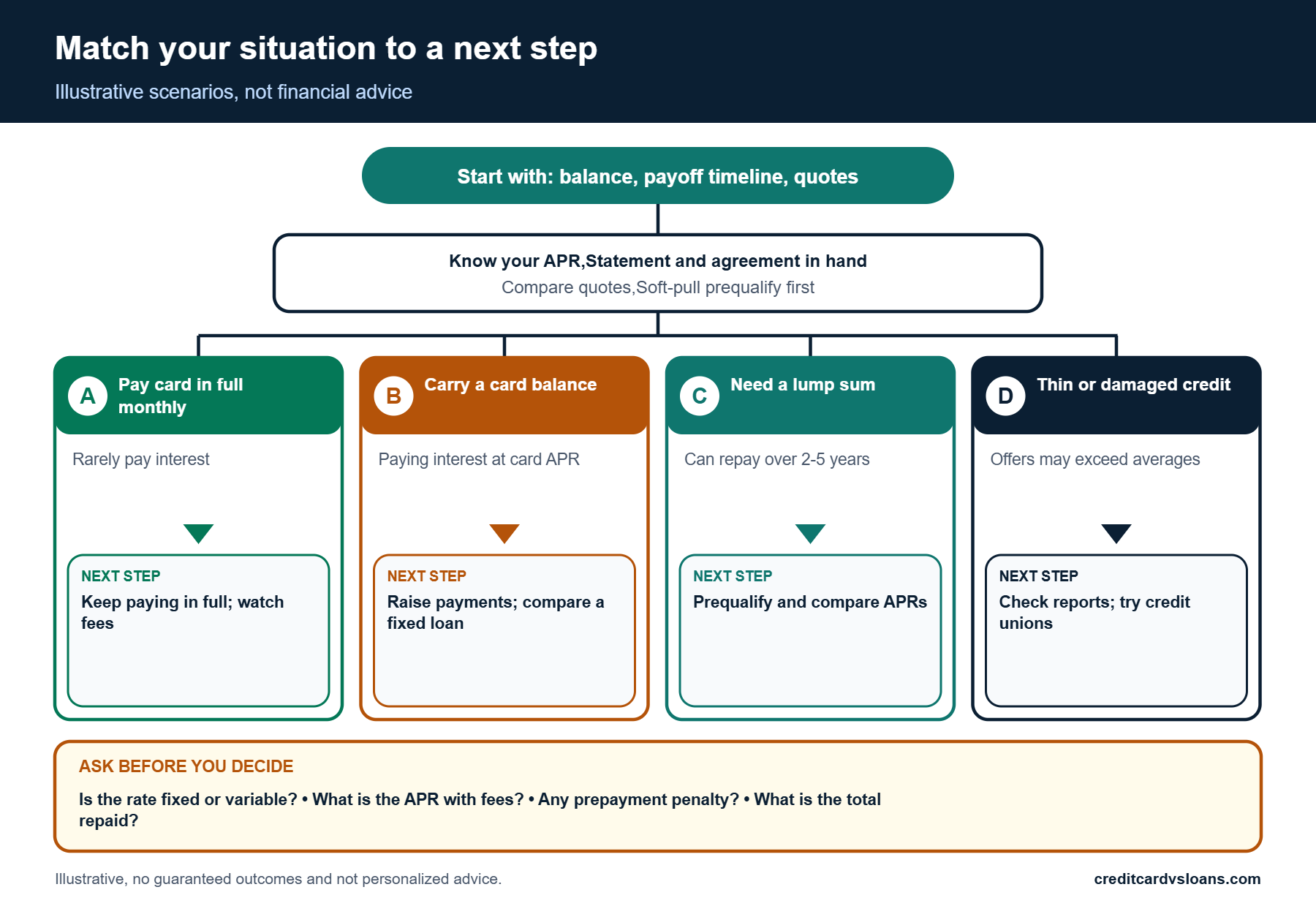
| Your situation | What the data suggests | Reasonable next step |
|---|---|---|
| Pay your card in full each month | Card APR matters little to you | Keep paying in full; keep an eye on fees and rewards trade-offs |
| Carry a card balance for months | You are exposed to a ~22% average rate and prime-linked changes | Increase payments; compare a fixed-rate loan or 0% offer |
| Need a lump sum, can repay in 2-5 years | Fixed-rate loans averaged 11.90% for 24 months at banks | Prequalify with several lenders and compare APRs |
| Thin credit file or recent late payments | Offers may be well above averages | Check credit reports, consider credit unions, avoid high-fee products |
| Considering consolidation | A ~10-point average gap does not guarantee your gap | Compare total cost, including fees, against what you pay today |
Special cases worth a second look
Variable-rate and promotional offers
If an offer has a promotional rate, find out when it ends and what rate applies afterward, because the post-promotion APR is the one that matters if you still owe a balance. If the rate is variable, ask which index it follows, how often it adjusts and whether there is a cap. Those details decide whether the headline number holds up over the life of the debt.
Write the answers down next to the quote. A rate that sounds low can look very different once you account for how and when it can change.
Borrowers with several debts
If you hold a card balance, an auto loan and perhaps a personal loan, treat each on its own terms. The Fed’s August average for a 60-month new car loan was 7.54%, far below the card average, so paying extra on the highest-rate balance usually saves the most interest, while keeping every account current protects your credit.
Before moving debt around, total what you will pay on the old arrangement and the new one, including fees. If the savings are small, the simpler path may be to keep what you have and pay it down faster. Business owners weighing the same trade-offs can start with business credit cards vs. business loans.
Practical Questions About Borrowing After a Rate Increase
Questions about credit cards
Will my card rate change right away?
Not necessarily. Whether and when your APR changes depends on whether it is variable, which index it follows and what your cardholder agreement says about adjustment dates. The issuer generally must notify you before certain changes, and the CFPB notes that a higher fixed rate usually applies only to transactions made after you receive notice. Check your agreement or your issuer’s website for the exact rule.
If you see a change on a statement, compare the new APR with the index and margin described in your agreement. If something does not add up, contact the issuer and ask for an explanation.
Is it worth moving a balance to a new card?
It can be, if the promotional period is long enough to pay the balance down and the transfer fee does not erase the savings. For example, a hypothetical 3% transfer fee on a $5,000 balance would cost $150 up front. If you cannot clear the balance in the promotional window, the remaining amount will be subject to the regular APR, which could be as high or higher than your current rate.
Approval and the promotional terms depend on your credit profile, and no one can promise either. Prequalify where possible, and read how the promotion treats new purchases.
Questions about personal loans
Should I lock in a loan before rates rise further?
Nobody can reliably predict the direction of rates, so building a decision on a guess is risky. What you can control is whether you need the money, whether the payment fits your budget and whether the offer’s APR is competitive among your quotes. A fixed rate does protect you from later increases, but it also means you will not benefit if rates fall unless you refinance, which may involve fees.
Borrow because you need to, in the amount you need, not because a headline says rates might climb.
What if my quotes are far above the Fed average?
That is common for borrowers with limited credit history, higher debt-to-income ratios or recent delinquencies. Averages cover a wide range of borrowers, and some pay much more. Look at your credit reports for errors, consider whether a credit union or a cosigner is an option, and compare the total cost of a smaller loan or a shorter term.
Be cautious with offers that cost far above the market and promise approval with no review. Our predatory lending guide explains the patterns to avoid.
Questions about timing and credit
Does applying now hurt my credit?
A formal application usually results in a hard pull, which can lower some scores slightly for a limited time. Soft-pull prequalification generally does not. Credit scoring models often treat several inquiries for the same type of loan within a short window as a single event, but the details depend on the model, so do not assume it applies to your situation.
Keeping your card utilization low before applying can help your profile. Credit utilization and your score covers how that works.
When should I just wait?
If the purchase is optional and the financing is expensive, waiting while you save can be the cheapest choice. If the expense is urgent, such as a repair or medical bill, waiting may not be practical, and the better move is to compare the best available options now. Consider whether a payment plan with the provider avoids borrowing altogether.
There is no universal answer, only a trade-off between the cost of waiting and the cost of borrowing.
What to Watch Next
The calendar
FOMC meetings and data releases
The FOMC is scheduled to meet October 27-28 and December 8-9, 2026. The Federal Reserve posts statements on its website at the time of each decision. The G.19 covering September had not been released as of October 22, 2026, and the H.15 updates on a regular schedule with daily values.
When the next G.19 arrives, compare its September card and loan figures with the August numbers in this article. Remember that preliminary readings may change.
How to read the next headline
News coverage often says rates are rising or falling without specifying which rate. Ask which series it refers to: the federal funds target range, the prime rate, average card APRs, average loan rates or Treasury yields. They move at different speeds and for different reasons.
A change in the target range reaches consumers unevenly. Variable-rate card APRs may follow soon after, while new fixed-rate loan pricing responds to lender funding costs, competition and risk, which can differ from policy moves.
What would change our read
Signals worth tracking
Three things matter for ordinary borrowers: whether the FOMC changes the target range again, whether the average card rate in the next G.19 moves meaningfully from 22.36%, and whether personal loan averages shift away from the roughly 11.9% level. A large move in any of them would change the cost examples above, which use August averages.
If you are planning borrowing in the coming months, check each lender’s current APR instead of relying on any average published here.
What does not change
Regardless of the rate environment, the basics hold: compare the APR and total cost, pay on time, avoid borrowing more than you need, and read agreements before signing. Rates are only one input, alongside fees, payment size, term and your ability to repay.
A slightly higher rate with a payment you can sustain is often better than a lower rate that strains your budget.
Your Checklist and Next Steps
A short decision checklist
Before you apply for anything
- Write down your current APRs and balances.
- Decide the monthly payment you can sustain, with a small cushion.
- Prequalify with soft pulls and note each APR, fee and term.
- Compare total cost over the time you will actually hold the debt.
- Check whether the rate is fixed or variable, and whether there is a prepayment penalty.
If an offer is much higher than national averages, ask why, and look at alternatives before accepting.
Before you sign
Read the APR, origination fee, late-payment terms and any promotional end date. Confirm the payment schedule and the total repayment amount. If a term is unclear, ask in writing, and do not sign under pressure.
Keep a copy of the signed agreement and set autopay so that a missed payment does not cost you the rate you worked to get.
Mistakes to avoid when rates move
Reacting to headlines instead of numbers
A headline that rates are rising can prompt rushed decisions. Compare actual quotes and your own budget, and give yourself time to read the agreement. Rushed borrowing is where fees and unfavorable terms tend to slip through.
A calm comparison of two or three offers usually beats a fast decision driven by a news cycle.
Ignoring the cost of carrying a balance
At the Fed’s August average for accounts assessed interest, a $1,000 balance that sits for a year costs on the order of $224 in interest, before fees. Small balances feel harmless, but they add up across several cards. Putting a payoff date on every balance is one of the simplest ways to keep interest in check.
If your budget is stretched, contact your issuer about hardship options before you miss a payment. Terms vary by issuer and are not guaranteed.
How to use this brief next month
Keep a simple rate log
Write down your own APRs, the date of your last statement, and the three numbers from this brief that matter most to you: the card average, the personal loan average and the Fed’s target range. When the next G.19 and FOMC decision arrive, you can see in two minutes whether your situation has changed, instead of relying on memory or headlines.
Add any quotes you receive, with the date and the lender type. Quotes go stale quickly, so a dated log prevents you from comparing last month’s offer with this month’s.
Decide your trigger points in advance
Decide ahead of time what would make you act: for example, a payoff date you refuse to pass, a rate above which you will refinance only if fees are low, or a balance level at which you stop using a card. Pre-set triggers keep you from reacting to every news cycle and keep the focus on your budget.
If your finances change, such as a job change or a large expense, revisit the plan right away rather than waiting for the next release.
The bottom line
What the September 2026 numbers say
As of the Federal Reserve’s October 7, 2026 release, card interest ran about 22.36% for accounts assessed interest and bank personal loans about 11.90% in August, a gap of roughly ten and a half points. The FOMC’s September 16 increase to 3.75%-4.00% has not yet shown up in those averages, so expect the next releases to be informative.
For most borrowers, the decision hinges less on national averages than on how long they will owe, what offers they can actually obtain and whether the payment fits their budget.
Your next steps
- Check your own card APRs and whether they are variable.
- If you carry a balance, set a payoff date and a payment that gets you there.
- If you need new borrowing, prequalify and compare APRs, not just rates.
- Revisit your plan after the October 27-28 FOMC meeting and the next G.19.
National averages show how wide the card-versus-loan gap is, but only your quotes tell you what you will pay. Compare the APR and the total cost, and pick the option you can repay on schedule.
- Credit Card vs. Personal Loan: Which Is Better for Borrowing?
- What Credit Score Do You Need for a Personal Loan?
- 0% APR Credit Card vs. Personal Loan: Which Is Cheaper?
- Credit Utilization: How Card Balances Affect Your Credit Score
- Personal Loan With a 700 Credit Score: How Much Better Can Rates Get?
- Business Credit Card vs. Business Loan: Which Fits Your Cash Flow?
- Federal Reserve: Consumer Credit – G.19 (release of October 7, 2026) (August 2026 preliminary and Q2 2026 revised rates; consumer credit levels)
- Federal Reserve: Federal Open Market Committee statement, September 16, 2026
- Federal Reserve: Federal Open Market Committee statement, July 29, 2026
- Federal Reserve: Selected Interest Rates – H.15 (release of October 21, 2026)
- Federal Reserve: FOMC meeting calendars and information
- CFPB: What is a deferred interest promotion?
Last updated: October 22, 2026. Rates, fees and lender rules change; verify current terms before acting.
The information on creditcardvsloans.com is provided for general educational and informational purposes only. It is not financial, legal, tax, credit, accounting or investment advice, and reading it does not create an advisor-client, fiduciary or any other professional relationship. Nothing here is an offer, solicitation or recommendation to borrow, lend or apply for any product.
Credit scores, interest rates, fees, eligibility rules, lender policies and laws change frequently and vary by lender, location and individual circumstances. Examples, figures and scenarios are illustrative only, do not predict your results and do not guarantee approval, savings, a particular rate or a credit-score outcome. Always confirm current terms directly with the lender or issuer and read the full agreement before you apply or sign.
Although we aim for accuracy and use reputable sources, we make no representations or warranties, express or implied, about the completeness, accuracy, reliability or timeliness of the content. Content may be drafted with the assistance of automated tools, so errors or omissions may still occur. Links to third-party sites are provided for convenience; we don’t control and aren’t responsible for their content.
To the fullest extent permitted by law, creditcardvsloans.com and its owners, editors, authors, contributors and affiliates disclaim all liability for any loss, damage or expense arising directly or indirectly from your use of, or reliance on, this content. Before making financial decisions, consult a licensed professional, such as a qualified financial advisor, attorney, tax professional or nonprofit credit counselor, who can consider your complete situation.

