In the points vs cash back decision, cash back is worth exactly what it says, while a point is worth whatever you get when you spend it. That makes the whole choice a valuation problem: if your realistic value per point, after fees and after the points you never use, is higher than one cent, points can win; if it is not, cash back is the better reward.
This guide is about that valuation. It builds a simple, repeatable way to put a dollar figure on a point, runs the arithmetic month by month on hypothetical numbers so every step can be checked, and shows how fees, expiration and program changes pull the number down. It does not recommend a specific card. For how rewards work in general, see our overview of rewards credit cards; for flat-rate comparison, see how to compare cash back credit cards; and for a spending-profile view of the same choice, see travel rewards vs. cash back.
Every point value, fee and spending figure below is hypothetical unless a federal source is named. The aim is to teach you the method, so you can plug in your own numbers.
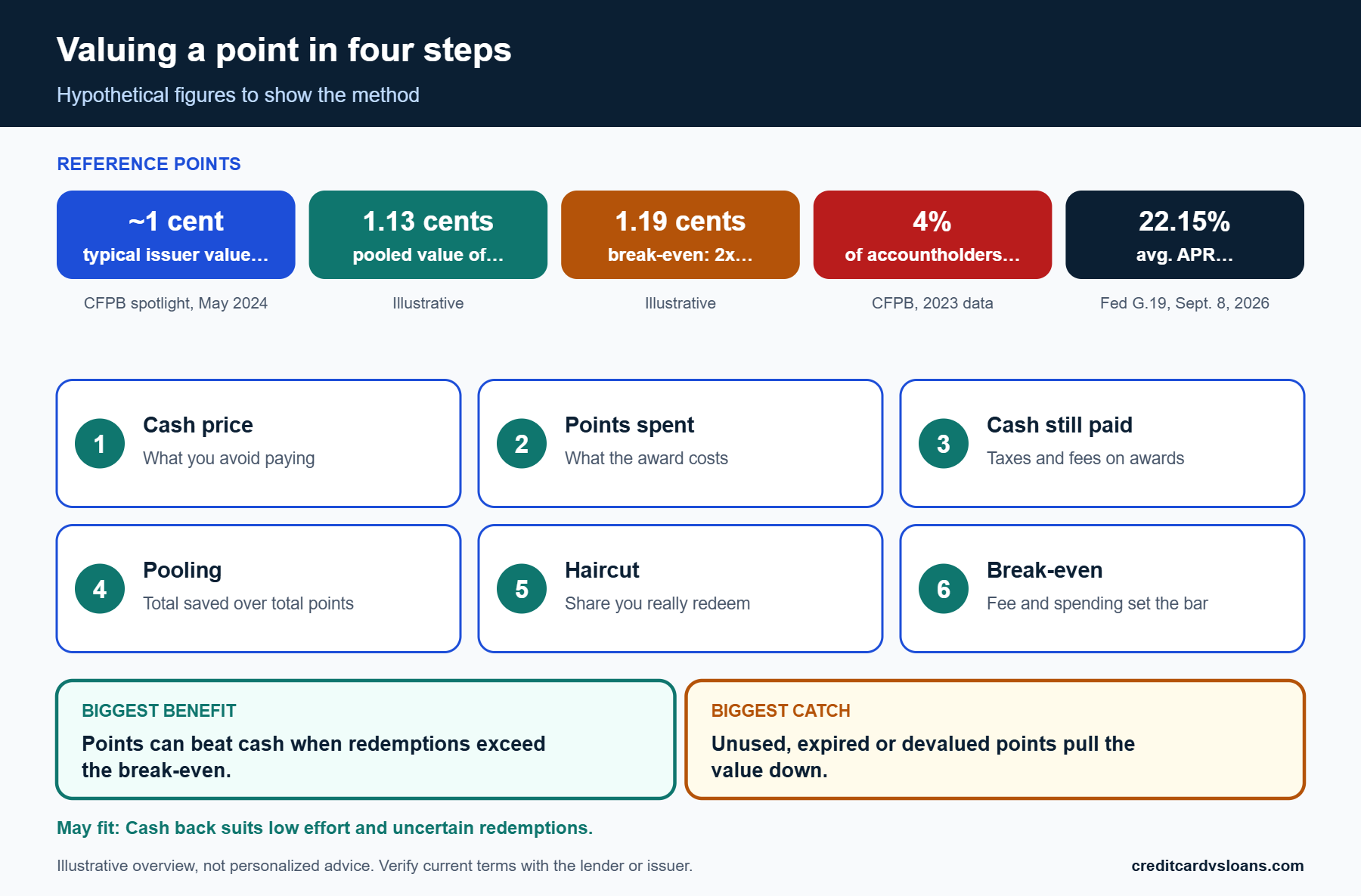
- Value a point in cents: the cash price you avoid, minus any cash you still pay, divided by the points you spend, times 100.
- The CFPB’s May 2024 rewards spotlight says major issuers typically value a point at about one cent as cash back, which makes one cent the natural benchmark.
- A points card that earns the same number of points per dollar as a cash back card earns cents per dollar can only beat it if your realistic value per point is above one cent.
- Haircuts matter: points that expire, go unused or lose value through program changes reduce the effective value per point.
- Interest beats both: the Federal Reserve reported 22.15 percent as the average rate on accounts assessed interest in the second quarter of 2026.
Federal figures come from the CFPB’s May 2024 rewards spotlight and its Dec. 18, 2024 circular, and from the Federal Reserve’s G.19 release of Sept. 8, 2026. Redemption examples, fees and spending levels are made-up numbers for illustration.
Table of contents
Points vs cash back in one answer
The one-number framework
Cents per point is the only comparison that matters
Cash back has a built-in exchange rate of one cent per unit earned. A point has no fixed rate. To compare the two, convert the points to cents using your actual redemptions. If a card earns 2 points per dollar and your points are worth 1 cent each, it earns an effective 2 percent, the same as a 2 percent cash back card. If your points are worth 1.4 cents, the effective rate is 2.8 percent. If they are worth 0.8 cents, it is 1.6 percent.
That is why advertising comparisons of points per dollar mislead. Two points per dollar and 2 percent are the same only at one cent a point, and the real question is whether you will beat or fall short of that benchmark.
What the CFPB says about the benchmark
The CFPB’s rewards spotlight describes points as a proprietary currency that can be redeemed as cash back, converted to miles through transfer partners, or exchanged for merchandise, gift cards, travel, charity, a 529 plan, purchase credits or investments, and notes that major issuers typically value a point at about one cent. The Bureau also reported that average rewards value across major issuers’ general purpose cards rose from 1.4 cents per dollar spent in 2019 to 1.6 cents in 2022.
Those are market-wide figures, and your own value depends on your redemptions. They do suggest that one cent is a reasonable default for a point you redeem as cash, and that anything above it must come from specific redemptions you earn through effort.
Where the two rewards really differ
Certainty versus upside
Cash back trades upside for certainty. You know what you earned and what it is worth the moment it posts. Points offer possible upside, since a well-priced award can return more than a cent per point, and they offer possible downside, since a poorly priced redemption can return less.
The rational question is not whether points can be worth more than cash. It is whether, for the way you actually redeem, they are, after you subtract the costs that come with a points card.
Effort and risk
Points ask for research, timing and attention to program changes. They also expose you to risks that cash back mostly avoids: award availability, expiration and devaluation. The CFPB’s Circular 2024-07 says that lowering the value of rewards a consumer has already earned can be unfair or deceptive, which tells you that the risk is serious enough to draw regulators’ attention.
If the effort and the risk are not appealing, a cash back card is a reasonable choice, even if it leaves a small amount of upside on the table.
Choose points only if you can name the redemptions that will return more than a cent each, and if you will really make them. Otherwise, cash back is the better reward, because it is worth the same on every day and in every situation.
How to put a dollar value on a point
The formula, written as code
Cents per point for any redemption
Valuing a point takes three inputs: the cash price you would otherwise pay, the points you spend, and any cash you still have to pay, such as taxes and fees on an award. The result is the cents you got per point. Writing it as a short Python function makes the logic easy to verify and reuse.
Both functions use hypothetical inputs. The first answers what one redemption was worth; the second converts a points card’s earn rate into the same percentage language as cash back.
Four hypothetical redemptions
Suppose you consider four awards. A $350 flight costs 30,000 points plus $5.60 in taxes. A $220 flight costs 25,000 points plus $5.60. A $900 trip costs 60,000 points plus $60. A $1,400 premium-cabin flight costs 120,000 points plus $150. Running the function gives 1.15, 0.86, 1.40 and 1.04 cents per point respectively.
The spread is the point. Four redemptions from the same card ranged from about 0.86 to 1.40 cents per point, a gap of more than 60 percent. Only two of the four beat a cent by a margin that would cover a modest annual fee.
Valuing the whole balance, not the best redemption
Pool your redemptions
It is tempting to remember the best award you ever booked and apply it to every point. A better method is to pool: add up the dollars saved across the redemptions and divide by the total points spent. For the four awards above, the total saved is $2,648.80 across 235,000 points, a pooled value of about 1.13 cents per point.
That figure is the one to carry into your comparison, and not the 1.40 cents from the best award. If you only make the first three awards, the pooled value is about 1.22 cents; the premium-cabin award pulls the pool down because it costs so many points.
What the pooled value does to the effective rate
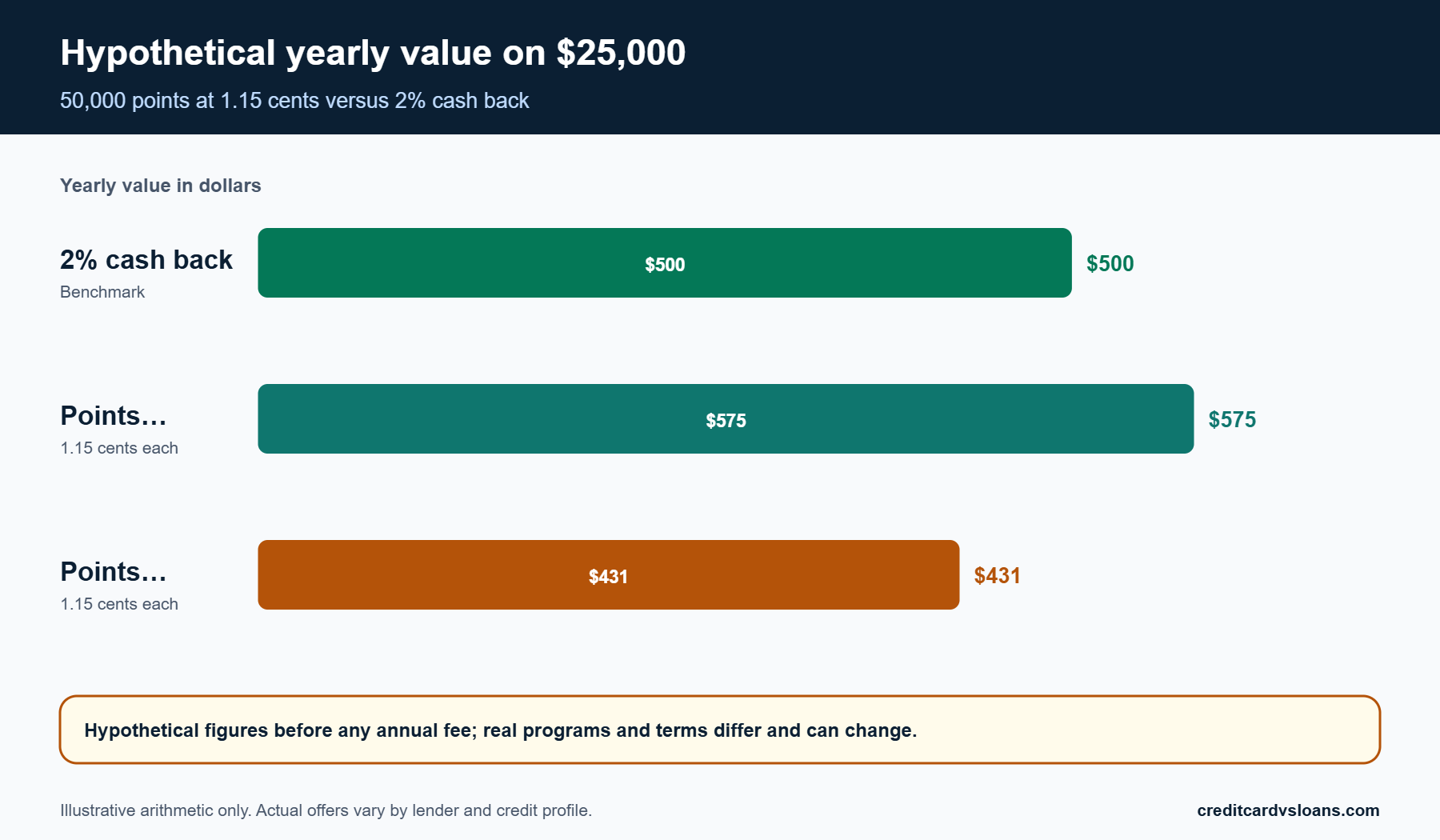
At 2 points per dollar and a pooled value of 1.13 cents, the effective rate is about 2.25 percent. On $25,000 of annual spending that is about $565 in value, compared to $500 from a 2 percent cash back card. The points card is ahead by about $65, before any annual fee and before any haircuts.
A $95 annual fee would turn that lead into a loss of $30. That is the sort of result the comparison is designed to expose.
| Redemption | Cash price | Points | Cash still paid | Cents per point |
|---|---|---|---|---|
| Short flight, flexible date | $350 | 30,000 | $5.60 | 1.15 |
| Short flight, off-peak | $220 | 25,000 | $5.60 | 0.86 |
| Longer trip | $900 | 60,000 | $60 | 1.40 |
| Premium cabin | $1,400 | 120,000 | $150 | 1.04 |
| Pooled across all four | $2,870 | 235,000 | $221.20 | 1.13 |
Valuing bonuses and category multipliers
Sign-up bonuses in cents
A bonus quoted in points should be converted before you compare it with a cash offer. Multiply the bonus by your pooled cents per point, divide by 100, and subtract the cost of any extra spending required to earn it. A 60,000-point bonus at 1.13 cents is about $678, and the same bonus at 0.9 cents is $540. If earning it requires $4,000 of spending you would not otherwise do, and you pay interest on part of it, the real gain shrinks fast.
It also helps to compare against a cash bonus of the same size. A $200 cash back bonus is worth $200 on any day, while a points bonus is worth whatever the program lets you do with it.
Category multipliers on a points card
Some points cards pay several points per dollar in selected categories. The same weighted-average approach used for cash back applies: multiply the points per dollar in each category by your spending there, add them up, and then multiply by your cents per point. A card that pays 4 points per dollar on dining looks generous until you notice that dining is a small share of your budget and the value of a point is under a cent.
Keep the arithmetic honest by using your spending, not the category’s maximum, and by checking whether caps limit the multiplier.
Haircuts: why the headline value is not what you keep
Points that never become value
Unredeemed and expired points
A point that is never redeemed is worth zero. The CFPB’s spotlight reported that each quarter about 4 percent of accountholders lose access to at least some of their rewards, and that issuers forfeit, expire or revoke hundreds of millions of dollars in earned rewards each year, based on the Bureau’s 2023 market report. Most issuers with rewards programs have expiration policies, commonly tied to account inactivity, and the definitions are not consistent.
These are market-wide figures and do not describe your account. They do suggest that you should apply a haircut to your valuation if you expect to let points sit.
A simple haircut model month by month
You can model this with one more small function. It multiplies the earned points by the value per point and by the share you expect to actually redeem. Using hypothetical inputs, a household earns 50,000 points a year from 2 points on $25,000 of spending.
The inputs are made up, but the structure is general. Redeeming 90 percent of points takes $57.50 off the value, and redeeming only 75 percent takes off $143.75. In both cases the 2 percent cash back card, which would have paid $500 on the same spending, looks better against the haircut version than it did before.
Value that moves after you earn it
Devaluation of earned points
Programs can change what points buy. The CFPB’s Circular 2024-07, published Dec. 18, 2024, says that reducing the value of rewards a consumer has already earned may be unfair or deceptive and can resemble a bait-and-switch, particularly if the card was marketed on a specific value. It adds that fine print reserving the right to change the program does not necessarily fix the problem.
In the model above, a 25 percent increase in the points an award costs lowers the value per point from 1.15 cents to 0.92 cents and the year’s value from $575 to $460. A circular is the agency’s view of existing law and does not itself create rights, so the cautious assumption is that some change can happen.
Award availability and redemption friction
The CFPB spotlight cited a 2015 Department of Transportation Inspector General review of two large airlines. Ninety-nine percent of round-trip flights had award seats, 63 percent had them at the lowest award level, and only 13 percent of holiday-week flights did. It also relayed consumer reports of award costs rising after a page refresh. The data is old and the reports are anecdotal, but the pattern supports using conservative values for travel at peak times.
If your trips are tied to fixed dates, use the pooled value from awards on those dates, not from flexible-date searches.
| Scenario | Assumption | Value kept | Compared to 2% cash back on $25,000 ($500) |
|---|---|---|---|
| Everything redeemed | 100% redeemed, no change in award prices | $575.00 | $75 ahead |
| Some points idle | 90% redeemed | $517.50 | $17.50 ahead |
| Many points idle | 75% redeemed | $431.25 | $68.75 behind |
| Awards cost 25% more | All redeemed after devaluation | $460.00 | $40 behind |
The cost side: fees, interest and the break-even value per point
Break-even cents per point
The formula for a points card with a fee
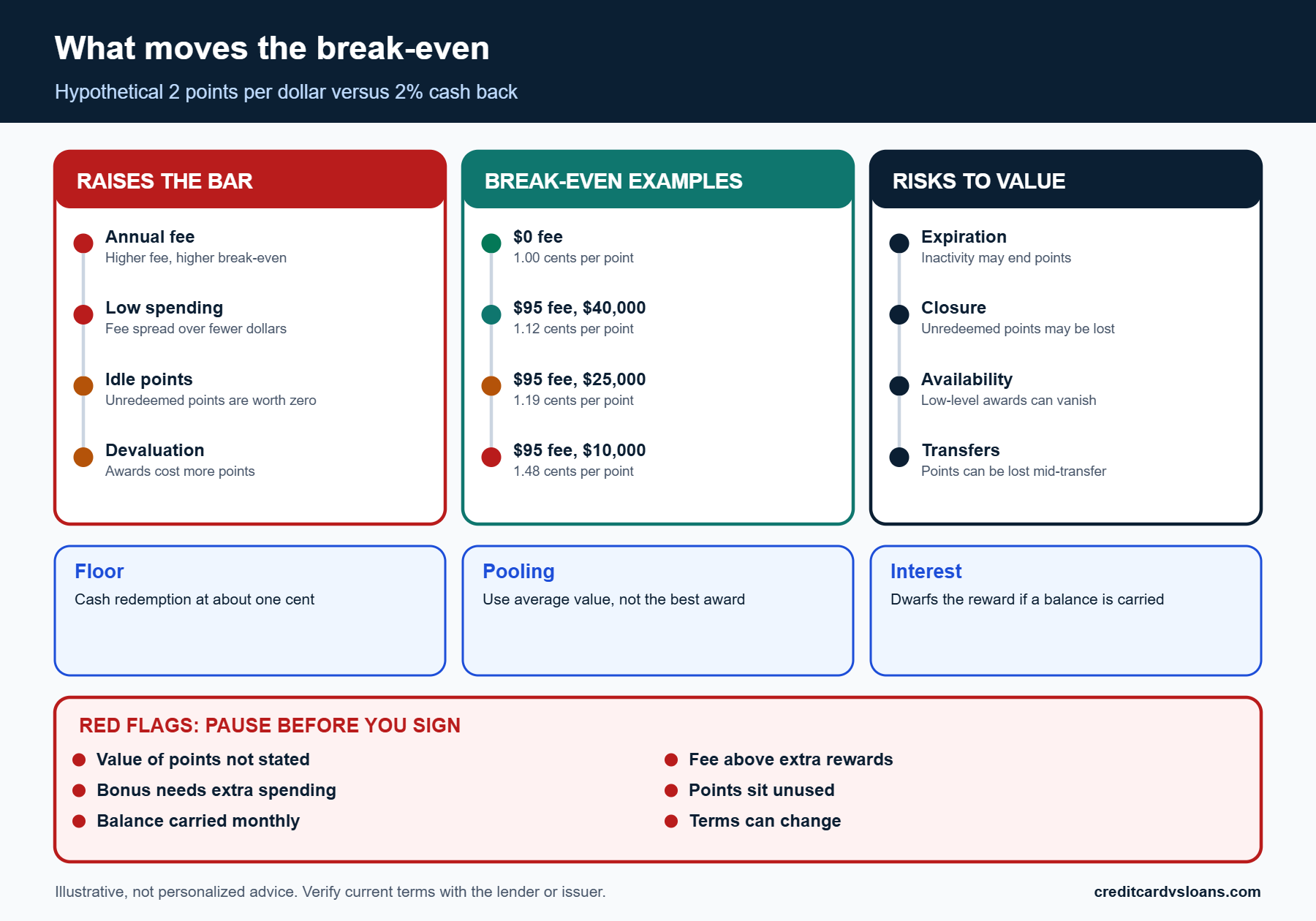
Break-even value per point is the value at which the points card exactly matches a cash back card. For a card that earns m points per dollar, charges an annual fee F, and is compared to cash back at rate r on S dollars of spending, the break-even cents per point is (r times S plus F) divided by (m times S), times 100. Anything above that number favors points; anything below favors cash.
These runs are hypothetical, and they show two things. With no fee and an equal earn rate, break-even is exactly one cent. With a $95 fee, break-even rises, and it rises faster when spending is low because the fee is spread over fewer dollars.
Reading the break-even against your pooled value
Compare the break-even to the pooled value from your own redemptions. In the earlier example, the pooled value was about 1.13 cents. At $25,000 of spending the fee card needs 1.19 cents, so it falls short by a small margin. At $40,000 of spending it needs 1.12 cents, so it clears it by a hair. The conclusion flips with the spending level, which is why the calculation belongs on your numbers rather than on an average.
If the margin is small in either direction, favor the option with less risk, which is usually cash back.
| Annual fee | Annual spending | Break-even cents per point | Reading |
|---|---|---|---|
| $0 | Any amount | 1.00 | Points must beat one cent to win |
| $95 | $10,000 | 1.48 | High bar at low spending |
| $95 | $25,000 | 1.19 | Moderate bar |
| $95 | $40,000 | 1.12 | Lower bar at higher spending |
Interest and other costs
When interest outweighs the whole comparison
The Federal Reserve’s G.19 release of Sept. 8, 2026 reported that the average credit card interest rate was 22.15 percent on accounts assessed interest in the second quarter of 2026, and 20.94 percent across all accounts. A simple annual estimate of the interest on a $2,000 balance held all year is about $443, compared to $575 in the haircut-free case above and $500 in cash back on the same spending.
The CFPB’s grace period guidance explains that you generally avoid purchase interest by paying the statement balance in full by the due date. Carry a balance and the grace period goes away. At that point, the value per point matters less than the cost of the balance.
Late fees and cash advances earn nothing
Late fees, returned-payment fees and cash advance fees do not earn points, and cash advances typically accrue interest from the transaction date, according to the CFPB. A single late fee can exceed a month of rewards. Use autopay for at least the minimum, and calendar the due date for the full statement balance.
If the balance is already a problem, the cheaper route is a lower rate or a promotional offer, as described in our guide to 0% balance transfer cards.
When points win and when cash back wins
Situations that favor points
Concentrated, high-value redemptions
Points can win when you reliably redeem for something that pays well above a cent per point, and when the card’s fee and your spending level make the break-even reachable. People who travel often, can move their dates, and are comfortable comparing award prices against cash prices have the best chance of exceeding one cent, according to the way the redemption data above plays out.
The same people also benefit when a program lets them transfer points to a partner with a favorable award chart. The CFPB spotlight noted that five issuers offered transfers to airline and hotel partners at the time of writing and that smaller issuers rarely do, so partner access is itself a feature to confirm before you apply.
Bonuses that you were going to earn anyway
A sign-up bonus of 60,000 points is worth $600 at one cent and $690 at 1.15 cents. That is a real return if you reach the spending requirement through purchases you already planned. The CFPB spotlight reported that sign-up bonuses account for almost one in ten dollars of rewards overall, and about one in five for consumers with below-prime scores.
The same spotlight reported that about one in four consumers eligible for a promotional bonus failed to meet its requirements in 2022. Treat the bonus as a possible one-time gain, and not as part of the steady-state math.
Situations that favor cash back
Low or irregular redemptions
If you are unlikely to redeem for travel, if your redemptions tend to be in gift cards or merchandise at below a cent per point, or if you expect to let a balance sit, cash back is the better reward. The value is certain, the haircuts are smaller, and nothing needs to be planned.
The CFPB spotlight also reported that cardholders with near-prime and subprime scores typically pay more in interest and fees on a rewards card than on a non-rewards card, even after counting rewards earned. If that profile fits, the reward type matters less than the cost of the card.
Households that value simplicity
Many people would rather spend an hour a year on a budget than on a spreadsheet of award searches. Cash back lets you do that. The cost is the upside you give up, and the hypothetical numbers above put that upside at a few dozen to a few hundred dollars a year, depending on spending.
Whatever the dollar figure, it is only worth chasing if you will actually collect it.
| Your situation | Points | Cash back |
|---|---|---|
| Frequent, flexible travel; likes comparing awards | Can exceed one cent | Leaves upside unused |
| One or two trips a year, fixed dates | Awards often cost more at peak times | Predictable |
| Everyday spending, little interest in travel | Redemptions may land below one cent | Fits |
| Carries a balance some months | Interest swamps the gap | Interest still swamps the reward |
| Wants a low-effort setup | Requires tracking | Low effort |
Turning points into cash and back again
Cash-equivalent redemptions as the safety net
Most points programs allow redemption as a statement credit or deposit, often at one cent per point, according to the CFPB spotlight’s description of the typical issuer valuation. That option sets a floor under your points: you can always take about a cent, so a redemption that pays less than that is a choice and not an obligation.
Check the actual rate in the program terms. Some programs pay less than a cent for cash redemptions, which lowers the floor and changes the comparison with a card that pays cash directly.
A points card used like a cash back card
One way to hold a points card is to treat it as a cash back card with optional upside. Earn points on everyday spending, redeem for cash at the floor when nothing better is available, and use partners only when an award is clearly worth more. This approach limits effort and caps the downside at the cash rate, though the annual fee, if there is one, still has to be covered by the upside.
If the fee is not covered even at the floor, the card is just a more expensive way to earn cash back.
How points and cash back affect your credit and approval
The credit effects are the same
Hard pull, new account and utilization
Whether a card pays points or cash back, a full application typically causes a hard pull, a new account lowers the average age of your accounts, and the reported balance feeds utilization. Prequalification, where it is offered, generally uses a soft pull and does not affect your score, although it does not promise approval.
The rewards themselves are not reported to the bureaus, so a large points balance does not help your score and a small one does not hurt it.
Spend a little more, borrow a little more
The indirect effect is behavioral. Points programs often encourage spending through bonus categories and sign-up offers, and a higher balance at statement time can raise utilization. Pay before the statement closes if you want the reported figure to stay low.
If your aim is to build credit, our guide to how rewards credit cards work explains why the simplest card used lightly is often enough at the start.
Requirements and what to do after a denial
Who is likely to see points offers
Cards with transfer partners, travel credits and richer bonuses tend to be offered to applicants with established credit. Cash back cards with no annual fee are generally available across a broader range of profiles. Issuers set their own thresholds, and income and debt matter alongside the score.
Because each issuer decides, there is no single published cutoff. Use prequalification to see what you may be offered, and compare terms before you apply.
If you are declined
A denial notice will usually list the main reasons. Check your reports for errors, work on payment history and utilization, and wait before reapplying. In the meantime a no-fee cash back card may be easier to get and cheaper to hold than a points card with a fee.
Revisit the points question once your profile is stronger and your spending is stable.
A high points number feels like more value than a small dollar figure. A card that pays 100,000 points and a card that pays $1,000 are the same only if each point is worth a cent, which is why the first thing to do with any points offer is convert it to dollars.
Fine print and risks specific to points
What the rules say and do not say
The CFPB’s position on rewards practices
The CFPB’s Circular 2024-07 addresses three situations: devaluing rewards already earned, revoking or denying rewards on vague or buried conditions, and failures during redemption that cause points to be lost. In each, the agency said the practice may be unfair or deceptive, even when a merchant partner is involved and even when the company follows its stated terms. The circular describes the agency’s approach to existing law, and it does not itself create enforceable rights.
For a cardholder this is context, not protection you can count on to restore a lost balance. The practical response is to read the program terms, keep records of balances and redemptions, and file a complaint with the CFPB if a problem cannot be resolved with the issuer.
Complaints as an early-warning signal
The CFPB spotlight reported more than 1,200 rewards-related complaints in 2023, more than 70 percent above pre-pandemic levels, and noted that the figure excludes rewards issues filed under other categories. It also cited individual complaints, such as a 25 percent jump in the miles needed for the same gift card, as examples of the kinds of problems reported.
Single complaints are anecdotes, not statistics. Still, they illustrate what can go wrong and where to look in the terms: change clauses, forfeiture on closure, minimum redemptions and expiration.
Operational risks you can reduce
Closing, downgrading and inactivity
Closing a card, or having it closed by the issuer, can end your access to unredeemed points. Some programs allow a transfer or a redemption period, and some do not. Before you close or downgrade any points card, redeem or move what you can, and take a screenshot of the balance for your records.
If you are inactive on an account, find out what the issuer counts as activity. A small recurring charge can keep points alive in some programs, but only the terms can say whether yours does.
Redemption errors and disputes
If points disappear during a redemption or transfer, document the time, the amount and any confirmation numbers, and contact the program in writing. For billing errors on a charge, the FTC explains that you should send a written dispute so the issuer receives it within 60 days of the first statement that shows the error. That right covers charges on the card; whether points are restored depends on the program’s terms.
The safest approach is to redeem in smaller steps and to confirm each transfer before moving the next batch.
| Risk | What can happen | How to reduce it |
|---|---|---|
| Devaluation | Same award costs more points | Redeem on a regular schedule |
| Expiration | Inactivity ends the balance | Learn the activity rule |
| Forfeiture on closure | Unredeemed points lost | Redeem before closing |
| Transfer errors | Points lost mid-transfer | Transfer in steps and keep records |
| Bonus conditions | Bonus reclaimed or never paid | Read the conditions and keep the account open as required |
A ten-minute terms review
The five clauses to find
Open the rewards terms and search for five things: how points are valued for each redemption type, when points expire, what happens to points when the account closes, whether the issuer can change the program, and what minimum is needed to redeem. Write the answers in two lines each. If any are missing from the terms, ask the issuer in writing before you apply.
These clauses tell you more about the real value of a program than the headline earn rate does.
What to keep on file
Save a copy of the terms as of the date you opened the account, a screenshot of your points balance each quarter, and confirmation emails for redemptions and transfers. If something goes wrong, those records make a complaint to the issuer or to the CFPB much easier to support.
The habit takes minutes and is worth it for any balance large enough to matter.
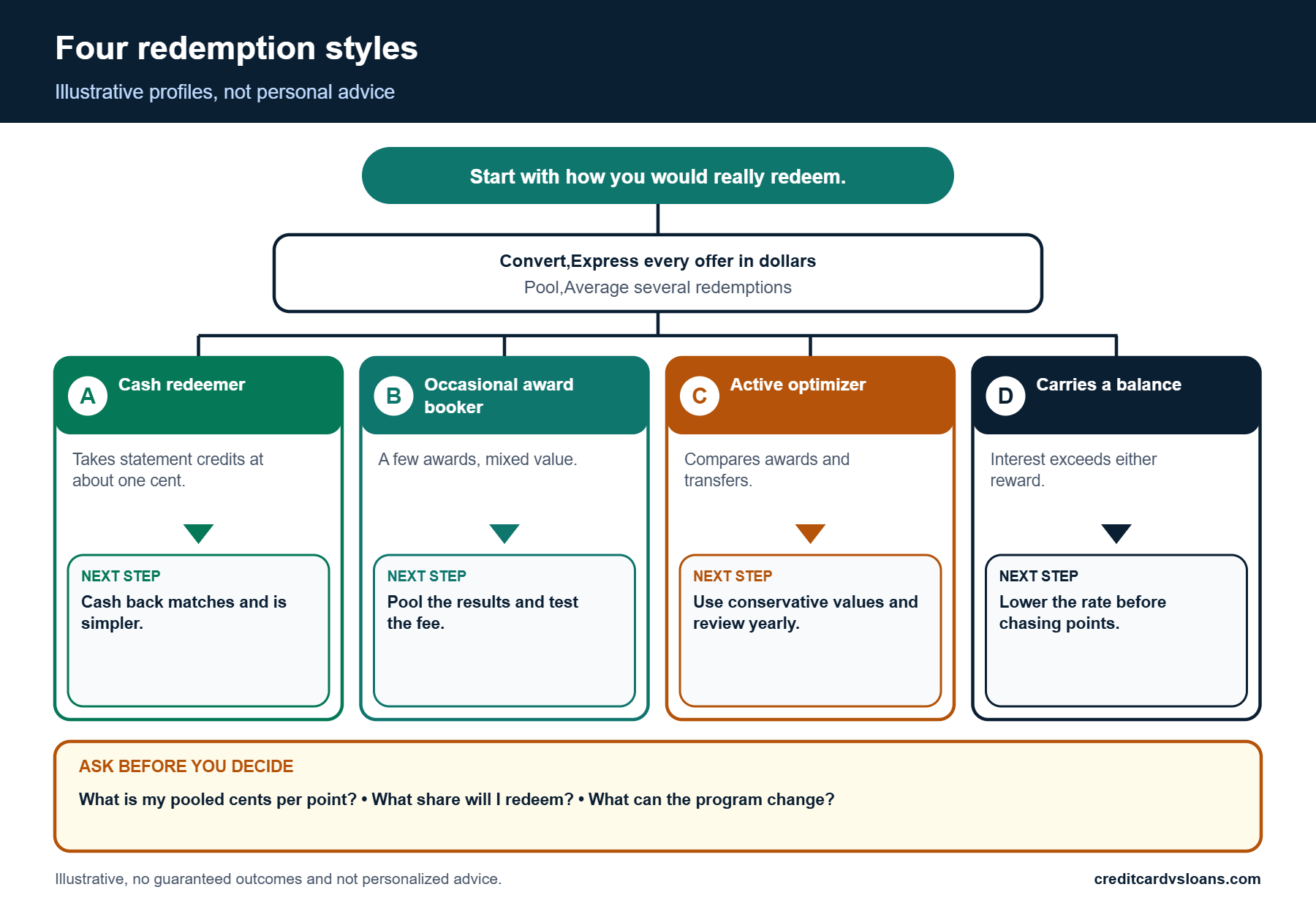
Alternatives when neither reward is the right tool
If a balance is the real problem
Promotional rates and lower-rate cards
When interest is the largest cost, a card with a promotional rate on transfers or a lower ongoing rate usually beats any reward. Read the length of the promotional period, any transfer fee, and the rate that applies afterward. Our guide to 0% balance transfer cards and the debt trap shows how to check those terms.
A promotional rate works only if the plan includes paying the balance before it ends.
Consolidation and repayment structures
A fixed-rate installment loan or a structured repayment plan can replace revolving interest with a schedule. Compare the rate, any origination fee, and the term, and be honest about whether the old cards will stay unused. Rewards on a card you are paying interest on are rarely a good reason to keep that balance.
If the balance is large relative to your income, a nonprofit credit counselor can review your options without selling you a product.
Business spending
Business cards and their own terms
Business owners face the same points vs cash back choice with different terms. Business cards often have different protections and reward structures, and mixing personal and business spending complicates records. Our guide to 0% APR business credit cards explains when a promotional rate is a tool and when it becomes a cash-flow trap.
If the main job of the card is short-term financing, the rate on the balance matters more than any reward.
Keeping records for taxes
How rewards are treated for tax purposes depends on how they are earned, and a sign-up bonus or business use can change the analysis. Ask a tax professional or check IRS guidance for your situation, and keep statements and redemption records for the year.
This is a general reminder and not tax advice.
A decision checklist for choosing points or cash back
Run the valuation once, on your own numbers
The four-input worksheet
Gather four inputs: your annual card spending, the points per dollar on that spending, the annual fee, and your pooled cents per point from at least three real or realistic redemptions. Add one haircut input, the share of points you expect to redeem. Then compute the break-even value per point and compare it to your pooled value times the share redeemed.
If your haircut-adjusted value is above the break-even, points can win. If it is below, take the cash. If it is close, take the cash, because the downside risk is smaller.
Stress-test the conclusion
Rerun the worksheet with 20 percent less spending, with a 25 percent devaluation, and with one idle quarter. If the points card still comes out ahead, you have a sturdier case. If it only wins in the best scenario, the cash back card is the safer choice.
Write the result on one page, with the date, so you can compare it to next year’s numbers.
Next steps
Before you choose
- Convert every points offer into dollars, using one cent as the starting point.
- Estimate your pooled cents per point from realistic redemptions, not the best one.
- Compute break-even value per point with the annual fee and your spending.
- Read expiration, forfeiture and program-change terms.
- Decide how you will pay: autopay for the full statement balance is the simplest safeguard.
After you choose
- Redeem on a schedule so balances do not sit exposed to changes.
- Review your results once a year and switch to a simpler card if the points are not beating the cash benchmark.
- Keep records of balances, redemptions and any disputes.
- If a balance builds up, address the interest first; the reward can wait.
Points beat cash back only when your realistic value per point, after fees and after the points you never use, is above the break-even for your spending. If you cannot name the redemptions that get you there, take the cash back and keep the money you would have spent on complexity.
- Rewards Credit Cards: How Points, Miles and Cash Back Really Work
- Cash Back Credit Cards: How to Compare Real Value
- Travel Rewards vs. Cash Back: Which Card Fits Your Spending?
- 0% Balance Transfer Credit Cards: How to Use Them Without a Debt Trap
- 0% APR Business Credit Cards: Useful Tool or Cash-Flow Trap?
- CFPB: Credit card rewards: Issue spotlight (May 2024)
- CFPB: Consumer Financial Protection Circular 2024-07: Design, marketing, and administration of credit card rewards programs
- CFPB: What is a grace period?
- Federal Reserve: Consumer Credit – G.19 (release of Sept. 8, 2026)
- FTC: Using credit cards and disputing charges
Last updated: October 22, 2026. Rates, fees and lender rules change; verify current terms before acting.
The information on creditcardvsloans.com is provided for general educational and informational purposes only. It is not financial, legal, tax, credit, accounting or investment advice, and reading it does not create an advisor-client, fiduciary or any other professional relationship. Nothing here is an offer, solicitation or recommendation to borrow, lend or apply for any product.
Credit scores, interest rates, fees, eligibility rules, lender policies and laws change frequently and vary by lender, location and individual circumstances. Examples, figures and scenarios are illustrative only, do not predict your results and do not guarantee approval, savings, a particular rate or a credit-score outcome. Always confirm current terms directly with the lender or issuer and read the full agreement before you apply or sign.
Although we aim for accuracy and use reputable sources, we make no representations or warranties, express or implied, about the completeness, accuracy, reliability or timeliness of the content. Content may be drafted with the assistance of automated tools, so errors or omissions may still occur. Links to third-party sites are provided for convenience; we don’t control and aren’t responsible for their content.
To the fullest extent permitted by law, creditcardvsloans.com and its owners, editors, authors, contributors and affiliates disclaim all liability for any loss, damage or expense arising directly or indirectly from your use of, or reliance on, this content. Before making financial decisions, consult a licensed professional, such as a qualified financial advisor, attorney, tax professional or nonprofit credit counselor, who can consider your complete situation.