For telemarketed debt settlement and similar services, debt relief company upfront fees are banned by federal rule: a seller cannot request or receive payment until it has actually settled, reduced or otherwise changed the terms of at least one of your debts, and you have made at least one payment under that deal. The ban sits in the Federal Trade Commission’s Telemarketing Sales Rule, and it is the single most useful test you can apply to a debt relief pitch.
Knowing the sentence is helpful. Knowing how the rule is built is better, because the details explain what a company may legally charge, when, and how the money has to be handled. Those details also show where sales pitches quietly try to work around the ban, through “enrollment” fees, trust accounts, financed fees and vague descriptions of what the company will do.
This guide walks through the text of the rule and the agency explanations around it, then turns it into a checklist you can use before signing anything. It is general education about federal rules and not legal advice, and state law or the facts of your situation can change the analysis.
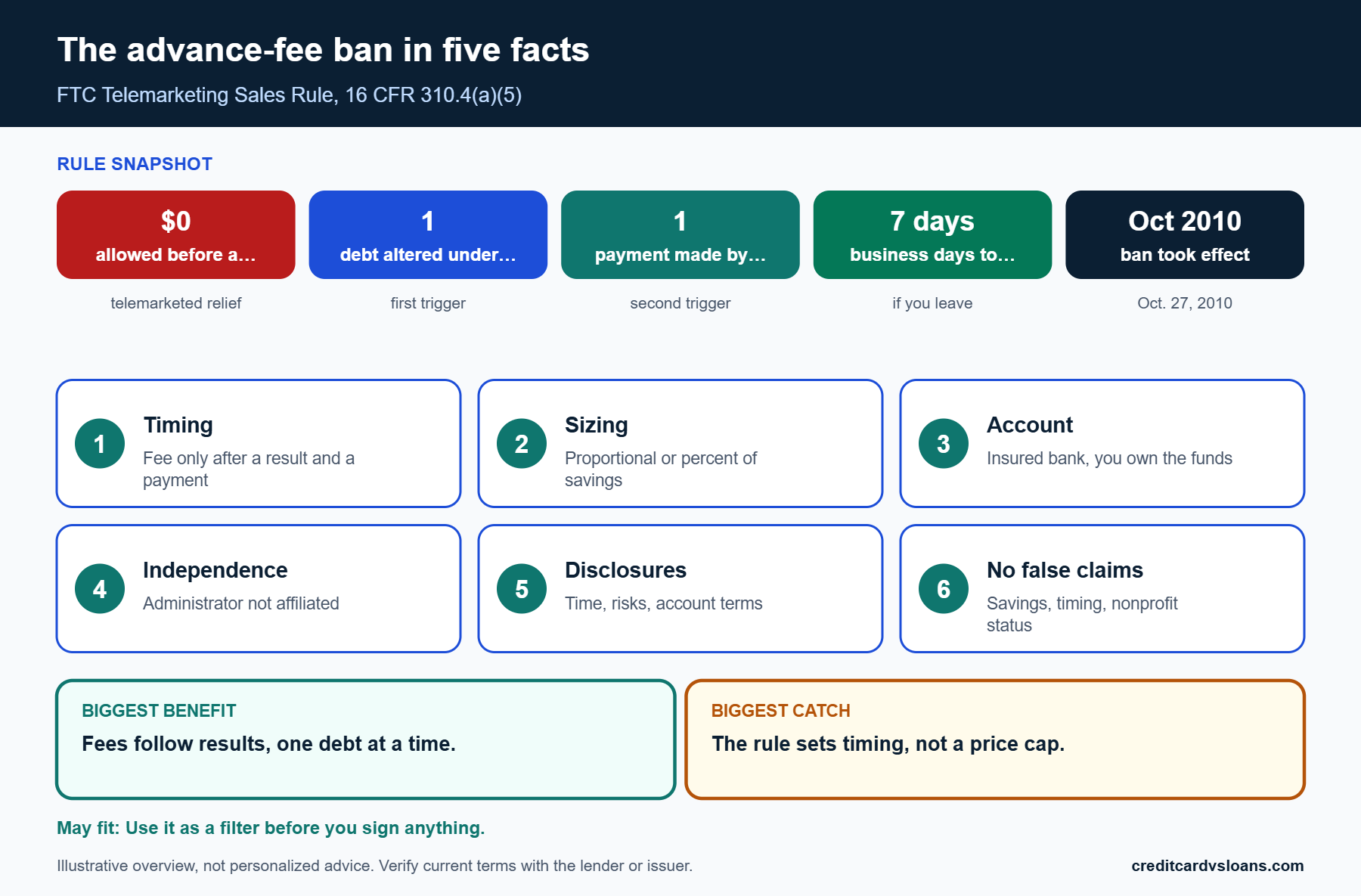
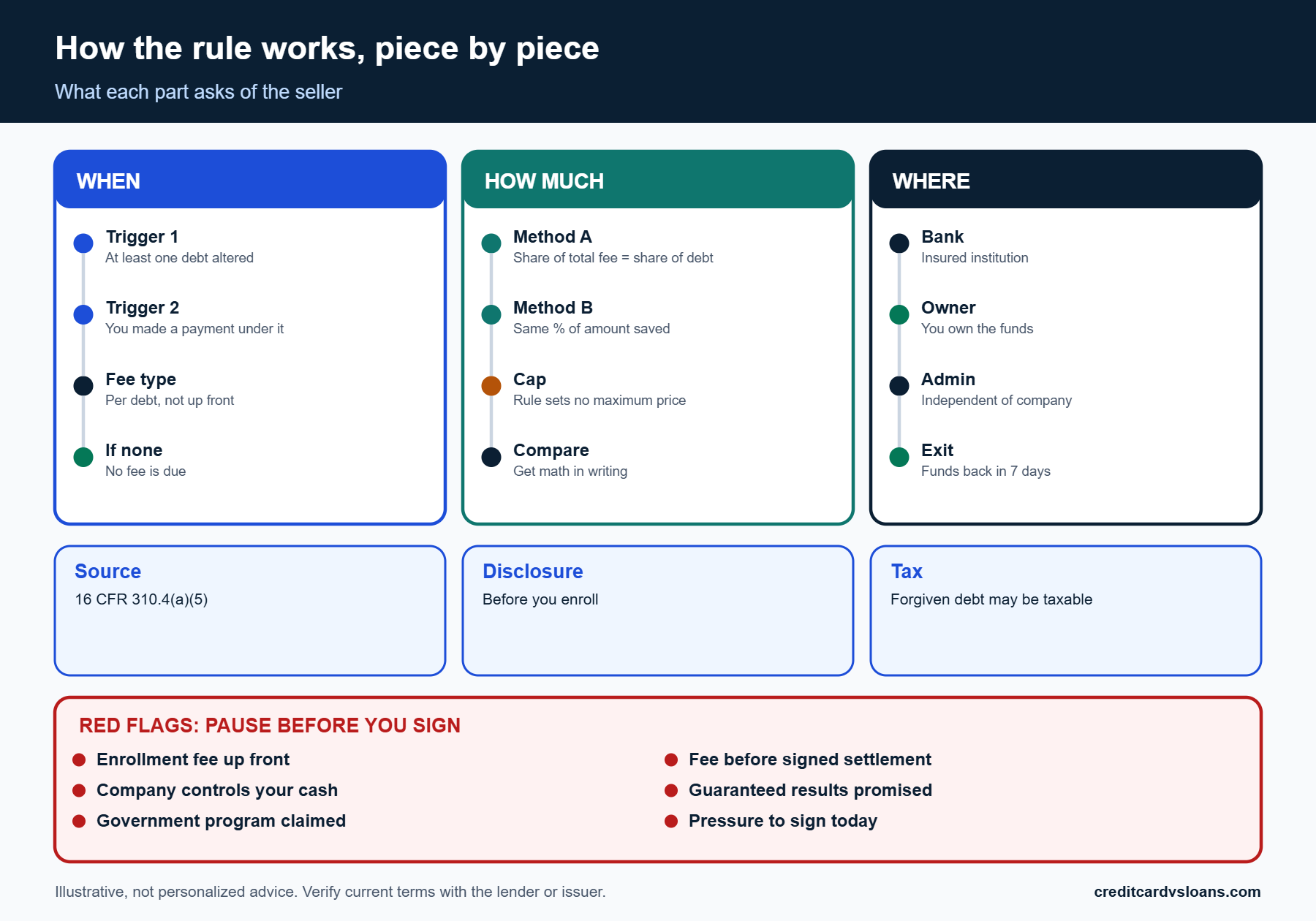
- The core rule is timing. Under 16 CFR 310.4(a)(5), no fee for a covered debt relief service until a debt has been renegotiated, settled or reduced under a signed agreement and you have made at least one payment under it.
- The fee itself is limited too. It must be proportional to the debt resolved, or a consistent percentage of the amount saved.
- Your money can wait in your own account. The rule allows a dedicated account only if you own the funds, an insured bank holds them, and the administrator is independent of the company.
- Disclosures come before you enroll. Sellers must tell you the time it will take, what you must save before offers, the risks of missed payments and the account terms.
- Scope matters. The rule is built around telemarketing, so check how you were contacted and what your state adds.
Rule text is quoted from the Electronic Code of Federal Regulations as retrieved in October 2026. The rule was adopted in an amendment announced in 2010, with the advance-fee ban effective October 27, 2010. Regulations can be amended, so confirm the current text at ecfr.gov if a decision depends on it.
Table of contents
Debt Relief Upfront Fees: The Short Answer
The rule in plain words
What the ban stops
The FTC’s consumer alert on credit card debt relief puts it simply: it is illegal for a debt relief company to charge you a fee before it does anything to relieve your debt. The FTC’s debt relief scams page describes the 2010 Telemarketing Sales Rule amendment the same way, saying it bars for-profit companies that sell debt relief by phone from charging a fee before they actually settle or reduce a consumer’s debt.
The CFPB repeats the point in its list of warning signs, advising consumers to avoid any company that charges fees before it settles your debts. Three agencies, one message: a bill that arrives before a result is a red flag.
What the rule allows after results
The rule does not ban debt relief fees altogether. Once the company has renegotiated, settled, reduced or otherwise altered the terms of at least one of your debts under a valid agreement, and you have made at least one payment under it, a fee tied to that debt may be requested. The text names a settlement agreement, a debt management plan or another valid contractual agreement you executed.
So the fee follows the work, one debt at a time. If you want the broader picture of when settlement makes sense at all, credit card debt relief options and red flags compares the routes.
Who and what the rule covers
How the rule defines a debt relief service
Section 310.2 defines a debt relief service as any program or service represented, directly or by implication, to renegotiate, settle or alter the terms of a person’s debt with unsecured creditors or debt collectors. That includes changes that reduce the balance, the interest rate or the fees owed. The wording “represented, directly or by implication” matters: the company’s marketing counts, not just its contract.
Unsecured debts include most credit card balances, which is why the rule matters so much to people with card debt. Your car loan or mortgage is different, since those are secured by the asset.
The telemarketing limit and why to check your facts
The same section defines telemarketing as a plan, program or campaign conducted to induce the purchase of goods or services, using telephones and involving more than one interstate call. The advance-fee ban applies to a “seller or telemarketer” in that setting. The FTC’s description of the ban refers to companies that sell debt relief by phone.
Whether a specific transaction is covered depends on the facts, such as how the company reached you and how the sale was made, and states may have their own rules about debt settlement fees. When in doubt, treat the ban as your baseline expectation and check your state attorney general’s guidance. A company that refuses to explain when it charges is giving you a reason to leave.
| Question | What the rule text says | What it means for you |
|---|---|---|
| Can a company charge on enrollment? | No fee until a debt is altered and you make a payment under the deal | Walk away from any “enrollment” or “setup” fee for telemarketed relief |
| What triggers the first fee? | At least one debt renegotiated, settled or reduced under a signed agreement, plus one payment | Ask for the signed creditor agreement before paying |
| How is the fee sized? | Proportional to the debt resolved, or a set percentage of the amount saved | Ask which method applies and for the math in writing |
| Can the company hold my money? | Only in an independent, insured account that you own | Confirm who administers the account and its fees |
| Can I leave? | Yes, without penalty, with funds returned within seven business days | Get the exit terms before you sign |
Inside the Advance-Fee Ban: The Rule’s Conditions
The two triggers before any fee
A settlement or plan you signed
Under 310.4(a)(5)(i)(A), the seller or telemarketer must have renegotiated, settled, reduced or otherwise altered the terms of at least one debt “pursuant to a settlement agreement, debt management plan, or other such valid contractual agreement executed by the customer.” The wording ties the fee to a concrete, signed outcome with a creditor, not to effort or enrollment.
Ask for a copy of the agreement and read it. If a company says it “has been working on” your accounts but cannot show an agreement, no fee is due under the rule.
At least one payment under that agreement
Under (B), you must also have made at least one payment under the settlement agreement or other valid contract between you and the creditor or debt collector. This is a second safeguard: it prevents a company from claiming a result that you never actually saw implemented.
The practical consequence is that the first dollar of fee comes after the first dollar of progress. If a payment demand arrives before a creditor has accepted anything, treat it as a red flag, and keep records of every request.
How the fee may be sized
The proportional method
Under (C)(1), the fee for an individually renegotiated debt must bear the same proportional relationship to the total fee as the individual debt bears to the total debt owed when you enrolled. In other words, if one debt is a quarter of what you enrolled, the fee tied to it can be a quarter of the total fee.
The rule fixes the proportion, not the price. It does not say what the total fee may be, so the percentage a company charges is a separate negotiation and a reason to compare more than one provider.
The percentage-of-savings method
Under (C)(2), the alternative is a fee that is a percentage of the amount saved as a result of the renegotiation, with the same percentage applied to every debt. That ties the fee directly to the benefit you receive.
Either approach should be stated in your written agreement. If the contract mentions flat monthly charges that start immediately, ask how they square with the rule.
The Dedicated Account Rules: Where Your Money Waits
What the account must look like
Ownership and the bank
Many settlement programs ask you to build up cash before creditors will talk. The rule does not forbid that, but 310.4(a)(5)(ii) sets conditions for asking you to fund a dedicated account for fees and creditor payments. The funds must be held in an account at an insured financial institution, and you must own the money and be paid any accrued interest.
That ownership point is a practical test. If the company’s contract says the money becomes its property when deposited, or that it can move funds at will, the structure does not match the rule’s description. The FTC adds that settlement funds usually go into a third-party account that you own, and that the administrator may charge a reasonable maintenance fee.
Independence of the administrator
The entity administering the account must not be owned or controlled by, or affiliated with, the debt relief service, and it must not give or accept compensation for referrals tied to the service. This is meant to prevent a company from effectively holding your cash in a pocket it controls while claiming a bank is involved.
In 2014, the CFPB announced an action against Global Client Solutions, a payment processor for the debt settlement industry, alleging it helped debt settlement companies collect illegal upfront fees. The announcement noted that its complaint was not a finding of a violation, but it shows regulators look beyond the company’s own name to the payment chain.
Leaving the program
The seven-business-day return
You must be able to leave the service at any time without penalty and receive the funds in the account, other than amounts the service has earned under the fee conditions, within seven business days of your request. This is one of the more consumer-friendly parts of the rule, and one of the least advertised.
Ask the company to show you where this appears in the contract. If the agreement describes cancellation fees, forfeiture or longer holding periods, ask how those terms are consistent with the rule, and consider getting advice before you sign.
What you can ask before you deposit
Before moving money, ask: Who is the account administrator? Is it affiliated with the company? What maintenance fees apply? Who can withdraw, and under what conditions? Where do statements go? A written answer to each is a reasonable request.
Keep your own statements and compare them with what the company reports. If balances do not match, ask in writing and, if unresolved, contact your state attorney general or file a complaint with the CFPB.
Disclosures and Misrepresentations: What a Seller Must Tell You
The required disclosures
Time, savings targets and costs
Section 310.3(a)(1)(viii) lists what a seller of debt relief services must disclose, starting with the amount of time necessary to achieve the represented results. For debt settlement services, the 2010 final rule summary adds that the seller must disclose the amount of money or percentage of each outstanding debt that the customer must accumulate before the provider makes a bona fide settlement offer. The cost information required by the general rule also applies.
The timing standard is notable: a footnote in the rule says the seller must make the debt relief disclosures before the consumer enrolls in an offered program. A pitch that rushes you to sign before these are given falls short.
The risks of missed payments and the account terms
If a program relies on you not making timely payments to creditors, the seller must say that this may affect your creditworthiness, may lead to collections or lawsuits, and may increase the amount owed. If a dedicated account is required, the seller must say that you own the funds, may withdraw them at any time without penalty, and will receive all funds in the account on request.
These disclosures reflect the evidence regulators gathered: many providers told consumers to stop paying creditors without explaining that doing so might increase what they owe. If a sales call skips these topics, ask the seller to cover each one aloud and in writing.
The prohibited claims
Misrepresenting material aspects
Section 310.3(a)(2)(x) bars misrepresenting any material aspect of a debt relief service, including the amount of money or the percentage of debt that can be saved, how long it will take, the effect on creditworthiness, and whether the provider is a nonprofit. The 2010 rulemaking background describes practices such as claims of specific reductions and promises to eliminate debt in a set period.
The CFPB’s red-flag list lines up: a promised percentage reduction, a guarantee that debt will disappear and a “new government program” are all claims that should make you stop. For the government-program version, see predatory lending and debt relief warning signs.
Success claims and nonprofit labels
A nonprofit label does not mean low fees, and the FTC cautions that some groups charge high fees or push voluntary contributions. A claim about “most clients settle for pennies on the dollar” is a success-rate statement, and the rule prohibits misrepresenting success rates. Ask for the basis in writing, and for results specific to your creditors.
When a company cannot support a claim with documents, consider it unsupported. You can also ask your state attorney general whether complaints exist.
What Fees Look Like Under the Rule: Worked Illustrations
The proportional method in numbers
A hypothetical four-debt enrollment
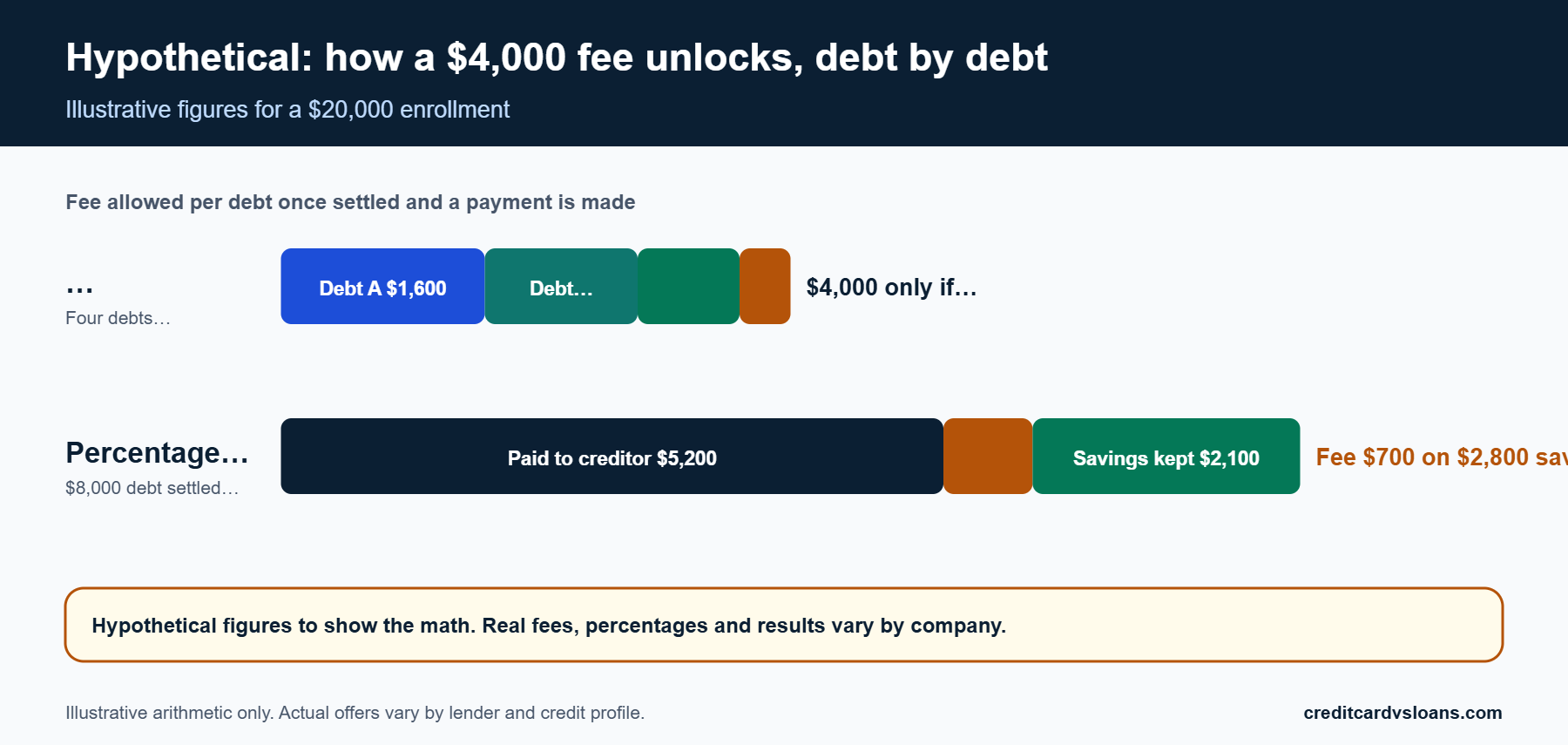
Suppose, purely as an illustration, that someone enrolls four debts totaling $20,000: $8,000, $6,000, $4,000 and $2,000. Assume the company’s agreed total fee is $4,000, a figure chosen to make the math easy and not a typical price. Under the proportional method, the fee tied to each debt equals that debt’s share of $20,000 times $4,000.
That produces $1,600 for the $8,000 debt, $1,200 for the $6,000 debt, $800 for the $4,000 debt and $400 for the $2,000 debt. None of it is collectible until that particular debt has been settled under a signed agreement and you have made at least one payment under it. If only the $2,000 debt is ever settled, the most the company could collect in this illustration is $400.
The percentage-of-savings alternative
Under the second method, the fee is a percentage of the amount saved. Suppose the $8,000 debt settles for $5,200, saving $2,800, and the agreed percentage is 25 percent. The fee would be $700, applied at the same percentage to every debt, and you would keep $2,100 of the savings before taxes or other costs.
Again, these numbers are hypothetical. The rule governs timing and proportion, not the level of the percentage, so compare the effective fee against the savings and against doing nothing, negotiating yourself or using a nonprofit plan.
| Debt (enrolled) | Proportional share of $4,000 total fee | When it may be collected | Percentage-of-savings check |
|---|---|---|---|
| Debt A, $8,000 | $1,600 (40%) | After A is settled and a payment is made | Settled at $5,200: saved $2,800, 25% fee = $700 |
| Debt B, $6,000 | $1,200 (30%) | After B is settled and a payment is made | Depends on settled amount |
| Debt C, $4,000 | $800 (20%) | After C is settled and a payment is made | Depends on settled amount |
| Debt D, $2,000 | $400 (10%) | After D is settled and a payment is made | Depends on settled amount |
| Fee if nothing settles | $0 | Nothing is due | $0 |
What the rule does not cap
The total price is still yours to negotiate
The ban controls when fees are collected and how they are apportioned. It does not set a maximum percentage, and the CFPB notes simply that debt settlement companies often charge expensive fees. Treat the rule as a floor of protection, not a promise that the price is fair.
The effective cost includes account maintenance fees, taxes on forgiven amounts and credit effects. The IRS says forgiven debt is generally taxable income, so a settlement that looks like a bargain can arrive with a bill.
Costs that sit outside the rule’s focus
Late fees and penalty interest that build on accounts you stop paying are not a fee charged by the company, yet they can erase savings, as the CFPB warns. A proper comparison therefore looks at all-in cost across the full time period, which the FTC says is often 36 months or more.
Before choosing, compare with the cheapest routes: calling your issuer, a nonprofit plan, or a lower-rate loan from a personal loan for debt consolidation. Rate shopping can be done with limited credit impact; see whether rate shopping hurts your credit.
Why the Rule Exists: The Record Behind the Ban
What regulators found before 2010
Fees came first, results later
The FTC’s final rule notice in the Federal Register (August 10, 2010) summarizes the findings that supported the advance-fee ban. Consumers often did not realize that early payments went to the provider’s fees rather than to a settlement fund, and providers often underestimated how long the program would take. Fees were front-loaded: some providers collected 40 percent or more of the total fee in the first three or four months.
Even “pay as you go” models, according to the same record, required hundreds of dollars before any settlement. That is the practice the ban was written to stop, and it explains why timing, not just amount, is the heart of the rule.
Dropouts and lawsuits
The record also describes a large percentage of consumers dropping out before settlement and forfeiting fees paid, without giving a precise rate. In one FTC case cited there, nearly a third of 18,116 customers were sued by creditors or debt collectors in 2004 and 2005. The record notes that many consumers fell further behind, incurred extra charges and harmed their credit.
These are older findings and not a prediction for every program today. They are useful because they explain why regulators did not simply require better disclosures and left it there: disclosure alone did not solve a model in which money moved before relief did.
Enforcement in the public record
Payment processors and the chain of fees
In August 2014, the CFPB announced a proposed order against Global Client Solutions, alleging that it processed tens of millions of dollars in advance fees from tens of thousands of consumers for hundreds of debt relief companies since October 2010. The CFPB alleged violations of the Telemarketing Sales Rule. The proposed terms included more than $6 million in consumer relief and a $1 million civil money penalty, and a later update to the page reported a final court order. Complaints are allegations until a court rules.
The lesson for consumers is that the rule reaches more than the name on the contract. A fee can flow through a processor, so ask who actually receives your money.
Student loan “help” is covered too
In November 2020, the CFPB filed a complaint against a California business and its owner, alleging advance fees for telemarketed help with federal student loan consolidation, forgiveness or income-driven repayment, with fees of $1,000 to $1,450 charged at or just after enrollment, for paperwork that borrowers can file themselves at no cost. The CFPB also alleged missing disclosures. As with any complaint, it is not a finding that the defendants broke the law.
The case shows how the ban applies to telemarketed debt relief generally, not only to credit cards. If you have both card and student loan debt, the same caution about upfront fees applies to both, and free official channels exist for federal student loans at studentaid.gov.
Fees That Look Different but Raise the Same Question
Common labels for early charges
Enrollment, processing and retainer fees
Early charges are often relabeled: “enrollment,” “setup,” “processing,” “retainer,” “file review,” or a first month’s “program fee.” The test is not the label but the timing and purpose: is money being requested for a debt relief service before a debt has been altered and a payment made under it? If so, ask the seller to explain why the rule does not apply.
A fee for a separate, genuinely independent service, such as a bank’s account maintenance charge in a compliant dedicated account, is different. Ask for a written list of every fee, who receives it and when it is due.
Financed fees and loans to pay the fee
Some sellers arrange financing so you can pay their fee up front. The CFPB’s 2020 complaint alleged that some borrowers financed fees through high-interest loans from a third party. Financing a fee does not change when the seller may request it under the rule, and it adds interest on top.
If a seller offers a loan or payment plan to cover its own charges at enrollment, treat that as a signal to slow down. Compare the full cost, and talk to a nonprofit counselor first.
Where legitimate fees do appear
Nonprofit plans and approved agencies
A debt management plan is named in the rule among agreements that can trigger a fee once the debt terms have changed, and counseling agencies may charge setup or monthly fees. The CFPB tells consumers to ask about those fees and get a written price quote, and to avoid organizations that charge for educational materials.
The FTC notes that nonprofit status does not guarantee low fees, so compare. Debt management is also covered in credit card debt relief: legitimate options and red flags.
Loans, transfers and ordinary lender fees
Consolidation loans and balance transfers are products from lenders, not debt relief services in the rule’s sense of renegotiating with your creditors, and their fees, such as origination or transfer fees, are disclosed in the offer. Compare them on total cost, and check eligibility if your credit is damaged; credit card debt consolidation with bad credit covers realistic options.
A lender asking for an “advance fee” before it releases a loan is a separate problem. Genuine lenders disclose fees in the loan terms and deduct them from the proceeds, and the FTC warns that advance-fee loan guarantees are a scam pattern.
| Fee request | Usually | Why |
|---|---|---|
| “Enrollment fee” before any creditor agreement, on a telemarketed settlement | Red flag | Conflicts with the advance-fee ban’s timing |
| Fee after a signed settlement and your first payment under it | Possible | Matches the rule’s timing; check proportional or percentage method |
| Reasonable maintenance fee at an independent insured account | Possible | The FTC notes such fees may be charged; confirm independence |
| Nonprofit DMP setup or monthly fee | Ask and compare | The CFPB says to ask about fees and get a written quote |
| Loan origination or balance-transfer fee | Compare total cost | Disclosed lender fees; not the same as a relief fee |
| “Fee to qualify for a government program” | Red flag | CFPB warns about “new government program” claims |
Reading a contract line by line
Clauses that deserve a second look
Start with the fee section and the cancellation section. Look for language that describes charges beginning at enrollment, charges “earned” before a creditor has agreed to anything, or monthly program fees that begin before the first settlement. Check how the contract defines a “settlement,” since a vague definition can let a company claim a result early.
Also look for clauses that waive your right to cancel, require arbitration without explanation, or limit your ability to withdraw funds from the dedicated account. None of these is automatically unlawful, but each is a reason to ask a question or get advice before signing.
Verbal promises versus written terms
If the salesperson promises something that does not appear in the contract, such as a guaranteed settlement percentage or an end date, assume it does not exist. The CFPB advises getting all verbal promises in writing for counseling agencies, and the same habit protects you here.
Take your time. A legitimate provider will not object to your reviewing the contract overnight or having a family member, counselor or attorney read it. Pressure to sign immediately is information about the seller.
Rights beyond the fee rule
State protections and where to look
Some states license or regulate debt settlement and debt management companies, and may add rules on fees, contracts or cancellation. Details vary, so check with your state attorney general or consumer protection office. The CFPB suggests checking any credit counseling organization with these offices before you pay.
If your state is stricter than the federal rule, the stricter requirement may be the one that matters. You do not have to determine that on your own; ask a consumer attorney or legal aid office.
How to complain and what to keep
Keep your contract, statements, emails, call notes and receipts. You can report suspected scams to the FTC at ReportFraud.ftc.gov, and the CFPB accepts complaints about financial products and services. Describe what was promised, what you paid, the dates, and the company’s responses.
Reports do not guarantee a refund, but they inform enforcement. Ask your card issuer or bank about disputing charges when a payment was obtained through misleading claims.
Checklist: What to Do When a Debt Relief Company Asks for Money
Questions to ask and answers to expect
Seven questions before any payment
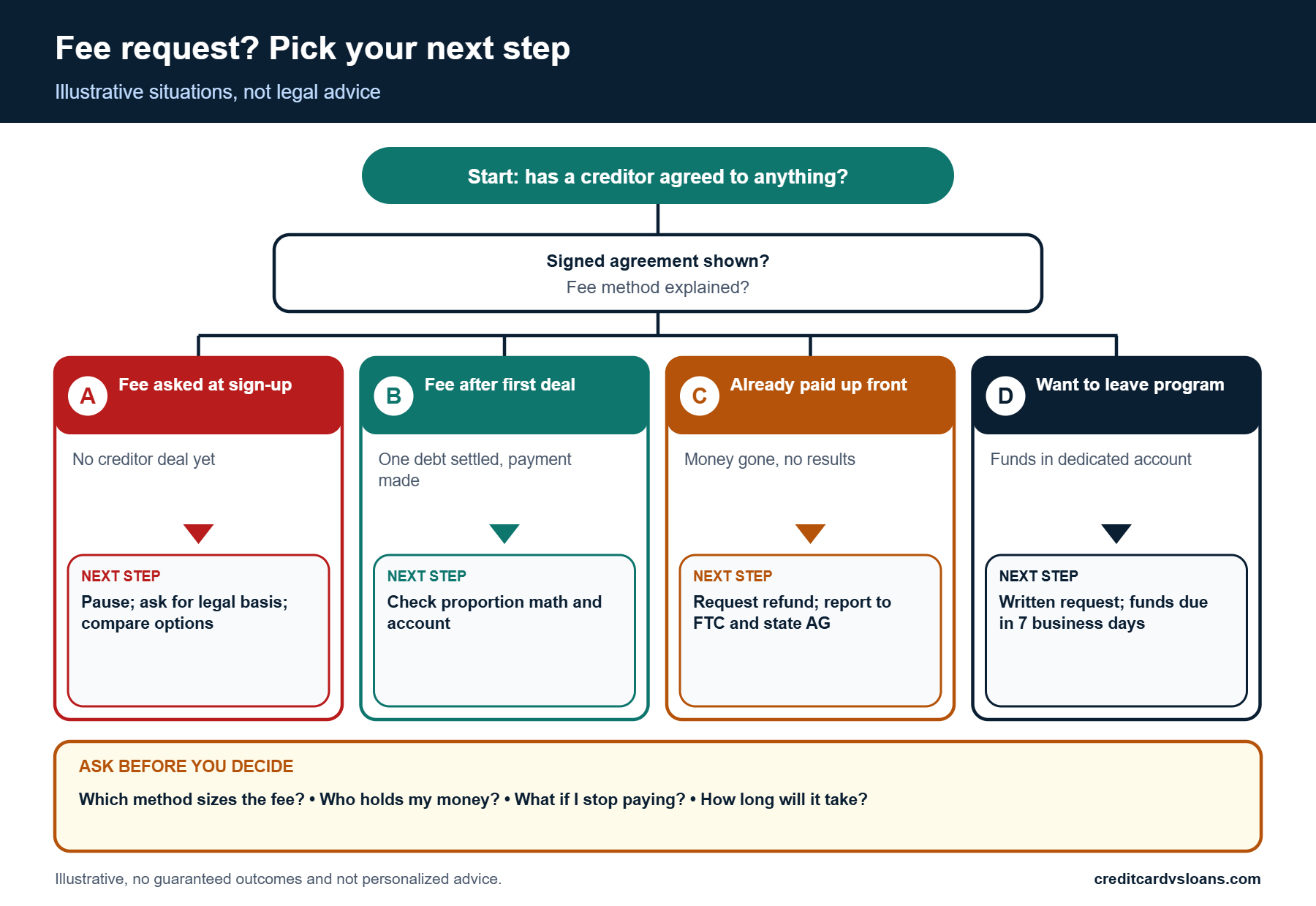
- Which debts will you settle, and do you have signed agreements? No agreement, no fee under the rule.
- Which method sizes your fee? Proportional or percentage of savings, with the math on paper.
- Who holds my money? An independent, insured account that you own.
- How do I leave, and how fast do I get funds back? Without penalty, within seven business days.
- What happens if I stop paying creditors? A clear written warning about credit, collections, lawsuits and the amount owed.
- How long will this take, and what must I save first? Specific numbers before you enroll.
- Is there any fee before a result? If yes, ask for the legal basis and walk away if you do not get one.
A seller that answers calmly, in writing, and gives you time to decide is behaving differently from one that pushes for a same-day signature.
If you already paid an upfront fee
Stop further payments, gather documents, and ask in writing for a refund and an accounting of every fee. Report the company to the FTC and your state attorney general, and consider contacting the CFPB. Ask your bank or card issuer about dispute options, and check your credit reports for accounts you did not authorize.
Results vary and nothing here is a guarantee of recovery. A consumer attorney or legal aid office can tell you what remedies may exist in your state.
Questions people still ask
Does the ban apply if I called the company first?
The rule’s scope turns on how the sale was made and whether it fits the definition of telemarketing, which involves phone contact across state lines and a plan to induce a purchase. Whether a call that you initiated is covered can depend on the specifics, so avoid assuming either way. The safer approach is to expect no fees before results regardless of who dialed first, and to ask a consumer attorney if a company insists the rule does not apply to you.
State law may apply in addition to federal rules. Your state attorney general’s office can tell you what is required where you live.
Are lawyers and bankruptcy attorneys covered by the same ban?
Attorneys who represent you in a bankruptcy case are doing a different job than a company that negotiates your unsecured debts for a fee, and fee rules for lawyers come from court and state bar rules. The CFPB says some bankruptcy attorneys offer a free initial consultation. If someone calls themselves a law firm but runs a settlement program, ask who your attorney is and how fees are earned.
Whatever the label, apply the same questions: what result, what agreement, what fee, and when.
What if a creditor sues while I am in a program?
Do not ignore a lawsuit. Respond within the deadline stated on the court papers and seek help from a legal aid office or consumer attorney. The CFPB warns that stopping payments can lead to lawsuits, and the FTC’s rulemaking record documents that creditors sued many consumers in earlier programs.
Tell the company about the lawsuit in writing, but do not rely on it alone to protect you. You remain responsible for responding to the court.
If you are already enrolled in a program
An account review you can do this week
Request a written accounting from the company: every fee charged, the date, the debt it relates to, and the status of each negotiation. Compare it with your own bank statements and with the dedicated account statements, which you are entitled to see because you own the funds. Look for fees taken before any signed creditor agreement.
Then check your credit reports and your creditors’ statements to see which accounts have settled, which are delinquent and which have been sent to collectors. The picture may differ from what the company has told you, and the differences are what you will want to raise.
Deciding whether to stay or leave
Leaving is allowed without penalty under the rule’s dedicated-account provision, with funds due back within seven business days other than amounts the service has legitimately earned. Before you leave, consider what your accounts look like: if several are well past due, a nonprofit counselor or bankruptcy attorney can help you weigh a plan, a negotiation or a court option.
If you stay, ask for a revised timeline and a statement of which debts will be addressed first. Nothing in this guide can tell you the right choice for your account, but a calm, documented review makes a good decision more likely.
Conclusion and next steps
The bottom line
For telemarketed debt relief, the federal rule ties any fee to a real, signed result and a payment you have made, limits how the fee is sized, and keeps your money in an account you own. A company that wants money first is outside that framework.
Use the rule as your filter, but do not mistake it for a price guarantee. Even a compliant fee can cost more than a nonprofit plan, a direct negotiation or a lower-rate loan, so compare before choosing.
Your concrete next steps
- Pause any enrollment and ask the company for its fee schedule, contract and disclosures in writing.
- Check the company with your state attorney general and look for FTC or CFPB enforcement news.
- Call your issuer about a hardship plan and ask a nonprofit counselor for a fee quote.
- Price a lower-rate consolidation loan or transfer, using prequalification where available.
- If you were asked to pay first, report it at ReportFraud.ftc.gov and keep your records.
For help telling the lawful from the predatory, read predatory lending warning signs in loans and debt relief offers.
- Predatory Lending: Warning Signs in Personal Loans and Debt Relief Offers
- Credit Card Debt Relief: Legitimate Options and Red Flags
- Personal Loan for Debt Consolidation: When It Can Save Money
- Does Rate Shopping for a Personal Loan Hurt Your Credit?
- Credit Card Debt Consolidation With Bad Credit: Realistic Options
- eCFR: 16 CFR 310.4 Abusive telemarketing acts or practices (Advance-fee ban, 310.4(a)(5))
- eCFR: 16 CFR 310.3 Deceptive telemarketing acts or practices (Debt relief disclosures and misrepresentations)
- eCFR: 16 CFR 310.2 Definitions
- Federal Register: Telemarketing Sales Rule, final rule amendments (75 FR 48458, Aug. 10, 2010)
- FTC: Debt Relief Service and Credit Repair Scams
- FTC: Credit card debt relief isn’t
- FTC: Coping with Debt
- CFPB: What is a debt relief program and how do I know if I should use one?
- CFPB: What is credit counseling?
- CFPB: CFPB takes action against Global Client Solutions for processing illegal debt settlement fees (Announced Aug. 25, 2014)
- CFPB: CFPB takes action against debt relief business and its owner taking illegal advance fees (Announced Nov. 5, 2020)
- IRS: Topic no. 431, Canceled debt: Is it taxable or not?
Last updated: October 22, 2026. Rates, fees and lender rules change; verify current terms before acting.
The information on creditcardvsloans.com is provided for general educational and informational purposes only. It is not financial, legal, tax, credit, accounting or investment advice, and reading it does not create an advisor-client, fiduciary or any other professional relationship. Nothing here is an offer, solicitation or recommendation to borrow, lend or apply for any product.
Credit scores, interest rates, fees, eligibility rules, lender policies and laws change frequently and vary by lender, location and individual circumstances. Examples, figures and scenarios are illustrative only, do not predict your results and do not guarantee approval, savings, a particular rate or a credit-score outcome. Always confirm current terms directly with the lender or issuer and read the full agreement before you apply or sign.
Although we aim for accuracy and use reputable sources, we make no representations or warranties, express or implied, about the completeness, accuracy, reliability or timeliness of the content. Content may be drafted with the assistance of automated tools, so errors or omissions may still occur. Links to third-party sites are provided for convenience; we don’t control and aren’t responsible for their content.
To the fullest extent permitted by law, creditcardvsloans.com and its owners, editors, authors, contributors and affiliates disclaim all liability for any loss, damage or expense arising directly or indirectly from your use of, or reliance on, this content. Before making financial decisions, consult a licensed professional, such as a qualified financial advisor, attorney, tax professional or nonprofit credit counselor, who can consider your complete situation.