
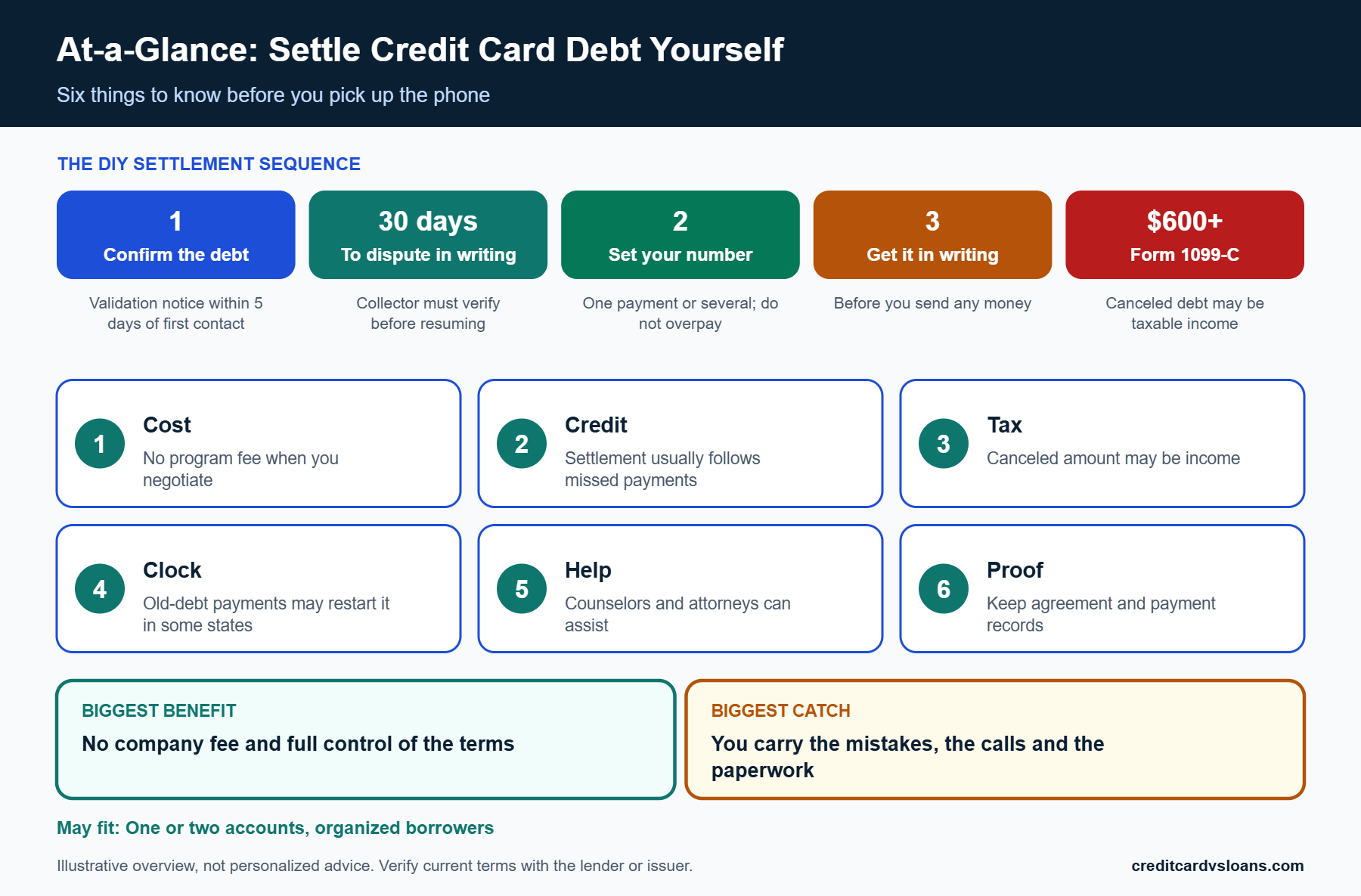
Yes, you can settle credit card debt yourself, and it costs nothing in program fees. The FTC says settling on your own is possible, and the CFPB lays out the basic steps: confirm the debt, work out what you can realistically pay, make a proposal, and get everything in writing before you send money. What matters is doing those steps in the right order.
The do-it-yourself route has trade-offs. You carry the risk of mistakes, such as paying on a verbal promise or restarting the clock on an old debt, and you still face the credit and tax consequences of any settlement. This guide focuses on the negotiation itself: how to prepare, who you are talking to, how to structure an offer and how to protect yourself once you have a deal.
For a full account of settlement’s costs, see our guide to credit card debt settlement risks, taxes and credit damage. For the wider menu of options, see credit card debt relief: legitimate options and red flags.
- You do not need a settlement company. The CFPB describes direct negotiation as a few clear steps, and a nonprofit credit counselor or attorney can help if you want support.
- Confirm the debt first. A collector must provide information about the debt, generally in writing, within five days of first contacting you, and you can dispute it in writing within 30 days of that notice.
- Decide your number before you call. Choose the total you can pay in one payment or several, and do not pay more than you can afford.
- Get the agreement in writing before you pay. A payment without written terms can leave a remaining balance in dispute.
- A settled balance may be taxable income and the account may leave negative marks on your reports for years.
Steps and rights described here come from CFPB, FTC and IRS pages as they read in October 2026. State law can change who can sue, when, and what a payment does to an old debt, so use this as a framework and check your state’s rules for anything time-sensitive.
Table of contents
Can you settle credit card debt yourself? The short answer and the conditions
What do-it-yourself settlement involves
Negotiating directly, with no middleman
Settling on your own means you contact the creditor or collector, propose a payment that resolves the account, and agree on written terms. Nothing in the process requires a third party, and the CFPB notes you may have more room to negotiate with a collector than with the original creditor. The FTC’s own debt guide says that settling on your own is possible and that you should get any agreement in writing.
A direct deal also avoids the for-profit program model the FTC describes, in which you save in a dedicated account while accounts go unpaid. Without a company, there is no program fee to pay, though you also have no one handling the calls for you.
What you give up compared with a company
The main thing you give up is convenience. You handle the calls, keep the records and meet the deadlines. In exchange you avoid fees that the FTC rule allows companies to charge once a debt is settled, and you avoid the risk of a provider that over-promises.
The CFPB cautions that some settlement companies promise more than they can deliver and often cannot settle the debt. If you are willing to make the calls, the direct route is usually the lower-cost way to try.
When it makes sense, and when it does not
Situations that suit a direct negotiation
Direct settlement fits best when you have a lasting hardship, an account that is already delinquent or charged off, and a lump sum or a short stream of payments you can commit to. It also suits people who are organized enough to track documents and deadlines.
It can work for one or two accounts. With many accounts and many collectors, the workload multiplies, and a nonprofit counselor may be a better first step.
Situations where another route is better
If you are current and mainly want a lower payment, ask your issuer about a hardship plan first. The FTC lists that as its opening suggestion for card debt. If the debt may be time-barred, speak with an attorney or legal aid office before paying anything, because in some states a payment can restart the clock.
And if a lawsuit has already been filed, do not rely on a phone negotiation alone. Respond to the court papers by the deadline, as the FTC warns that ignoring a lawsuit can lead to a judgment and garnishment.
| Question | Settle it yourself | Settlement company | Nonprofit counselor |
|---|---|---|---|
| Upfront cost | None | Not allowed before a qualifying settlement | Ask for a written fee quote |
| Who negotiates | You | The company | Counselor works with creditors on a plan |
| Reduces what you owe? | Possible, not guaranteed | Possible; often cannot settle every debt | Usually lowers cost, not principal |
| Main risk | Mistakes, unwritten promises | Stop-paying advice, fees, lawsuits | Creditors may not accept the plan |
| Best for | One or two accounts; organized borrowers | Many accounts; lasting hardship | Steady income; several cards |
Before you call: confirm the debt and know your numbers
Confirm what you actually owe
Use your validation rights
The FTC says a collector must send a written validation notice within five days of first contacting you, stating the amount owed, the creditor’s name and how to dispute the debt. If you dispute it in writing within 30 days of receiving the notice, the collector must provide verification, such as a copy of a bill, before it resumes collection.
Use that notice to check the amount, the original creditor and the account number. If anything is wrong, say so in writing before you negotiate. A debt that is not yours or is overstated is not one you want to settle.
Gather the account history
Collect your last statements, the date of your last payment, any letters from the creditor or collector, and your credit reports. The date of your last payment matters because, as the FTC explains, the statute of limitations usually starts at the first missed payment and the rules vary by debt type and state.
If you are not sure whether an account is old enough to be time-barred, read our guide to the credit card debt statute of limitations before you make any payment or written acknowledgment.
Decide what you can pay
Build a budget with room for emergencies
The CFPB advises listing monthly take-home pay and expenses and deciding what you can pay without leaving yourself short for emergencies. Falling behind on other bills while resolving this debt can create bigger problems, so do not drain your rent or utility money for a settlement.
A nonprofit credit counselor can help build the budget and even work with collectors, according to the CFPB. If you feel stuck, that is a good free first appointment.
Set your offer and your limit before the call
The CFPB tells you to decide the total you are willing to pay, whether in one payment or several, and not to pay more than you can afford. Settle on an opening figure and a walk-away figure in advance, so the pressure of a live call does not decide for you.
No percentage is standard, and the amount a creditor will accept depends on the account, the creditor and what you can offer, so any quoted range is a guess. Let the lender’s response, not a rumor, set your expectations.
Who you are negotiating with: issuer, collector or attorney
The original creditor
Early in the delinquency
When an account is only a few months behind, you are usually dealing with the card issuer’s own collections or hardship team. The FTC suggests contacting creditors early, before a collector gets involved, explaining your situation and proposing a payment plan you can manage. It notes creditors may accept less than the full balance.
At this stage, a hardship plan may be easier to get than a settlement, and it keeps the account in better standing. If the issuer will not discuss a reduced payoff, ask what hardship options exist and how each would be reported.
After a charge-off
The FTC says an issuer may charge off a debt after four to six months of missed payments and may sell it to a collector, but you still owe it and creditors may still negotiate. The issuer may keep the account in-house or transfer it, so ask who currently owns it before you make an offer.
If the account has been sold, the original issuer may no longer be able to settle it, and the new owner will set the terms. Get the owner’s name and address in writing.
Collection agencies and debt buyers
Know their obligations
The FTC’s FAQ says collectors cannot harass you, lie about the amount owed, pose as attorneys or government officials, falsely threaten arrest or legal action, or add interest or fees not allowed by the contract or state law. The CFPB adds that the Fair Debt Collection Practices Act bans repeated or continuous calls meant to harass, oppress or abuse you.
If a collector breaks these rules, you can report it to your state attorney general, the FTC or the CFPB. The FTC says you can also sue within one year of a violation.
Stopping the calls in writing
You can stop a collector from contacting you by sending a letter. The FTC advises keeping a copy and considering certified mail with a return receipt. After the collector receives it, it may contact you only to confirm it will stop or to tell you about a specific action, such as a lawsuit.
That is useful if the calls are overwhelming, but it also ends the easy back-and-forth of a negotiation. If you want to settle, communicate in writing so you build a record.
Making the offer: negotiation basics that hold up
Structuring the proposal
Lump sum or installments
The CFPB says you can propose a payment in full or a repayment plan, and that a single payment or a series of smaller payments can both settle a debt. Creditors often respond more readily to a lump sum, but that is a general pattern, not a rule, and an installment plan you can truly afford beats a lump sum you cannot.
Whatever structure you choose, specify the amount, the dates and what the payment resolves. Vague promises such as “we’ll work something out” do not help you later.
Tell them which debt the payment covers
If you owe the same collector more than one debt, the CFPB says you can tell it which debt a payment should apply to. It adds that collectors cannot apply one payment across multiple debts that you are disputing.
Say which account the offer addresses, and have the written agreement list the account number. Without that, a payment could be applied somewhere you did not intend.
Conversation basics
Explain the hardship, then stay factual
The CFPB suggests explaining your financial situation as part of the proposal. A short, honest description of what changed and what you can pay is more useful than a long story. Keep the focus on the numbers and the date.
Take notes during each call: date, time, name, what was said and what was promised. Ask the representative to email or mail the terms. If they cannot or will not, pause the negotiation until you have something in writing.
Be cautious about account access
Avoid giving a collector ongoing access to your bank account. A one-time payment you initiate yourself, with proof, gives you more control than an open-ended authorization. The FTC notes collectors cannot deposit post-dated checks early, but you are safest when you control the timing.
Do not share information with callers whose identity you cannot confirm. The FTC advises verifying who is on the line before giving personal or financial details.
| Structure | How it works | Strength | Watch for |
|---|---|---|---|
| Lump sum | One payment resolves the account | Clean end date; often easier to agree | You need the cash on hand |
| Short installments | A few payments over weeks or months | Fits tighter cash flow | A missed payment may void the deal |
| Hardship plan | Lower rate or payment while you pay the balance | Keeps account in better standing | Terms vary; the balance remains |
| Payment on a possibly time-barred debt | Any payment or acknowledgment | None until you check state law | Can restart the clock in some states |
Getting it in writing and paying safely
What the written agreement should say
The essentials
The CFPB says to get the plan and the collector’s promises in writing before you make any payment, including promises to stop collection efforts and to end or forgive the debt once you finish the plan. The FTC adds that, when settling an old debt, you should get a signed statement that the payment fully resolves the debt before paying, and keep records.
A solid letter names the account, the current owner, the amount and due dates, states that payment resolves the debt in full, and says that no remaining balance will be sold, collected or reported as owed.
Reporting and tax language
Ask how the account will be reported to the credit bureaus and whether the creditor expects to file a Form 1099-C. Neither question guarantees a particular answer, but asking puts it on the record and helps you plan for the tax season ahead.
The CFPB page on negotiating does not address credit reporting or tax effects, so these items are not covered by the standard script and are easy to overlook.
Paying and keeping proof
Choose a traceable method
Pay in a way that creates a record: a bank transfer or check you send yourself, rather than an arrangement that lets the other side pull funds on its own schedule. Write the account number and the words “payment in full per agreement dated” on the payment where possible.
Keep the confirmation. If a bank transfer is used, save the transaction record next to the agreement.
Keep everything for years
File the agreement, the payment proof and any follow-up letter in one place and keep them indefinitely. Debts get sold, files get lost and the same account can resurface years later. A paper trail is how you show the account was resolved.
Check your credit reports a few months afterward to confirm that the entry matches the terms. If it does not, dispute it with the bureau and send the creditor your documentation; the FTC says disputing genuine errors costs nothing.
What a DIY settlement costs: money, credit and taxes
The money and credit side
The payment itself
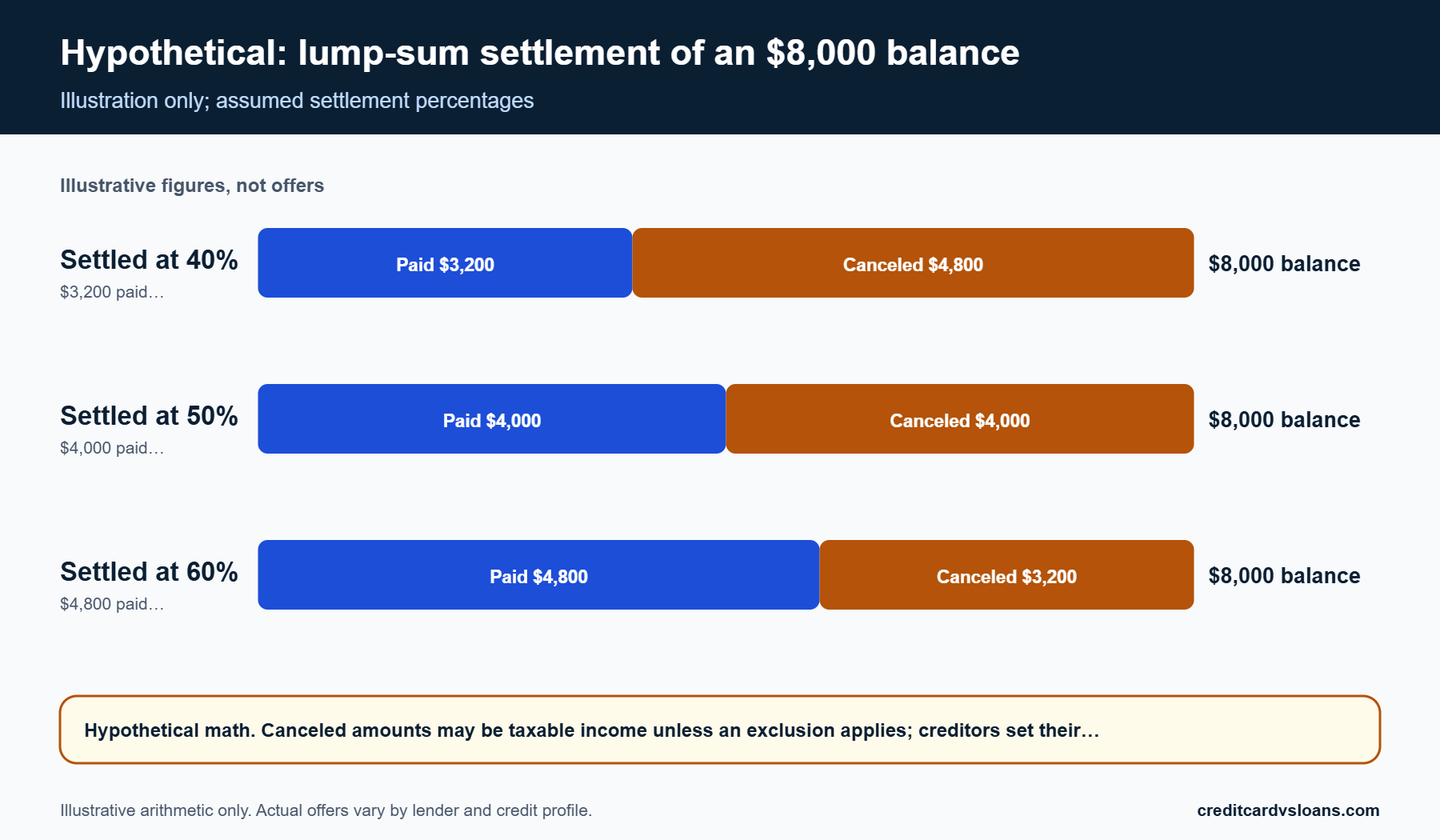
Without a company, your cost is the settlement payment, plus whatever interest and fees accumulated before the deal. The hypothetical chart below shows how a lump-sum settlement changes the split between what you pay and what is canceled on an $8,000 balance. It is an illustration of arithmetic, not a prediction of what any creditor will accept.
The credit effect
Settlement usually follows missed payments, which are the most damaging part for payment history. The CFPB says most negative information can generally be reported for seven years. It does not say whether paying or settling a collection shortens that period, so avoid assuming it does.
No result is promised either way. Ask the creditor how it will report the account, and plan on rebuilding with on-time payments afterward.
The tax side
Canceled debt can be income
The IRS says canceled debt is generally taxable ordinary income, reported for the year it was canceled, and a creditor that cancels $600 or more generally files Form 1099-C. In Publication 4681’s example, paying $400 on a $1,000 debt leaves $600 canceled.
So in the hypothetical chart, a settlement at 50 percent of $8,000 leaves $4,000 canceled, and that amount may be taxable unless an exclusion applies.
Insolvency may help
If your liabilities exceeded the fair market value of your assets immediately before the cancellation, the IRS insolvency exclusion may remove some or all of the canceled amount from income, and you claim it on Form 982. The IRS counts all assets, including retirement accounts, in that comparison.
Our guide to credit card settlement taxes and credit damage walks through the IRS’s worked examples. A tax professional can apply them to your return.
The risks of going it alone
Legal risks
Lawsuits while you negotiate
A creditor can sue while talks are underway, and a pending conversation does not stop a court deadline. The FTC says to respond to a lawsuit by the court deadline, personally or through an attorney, because ignoring one can lead to a judgment and garnishment. A judgment can also lead to a lien on your home according to the FTC’s description of settlement risks.
If you receive court papers, treat them as the priority. An attorney or legal aid office can tell you whether defenses apply, and you can still try to settle the case in parallel.
Old debts and the clock
The FTC explains that the statute of limitations limits how long a collector can sue, that once it expires the debt is time-barred, and that in some states a payment or written acknowledgment restarts the clock. In some states even a partial payment or a promise to pay can revive the debt, opening the door to a lawsuit for the full amount.
That makes the first payment on an old account the riskiest one you will make. Read the credit card debt statute of limitations guide, check your state’s rule and consider a short consultation before you pay. If you are sued on a time-barred debt, the FTC says to respond anyway and tell the judge it is time-barred.
Practical and scam risks
Verbal promises that never get written
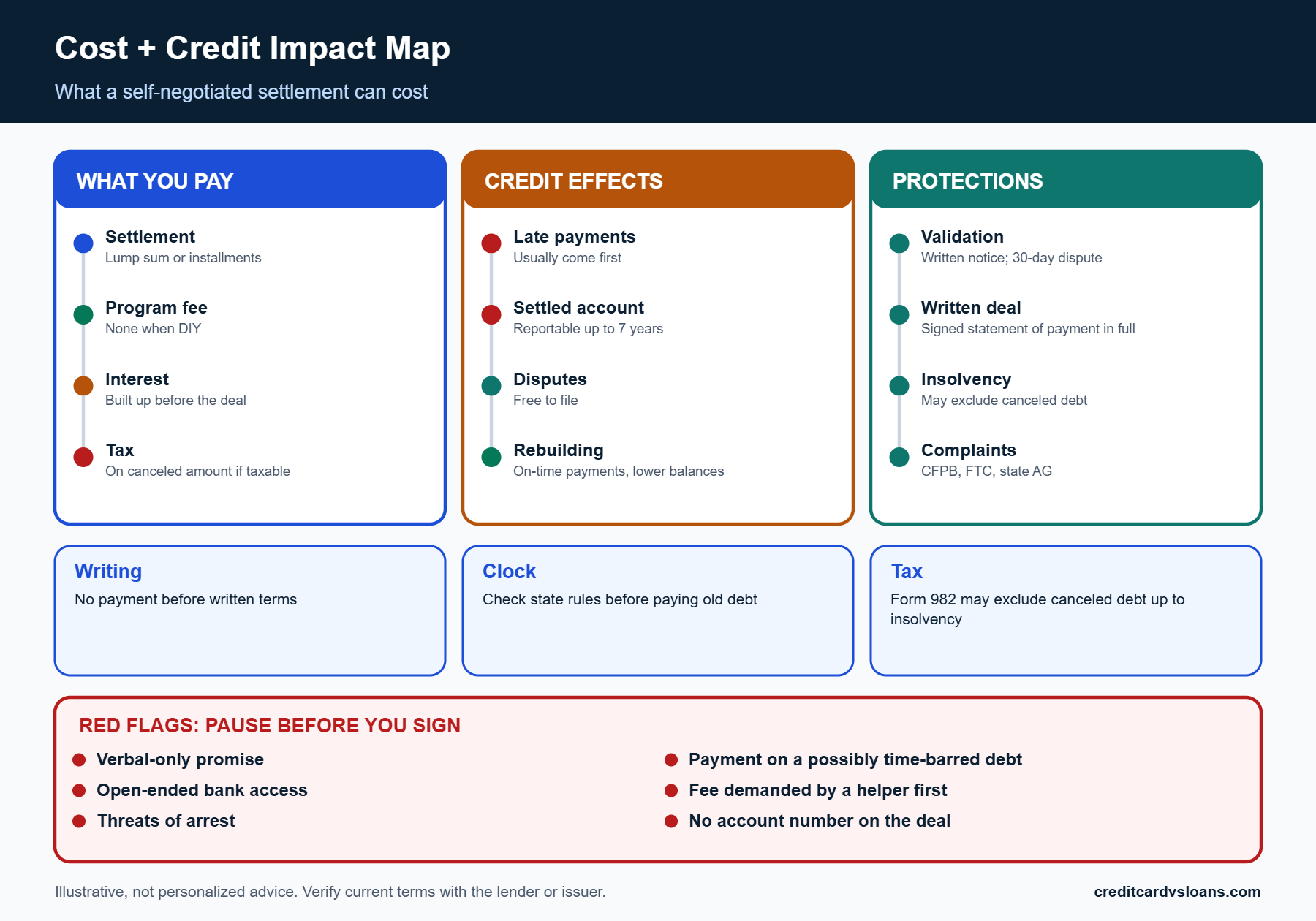
The most common failure in DIY deals is a verbal agreement that the other side later denies. The CFPB’s and FTC’s advice is the same: get the terms in writing before you pay. If a representative says paperwork will follow after the payment, politely decline and wait for the letter.
Keep your copy, and compare it to what you were told on the phone. If they differ, resolve the difference before sending money.
Lookalike offers and “settlement helpers”
Once you start searching or answering collection calls, you may attract offers from companies promising to do the negotiating for a fee. The FTC says anyone who asks you to pay before any debts are settled, or who promises to settle all your debts, is a scammer. Our guide on credit card debt forgiveness: what is real and what is a scam covers the scripts to expect.
If you decide to use a company anyway, the FTC rule bars covered providers from charging before a debt is settled, you agree and you pay. Our overview of credit card debt relief options and red flags shows how to compare providers against free routes.
Cost risks that surprise people
Paying more than you can afford
The CFPB’s warning not to pay more than you can afford is easy to read past. A settlement funded by skipping rent, borrowing from a retirement account or taking a high-cost loan can turn one problem into several. Before committing, check that the payment leaves room for essentials and for an emergency.
If the number is out of reach, an installment arrangement or a counselor-managed plan may be better than an offer you cannot keep. A broken settlement can put you back at the start with less money.
Ignoring the tax and credit side
A discount that looks large can shrink once you account for tax on the canceled amount and the credit effect of the settled account. The IRS says canceled debt is generally taxable unless an exclusion such as insolvency applies, and the CFPB says most negative information can be reported for seven years.
Build those into the comparison from the start, using the hypothetical chart above as a template for your own numbers.
One more cost is time. Collections calls, document requests and follow-up letters can take weeks, and the FTC notes that settlement in general can take years. Decide how much time you can give it before you start, and ask a nonprofit counselor for help if the workload feels like too much.
None of these costs is a reason to avoid negotiating. They are reasons to price the whole path before you promise a number to anyone.
What to say on the call, and what to avoid saying
Opening the conversation
A simple structure for the first minute
Start by identifying the account and asking for the current balance and who owns the debt. Then say you want to resolve it and describe, briefly, what changed in your finances. Keep it short and calm. You are not apologizing for the debt, and you are not asking for charity; you are proposing a transaction that may be better for the creditor than waiting.
Ask what resolution options exist before naming a number. The CFPB suggests that you may have more room to negotiate with a collector than with the original creditor, so listening first can reveal how flexible the other side is.
Making the number land
When you propose a figure, tie it to a specific payment date and ask for the terms in writing. A line such as “I can pay this amount by this date if you confirm in writing that it resolves the account in full” keeps the focus on the agreement, not on the discount.
If the first answer is no, ask what the lowest acceptable amount would be and whether a later date or installments would change it. Do not raise your own number to fill a silence; the CFPB advises not paying more than you can afford.
Handling pressure and pushback
Deadlines, threats and “this offer expires today”
Pressure is common, and some of it crosses legal lines. The FTC says collectors cannot lie about the amount owed, pose as attorneys, or falsely threaten arrest or legal action. A real settlement offer is still real tomorrow, and a written offer is a reason to take a day to read it.
If a representative threatens something that sounds unlawful, end the call politely, write down what was said, and consider reporting it to the CFPB, the FTC or your state attorney general.
Statements to avoid
Avoid saying that the debt is yours or that you will pay it if you are unsure whether it is valid or time-barred, because in some states an acknowledgment can restart the clock. Do not agree to a payment date you cannot meet. And do not promise to pay “as soon as possible,” which sounds like an acknowledgment without being a plan.
Instead, stick to factual statements: what you can pay, when you can pay it and what you need in writing. If you are unsure whether a statement helps or hurts, wait and ask a counselor or attorney.
Deciding between going it alone and getting help
When DIY is a reasonable fit
Signals that you can handle it
You are organized, have one or two accounts, can set a firm budget and offer, and are comfortable asking for terms in writing. You also have time for calls and can tolerate a no. In that case, DIY costs the least and gives you the most control.
Start with the issuer if the account has not been sold, and move to a collector only if the issuer cannot help.
Signals to bring in a professional
If you are facing a lawsuit, if the account may be time-barred, if multiple collectors are involved or if the tax effect could be large, a nonprofit counselor or attorney is worth the time. The CFPB says a credit counselor or attorney can help negotiate.
The CFPB recommends confirming any counseling organization with your state attorney general, and the FTC suggests asking about fees and written quotes in advance.
Mapping your situation to a next step
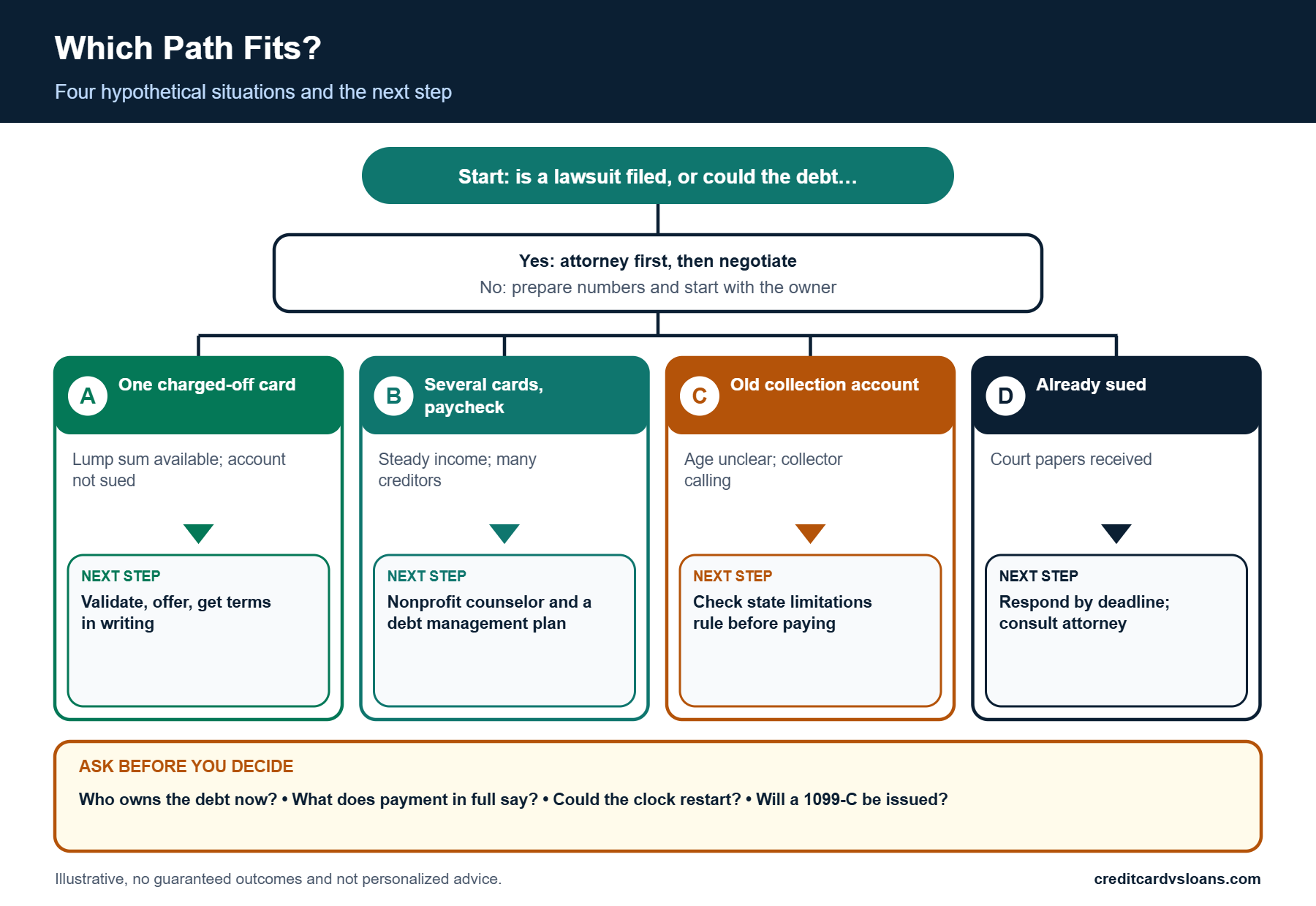
Four hypothetical situations
A borrower with one charged-off card and a lump sum may be a candidate for direct settlement. A borrower with five cards and a steady paycheck is more likely to benefit from a counselor and a debt management plan. A borrower with an old collection account of uncertain age should check the statute of limitations first. A borrower who has been sued should prioritize the court response.
Table 3 turns those into a quick guide, with the caveat that it is general information and not personal advice.
| Scenario | Next step to investigate | Why | What to confirm | When to avoid it |
|---|---|---|---|---|
| One charged-off card, lump sum available | Direct settlement | Simple; no program fee | Current owner; written terms; tax effect | If the debt may be time-barred |
| Several cards, steady income | Nonprofit counseling and a DMP | Lower rates without a forgiven amount | Creditors accepted the plan | If a counselor pushes it without a review |
| Old collection account, age unclear | Check state limitations rules first | A payment may restart the clock | Last payment date; validation notice | Do not pay or acknowledge before checking |
| Already sued | Respond to court; consult attorney | Deadlines are strict | Court date; defenses | If you plan to rely on phone talks alone |
| Offer from a company wanting money first | Decline and report | Matches FTC scam signs | Independent lookup | Always |
How to use the matrix without over-reading it
The table is a starting point for questions, not a verdict. Two borrowers with the same balance can land on different rows because of their state, the age of the account, who owns the debt and what they can pay. Use the matrix to decide which conversation to have first, then confirm the specifics with the creditor, a counselor or an attorney.
If more than one row fits, begin with the option that keeps the most credit intact and costs the least, and move down only if it does not work. Keep notes on each attempt, since a failed first approach still teaches you what the creditor will and will not do.
Remember that a settlement is a one-way door. Once you pay and the account is resolved, you cannot return to a hardship plan on that account. That is another reason to compare before acting.
After the settlement: reports, records and rebuilding
Checking that the deal was honored
Review your credit reports
A few months after payment, pull your credit reports and look at how the account appears. The balance, status and dates should match the written terms. The CFPB says credit reporting companies must follow reasonable procedures to ensure accuracy, and that you can dispute errors yourself at no cost.
If the account is wrong, file a dispute with the bureau and send the creditor your agreement and proof of payment. Keep copies of everything you send.
Watch for tax forms
If the creditor cancels $600 or more, it generally sends a Form 1099-C. The IRS says to contact the creditor if the form is wrong, and that you remain responsible for reporting the correct amount even then. Put a reminder on your calendar for tax season so the form does not surprise you.
If you were insolvent, gather your records of assets and liabilities from around the cancellation date to support Form 982.
Rebuilding
Healthy habits after a deal
Credit recovers through time, on-time payments and lower balances. The FTC lists paying bills on time, reducing debt, avoiding new debt and disputing genuine errors as the legitimate steps, and warns that anyone offering to remove accurate negatives for a fee is not being honest.
Build a small emergency cushion if you can, so a future shortfall does not return to the cards. Even a modest buffer reduces the chance of another round of missed payments.
Where public programs fit
Some people hope a public program will cover what a settlement cannot. Our guide to government debt relief programs for credit card debt explains what exists and what does not, so you can rule options in or out without paying anyone to apply for you.
If an offer claims to be a special program for card debt and asks for a fee, the FTC and CFPB treat that as a scam signal.
Checklist and next steps to settle credit card debt yourself
Your preparation checklist
Before the first call
- Request written validation and confirm the amount, the creditor and the current owner.
- Note the date of your last payment and check your state’s statute of limitations.
- Build a budget, decide your opening offer and your walk-away number, and know how you will fund it.
- Decide whether to ask a nonprofit counselor or attorney to review your plan first.
Ten minutes of preparation can prevent the mistakes that cost the most later.
During and after the call
- Take notes, ask for the offer in writing and do not pay until you have it.
- Confirm the account number, the amount, the payment dates and that payment resolves the debt in full.
- Ask how the account will be reported and whether a Form 1099-C will be issued.
- Pay in a traceable way, save the proof and check your reports a few months later.
If anything on the call feels pressured, end it politely and call back after reading the terms.
What to do this week
Three practical moves
Pick one account and start there. Get the validation notice, find the date of your last payment and decide the most you can pay. Then contact the creditor or collector in writing or by phone, with a note-taking plan in place.
In parallel, schedule a free or low-cost session with a nonprofit credit counselor, and look up any company that has contacted you. If an offer asks for money before settling a debt, report it at ReportFraud.ftc.gov.
The bottom line
You can settle credit card debt yourself, and doing it directly avoids program fees. The work is in the preparation: confirm the debt, set your number, check whether the clock is a risk, and get the terms in writing before you pay. Remember that a settlement can still carry credit damage and a possible tax bill, and bring in a counselor or attorney when a lawsuit, an old debt or a large balance is involved.
- Credit Card Debt Settlement: Risks, Taxes and Credit Damage
- Credit Card Debt Relief: Legitimate Options and Red Flags
- Credit Card Debt Forgiveness: What Is Real and What Is a Scam?
- Credit Card Debt Statute of Limitations: What It Means and What It Doesn’t
- Government Debt Relief Programs for Credit Card Debt: What Exists and What Doesn’t
- CFPB: How do I negotiate a settlement with a debt collector?
- CFPB: What is credit counseling?
- CFPB: How long do negative items remain on my credit report?
- FTC: Debt collection FAQs
- FTC: How to Get Out of Debt (FTC publication, December 2025)
- FTC: Looking for debt relief? Here is how to avoid a scam (FTC Consumer Alert, March 2026)
- FTC: Debt Relief Services and the Telemarketing Sales Rule: A Guide for Business
- IRS: Topic no. 431, Canceled debt: Is it taxable or not?
- IRS: About Form 1099-C, Cancellation of Debt
- IRS: Publication 4681, Canceled Debts, Foreclosures, Repossessions, and Abandonments
- IRS: Instructions for Form 982
Last updated: October 22, 2026. Rates, fees and lender rules change; verify current terms before acting.
The information on creditcardvsloans.com is provided for general educational and informational purposes only. It is not financial, legal, tax, credit, accounting or investment advice, and reading it does not create an advisor-client, fiduciary or any other professional relationship. Nothing here is an offer, solicitation or recommendation to borrow, lend or apply for any product.
Credit scores, interest rates, fees, eligibility rules, lender policies and laws change frequently and vary by lender, location and individual circumstances. Examples, figures and scenarios are illustrative only, do not predict your results and do not guarantee approval, savings, a particular rate or a credit-score outcome. Always confirm current terms directly with the lender or issuer and read the full agreement before you apply or sign.
Although we aim for accuracy and use reputable sources, we make no representations or warranties, express or implied, about the completeness, accuracy, reliability or timeliness of the content. Content may be drafted with the assistance of automated tools, so errors or omissions may still occur. Links to third-party sites are provided for convenience; we don’t control and aren’t responsible for their content.
To the fullest extent permitted by law, creditcardvsloans.com and its owners, editors, authors, contributors and affiliates disclaim all liability for any loss, damage or expense arising directly or indirectly from your use of, or reliance on, this content. Before making financial decisions, consult a licensed professional, such as a qualified financial advisor, attorney, tax professional or nonprofit credit counselor, who can consider your complete situation.