Debt consolidation vs debt settlement is not a close call between two flavors of the same help. Consolidation reorganizes what you owe and keeps your accounts in good standing, while settlement asks creditors to accept less than the full balance, usually after you have stopped paying them. The risks are different in kind, not just in degree.
That difference gets blurred in advertising, where both are called “debt relief” and both promise a lower monthly burden. A consolidation loan can lower your interest cost if you qualify, and you still repay every dollar of principal. A settlement program, by contrast, may leave unpaid accounts to grow with late fees and penalty interest while you save money for a possible deal that creditors are not required to accept.
This guide puts the two side by side on the things that decide outcomes: how each works, what can go wrong, what you pay and when, how your credit and taxes are touched, and which kind of borrower each tends to fit. It is general education and not personal advice, and your numbers will change the answer.
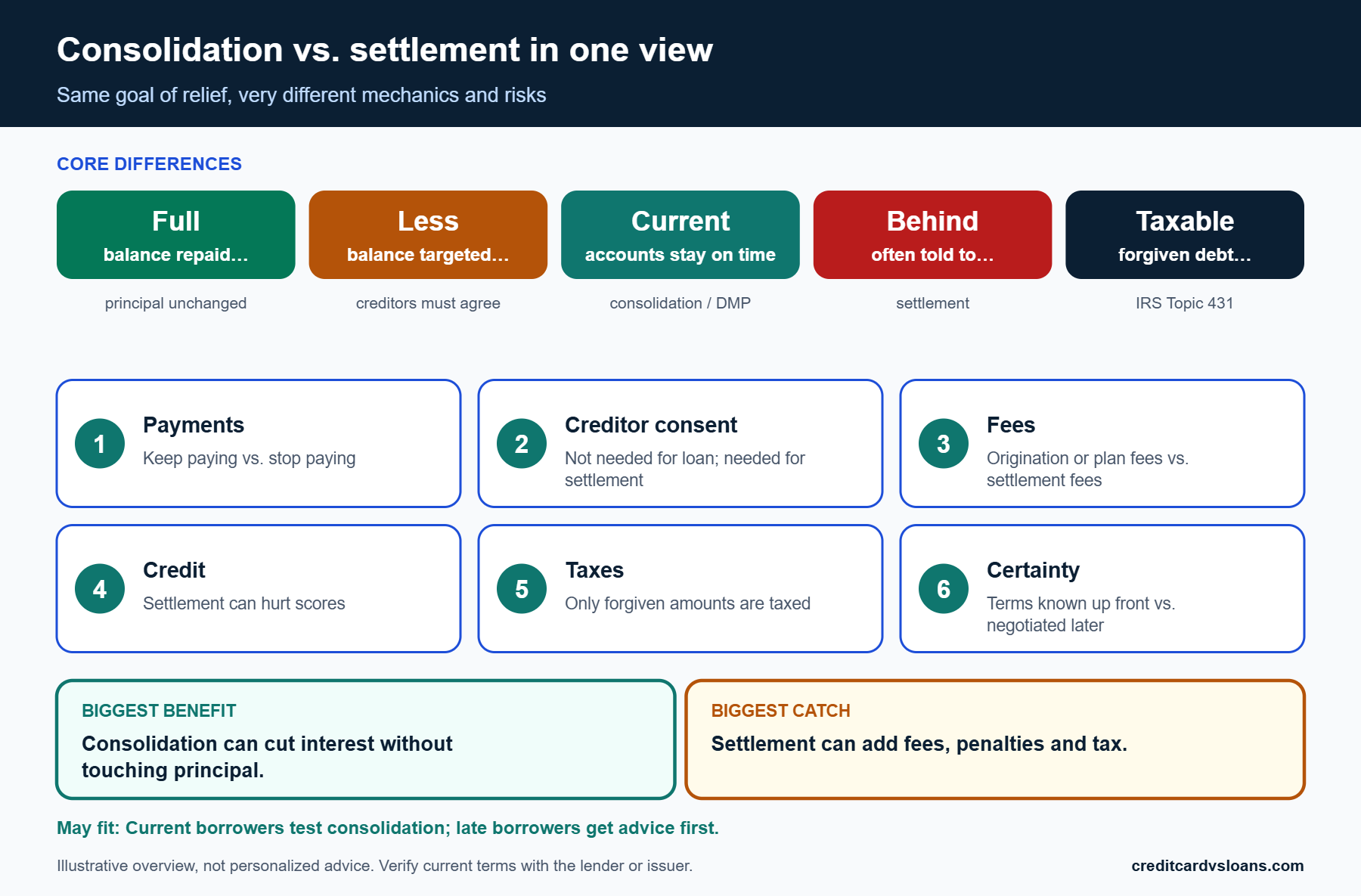
- Consolidation changes the structure of what you owe; settlement tries to change the amount. Only the second can leave you with a forgiven balance, and that balance may be taxable.
- Settlement usually involves stopping payments. The CFPB warns this can bring late fees, penalty interest, more collection activity and possibly lawsuits.
- Consolidation needs qualification. Approval, rates and fees vary by lender, and a consolidation loan or transfer only helps if the new cost is lower than what you pay now.
- For telemarketed debt settlement, upfront fees are barred. Under the FTC’s Telemarketing Sales Rule, a seller cannot take a fee until at least one debt has been settled and you have made a payment under the agreement.
- There is a middle path. A nonprofit debt management plan can consolidate payments without asking creditors for a reduction in principal.
Interest-rate context comes from the Federal Reserve’s G.19 release of October 7, 2026, which reports August 2026 data on a preliminary basis. Loan terms, fees and eligibility differ by lender and product, so treat the illustrations as hypothetical and confirm real terms before you commit.
Table of contents
Debt Consolidation vs Debt Settlement: The Core Difference
Restructuring versus paying less
What consolidation actually changes
Debt consolidation combines several balances into one, typically through a personal loan, a balance transfer card or a structured payment plan. The amount you owe stays the same. What changes is the interest rate, the payment schedule and the number of due dates you track. How debt consolidation works covers the mechanics in detail.
Because you keep paying on time, your accounts remain current. That is the main reason its risks look different from settlement. The danger in consolidation is mostly about cost and behavior: fees that eat the savings, a rate that is not actually lower, or running the old cards back up after they are paid off.
What settlement is trying to do
Debt settlement aims to resolve a debt for less than the full balance. The CFPB describes settlement and relief companies as businesses that claim they can renegotiate, settle or change the terms of your debts with creditors or collectors. The FTC adds that these for-profit companies negotiate lump-sum payments below the full balance, and that you typically save money each month for 36 months or more while you wait.
The key phrase is “claim they can.” Creditors are not required to settle, the FTC notes, and firms often settle smaller debts first while interest keeps growing on larger ones. For the full risk list, see credit card debt settlement risks, taxes and credit damage.
Why the risks diverge
Staying current versus falling behind
The sharpest dividing line is payment status. Consolidation works when you continue to pay, while many settlement programs instruct you to stop paying creditors and funnel money into a savings account instead. The CFPB says that typically brings late fees, penalty interest and more collection activity, including possible lawsuits.
The 2010 rulemaking record behind the FTC’s debt relief rule describes the same concern: many providers told consumers to stop paying creditors without clearly disclosing that failing to pay may increase what they owe. If any plan you are weighing includes missed payments, ask for the consequences in writing before you start.
Certainty of outcome
A consolidation loan has a rate, payment and end date on the offer sheet once you are approved. Settlement has a target, not a promise. The result depends on which creditors agree, at what percentage, and in what order, and some may refuse to work with a settlement company at all.
That asymmetry matters when you compare. Consolidation’s cost is knowable before you sign, subject to approval, while settlement’s cost and credit effect only become clear after months, and the CFPB warns that penalties on unsettled debts can cancel out savings on the debts that were settled.
Which one are you actually being offered?
Signs it is a real consolidation product
A genuine consolidation offer states an APR, a term, an origination or transfer fee if one applies, and the monthly payment. It pays your existing creditors, or gives you funds to do so, and does not ask you to stop paying anyone. A DMP offered by a nonprofit counseling agency is also a form of consolidation, in that you make one monthly deposit and the agency pays creditors, as the CFPB describes.
Ask where the money goes, in what order, and what happens if a creditor declines. Read the agreement before you sign and get verbal promises in writing.
Signs it is settlement under another name
If a company calls its service “consolidation” but asks you to deposit money into a dedicated account, stop paying cards, or wait months for creditor offers, you are looking at settlement. The FTC notes that legitimate settlement providers must disclose the time it will take, the consequences of not making timely payments, and the terms of any dedicated account.
Words matter less than mechanics. Ask whether your accounts will stay current, whether any balance will be reduced, and whether you will owe fees before a settlement is reached.
| Factor | Debt consolidation | Debt settlement |
|---|---|---|
| Goal | Lower cost or simpler payments on the full balance | Pay less than the full balance |
| Payments during the process | You keep paying on schedule | Often told to stop paying creditors |
| Creditor agreement | Not needed for a loan or transfer; needed for a DMP | Required, and creditors may refuse |
| Principal owed | Unchanged | May fall, if creditors agree |
| Tax on forgiven amount | Generally none (nothing forgiven) | Canceled debt is generally taxable |
| Predictability | Rate, payment and term known at approval | Results known only after negotiation |
How Consolidation Works and Where It Can Go Wrong
The main consolidation routes
Personal loans and balance transfers
A personal loan pays off your cards and leaves you with one fixed payment, and a balance transfer moves balances to a card with a promotional rate. Both depend on your credit and income, and both can carry fees. The CFPB notes that moving an unpaid balance to another card can carry a fee even when the transfer comes with a 0 percent promotional rate.
The choice between them is its own decision, covered in balance transfer card versus personal loan. The point here is that either route keeps every creditor paid in full, which is why it sits on the lower-risk side of this comparison.
Debt management plans as consolidation
A debt management plan consolidates payments through a nonprofit credit counseling agency. The CFPB says it can lower monthly payments and reduce interest and fees, and the FTC says plans often take 48 months or more and may require you to avoid new credit. You still repay the principal.
A DMP is a good test of the dividing line: it simplifies payments and may lower interest, yet it does not ask you to miss payments or ask creditors to forgive principal. See how a debt management plan affects your credit.
Consolidation risks to price in
Fees and rates that erase the savings
Consolidation helps only when the all-in cost is lower than what you are paying. According to the Federal Reserve’s G.19 release of October 7, 2026, the average rate on credit card accounts assessed interest was 22.36 percent in August 2026 (preliminary). If your offer comes in near that level, or an origination or transfer fee uses up the difference, the savings can disappear.
Always compare total repayment, not just the monthly payment. A longer term can lower the payment and raise the total interest.
Running the cards back up
The most common consolidation failure is behavioral: balances move to a new loan, the old cards show zero, and spending creeps back. You then owe the loan and new card debt. That is not a rule violation or a trap, just a risk that falls on the borrower.
Some people respond by lowering card limits or removing cards from wallets, while others keep one card for emergencies. Whatever you choose, tie it to a written budget so the consolidation payment fits.
How Settlement Works and Where It Can Go Wrong
The settlement process step by step
Enrolling, saving and waiting
A typical program has you deposit money each month into a dedicated account while the company negotiates. The FTC says settlement funds usually sit in a third-party account that you own, where you earn interest and can withdraw without penalty, although the administrator may charge a reasonable maintenance fee. The CFPB warns that you may have to use a third-party-managed account, which can carry its own fees.
Timelines are long. The FTC mentions 36 months or more of saving, and the 2010 rulemaking record cites a state-reported average program length of 32.3 months. During that time, accounts you were told to stop paying remain open to late fees and collection.
What creditors can say no to
Creditors decide whether to settle, at what percentage, and whether to work with your company at all. The CFPB notes that some creditors may refuse, and that firms often cannot settle all your debts. The FTC says firms tend to settle smaller debts first while interest grows on larger ones.
That sequencing can leave you in an uneven position: a few cleared accounts, others larger than when you started, and fees paid for the work. Ask any company for the settlement results it has had with each of your specific creditors, and be skeptical of blanket claims.
The risks that make settlement different
Penalties, collections and lawsuits
The CFPB lists the main hazards: late fees, penalty interest, more collection activity and possible lawsuits. In the FTC’s 2010 rulemaking record, one case cited in the background found that nearly a third of 18,116 customers were sued by creditors or debt collectors in 2004 and 2005. That is history, not a prediction for you, but it shows the downside is not hypothetical.
A lawsuit can lead to a judgment, and what follows depends on state law. If you are sued while in a settlement program, do not ignore the paperwork. Contact an attorney or legal aid office promptly.
Credit and the long tail
The CFPB says debt settlement can hurt your credit scores and your ability to get credit later. Missed payments are generally recorded when they happen, and settled accounts may be reported as such. No source can tell you the exact point change, which depends on your starting file, and anyone who promises one is guessing.
The long-tail effect is on borrowing: a mortgage, car loan or new card application may be harder or pricier afterward. Keep that in mind if a major purchase is on your horizon, and see our settlement risks guide for detail.
What Each Path Costs: Fees, Interest and Taxes
Fees you will pay and when
Consolidation costs
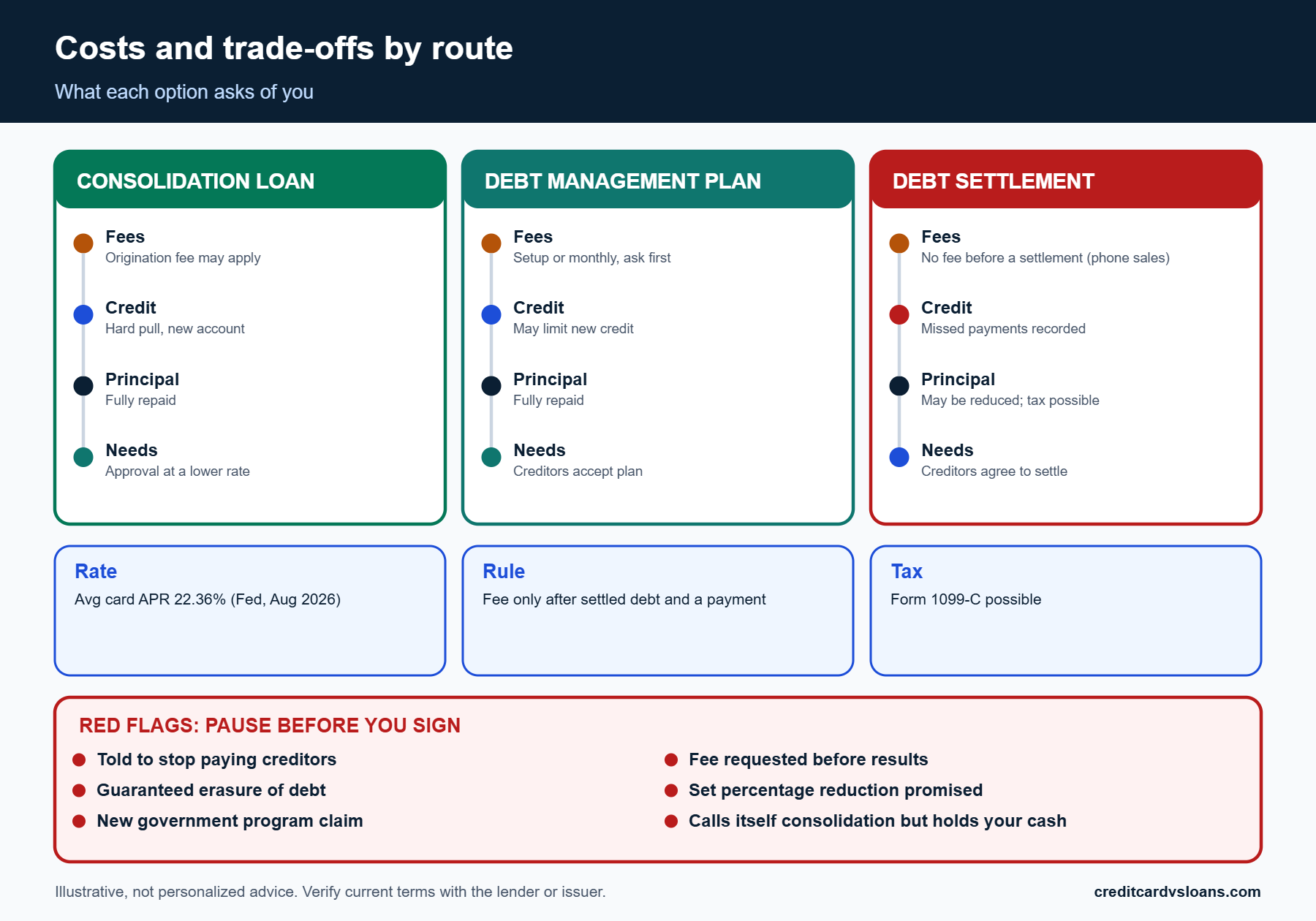
Consolidation costs are visible upfront: interest, any origination fee on a loan, any transfer fee on a card, and in a DMP any setup or monthly fees. The CFPB says to ask about setup and monthly fees and get a written quote from a counseling agency, and to avoid organizations that charge for educational materials.
The interest is the larger lever. The Federal Reserve’s G.19 shows an August 2026 preliminary average of 22.36 percent on credit card accounts assessed interest, so a lower-rate consolidation product can matter a great deal, provided you qualify and the fees are modest.
Settlement fees and the advance-fee rule
For debt relief sold by phone, 16 CFR 310.4(a)(5) says a seller or telemarketer cannot request or receive a fee until it has renegotiated, settled or otherwise altered the terms of at least one debt under a valid agreement you signed, and you have made at least one payment under it. The fee must then either bear the same proportional relationship to the total fee as that debt does to the total debt enrolled, or be a percentage of the amount saved, applied consistently.
The rule does not tell you whether the fee is reasonable, only when and how it may be collected. Our guide on credit card debt relief options and red flags shows what to watch for, and the 2010 record says fees had been front-loaded, with some providers collecting 40 percent or more of the total fee in the first three or four months before the rule.
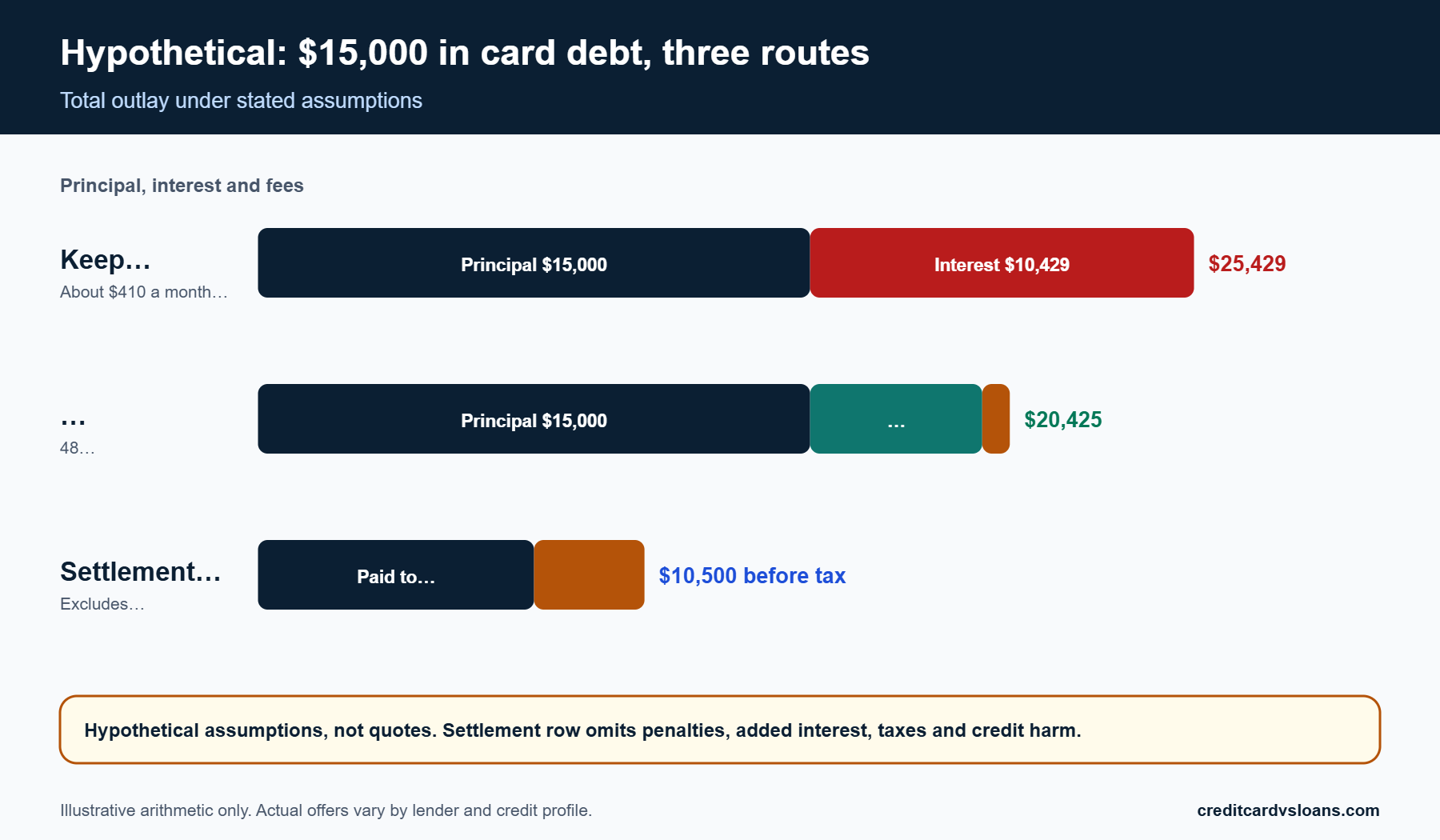
| Route (illustrative assumptions) | Repaid to lenders | Fees | Total outlay | What is left out |
|---|---|---|---|---|
| Keep paying cards at 22.36% APR, about $410 a month | $25,429 over 63 months | None added | $25,429 | No new charges assumed |
| Consolidation loan at 14% APR, 48 months | $19,675 ($409.90 a month) | 5% origination: $750 | $20,425 | Rate assumes approval at that APR |
| Settlement at 50% of balance, 20% fee on enrolled debt | $7,500 | $3,000 | $10,500 | Penalties, interest, tax, credit harm, refusals |
Credit and tax consequences
How credit reacts to each route
A consolidation loan usually involves a hard pull and a new account, and paying cards to zero can lower utilization. A DMP may close or restrict accounts. Settlement can involve late payments recorded over many months. No outcome is guaranteed in any of these cases, and your starting profile matters.
The better question is not “which hurts less in the first month” but “which gets me back to on-time payments with a lower cost.” Consolidation and DMPs aim for that directly, while settlement accepts damage as the price of a smaller bill.
Taxes on forgiven balances
The IRS says debt forgiven or discharged for less than the full amount is generally taxable as ordinary income, and a creditor may send Form 1099-C. Insolvency and bankruptcy exclusions exist, reported on Form 982, but whether they apply depends on your assets and liabilities.
In the example above, $7,500 would be forgiven. Even if the exclusion does not apply, the tax owed depends on your bracket and other income, so a tax professional should check before you rely on the settlement math.
Who Each Approach Tends to Fit
When consolidation is the stronger candidate
You are current but the interest is heavy
If you are making payments on time, your income covers more than the minimums, and a large share of each payment goes to interest, consolidation is usually the first thing to test. You keep accounts in good standing, and a lower rate converts directly into faster payoff. Prequalification tools that use a soft pull let you see offers before a hard pull, though terms vary by lender.
The trade-off is qualification. Approval and pricing depend on your credit and income, and a thin credit file or recent missed payments may narrow options. Balance transfer card versus personal loan helps you compare the two main routes.
You want a predictable end date
A fixed-rate loan or a DMP has a known term, which helps if you want to see the finish line. The FTC says DMPs often run 48 months or more, and a loan term is set when you accept the offer. That predictability can be worth paying a modest fee for.
The warning is to keep the term honest. Stretching a loan to lower the payment can cost more overall, so compare total repayment across offers before you sign.
When settlement enters the conversation
You are already far behind
Settlement tends to come up when accounts are seriously delinquent and the balance is more than you can realistically repay. At that point, the damage from missed payments may already exist, and the decision becomes how to resolve debts with the least overall harm. A bankruptcy attorney or nonprofit counselor can weigh settlement against other options.
Even then, the CFPB warns of fees, refusals and the possibility of ending up deeper in debt. Treat it as a high-risk tool that suits few people, not as a default.
You prefer to negotiate yourself
Nothing requires you to use a company. The CFPB lists negotiating directly with your creditor or debt collector as an alternative, and offers a how-to guide. Doing so avoids company fees, though you take on the work and the same risks of nonpayment and tax on forgiven amounts. Can you settle credit card debt yourself? covers negotiation basics.
If you try it, get any agreement in writing before you send money, and make sure it states how the account will be reported and that the balance is resolved.
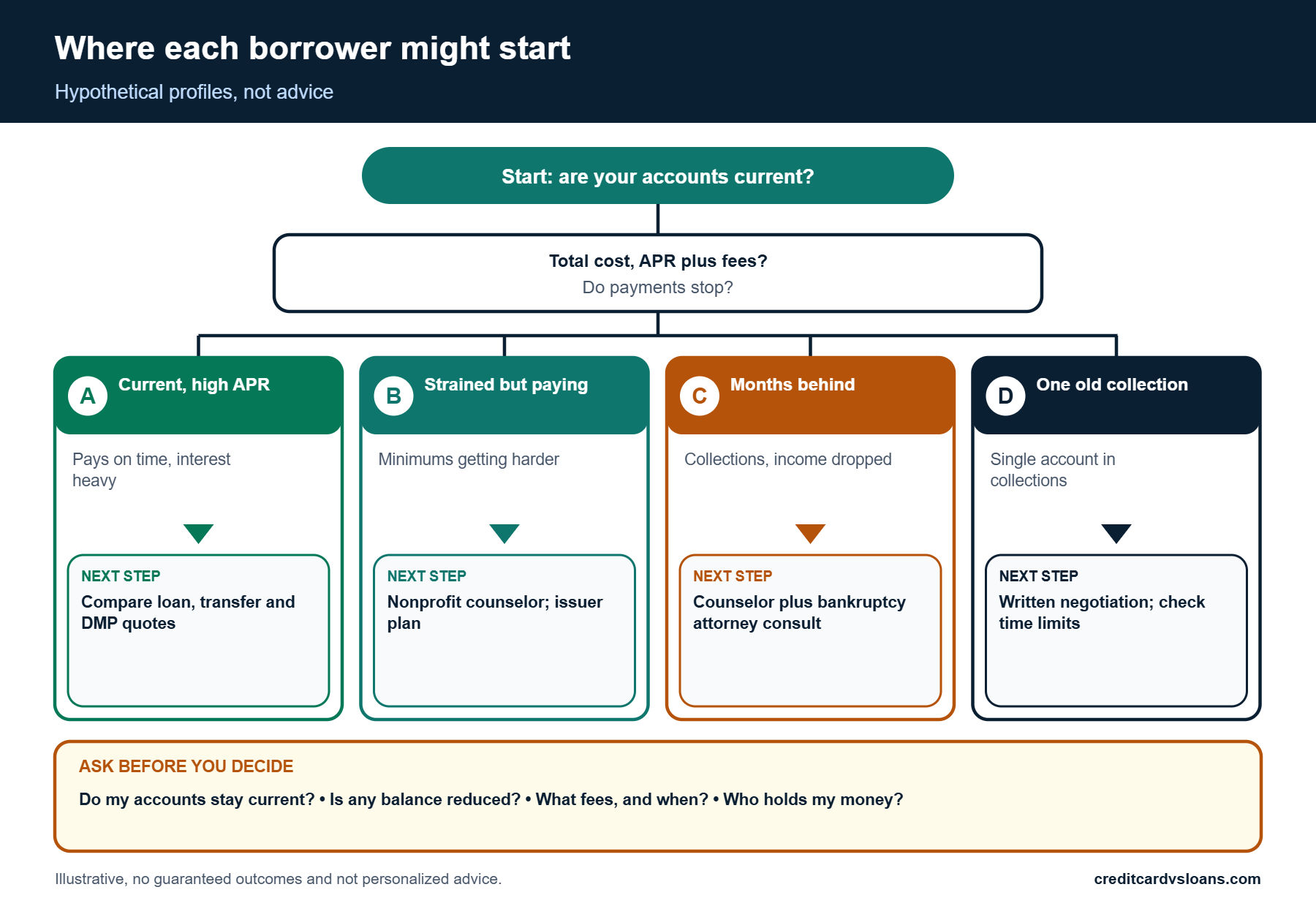
| Your situation | Often worth testing first | Why | Watch for |
|---|---|---|---|
| Current on payments, high APR | Consolidation loan or balance transfer | Keeps accounts current; lowers cost if approved | Fees, promo end dates, new spending |
| Strained but still paying | Nonprofit DMP or issuer plan | Single payment, possible lower rates | Setup and monthly fees; creditor consent |
| Several accounts delinquent | Counselor or attorney consult first | Compares settlement, DMP and bankruptcy | Pressure to stop paying |
| Single old account in collections | Direct negotiation, with written terms | Avoids company fees | Tax on forgiven debt; time-barred rules |
The Middle Paths Most Comparisons Skip
Nonprofit counseling and debt management
What a counseling session offers
The CFPB says credit counselors can give guidance on managing money and debt, build budgets, set up debt management plans and run workshops, and that most are nonprofits. A reputable provider sends free information without demanding personal details. The FTC says an initial session typically lasts about an hour.
A session does not commit you to anything, and it is the cheapest way to see your options side by side. It is also where you can ask whether consolidation, a DMP or something else matches your numbers.
Choosing a counselor carefully
The CFPB suggests starting with the National Foundation for Credit Counseling, the Financial Counseling Association of America or the Justice Department’s list of approved agencies, then checking each with your state attorney general. Warning signs include pushing a DMP as your only option and paying staff more for signing people up.
The FTC warns that nonprofit status does not guarantee low fees. Compare fee schedules and get everything in writing.
Bankruptcy as the comparison point
What it offers that settlement does not
Bankruptcy is the legal process that can discharge unsecured debts. According to the U.S. Courts, over 99 percent of individual Chapter 7 cases that are not dismissed or converted result in a discharge, though means testing, exemptions and non-dischargeable debts apply. The FTC says bankruptcy can stay on your credit report for 10 years.
Unlike settlement, it comes with court protection from creditor collection actions once a case is filed, which is a different kind of certainty. It also comes with real costs and consequences, so a bankruptcy attorney consult is the right step before deciding.
Why to compare before you pick
If settlement is on the table because the balance is unmanageable, bankruptcy belongs in the comparison. Court fees for Chapter 7 are listed by the U.S. Courts at $245, $75 and $15 ($335 total) plus attorney fees, which may be lower than total settlement fees on a large balance, though that depends on your case.
Many bankruptcy attorneys offer a free first consultation, as the CFPB notes. A short meeting can prevent a costly mistake in either direction.
Hypothetical Borrowers: How the Choice Plays Out
Two illustrative profiles
Profile A: current on payments, balances heavy
Imagine a borrower with $15,000 spread across three cards, no missed payments, and a steady paycheck that covers the minimums with some room. This is a hypothetical, not a real person. Consolidation is the natural first test: a fixed-rate loan, a promotional transfer for part of the balance, or a counselor-run plan could each lower the interest cost if approved.
The hypothetical numbers in Table 2 show why. At a 22.36 percent rate, the same roughly $410 monthly payment takes about 63 months to clear the balance, while a 14 percent loan with a 5 percent fee clears it in 48 months for a lower total. Real offers vary, and an offer near the card rate would change the picture entirely.
Profile B: months behind and overwhelmed
Now imagine a borrower with the same $15,000, but two accounts are 90 days late, income has dropped and collection calls have started. Another hypothetical. A consolidation loan may be hard to get with recent delinquencies, and a DMP may or may not be accepted by every creditor.
This is where settlement offers feel attractive, and where the CFPB’s cautions matter most: fees, refusals, lawsuits and the possibility of ending up deeper in debt. A counselor and a bankruptcy attorney can help compare outcomes before any enrollment. The decision should rest on a written comparison, not on a phone pitch.
Reading the hypothetical results with care
What the settlement example leaves out
The settlement row in Table 2 assumes creditors accept 50 percent and the company charges 20 percent of enrolled debt. Neither is a quote or a typical result. It also leaves out interest and fees that accrue while payments stop, which the CFPB says can cancel out savings, and it leaves out income tax on the forgiven amount.
Using a hypothetical 22 percent tax rate purely for illustration, tax on $7,500 of canceled debt would be $1,650, and an insolvency exclusion could reduce or remove it. Your rate and eligibility differ, so the only safe use of the example is to see which line items to ask about.
What the consolidation example leaves out
The consolidation rows assume you qualify at the stated rate, make every payment, and add no new debt. If a hard pull and a new account change your score, or if you miss a payment, results change. A longer term would also lower the monthly payment while increasing total interest.
The right takeaway is directional: a lower all-in rate on a fully repaid balance often beats a negotiated reduction that comes with penalties, fees and tax, but only if you can actually qualify and stick to the plan.
Marketing Traps: Where the Two Get Confused
Forgiveness language and “consolidation” labels
Promises that should end the call
The CFPB lists the red flags: fees charged before debts are settled, a promised percentage reduction, guarantees that debt will be erased, instructions to stop communicating with creditors, promises to stop all collection calls and lawsuits, and a “new government program” for card debt. Any one is reason to walk away.
Our guide on credit card debt forgiveness: what is real and what is a scam goes through the language you will see in ads and calls.
When “consolidation” is a sales label
Some offers wrap settlement in consolidation vocabulary: “one low payment,” “we combine your debts,” “stop the calls.” The difference is in the mechanics. If you will be told to stop paying creditors, deposit money into an account, or wait for negotiated deals, it is settlement regardless of the name.
Ask three questions in plain words: do my accounts stay current, will any balance be reduced, and do I owe fees before a result? The answers sort the offers.
Questions to ask before you sign
Questions for lenders and counselors
For a loan, ask for the APR, term, origination fee and total repayment, and whether the lender pays your creditors directly. For a counselor, ask for the fee schedule, which creditors have accepted the plan, and what happens if you miss a payment.
Get answers in writing and compare at least two offers. Rate shopping within a short window is typically treated differently from repeated applications over time, but check the scoring model and lender details.
Questions for settlement companies
Ask which of your creditors the company has settled with, how long each took, what the fee is and when it is charged, who holds your account, and what happens if a creditor sues. The FTC says the company must disclose the time, the stop-paying consequences and the account terms.
If answers are vague, or you are pressed to sign quickly, treat that as a red flag. Legitimate providers can explain risks without pressure.
Verifying a company before you share anything
Independent checks that take ten minutes
Look up the company through your state attorney general and state consumer protection agency, as the CFPB suggests for counselors, and search the FTC’s site for enforcement news that names it. Ask for the contract in writing before you share account numbers, and read the fee section first. A provider comfortable with scrutiny will send documents without pushing for a decision.
Check where your money would be held, who administers the account, and whether that administrator is independent of the company. The rule requires that an administrator of a dedicated account not be owned or controlled by, or affiliated with, the debt relief service.
What to do if the pitch starts with a phone call you did not request
An unsolicited call about debt relief deserves extra caution. The FTC describes operations that rely on robocalls, including calls to numbers on the Do Not Call list, and large upfront fees from people short on cash. Hang up, look up the company independently, and report the call at ReportFraud.ftc.gov if it asks for money first.
If you already agreed to something on a call, read the paperwork carefully, and cancel in writing if the terms differ from what you were told. Keep copies of everything.
Checklist: Choosing Between Consolidation and Settlement
A decision checklist
Seven questions that sort the choice
- Am I current on payments? If yes, test consolidation or a DMP first.
- Can I qualify for a lower all-in cost? Compare APR, fees and total repayment, not just the monthly payment.
- Would I have to stop paying anyone? If so, understand the penalty, collection and lawsuit risk in writing.
- Is a fee requested before any result? For telemarketed debt relief, that is barred by the Telemarketing Sales Rule.
- What happens to taxes? Ask about Form 1099-C if any balance would be forgiven.
- Have I priced bankruptcy? Check with an attorney if the balance is out of reach.
- Is the information coming from a source I chose? Use the CFPB, FTC and Justice Department lists.
If you cannot answer most of these, you do not yet have enough information to commit. Pause and book a counseling session.
What to bring to a counseling session
Gather statements for each card or loan showing balance, rate and minimum payment, a list of monthly income and fixed expenses, and notes on any collection letters. The more complete the picture, the sooner a counselor can tell you whether a DMP, consolidation or another route fits. You do not need to share more than the counselor asks for.
Write your questions in advance: total fees, who pays which creditor, how long it takes and what happens if you miss a payment.
When waiting costs money
Delay has a price on both sides. Interest on a card balance accrues monthly, and a delinquent account can pick up fees. At the same time, rushing into a program that you do not understand can cost more than waiting a week to compare offers.
A practical rule of thumb is to use the quickest free step first: call your issuer, ask about a hardship or payment plan, and write down the offer while you gather the other quotes.
Questions people still ask
Can I switch from settlement to consolidation later?
Sometimes, but the order matters. If you stop paying during a settlement program, your credit file may show late payments, which can make loan approvals harder or more expensive. The FTC and CFPB say customers can generally leave a settlement program, and the third-party account rules say you can withdraw funds without penalty, although fees already earned may be kept.
If you are thinking about switching, ask the company in writing what you would owe on exit, and check your reports to see what has been recorded. Then price a consolidation offer or a DMP from the position you are in now, not the one you were in at enrollment.
Does a debt management plan count as settlement?
No. A DMP asks creditors to accept a payment schedule, often with lower interest or waived fees, but you repay the principal. The CFPB describes it as one monthly payment to the counseling organization, which pays your creditors. Settlement targets a reduced balance and typically involves missed payments.
That is why a DMP sits closer to consolidation in risk, even though it comes through a counseling agency rather than a lender. Ask about fees and creditor acceptance before enrolling.
Should I stop paying my cards while I decide?
Do not stop payments on the strength of a sales call. The CFPB and FTC both warn that missed payments can bring late fees, penalty interest, collection activity and lawsuits, and that a plan built on missed payments can leave you owing more. If you truly cannot pay, contact your issuer first and ask about a hardship arrangement, and get a nonprofit counselor or attorney involved before you let accounts lapse.
The cost of one more week of research is usually smaller than the cost of a missed-payment cascade, and it keeps your options open.
Conclusion and next steps
The bottom line
Consolidation restructures what you owe and keeps you current; settlement tries to shrink what you owe and often puts you behind first. If you can qualify for a lower cost and keep paying, consolidation is the lower-risk path. If you cannot, talk to a nonprofit counselor and a bankruptcy attorney before agreeing to settlement.
Neither is a shortcut. Both work only if the numbers fit your budget, so run your own totals and keep every promise in writing.
Your next steps
- List balances, rates, minimums and which accounts are current or late.
- Get at least two consolidation or DMP quotes, noting APR, fees, term and total repayment.
- Book a session with a nonprofit counselor from the CFPB-suggested or Justice Department-approved lists.
- Ask a tax professional about any forgiven amounts before you accept a settlement.
- If a company wants money first, or tells you to stop paying, walk away and report it at ReportFraud.ftc.gov.
For the full settlement picture, read credit card debt settlement: risks, taxes and credit damage, and for a practical comparison of consolidation tools, see how debt consolidation works.
- Credit Card Debt Settlement: Risks, Taxes and Credit Damage
- Can You Settle Credit Card Debt Yourself? Risks and Negotiation Basics
- Credit Card Debt Relief: Legitimate Options and Red Flags
- How Debt Consolidation Works: Loans, Balance Transfers and Other Options
- Credit Card Debt Forgiveness: What Is Real and What Is a Scam?
- CFPB: What is a debt relief program and how do I know if I should use one?
- CFPB: What is credit counseling?
- CFPB: Debt collection
- CFPB: CFPB warns credit card companies against deceptively marketing promotional offers (Published Sept. 3, 2014)
- FTC: Debt Relief Service and Credit Repair Scams
- FTC: Coping with Debt
- Federal Register: Telemarketing Sales Rule, final rule amendments (75 FR 48458) (Aug. 10, 2010)
- eCFR: 16 CFR 310.4 Abusive telemarketing acts or practices
- IRS: Topic no. 431, Canceled debt: Is it taxable or not?
- U.S. Courts: Chapter 7 Bankruptcy Basics
- Federal Reserve: Consumer Credit – G.19 (Release of Oct. 7, 2026)
- CFPB: What is a credit card interest rate? What does APR mean?
Last updated: October 22, 2026. Rates, fees and lender rules change; verify current terms before acting.
The information on creditcardvsloans.com is provided for general educational and informational purposes only. It is not financial, legal, tax, credit, accounting or investment advice, and reading it does not create an advisor-client, fiduciary or any other professional relationship. Nothing here is an offer, solicitation or recommendation to borrow, lend or apply for any product.
Credit scores, interest rates, fees, eligibility rules, lender policies and laws change frequently and vary by lender, location and individual circumstances. Examples, figures and scenarios are illustrative only, do not predict your results and do not guarantee approval, savings, a particular rate or a credit-score outcome. Always confirm current terms directly with the lender or issuer and read the full agreement before you apply or sign.
Although we aim for accuracy and use reputable sources, we make no representations or warranties, express or implied, about the completeness, accuracy, reliability or timeliness of the content. Content may be drafted with the assistance of automated tools, so errors or omissions may still occur. Links to third-party sites are provided for convenience; we don’t control and aren’t responsible for their content.
To the fullest extent permitted by law, creditcardvsloans.com and its owners, editors, authors, contributors and affiliates disclaim all liability for any loss, damage or expense arising directly or indirectly from your use of, or reliance on, this content. Before making financial decisions, consult a licensed professional, such as a qualified financial advisor, attorney, tax professional or nonprofit credit counselor, who can consider your complete situation.