For most people with decent credit and a balance a 0% offer can actually cover, a balance transfer costs less than a debt management plan. For people who can’t get approved for a big enough limit, or who can’t realistically pay the balance down during a promotional window, a debt management plan often costs less in the end. Comparing a balance transfer vs debt management plan comes down to a handful of numbers you can check before you commit: the transfer fee, how long the promotional APR lasts, what your cards charge now, and what a counseling agency charges per month.
These two tools get lumped together because both are used to pay off credit card debt, but they work in very different ways. A balance transfer moves what you owe onto a new card, usually with a low promotional rate and an upfront fee. A debt management plan (DMP) is a repayment arrangement run by a credit counseling agency, where you make one monthly payment and the agency pays your creditors on a schedule you agreed to, often with lower interest rates the creditors may agree to.
The honest answer to “which costs less” is that it depends on your credit, your balance, and your discipline over the next 12 to 18 months. This guide walks through the real cost drivers, runs a clearly labeled hypothetical comparison, and shows where each option breaks down. Where a neighboring question deserves its own full answer, such as how debt settlement compares with a transfer, you’ll find a short summary and a link instead of a repeat.
- A balance transfer usually costs less when you qualify for a limit large enough to move most of your debt and can pay it off before the promotional rate ends.
- A debt management plan can cost less when you can’t qualify for a transfer, or when your payoff will take well beyond the promotional window.
- Both options have fees: balance transfers typically carry a one-time fee, while DMPs may carry setup and monthly fees you should get in writing.
- Neither option helps if new spending keeps adding to the balance. A DMP may require you to stop using the cards; a transfer card doesn’t stop you from overspending.
- Credit effects differ: a transfer involves a new application, while a DMP may involve closed or restricted accounts. Ask your counselor exactly how each creditor will report the plan.
Figures on card interest come from the Federal Reserve’s G.19 consumer credit release of October 7, 2026. Your own offers, fees and rates will differ, so treat every number labeled hypothetical as a model, not a quote.
Table of contents
Balance Transfer vs. Debt Management Plan: The Short Answer
Which Option Usually Costs Less, and When That Flips
The cost drivers that decide the winner
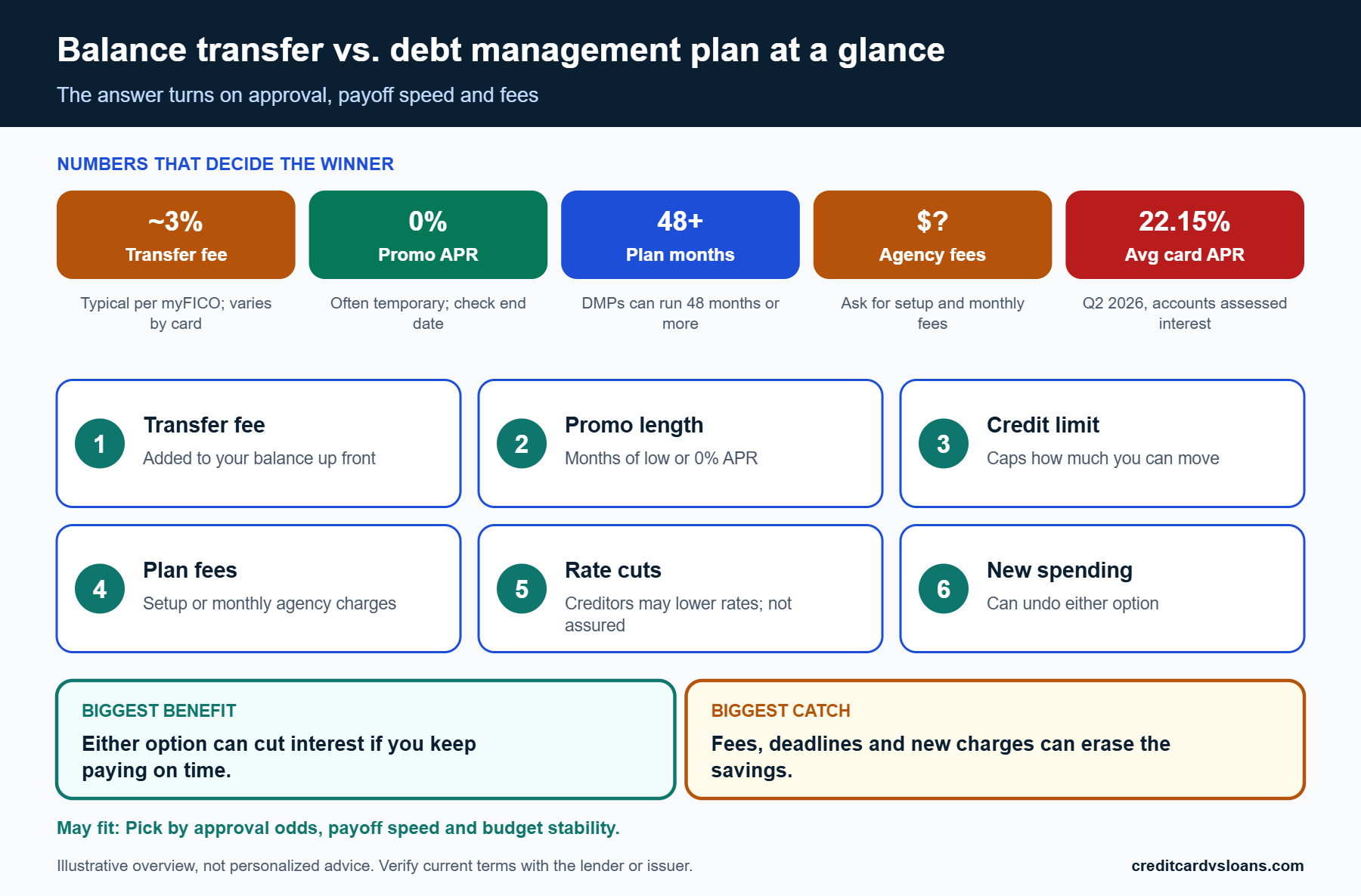
Four things do most of the work. The first is the size of the transfer fee against the interest you would otherwise pay. The second is how many months of low or 0% interest you get, compared with how long you need to pay the balance off. The third is the interest rate on your current cards. The fourth is what a counseling agency charges each month and how much interest your creditors agree to cut.
Because a balance transfer is a one-time fee plus a temporary rate, it tends to be cheapest when you can finish paying inside the promotional period. Because a DMP’s savings come from reduced interest sustained over three to five years, it tends to win when your payoff runs long or you can’t get a transfer card at all.
Quick decision rules that hold up in most cases
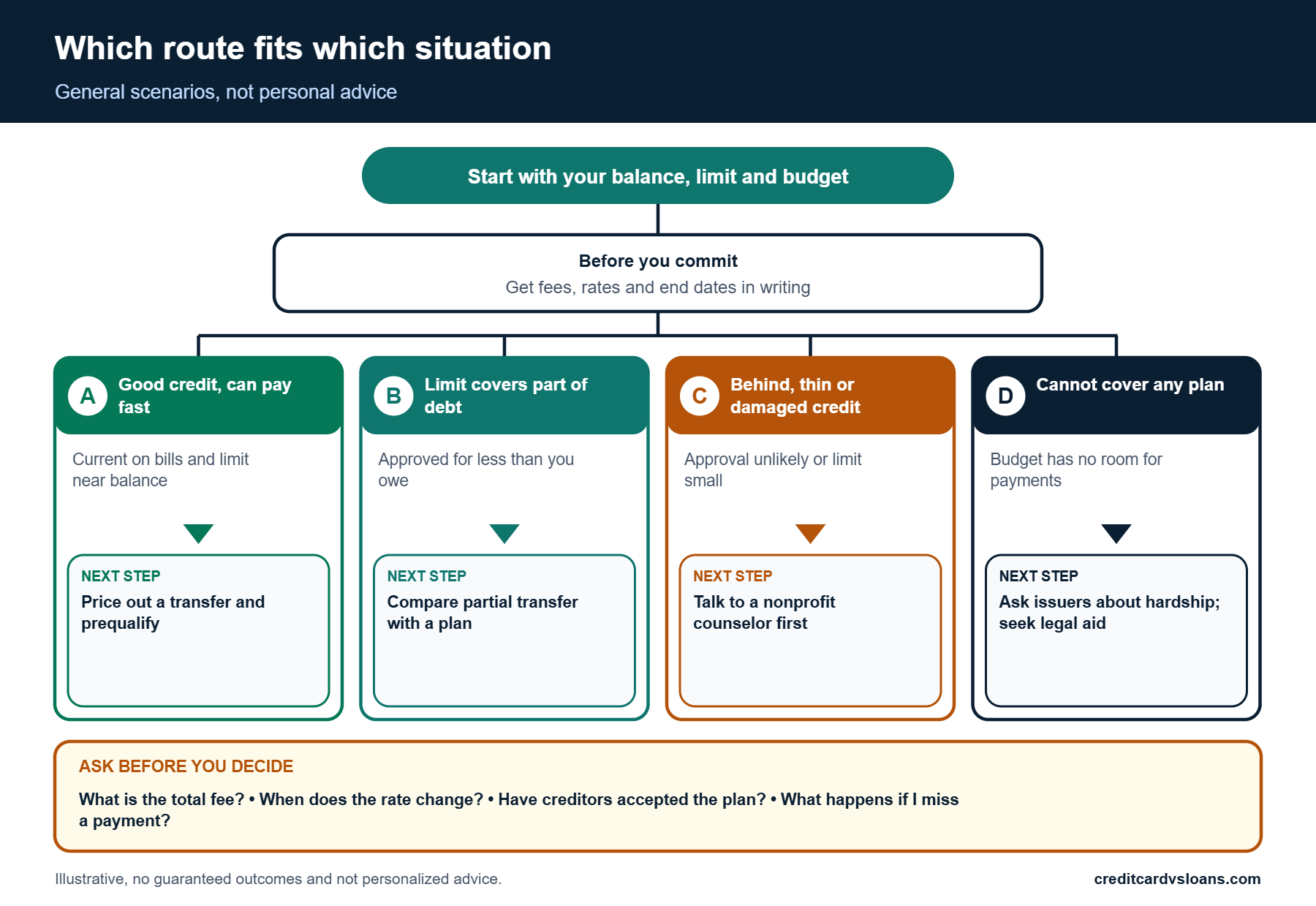
As a rule of thumb, ask three questions. Can you be approved for a limit that covers most of the balance? Can your budget pay it off, or nearly off, within the promotional period? Can you stop adding new charges? If the answer to all three is yes, a transfer is worth pricing out first.
If you answer no to the first or second, or you are already behind on payments, a nonprofit counseling session is a better first call than a new card application. The decision is not permanent: a counselor can tell you whether a plan fits before you enroll, and the CFPB’s page on credit counseling and debt management explains what to ask.
What Each Option Actually Is
A balance transfer in plain terms
A balance transfer means you ask a card issuer to pay off some or all of your existing card balances and put that amount on a new card. The new issuer usually charges a fee, and many offers start with a low or 0% promotional APR for a fixed number of months. When the promotional period ends, the remaining balance generally moves to the card’s regular rate, which could match or exceed the rate on your old cards.
It is a loan from a new lender, so approval, your credit limit, and the fine print all matter. If you want a broader view of how transfers fit among consolidation methods, how debt consolidation works lays out loans, transfers and other options side by side.
A debt management plan in plain terms
A DMP is not a loan. A credit counselor reviews your income, expenses and debts, and if a plan makes sense, you send one monthly deposit to the agency. The agency pays your unsecured creditors on a schedule, and the creditors may agree to lower interest rates or waive some fees. The Federal Trade Commission notes that a DMP can take 48 months or more and that you may have to agree not to apply for or use new credit while you are in it.
Because no new debt is created, a DMP doesn’t require a credit application. It does require you to make every payment on time, since a missed deposit can put the arrangement at risk. We cover the credit side in detail in how a debt management plan affects your credit.
A transfer is a short sprint with a price tag at the start. A DMP is a longer, structured plan with a smaller monthly fee and sustained interest relief. Match the tool to the length of your payoff, not to the one that sounds easier.
How a Balance Transfer Works and What It Costs
Transfer Fees and the Promotional APR
The balance transfer fee
Balance transfer fees are typically around 3% of the amount you move, according to myFICO. Moving $5,000 would likely add roughly $150 to your balance. A “0%” label on the rate doesn’t mean the transfer is free, because the fee is separate from the interest rate. Fees vary by card, so read the offer’s disclosure rather than relying on an average.
The fee is usually added to the balance you owe, which means you start the promotional period with a slightly larger debt than the one you moved. That is why the math needs to be done before you apply, not after.
The promotional APR and the cliff at the end
Promotional rates are often 0%, but they’re temporary. Once the period ends, the remaining balance moves to the regular APR. According to the Federal Reserve’s G.19 release of October 7, 2026, the average rate on credit card accounts assessed interest was 22.15% in the second quarter of 2026, and 20.94% across all accounts. Your own post-promotion rate could land near that range or outside it, which is why you want to see it in writing.
The catch is that new purchases may accrue interest at the regular rate even while the transferred balance sits at 0%, according to myFICO. Use the card only for moving existing debt, and think of the end date as a deadline. If you are weighing a transfer against other consolidation routes, this overview of consolidation options shows where each one fits.
Approval, Limits and What Actually Moves
Your credit limit caps the transfer
You can only transfer up to the credit limit you are approved for, and often less once the fee is counted. A person with $12,000 in card debt who is approved for a $5,000 limit can only move part of it, leaving the rest on high-rate cards. This partial-transfer outcome is common enough that it should be your base case until you see an actual limit.
Many issuers also don’t let you transfer balances from their own cards. Check the offer terms for any restrictions before you assume your largest balance is eligible.
Applications, hard pulls and thin credit files
Applying for a transfer card generally means a hard pull, which is an inquiry that can ding your score a little. myFICO also warns that submitting several credit applications in a short period can hurt your score. If your file is thin or you have recent late payments, approval for a large limit at a 0% rate may be unlikely, and applying repeatedly can make things worse.
Prequalify tools, where an issuer offers a soft-pull check, can help you gauge your odds without a hard inquiry. They are not guarantees, and the final approved limit and terms can differ.
How a Debt Management Plan Works and What It Costs
From First Counseling Session to Monthly Payment
The counseling session comes first
A legitimate DMP starts with a conversation, not a sales pitch. According to the CFPB, counselors review your finances, help you build a budget, and can set up a DMP covering your debts if you are struggling to make payments. An initial session typically lasts about an hour, with follow-up sessions offered, and can be in person, online or by phone.
The FTC says you shouldn’t enroll until a certified counselor has thoroughly reviewed your finances, because a DMP isn’t right for everyone. Be wary of any organization that pushes a DMP as your only option before analyzing your situation, or that refuses to send information unless you hand over personal details first. Those are red flags the CFPB specifically lists.
If the counselor finds you can pay your debts on your own with a better budget, you may walk away with a plan that costs nothing beyond the session. If the numbers show you can’t, that conversation also gives you evidence for any other option you choose.
One payment, many creditors
If you enroll, you make one payment each month or pay period to the counseling organization, which then pays each creditor, per the CFPB. The FTC describes it as a monthly deposit used to pay unsecured debts such as credit cards, on a schedule set with you and your creditors.
That structure removes the juggling act of several due dates, which matters more than it sounds. People who fall behind on multiple cards are often not short of intention; they’re short of a system. The tradeoff is that you’ve handed a monthly deposit to a third party, so you want to confirm in writing that each creditor accepted the plan and how quickly payments are forwarded.
Because the plan only covers the debts you enroll, anything left out, such as a car loan or a card you leave off the plan, still needs its own payment on time.
Fees, Concessions and Plan Rules
What a plan can cost you
Nonprofit status doesn’t mean free. The CFPB says counselors may charge for some services and tells you to ask whether there are setup or monthly fees and to get a specific price in writing. The FTC adds that reputable nonprofits may still charge high or hidden fees and that legitimate services don’t charge fees before enrollment.
Fee amounts and rules vary by agency and sometimes by state, so we can’t give you a typical figure here. What you can do is ask three questions before you sign: What is the setup fee? What is the monthly fee? What happens if I can’t afford it? If an agency won’t help because you can’t afford its fees, the CFPB says to look elsewhere.
Because fees accumulate over a 48-month plan, a small monthly charge matters. We build a hypothetical $35 monthly fee into the comparison below so you can see how it changes the result.
Interest concessions are not automatic
The FTC says creditors may lower interest rates or waive certain fees, but you should confirm each concession directly with each creditor. “May” is doing real work in that sentence. The size of any rate cut depends on the creditor, and the plan’s savings depend on what your cards charge today.
You’ll also have to follow the plan’s rules. According to the FTC, you must make regular, timely payments, the plan can take 48 months or more, and you may have to agree not to apply for or use new credit. That last rule can be a feature if overspending got you here, and a real inconvenience if you rely on a card for emergencies. If you want the credit-reporting side, our guide to how a DMP affects your credit goes deeper.
A DMP can reduce interest, but it can’t create money your budget doesn’t have. If your required monthly deposit is higher than you can sustain, the plan can fail partway through, which is why the counselor’s budget review matters more than the interest rate they quote.
Side-by-side: what you are comparing
The table below lines up the features that most affect cost. Use it as a checklist when you read actual offers and agency quotes.
| Feature | Balance transfer | Debt management plan |
|---|---|---|
| What it is | New card (or offer) that pays off old cards | Repayment arrangement run through a counseling agency |
| Upfront cost | One-time transfer fee, often around 3% per myFICO | Setup fee possible; get a quote in writing |
| Ongoing cost | None if paid off in promo window; regular APR after | Monthly fee possible |
| Interest | Often 0% for a fixed period | Creditors may lower rates; varies by creditor |
| Approval | Requires a credit application and limit large enough | No new credit application |
| Typical length | Promotional period, then regular terms | 48 months or more per the FTC |
| New credit use | Card stays open; new charges may be possible | May be required to avoid new credit |
Balance Transfer vs. Debt Management Plan Fees and APR: A Hypothetical Cost Comparison
A $12,000 Illustration Under Clearly Stated Assumptions
The assumptions behind the numbers
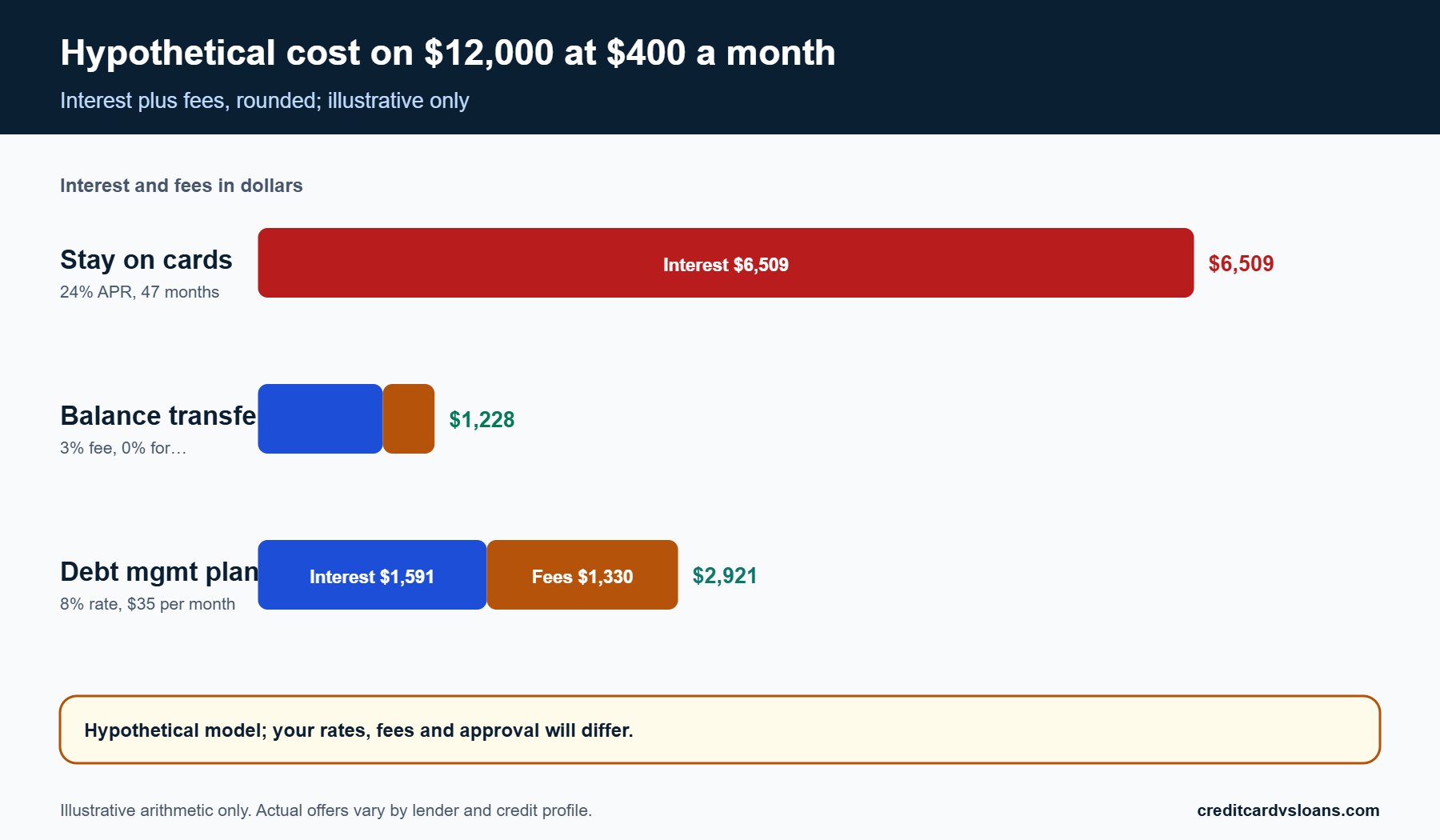
Everything in this section is hypothetical and rounded. It is a model built to show how the pieces interact, not a prediction of any offer you will see. Assume someone owes $12,000 across several cards at a 24% APR and can put $400 a month toward the debt. Interest here is calculated monthly as one-twelfth of the APR, which is a simplification of the daily interest issuers actually use.
For the balance transfer, assume a 3% fee ($360) added to the balance, 0% for 18 months, and a 24% regular APR afterward, with approval for a limit that covers the full $12,360. For the DMP, assume a $35 monthly fee, an 8% blended rate after creditors cut interest, and $365 of the $400 going to creditors so the total out-of-pocket stays at $400. Those DMP rate and fee inputs are placeholders; your creditors and agency may differ a lot.
For reference, the Federal Reserve’s October 7, 2026 G.19 release reports an average 22.15% APR on card accounts assessed interest in the second quarter of 2026, so 24% is in a plausible range for the do-nothing case without being a quote of anyone’s actual rate.
What the numbers show
Under those assumptions, staying on the cards at $400 a month takes about 47 months and costs roughly $6,509 in interest. The transfer path finishes in about 34 months with roughly $868 of interest plus the $360 fee, or about $1,228 in total cost. The DMP path takes about 38 months, with roughly $1,591 in interest plus $1,330 in monthly fees, or about $2,921.
The transfer wins in this model because 18 months of 0% is a large head start and the fee is small relative to the interest avoided. The DMP still beats doing nothing by a wide margin, and it doesn’t depend on a credit approval. Neither path is “free.”
| Path | Months to pay off | Interest | Fees | Total cost |
|---|---|---|---|---|
| Stay on cards (24% APR) | 47 | $6,509 | $0 | $6,509 |
| Balance transfer (3% fee, 0% for 18 months, then 24%) | 34 | $868 | $360 | $1,228 |
| DMP (8% rate, $35 monthly fee) | 38 | $1,591 | $1,330 | $2,921 |
What Changes the Math
Partial approval or a higher payment
The transfer result above assumed a limit big enough to move everything. Suppose instead you were approved for only $6,000 of transfers, with the other $6,000 staying on a 24% card, and you split $300 and $100 between them for 18 months, then roll the rest onto the higher-rate card. In this simple model, total interest rises to roughly $4,049 plus a $180 fee, about $4,229 total. That is still below doing nothing, but now above the DMP’s modeled cost.
Pay more and the transfer looks even better. At about $700 a month, the whole balance including the fee clears inside 18 months and costs only the $360 fee. If you can’t get near that number, the question becomes what happens at month 19, which is where the next heading comes in.
What happens if you miss a payment or the promotion ends
The DMP column in the table is only as good as your discipline. Miss payments and the arrangement can break down, and the FTC notes that regular, timely payments are required. On the transfer side, a late payment can mean losing the promotional rate depending on the card’s terms, so read the account agreement before you rely on the 0% window.
Federal rules also limit when an issuer can raise the rate on an existing balance. Under 12 CFR 1026.55, an issuer can generally raise the APR if you are more than 60 days late with the minimum payment, and the increase must be removed after six consecutive on-time payments. That is the legal floor, not a reason to be late: individual card terms and fees still apply.
| Blended rate after concessions | Months | Interest | Fees | Total cost |
|---|---|---|---|---|
| 6% | 37 | $1,142 | $1,295 | $2,437 |
| 8% | 38 | $1,591 | $1,330 | $2,921 |
| 10% | 39 | $2,082 | $1,365 | $3,447 |
The table shows how much weight monthly fees carry. In this model fees are roughly as large as the interest, which is why you should push for a written quote before comparing plans.
Credit Score Impact: What Each Option Can Do to Your Credit
How a Balance Transfer Touches Your Credit
The application and new-account effects
A balance transfer card is a new credit account, which usually means a hard pull when you apply. myFICO’s score breakdown puts new credit at 10% of a FICO Score, so one inquiry is a small factor, but several applications in a short period can add up, as myFICO cautions in its guidance on transfers.
A new account also lowers the average age of your accounts, which falls under length of credit history, about 15% of the FICO calculation according to myFICO. These are modest effects on their own and can be outweighed by the other factors discussed next. No one can promise whether your score will go up or down.
Utilization and payment history are the bigger levers
Amounts owed is about 30% of a FICO Score, per myFICO, and credit utilization falls under it. Moving a balance onto a card with a larger limit, or spreading it across cards, can change your utilization ratio; paying the balance down changes it more. On the other hand, a new card with a big balance on it can show a high utilization on that single card.
Payment history is the largest category at 35%. The most reliable credit move in either option is to make every payment on time. A transfer doesn’t fix a late payment already on your report, and the CFPB says negative information generally can remain on a report for seven years.
How a Debt Management Plan Touches Your Credit
What the sources do and don’t say
The CFPB’s page doesn’t say how a DMP affects your credit report or scores, and tells you to ask the counselor directly. The FTC’s guide likewise doesn’t state it. That silence is itself useful: any agency that promises a specific score outcome is promising something it can’t know.
What is known is structural. Some plans ask you to stop using the enrolled cards, and some creditors may close or restrict enrolled accounts, so ask. Closing accounts can reduce your available credit and shift utilization, and your payment history on the plan will be reported by each creditor according to its own practices. Our full explainer on DMP credit effects covers the questions to ask.
Questions to ask before enrolling
Before you sign, ask the agency how each creditor reports accounts in a plan, whether accounts will be closed, whether late payments already on the file are updated, and how long the plan notation could remain. Get the answers in writing where you can.
Also ask what happens to your credit if you leave the plan early. Because these answers vary by creditor, a good counselor will tell you what they know and what they don’t. If a mortgage or car loan is coming in the next year, mention that, since timing can matter. Our companion piece on debt consolidation vs. debt settlement compares the much bigger credit risks of settlement, which is a different product from a DMP.
Pull your free credit reports first, list every card with its balance and APR, and note which accounts are already late. Those three facts change which option is realistic and give a counselor something concrete to work with.
Pros, Cons and Risks of Each Option
Balance Transfer: What Helps and What Can Hurt
Where a transfer shines
The main appeal is speed and simplicity. If you are approved, the old balances are paid off by the new issuer and you can start putting every dollar toward principal during the promotional window. Consolidating several cards onto one also means one due date to track, which myFICO lists as a practical benefit.
It also doesn’t depend on a third party staying in the middle. Once the transfer posts, the relationship is between you and one issuer. If your income is stable and you can pay down a large share inside the promotion, the interest saved can be significant compared with the fee.
Where a transfer can backfire
The risks are mostly about what happens after the transfer. A card that has been paid down to zero is easy to charge again, and many people end up with the old debt returning on top of the transferred balance. myFICO’s advice is to use the card only to move current debt and to pay the balance off before the promotion ends.
Fees and deadlines add up too. The fee is added to the balance, new purchases may accrue interest at the regular rate, and the leftover balance after the promotion may be charged a rate similar to or higher than the cards you left. Treat the end date as a hard deadline and set a calendar reminder for two months before it.
Debt Management Plan: What Helps and What Can Hurt
Where a plan helps
A DMP adds structure. The CFPB describes one monthly payment to the agency, which pays your creditors, and says a DMP typically lowers monthly payments and reduces interest charges and fees. For someone who can’t qualify for a transfer, or whose balance is too large for any one card limit, that is the main attraction.
A good plan also comes with a budget review, which tends to be the part people value most. You get a single point of contact, a schedule, and an end date that is typically measured in years rather than open-ended minimums.
Where a plan can hurt
The FTC notes that a plan can take 48 months or more, that regular, timely payments are required, and that you may have to agree not to apply for or use new credit. A DMP also covers only the debts you enroll, so secured debts such as a car loan or mortgage, which the FTC says should be prioritized because default can cost you the asset, still need separate attention.
And the fees count. The FTC warns that even reputable nonprofits may charge high or hidden fees, so a plan with generous interest cuts but heavy monthly fees can end up costing more than it saves. The CFPB notes that the FTC has found some organizations offering DMPs have defrauded people, which is why confirming creditor acceptance before you send money matters.
Never send money to a counseling agency until you have confirmed that your creditors accept the plan. The CFPB specifically advises contacting your creditors first to make sure they will go along with it.
Requirements and Who Fits Which Option
What You Need to Qualify
Balance transfer requirements
A transfer requires approval for a new card or offer, which depends on your credit profile, income, existing debts and the issuer’s criteria. Issuers don’t publish a single cutoff score, and approval is never guaranteed. Even if you are approved, the limit may be lower than your debt, and the fee will eat into it.
Check whether the offer excludes balances from the same issuer, whether there is a time limit for completing transfers to get the promotional rate, and whether late payments void the promotion. If you can prequalify with a soft pull, do so before you submit a full application.
Debt management plan requirements
A DMP does not require a credit application, but it does require that your debts are the kind a plan can cover, mainly unsecured accounts such as credit cards, and that you can afford the monthly deposit. According to the FTC, creditors agree to concessions individually, so plan participation depends on your creditors. Some plans exclude certain accounts.
You’ll also need a steady income, since the plan assumes regular payments for years. If the counselor’s budget shows the numbers don’t work, ask what alternatives they would suggest, and compare them with the paths in the alternatives section below.
Matching the Option to Your Situation
Situations where a transfer fits better
A transfer tends to fit a person who is current on all accounts, has a solid enough credit profile to prequalify for a limit near the balance, and can realistically pay most of the debt off inside the promotional period. It also suits someone whose main problem is interest, not cash flow, because the 0% window removes the interest drag.
It fits less well when the total is far larger than anything you could repay in 12 to 21 months, or when you are likely to keep spending on the cards. A transfer treats the interest symptom without changing the habits behind it.
Situations where a plan fits better
A DMP tends to fit a person who is struggling with several card payments, can’t get approved for a large enough transfer limit, or needs a longer runway than a promotional period offers. The structure and the end date can be as valuable as the interest relief.
It fits less well when you need to keep using your cards for essentials, when a lump-sum event such as a bonus or tax refund could clear most of the debt soon, or when your income is too unstable to commit to a multi-year schedule. Use the table to see how those cases line up.
| Your situation | Balance transfer | Debt management plan |
|---|---|---|
| Current on payments, good credit, can pay off in 12 to 21 months | Often worth pricing out | Usually unnecessary |
| Approved limit covers only part of the debt | Partial relief only | Can cover multiple accounts |
| Already behind or credit is thin | Approval unlikely or limit small | No new credit application needed |
| Need to keep using cards for essentials | Card remains open | New credit use may be restricted |
| Overspending drives the balance | Easy to recharge the cards | Structure and budgeting built in |
| Unstable income | Minimums still required after promo | Multi-year deposits can be hard to sustain |
Alternatives to Consider Before You Choose
Lower-Risk Alternatives
Talk to your card issuer
If you are struggling, the CFPB’s first piece of advice is to contact your card company right away, because many issuers will work with you on changing your payment during a financial emergency. Explain why you can’t make the minimum payment, how much you can afford, when you expect to resume normal payments, and the reduced amount you’re requesting and how long you need it.
A hardship arrangement can be cheaper than either a transfer or a plan, but it typically covers one card at a time, and terms vary by issuer. Get anything they agree to in writing. We go through these conversations in detail in a related guide on what to do when you can’t pay your card bills.
A consolidation loan or a self-directed payoff plan
A fixed-rate consolidation loan can replace several variable-rate cards with one payment and a set end date. It brings its own costs, such as possible origination fees, and the rate you are offered depends on your credit. If you want to compare it directly with a transfer, our guide on how debt consolidation works lays out the trade-offs.
Some people don’t need a product at all. Federal rules say that when you pay more than the minimum, the issuer must apply the extra to the balance with the highest APR first, per 12 CFR 1026.53. That means putting extra money toward your cards is not wasted on the cheapest balance, and a simple budget can do part of the work a plan would otherwise do.
Higher-Risk Alternatives
Debt settlement
Settlement companies negotiate a lump sum that is less than you owe, and often tell you to stop paying creditors while you save. The FTC warns that stopping payments can hurt your credit report, increase late fees, bring collector calls and lead to lawsuits, and that settled amounts can be taxable income unless you are insolvent. Creditors also aren’t required to negotiate.
That is a very different risk profile from a transfer or a DMP, which is why debt consolidation and debt settlement carry very different risks, and why settlement and balance transfers aren’t truly comparable. If the deal sounds like a shortcut, treat it as one with a price.
Bankruptcy and the counseling requirement
For some people, no repayment plan is realistic. The FTC explains that Chapter 7 and Chapter 13 can eliminate many unsecured debts and stop collection activity, but that the filing remains on your credit report for 10 years, and many costs and exceptions apply. You must also complete government-approved credit counseling within six months before filing.
The U.S. Department of Justice’s U.S. Trustee Program publishes a list of credit counseling agencies approved for that requirement. It is a starting point, not an endorsement of any agency’s other services. Talk to a bankruptcy attorney or legal aid office if you think bankruptcy might be on the table.
How to Avoid Scams and Choose a Provider
Red Flags in Debt Relief Offers
Upfront fees and guarantees
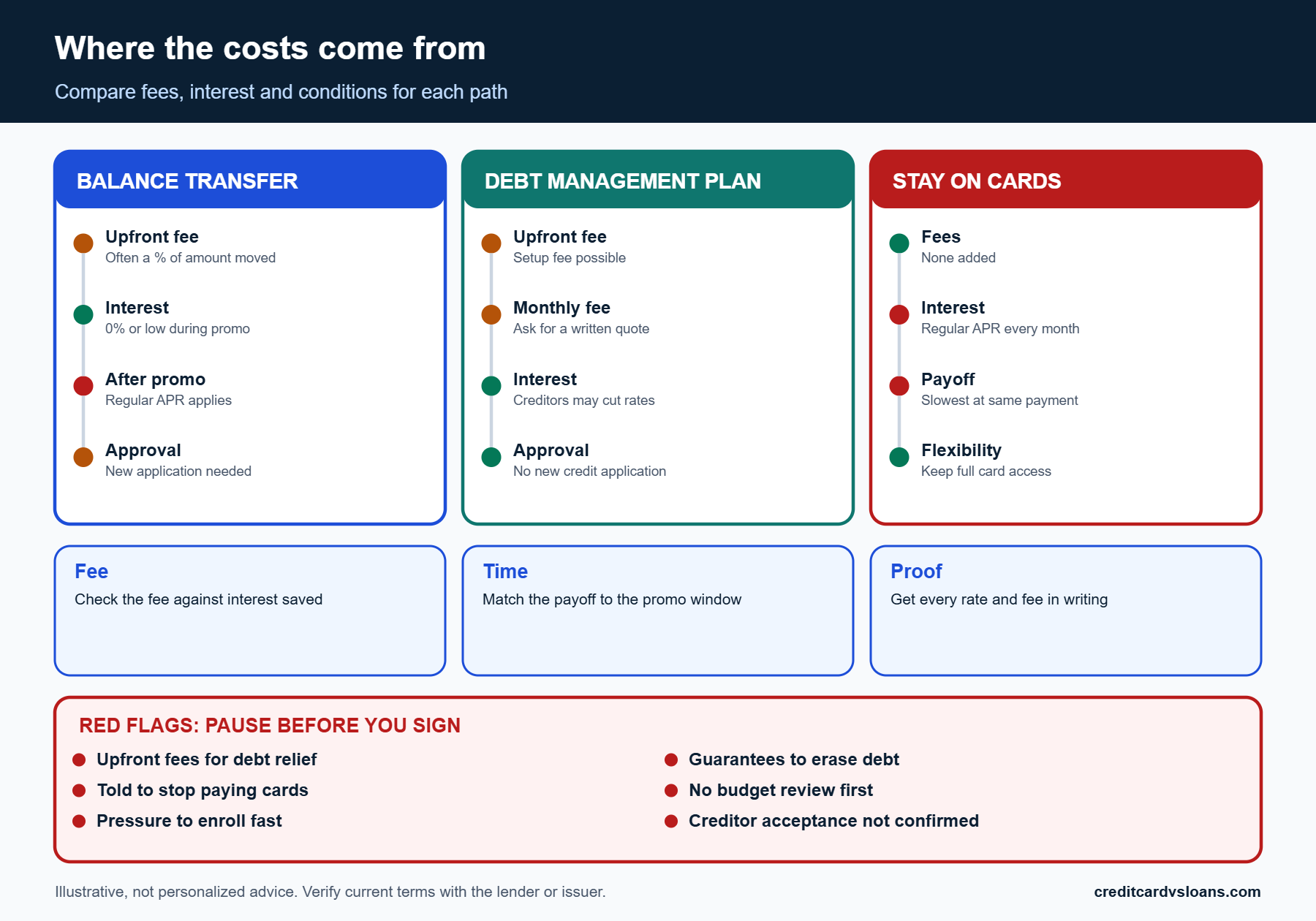
The FTC’s March 2026 consumer alert is blunt: only scammers will tell you to pay them upfront before settling debts or enrolling you in a debt management plan, and any company that promises to settle all your debts or obtain fast loan forgiveness is a scammer. A federal rule also restricts advance fees for debt relief services sold by telephone: under 16 CFR 310.4(a)(5), a provider generally can’t collect fees until at least one debt has been settled or changed under a valid agreement you signed and you’ve made at least one payment under it.
An unexpected call or text offering quick debt settlement that asks for personal or financial information is, according to the FTC, a sure sign of a scam. Don’t reply or share anything, and report it at ReportFraud.ftc.gov.
Promises that sound too good
“Debt forgiveness” ads often blur the line between real programs and fiction. The CFPB lists three warning signs: guarantees that your debt will disappear, instructions to stop communicating with your credit card company, and instructions to stop making minimum payments. If you hear any of those, walk away.
Our guide on what credit card debt forgiveness is and what is a scam sorts the real from the false in more detail.
Questions That Separate Good Help From Bad
Ask about fees, qualifications and pay
The CFPB suggests asking what services an agency offers, what its fees are including setup and monthly charges, what happens if you can’t afford them, what the counselors’ qualifications and certifications are, how employees are paid, and whether you will sign a written agreement. It also suggests asking for two or three past clients as references.
How staff are paid matters: if employees earn more when you sign up, pay a fee or donate, that is a red flag. A reputable organization should be able to answer every one of these without pressure.
Where to look first
The CFPB names the Financial Counseling Association of America, the National Foundation for Credit Counseling, and the U.S. Department of Justice list of approved credit counseling agencies as starting points, and says to verify candidates with your state attorney general and state consumer protection agency. The FTC adds that local credit unions, universities, community colleges and military personal financial managers may offer low-cost credit counseling.
Ask about fees before you sign up with any of them. Nonprofit status alone doesn’t guarantee that the services are free, affordable or legitimate.
Decision Checklist and Next Steps
A Simple Path to a Decision
Put your numbers on one page
List every card with its balance, APR and minimum payment, and add what you can truly pay each month after essentials. Note which cards are current and which are late. This single page is what you’ll use to compare a transfer offer, a counseling agency’s plan, and doing nothing.
Then run the same comparison we used above with your real figures: fee, promotional months, regular APR, monthly agency fee and any interest concessions. If you can’t get a number in writing, treat it as unknown rather than guessing.
Choose, then protect your choice
If a transfer wins and you can be approved for enough, set up automatic payments sized to clear the balance before the promotion ends, and decide in advance how you’ll handle spending on the old cards. If a plan wins, confirm creditor acceptance in writing before you send the first deposit.
If neither clearly wins, a nonprofit counselor can help you decide at little or no cost, and that conversation is not a commitment. Nothing in this guide is personal advice, so use it to prepare the right questions.
Next-Step Checklist
This week
- Pull your free credit reports and list every card’s balance, APR and due date.
- Write down the monthly amount you can reliably put toward debt.
- Call your card issuers about hardship options if any payment is at risk.
- Check whether any balance transfer offers allow you to prequalify with a soft pull.
- Book a session with a nonprofit credit counselor and ask about fees before the session.
Before you sign anything
- Get the transfer fee, promotional period and post-promotion APR in writing.
- Get the agency’s setup and monthly fees, and confirmation that creditors accepted the plan, in writing.
- Calculate the total cost of each path using your own numbers, including fees.
- Set a calendar reminder two months before any promotional rate ends.
- Decide how you will avoid adding new charges while you pay down the balance.
If you can be approved for a big enough limit and pay down fast, a transfer usually costs less. If you can’t, or if you need structure and a longer runway, a debt management plan can cost less than doing nothing even after fees. Get the numbers in writing, then pick the one that holds up on your page.
- Debt Consolidation vs. Debt Settlement: Very Different Risks
- Debt Settlement vs. Balance Transfer: Why These Strategies Aren’t Comparable
- How a Debt Management Plan Affects Your Credit
- How Debt Consolidation Works: Loans, Balance Transfers and Other Options
- Credit Card Debt Forgiveness: What Is Real and What Is a Scam?
- CFPB: What is credit counseling and a debt management plan?
- CFPB: What should I do if I can’t pay my credit card bills?
- FTC: Coping with Debt
- FTC: Looking for debt relief? Here’s how to avoid a scam (March 26, 2026)
- eCFR: 12 CFR 1026.55: Limitations on increasing annual percentage rates, fees, and charges
- eCFR: 12 CFR 1026.53: Allocation of payments
- eCFR: 16 CFR 310.4: Abusive telemarketing acts or practices (debt relief advance fees)
- Federal Reserve: Consumer Credit – G.19 (release of October 7, 2026)
- myFICO: Credit card balance transfers: tips
- myFICO: What’s in my FICO Scores?
- CFPB: How long does negative information remain on my credit report?
- U.S. Department of Justice: List of credit counseling agencies approved under 11 U.S.C. 111
Last updated: October 22, 2026. Rates, fees and lender rules change; verify current terms before acting.
The information on creditcardvsloans.com is provided for general educational and informational purposes only. It is not financial, legal, tax, credit, accounting or investment advice, and reading it does not create an advisor-client, fiduciary or any other professional relationship. Nothing here is an offer, solicitation or recommendation to borrow, lend or apply for any product.
Credit scores, interest rates, fees, eligibility rules, lender policies and laws change frequently and vary by lender, location and individual circumstances. Examples, figures and scenarios are illustrative only, do not predict your results and do not guarantee approval, savings, a particular rate or a credit-score outcome. Always confirm current terms directly with the lender or issuer and read the full agreement before you apply or sign.
Although we aim for accuracy and use reputable sources, we make no representations or warranties, express or implied, about the completeness, accuracy, reliability or timeliness of the content. Content may be drafted with the assistance of automated tools, so errors or omissions may still occur. Links to third-party sites are provided for convenience; we don’t control and aren’t responsible for their content.
To the fullest extent permitted by law, creditcardvsloans.com and its owners, editors, authors, contributors and affiliates disclaim all liability for any loss, damage or expense arising directly or indirectly from your use of, or reliance on, this content. Before making financial decisions, consult a licensed professional, such as a qualified financial advisor, attorney, tax professional or nonprofit credit counselor, who can consider your complete situation.