The business credit card vs business loan decision comes down to one question: is your need a recurring, unpredictable cash-flow gap, or a defined, one-time expense you can repay on a schedule? A card is built for the first, a loan for the second. Choosing the wrong one usually costs you in interest, in fees, or in personal risk.
Most owners don’t have to pick one forever. Plenty of firms use both: a card for day-to-day purchases and short gaps between invoices and payroll, and a term loan or line of credit for larger, planned investments. The real work is matching each tool to the job it’s good at, and knowing what you’re signing personally when you do.
This guide is a decision framework, not a rate sheet. We don’t name lenders or cards, and we don’t quote current rates, because they vary by lender, by your business’s profile and by the date. Where we do cite numbers, they come from primary sources such as the Federal Reserve’s Small Business Credit Survey, the SBA, the CFPB and the FTC, and we date-stamp them. Any math in the article is hypothetical and labeled that way.
- Cards are revolving; loans are installment. A card lets you borrow, repay and borrow again up to a limit. A term loan pays out a lump sum you repay on a set schedule.
- Match the tool to the timeline. Short, repeatable gaps tend to suit a card you can pay off quickly. Larger, planned costs with a payoff date tend to suit a loan or a line of credit.
- Personal liability is common on both. In the Federal Reserve’s 2025 Small Business Credit Survey, 59% of firms with debt said a personal guarantee secured it.
- Consumer card protections often don’t carry over. Under Regulation Z, most consumer credit card rules do not apply to business-purpose cards. Read the agreement for what your issuer promises.
- Compare total cost, not the headline rate. Fees, the repayment term and how fast you’ll repay often matter more than the stated rate alone.
Survey figures come from the Federal Reserve Banks’ 2025 Small Business Credit Survey report on employer firms (fielded Sept. 3 to Nov. 14, 2025). SBA program details reflect SBA.gov pages we reviewed in October 2026. Lender terms, SBA rules and state laws change, so confirm the details with the lender or the agency before you apply.
Business Credit Card vs Business Loan: The Short Answer
Before the detail, here is the practical frame. Each product has a natural home, and the overlap between them is smaller than most comparison pages suggest.
The two products at a glance
What a business credit card actually is
A business credit card is a revolving line of credit. The issuer gives you a limit, you charge purchases or take cash advances against it, and you repay some or all of the balance each month. Unpaid balances accrue interest at the card’s APR, and the available credit refreshes as you repay.
That structure is why cards fit spending that comes in small, frequent pieces: software subscriptions, fuel, supplies, travel, ad spend. It’s also why they get expensive when balances linger, because interest on a revolving balance is typically charged at a variable rate that is higher than most installment financing. We cover the cost mechanics in detail later in this guide.
What a business loan actually is
A business term loan delivers a fixed amount up front, which you repay over a stated term with scheduled payments. Payments cover interest and principal, and the loan ends on a known date. Some loans carry an origination fee, some require collateral, and many small-business loans ask for a personal guarantee from the owners.
Variations include SBA-guaranteed loans, equipment financing, business lines of credit and short-term products such as merchant cash advances. A line of credit sits between the two categories: you draw what you need up to a limit, much like a card, but without the card network. We unpack each variety in the loan section below.
Why the structure drives the decision
Revolving credit rewards discipline and speed. Installment credit rewards planning. If your cash needs are lumpy and you can usually repay within a billing cycle or two, revolving credit can be efficient. If you need a large amount that you’ll repay over many months or years, a fixed schedule gives you a known payment and a known end date.
The trade-off is flexibility versus predictability. A card lets you adapt as the month unfolds. A loan makes you commit up front, and in return it usually costs less per dollar for larger, longer borrowing, though that depends on the lender and your profile.
| Feature | Business credit card | Business term loan |
|---|---|---|
| Structure | Revolving: borrow, repay, borrow again | Installment: lump sum, fixed schedule |
| Best for | Small, frequent purchases and short gaps | Larger planned costs with a payoff date |
| Payment pattern | Minimum due each month; you choose how much more to pay | Set payment each period until the term ends |
| Cost if you carry a balance | Interest accrues on a revolving balance, often at a high variable rate | Interest is built into the schedule; fees may apply |
| Speed to funds | Existing card is instant; new card varies by issuer | Varies from days to weeks or longer, especially for SBA-backed loans |
| Personal liability | Often required from the owner; read the agreement | Often required, especially for smaller firms |
| Consumer-law protections | Many consumer card rules don’t apply to business-purpose cards | Consumer lending disclosures generally don’t apply either |
A fast way to sort your situation
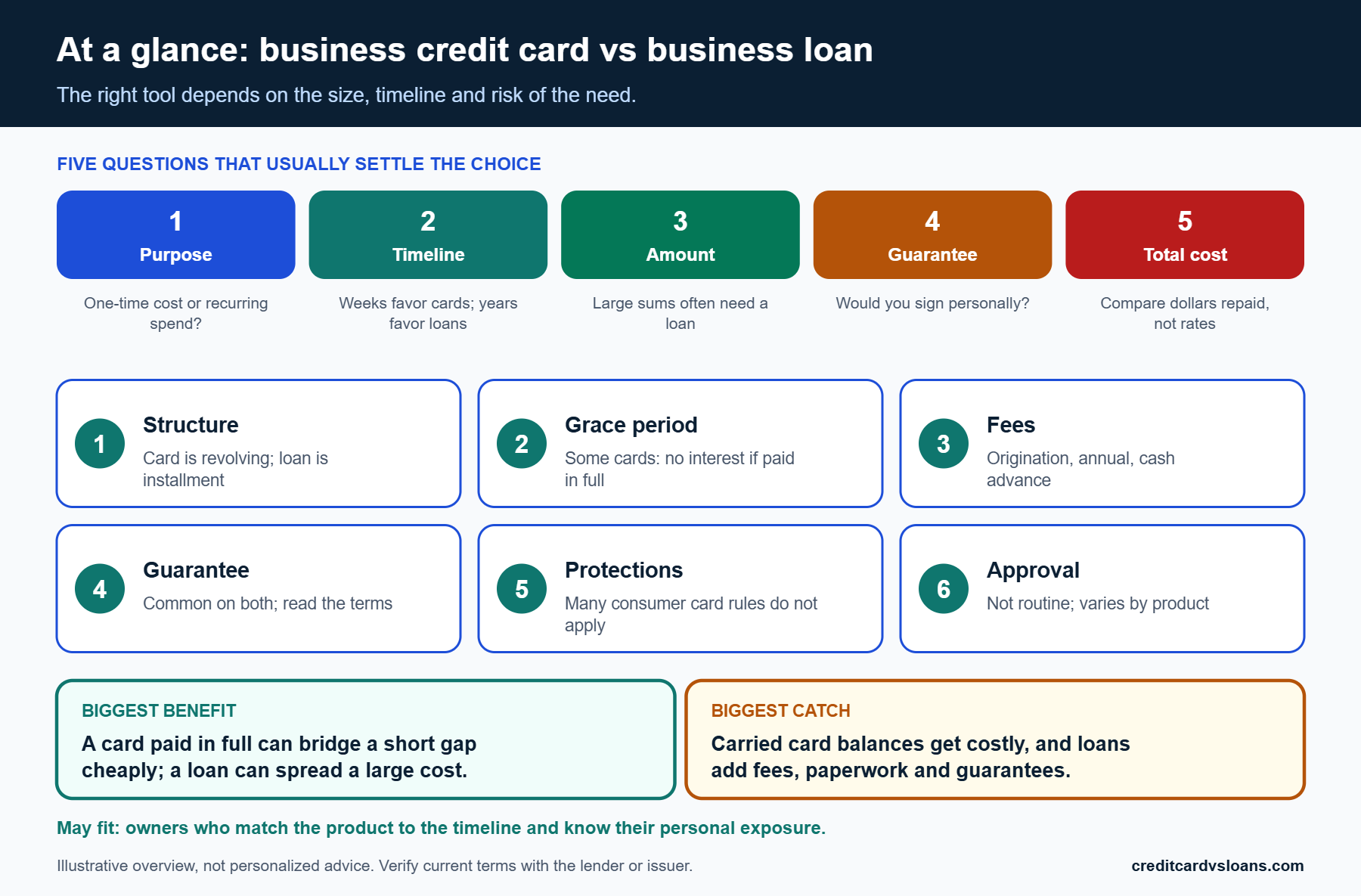
Five questions that usually settle it
Start with the purpose. Is the money for a one-time purchase, such as equipment, or for ongoing operating costs? Then the timeline: can you repay within 30 to 60 days, or will it take a year or more? Then the amount: is it a few thousand dollars or tens of thousands?
Next, certainty. Do you know exactly what you’ll spend, or does the amount depend on how the month goes? Finally, risk tolerance: are you comfortable pledging personal assets or signing a personal guarantee? Short repayment, small amounts and uncertain spending point toward a card. Long repayment, larger amounts and a known cost point toward a loan.
When the card is the clearer pick
A card tends to win when you can pay the statement in full, or nearly so, and when the spending is spread across many small purchases. It also tends to win when speed matters and you already have an open line. Cards can also simplify bookkeeping by consolidating expenses into one monthly statement, and some offer rewards, although rewards are an extra, not a reason to borrow.
The catch: the card gets expensive if “short gap” becomes “permanent balance.” If you find yourself carrying the same balance for many months, that’s a signal the need is structural, and a loan or restructured financing may be cheaper. Watch for promotional APR offers too, since the rate after the promotional period can look very different.
When the loan is the clearer pick
A loan tends to win when you’re buying something with a long useful life, such as equipment or a build-out, and you want payments that line up with the benefit. It also tends to win when the amount is large relative to realistic card limits, or when you want a predictable monthly obligation for budgeting.
It’s not automatically cheaper. Origination fees, prepayment terms and collateral requirements can change the math, and approval is not a given. In the Federal Reserve’s survey, only some applicants received the full amount they sought, which we detail in the next section. Think of the loan as the right tool for planned, bigger borrowing, not as a default.
See how a card compares with a personal loan for consumers if you’re weighing the same tradeoff for personal rather than business borrowing; the logic overlaps, but the legal protections differ.
Two myths that skew the comparison
Myth: a card is always the more expensive option
Cards earn this reputation because carried balances do accrue interest at rates that are often higher than installment financing. But the reputation ignores timing. If you pay the full statement by the due date and your card offers a grace period, a purchase can cost you nothing in interest, while a loan taken for the same few weeks would carry fees and interest from day one. For a gap you can close quickly, the card can be the cheaper tool.
The rule of thumb is that cards are cheap for short borrowing and costly for long borrowing. The same card can be both, depending entirely on how long the balance sits. That is why the honest question is not which product is cheaper, but cheaper for how many months.
Myth: a loan is always the safer option
A loan feels safer because the schedule is fixed and the balance goes down every month. But a fixed payment is also a fixed obligation, and it doesn’t flex when your sales dip. Loans can come with collateral, a personal guarantee, fees and prepayment terms, and a missed payment can set off default clauses that are more severe than a late card payment.
Safety is about whether the structure matches your cash flow and whether you understand what you’ve pledged. A well-matched card paid in full can be safer than a mismatched loan that strains your budget. Neither product is safe on its own; the fit is what protects you.
What the Federal Reserve’s Small Business Credit Survey Shows
Before comparing products in the abstract, it helps to see how real firms borrow. The Federal Reserve Banks’ Small Business Credit Survey is the most widely cited public dataset on the subject, and its 2025 report on employer firms is the latest we reviewed.
What the survey measured and who answered
The sample and its limits
The 2025 report on employer firms was fielded from Sept. 3 to Nov. 14, 2025, and drew 6,525 responses from firms with 1 to 499 employees across all 50 states and the District of Columbia. The report states plainly that the sample is a convenience sample, not a random one. That matters: the numbers describe the firms that answered, and they shouldn’t be read as a precise portrait of every small business in the country.
The survey also covers employer firms only, meaning businesses with at least one paid employee besides the owner. If you’re a sole proprietor or a freelancer with no employees, your financing options and experience may look different, and the survey wasn’t designed to measure them.
How many firms apply, and why
According to the report, 60% of firms applied for financing in the prior 12 months, and 40% did not. Among reasons for applying, the most common was meeting operating expenses (56%), followed by refinancing or paying down debt (46%) and expanding or pursuing new opportunities (42%). The executive summary and the chart on page 11 differ slightly in how they present two of these figures, so treat the exact percentages as approximate and read the direction.
The direction is useful for this article. More than half of applicants were borrowing to cover day-to-day operating costs, which is the cash-flow use case where the card-versus-loan choice matters most. Expansion and refinancing, the classic loan cases, were close behind.
Which products firms applied for
Asked what they applied for, 38% of firms said a loan, line of credit or merchant cash advance, and 29% said a credit card. Trade credit (17%), leases (11%) and factoring (3%) trailed. In other words, a large share of small firms are shopping for both products at once, which is consistent with how many owners actually use them.
Notice what the grouping hides. The “loan, line of credit or merchant cash advance” bucket combines products with very different costs and protections. A bank term loan and a merchant cash advance are not apples-to-apples, even though they share a survey category. We treat the differences in the loan section.
What the numbers suggest about cards versus loans
How firms use cards in practice
The report says 86% of firms use financing regularly, with credit cards and loans the most common products. Among the 4,016 firms that regularly use a credit card, 58% use only a business card, 8% use only a personal card, and 34% use both. That last group is worth pausing on: about a third of card-using firms mix personal and business cards, which can blur the line between your finances and your company’s.
Mixing has consequences. A personal card used for business spending may carry the full set of consumer protections for that card, while a business card often won’t. We explain that difference in the legal section later on. For now, note that the commonest pattern is a dedicated business card, which is the cleaner choice for bookkeeping.
How often applicants got what they asked for
Among applicants, 42% received the full amount they sought, 36% received some or most of it, and 22% received none. By product, the report lists the share of applicants fully approved as 71% for auto or equipment loans, 45% for business lines of credit, 37% for SBA loans or lines of credit, 35% for business loans and 40% for personal loans, among others. These are survey self-reports from a non-random sample, so they are not a forecast of your odds.
What they do show is that approval is not routine, and that it differs by product. A secured, asset-backed loan such as equipment financing was approved far more often than an unsecured business loan. If you’re counting on a loan for a cash-flow need and your timeline is tight, build in the possibility of a smaller offer or a decline.
Personal guarantees are the norm, not the exception
On the question of security, the report found that 59% of firms with debt secured it with a personal guarantee, the most common form of collateral. Business assets were the second most common, at roughly half of debtholders; the executive summary and a footnote differ slightly on the exact figure, 51% versus 49%.
This is one of the most decision-relevant facts in the survey. It means that for most small borrowers, the question isn’t whether you’ll be personally exposed, but how much, and on which product. We return to personal guarantees in a dedicated section.
| Topic | Reported finding | How to read it |
|---|---|---|
| Applied for financing (prior 12 months) | 60% applied; 40% did not | Applying is common, but not universal |
| Top reason for applying | Operating expenses (56%) | Cash-flow needs lead; relevant to the card-vs-loan choice |
| Products applied for | Loan, line of credit or cash advance 38%; credit card 29% | Many firms shop for both |
| Card users who use only a business card | 58% (34% use both business and personal) | A third mix personal and business cards |
| Amount received by applicants | 42% full; 36% some or most; 22% none | Plan for a smaller offer or a decline |
| Debt secured by personal guarantee | 59% of debtholders | Personal exposure is common |
Source: Federal Reserve Banks, 2025 Small Business Credit Survey, report on employer firms. Convenience sample; figures are self-reported.
How a Business Credit Card Works, Including the Fine Print
Cards look simple at the checkout counter. The details that decide whether one is a good fit sit in the cardholder agreement, and they differ by issuer.
Limits, billing cycles and interest
How limits and approval work
An issuer sets your credit limit after reviewing your application. For many small businesses, that review includes the owner’s personal credit history in addition to, or instead of, business credit data, especially for newer firms. Exactly what the issuer weighs, and how it sets the limit, varies by issuer and isn’t something we can state for every card.
Two practical points follow. First, applying can involve a hard pull, which is a credit check that may be recorded on a credit report, while some issuers offer a prequalify step that uses a soft pull and doesn’t affect your score. Second, a limit is a ceiling the issuer chooses, not a measure of what your business can safely carry. Treat it as an upper bound, not a budget.
The billing cycle and the grace period
A card’s billing cycle closes on a statement date, and you owe at least a minimum payment by the due date. Many cards offer a grace period, meaning that if you pay the full statement balance by the due date, new purchases don’t accrue interest. Whether yours does, how long it lasts, and what makes you lose it, are all spelled out in the agreement.
That grace period is the single biggest reason a card can be inexpensive financing for a short gap. If you charge a supplier on the 5th and pay the full statement on the due date, you may get several weeks of float at no interest. The moment you carry a balance past the due date, many cards start charging interest on new purchases too, which is why “pay in full” is the discipline that makes cards work.
How interest on a revolving balance accrues
If you don’t pay in full, interest accrues on the unpaid balance at the card’s APR, which is the annual percentage rate. Most card APRs are variable, meaning they can move when a benchmark rate moves, and the agreement describes how. Interest is typically calculated daily on the balance and added to the account, so the cost of a balance builds with time.
We do not quote current card APRs here because they differ by issuer and by applicant, and they change. The better habit is to read the rate in your own agreement and plug it into a simple worksheet: balance, rate, days outstanding. Later in this guide we show hypothetical math so you can see how the term and the rate interact.
Fees, promotions and who is liable
Fees to look for
Business cards can carry an annual fee, late payment fees, cash advance fees, foreign transaction fees, fees for additional employee cards, and returned payment fees. Not every card has all of them, and some cards waive some fees in some years. The only way to know is to read the fee schedule before you apply.
A cash advance deserves special attention. It generally costs more than a purchase: it can come with an upfront fee and may start accruing interest immediately, without a grace period. Using a card to pull cash for payroll may feel like a loan, but it’s often the most expensive way to use one.
Promotional APR offers
Some cards offer a promotional APR, such as a low or zero introductory rate for a set number of months. These can be useful for a purchase you can repay inside the window. The catch is what happens afterward: any balance remaining when the promotion ends is generally charged at the standard APR going forward, and some promotions have terms about late payments that can end the offer early.
The rule of thumb is to divide the balance by the number of promotional months and see whether that payment fits your cash flow. If it doesn’t, the promotion isn’t solving your problem; it’s postponing it. Treat the offer as a payoff plan with a deadline, not as free money.
Who is on the hook for the debt
Many business cards require the owner to sign a personal guarantee, which makes you personally responsible if the business doesn’t pay. Some issuers hold only the individual who applied liable. Others extend liability to additional signers. The agreement controls, and the terms differ across issuers.
Because a card is often tied to your personal credit profile, the account may also show up in ways that affect your personal borrowing. Whether and how an issuer reports business cards to the personal credit bureaus varies by issuer, so ask before you apply. If you’re also watching your personal score, how card balances affect credit utilization explains why the balance relative to the limit is the number to watch.
| Item | Why it matters | What to check before applying |
|---|---|---|
| Purchase APR | Sets the cost of any balance you carry | Is it variable? How is it set? What does the agreement say about changes? |
| Grace period | Can make short gaps nearly free if paid in full | How long does it last, and what makes you lose it? |
| Annual fee | Adds a fixed cost whether or not you borrow | Is it waived in year one? What is the charge afterward? |
| Cash advance terms | Often the costliest way to use a card | Upfront fee, immediate interest, separate APR |
| Promotional APR | Helpful only if you can repay inside the window | Rate after the promotion; conditions that end it |
| Personal guarantee | You may owe the debt personally | Who signs, who is liable, how it is reported |
How Business Loans Work: Term Loans, SBA Loans and Lines of Credit
“Business loan” covers a family of products. Naming the right member of the family is half the battle, because their costs, speed and risks differ more than the label suggests.
Conventional term loans, lines of credit and equipment financing
Term loans
A term loan is the textbook version: you receive a lump sum and repay it in scheduled installments over a set term. The payment typically covers interest and a slice of principal, so the balance shrinks on a known schedule. That predictability is the main appeal. You can budget a fixed payment and know exactly when the debt ends.
Costs to read for include the interest rate or APR, any origination fee (a charge for processing the loan, often deducted from the proceeds), prepayment terms, and collateral or guarantee requirements. Because fees can be taken out of the amount you receive, the cash you can actually spend may be less than the headline loan size. Ask for the APR and a full fee schedule in writing before you commit.
Business lines of credit
A business line of credit works more like a card than a term loan. You have a limit, you draw what you need, you pay interest on the drawn amount, and available credit comes back as you repay. Many lines have a draw period, renewal reviews and fees such as a maintenance or draw fee, all of which differ by lender.
For firms with uneven receipts, a line can be a cleaner fit than a card because the borrowing is explicit and can be priced as credit rather than as card spending. In the Federal Reserve survey, business lines of credit were fully approved for 45% of applicants, a higher share than unsecured business loans, though the survey’s caveats apply. Lenders may also ask for a personal guarantee on a line.
Equipment financing
Equipment financing is a loan used to buy machinery, vehicles or similar assets, with the equipment itself serving as collateral. Because the lender has something to repossess if you stop paying, it can be easier to get than an unsecured loan: the Fed survey reported auto or equipment loans fully approved for 71% of applicants, the highest among the products it listed.
The trade-off is that the asset is on the line. If the business slows and you can’t pay, the lender can take the equipment, which may be the very thing you need to earn income. Match the term to the equipment’s useful life so you’re not still paying for something that’s worn out.
SBA-backed loans and short-term cash products
How SBA loans work
The U.S. Small Business Administration doesn’t generally lend directly. Per SBA.gov, SBA sets program guidelines and guarantees part of the loan, while the loans themselves are funded and managed by SBA-approved lenders. The agency only makes direct loans to businesses and homeowners recovering from a declared disaster. To start, you enter basic information on the SBA’s Lender Match tool and work with a lender who reviews and approves the loan.
Major programs include the 7(a) loan, SBA’s primary long-term financing program, with a maximum loan amount of $5 million; the 504 loan, which provides long-term fixed-rate financing through Certified Development Companies; and microloans of $50,000 or less delivered through intermediary lenders. To qualify, the business generally must be a for-profit, operating in the U.S., meet SBA size standards, show an ability to repay, and be unable to get the credit it needs on reasonable terms elsewhere. Individual lenders add their own criteria.
SBA rate caps, terms and guarantees
SBA publishes maximum interest rates for variable-rate 7(a) loans as a margin over a base rate, and the cap shrinks as the loan grows: base rate plus 6.5% for loans of $50,000 or less, plus 6.0% for $50,001 to $250,000, plus 4.5% for $250,001 to $350,000, and plus 3.0% above $350,000. These are ceilings, not what any given borrower will pay, and the base rate moves. Maximum maturity is generally 10 years, with up to 25 years when real estate is financed.
SBA guarantees up to 85% of 7(a) loans of $150,000 or less and up to 75% above that, which reduces lender risk, not yours. The lender pays an upfront guarantee fee and may pass it to the borrower; the annual lender’s service fee cannot be charged to the borrower. For loans of $50,000 or less, SBA does not require collateral. For larger loans, the lender follows its own collateral policy, and SBA says a loan shouldn’t be declined solely for inadequate collateral. Which owners must sign a personal guarantee depends on SBA’s operating procedures and the lender, so ask your lender directly.
Merchant cash advances and similar short-term products
Some short-term products advance a lump sum in exchange for a share of future sales or receipts, with repayment often taken as a daily or weekly debit. They are marketed for speed, and they’re often priced with a factor rate or a fixed fee rather than an APR, which makes them hard to compare with loans or cards without converting to an annual cost. Terms differ widely, and these products are not all regulated like consumer loans.
The FTC has pursued funders that allegedly advertised no personal guaranty or upfront costs and then required both, and it has described agreements that included a confession of judgment, which lets a lender obtain a court judgment without the borrower responding. The lesson is practical: get every term in writing, understand what happens if you pay late, and ask for the total repayment amount in dollars. We cover red flags in a separate section.
| Option | Typical use | Repayment | Watch for |
|---|---|---|---|
| Business credit card | Everyday purchases, short gaps | Revolving; pay full or part | Interest on carried balances; personal guarantee |
| Term loan | Planned, larger one-time costs | Fixed installments to a set end date | Origination fee, prepayment terms, collateral |
| Business line of credit | Uneven receipts, seasonal swings | Revolving; interest on drawn amount | Maintenance and draw fees, renewals |
| Equipment financing | Buying machinery or vehicles | Fixed installments, secured by the asset | Repossession risk if you cannot pay |
| SBA 7(a) loan | Working capital, equipment, refinancing, real estate | Monthly installments; term up to 10 years (25 for real estate) | Lender requirements; processing time varies |
| SBA microloan | Small start-up or working-capital needs (up to $50,000) | Installments through an intermediary | Intermediary criteria vary |
| Short-term cash advance | Fast cash when other options are closed | Daily or weekly debits from sales | Hard-to-compare pricing; personal guaranty; harsh remedies |
If you’re also comparing personal borrowing options for a sole proprietor-style need, the card versus personal loan comparison lays out the consumer side, where a different set of protections applies.
Total Cost: Business Credit Card vs Business Loan, Side by Side
This section is where the decision usually gets made. The numbers below are hypothetical and chosen only to show how rate, term and fees interact. They are not offers, and real pricing depends on the lender, your business and the date.
How to compare cost on a level playing field
Rate, APR and factor rates are not the same thing
A stated interest rate is the price of the money. An APR folds in certain fees to express the yearly cost, which makes it the better yardstick between loans. Some products, including merchant cash advances, quote a factor rate (a multiplier, like 1.3, applied to the amount advanced) instead of an APR. A factor rate looks small, but if you repay it over a few months, the equivalent annual cost can be far higher than the number suggests.
So before you compare, convert everything to the same units: total dollars repaid, the term, and the APR if the lender will provide one. If a lender won’t or can’t state the total cost in dollars, treat that as a signal to keep shopping. Remember, business lenders are generally not subject to the consumer APR disclosure rules that apply to consumer loans, so you may need to ask for the figure.
The repayment term changes the bill
A longer term lowers the monthly payment and raises the total interest, because you owe interest on the balance for more months. A shorter term does the opposite. With a card, you choose the term every month by deciding how much to pay above the minimum, which is flexible but easy to let slide.
That’s why the same APR can be cheap on a 45-day gap and expensive over two years. The honest comparison is always rate times time. Pick the realistic number of months you’d carry the borrowing, not the most optimistic one.
Fees that move the real price
An origination fee reduces the cash you receive while the payment is based on the full loan amount. In a hypothetical example, a $30,000 loan at 9% over 36 months has a payment of about $953.99 and total interest of about $4,344. If a 3% origination fee ($900) is deducted up front, you receive $29,100 but still repay on $30,000. Working that through, the effective annual cost is roughly 11.1%, not 9%.
The same logic applies to card annual fees, cash advance fees and line-of-credit maintenance fees. A 9% loan with a 3% fee can cost more than a 10% loan with no fee. Always ask for the fee schedule and calculate the all-in cost before choosing on the headline rate.
Hypothetical numbers: when each product wins
The same $20,000 at two rates and two terms
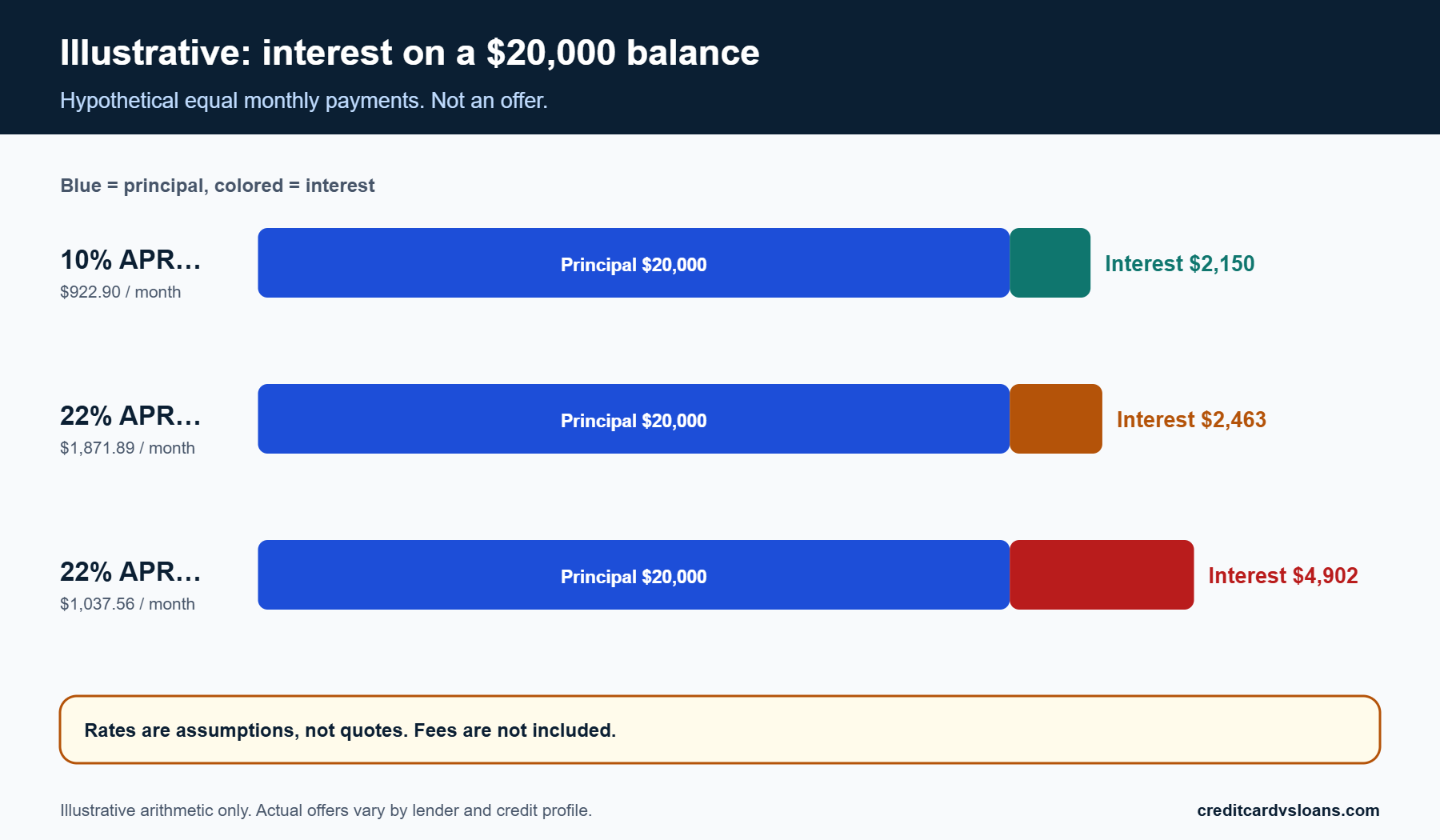
The table shows a hypothetical $20,000 repaid in equal monthly payments, using an illustrative 10% APR (a loan-like rate) and an illustrative 22% APR (a revolving-balance-like rate). These rates are assumptions for the illustration, not market quotes.
| Scenario (illustrative APR, term) | Monthly payment | Total interest | Takeaway |
|---|---|---|---|
| 10% APR, 12 months | $1,758.32 | $1,100 | Short and lower rate: least interest |
| 22% APR, 12 months | $1,871.89 | $2,463 | Same term, higher rate more than doubles interest |
| 10% APR, 24 months | $922.90 | $2,150 | Lower payment, more interest than 12 months |
| 22% APR, 24 months | $1,037.56 | $4,902 | Long and high rate: most interest |
The monthly payment difference between a 10% and a 22% rate at 24 months is only about $115, which makes the higher rate feel affordable. The total interest difference is more than $2,700. This is the pattern to watch: the monthly payment hides the cost.
A short gap on a card versus a loan
Now a different scenario. Suppose a customer’s invoice arrives 45 days after you must make payroll of $15,000. If you put the cost on a card and pay the full statement balance by the due date, and your card has a grace period, you may owe no interest at all. If you instead carried the $15,000 at an illustrative 22% APR for those 45 days, simple interest would be roughly $407 ($15,000 x 0.22 x 45/365).
Compare that to a term loan for the same short gap: even with a modest fee, a loan processed over days or weeks may cost more than the card and arrive too late. For a 45-day gap that you can clear in full, the card often wins on cost and speed. For a need that won’t clear for a year, the same card can turn expensive quickly.
A larger, longer need where a loan can win
For a hypothetical $50,000 purchase repaid over 60 months, an illustrative 9% APR gives a payment of about $1,037.92 and total interest of about $12,275. At an illustrative 12% APR, the payment is about $1,112.22 and total interest about $16,733, a difference of roughly $4,458. Those are the stakes of rate shopping on a larger, longer loan, even without any fees.
Few cards would give you a $50,000 limit at a rate competitive with a term loan, and carrying that size of balance on a card for five years would usually be costlier. Here the loan’s fixed term and generally lower rate for the amount are the point, provided you qualify, can handle the payment, and understand the guarantee.
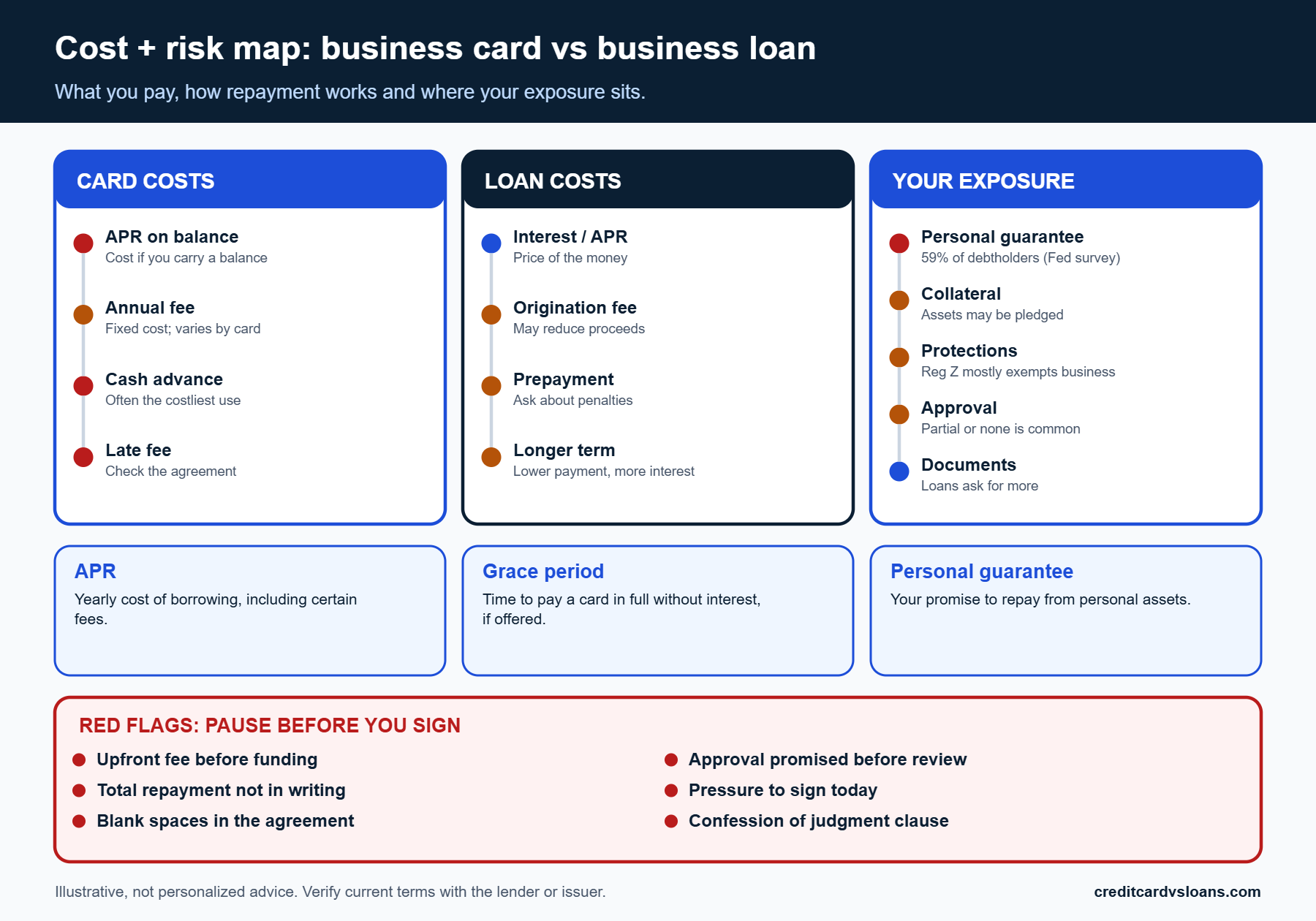
Cash Flow Fit: Matching the Product to Your Timing
Cost is only half of the picture. A product can be cheap and still fail you if its timing doesn’t match the way money moves through your business.
Common cash-flow patterns and the products that suit them
The invoice gap
If you bill customers on net-30 or net-60 terms but pay staff and suppliers on a faster schedule, you have an invoice gap. The need is short, recurring and tied to a predictable event: the day the invoice is paid. A card paid in full when the receipt arrives, or a line of credit you draw and repay, tends to fit this pattern better than a term loan, because you don’t want to pay interest for years on a gap that closes in weeks.
The risk is that a late-paying customer turns a 30-day gap into a 90-day one. Build a plan for that case in advance: which account you’d draw on, how much it would cost per extra month, and whether you could tolerate the cost. If delays are routine, the gap isn’t a gap, it’s a financing structure, and a line of credit or a restructured payment term with your customers may be the more durable fix.
Seasonal swings
Seasonal businesses build inventory or hire ahead of a busy period and collect weeks or months later. The need is larger and the timeline is longer than a typical invoice gap, but it still has a clear payoff point. A line of credit that you draw before the season and repay after it is a common fit, because you pay interest only on what you use and only while you use it.
A card can cover the smaller piece, such as supplies and marketing. For larger inventory purchases, the limit may not stretch far enough, and carrying a balance across the off-season can turn into the expensive scenario in Table 5. Map the season on a calendar and be honest about the month you’d actually be debt-free.
One-time growth spending
Buying equipment, renovating, opening a second location or hiring a team has a different shape: a large expense up front, with payback spread over years. A term loan or equipment financing matches that shape, because the payments run alongside the benefit. A card would put a long-term cost on short-term, high-rate financing.
The key discipline is to match the term to the useful life of what you’re buying, and to stress-test the payment against a slow quarter. If the project only works when sales are strong, the loan payment becomes a risk rather than a tool.
| Cash-flow pattern | How long is the need? | Often a good fit | Main risk |
|---|---|---|---|
| Invoice gap (30 to 60 days) | Weeks | Card paid in full, or a line of credit | Customer pays late; balance rolls over |
| Seasonal inventory build | Months | Line of credit; term loan for larger amounts | Slow season stretches repayment |
| Equipment purchase | Years | Equipment financing or term loan | Payment outlasts the asset’s usefulness |
| Ongoing small expenses | Recurring | Business card, paid monthly | Balances creep up and are carried |
| Large expansion | Multi-year | SBA-backed or conventional term loan | Personal guarantee; approval and timing uncertainty |
| Emergency cash crunch | Unknown | Compare all options; avoid pressure offers | Costly, fast products; upfront-fee scams |
Building a cash-flow picture before you choose
Map your actual receipts and payments
Take the last 6 to 12 months and chart when money came in and when it went out, week by week if you can. Mark the low points. The size and length of the lowest point is your real borrowing need, and it’s often smaller or shorter than people assume when they start shopping.
Include fixed costs (rent, payroll, loan payments, taxes) and variable ones. Estimated tax payments and quarterly bills are common blind spots. A dated map will tell you whether you need a 30-day bridge or a 12-month facility, and that decides which section of this guide matters most to you.
Stress-test the payment
Whatever you choose, test the payment against a bad month. What if revenue falls 15% or 25% for a quarter, or a major customer pays 30 days late? Could you still make the loan payment or pay the card in full? If the answer is “only by borrowing more”, the structure is too tight.
This is also where a card’s flexibility helps and hurts. The minimum payment is low, which keeps you current in a pinch, but the balance stays. A fixed loan payment is higher and less forgiving, but it forces repayment. Choose the one whose failure mode you can live with.
Keep a buffer, not just a plan
Financing is a bridge, not a floor. If you rely on a card limit or an undrawn line as your only liquidity, a lender can reduce or freeze it, and you may be unable to borrow exactly when you need to. A modest cash reserve and a diversified set of options protect you from the single point of failure.
That doesn’t mean sitting on cash you can’t afford to. It means knowing, in advance, your second and third choices if the first one closes. For rate trends that may affect variable-rate borrowing, the latest credit card and personal loan rate outlook shows how we track conditions, though business pricing differs.
Personal Guarantees, Liability and Which Protections Apply
For many owners, the biggest difference between business and consumer borrowing isn’t the interest rate. It’s what happens to your personal assets if the business can’t repay, and which legal protections you actually have.
Personal guarantees explained
What a personal guarantee means
A personal guarantee is your written promise to repay the debt from your own assets if the business doesn’t. It can be unlimited, covering the whole debt plus costs, or limited, capped at an amount or a share. It often sits on top of the business’s own obligation, so a company structure such as an LLC or a corporation doesn’t necessarily shield you from this particular debt.
Guarantors who sign the same agreement can be jointly and severally liable, which means the lender may pursue any one of them for the entire amount. SBA’s own guarantee form instructions note this. Read the document itself rather than relying on a summary, including who signs and what is pledged.
How common they are
In the Federal Reserve’s 2025 survey, 59% of debtholders reported securing their debt with a personal guarantee, making it the most common form of collateral, ahead of business assets. That fits what most small borrowers experience: the lender looks to the owner as the backstop, particularly when the business is young or thin on assets.
This applies to cards as well as loans. Many business card issuers require the owner to guarantee the account personally. The survey figure covers debt generally, not each product, so we can’t tell you the rate for any single one. Ask the specific issuer or lender.
Questions to ask before you sign
Before agreeing to a guarantee, ask who must sign, whether it is limited or unlimited, whether it ends when the loan is repaid or survives renewals, and whether any of your personal assets, such as a home, are pledged. Ask what the lender can do first: pursue the business assets, or come straight to you.
If the answer is unclear, get it in writing and consider a review by a lawyer or an accountant. SBA says lenders and programs differ on which owners must provide a guarantee, so don’t assume the answer from a different loan carries over.
Consumer protections: what carries over and what doesn’t
The Regulation Z business-purpose exemption
The federal Truth in Lending rules are written in Regulation Z, which also implements the consumer credit card protections added by the CARD Act. According to the CFPB’s text of Regulation Z (12 CFR 1026.3), credit extended primarily for a business, commercial or agricultural purpose is exempt, as is credit extended to a non-natural person such as a corporation. For business-purpose credit cards, the CFPB’s commentary says the rest of the regulation does not apply, with two exceptions covered next.
In plain terms, many of the features consumers rely on, such as detailed disclosures, billing-error procedures and the card-specific rules adopted after the CARD Act, don’t automatically apply to a card issued for business purposes. Some issuers voluntarily extend similar terms, but that is a matter of their agreement, not federal law, so read it.
What still applies to business cards
The CFPB’s commentary says the provisions in Section 1026.12(a) and (b), which cover how cards are issued and the cardholder’s liability for unauthorized use, apply to all credit cards, including those issued for otherwise exempt credit. So a few protections do reach business cards, including limits on unauthorized-use liability. The specific rules in Section 1026.12(b) have particular provisions for business cards with multiple employee cardholders, so check how your issuer’s terms work.
The reverse case matters too. If you use a personal, consumer-purpose card for business expenses, the full regulation continues to apply to that card, including billing-error rights for the business charges. And a card can switch between consumer and business purpose at renewal, which changes the protections. This is one reason some owners keep a dedicated business card while others stay with a personal one.
What to do about the gaps
Assume the protections you’d have on a personal card may be absent, and verify before you rely on them. Read the cardholder agreement for rate-change terms, penalty fees, how payments are applied and how disputes work. Ask the issuer in writing what it provides if the answer isn’t in the document.
State law varies. Some states have rules on commercial financing disclosures, and state banking regulators handle complaints about licensed lenders. The CFPB maintains a directory of state banking regulators, and the SBA can point you to local resources. If you can’t tell what applies in your state, ask a regulator or an attorney rather than guessing. For consumer-side comparisons where the full set of protections does apply, see our consumer card versus personal loan guide.
Qualifying and Credit Impact: What Lenders Look At
Whether you apply for a card or a loan, the lender is asking the same two questions: can this business repay, and what happens if it can’t? How each product answers them shapes your chances, your price and your paperwork.
What underwriters typically review
Business and personal credit
For newer or smaller firms, lenders often review the owner’s personal credit alongside any business credit file. A thin credit file, meaning limited history or few accounts, can limit options or push pricing up. Exactly which scores a lender uses, and which cutoffs it applies, varies by lender and product. We don’t publish score thresholds here, because no universal minimum exists and the ones advertised are often marketing, not policy.
What you can do is check your own reports ahead of time. Errors and old accounts you didn’t recognize are worth catching before a lender sees them. Keep in mind that preparing is not the same as being approved: no one can promise approval, and you should be skeptical of anyone who does.
Revenue, time in business and documentation
Loans usually ask for more documentation than cards. Expect requests such as tax returns, bank statements, profit and loss statements, a list of debts, and details on ownership. The SBA says it looks for a for-profit business that is registered, operating, creditworthy enough to assure repayment and has a sound business purpose. Lenders add their own rules on revenue and time in business.
Cards are usually quicker because the issuer relies on less documentation, though it may still ask for revenue or business details. That speed comes at a price you can’t see in the application: lower flexibility on limits, and a shift in who bears risk. A loan application asks more of you up front, and in exchange can fit a larger need.
Debt load and cash flow
Lenders compare what the business earns with what it already owes. For loans, they commonly look at debt service, meaning the payments the business must make on existing debt, relative to income. Higher existing obligations can reduce how much you can borrow or increase pricing.
Refinancing or paying down debt was the second most common reason firms gave for applying in the Fed survey. If you already carry high-cost balances, a loan that consolidates them may be worth pricing out, but only if the total cost, including fees, is lower than staying put.
| Item | Card application | Loan application |
|---|---|---|
| Business details (legal name, structure, EIN or SSN, address) | Usually required | Required |
| Annual revenue and expenses | Often asked | Required, usually documented |
| Tax returns and bank statements | Sometimes | Commonly required |
| Debt schedule | Sometimes | Commonly required |
| Personal credit consent | Often | Often |
| Collateral or guarantee details | Personal guarantee often | Varies: collateral, guarantee or both |
How these products can affect your credit
Inquiries and new accounts
A hard pull, which is a credit inquiry from a lender reviewing your application, can cause a small, temporary dip in a personal score. Prequalifying with a soft pull generally does not affect your score, though not every issuer or lender offers it. Applying for several products in a short span can add up, so apply deliberately and gather prequalification offers first where available.
Rate shopping within a short window is often treated as a single inquiry for some scoring models, but the rules differ by model and by loan type, so don’t assume it applies to your situation. A new account also lowers the average age of your accounts, which can matter for thin files.
Utilization and payment history
On revolving accounts, the share of your limit you’re using, called utilization, can influence scores when the card reports to the personal bureaus. Whether a particular business card does is up to the issuer, so check before you apply. Our guide to credit utilization explains how balances and limits interact for consumer scoring.
Payment history is the heavy factor: late payments can damage a score, and defaults can bring collection and legal consequences, especially where you’ve guaranteed the debt personally. Whatever you choose, set up automatic payments for at least the minimum and calendar the due dates.
Keeping personal and business finances separate
Using a personal card for business, or the reverse, tangles bookkeeping and may change your legal protections, as described earlier. A separate business account and card make the books cleaner at tax time and can make it easier to show a lender your business’s true cash flow.
Separation isn’t a legal shield by itself, especially when you’ve guaranteed the debt. But it’s still good hygiene. Over time, a record of on-time payments on business accounts can support future applications, though we can’t say how much or how quickly, and no one should promise a score change.
Red Flags, Scams and Predatory Offers
Business owners under pressure are targets. The FTC runs a dedicated resource on scams against small businesses, and its financing-related warnings are consistent: be wary of speed, secrecy and upfront money.
Warning signs in the offer
Upfront fees and approval promises
The FTC describes advance-fee loan scams as offers that promise a loan or credit card regardless of credit history, then demand an upfront fee labeled as processing, insurance or an application cost. According to the FTC, once the money is paid, no loan appears. Telemarketers can’t legally ask for payment for a loan in advance, and a pitch that arrives as an unsolicited call or recorded message deserves extra suspicion.
Related red flags include claims of approval before any review, pressure to sign today, refusals to put terms in writing, and requests to pay by wire, cryptocurrency or gift card, which are hard to recover. Legitimate lenders disclose their fees and rarely require payment before funding beyond clearly documented costs.
Opaque pricing and harsh terms
In its alert on funders that harm small businesses, the FTC described a company that allegedly advertised no personal guaranty or upfront costs, then delivered less money than promised, required personal guarantees and charged large upfront fees. It also described agreements that included a confession of judgment, which lets a lender obtain a court judgment without the borrower responding.
The practical takeaway is to ask for the total repayment amount in dollars, the payment schedule, every fee, what happens on a late or missed payment, and whether you’re signing a guarantee or a confession of judgment. If the lender can’t answer in writing, move on. Our guide on red flags in a loan agreement walks through the clauses worth reading line by line, although it is written for personal loans.
Blank spaces, blame-shifting and rushed signatures
Never sign an agreement with blank fields, and never accept a verbal explanation that the written terms contradict. If the document and the salesperson disagree, the document is what binds you. Ask for a copy of everything before you sign, and keep it.
A real lender can wait a day while you read. If someone insists that the offer disappears in an hour, or that a competitor is about to take the deal, treat the pressure itself as the warning.
What to do if something looks wrong
Verify the lender
Confirm the lender is licensed or registered where required, by checking with your state’s banking regulator or attorney general. The CFPB provides a directory of state banking regulators on its website. Search the company’s name together with words like “complaint” or “scam”, and look for consistent patterns, not a single review.
For SBA-backed loans, start from SBA.gov and its Lender Match tool rather than responding to a cold call that mentions the SBA. SBA says it works through approved lenders, so anyone claiming SBA will send you money directly outside a declared disaster deserves scrutiny.
Report and get help
If you suspect a scam, report it at ReportFraud.ftc.gov. If you’ve already paid, act quickly, because payments by wire, crypto or gift card are difficult to reverse. Contact your bank or card issuer right away, and keep records of every message and receipt.
Consider free or low-cost advice before signing something large. Local Small Business Development Centers and other SBA resource partners can review your options, and a qualified attorney or accountant can read the contract. None of these is a substitute for reading it yourself.
Six Hypothetical Scenarios: Which Tool Fits Which Job
The following scenarios are invented to illustrate how the logic plays out. They are not real businesses, and the numbers are round and illustrative. Your own cash flow, credit profile and lender terms will decide what is possible.
Scenarios where a card tends to fit
A small design studio with monthly software and ad spend
Imagine a studio that spends a few thousand dollars a month on software, stock assets and ads, and collects from clients within 30 days. The spending is steady, the gap is short, and the owner can pay the statement in full each month. A business card with a grace period is a natural fit: the purchases are consolidated, the statement serves as a record, and no interest accrues as long as the balance is cleared by the due date.
The warning sign is drift. If one slow quarter leaves a balance that the owner carries for six months, the card has quietly become a high-rate loan. The fix is to set a rule in advance, such as moving any balance that remains after two statements into a cheaper installment product, and to track the balance monthly instead of waiting for the statement.
A contractor bridging a 45-day payment delay
Picture a contractor who must buy $15,000 in materials now but won’t be paid for 45 days. If the card has a grace period and the owner pays the full statement on time, the cost of the bridge could be close to zero, apart from any fees. If the balance is carried at an illustrative 22% APR for the 45 days, simple interest is roughly $407, as computed earlier.
Even the costly version is likely cheaper than a loan that closes in three weeks and carries an origination fee. The risk is the client who pays late. A clear understanding of the payment date, written into the contract, matters as much as the card.
A seasonal retailer with a short holiday inventory build
Consider a retailer that buys holiday inventory in the fall and sells most of it in the final weeks of the year. A card can cover part of the purchase, and a line of credit can cover more, with both repaid in January. The structure fits because the revenue event is predictable and the payoff is close.
Where it goes wrong is a weak season. Unsold inventory leaves balances in place into the spring, and interest keeps accruing. The retailer should decide ahead of time how much inventory it can afford to carry on revolving credit if sales disappoint, and cap the build there.
Scenarios where a loan, or a blend, fits
A restaurant buying a $50,000 piece of kitchen equipment
A restaurant plans to replace a major piece of equipment that it expects to use for a decade. The cost is large, the item has a long useful life, and a fixed payment is easy to budget. Equipment financing or a term loan fits, since the term can be set to the equipment’s useful life, and the payment sits alongside the savings or revenue the equipment produces.
As the hypothetical $50,000 example earlier shows, a few points of APR on a five-year term can mean thousands of dollars, so the owner should collect several offers and compare APRs and total dollars repaid. The owner should also read the guarantee, since the equipment may be only part of what secures the debt.
A two-year-old firm seeking working capital through an SBA-backed lender
A young firm wants working capital to hire and grow. It prefers a lower payment over a longer term and is willing to spend time on paperwork. An SBA-backed loan is worth exploring, because SBA guarantees part of the loan to reduce the lender’s risk and sets maximum rates and terms. The firm would use Lender Match, work with an approved lender, and expect a more document-heavy application than a card.
No result is certain. The Fed survey shows SBA loans were fully approved for 37% of applicants in its sample, and individual lenders set their own criteria. The sensible approach is to apply with accurate numbers, ask about timelines up front, and keep a backup plan in case the answer is no or arrives late.
A blended approach for a growing e-commerce shop
A growing shop buys inventory in bulk twice a year, runs steady advertising spend, and plans a warehouse upgrade. It could put recurring ad spend and supplies on a business card paid in full, use a line of credit for the bulk inventory purchases, and finance the warehouse upgrade with a term loan. Each piece of borrowing has a payoff date that matches its purpose.
The cost of blending is complexity: more accounts, more due dates, and more places for a guarantee to attach. A single dashboard of balances, rates and due dates, reviewed monthly, keeps the structure under control. Without one, the combined obligations can exceed what any single product would have allowed.
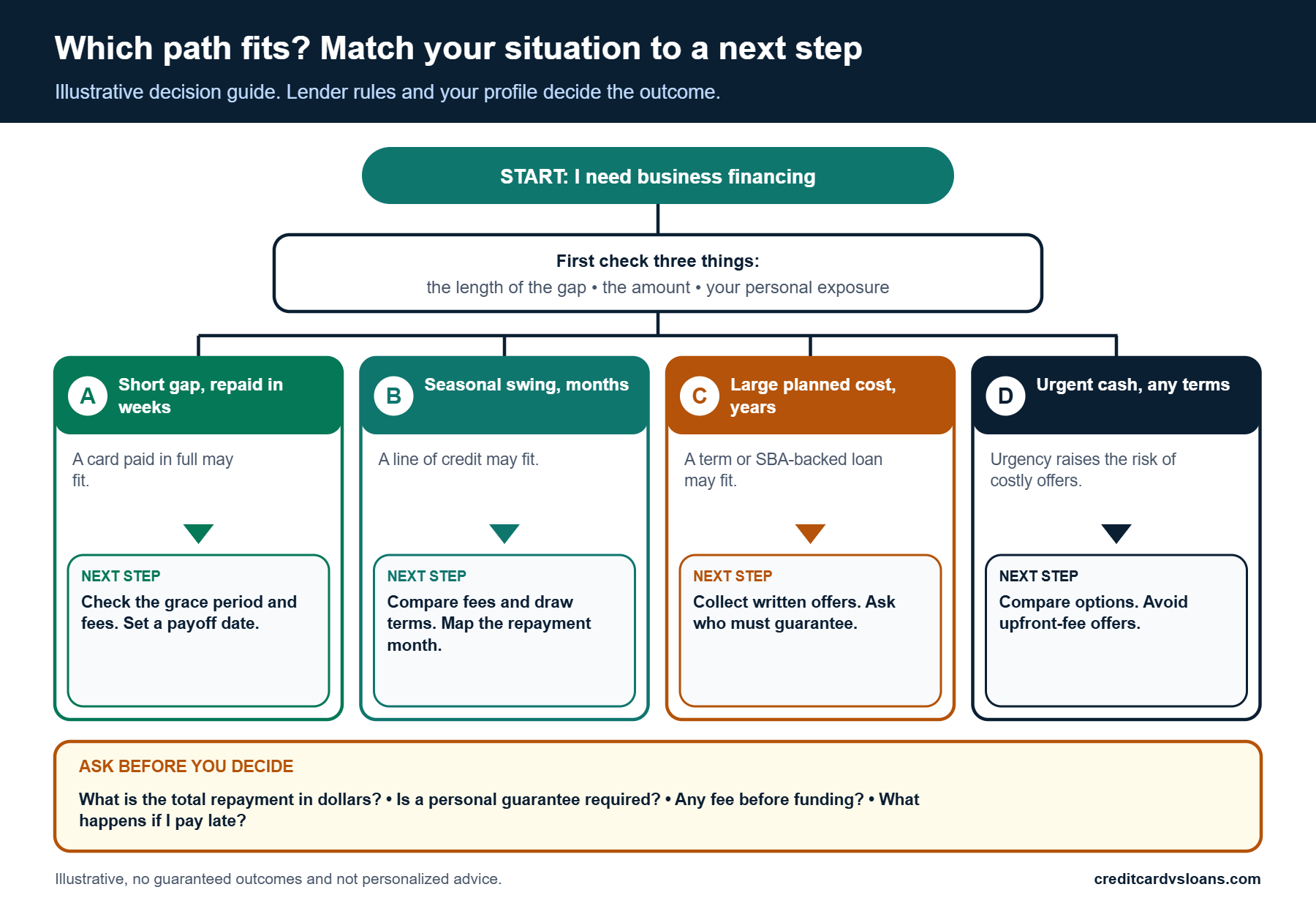
Your Pre-Application and Pre-Signing Checklist
Most costly mistakes in business borrowing happen before the application or at the signature. This checklist is built to catch them at both points.
Before you apply
Define the need in dollars and dates
Write down the amount you need, the date you need it, and the date you expect to repay it. Be specific about where repayment comes from: which invoices, which sales period, which refinancing. A need with a clear repayment source is easier to match to a product, and it’s easier to explain to a lender.
- How much, exactly, and what is it for?
- When will the money be needed, and when will it come back?
- What is the worst-case delay, and could you still repay?
- Is the need one-time, recurring, or growing?
If the answers show that the need keeps returning, you’re probably looking at a structural cash-flow issue. A line of credit, better payment terms from customers or a longer-term loan may address it more cheaply than repeated card balances.
Gather your documents and check your reports
Collect recent bank statements, tax returns, a profit and loss statement, a list of existing debts with balances and payments, and ownership details. Pull your personal credit reports and, if you have one, your business credit file, and look for errors. Disputing a mistake takes time, so start early.
Know your numbers before the lender asks. Be ready to explain any dip in revenue, any late payment, and any recent large purchase. A short, honest explanation is better than a surprise discovered during underwriting.
Collect comparable offers in writing
Get at least two or three written offers, using prequalification where it’s available, so a soft pull rather than a hard pull is used. For each, record the loan amount or limit, the interest rate and APR, all fees, the term, the payment, the total repayment in dollars, prepayment terms, collateral and guarantee requirements.
Put them side by side on one page. If a lender won’t give a number in writing, treat that as information. This is the apples-to-apples step that the business credit card vs business loan decision depends on.
Before you sign
Read the whole agreement
Read every page, including the fee schedule, the default and remedies sections, and any clause about confession of judgment, cross-default, or automatic debits. Cross-default means a default on one obligation can trigger a default on others. Automatic debits can drain an account on days when cash is tight, so confirm the amounts and dates.
- No blank fields; every figure filled in.
- APR, total repayment and fees match what you were quoted.
- Late-payment fees, default interest and acceleration terms are clear.
- You know whether prepayment carries a penalty.
If a term differs from what you were told, ask for the correction in writing before you sign. A verbal promise won’t help you later.
Understand your personal exposure
Know whether you’re signing a personal guarantee, whether it’s limited or unlimited, who else is signing, and whether any personal assets are pledged. Ask what happens if the business closes or is sold. For SBA-backed loans, ask the lender which owners must guarantee, since requirements depend on program rules and the lender.
Consider having a lawyer or accountant review a large agreement. The cost is small compared with the risk of an unlimited guarantee you didn’t understand.
Build the repayment into your calendar
Set payment reminders and, where it makes sense, automatic payments, but only for amounts you can cover. Put the due dates on the same calendar as payroll and tax dates. For cards, decide the rule for paying the statement in full, and for what triggers a move to a cheaper product if a balance persists.
Revisit the plan monthly for the first quarter. If revenue is tracking below the plan, talk to the lender early. Many lenders are more willing to adjust terms before a missed payment than after one.
The Bottom Line: Choosing Between a Business Credit Card and a Business Loan
If you read only one section, read this one. The choice is rarely about which product is better in general; it’s about which fits your cash flow, your timeline and your tolerance for personal risk.
A decision summary
When a business credit card usually makes sense
A card usually makes sense when your spending is frequent and small, the need is short, you expect to pay the full statement balance on time, and you want speed and simple records. The grace period can make it very inexpensive financing for a gap measured in weeks. It makes less sense when you expect to carry a balance for many months, because revolving rates are generally higher than installment rates, though pricing depends on the issuer and applicant.
Before you rely on one, check the guarantee terms and remember that most consumer card protections don’t automatically apply to business-purpose cards.
When a business loan usually makes sense
A loan or line of credit usually makes sense when the amount is large, the use has a long life, and a fixed payment with a known end date helps you plan. For larger and longer needs, the potential rate and term advantage can outweigh a card’s convenience, as the hypothetical $50,000 example showed. SBA-backed programs are worth exploring if you can handle a slower, more document-heavy process.
Loans demand more of you in advance: documentation, possible fees, collateral or a guarantee, and a real chance of a partial approval or a decline. Plan for those, and keep a second option alive while you wait.
When a mix makes sense
Many firms use both: the card for day-to-day purchases, paid in full, and a loan or line of credit for planned, larger needs. The mix works when each product has a defined job and a payoff plan, and when you track the total of all your obligations, including guarantees, in one place.
If you’re unsure, start with the smaller, shorter, easier-to-reverse commitment and learn from it. Then step up to a larger loan when you have a clear picture of the cash flow, and a lender who has seen your numbers.
Use revolving credit, like a card, for short and repeatable gaps you can clear quickly. Use installment credit, like a term loan or SBA-backed loan, for larger planned costs with a payoff date. Compare total dollars repaid, read the guarantee, and never assume consumer protections apply to a business account.
Questions that come up after the decision
What if I’m turned down or offered less than I asked for?
It happens often. In the Federal Reserve’s 2025 survey, 36% of applicants received some or most of what they sought and 22% received none. Ask the lender for the reasons in writing, check whether your credit reports or financial statements contain errors, and consider whether a smaller amount, a different product or a longer lead time would work.
Avoid the temptation to apply everywhere at once, since multiple hard pulls can add up. Instead, use prequalification where it’s offered, and consider an SBA resource partner or a Small Business Development Center for a second opinion on your application.
Should I use a loan to pay off business card balances?
Maybe, if the all-in cost is lower and you can handle the new payment. Compare the total dollars you would pay by keeping the balance on the card with the total on the loan, including any origination fee. A lower rate on a much longer term can still cost more in total, as the hypothetical tables showed.
The bigger risk is behavioral. If you consolidate the balances and then run the cards back up, you carry both the loan and new card debt. Decide in advance what changes in your cash flow so the balances don’t return.
Can I just use my personal card for business expenses?
You can, and many firms do: the Federal Reserve survey found about a third of card-using firms use both business and personal cards. According to the CFPB’s commentary on Regulation Z, a consumer-purpose card used for business keeps its consumer protections, including billing-error rights for the business charges. That’s a point in its favor.
The costs are practical. Business and personal spending blend together, bookkeeping gets harder, and a personal balance can raise your personal utilization. A dedicated business card paid in full is usually cleaner, but check its terms first, since the protections can be thinner.
Your next steps
A short action list
Take these steps in order. They keep you from committing before you understand the cost and the risk.
- Write down the amount, the use and the repayment date for your need.
- Map your last 6 to 12 months of receipts and payments to find the real low point.
- Decide whether the need is a short gap, a seasonal swing, or a long-term investment.
- Check your personal and business credit reports for errors.
- Prequalify where possible and collect two or three written offers.
- Compare total dollars repaid, APR, fees, term and guarantee terms side by side.
- Read the full agreement, and ask about prepayment, default and confession-of-judgment clauses.
- Set payment reminders and a monthly review for the first quarter.
Where to get independent help
The SBA’s Lender Match tool and local resource partners can help you explore SBA-backed options. The CFPB lists state banking regulators, which is where to check on a lender’s license or file a complaint about a regulated lender. The FTC accepts reports of suspected fraud at ReportFraud.ftc.gov.
A lawyer or accountant can review any agreement that includes a guarantee. If cash is already tight, a nonprofit credit counselor or an SBA resource partner can help you plan before the situation gets harder. None of this is personalized legal or financial advice, and this article can’t know your finances.
Keep learning before you commit
Related reading on this site covers the consumer side of the same trade-offs. See credit card vs personal loan for borrowers who are not borrowing for a business, credit utilization for how balances interact with scoring, personal loan agreement red flags for the clauses to look for, and the latest rate outlook for how conditions are shifting.
Whatever you choose, the strongest move is the same: decide on the job before the product, get the terms in writing, and know exactly what you’re signing personally.
- Federal Reserve Banks: 2025 Small Business Credit Survey: Report on Employer Firms (Fielded Sept. 3 to Nov. 14, 2025; convenience sample)
- CFPB: Regulation Z, 12 CFR 1026.3: Exempt transactions (Business-purpose credit exemption and card exceptions)
- SBA: 7(a) loans
- SBA: Loans (SBA loan types and how SBA-backed loans work)
- SBA: 7(a) loan program: terms, conditions and eligibility (Rate caps, maturities, guarantee percentages, collateral)
- FTC: What To Know About Advance-Fee Loans
- FTC: Fraudulent funders = big woes for small businesses (Updated July 6, 2022)
- FTC: Scams Against Small Businesses
Last updated: October 22, 2026. Rates, fees and lender rules change; verify current terms before acting.
The information on creditcardvsloans.com is provided for general educational and informational purposes only. It is not financial, legal, tax, credit, accounting or investment advice, and reading it does not create an advisor-client, fiduciary or any other professional relationship. Nothing here is an offer, solicitation or recommendation to borrow, lend or apply for any product.
Credit scores, interest rates, fees, eligibility rules, lender policies and laws change frequently and vary by lender, location and individual circumstances. Examples, figures and scenarios are illustrative only, do not predict your results and do not guarantee approval, savings, a particular rate or a credit-score outcome. Always confirm current terms directly with the lender or issuer and read the full agreement before you apply or sign.
Although we aim for accuracy and use reputable sources, we make no representations or warranties, express or implied, about the completeness, accuracy, reliability or timeliness of the content. Content may be drafted with the assistance of automated tools, so errors or omissions may still occur. Links to third-party sites are provided for convenience; we don’t control and aren’t responsible for their content.
To the fullest extent permitted by law, creditcardvsloans.com and its owners, editors, authors, contributors and affiliates disclaim all liability for any loss, damage or expense arising directly or indirectly from your use of, or reliance on, this content. Before making financial decisions, consult a licensed professional, such as a qualified financial advisor, attorney, tax professional or nonprofit credit counselor, who can consider your complete situation.