A 0 APR business credit card can be a genuinely useful short-term tool when you know exactly how and when the balance will be paid off, and a cash-flow trap when the payoff plan depends on revenue that has not arrived yet. The offer itself is simple: no interest for a stated promotional period. The risk sits in what happens after that period, and in how little of the consumer-card safety net you can count on when the card is issued for business purposes.
This guide is for owners who are weighing a 0% APR business credit card against a loan, a line of credit, or simply paying vendors on normal terms. It explains how the promotional period works, why business cards fall outside several consumer credit card rules, what a personal guarantee means for you, and how to test an offer against a realistic month of sales. Every dollar example here is hypothetical and labeled that way.
We will stay product-neutral. Card terms, fees, limits and approval standards vary by issuer, so the goal is to give you the questions and the math that help you compare real offers on their own paperwork.
- A 0% introductory APR is a timing tool, not a discount. You still owe the principal, and the interest clock usually starts when the promotion ends.
- Business-purpose credit is exempt from much of Regulation Z, and several CARD Act-era rules are written for consumer plans. Do not assume the protections you know from personal cards apply.
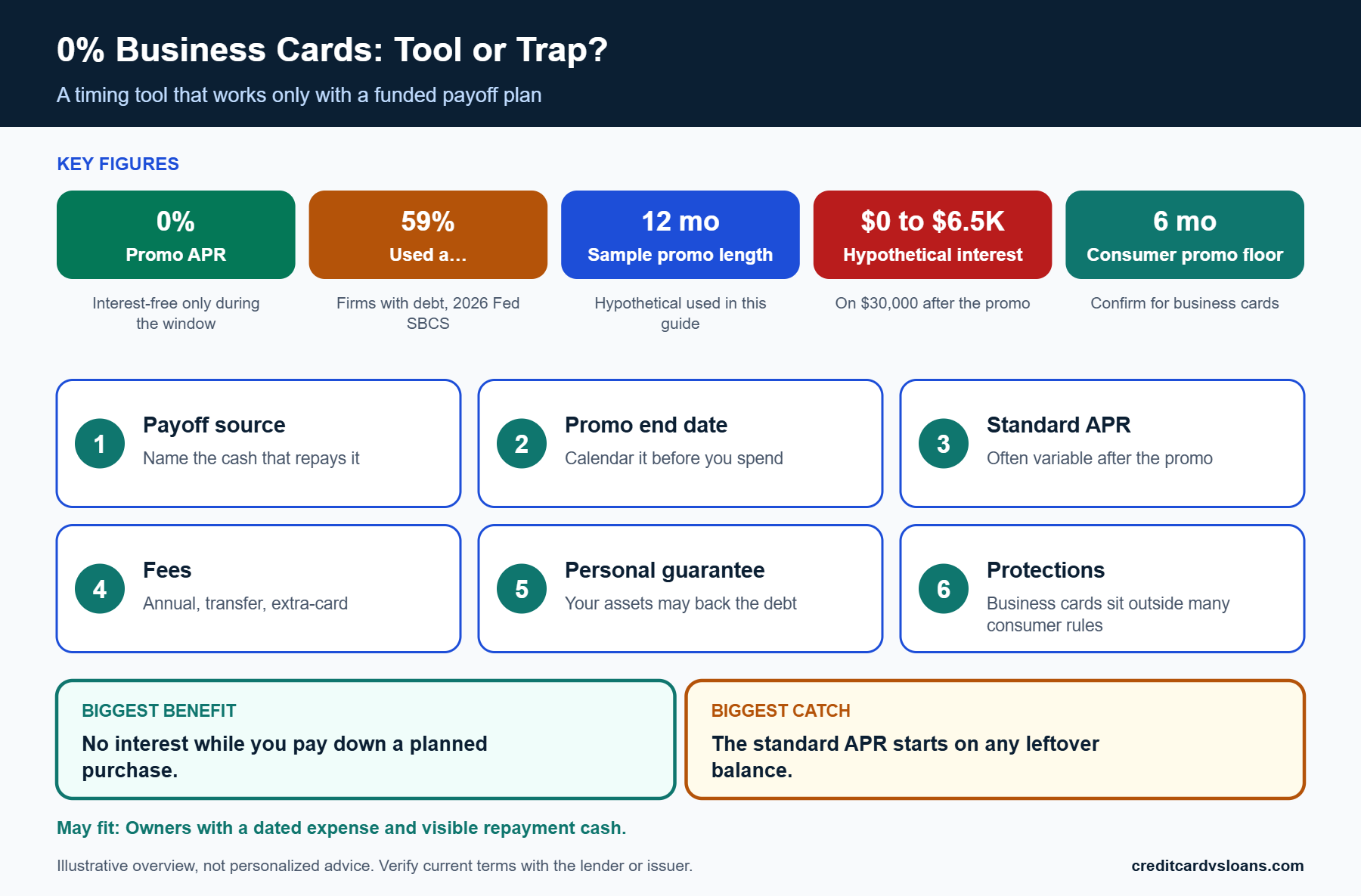
- Many small business owners back their debt personally. In the Federal Reserve Banks’ 2026 Report on Employer Firms, 59% of firms with debt used a personal guarantee.
- The safest use is a purchase you can pay off before the promotion ends, using money you can already see, with a cushion for a slow month.
- If the plan only works when sales are strong, price a business loan or line of credit before you swipe.
Regulatory text is cited from the eCFR as of October 2026. Survey figures come from the Federal Reserve Banks’ Small Business Credit Survey 2026 Report on Employer Firms, which reports on a survey fielded September 3 to November 14, 2025 and was published March 3, 2026. Card offers change often, so treat the examples as illustrations, not quotes.
Table of contents
The short answer: when a 0 APR business credit card helps and when it hurts
When it works as a tool
You have a dated, predictable expense
A 0% promotional period fits best when you can name the purchase, the date, and the source of the payoff. Think of a one-time equipment replacement, a seasonal inventory order, or a software and hardware refresh that you will pay down from receivables you can already point to. The card gives you breathing room between spending and collecting.
The test is concrete. If you can write down a monthly payment that clears the balance before the promotional period ends, and your last three months of deposits would have covered that payment comfortably, the offer is working for you rather than on you.
The alternative is more expensive or slower
Compared with a term loan, a 0% card can mean no interest and a faster approval decision. Compared with giving up a vendor discount or missing a time-limited deal, the card can also be cheaper. Those comparisons only hold if you actually clear the balance in time, so run the numbers on the payoff, not on the promotion. Business credit card vs. business loan walks through that comparison when the purchase is larger or the payoff stretches past a year.
When it turns into a trap
The payoff depends on future sales
The most common trap is a plan that reads, “I will pay it off when the big job pays.” That plan is a bet on a customer, a season, or a contract. If the payment slips, the balance that remains when the promotion ends starts accruing interest at the card’s standard rate, which can be well above what a term loan would have cost.
A useful rule of thumb: only count revenue that is already invoiced and likely to be collected inside the promotional window, and apply a haircut for late payers.
You stack promotions to avoid the bill
Opening another card to move or cover a balance can feel like extending the runway. Each new application adds a hard pull, and each new account adds a payment due date. If the underlying cash problem is a margin problem or a slow-paying customer, stacking offers postpones the decision while the balances grow.
| Situation | Fit | Why it matters |
|---|---|---|
| One-time purchase, payoff funded by cash already on hand | Often reasonable | You borrow your own timing, not future revenue. |
| Seasonal inventory, sales cycle ends before the promotion does | Possible with a cushion | Depends on a realistic sell-through plan and a slow-season buffer. |
| Covering payroll or rent during a revenue gap | Use caution | No repayment source is identified, so the balance may outlast the promotion. |
| Paying off one card with another, repeatedly | High risk | Hard pulls and growing balances without a payoff path. |
| Large, multi-year equipment purchase | Compare a loan first | The payoff usually runs longer than a typical promotional window. |
How a 0 APR business credit card works
The anatomy of the offer
Length, scope and the starting point
A promotional APR applies for a set number of billing cycles and often only to certain activity, such as new purchases, balance transfers, or both. The clock typically starts when the account opens, not when you make your first purchase, so a card used in month three has a shorter runway than the headline suggests. Read the offer terms to see exactly which balances qualify and when the promotional period ends.
Some offers also set separate promotional terms for purchases and transfers. A mismatch between the two is easy to miss, and it changes which balance you should pay down first.
What a zero rate does not remove
A 0% rate removes interest during the promotional window. It does not remove an annual fee, a balance transfer fee, a foreign transaction fee, late fees, or fees tied to extra employee cards. Cash advances and certain transactions may carry their own terms. The Consumer Financial Protection Bureau notes that the APR on a loan includes certain lender fees, which is one reason comparing APR to APR matters when you stack a card against a loan. Fees differ by issuer, so list every fee on your paperwork before you decide.
What happens after the promotion ends
The standard rate takes over
When the promotional period ends, the remaining balance generally moves to the card’s standard APR. Many card APRs are variable and tied to an index such as the prime rate. As of the Federal Reserve’s H.15 release of October 21, 2026, the bank prime loan rate was 7.00%, so a variable card rate moves with that benchmark plus the issuer’s margin. Your agreement shows the margin and how often the rate adjusts.
That is why a plan to roll a small remainder into “normal” interest should be priced before you rely on it.
True 0% versus deferred interest
A true 0% APR means interest does not accrue during the promotion. Deferred interest is different: interest accrues in the background and is added if the balance is not fully paid by the deadline. The CFPB describes deferred interest plans as carrying the risk of a large retroactive charge. Business cards and retail financing offers do not all use the same structure, so confirm in the terms which one you have. If you cannot tell, ask the issuer in writing.
Why business cards fall outside several consumer card protections
What the federal rules say
The business-purpose exemption
Regulation Z, the rule that implements the Truth in Lending Act, generally does not cover credit extended primarily for a business, commercial or agricultural purpose. Section 1026.3(a)(1) of the regulation states that exemption in so many words. If a card account is opened for business use, most of Regulation Z’s consumer credit card provisions are therefore not written to reach it.
This is the starting point for every question about what an issuer can and cannot do on a business card. It is also why the protections you may have read about for personal cards should be treated as unconfirmed until you see them in the business cardholder agreement.
What still applies
The exemption is not total. Section 1026.12(a) says a card may be issued only in response to a request or application, or as a renewal or substitute, and it expressly applies “regardless of the purpose” of the card, including business use. Section 1026.12(b), which governs liability for unauthorized use, contains its own business-use provision for organizations that have ten or more cards issued to employees: the issuer and the organization may agree to liability terms that differ from the consumer rule, while liability placed on an individual employee still has to follow the section.
Separately, the Equal Credit Opportunity Act rule at 12 CFR 1002.9 requires creditors to tell business applicants about the action taken on an application. The detail required depends on the business’s size: for firms with $1 million or less in gross revenues, notice rules track the general consumer timing, and for larger firms the creditor must notify within a reasonable time.
What that means for a promotional card
Rules written for consumer plans
Several of the best-known credit card rules are scoped to open-end consumer credit plans. The limits on fees in the first year (1026.52), the rule that extra payments go first to the highest-APR balance (1026.53), and the limits on raising rates, including the requirement that a promotional rate last at least six months (1026.55), are all written for credit card accounts under open-end consumer credit plans.
You should not assume a business card carries the same promotional-rate floor, fee limits or payment-allocation order. Some issuers may extend similar terms voluntarily, and some state laws may add protections. The cardholder agreement controls, so read the promotional terms and the section on changes to the agreement before you apply.
Where to read the actual terms
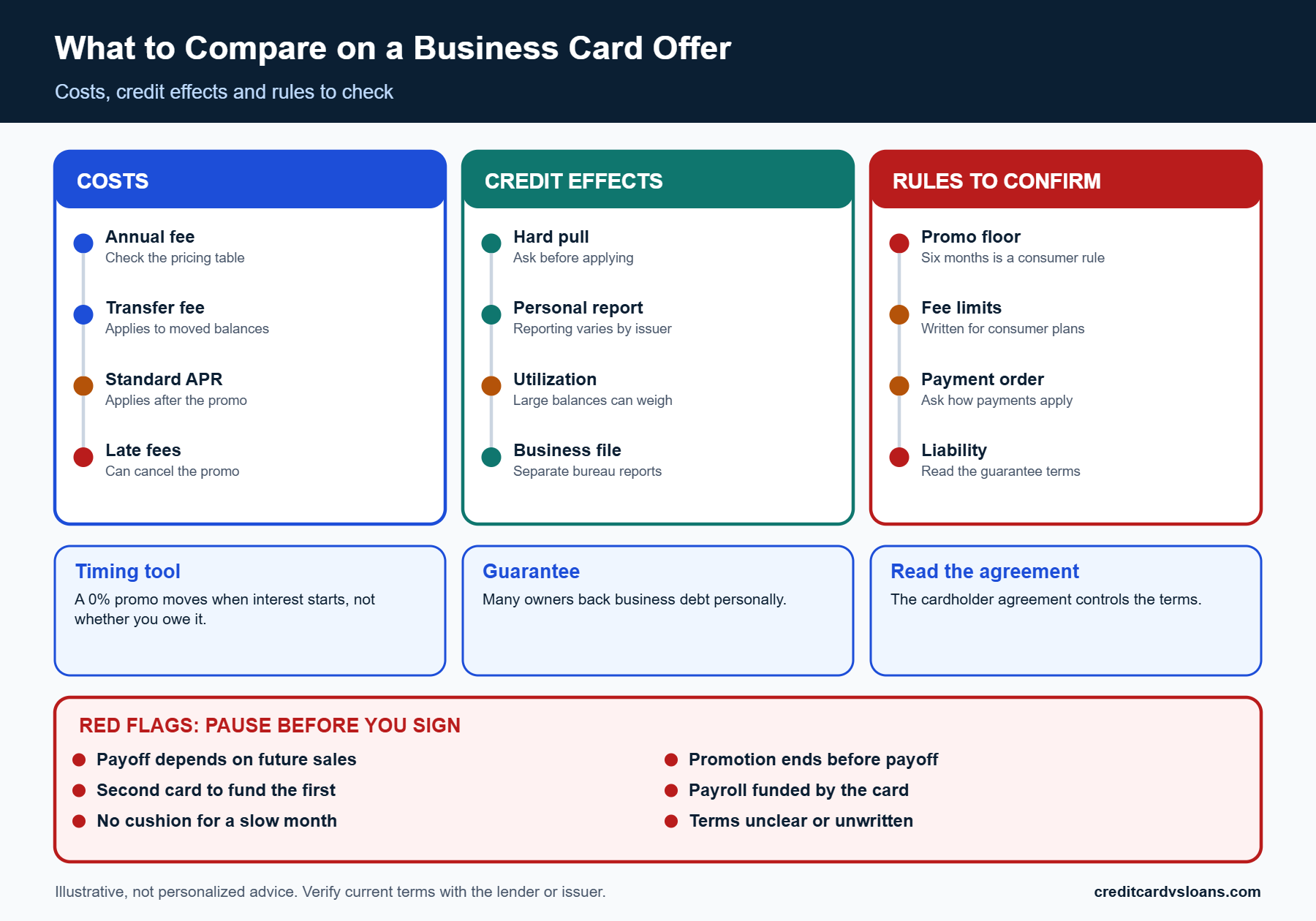
Ask for the full cardholder agreement and pricing disclosure, not a marketing page. Look for four items: how long the promotional rate lasts and what ends it early, whether a late payment can cancel the promotion, how the issuer can change terms and with how much notice, and how payments are applied when you carry more than one type of balance. If any answer is missing, treat it as unknown.
The CFPB’s guidance for consumer cards says an introductory rate must last at least six months and that a payment more than 60 days late can end it. That is a consumer-card rule. Use it as a question to ask, not as a promise about a business account.
| Topic | Consumer card (Regulation Z) | Business card: what to do |
|---|---|---|
| Unsolicited issuance | Cards only on request or application (1026.12(a)) | Also applies to business cards by the rule’s own wording. |
| Unauthorized use | Liability limits in 1026.12(b) | Section has a business provision for 10+ cards; read your agreement. |
| Promotional rate floor | Six-month minimum in 1026.55 | Written for consumer plans; confirm in the agreement. |
| First-year fee cap | 25% of credit limit in 1026.52(a) | Written for consumer plans; list every fee. |
| Payment allocation | Excess to highest APR first (1026.53) | Written for consumer plans; ask how payments are applied. |
| Notice of denial | Adverse action notice rules | ECOA rule 1002.9 covers business credit, with detail depending on revenue. |
What a 0% APR business card can really cost
Fees, rates and the arithmetic of a balance
The costs that sit outside the zero
Even with no interest, a business card can cost money. Annual fees, balance transfer fees, extra-card fees and late fees all appear in pricing disclosures. A rule of thumb is to add every fee you expect to pay over the promotional period, then divide by the amount you plan to finance to find the effective cost.
If the number is not materially below what a term loan would cost over the same period, the promotion is not buying you much. Compare on an apples-to-apples basis, using APR for the loan and total dollars for the card.
A hypothetical $30,000 purchase
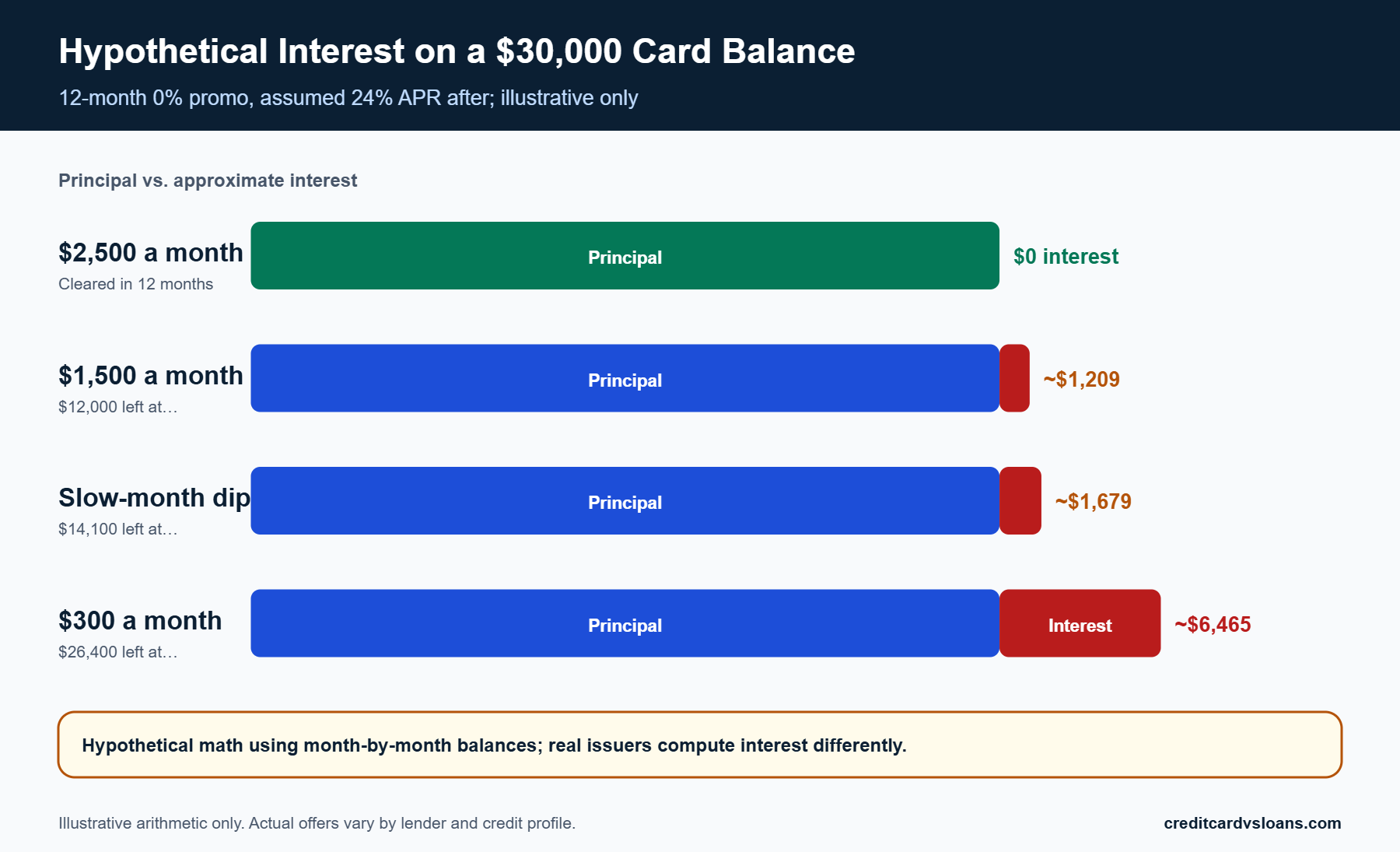
Suppose, hypothetically, a business puts $30,000 of equipment on a card with a 12-month 0% promotion and a 24% standard APR afterward. This 24% is an assumption for illustration, not a quote from any issuer. We computed the outcomes below with a standard month-by-month balance schedule. Interest figures are approximate because issuers compute interest differently.
Paying $2,500 a month clears the balance in 12 months with no interest. Paying $1,500 a month leaves $12,000 when the promotion ends; at 24% and the same $1,500 payment, that remainder takes about nine more months and roughly $1,209 in interest. Paying only $300 a month leaves $26,400, and at $1,500 afterward the payoff takes about 22 more months and roughly $6,465 in interest. For comparison, a hypothetical 36-month loan at 12% would carry a payment of about $996 and about $5,871 in total interest.
A slow month in the middle of the plan
What a revenue dip does to the payoff
Now assume, hypothetically, the owner pays $1,500 for three months, only $800 for three slow months, then returns to $1,500. After 12 months the balance is $14,100 instead of $12,000. At 24% and $1,500 a month afterward, clearing it takes about 11 more months and roughly $1,679 in interest.
The lesson is not that the card is bad. It is that the margin for error is thin when the payment is sized to the exact payoff and the promotion has a hard end date.
Sizing the payment with a cushion
A practical approach is to divide the balance by two fewer months than the promotion runs, so a missed or short payment does not push the balance past the deadline. On a 12-month promotion, that means planning for a 10-month payoff. Set the payment on autopay at that level and treat any extra month as a buffer rather than a plan.
Keep the promotion’s end date in your calendar and on the first page of your accounting notes, because the date matters more than the headline rate.
| Payment path | Balance when promotion ends | Approx. interest after |
|---|---|---|
| $2,500 for 12 months | $0 | $0 |
| $1,500 for 12 months, then $1,500 | $12,000 | About $1,209 |
| Dip: $1,500 x3, $800 x3, $1,500 x6, then $1,500 | $14,100 | About $1,679 |
| $300 for 12 months, then $1,500 | $26,400 | About $6,465 |
Credit and reporting effects
Applications and your personal file
Applying for a business card usually involves a credit check on the owner, because the issuer often looks at your personal credit even when the account is a business account. Whether an inquiry is a hard pull or a soft pull depends on the issuer, and whether the account later appears on your personal credit report varies by issuer. Ask both questions before you apply. The credit score needed for a 0% APR card covers the consumer side of that approval picture.
Utilization and business credit files
Balances that appear on a personal credit report can raise your utilization, which is the share of your available credit in use, and may affect your scores. Business credit reports are separate files kept by business credit bureaus. The SBA notes that you can obtain a business credit report from Experian, Equifax and Dun & Bradstreet. A large balance on a business card can therefore affect different files in different ways, depending on how the issuer reports it.
Behavior risks that raise the real cost
Treating the limit as revenue
A generous credit limit is not income. The most expensive pattern with promotional cards is spending to the limit because the first months feel free, then discovering that the monthly payment needed to clear the balance is larger than the margin the spending created. Set an internal spending cap well below the limit, based on the payoff you tested earlier, and stick to it even if the issuer offers a higher line.
Chasing bonuses and extras
Some cards advertise welcome bonuses that require a minimum amount of spending within a set period. Spending money you would not otherwise spend to reach a bonus converts a perk into a cost. Count only the bonus value you would earn on purchases you were already going to make, and ignore the rest. Rewards terms vary by issuer, so confirm the requirements and any limits in writing before you rely on them.
Personal guarantees and the owner’s own credit
What a personal guarantee means for you
You can be liable when the business cannot pay
A personal guarantee is your promise to repay the debt from your own assets if the business does not. For a business card, that often means the issuer can pursue you personally even if the card is in the company’s name. Whether a specific card requires one, and what it covers, is spelled out in the application and the cardholder agreement.
This is the point owners most often underestimate. A 0% promotion can make the balance feel temporary, but the liability behind it does not shrink when the promotion ends.
How common it is
The Federal Reserve Banks’ 2026 Report on Employer Firms, based on the 2025 Small Business Credit Survey, found that among firms with debt, 59% used a personal guarantee and 51% used business assets to secure it. The same report found 38% of firms applied for a loan, line of credit or merchant cash advance in the prior 12 months, and that applicants received the full amount sought 42% of the time. Those are survey results for a broad group of employer firms, not predictions for your application. They do show that owner-backed debt is the norm rather than the exception.
Protecting yourself and the business
Employee cards and authorized users
Extra employee cards expand your exposure. Each card can run up charges that you may owe, and the unauthorized-use provision for organizations with ten or more cards can allow different liability terms between issuer and company. Set per-card limits, require receipts, and review statements monthly so a problem is caught inside the dispute window.
Assign each card a named user and a purpose. Closing a card the day someone leaves is simpler than reconstructing what they spent.
Entity structure and legal advice
Forming an LLC or corporation can separate the business from the owner for many purposes, but a personal guarantee generally sits on top of that structure for the debt it covers. Questions about how a guarantee interacts with your entity are legal questions that depend on your state and your documents, so ask a business attorney before you sign a large facility. Do not rely on a general article, including this one, for that decision.
Alternatives worth pricing before you apply
Credit products that do a similar job
A business loan or line of credit
A term loan matches a long-lived purchase to a fixed payment schedule, and a line of credit lets you borrow and repay as needs change. Both usually involve underwriting beyond a quick card decision, and both may require a personal guarantee. The card-versus-loan comparison lays out when each fits, and business loan requirements for revenue, time in business and credit explains what lenders ask for so you can see whether you would qualify.
The SBA’s description of its 7(a) program says a borrower must be creditworthy and show a reasonable ability to repay, and that the business generally must be unable to get credit on reasonable terms elsewhere.
Vendor terms and customer deposits
Net-30 or net-60 vendor terms can finance inventory at no interest if you pay on time, and a customer deposit can cover materials before you buy them. These are often cheaper than any card. They also come with relationships you want to protect, so negotiate them in writing and keep your payment record clean.
When a different card is the better tool
A rewards or cash back card you pay in full
If you can pay the statement balance each month, a cash back or rewards card can return a small share of spending without any interest at all. Comparing real cash back value shows how to weigh annual fees and category limits against what you actually spend. The trade-off is that the card stops being a financing tool the moment you carry a balance.
Mixing personal and business borrowing
Some owners consider a personal 0% card or personal loan for a business expense. That can blur your records and put personal credit in the way of business needs. If you are comparing consumer options, the 0% APR card versus personal loan breakdown covers the cost math, but keep business expenses on business accounts so your books and any later loan applications stay clean.
| Option | Cost structure | Main strength | Main catch |
|---|---|---|---|
| 0% APR business card | No interest during promotion; fees and standard APR afterward | Fast, flexible, no interest if repaid in time | Rate jumps after the promotion; consumer protections may not apply |
| Business term loan | Fixed or variable APR, possible origination fee | Predictable payment for longer payoffs | Slower, stricter underwriting |
| Business line of credit | Interest on drawn amounts, possible fees | Borrow only what you use | Variable rate and renewal terms |
| Vendor terms | Often no interest if paid on time | Lowest cost when available | Late payment can strain the relationship |
| Rewards card, paid in full | No interest if balance is cleared | Earns value on spending | Interest applies if you carry a balance |
Matching the card to your business and your cash cycle
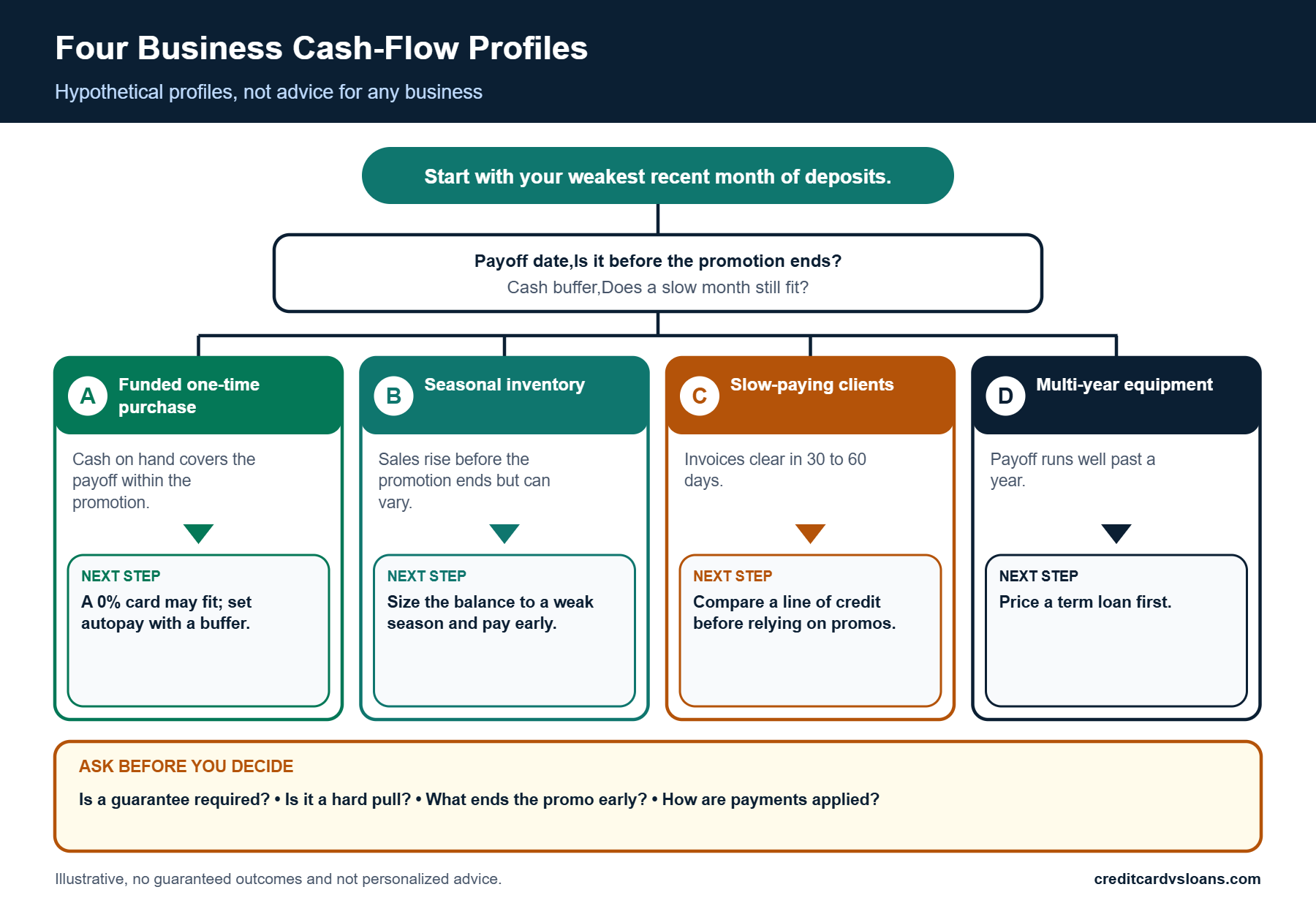
Three cash-flow profiles
Seasonal retail or hospitality
A seasonal business can use a promotion to buy inventory ahead of its peak and clear the balance from peak sales. The risk is a weak season. Size the borrowed amount to what you can sell through even in a below-average year, and keep the payoff date earlier than the end of the promotion.
Do not count sales you hope to make. Count orders, contracts and the last two seasons of actual deposits.
Service firms with slow-paying clients
Consulting, trades and agencies often wait 30 to 60 days for payment. A card can bridge payroll until an invoice clears, but the plan needs a collections routine and a stated payoff date. If you find yourself needing the card every month to cover wages, the issue is working capital, and a line of credit or tighter payment terms may serve you better than serial promotions.
Controls that keep the tool useful
A payoff schedule written before the first charge
Write the payoff plan before you spend: amount, monthly payment, the date the promotion ends, and the funding source for each payment. Put the schedule in your books and set autopay for at least the planned amount. Review it on the first of each month against actual deposits.
A trigger for switching plans
Decide in advance what would cause you to change course, such as two short payments in a row or a major customer going late. When the trigger hits, compare moving the remaining balance to a lower-cost option before the promotion ends rather than after. Score and approval factors for 0% offers can help you gauge whether a new offer is even realistic.
Questions to settle before you apply
Read the terms like a lender would
The questions that decide the outcome
Before applying, get written answers to a short list: the length and start date of the promotional period, what ends it early, the standard APR and whether it is variable, every fee, whether a personal guarantee is required, whether the account is reported to your personal credit, and how payments are applied. Compare two or three offers on the same questions rather than choosing by headline.
Prequalify when you can
Some issuers offer a prequalification step that uses a soft pull. Prequalification is not an approval and the final offer can differ, but it can reduce the number of hard pulls you take on while rate shopping. Availability varies by issuer, so look for the option before you submit a full application.
Stress-test the plan
Use your worst recent month
Take your weakest month of deposits from the past year and test whether the planned payment still fits after payroll, rent and taxes. If it does not, reduce the amount you finance or lengthen the plan by choosing a product with a longer term. The point is not to avoid the card. It is to avoid learning your limits after the promotion ends.
Keep a fallback ready
Know in advance where the money would come from if a payment slipped: a cash reserve, a line of credit already in place, or a deposit from a customer. A fallback that needs a new approval during a cash crunch is weaker than one you arranged while the business was healthy.
Reading your own numbers honestly
Separate owner pay from business cash
Many small businesses blur the line between what the owner draws and what the business earns. Before you size a payment, decide what you will pay yourself in a thin month and treat that as a fixed cost. A payoff plan that only works when the owner takes nothing is not a plan, and it tends to end with the owner covering the gap from personal savings or a personal card.
Write the draw into the same schedule as the payoff, so the two are tested together.
Check taxes and seasonality
Quarterly tax payments, sales tax remittances and seasonal swings in vendor costs can all land in the same months as your card payments. List them by month next to the payoff schedule. If two big outflows collide with the lowest deposit month, move the payment, shrink the balance, or choose a financing path with a longer term. Your accountant or tax professional can tell you what applies to your entity and state.
Questions owners ask about 0% business cards
Approval and credit questions
Can a new business get one?
Many issuers look at the owner’s personal credit when a business has little history of its own. The SBA’s guidance says that for a new business, loan eligibility is typically based on the owner’s personal credit score, and that a poor credit history is one of the main reasons small business loan applications are declined. Whether a particular card is open to a new business, a sole proprietor or an LLC depends on the issuer’s own standards, which are not public in the same way for every product. The score and approval factors for 0% offers show how issuers weigh credit on the consumer side.
Will it show up on my personal credit report?
It might. Issuers differ on whether they report business card accounts to the personal credit bureaus, and on whether they do so only when an account becomes delinquent. Ask before you apply and read the account agreement. If personal reporting matters to you, for example because you plan to apply for a mortgage soon, treat it as a deciding factor rather than a footnote.
Terms and payoff questions
What if I miss a payment during the promotion?
For consumer cards, the CFPB says an introductory rate protection does not apply once a payment is more than 60 days late. A business card may follow different rules, and the agreement may let the issuer end the promotion sooner or add a penalty rate. Set autopay for at least the minimum so a missed payment is less likely, and call the issuer before a payment is late rather than after.
What if a balance is left when the promotion ends?
You have a few options, all of which depend on your credit and cash flow at that point: pay it down faster from reserves, move it to a lower-cost loan or line of credit, or accept the standard APR for a short time while you pay it off. Compare the cost of each, using total dollars. Do not assume a new promotional offer will be available, because that depends on approval and issuer terms at the time.
Decision checklist and next steps
Your bottom line
Use the card for timing, not for rescue
A 0 APR business credit card is most useful when it moves the timing of a payment you can already fund. It is least useful when it hides a gap that has no repayment source. If you can name the purchase, the payoff date and the cash that will pay it, with a buffer for a bad month, the promotion can save real money. If you cannot, price a loan or line of credit first.
Remember the other half of the picture: business-purpose cards sit outside much of the consumer card rulebook, and a personal guarantee can put your own assets behind the balance.
Three numbers to write down first
Before you apply, write down the exact amount you plan to finance, the monthly payment that clears it with two months to spare, and the lowest monthly deposit total you saw in the past year. If the payment is more than a comfortable share of that lowest month, shrink the amount or pick a product with a longer term. Having three numbers on one page makes it much harder to talk yourself into a plan that only works on paper.
Borrow only what the next ten months of already-visible cash can repay, confirm the terms in the cardholder agreement rather than assuming consumer protections, and know what your personal guarantee covers before you sign.
When to skip it
Skip the promotion when the payoff stretches beyond the promotional period, when the purchase is for ongoing payroll, or when you would need a second card to make the first one work. Those are signs that a term loan, a line of credit or a change in payment terms with customers is the better fit. The business card versus business loan guide can help you compare.
A checklist you can use this week
Before you apply
- Write the purchase, amount and payoff date, and the source of each payment.
- Collect two or three offers and compare the promotional length, standard APR, fees and guarantee terms.
- Ask whether the application is a hard pull and whether the account is reported to personal credit.
- Read the sections on rate changes, late payments and how payments are applied.
- Confirm your cash buffer using your weakest recent month.
After you are approved
- Set autopay for the planned payment, sized to finish at least two months before the promotion ends.
- Put the promotion end date on your calendar with a reminder 60 days earlier.
- Track business charges separately from personal ones.
- Limit employee cards, and review statements monthly.
- If a trigger hits, compare moving the balance to a lower-cost option before the promotion ends. Lender requirements for business loans show what to prepare, and the 0% card versus loan cost breakdown shows how to run the numbers.
- eCFR: 12 CFR 1026.3 Exempt transactions (business, commercial, agricultural credit)
- eCFR: 12 CFR 1026.12 Special credit card provisions
- eCFR: 12 CFR 1026.55 Limitations on increasing annual percentage rates, fees, and charges
- eCFR: 12 CFR 1026.52 Limitations on fees
- eCFR: 12 CFR 1002.9 Notifications (Regulation B)
- Federal Reserve Banks: 2026 Report on Employer Firms: Small Business Credit Survey
- SBA: Establish business credit
- SBA: 7(a) loans
- CFPB: How long can I keep a low rate on a balance transfer or other introductory rate?
- Federal Reserve: Selected Interest Rates (H.15)
Last updated: October 22, 2026. Rates, fees and lender rules change; verify current terms before acting.
The information on creditcardvsloans.com is provided for general educational and informational purposes only. It is not financial, legal, tax, credit, accounting or investment advice, and reading it does not create an advisor-client, fiduciary or any other professional relationship. Nothing here is an offer, solicitation or recommendation to borrow, lend or apply for any product.
Credit scores, interest rates, fees, eligibility rules, lender policies and laws change frequently and vary by lender, location and individual circumstances. Examples, figures and scenarios are illustrative only, do not predict your results and do not guarantee approval, savings, a particular rate or a credit-score outcome. Always confirm current terms directly with the lender or issuer and read the full agreement before you apply or sign.
Although we aim for accuracy and use reputable sources, we make no representations or warranties, express or implied, about the completeness, accuracy, reliability or timeliness of the content. Content may be drafted with the assistance of automated tools, so errors or omissions may still occur. Links to third-party sites are provided for convenience; we don’t control and aren’t responsible for their content.
To the fullest extent permitted by law, creditcardvsloans.com and its owners, editors, authors, contributors and affiliates disclaim all liability for any loss, damage or expense arising directly or indirectly from your use of, or reliance on, this content. Before making financial decisions, consult a licensed professional, such as a qualified financial advisor, attorney, tax professional or nonprofit credit counselor, who can consider your complete situation.