If you cant pay credit card bills this month, the most useful move is to contact your card issuer before the due date passes, tell them what you can afford, and ask what hardship options exist. Doing that early keeps more choices open than waiting until you are already late. This guide walks through what to do first, which bills to protect, what happens if you miss more payments, and how to avoid the scams that target people in exactly this spot.
Falling behind on cards is stressful and common, and it isn’t a character flaw. A job change, a medical bill, a holiday season that ran over budget, or a run of price increases can leave a minimum payment out of reach for a while. What matters now is turning a vague dread into a short list of actions you can take in the next few days.
Nothing here is personal advice, because we don’t know your income, your balances or your state’s rules. But the steps below come from federal consumer agencies, and they apply to most people in this situation. Where something varies by issuer or by state, we say so and point you to where you can confirm it.
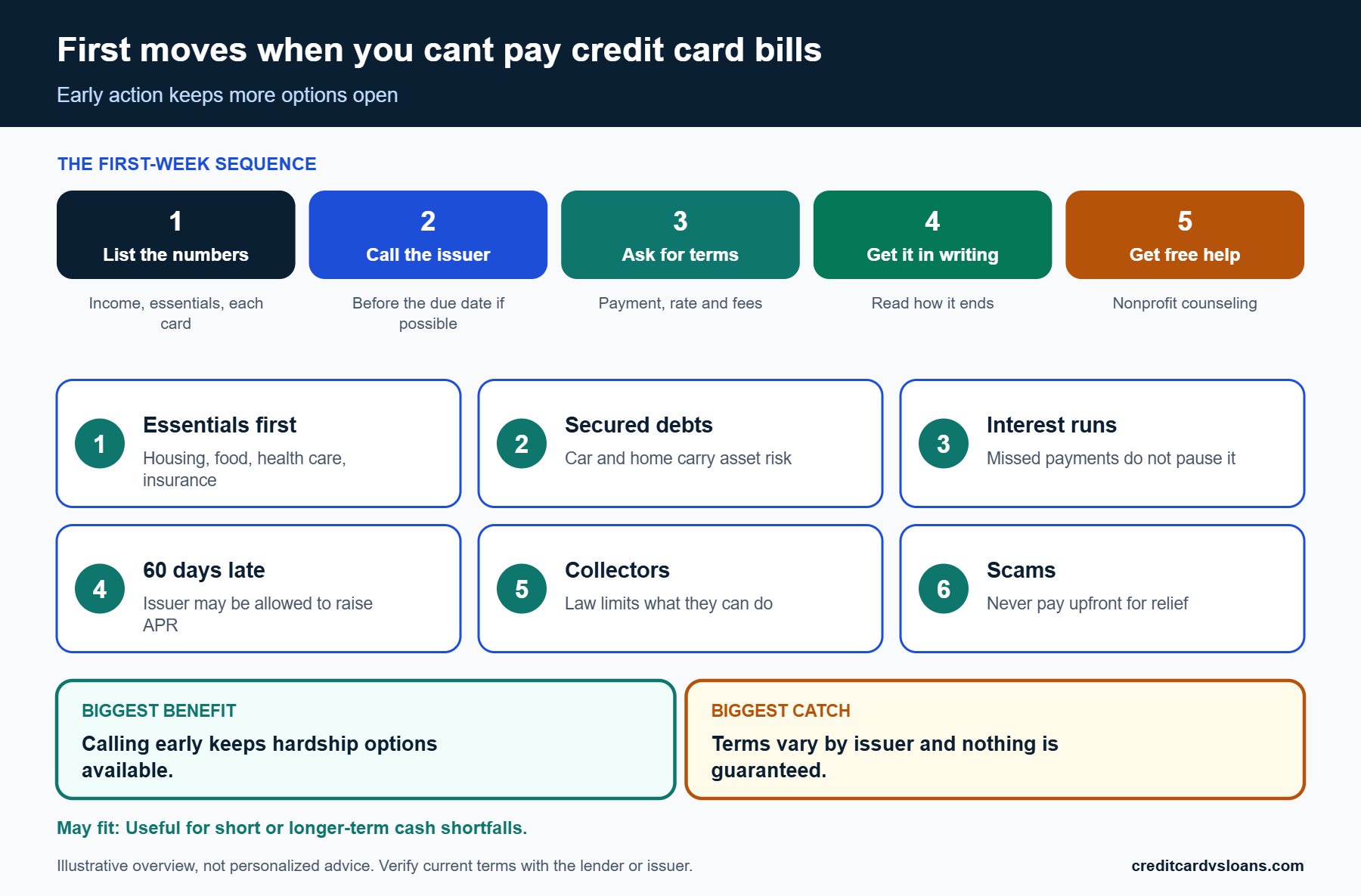
- Call your card issuer before you miss a payment if you can. The CFPB says many card companies will work with you on changing your payment during a financial emergency.
- Cover essentials and secured debts first. Housing, food, utilities, health care and transportation protect your ability to keep earning.
- Missing payments is not free: interest keeps running, fees can apply, and negative information can generally stay on your credit report for seven years.
- Ignoring collectors rarely makes them go away, but federal law limits what they can do and gives you rights to information and to dispute a debt.
- Be wary of anyone who asks for upfront fees, guarantees your debt will vanish, or tells you to stop talking to your card company.
Card interest figures come from the Federal Reserve’s G.19 release of October 7, 2026. Examples labeled hypothetical are models built to show how the math works, not quotes, and your own terms will differ.
Table of contents
What to Do First When You Cant Pay Credit Card Bills
The First 72 Hours
Get your numbers on one page
Before you call anyone, write down what comes in each month and what goes out. The CFPB’s guidance starts the same way: total your income and expenses, look for costs you can cut, and, if you still can’t cover the minimum, work out how much you can realistically pay. A realistic number is more persuasive to a lender than a hopeful one.
List each card with its balance, APR, minimum payment and due date, and mark which accounts are current and which are already late. If you don’t know the balances or rates, log into the accounts or check your statements. The Federal Reserve’s October 7, 2026 G.19 release put the average card rate at 22.15% for accounts that were assessed interest in the second quarter of 2026, so a $6,000 balance at that rate generates roughly $110 of interest every month before you touch the principal.
Call the issuer before the due date
The CFPB says to contact your credit card company immediately. When you call, explain why you can’t make the minimum payment, how much you can afford to pay, when you expect to resume normal payments, and the reduced payment amount you’re requesting and for how long. Having those four points ready keeps the call short and gives the representative something specific to approve.
Ask what hardship programs are available and what they would change: the payment, the interest rate, the fees, or all three. Write down the date, the representative’s name and any reference number. If you reach someone who can’t help, politely ask for a supervisor or the hardship or loss-mitigation department, and follow up in writing. Terms vary by issuer, and nothing is guaranteed.
What Not to Do
Don’t hide from the problem
Avoiding statements, ignoring calls and letting mail pile up feels like relief, and it costs you options. Interest and fees continue whether you open the envelope or not. The CFPB warns that ignoring or avoiding a debt collector is unlikely to make the collector stop contacting you, and the FTC points out that an account turned over to a collector means the creditor has given up on negotiating with you.
That second point is the practical reason to act early. While the account is still with the original issuer, hardship options are usually on the table. After it is sold or placed with a collector, you may be negotiating from a weaker position. We cover that stage later in this guide.
Don’t make it worse with the wrong fix
Some quick fixes make things worse. Putting rent or groceries on a new card to pay an old card just moves the problem and often raises the rate you pay. Paying a company upfront to “settle” your debts can cost you money and leave the debt intact. The CFPB lists three warning signs to treat as stop signs: guarantees that your debt will disappear, instructions to stop communicating with your credit card company, and instructions to stop making minimum payments.
If you’re considering a new 0% card to buy time, pause first. Our guide to 0% APR cards for holiday spending explains why a promotional rate helps only if you can clear the balance before it ends, which is difficult when the underlying problem is cash flow.
Your best leverage is time. A call before you miss a payment lets you ask for help while the account is in good standing, and it costs nothing to ask.
Triage: Which Bills to Protect First
Essentials and Secured Debts Come Before Cards
Protect the basics that keep you earning
When the money won’t stretch, the order you pay things in matters. The FTC’s guidance on coping with debt advises budgeting so you can cover basics first: housing, food, health care, insurance and education. Those are the expenses that, if they lapse, can create bigger problems, such as eviction, loss of transportation to work, or loss of health coverage.
It may feel wrong to pay a utility bill while a card goes unpaid, but a credit card is unsecured, meaning no property is tied to it, and the consequences of missing it play out differently than missing rent. That doesn’t make the card irrelevant. It means the card is usually where you negotiate rather than where you cut first.
Secured debts have the sharpest edge
Secured debts, such as a car loan or mortgage, are tied to an asset. According to the FTC, default can lead to repossession or foreclosure, and repossession can happen without notice. For that reason it advises prioritizing secured debts tied to your home or car, and contacting your mortgage lender immediately if you are struggling, since options may include a temporary payment reduction, suspension or term extension.
The same guide notes that selling a car yourself may avoid towing and storage costs and a negative credit entry, though that is a decision to weigh carefully with the lender. If your housing is at risk, the FTC points to housing counseling agencies, which HUD or your local housing authority can help you find.
Where Credit Cards Fit in the Order
Cards are unsecured, but not harmless
Credit cards are unsecured debts, like medical bills and signature loans, per the FTC. No collateral is attached, so the consequences come through fees, a higher interest rate, damage to your credit reports, collections and, possibly, a lawsuit. They deserve a plan, not neglect.
If you can only partly pay, think about which payment keeps you out of the worst of it. A reduced payment that you’ve agreed with the issuer in advance is very different from a missed payment, and the table below helps you sort which bills to protect first.
A simple sort for a tight month
Use the table as a general rule of thumb, not a rulebook. Your state, your lease, your lender’s terms and your family’s needs can reorder it. If you are unsure, call the creditor or a nonprofit counselor and ask what happens if a particular bill is late.
| Priority | What it covers | Why it comes here |
|---|---|---|
| First | Housing, food, utilities, health care, insurance | Basic needs; losing them creates larger problems |
| Second | Secured debts: car loan, mortgage | Default can lead to repossession or foreclosure, per the FTC |
| Third | Court orders, taxes, support obligations | Consequences can be severe; get specific advice |
| Fourth | Credit cards and other unsecured debt | Negotiate a hardship plan rather than going silent |
| Last | New debt to cover old debt | Usually raises costs without fixing cash flow |
What Happens If You Miss Credit Card Payments
The Timeline From the First Missed Payment
The first missed payment
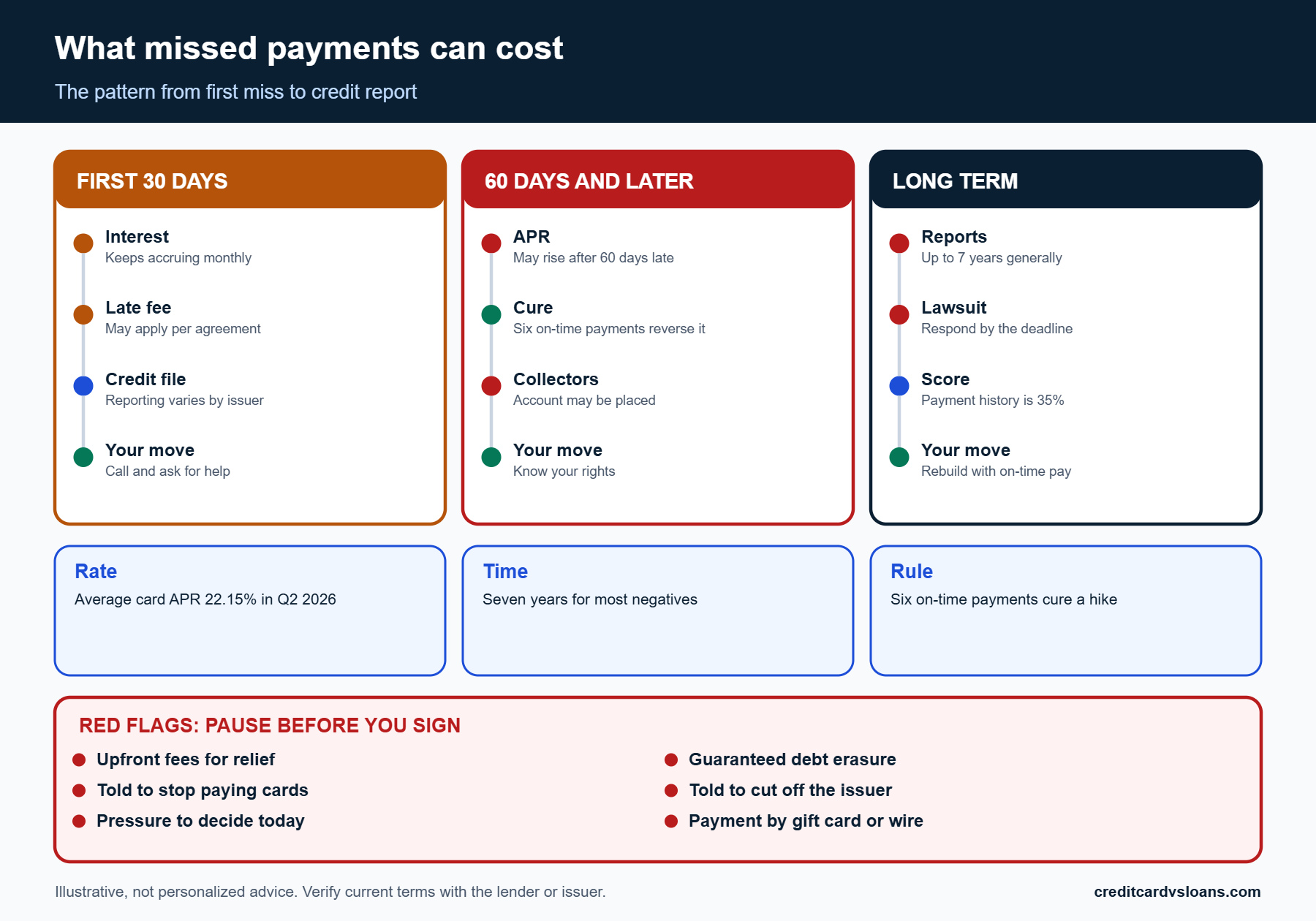
When you miss a due date, the first effects are usually on your account, not your credit report. Interest keeps accruing on the balance, and the issuer may charge a late fee, depending on your cardholder agreement. Fee amounts vary by issuer and over time, so check your most recent statement and agreement for the figure that applies to you rather than assuming a typical number.
Whether the late payment shows up on your credit reports depends on how late it is and on the issuer’s reporting practices. Reporting practices vary by issuer, so call before the due date if you can, and ask directly whether and when a late payment would be reported.
Sixty days late and the rate on your balance
Federal rules put limits on when a card issuer can raise the rate on an existing balance. Under 12 CFR 1026.55, an issuer can generally increase the rate if it hasn’t received your required minimum payment within 60 days after the due date. The issuer must tell you why, and the notice must say the increase will end after you make six consecutive on-time minimum payments, starting with the first payment due after the increase takes effect.
That is the legal floor, not the full story. Your cardholder agreement may allow other fees and terms, so read it. And the practical lesson is that the 60-day mark is a line to stay behind: a call, a hardship plan or even a partial payment arranged in advance can keep you from crossing it.
How the Costs Stack Up
Interest keeps running while you are behind
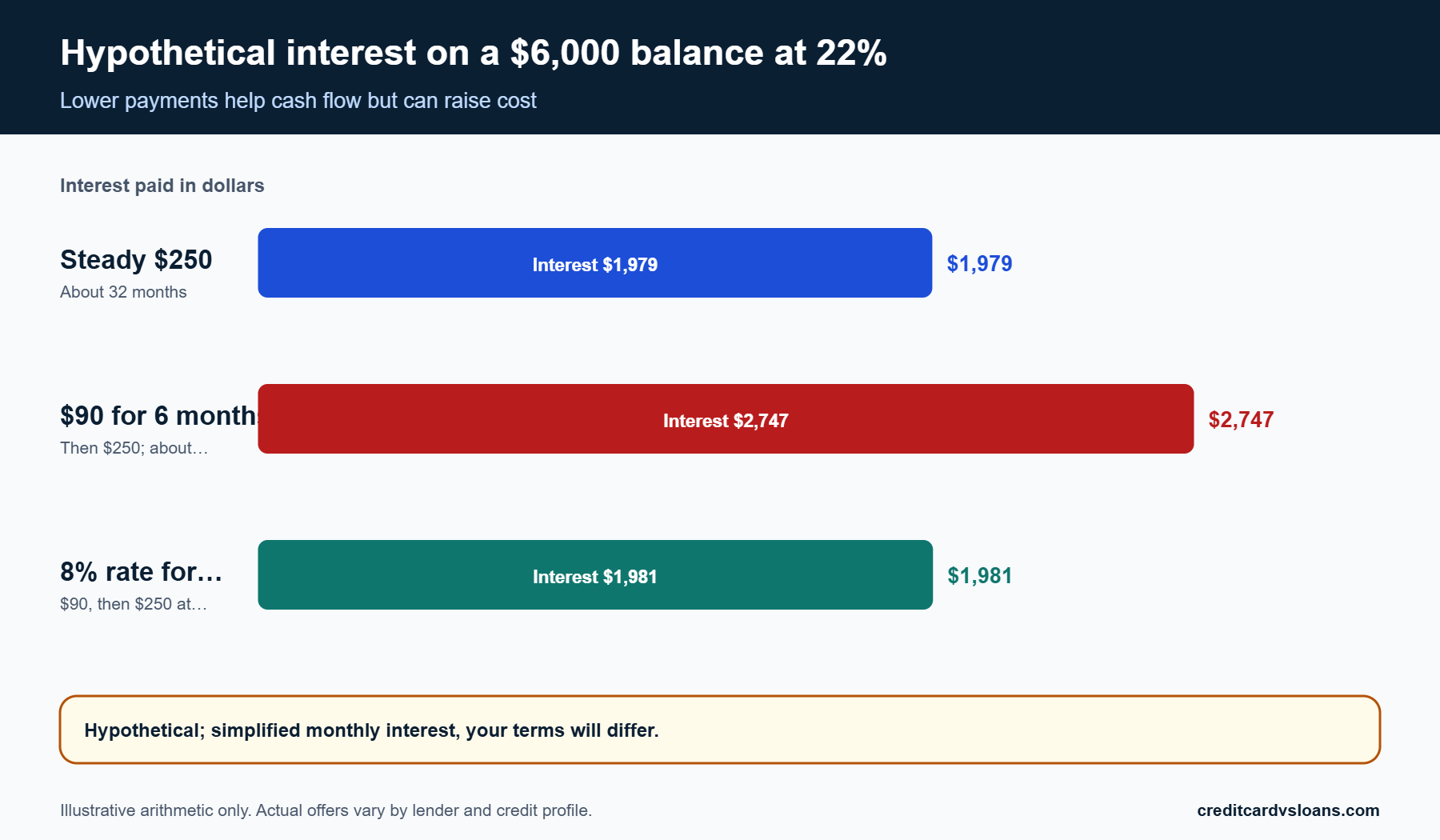
Missing payments doesn’t pause interest. In the hypothetical below, a $6,000 balance at 22% APR generates roughly $110 of interest per month. If you made no payments for three months, and interest simply compounded monthly, the balance would climb to about $6,336 before any late fees, and you’d still owe the next minimum payment on top of any past-due amount.
The Federal Reserve’s October 7, 2026 release reports that the average rate on card accounts assessed interest was 22.15% in the second quarter of 2026, and 20.94% across all accounts. We use 22% here as a rounded, illustrative stand-in, not as your rate.
A cheaper-looking payment can cost more
It is tempting to accept any lower payment that is offered, so it helps to see what a reduced payment alone does. Take the same hypothetical $6,000 at 22%. Paying a steady $250 a month clears the balance in about 32 months with roughly $1,979 of interest. Drop to $90 a month for six months and then return to $250, and the payoff takes about 39 months with roughly $2,747 of interest, or about $768 more.
Now suppose a hardship program also cut the rate to 8% for the first 12 months at $90 a month, then returned to 22% at $250. That path takes about 40 months and costs roughly $1,981 in interest, about the same as the steady $250 path. The lesson: a lower payment helps cash flow now, but it saves money only if the rate or fees come down too. All of these figures are hypothetical and simplified.
| Stage | What may happen | What you can do |
|---|---|---|
| Day 1 to 29 | Interest continues; late fee may apply | Pay what you can; call the issuer; ask about hardship |
| Around 30 days | Late payment may be reported, depending on the issuer | Ask whether reporting can be avoided with an arrangement |
| 60 days | Issuer may be allowed to raise the APR on the balance | Make the minimum payments to cure; document everything |
| Months later | Account may be turned over to a collector | Contact the creditor early; know your collector rights |
| Years | Negative information can remain up to seven years | Rebuild with on-time payments after you stabilize |
Credit Report and Collections Effects
How long negative marks stay
Negative information about your payment history can generally stay on your credit report for seven years, according to the CFPB. Lawsuits and judgments can be reported for seven years or until the statute of limitations runs out, whichever is longer, and bankruptcies up to ten years. After those limits, companies usually stop reporting the information.
Payment history is the largest category in a FICO Score at 35%, and amounts owed is 30%, per myFICO. myFICO also notes that a few late payments aren’t an automatic score-killer, and that an otherwise good history can outweigh one or two late card payments. No one can promise how a particular missed payment will move your score.
When an account goes to collections
If you keep missing payments, the creditor may eventually turn the account over to a collector. The FTC says that means the creditor has given up on negotiating, which is why contacting your creditors early is advised. Once a collector contacts you, the CFPB says to use that contact to find out about the debt and whether you actually owe it.
A collector may also be willing to negotiate. The CFPB’s debt collection page lists negotiating a settlement with the collector as one option when you can’t pay right away. We cover your rights in detail in the debt collection section below.
Asking Your Card Issuer for Help
What to Say and How to Document It
The four things to explain
The CFPB’s four-part script is a good backbone: why you can’t make the minimum payment, how much you can afford, when you expect to resume normal payments, and the reduced amount you want and for how long. Be factual and brief. Job loss, reduced hours, illness, a disaster, a family emergency and unexpected expenses are the kind of reasons issuers hear every day.
Have your account numbers handy, along with your monthly income and expenses. If you are asked for documentation, such as a layoff notice or medical bills, ask what format they accept and how to send it securely. Don’t send full account numbers or Social Security numbers over unsecured email.
Get terms in writing before you rely on them
Verbal promises are not enough. The CFPB’s guidance on credit counselors says to get all verbal promises in writing, and the same logic applies to your issuer. Ask for the hardship agreement by mail or secure message, and read what happens when it ends: does the rate return to normal, do skipped fees come back, and does the account stay open?
Federal rules address some of this. Under 12 CFR 1026.55, an issuer can raise a rate after a workout or temporary hardship arrangement only if it gave you a clear written disclosure of the terms, including any increases, before the arrangement began. If something in the paperwork surprises you, ask about it before you agree.
What a Hardship Arrangement May Include
Possible features, not promises
Depending on the issuer, a hardship arrangement may reduce your required payment for a period, lower your interest rate, waive some fees, or pause late fees while you catch up. Not every issuer offers all of these, and each can come with conditions, such as closing the account or freezing new purchases. The CFPB says only that many card companies will work with you; it doesn’t promise specific terms.
Your goal on the call is to leave with a clear outcome: either an arrangement in writing, or a clear answer on what the issuer can’t do so you can move to the next option.
Risks and trade-offs to ask about
Ask whether the account will be closed, whether the arrangement is reported to the credit bureaus and how, and what the payment will be when the arrangement ends. A temporary reduction that snaps back to the full minimum in six months can create a second crisis if your income hasn’t recovered by then.
Ask too whether interest continues during the reduced-payment period, as the hypothetical math above shows that the rate matters as much as the payment. If you can’t get clear answers, a nonprofit counselor can help you interpret the offer before you accept.
Nonprofit Credit Counseling and Debt Management Plans
How Credit Counseling Works
What a counselor does
If you need more help than one call can give, the CFPB suggests considering credit counseling. Credit counseling organizations help you manage your money, build a budget and, where it makes sense, set up a debt management plan. The CFPB notes counselors are usually nonprofits, and an initial session typically lasts about an hour with follow-ups available.
The FTC adds that universities, military bases, credit unions, housing authorities and Cooperative Extension Service branches may run counseling programs, and that in-person help is preferred if available.
Costs and how to vet an agency
Nonprofit doesn’t mean free. Before you enroll, the CFPB says to ask whether you’ll be charged, how much, and what services you will receive, and to get any quote in writing. A reputable organization should send information without requiring details about your situation, and it shouldn’t push a DMP before analyzing your finances.
The CFPB lists the Financial Counseling Association of America, the National Foundation for Credit Counseling and the U.S. Department of Justice list of approved credit counseling agencies as places to start, and recommends verifying any candidate with your state attorney general and consumer protection agency.
When a Debt Management Plan Might Fit
How a plan works
In a DMP, you make one payment to the counseling organization, which pays each creditor, per the CFPB. The FTC says creditors may lower interest rates or waive some fees, that you should confirm each concession with each creditor, and that a plan can take 48 months or more. You may also have to agree not to use or apply for new credit while you’re in the plan.
For a side-by-side look at how a plan compares with moving balances to a transfer card, see our comparison of consolidation loans and balance transfer cards, and note that a DMP is a separate approach from either.
When a plan may not be the answer
A plan assumes you can make regular, timely monthly payments. If your income has dropped so far that even a reduced deposit is out of reach, enrolling can set you up to fail. The FTC says a DMP is not right for everyone and that you should not enroll until a certified counselor has thoroughly reviewed your finances.
If a counselor tells you a DMP doesn’t fit, ask what they would suggest instead. That might be a hardship arrangement, a temporary budget cut, or a conversation about legal options. The point of the session is to find the least costly path that is actually feasible.
Other Options When a Plan or Hardship Deal Isn’t Enough
Lower-Risk Moves to Price Out
Consolidation loans and transfer cards
If your credit is still in decent shape and your income is steady but strained, moving high-rate card balances onto a lower-rate loan or a promotional-rate card can reduce interest. Both require approval, both can carry fees, and both only help if the monthly payment fits your budget. If you’re already behind, approval may be difficult, and applying repeatedly can add inquiries to your file.
We compare the two in detail in our guide to consolidation loans vs. balance transfer cards. For this article, the key point is that a new product doesn’t fix a budget that is short each month, so run the numbers on the monthly payment before you apply, not after.
Negotiating a settlement yourself
For some people, a negotiated settlement with the issuer or a collector is an option, particularly if the account is already past due and a lump sum is realistic. The CFPB lists negotiating a settlement with the collector as one path when you can’t pay right away. Settlements carry credit and tax consequences, and creditors are not required to agree.
Our guide on whether you can settle credit card debt yourself covers the risks and negotiation basics, including what to get in writing before you send any money. Until a settlement is in writing and honored, don’t assume the debt is resolved.
Last Resorts With Serious Trade-Offs
Debt settlement companies
For-profit debt settlement companies negotiate a lump-sum settlement for less than you owe and often tell you to stop paying creditors while you save. The FTC warns that this can hurt your credit report, increase late fees, bring collector calls and lead to lawsuits, and that if creditors win, they may garnish wages or place liens on your home. Settled amounts may be taxable income unless you are insolvent.
The CFPB adds that a debt settlement company may not collect fees before it settles or resolves your debt, and that guarantees, instructions to stop communicating with your card company, or instructions to stop paying minimums are warning signs.
Bankruptcy and legal help
If your debts are far beyond what any plan could repay, bankruptcy may be worth discussing with an attorney. The FTC explains that Chapter 7 and Chapter 13 can eliminate many unsecured debts and stop collection activity, but that the filing stays on your credit report for 10 years and brings costs, rules and exceptions. You must complete approved credit counseling within six months before filing.
Legal aid offices and bankruptcy attorneys can tell you what applies in your state, including which assets are protected. This guide doesn’t replace that advice, and it isn’t a recommendation to file or not file.
| Option | Best for | Main cost or risk |
|---|---|---|
| Issuer hardship arrangement | Short-term cash crunch, account still current or slightly late | Terms vary; account may close; rate may return |
| Nonprofit credit counseling | Need budget help and a full picture | Possible fees; get a quote in writing |
| Debt management plan | Steady income, several card balances | 48 months or more; may need to avoid new credit |
| Consolidation loan or transfer card | Decent credit and stable income | Approval and fees; no help if budget is short |
| Self-negotiated settlement | Account past due and lump sum available | Credit and tax effects; creditor need not agree |
| Debt settlement company | Rarely a first choice | Stopping payments can trigger fees, suits and credit damage |
| Bankruptcy | Debts far beyond repayment ability | Stays on report 10 years; legal advice needed |
Debt Collectors and Your Rights
What Collectors Must Tell You and What They Can’t Do
Information and disputes
According to the CFPB, when a collector contacts you, use that contact to learn about the debt and whether you actually owe it. Collectors must share key details, including the name of the creditor, the amount owed and how to dispute the debt. If they refuse or can’t, the CFPB warns it could be a scam.
If you believe you don’t owe the debt, tell the collector, and respond in writing when you need to dispute or reply. Keep copies of everything you send, and note when you sent it. Federal law, including the Fair Debt Collection Practices Act, limits what collectors can say or do and bans unfair practices.
Contact limits and your right to say stop
The FTC explains that federal law limits contact to the period after 8 a.m. and before 9 p.m., prohibits calls at work if the collector knows your employer disapproves, and prohibits harassment, lies and unfair practices. Collectors must stop contacting you if you request it in writing.
Stopping contact doesn’t erase the debt, and it can make a lawsuit more likely, so decide whether silence helps or hurts before you send that letter. The CFPB also notes that collectors can take Social Security or VA benefits only in rare cases. The CFPB’s helpline is (855) 411-2372, and you can file a complaint at consumerfinance.gov/complaint.
Lawsuits and Time Limits
If you are sued
If a creditor or collector sues you, treat the court papers as urgent, because deadlines matter. The CFPB has a guide on what to do if you are sued, and the FTC notes that if creditors win, they may garnish wages or place liens on your home. Don’t ignore a summons. Even if you think the debt is wrong or too old, responding on time is generally how you preserve your defenses.
Get legal help if you can; many areas have legal aid offices or bar association referral services. The rules about how and when to respond vary by state and court.
Old debts and the statute of limitations
Time limits on collecting old debts are set by state law and vary. They can also interact with credit reporting limits, which are separate: the CFPB says negative information generally can be reported for seven years, while lawsuits and judgments can be reported for seven years or until the statute of limitations runs out, whichever is longer.
Our explainer on the credit card debt statute of limitations covers what the term means and what it doesn’t, including why a time-barred debt isn’t automatically gone. Before you make a payment on a very old debt, check your state’s rules.
Protecting Your Credit and Avoiding Scams While You Recover
Keeping Credit Damage Smaller
Prioritize on-time payments where you can
Payment history is the biggest part of a FICO Score at 35%, per myFICO, followed by amounts owed at 30%. That is why a reduced payment you’ve agreed in advance can matter more than a perfect plan you can’t keep: staying current on the arrangement protects you more than skipping and hoping.
If you can only keep up some accounts, think about which ones you most want to keep in good standing, such as the cards you’d like to use again, and which you’re willing to let go through a hardship program. Then ask each issuer how it reports the arrangement.
Be careful with new credit while you’re stretched
Opening new accounts while you’re behind can add inquiries and new balances. If you’re looking for a lower-cost card to carry a balance, our comparison of rewards cards and low-interest cards explains why the interest rate deserves more weight than rewards when you’re carrying a balance, since interest can quickly outweigh the value of points or cash back.
Before applying anywhere, ask whether approval is likely and whether the new credit would actually reduce your monthly payments. If the answer is no, skip it.
Spotting Debt Relief Scams
Fees up front and promises you can’t verify
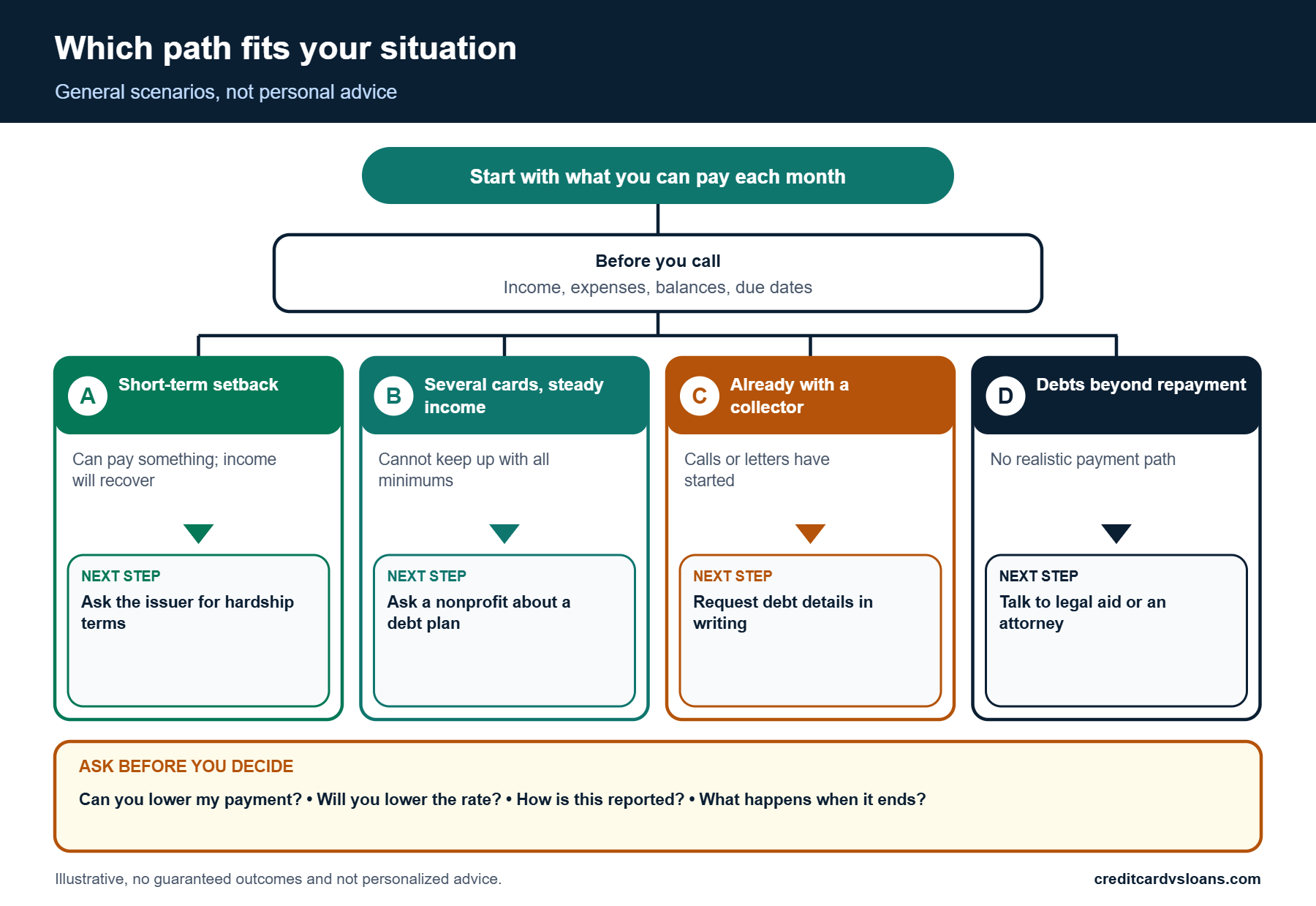
The FTC’s March 2026 consumer alert says only scammers will tell you to pay them upfront before settling debts or enrolling you in a debt management plan. Any company that promises to settle all your debts or obtain fast loan forgiveness is a scammer, and an unexpected call or text offering quick debt settlement that asks for personal or financial information is a sure sign of a scam.
Under the FTC’s Telemarketing Sales Rule, 16 CFR 310.4(a)(5), debt relief services sold by phone generally can’t collect a fee until at least one debt has been settled or changed under a valid agreement you signed and you’ve made at least one payment under it. If a company asks for money first, walk away.
Where to report and where to get legitimate help
If you encounter a scam, report it to the FTC at ReportFraud.ftc.gov. For help with a debt collector or a card issuer, the CFPB takes complaints and has a phone line at (855) 411-2372. Legitimate credit counseling organizations send free information about their services before you disclose details about your situation, and they review your finances in depth without charging in advance for help they haven’t provided.
Local credit unions, universities, community colleges and military personal financial managers may offer low-cost counseling. Ask about fees before signing up, wherever you go.
Your Action Plan and Next Steps
Choosing Your Path
If you can pay something
If you can pay part of the minimum, call the issuer, explain your four points and ask for a written hardship arrangement. If your balance is spread across several cards and your income is steady, ask a nonprofit counselor whether a debt management plan fits. Compare the total cost of each path, using the questions in this guide.
Keep paying essentials and secured debts first, and avoid adding new charges to cards you are trying to pay down. The interest on a $6,000 balance at a typical card rate is already a cost of more than $100 a month, so each month you can reduce it matters.
If you can’t pay anything right now
If you truly can’t pay, still call. Explain your situation and ask what the issuer can do, including pausing the account’s late fees or lowering the rate while you stabilize. Contact a nonprofit counselor or a legal aid office, and ask them about your options, including bankruptcy if your debts are far beyond what you could repay.
Keep your documents, avoid signing anything you don’t understand, and report any call that demands payment by gift card, wire or crypto. No legitimate relief program is run that way.
Next-Step Checklist
In the next three days
- Write down income, essential expenses and every card’s balance, APR, minimum and due date.
- Pay or arrange the essentials and secured debts first.
- Call each card issuer before a due date passes and ask about hardship options.
- Write down who you spoke to, the date and what was offered.
- Ask for any agreement in writing and read how it ends.
In the next two weeks
- Book a session with a nonprofit credit counselor and ask about fees in advance.
- If a collector contacts you, ask for the creditor name, amount and dispute instructions in writing.
- Check your credit reports for errors and for accounts you didn’t know were past due.
- Avoid any company that asks for upfront fees or tells you to stop paying.
- Decide on a longer-term path and set reminders for each due date.
When you cant pay credit card bills, the cheapest move is usually the earliest one: contact the issuer, document the deal, protect essentials, and get independent help if the numbers don’t add up. Every month of silence adds interest and removes options.
- Can You Settle Credit Card Debt Yourself? Risks and Negotiation Basics
- Rewards Credit Card vs. Low-Interest Card: Which Saves More?
- 0% APR Credit Cards for Holiday Spending: Smart Tool or Debt Trap?
- Debt Consolidation Loan vs. Balance Transfer Card: Which Saves More?
- Credit Card Debt Statute of Limitations: What It Means and What It Doesn’t
- How to Finance Professional Licensing Fees: Credit Cards, Loans and Lower-Cost Options
- CFPB: What should I do if I can’t pay my credit card bills?
- CFPB: Credit counseling and debt management plans
- CFPB: Debt collection tools and your rights
- CFPB: How long does negative information remain on my credit report?
- FTC: Coping with Debt
- FTC: Looking for debt relief? Here’s how to avoid a scam (March 26, 2026)
- eCFR: 12 CFR 1026.55: Limitations on increasing annual percentage rates, fees, and charges
- eCFR: 16 CFR 310.4: Abusive telemarketing acts or practices (debt relief advance fees)
- Federal Reserve: Consumer Credit – G.19 (release of October 7, 2026)
- myFICO: What’s in my FICO Scores?
Last updated: October 22, 2026. Rates, fees and lender rules change; verify current terms before acting.
The information on creditcardvsloans.com is provided for general educational and informational purposes only. It is not financial, legal, tax, credit, accounting or investment advice, and reading it does not create an advisor-client, fiduciary or any other professional relationship. Nothing here is an offer, solicitation or recommendation to borrow, lend or apply for any product.
Credit scores, interest rates, fees, eligibility rules, lender policies and laws change frequently and vary by lender, location and individual circumstances. Examples, figures and scenarios are illustrative only, do not predict your results and do not guarantee approval, savings, a particular rate or a credit-score outcome. Always confirm current terms directly with the lender or issuer and read the full agreement before you apply or sign.
Although we aim for accuracy and use reputable sources, we make no representations or warranties, express or implied, about the completeness, accuracy, reliability or timeliness of the content. Content may be drafted with the assistance of automated tools, so errors or omissions may still occur. Links to third-party sites are provided for convenience; we don’t control and aren’t responsible for their content.
To the fullest extent permitted by law, creditcardvsloans.com and its owners, editors, authors, contributors and affiliates disclaim all liability for any loss, damage or expense arising directly or indirectly from your use of, or reliance on, this content. Before making financial decisions, consult a licensed professional, such as a qualified financial advisor, attorney, tax professional or nonprofit credit counselor, who can consider your complete situation.